

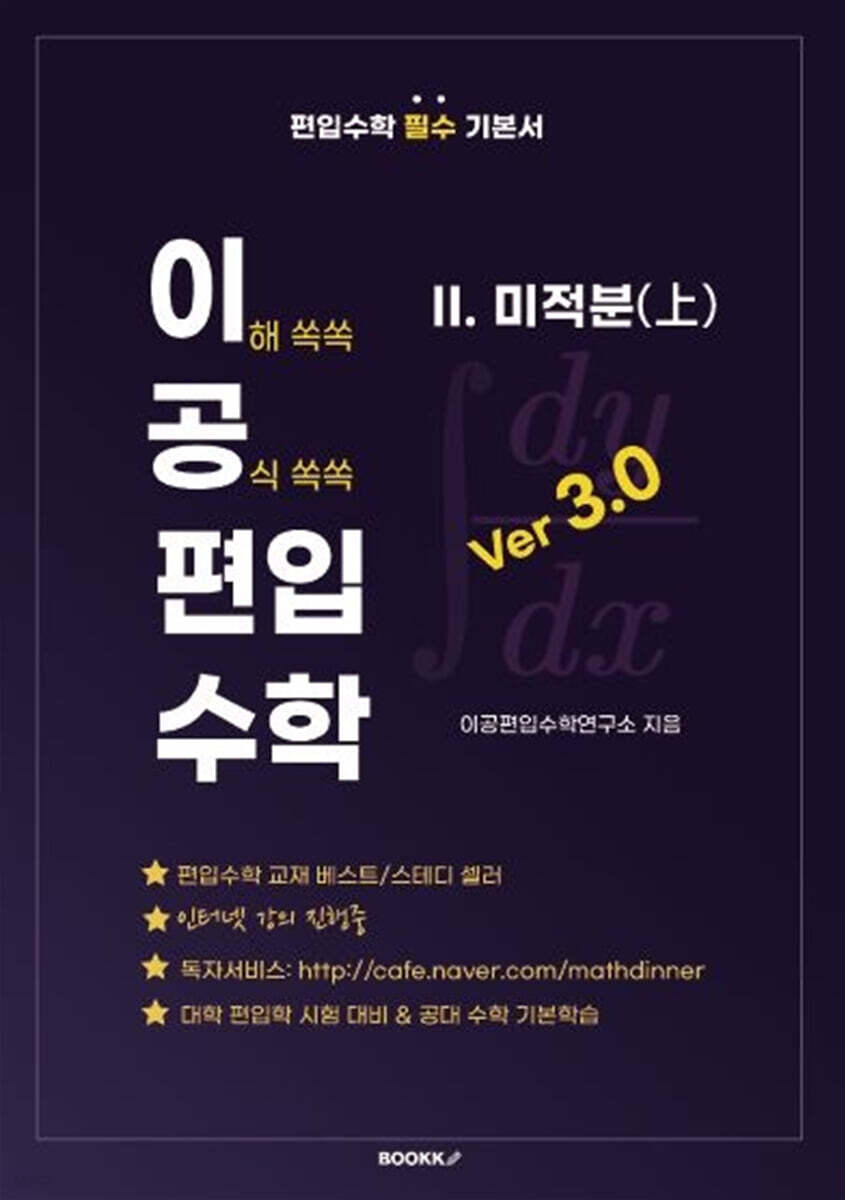
Science and Engineering Transfer Mathematics Version 3.0 (2) Calculus (Part 1)
 |
Description
Book Introduction
『Science and Engineering Transfer Mathematics Ver. 3.0』 is a book that explains the basic theories and solutions needed to take the transfer math test (multiple choice) at a level suitable for test takers.
Not only test takers, but also freshmen and returning students in engineering schools can learn the mathematics taught in engineering schools very easily and quickly by studying this book.
The 『Science and Engineering Transfer Mathematics Series』 consists of a total of five volumes (Volume 1: Basic Mathematics, Volume 2: Calculus (Volume 1), Calculus (Volume 3), Linear Algebra (Volume 4), and Industrial Mathematics). 『Volume 2.
In 『Calculus (Volume 1)』, we learn about single-variable calculus.
It is designed to help you quickly summarize the core concepts of calculus and conclude with quizzes, essential examples, and expected questions.
- Notices and textbook samples: http://cafe.naver.com/mathdinner
- When you order, the most recent detailed version will be sent to you.
Not only test takers, but also freshmen and returning students in engineering schools can learn the mathematics taught in engineering schools very easily and quickly by studying this book.
The 『Science and Engineering Transfer Mathematics Series』 consists of a total of five volumes (Volume 1: Basic Mathematics, Volume 2: Calculus (Volume 1), Calculus (Volume 3), Linear Algebra (Volume 4), and Industrial Mathematics). 『Volume 2.
In 『Calculus (Volume 1)』, we learn about single-variable calculus.
It is designed to help you quickly summarize the core concepts of calculus and conclude with quizzes, essential examples, and expected questions.
- Notices and textbook samples: http://cafe.naver.com/mathdinner
- When you order, the most recent detailed version will be sent to you.
- You can preview some of the book's contents.
Preview
index
『Volume 2.
Calculus (Part 1)
PART1.
Limits and continuity of functions
1-1.
limit of a function
1-2.
continuity of functions
PART2.
Differential calculus
2-1.
Derivatives and Differentiation
2-2.
Higher-order derivatives
2-3.
Differentiation of parametric equations
2-4.
Differentiation of inverse functions
2-5.
Differentiation of implicit functions
2-6.
Equation of tangent line
2-7.
Approximation
PART 3.
Application of differentiation
3-1.
Increasing and decreasing functions
3-2.
Maxima and minima of functions
3-3.
Maximum and minimum of a function
3-4.
Equations & Inequalities and Differentiation
3-5.
Median theorem
3-6.
Mean theorem
3-7.
The irregularities of the curve
3-8.
Application of rate of change
3-9.
Curvature of a plane curve
PART4.
Integration method
4-1.
indefinite integral
4-2.
definite integral
4-3.
Infinite series and definite integrals
4-4.
Function expressed as a definite integral
4-5.
singular integral
PART5.
Applications of integration
5-1.
Integral and Area
5-2.
Mean value theorem of integrals
5-3.
Approximation of definite integral
5-4.
length of the curve
5-5.
Volume and definite integrals
5-6.
Surface area of a rotating body
5-7.
Real-life applications
Appendix (In-depth Exploration)
1) Epsilon-delta argument and limits of functions (for multiple-choice tests only)
2) Limits and continuity of composite functions
3) Calculus proposition exploration
Practice Problem Answers and Explanations
Calculus (Part 1)
PART1.
Limits and continuity of functions
1-1.
limit of a function
1-2.
continuity of functions
PART2.
Differential calculus
2-1.
Derivatives and Differentiation
2-2.
Higher-order derivatives
2-3.
Differentiation of parametric equations
2-4.
Differentiation of inverse functions
2-5.
Differentiation of implicit functions
2-6.
Equation of tangent line
2-7.
Approximation
PART 3.
Application of differentiation
3-1.
Increasing and decreasing functions
3-2.
Maxima and minima of functions
3-3.
Maximum and minimum of a function
3-4.
Equations & Inequalities and Differentiation
3-5.
Median theorem
3-6.
Mean theorem
3-7.
The irregularities of the curve
3-8.
Application of rate of change
3-9.
Curvature of a plane curve
PART4.
Integration method
4-1.
indefinite integral
4-2.
definite integral
4-3.
Infinite series and definite integrals
4-4.
Function expressed as a definite integral
4-5.
singular integral
PART5.
Applications of integration
5-1.
Integral and Area
5-2.
Mean value theorem of integrals
5-3.
Approximation of definite integral
5-4.
length of the curve
5-5.
Volume and definite integrals
5-6.
Surface area of a rotating body
5-7.
Real-life applications
Appendix (In-depth Exploration)
1) Epsilon-delta argument and limits of functions (for multiple-choice tests only)
2) Limits and continuity of composite functions
3) Calculus proposition exploration
Practice Problem Answers and Explanations
Detailed image

Publisher's Review
[Book Review]
Kim X-do (Dokpyeonsa nickname: Nenyaple) - Yonsei University Department of Mathematics -
I would also recommend this book to beginners who have no knowledge of college mathematics.
Unlike other transfer math books, the author's efforts to provide intuitive and easy-to-remember explanations and many analogies are clearly evident, and this is a rare book that introduces both standard and practical solutions to problems that can be used on actual transfer exams.
Although this book is primarily intended for transfer exam preparation, I believe it will also be helpful for students who transfer to college and take calculus or engineering mathematics classes alongside their school textbooks to get good grades.
Kim X-ram - Dongguk University Mathematics Education/Pedagogy -
This book is not a simple listing of mathematical knowledge, but rather explores the logical structure between college mathematics concepts.
We have improved the efficiency and effectiveness of knowledge transfer through language that beginners can understand.
I would like to recommend this to students who want to learn college mathematics in a thorough and easy way.
Jeong X-yeol - Hanyang University College of Engineering -
If you are looking for a suitable self-study book for transfer math, I would definitely recommend 『Science and Engineering Transfer Math』.
Transfer math, by its very nature, requires students to acquire only the necessary information in a short period of time, but it covers the entire scope of college mathematics, making it somewhat challenging to study. For this reason, there aren't many transfer math reference books available on the market.
I am confident that this book will be a ray of hope, relieving students of their worries, as it contains only the essential information needed for the exam.
Cho X-won - Seoul National University of Science and Technology, College of Engineering -
This book clearly explains the concepts to those who are studying transfer mathematics for the first time.
If you look at the math books on the market, you can see that they are simply a copy of the original text's proofs and formulas.
It's like, 'Either figure it out on your own or memorize the formula and try to solve it.'
On the other hand, 『Science and Engineering Transfer Mathematics』 is not a simple list of concepts, but solves problems and easily resolves questions about why a concept should be used in a given situation.
Explained.
It felt like a commentary on a concept book.
[Successful Candidate Reviews]
"I solved almost all of my math problems with the science and engineering transfer math book.
It's a very well-made book."
Excerpt from the Success Story - One Successful Applicant to the Department of Electrical and Electronic Engineering at Sungkyunkwan University
"The book explained the core concepts of transfer math in an easy-to-understand manner, making it easy to study. I recommend this book to anyone new to transfer math."
Excerpt from "Success Story - One Successful Candidate in Sogang University's Computer Engineering Program"
“It was very helpful to realize that there are different approaches to solving problems.
If it weren't for the science and engineering transfer math, I probably wouldn't have passed."
Excerpt from an Admissions Story - A Successful Applicant to the Department of Electrical and Electronic Engineering at Konkuk University
Kim X-do (Dokpyeonsa nickname: Nenyaple) - Yonsei University Department of Mathematics -
I would also recommend this book to beginners who have no knowledge of college mathematics.
Unlike other transfer math books, the author's efforts to provide intuitive and easy-to-remember explanations and many analogies are clearly evident, and this is a rare book that introduces both standard and practical solutions to problems that can be used on actual transfer exams.
Although this book is primarily intended for transfer exam preparation, I believe it will also be helpful for students who transfer to college and take calculus or engineering mathematics classes alongside their school textbooks to get good grades.
Kim X-ram - Dongguk University Mathematics Education/Pedagogy -
This book is not a simple listing of mathematical knowledge, but rather explores the logical structure between college mathematics concepts.
We have improved the efficiency and effectiveness of knowledge transfer through language that beginners can understand.
I would like to recommend this to students who want to learn college mathematics in a thorough and easy way.
Jeong X-yeol - Hanyang University College of Engineering -
If you are looking for a suitable self-study book for transfer math, I would definitely recommend 『Science and Engineering Transfer Math』.
Transfer math, by its very nature, requires students to acquire only the necessary information in a short period of time, but it covers the entire scope of college mathematics, making it somewhat challenging to study. For this reason, there aren't many transfer math reference books available on the market.
I am confident that this book will be a ray of hope, relieving students of their worries, as it contains only the essential information needed for the exam.
Cho X-won - Seoul National University of Science and Technology, College of Engineering -
This book clearly explains the concepts to those who are studying transfer mathematics for the first time.
If you look at the math books on the market, you can see that they are simply a copy of the original text's proofs and formulas.
It's like, 'Either figure it out on your own or memorize the formula and try to solve it.'
On the other hand, 『Science and Engineering Transfer Mathematics』 is not a simple list of concepts, but solves problems and easily resolves questions about why a concept should be used in a given situation.
Explained.
It felt like a commentary on a concept book.
[Successful Candidate Reviews]
"I solved almost all of my math problems with the science and engineering transfer math book.
It's a very well-made book."
Excerpt from the Success Story - One Successful Applicant to the Department of Electrical and Electronic Engineering at Sungkyunkwan University
"The book explained the core concepts of transfer math in an easy-to-understand manner, making it easy to study. I recommend this book to anyone new to transfer math."
Excerpt from "Success Story - One Successful Candidate in Sogang University's Computer Engineering Program"
“It was very helpful to realize that there are different approaches to solving problems.
If it weren't for the science and engineering transfer math, I probably wouldn't have passed."
Excerpt from an Admissions Story - A Successful Applicant to the Department of Electrical and Electronic Engineering at Konkuk University
GOODS SPECIFICS
- Publication date: December 14, 2021
- Page count, weight, size: 757 pages | 210*297*40mm
- ISBN13: 9791137265721
- ISBN10: 1137265728
You may also like
카테고리
korean


korean

![GQ KOREA Mark (Monthly): December [2025]](http://librairie.coreenne.fr/cdn/shop/files/8ef265dbbfbf186523ed75ba7319009d.jpg?v=1765340328&width=3840)


