

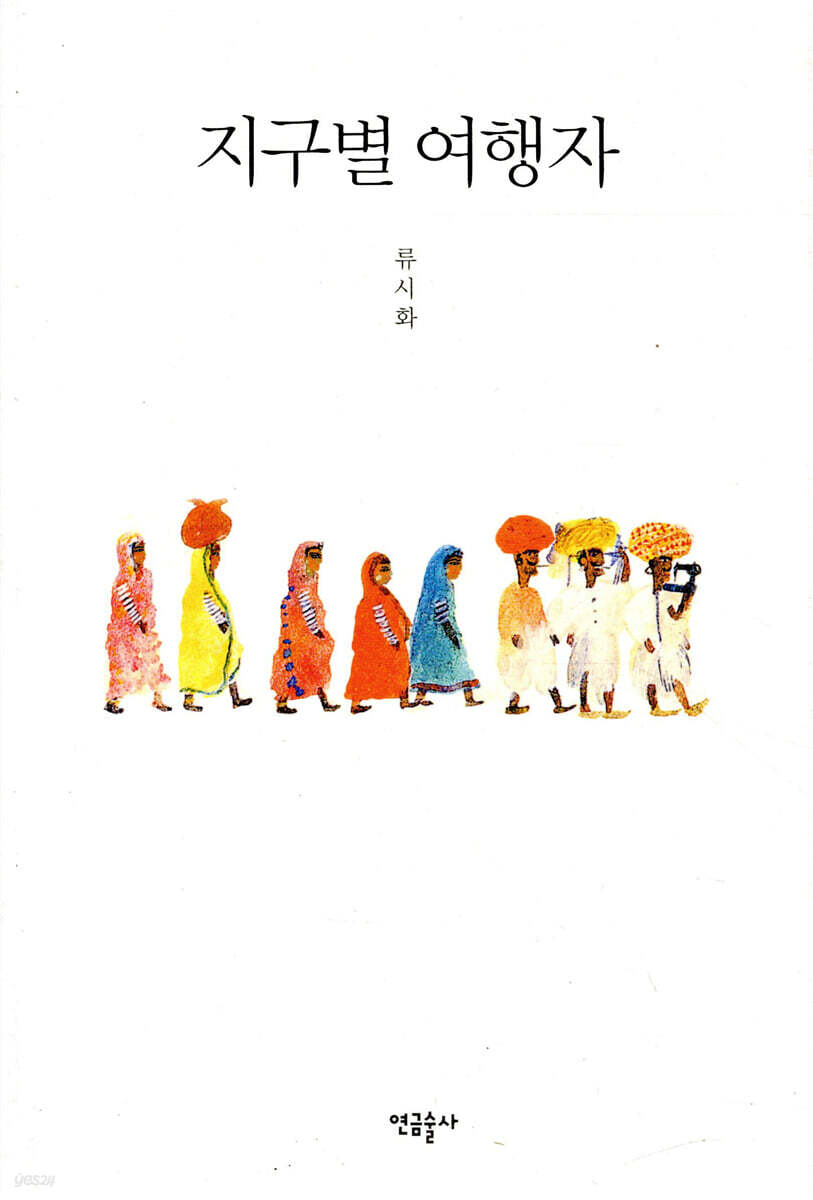
Earth Traveler
 |
Description
Book Introduction
Following 『A Journey to the Sky Lake』
Another special travelogue of India
“There was no need to take a separate book with me when I went on a trip.
The world was a book.
The train was a novel, and the bus roof, the fields, and the remote village were poetry books.
I read that book.
“Whenever I turn the page, a new path appears.”
Ryu Si-hwa, who writes poetry, translates books on meditation, and travels to India and Nepal every year, is a poet on the road.
"Traveler of the Earth" is a record of the life lessons and realizations he gained while traveling to India every year for 15 years and staying in one place for a long time.
Encounters with saints, beggars, desert nomads, innkeepers, shoe thieves, and fortune tellers clearly reveal the poet's perspective that we are all travelers on this world and students learning life's lessons.
Just like 『A Journey to the Sky Lake』, which was loved by 800,000 readers, 『Traveler of the Earth』 is a book that you can read lightly but gain great insight from.
The virtue of this book is that it conveys the most profound stories in the easiest way possible, with a philosophy full of humor.
Travel essays without a single portrait or landscape photo are more vivid than documentaries.
Each and every phrase is filled with reflections and meditations on the essence of freedom and enlightenment he had dreamed of.
However, this does not mean that he traveled to places with great people and historical sites that ordinary people would rarely meet in their lifetime.
There are the fortune tellers who wait for the escaped bird, the restaurant owner who likes to say a famous saying at the end of every sentence, the man who sneaks up and cracks peanuts while trying his best to monopolize travelers from other people, and the robber boss who likes poetry.
To the author, they are the 'archetypal models' of all people in this world.
So, it's a story about Indians, but it's not just their story, it's all of our story.
The book begins with the question, “Where is God?” and ends with “Are you happy?”
'Shin' means a utopian world, but people always create their utopia by shouting 'No problem' as if it were a spell.
There are many anecdotes that are so absurd that they make you laugh, but this book is so full of truth that it's hard to just pass it by.
It's a series of captivating stories that anyone who picks up once will be compelled to read to the end.
I can recommend this book even to people who don't like books or travel, and the moment you close the book, it makes you want to say "Namaste" and go to India.
The author calls freedom the discovery of one's own order, rather than conforming to the order established by others.
Another special travelogue of India
“There was no need to take a separate book with me when I went on a trip.
The world was a book.
The train was a novel, and the bus roof, the fields, and the remote village were poetry books.
I read that book.
“Whenever I turn the page, a new path appears.”
Ryu Si-hwa, who writes poetry, translates books on meditation, and travels to India and Nepal every year, is a poet on the road.
"Traveler of the Earth" is a record of the life lessons and realizations he gained while traveling to India every year for 15 years and staying in one place for a long time.
Encounters with saints, beggars, desert nomads, innkeepers, shoe thieves, and fortune tellers clearly reveal the poet's perspective that we are all travelers on this world and students learning life's lessons.
Just like 『A Journey to the Sky Lake』, which was loved by 800,000 readers, 『Traveler of the Earth』 is a book that you can read lightly but gain great insight from.
The virtue of this book is that it conveys the most profound stories in the easiest way possible, with a philosophy full of humor.
Travel essays without a single portrait or landscape photo are more vivid than documentaries.
Each and every phrase is filled with reflections and meditations on the essence of freedom and enlightenment he had dreamed of.
However, this does not mean that he traveled to places with great people and historical sites that ordinary people would rarely meet in their lifetime.
There are the fortune tellers who wait for the escaped bird, the restaurant owner who likes to say a famous saying at the end of every sentence, the man who sneaks up and cracks peanuts while trying his best to monopolize travelers from other people, and the robber boss who likes poetry.
To the author, they are the 'archetypal models' of all people in this world.
So, it's a story about Indians, but it's not just their story, it's all of our story.
The book begins with the question, “Where is God?” and ends with “Are you happy?”
'Shin' means a utopian world, but people always create their utopia by shouting 'No problem' as if it were a spell.
There are many anecdotes that are so absurd that they make you laugh, but this book is so full of truth that it's hard to just pass it by.
It's a series of captivating stories that anyone who picks up once will be compelled to read to the end.
I can recommend this book even to people who don't like books or travel, and the moment you close the book, it makes you want to say "Namaste" and go to India.
The author calls freedom the discovery of one's own order, rather than conforming to the order established by others.
- You can preview some of the book's contents.
Preview
index
Where is God
mango juice
My friend's younger sister's wedding
Start over where the monkey dropped the ball.
The Inn of My Soul
fortune teller
Saint and Papaya
A festival whose date changes every year
Hari Om Cafe
Storyteller on the Bus Roof
The World of Fireflies
Food for the Soul
Guruji and the Flower Necklace
Writer's Class
beggar woman
Earth Traveler
Peace in your heart, smile on your face
You, do you know this?
The Door to God
Birds don't look back as they fly.
It all started with a dream
City of Light
Indian driver
Pretend not to be Buddha
Om Mani Padme Hum
Pilgrim's House
Wisdom of the Desert Nomads
Ten postcards
The only country under the sun
shoe thief
The only tea house
My India Dream
Finish
Sadhu's Sayings 1: Students Who Came to Learn Life Lessons
Sadhu's Sayings 2: The Salt Doll Who Went Down to the Sea
Sadhu Quotes 3 Are you happy?
mango juice
My friend's younger sister's wedding
Start over where the monkey dropped the ball.
The Inn of My Soul
fortune teller
Saint and Papaya
A festival whose date changes every year
Hari Om Cafe
Storyteller on the Bus Roof
The World of Fireflies
Food for the Soul
Guruji and the Flower Necklace
Writer's Class
beggar woman
Earth Traveler
Peace in your heart, smile on your face
You, do you know this?
The Door to God
Birds don't look back as they fly.
It all started with a dream
City of Light
Indian driver
Pretend not to be Buddha
Om Mani Padme Hum
Pilgrim's House
Wisdom of the Desert Nomads
Ten postcards
The only country under the sun
shoe thief
The only tea house
My India Dream
Finish
Sadhu's Sayings 1: Students Who Came to Learn Life Lessons
Sadhu's Sayings 2: The Salt Doll Who Went Down to the Sea
Sadhu Quotes 3 Are you happy?
Into the book
“Don’t forget this.
All the important people we meet in life are people who meet each other with a promise between their souls.
We are born with a promise to play a certain role for each other.
“Everyone is a guide who appears in your life for a short time or a long time to teach you and guide you to your destination.”
--- p.63
“In India, think only of India, and in Nepal, think only of Nepal!”
I couldn't help but laugh at those words.
When travelers meet each other, they are busy talking about the different places they have visited.
In India, they talk about Nepal, in Nepal, they talk about India, and in Mumbai, they talk about Kolkata.
As is the case with most things in life.
Even though we live in this moment, we always talk about yesterday and tomorrow.
--- p.101
“If you put salt in food, it tastes good and is seasoned well, but if you put salt in food, it becomes salty and you can’t eat it at all.
The same goes for human desires.
You have to put desire into your life.
“You shouldn’t put your life into desire.”
--- p.105
“If you are a true writer, you should write only about what you have experienced.”
I nodded in agreement.
Then he said.
“If you have truly experienced something, you will never forget it.
There is no need to write them down on paper.
Because they are engraved in your heart.
Isn't that right?"
I could only nod again.
The old man spoke again.
“If you are a true writer, you should write not from notes scribbled on paper, but from your own experiences engraved in your heart!”
When I heard it, it was such a wonderful thing.
I thought I should quickly write those words down in my notebook before I forget them.
Just as I was about to take out my notebook again, the old man spoke.
“If it is not a true experience deeply engraved in your soul, it is not worth writing about.
“If you write about things that only flash through your mind for a moment and are quickly forgotten, how can that possibly move others?”
--- p.117~118
After walking for a while, I looked back and saw that the gypsies were still standing in front of the tent and waving their hands.
It was the same whether I went a hundred meters or two hundred meters.
Every time I looked back, the gypsies were still standing there in a line, waving at me.
The field was so flat that it was difficult to break up.
--- p.133
“You, do you know this? The people you’ll meet in your next life are the people you’re meeting right now.”
--- p.144
“Have you ever seen anything white? A place where everything is filled with white light.
It's a world of nothingness.
There is nothing there.
“It’s just a white world.”
--- p.169
Wherever you go, be there!
--- p.175
Needless to say, after that, I would often fall asleep and forget that I was a Buddha.
Sometimes I acted so thoroughly as if I were not a Buddha that I became convinced that I was not a Buddha.
--- p.200
“Now, how cool is that?
This is a good item.
The price won't be too expensive for you.
If you wear this necklace, you will never put anything off until 'next time'.
“Every time you wear this necklace, you will remember what I said.”
--- p.204
Stay in one place for a long time.
So become one with them and tan your forehead with the same sun.
That is the only way to break down the wall of the ego and become reconciled with the world.
--- p.205
“I understand Marwari, my native language, the language of my camels, and the language of the spirits that speak with God.
The last two may be foreign languages that you cannot understand.”
--- p.217
India taught me, above all, how to accept.
The world, the people, the weather excited by the sun and heat, the dust that accumulates on shoes and the sacred cow dung that spreads on the streets.
Sometimes, I had to endure unbearable heat and even dark nights when I couldn't find accommodation and had to sleep in a quiet train station.
It was like fate for a traveler like me.
Accepting and celebrating who I am and wherever I stand has been the most important rite of passage for me as a traveler.
--- p.246
In fact, not all travelogues are from travelers.
Travelers write as if it were their own story, but it really isn't.
All the stories are about the locals he met, the rickshaw drivers, the street children, the tricksters, the postmaster who invited him to his home for the first time.
Even though it is only a story of an old begging monk who waved goodbye and left, it is not his own.
--- p.248
“You claim to be lost, but you are not.
We are all going somewhere exactly according to God's plan.
Even when you think you're lost, you're definitely heading somewhere.”
--- p.263
As I was sitting there looking at the goat, one of the sadhus said:
“There are many people in the world who live tied to the past, like goats tied to a stake.
“If you break the rope that binds you, you will be able to roam freely like me.”
After saying that, the monk left freely.
--- p.289
Az ham bahut kus he.
I am very happy today.
All the important people we meet in life are people who meet each other with a promise between their souls.
We are born with a promise to play a certain role for each other.
“Everyone is a guide who appears in your life for a short time or a long time to teach you and guide you to your destination.”
--- p.63
“In India, think only of India, and in Nepal, think only of Nepal!”
I couldn't help but laugh at those words.
When travelers meet each other, they are busy talking about the different places they have visited.
In India, they talk about Nepal, in Nepal, they talk about India, and in Mumbai, they talk about Kolkata.
As is the case with most things in life.
Even though we live in this moment, we always talk about yesterday and tomorrow.
--- p.101
“If you put salt in food, it tastes good and is seasoned well, but if you put salt in food, it becomes salty and you can’t eat it at all.
The same goes for human desires.
You have to put desire into your life.
“You shouldn’t put your life into desire.”
--- p.105
“If you are a true writer, you should write only about what you have experienced.”
I nodded in agreement.
Then he said.
“If you have truly experienced something, you will never forget it.
There is no need to write them down on paper.
Because they are engraved in your heart.
Isn't that right?"
I could only nod again.
The old man spoke again.
“If you are a true writer, you should write not from notes scribbled on paper, but from your own experiences engraved in your heart!”
When I heard it, it was such a wonderful thing.
I thought I should quickly write those words down in my notebook before I forget them.
Just as I was about to take out my notebook again, the old man spoke.
“If it is not a true experience deeply engraved in your soul, it is not worth writing about.
“If you write about things that only flash through your mind for a moment and are quickly forgotten, how can that possibly move others?”
--- p.117~118
After walking for a while, I looked back and saw that the gypsies were still standing in front of the tent and waving their hands.
It was the same whether I went a hundred meters or two hundred meters.
Every time I looked back, the gypsies were still standing there in a line, waving at me.
The field was so flat that it was difficult to break up.
--- p.133
“You, do you know this? The people you’ll meet in your next life are the people you’re meeting right now.”
--- p.144
“Have you ever seen anything white? A place where everything is filled with white light.
It's a world of nothingness.
There is nothing there.
“It’s just a white world.”
--- p.169
Wherever you go, be there!
--- p.175
Needless to say, after that, I would often fall asleep and forget that I was a Buddha.
Sometimes I acted so thoroughly as if I were not a Buddha that I became convinced that I was not a Buddha.
--- p.200
“Now, how cool is that?
This is a good item.
The price won't be too expensive for you.
If you wear this necklace, you will never put anything off until 'next time'.
“Every time you wear this necklace, you will remember what I said.”
--- p.204
Stay in one place for a long time.
So become one with them and tan your forehead with the same sun.
That is the only way to break down the wall of the ego and become reconciled with the world.
--- p.205
“I understand Marwari, my native language, the language of my camels, and the language of the spirits that speak with God.
The last two may be foreign languages that you cannot understand.”
--- p.217
India taught me, above all, how to accept.
The world, the people, the weather excited by the sun and heat, the dust that accumulates on shoes and the sacred cow dung that spreads on the streets.
Sometimes, I had to endure unbearable heat and even dark nights when I couldn't find accommodation and had to sleep in a quiet train station.
It was like fate for a traveler like me.
Accepting and celebrating who I am and wherever I stand has been the most important rite of passage for me as a traveler.
--- p.246
In fact, not all travelogues are from travelers.
Travelers write as if it were their own story, but it really isn't.
All the stories are about the locals he met, the rickshaw drivers, the street children, the tricksters, the postmaster who invited him to his home for the first time.
Even though it is only a story of an old begging monk who waved goodbye and left, it is not his own.
--- p.248
“You claim to be lost, but you are not.
We are all going somewhere exactly according to God's plan.
Even when you think you're lost, you're definitely heading somewhere.”
--- p.263
As I was sitting there looking at the goat, one of the sadhus said:
“There are many people in the world who live tied to the past, like goats tied to a stake.
“If you break the rope that binds you, you will be able to roam freely like me.”
After saying that, the monk left freely.
--- p.289
Az ham bahut kus he.
I am very happy today.
--- p.291
Publisher's Review
Quirky, quirky, entertaining, and touching travel essays
Most of the Indians that poet Ryu Si-hwa met were poor and ordinary, but they were also quirky, witty, and cheerful.
They speak of the most essential happiness that most of us forget.
Sharp proverbs that are sometimes absurd but sometimes pierce the heart appear here and there.
It is not just a travel book, but is read as a kind of mental therapy.
As one reader wrote in a review, the author's attitude of being neither overly humble nor overly arrogant about his status as a poet adds to the sincerity.
Additionally, the author's writing skills stand out without losing his dignity.
As befitting a writer who answers "traveler" when asked what his identity is, this book reminds us of the true spirit realized on the road to travel and what we have forgotten.
Traveling is a way to embrace new things, but it is also a journey to find myself.
『Traveler of the Earth』 is fundamentally different from other travel stories.
It is not simply a record of everyday life: where you went, what you saw, what you ate, and what you did.
Rather than providing guidance on where to go to see great things, the author talks about how to travel and what mindset to have in life.
It is a travelogue of India, but it is also a travelogue of life and a pilgrimage to life.
The theme is a looseness that lowers the guard against the world and others, self-reflection, and what should be the most important thing for people.
It makes me imagine myself standing in India someday, even if not right now.
Start over where the monkey dropped the ball. - p.
36
The author, whose entire travel itinerary was thrown into disarray due to a major festival that made it impossible to get train tickets, was told a story by a travel agent in Mumbai.
When India was a British colony, the British built a golf course in Kolkata to enjoy their leisure time.
But every time I played golf, monkeys would show up, pick up my golf balls, and drop them in the wrong places.
Tired of being harassed by mischievous monkeys, the British eventually created new golf rules.
'The game is played at the exact spot where the monkey dropped the golf ball.'
Of course, this new rule had unexpected consequences.
Some people were lucky enough to have their golf ball fly to the wrong place and have the monkeys pick it up and drop it into the hole, while others were unlucky enough to have their ball fly close to the hole and have the monkeys quickly pick it up and drop it into the water.
The author learns that this is true not only in golf, but also in life.
You can't control everything that happens in life according to your plans.
Life is like a long-tailed monkey popping out of every course and knocking your golf ball into the wrong place.
The travel agency representative says.
“The advice I can give you is this:
“Don’t be discouraged, but continue your journey with joy, right from the spot where the monkey dropped the golf ball.”
“If one thing is dissatisfactory, everything is dissatisfactory.
“If you can be content with one thing, you can be content with everything.” - p.
43
The author, who stayed in a guesthouse that was obviously dirty and old, could not stand the poor conditions and started complaining.
Then the witty guesthouse owner gives some advice.
“Don’t start this sacred morning given by God with complaints.
Instead, start your day with prayer and meditation.”
Another day, when I complained about the sanitary conditions in the guesthouse kitchen, he said:
“I’ve been running this inn for over 20 years now, and there have always been two types of people.
One side is people who always complain, and the other side is people who always have fun in the same situation.
“It is up to you to decide which category you want to belong to.”
Then he adds:
“You came to India to travel, not to complain.”
Most of the Indians that poet Ryu Si-hwa met were poor and ordinary, but they were also quirky, witty, and cheerful.
They speak of the most essential happiness that most of us forget.
Sharp proverbs that are sometimes absurd but sometimes pierce the heart appear here and there.
It is not just a travel book, but is read as a kind of mental therapy.
As one reader wrote in a review, the author's attitude of being neither overly humble nor overly arrogant about his status as a poet adds to the sincerity.
Additionally, the author's writing skills stand out without losing his dignity.
As befitting a writer who answers "traveler" when asked what his identity is, this book reminds us of the true spirit realized on the road to travel and what we have forgotten.
Traveling is a way to embrace new things, but it is also a journey to find myself.
『Traveler of the Earth』 is fundamentally different from other travel stories.
It is not simply a record of everyday life: where you went, what you saw, what you ate, and what you did.
Rather than providing guidance on where to go to see great things, the author talks about how to travel and what mindset to have in life.
It is a travelogue of India, but it is also a travelogue of life and a pilgrimage to life.
The theme is a looseness that lowers the guard against the world and others, self-reflection, and what should be the most important thing for people.
It makes me imagine myself standing in India someday, even if not right now.
Start over where the monkey dropped the ball. - p.
36
The author, whose entire travel itinerary was thrown into disarray due to a major festival that made it impossible to get train tickets, was told a story by a travel agent in Mumbai.
When India was a British colony, the British built a golf course in Kolkata to enjoy their leisure time.
But every time I played golf, monkeys would show up, pick up my golf balls, and drop them in the wrong places.
Tired of being harassed by mischievous monkeys, the British eventually created new golf rules.
'The game is played at the exact spot where the monkey dropped the golf ball.'
Of course, this new rule had unexpected consequences.
Some people were lucky enough to have their golf ball fly to the wrong place and have the monkeys pick it up and drop it into the hole, while others were unlucky enough to have their ball fly close to the hole and have the monkeys quickly pick it up and drop it into the water.
The author learns that this is true not only in golf, but also in life.
You can't control everything that happens in life according to your plans.
Life is like a long-tailed monkey popping out of every course and knocking your golf ball into the wrong place.
The travel agency representative says.
“The advice I can give you is this:
“Don’t be discouraged, but continue your journey with joy, right from the spot where the monkey dropped the golf ball.”
“If one thing is dissatisfactory, everything is dissatisfactory.
“If you can be content with one thing, you can be content with everything.” - p.
43
The author, who stayed in a guesthouse that was obviously dirty and old, could not stand the poor conditions and started complaining.
Then the witty guesthouse owner gives some advice.
“Don’t start this sacred morning given by God with complaints.
Instead, start your day with prayer and meditation.”
Another day, when I complained about the sanitary conditions in the guesthouse kitchen, he said:
“I’ve been running this inn for over 20 years now, and there have always been two types of people.
One side is people who always complain, and the other side is people who always have fun in the same situation.
“It is up to you to decide which category you want to belong to.”
Then he adds:
“You came to India to travel, not to complain.”
GOODS SPECIFICS
- Date of publication: June 28, 2019
- Page count, weight, size: 300 pages | 468g | 139*204*20mm
- ISBN13: 9791186686454
- ISBN10: 1186686456
You may also like
카테고리
korean


korean

![GQ KOREA Mark (Monthly): December [2025]](http://librairie.coreenne.fr/cdn/shop/files/8ef265dbbfbf186523ed75ba7319009d.jpg?v=1765340328&width=3840)


