

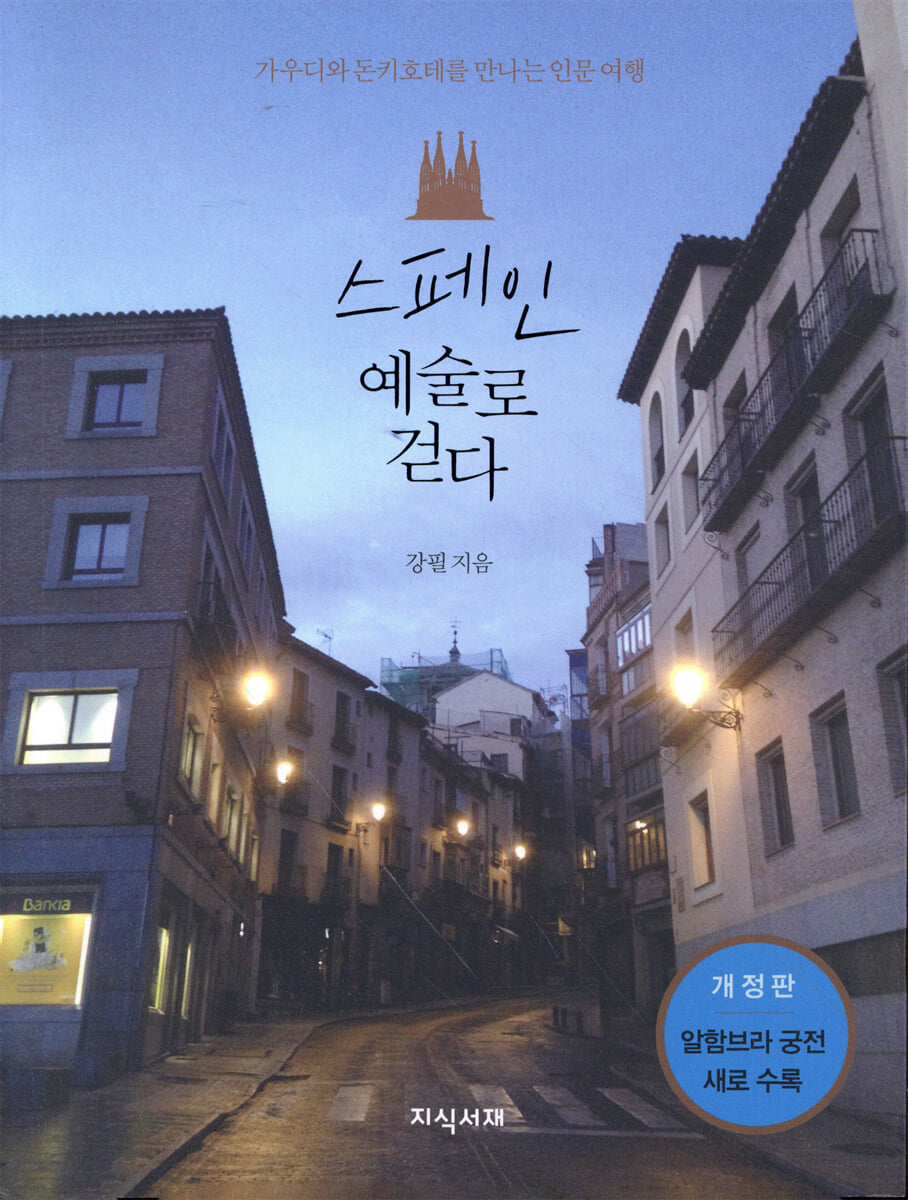
Walking through Spanish art
 |
Description
Book Introduction
From Madrid to Granada and Barcelona, discover the real Spain. Spain's charm is not limited to one city. This is because each region, such as Castile, Andalusia, Catalonia, and the Basque Country, has developed its own unique culture and traditions. There is a historical background to this, which is that Spain was created by unifying several kingdoms into one country. The revised edition of "Walking Through Spanish Art" offers a unique way to experience Spain's diverse regional colors through a city tour following art and humanities routes. In Madrid, you can see the paintings of the Prado Museum, in Toledo, you can see Don Quixote and the traditions of medieval knights, in Granada, you can see the Alhambra Palace and Islamic culture, in Barcelona, you can see the FC Barcelona football team and Gaudi's architecture, in Figueres, you can see the surrealist artist Dalí and the museum he built himself, and in Bilbao, you can see the world-famous Guggenheim Museum. In particular, this revised edition introduces the city of Granada and the Alhambra Palace, which became familiar through the tvN drama [Memories of the Alhambra]. The stories of art, literature, and film encountered throughout this exotic city guide us into the real lives and history of the Spanish people. Furthermore, it teaches us how to understand Spain from a new perspective. |
- You can preview some of the book's contents.
Preview
index
Introduction: Travel, the process of finding your own route
Madrid and the Prado Museum
-Prado Museum: Welcomed by Goya and Velazquez
-Rohier's [The Descent from the Cross]: The Masterpiece of a Lost Master
-Fra Angelico's [Annunciation]: A painting completed through prayer by a devout monk
- Raphael's [Portrait of a Cardinal]: The face of a cardinal who seems ready to accept any confession.
-Velázquez's [Portrait of a Court Jester]: Painting an Outsider at Court
-Velázquez's [Las Meninas]: Who is the real protagonist?
-Dürer's [Self-Portrait]: "I am a painter as great as God."
-Dürer's Adam and Eve: Secularized Biblical Figures
-Goya's [The Naked Maja] and [The Clothed Maja]: Who are the models?
-Goya's [Madrid, May 3, 1808]: Denouncing the horrors of war
-Goya's "The Disasters of War" series: For whom is the war?
-Goya's [The Club Duel]: Facing the Darkness of Humanity
-Boss's [Garden of Delights]: A painter bewitched by the devil
Madrid and the Thyssen-Bornemisza Museum
- Thyssen-Bornemisza Museum: A Great Achievement of One Family
- Ghirlandaio's [Portrait of Giovanna Tornabuoni]: Portrait of a beautiful but sad woman
-Caravaggio's [Saint Catherine of Alexandria]: A Martyr Painted by a Murderer Artist
-Holbein the Younger's Portrait of Henry VIII: The King Who Beheaded Two of His Six Wives
-Rembrandt's [Self-Portrait with Hat and Two Necklaces]: A Diary Written with a Brush by an Aging Artist
- Degas's [Dancing Ballerina]: A Momentary Capture of Modern Parisian Life
-Hopper's [Hotel Room]: We are all strangers in a strange world.
Madrid and the Reina Sofia Museum
-Reina Sofia Museum: Dedicated to Queen Sofia, now a place for everyone
-Picasso's [Guernica]: Against all wars in the world
-Nonelle's [The Face of a Gypsy Woman]: Portraits of the Marginalized
- Lichtenstein's [Brushstroke]: Enjoy it like a cartoon, like a joke.
Toledo and Don Quixote, El Greco
-Toledo: The city of Don Quixote and Sancho
-El Greco Museum: The home of a master who was not recognized in his time
-Toledo Cathedral and El Greco's [The Stripping of Christ]: Scenes from the Passion of Christ
-The Basilica of Santo Tomé and El Greco's [The Burial of the Count of Orgaz]: A miraculous moment when heaven and earth meet
Granada and the Alhambra Palace
-Alhambra: A foreign palace that rises like a beautiful fantasy
-Alcazaba Fortress: The oldest part of the Alhambra
-Generalife: Summer palace of the Nasrid kings
- Nasrid Palace: The most important Islamic building with a sad history
-Palace of Charles V: Architecture that heralds a new era
Barcelona and Gaudi
-Barcelona: The city of Gaudí and FC Barcelona
-Gaudi: An ascetic who transcended his time
-Gaudi's [Casa Batlló]: The bones spit out by the legendary dragon
-Gaudi's [Casa Mila]: Beyond architecture, a great work of sculpture
- Gaudi's [Park Güell]: A place of rest for Barcelona citizens and tourists
- Gaudi's [Sagrada Familia]: The genius architect's 150-year plan
-Gothic Quarter: A medieval ruin that served as a filming location for the movie [Perfume].
Unlike Figueres, the Theatre Museum
-Dali Theatre Museum: The largest object created by Dali
-Dali's [Mae West Room]: Enjoy it like a magic eye
-Dali's [In Six Real Mirrors… …]: You are preserved forever through the illusion of art
Bilbao and the Guggenheim Museum
The Guggenheim Museum in Bilbao: Saving a Declining City
- Koons' [Puppy]: A dog beloved by the citizens of Bilbao
-Bourgeois [Maman]: A daughter who has become a mother to her mother
supplement
Reference Sites / References / Sources of Illustrations
Madrid and the Prado Museum
-Prado Museum: Welcomed by Goya and Velazquez
-Rohier's [The Descent from the Cross]: The Masterpiece of a Lost Master
-Fra Angelico's [Annunciation]: A painting completed through prayer by a devout monk
- Raphael's [Portrait of a Cardinal]: The face of a cardinal who seems ready to accept any confession.
-Velázquez's [Portrait of a Court Jester]: Painting an Outsider at Court
-Velázquez's [Las Meninas]: Who is the real protagonist?
-Dürer's [Self-Portrait]: "I am a painter as great as God."
-Dürer's Adam and Eve: Secularized Biblical Figures
-Goya's [The Naked Maja] and [The Clothed Maja]: Who are the models?
-Goya's [Madrid, May 3, 1808]: Denouncing the horrors of war
-Goya's "The Disasters of War" series: For whom is the war?
-Goya's [The Club Duel]: Facing the Darkness of Humanity
-Boss's [Garden of Delights]: A painter bewitched by the devil
Madrid and the Thyssen-Bornemisza Museum
- Thyssen-Bornemisza Museum: A Great Achievement of One Family
- Ghirlandaio's [Portrait of Giovanna Tornabuoni]: Portrait of a beautiful but sad woman
-Caravaggio's [Saint Catherine of Alexandria]: A Martyr Painted by a Murderer Artist
-Holbein the Younger's Portrait of Henry VIII: The King Who Beheaded Two of His Six Wives
-Rembrandt's [Self-Portrait with Hat and Two Necklaces]: A Diary Written with a Brush by an Aging Artist
- Degas's [Dancing Ballerina]: A Momentary Capture of Modern Parisian Life
-Hopper's [Hotel Room]: We are all strangers in a strange world.
Madrid and the Reina Sofia Museum
-Reina Sofia Museum: Dedicated to Queen Sofia, now a place for everyone
-Picasso's [Guernica]: Against all wars in the world
-Nonelle's [The Face of a Gypsy Woman]: Portraits of the Marginalized
- Lichtenstein's [Brushstroke]: Enjoy it like a cartoon, like a joke.
Toledo and Don Quixote, El Greco
-Toledo: The city of Don Quixote and Sancho
-El Greco Museum: The home of a master who was not recognized in his time
-Toledo Cathedral and El Greco's [The Stripping of Christ]: Scenes from the Passion of Christ
-The Basilica of Santo Tomé and El Greco's [The Burial of the Count of Orgaz]: A miraculous moment when heaven and earth meet
Granada and the Alhambra Palace
-Alhambra: A foreign palace that rises like a beautiful fantasy
-Alcazaba Fortress: The oldest part of the Alhambra
-Generalife: Summer palace of the Nasrid kings
- Nasrid Palace: The most important Islamic building with a sad history
-Palace of Charles V: Architecture that heralds a new era
Barcelona and Gaudi
-Barcelona: The city of Gaudí and FC Barcelona
-Gaudi: An ascetic who transcended his time
-Gaudi's [Casa Batlló]: The bones spit out by the legendary dragon
-Gaudi's [Casa Mila]: Beyond architecture, a great work of sculpture
- Gaudi's [Park Güell]: A place of rest for Barcelona citizens and tourists
- Gaudi's [Sagrada Familia]: The genius architect's 150-year plan
-Gothic Quarter: A medieval ruin that served as a filming location for the movie [Perfume].
Unlike Figueres, the Theatre Museum
-Dali Theatre Museum: The largest object created by Dali
-Dali's [Mae West Room]: Enjoy it like a magic eye
-Dali's [In Six Real Mirrors… …]: You are preserved forever through the illusion of art
Bilbao and the Guggenheim Museum
The Guggenheim Museum in Bilbao: Saving a Declining City
- Koons' [Puppy]: A dog beloved by the citizens of Bilbao
-Bourgeois [Maman]: A daughter who has become a mother to her mother
supplement
Reference Sites / References / Sources of Illustrations
Detailed image

Into the book
Just as first impressions are important to people, first impressions are also important to paintings.
In that respect, the cardinal in Raphael's painting 'passes the test'.
His large, kind-looking eyes and neatly cut hair give the impression that he is an honest and truthful person.
Those tightly closed lips seem like they would keep a secret well.
If you go to confession with a person like this, it seems like you can confess all your shameful sins.
--- From "Raphael's Portrait of a Cardinal: The Face of a Cardinal Who Could Accept Any Confession"
Hopper's paintings are evaluated as depicting the bleak lives of modern people.
As urbanization and individualism developed, individuals became disconnected from their neighbors and families.
But while watching “Hotel Room,” I began to wonder if this feeling of loneliness was unique to modern people.
We are born into a strange world and form relationships with strangers.
But those relationships are bound to break down someday.
Even parents, children, and spouses are like that.
Aren't we all in a similarly lonely situation as we go through life? We're just staying in this hotel room called the world for a while, but when the time comes, we have to pack up and leave. Isn't that the human condition?
--- From "Hopper's Hotel Room: We Are All Strangers in a Strange World"
Guernica reflects an event that occurred during the Spanish Civil War.
But soon it went beyond the limited issues of a specific region and was elevated to an art form opposing all wars that lead to indiscriminate killing.
It has become a representative example of reverse art.
This may have been possible because of the abstractness and symbolism of the work.
I even think that such a dramatic story would have been necessary for the Cubist logic of “capturing the appearance of an object from multiple viewpoints on a single screen” to be accepted by the public.
--- From "Picasso's Guernica: Against All War in the World"
If you go to Plaza de Zocodover in Toledo, you can meet Don Quixote, Sancho Panza, the old horse Rocinante, and the donkey.
Don Quixote, a delusional man who mistook inn prostitutes for noblewomen and treated them politely, a madman who thought the innkeeper was the lord of a castle and asked to be appointed as a knight, a lunatic who ran towards a windmill shouting that it was a giant, and yet a noble idealist who wanted to fight against the injustice and inequality of the world no matter what the trials.
His appearance at first makes us laugh, but at some point he starts to move us.
Because the recklessness of boldly moving forward toward an impossible dream is the true reason we have lost, but are still alive.
--- From "Toledo: The City of Don Quixote and Sancho"
Finally, I'd like to share some essential information for those visiting the Alhambra.
Even during the off-season, not to mention the peak season, the site is crowded with visitors, and the number of visitors per day is limited to protect the site, so ticket reservations are essential.
Please purchase it online in advance before leaving Korea.
If you were unable to make a reservation because your visit date is uncertain, you should purchase it online as soon as your schedule is confirmed.
If you have no choice but to purchase tickets on-site due to the limited number of online reservations, you will need to be prepared to wait in line at the ticket booth from dawn.
Even if you do that, the tickets may sell out, and you may end up in a disaster(?) of going all the way to Granada and not being able to see the Alhambra.
For reference, my companion and I went to the ticket booth at 6 a.m. during the off-season, and we still had to compete with two Turkish college students for the first spot.
We wish all visitors good luck.
--- From "The Alhambra: A Foreign Palace That Rise Like a Beautiful Fantasy"
Gaudí failed several subjects while attending the Barcelona School of Architecture.
On graduation day, Dean Elys Rogent gave Gaudí his diploma and said this:
“I don’t know if we give degrees to fools or geniuses.
Time will prove it.” Time has proven that Gaudí was a genius.
Gaudí has the honor of having the most UNESCO World Heritage Sites as an individual.
In that respect, the cardinal in Raphael's painting 'passes the test'.
His large, kind-looking eyes and neatly cut hair give the impression that he is an honest and truthful person.
Those tightly closed lips seem like they would keep a secret well.
If you go to confession with a person like this, it seems like you can confess all your shameful sins.
--- From "Raphael's Portrait of a Cardinal: The Face of a Cardinal Who Could Accept Any Confession"
Hopper's paintings are evaluated as depicting the bleak lives of modern people.
As urbanization and individualism developed, individuals became disconnected from their neighbors and families.
But while watching “Hotel Room,” I began to wonder if this feeling of loneliness was unique to modern people.
We are born into a strange world and form relationships with strangers.
But those relationships are bound to break down someday.
Even parents, children, and spouses are like that.
Aren't we all in a similarly lonely situation as we go through life? We're just staying in this hotel room called the world for a while, but when the time comes, we have to pack up and leave. Isn't that the human condition?
--- From "Hopper's Hotel Room: We Are All Strangers in a Strange World"
Guernica reflects an event that occurred during the Spanish Civil War.
But soon it went beyond the limited issues of a specific region and was elevated to an art form opposing all wars that lead to indiscriminate killing.
It has become a representative example of reverse art.
This may have been possible because of the abstractness and symbolism of the work.
I even think that such a dramatic story would have been necessary for the Cubist logic of “capturing the appearance of an object from multiple viewpoints on a single screen” to be accepted by the public.
--- From "Picasso's Guernica: Against All War in the World"
If you go to Plaza de Zocodover in Toledo, you can meet Don Quixote, Sancho Panza, the old horse Rocinante, and the donkey.
Don Quixote, a delusional man who mistook inn prostitutes for noblewomen and treated them politely, a madman who thought the innkeeper was the lord of a castle and asked to be appointed as a knight, a lunatic who ran towards a windmill shouting that it was a giant, and yet a noble idealist who wanted to fight against the injustice and inequality of the world no matter what the trials.
His appearance at first makes us laugh, but at some point he starts to move us.
Because the recklessness of boldly moving forward toward an impossible dream is the true reason we have lost, but are still alive.
--- From "Toledo: The City of Don Quixote and Sancho"
Finally, I'd like to share some essential information for those visiting the Alhambra.
Even during the off-season, not to mention the peak season, the site is crowded with visitors, and the number of visitors per day is limited to protect the site, so ticket reservations are essential.
Please purchase it online in advance before leaving Korea.
If you were unable to make a reservation because your visit date is uncertain, you should purchase it online as soon as your schedule is confirmed.
If you have no choice but to purchase tickets on-site due to the limited number of online reservations, you will need to be prepared to wait in line at the ticket booth from dawn.
Even if you do that, the tickets may sell out, and you may end up in a disaster(?) of going all the way to Granada and not being able to see the Alhambra.
For reference, my companion and I went to the ticket booth at 6 a.m. during the off-season, and we still had to compete with two Turkish college students for the first spot.
We wish all visitors good luck.
--- From "The Alhambra: A Foreign Palace That Rise Like a Beautiful Fantasy"
Gaudí failed several subjects while attending the Barcelona School of Architecture.
On graduation day, Dean Elys Rogent gave Gaudí his diploma and said this:
“I don’t know if we give degrees to fools or geniuses.
Time will prove it.” Time has proven that Gaudí was a genius.
Gaudí has the honor of having the most UNESCO World Heritage Sites as an individual.
--- From "Gaudi: The Timeless Ascetic"
Publisher's Review
Madrid, a city filled with world-class art museums
The first city visited by 『Walking through Spanish Art』 is Madrid, the capital of Spain.
It is home to the world-renowned Prado Museum, the Thyssen-Bornemisza Museum, and the Reina Sofia Museum.
The three art museums are connected to form a triangle, and are also called the 'Golden Triangle of Art'.
At the Prado Museum, Spain's national art museum, you can see works by Velazquez, Dürer, Goya, Bosch, and others.
Francisco de Goya was a court painter who amassed great fame and wealth over many years.
But his gaze did not stop at the successful life, but was drawn to the harsh reality of his homeland, Spain.
At that time, Spain was sick because of the incompetent King Charles IV, his extravagant queen, and the prime minister Manuel de Godoy who relied on their power.
Manuel de Godoy even brought in a foreign power, namely the French Napoleonic army.
Napoleon's troops indiscriminately massacred Spanish citizens who had risen up in 1808, and Goya captured this event in his painting [The Third of May 1808].
At the Thyssen-Bornemisza Museum, you can see paintings by Caravaggio, Holbein the Younger, Rembrandt, and Degas.
Rembrandt Harmenszoon van Rijn's self-portrait is one of those moments in our lives that touches us.
Rembrandt's life, which once seemed to be running towards success, began to decline with [The Night Watch].
The critics downgraded this work.
Ironically, this work is now considered Rembrandt's finest work.
Rembrandt's later years were poor and lonely, marked by a series of losses, bankruptcies, and the deaths of his wife and son.
The more this happened, the more mature and profound his art became.
The aging artist painted self-portraits every day as if he were writing a diary.
There is no such thing as a smooth ride in any life.
If there is an uphill, there is also a downhill.
Besides, we all grow old and die.
In that respect, Rembrandt's self-portraits move us.
At the Reina Sofia Museum, you can see Picasso's famous work, [Guernica].
Pablo Picasso was working on a mural for the Paris World's Fair in 1937 when he heard the tragic news of the disaster in Guernica, a small town in the Basque Country.
In 1936, the Popular Front won the general election in Spain and a left-wing government came to power, but Franco's military launched a coup in response.
A year later, Germany, which was supporting Franco's military, bombed Guernica, killing innocent civilians.
Upon hearing this news, Picasso changed the subject of his mural to the tragedy of Guernica.
Afterwards, [Guernica] gained fame, and the Franco government that took over Spain asked Picasso to send [Guernica] to them.
However, Picasso refused, saying that he could not give [Guernica] to a country with a dictatorship.
When [Guernica] returned to his home country of Spain, it was 1981, after both the dictator Franco and Picasso, who opposed the dictator, had passed away.
Toledo, the city of Don Quixote and El Greco
Toledo, located about an hour from Madrid, is a medieval city with an old-world charm that is completely different from the modern city.
Because it was the capital of Spain before Madrid, many historical sites and traces remain.
Above all, here you can meet the famous medieval 'bromance couple' Don Quixote and Sancho Panza.
Miguel de Cervantes, the author of Don Quixote, lived an unhappy life.
He spent his childhood wandering due to his father's debts, and in his youth he joined the Spanish Navy stationed in Italy, where he was injured and lost the use of his left arm for the rest of his life.
After being discharged from the military, he was captured by pirates on his way back to his home country and lived as a slave in Algeria for five years.
After returning to his home country, he wrote Don Quixote and became famous after many twists and turns, but he did not make any money.
During economically difficult times, the book rights were sold to a publisher at a low price.
『Don Quixote』 was initially popular as a humorous novel that brought laughter to the absurd situations that occurred due to Don Quixote, who was so fascinated by chivalric literature that he came to believe that he was a knight.
But soon the novel's value began to be re-evaluated.
Don Quixote was elevated to a great literary work by satirizing Spanish politics, society, and religion, capturing the new trend toward a society without class or gender discrimination, and highlighting the figure of an idealist fighting for freedom and justice. It is now called the first modern novel.
Milan Kundera, author of The Unbearable Lightness of Being, even said, “All novelists are in some way descendants of Cervantes.”
Another artist not to be missed in Toledo is El Greco.
Although he is known as a Spanish painter, he was originally Greek.
The name 'El Greco' itself means Greek.
Toledo is home to the El Greco Museum, as well as El Greco's works scattered throughout the city.
The most famous of these is [The Burial of the Count of Orgaz], housed in the Basilica of Santo Tomé.
The legend tells that when the count, who was deeply religious and had done many good deeds, died, Saint Stephen and Saint Augustine came down from heaven and personally assisted in his burial.
But the real purpose of this painting was money.
The count had promised the cathedral a large sum of money after his death, but his descendants did not follow through on his will.
The cathedral sued and ultimately won.
As if that wasn't enough, he even drew a picture to teach the believers, "If you give a lot of money and donations to the church like the count, you can go to heaven."
Granada, the city of the Alhambra and Islamic culture
The Granada chapter is a new addition to this revised edition, and it meticulously includes maps and routes of the Alhambra Palace, information on its history and major historical sites, various stories related to the place, and anecdotes about the song [Memories of the Alhambra], making it a useful guide for travelers.
The biggest reason people visit Granada is the Alhambra Palace.
There is a historical reason why this palace, built in the Islamic style, was built in Spain, a European country.
Spain was under Islamic rule during the Middle Ages.
The last Islamic dynasty to rule Spain was the Nasrid dynasty, and its palace is the Alhambra.
The remaining ruins of the Alhambra Palace can be broadly divided into four areas: the Alcazaba, the Generalife, the Nasrid Palaces, and the Palace of Carlos V.
The Alcazaba is a military fortress and the oldest relic in the Alhambra.
In the tvN drama [Memories of the Alhambra], the underground prison that Yoo Jin-woo (played by Hyun Bin) entered to complete a game quest is located here.
The Generalife was the summer palace of the Nasrid sultans, and is composed of exotic buildings centered around beautiful gardens.
The Nasrid Palaces are the highlight of the Alhambra and are the most beautiful and ornate site.
You can also see the Abencerrajes room, where the family of a young man who loved the Sultan's concubine was massacred.
The Palace of Charles V is a Renaissance-style building built by the Catholic Kingdom after it drove out the Islamic forces.
Barcelona, the city of FC Barcelona, Gaudi, and the film [Perfume]
The hottest city in Spain right now is Barcelona.
This is because the buildings of Antoni Gaudi, a UNESCO World Heritage Site, are gathered together.
[Casa Mila], [Casa Batlló], [Park Guell], [Sagrada Familia], etc. are all in Barcelona.
[Sagrada Familia] Cathedral (Sagrada Familia) is an unfinished work that began construction in 1883 and is still being built.
Although Gaudí knew full well that he would not be able to complete the building in his lifetime, he did not rush it.
Rather, he believed that masterpieces needed time and passed the baton to later architects.
[Sagrada Familia] is made up of three façades: the Nativity Façade, the Passion Façade, and the Glory Façade, but Gaudi himself completed only the Nativity Façade.
The Passion Façade was started in 1954 by Josep Maria Subirach and completed in 1976, while the Glory Façade was started in 2002 and is scheduled for completion in 2026, the 100th anniversary of Gaudí's death.
The Nativity Façade contains scenes of the birth of Jesus, the killing of baby boys by Herod's soldiers in an attempt to eliminate Jesus, the flight of the Holy Family (Joseph, Mary, and baby Jesus) to Egypt to escape them, and the coronation of the Virgin Mary.
The Passion Façade features scenes such as the Last Supper, the Kiss of Judas, Ecce Homo (Pilate's cry to the crowd as he pointed to Jesus wearing the crown of thorns, meaning 'Behold the man'), Veronica (a saint who wiped Jesus' face with a cloth on his way to the execution grounds, the cloth is said to have Jesus' face imprinted on it), and the Crucifixion.
Inside, the doors that will be used when the Glorious Façade is completed are on display, and the Lord's Prayer is engraved on their surfaces in several languages.
You can also see the Korean text that says, “Give us this day the bread we need.”
[Sagrada Familia] When you go inside, the ceiling is shaped like a flower and the pillars are shaped like trees, making it feel like you are in a forest.
In particular, the color of the stained glass decorating the four sides changes from green to blue, blue to red, and red to yellow again, reflecting the changes of the four seasons in the forest.
Also, if you are a soccer fan, you cannot miss the FC Barcelona souvenir shop in Barcelona.
It's surprising how many items bearing the FC Barcelona emblem can be found all over the city.
The fervent support for a single football team is linked to the Catalan independence movement.
Travelers to Catalonia will see striped flags hanging from buildings here and there – this is the Estelada, the Catalan flag of independence.
Spain was formed in the late Middle Ages by the marriage of Isabella I of Castile and Ferdinand II of Aragon.
Afterwards, as the center of Spain moved to Castile, the Catalonia region, where Aragon was located, became marginalized.
The Catalan people have longed for independence.
However, the Catalan independence movement has historically been subject to thorough repression, and especially during the Franco dictatorship, even the use of the Catalan language was banned.
In 2017, the Catalan government declared independence, but was stripped of its autonomy, and still longs for the day when it will be independent from the central government.
In Barcelona's Gothic Quarter, you can also find Plaza Sant Felip Neri, the filming location for [Perfume], the film adaptation of Patrick Süskind's novel of the same name.
But this place is also where the Franco dictatorship executed innocent people during the civil war.
A journey to discover the life, history, and culture of the Spanish people
This book also introduces the world of surrealist artist Salvador Dali and the Dalí Theatre-Museum he built himself in Figueres, and the Guggenheim Museum in Bilbao, which revived a dying city with an unemployment rate of 20%.
A humanities tour that explores art, literature, and film in Spanish cities such as Madrid, Toledo, Granada, Barcelona, Figueres, and Bilbao provides an opportunity to truly encounter the lives, history, and culture of the Spanish people.
At the same time, it provides a different perspective on looking at and understanding Spain.
The first city visited by 『Walking through Spanish Art』 is Madrid, the capital of Spain.
It is home to the world-renowned Prado Museum, the Thyssen-Bornemisza Museum, and the Reina Sofia Museum.
The three art museums are connected to form a triangle, and are also called the 'Golden Triangle of Art'.
At the Prado Museum, Spain's national art museum, you can see works by Velazquez, Dürer, Goya, Bosch, and others.
Francisco de Goya was a court painter who amassed great fame and wealth over many years.
But his gaze did not stop at the successful life, but was drawn to the harsh reality of his homeland, Spain.
At that time, Spain was sick because of the incompetent King Charles IV, his extravagant queen, and the prime minister Manuel de Godoy who relied on their power.
Manuel de Godoy even brought in a foreign power, namely the French Napoleonic army.
Napoleon's troops indiscriminately massacred Spanish citizens who had risen up in 1808, and Goya captured this event in his painting [The Third of May 1808].
At the Thyssen-Bornemisza Museum, you can see paintings by Caravaggio, Holbein the Younger, Rembrandt, and Degas.
Rembrandt Harmenszoon van Rijn's self-portrait is one of those moments in our lives that touches us.
Rembrandt's life, which once seemed to be running towards success, began to decline with [The Night Watch].
The critics downgraded this work.
Ironically, this work is now considered Rembrandt's finest work.
Rembrandt's later years were poor and lonely, marked by a series of losses, bankruptcies, and the deaths of his wife and son.
The more this happened, the more mature and profound his art became.
The aging artist painted self-portraits every day as if he were writing a diary.
There is no such thing as a smooth ride in any life.
If there is an uphill, there is also a downhill.
Besides, we all grow old and die.
In that respect, Rembrandt's self-portraits move us.
At the Reina Sofia Museum, you can see Picasso's famous work, [Guernica].
Pablo Picasso was working on a mural for the Paris World's Fair in 1937 when he heard the tragic news of the disaster in Guernica, a small town in the Basque Country.
In 1936, the Popular Front won the general election in Spain and a left-wing government came to power, but Franco's military launched a coup in response.
A year later, Germany, which was supporting Franco's military, bombed Guernica, killing innocent civilians.
Upon hearing this news, Picasso changed the subject of his mural to the tragedy of Guernica.
Afterwards, [Guernica] gained fame, and the Franco government that took over Spain asked Picasso to send [Guernica] to them.
However, Picasso refused, saying that he could not give [Guernica] to a country with a dictatorship.
When [Guernica] returned to his home country of Spain, it was 1981, after both the dictator Franco and Picasso, who opposed the dictator, had passed away.
Toledo, the city of Don Quixote and El Greco
Toledo, located about an hour from Madrid, is a medieval city with an old-world charm that is completely different from the modern city.
Because it was the capital of Spain before Madrid, many historical sites and traces remain.
Above all, here you can meet the famous medieval 'bromance couple' Don Quixote and Sancho Panza.
Miguel de Cervantes, the author of Don Quixote, lived an unhappy life.
He spent his childhood wandering due to his father's debts, and in his youth he joined the Spanish Navy stationed in Italy, where he was injured and lost the use of his left arm for the rest of his life.
After being discharged from the military, he was captured by pirates on his way back to his home country and lived as a slave in Algeria for five years.
After returning to his home country, he wrote Don Quixote and became famous after many twists and turns, but he did not make any money.
During economically difficult times, the book rights were sold to a publisher at a low price.
『Don Quixote』 was initially popular as a humorous novel that brought laughter to the absurd situations that occurred due to Don Quixote, who was so fascinated by chivalric literature that he came to believe that he was a knight.
But soon the novel's value began to be re-evaluated.
Don Quixote was elevated to a great literary work by satirizing Spanish politics, society, and religion, capturing the new trend toward a society without class or gender discrimination, and highlighting the figure of an idealist fighting for freedom and justice. It is now called the first modern novel.
Milan Kundera, author of The Unbearable Lightness of Being, even said, “All novelists are in some way descendants of Cervantes.”
Another artist not to be missed in Toledo is El Greco.
Although he is known as a Spanish painter, he was originally Greek.
The name 'El Greco' itself means Greek.
Toledo is home to the El Greco Museum, as well as El Greco's works scattered throughout the city.
The most famous of these is [The Burial of the Count of Orgaz], housed in the Basilica of Santo Tomé.
The legend tells that when the count, who was deeply religious and had done many good deeds, died, Saint Stephen and Saint Augustine came down from heaven and personally assisted in his burial.
But the real purpose of this painting was money.
The count had promised the cathedral a large sum of money after his death, but his descendants did not follow through on his will.
The cathedral sued and ultimately won.
As if that wasn't enough, he even drew a picture to teach the believers, "If you give a lot of money and donations to the church like the count, you can go to heaven."
Granada, the city of the Alhambra and Islamic culture
The Granada chapter is a new addition to this revised edition, and it meticulously includes maps and routes of the Alhambra Palace, information on its history and major historical sites, various stories related to the place, and anecdotes about the song [Memories of the Alhambra], making it a useful guide for travelers.
The biggest reason people visit Granada is the Alhambra Palace.
There is a historical reason why this palace, built in the Islamic style, was built in Spain, a European country.
Spain was under Islamic rule during the Middle Ages.
The last Islamic dynasty to rule Spain was the Nasrid dynasty, and its palace is the Alhambra.
The remaining ruins of the Alhambra Palace can be broadly divided into four areas: the Alcazaba, the Generalife, the Nasrid Palaces, and the Palace of Carlos V.
The Alcazaba is a military fortress and the oldest relic in the Alhambra.
In the tvN drama [Memories of the Alhambra], the underground prison that Yoo Jin-woo (played by Hyun Bin) entered to complete a game quest is located here.
The Generalife was the summer palace of the Nasrid sultans, and is composed of exotic buildings centered around beautiful gardens.
The Nasrid Palaces are the highlight of the Alhambra and are the most beautiful and ornate site.
You can also see the Abencerrajes room, where the family of a young man who loved the Sultan's concubine was massacred.
The Palace of Charles V is a Renaissance-style building built by the Catholic Kingdom after it drove out the Islamic forces.
Barcelona, the city of FC Barcelona, Gaudi, and the film [Perfume]
The hottest city in Spain right now is Barcelona.
This is because the buildings of Antoni Gaudi, a UNESCO World Heritage Site, are gathered together.
[Casa Mila], [Casa Batlló], [Park Guell], [Sagrada Familia], etc. are all in Barcelona.
[Sagrada Familia] Cathedral (Sagrada Familia) is an unfinished work that began construction in 1883 and is still being built.
Although Gaudí knew full well that he would not be able to complete the building in his lifetime, he did not rush it.
Rather, he believed that masterpieces needed time and passed the baton to later architects.
[Sagrada Familia] is made up of three façades: the Nativity Façade, the Passion Façade, and the Glory Façade, but Gaudi himself completed only the Nativity Façade.
The Passion Façade was started in 1954 by Josep Maria Subirach and completed in 1976, while the Glory Façade was started in 2002 and is scheduled for completion in 2026, the 100th anniversary of Gaudí's death.
The Nativity Façade contains scenes of the birth of Jesus, the killing of baby boys by Herod's soldiers in an attempt to eliminate Jesus, the flight of the Holy Family (Joseph, Mary, and baby Jesus) to Egypt to escape them, and the coronation of the Virgin Mary.
The Passion Façade features scenes such as the Last Supper, the Kiss of Judas, Ecce Homo (Pilate's cry to the crowd as he pointed to Jesus wearing the crown of thorns, meaning 'Behold the man'), Veronica (a saint who wiped Jesus' face with a cloth on his way to the execution grounds, the cloth is said to have Jesus' face imprinted on it), and the Crucifixion.
Inside, the doors that will be used when the Glorious Façade is completed are on display, and the Lord's Prayer is engraved on their surfaces in several languages.
You can also see the Korean text that says, “Give us this day the bread we need.”
[Sagrada Familia] When you go inside, the ceiling is shaped like a flower and the pillars are shaped like trees, making it feel like you are in a forest.
In particular, the color of the stained glass decorating the four sides changes from green to blue, blue to red, and red to yellow again, reflecting the changes of the four seasons in the forest.
Also, if you are a soccer fan, you cannot miss the FC Barcelona souvenir shop in Barcelona.
It's surprising how many items bearing the FC Barcelona emblem can be found all over the city.
The fervent support for a single football team is linked to the Catalan independence movement.
Travelers to Catalonia will see striped flags hanging from buildings here and there – this is the Estelada, the Catalan flag of independence.
Spain was formed in the late Middle Ages by the marriage of Isabella I of Castile and Ferdinand II of Aragon.
Afterwards, as the center of Spain moved to Castile, the Catalonia region, where Aragon was located, became marginalized.
The Catalan people have longed for independence.
However, the Catalan independence movement has historically been subject to thorough repression, and especially during the Franco dictatorship, even the use of the Catalan language was banned.
In 2017, the Catalan government declared independence, but was stripped of its autonomy, and still longs for the day when it will be independent from the central government.
In Barcelona's Gothic Quarter, you can also find Plaza Sant Felip Neri, the filming location for [Perfume], the film adaptation of Patrick Süskind's novel of the same name.
But this place is also where the Franco dictatorship executed innocent people during the civil war.
A journey to discover the life, history, and culture of the Spanish people
This book also introduces the world of surrealist artist Salvador Dali and the Dalí Theatre-Museum he built himself in Figueres, and the Guggenheim Museum in Bilbao, which revived a dying city with an unemployment rate of 20%.
A humanities tour that explores art, literature, and film in Spanish cities such as Madrid, Toledo, Granada, Barcelona, Figueres, and Bilbao provides an opportunity to truly encounter the lives, history, and culture of the Spanish people.
At the same time, it provides a different perspective on looking at and understanding Spain.
GOODS SPECIFICS
- Date of issue: February 11, 2019
- Page count, weight, size: 352 pages | 580g | 152*200*30mm
- ISBN13: 9791196128982
- ISBN10: 1196128987
You may also like
카테고리
korean


korean

![GQ KOREA Mark (Monthly): December [2025]](http://librairie.coreenne.fr/cdn/shop/files/8ef265dbbfbf186523ed75ba7319009d.jpg?v=1765340328&width=3840)


