

Plant Walk
 |
Description
Book Introduction
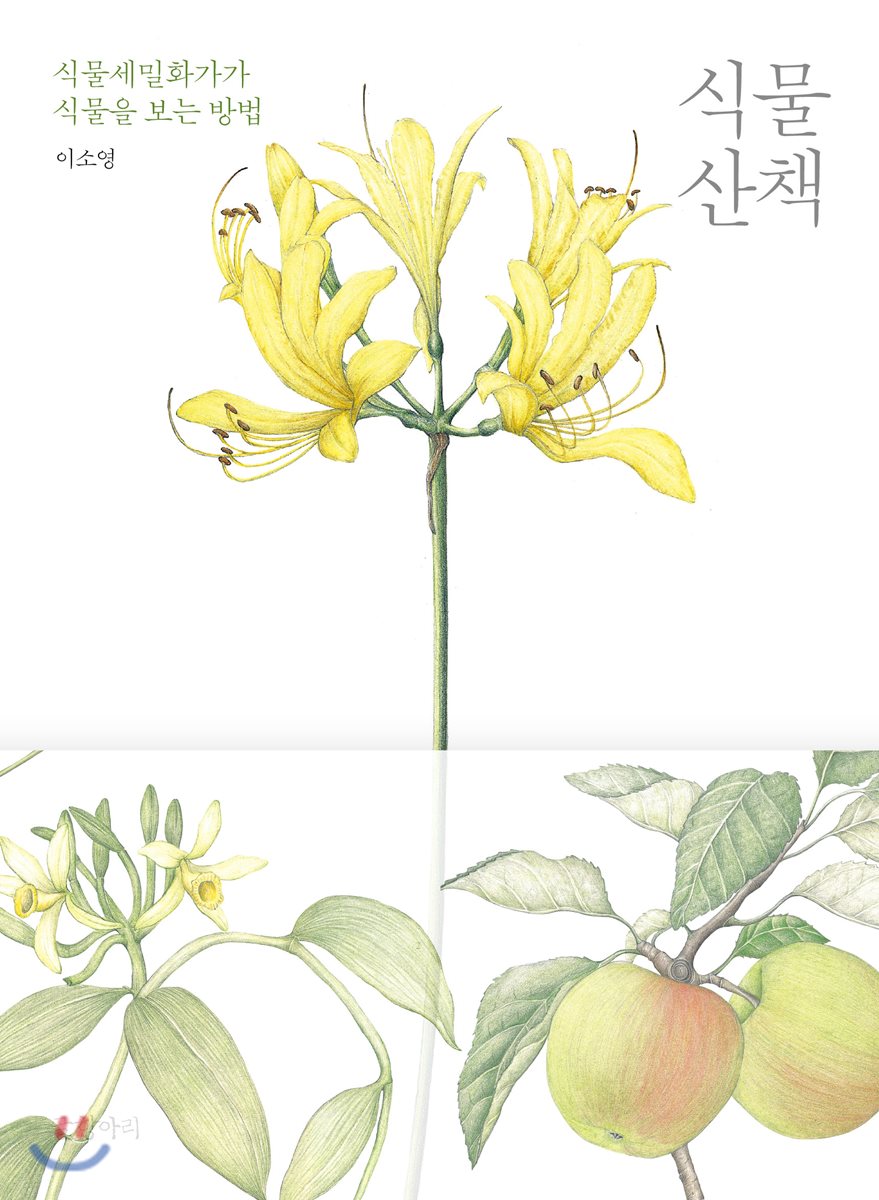
'I draw botanical drawings' The closest, the one I've been with for the longest time, About the world shown and told by plants What kind of world would unfold if I buried my head in a microscope on a desk in a small workshop and looked at a flower the size of a fingernail, the stamens inside it, and the pollen attached to it? If you were to examine a forest full of giant conifers, each branch, each leaf, each seed, feeling the rings of hundreds of years. If you become acquainted with the sticky spatula you met in the middle of the deep jungle and the sedge in the empty lot next to the parking lot. If you are curious about the time of the unknown palm tree in the hallway, or the greenhouse plants gathered from all over the world... This book is the story of a small human being, a botanist and botanical artist, who has quietly and gradually walked through the 'world of plants' that has been built up over the past 10 years, visiting botanical gardens, arboretums, mountains and fields, gardens and vacant lots, and meeting the plants and people he has encountered. |
- You can preview some of the book's contents.
Preview
index
Entering
Forest Detailer National Arboretum
The Beauty of Wild Grasses, Hakone Wetlands Garden
Berlin-Dahlem Botanical Garden, a Gardener's Touch
Living Plant Encyclopedia: Makino Botanical Garden, Kochi Prefecture
Plant Life: Ginger and Insecta Plants, Singapore Botanic Gardens
Herb Astronomical Observatory, the scent of herbs
Fruit's Fate Jade Garden
Paris Botanical Garden, the city's horticultural garden
There are no useless plants at Pyeonggang Botanical Garden
Botany and Botanists, Royal Botanic Gardens, Kew
Documenting Plants at the Amsterdam Botanical Garden
Ferns in the greenhouse, Korea Expressway Corporation Arboretum
Landscapes of Plant Culture: Tillandsia and Lithops at Tsukuba Botanical Garden
Childhood Plant Memories Jindai Botanical Garden
Old Trees Shinjuku Park
The Tokyo University Botanical Garden in its winter garden
Search
List of pictures
Forest Detailer National Arboretum
The Beauty of Wild Grasses, Hakone Wetlands Garden
Berlin-Dahlem Botanical Garden, a Gardener's Touch
Living Plant Encyclopedia: Makino Botanical Garden, Kochi Prefecture
Plant Life: Ginger and Insecta Plants, Singapore Botanic Gardens
Herb Astronomical Observatory, the scent of herbs
Fruit's Fate Jade Garden
Paris Botanical Garden, the city's horticultural garden
There are no useless plants at Pyeonggang Botanical Garden
Botany and Botanists, Royal Botanic Gardens, Kew
Documenting Plants at the Amsterdam Botanical Garden
Ferns in the greenhouse, Korea Expressway Corporation Arboretum
Landscapes of Plant Culture: Tillandsia and Lithops at Tsukuba Botanical Garden
Childhood Plant Memories Jindai Botanical Garden
Old Trees Shinjuku Park
The Tokyo University Botanical Garden in its winter garden
Search
List of pictures
Detailed image

Into the book
When I looked up at a tree, when I clung to it and peered at its bark with a loupe, when I stretched out my arm to cut a branch with a pair of scissors taller than I was, and when I found a cut branch on the ground and ran to carefully place it in my collecting bag, I was no different from the mushrooms that clung to this tree, living off its nutrients, or the insects that pollinated its flowers.
---From "The Detail Painter in the Forest"
I spent the whole day walking around the botanical gardens, observing the gardeners here and there.
They level the ground, plan what plants to grow there, source seeds or seedlings, plant the plants, water them at the right time to ensure proper growth, and prune and trim dead leaves so they don't hinder the growth of other leaves.
Weeds that hinder the growth of plants are pulled out, seeds are collected when the plants bear fruit, and leaves, stems, and roots are cut and replanted to propagate.
---From "The Gardener's Hand"
Can a single individual depict a plant species? To depict a plant, every part of its growth process—roots, stem, branches, leaves, flowers, and fruit—must be recorded. For trees, even the bark and winter buds must be recorded.
However, plants do not show this part at once.
In early spring, stems begin to grow from the roots and leaves appear, in summer, flowers bloom, and in winter, winter buds appear.
A single picture captures the long life of a plant.
---From the “Living Plant Encyclopedia”
The bare branches of a tree reveal their true beauty only in winter.
The different bark colors and patterns, the angles between branches that branch out, the straight and curved lines.
The shape of the tree with its bare branches seems to teach me something beyond aesthetics.
'No matter how hard you draw a line, you can't draw a natural curve like my branch, right?'
---From "The Detail Painter in the Forest"
I spent the whole day walking around the botanical gardens, observing the gardeners here and there.
They level the ground, plan what plants to grow there, source seeds or seedlings, plant the plants, water them at the right time to ensure proper growth, and prune and trim dead leaves so they don't hinder the growth of other leaves.
Weeds that hinder the growth of plants are pulled out, seeds are collected when the plants bear fruit, and leaves, stems, and roots are cut and replanted to propagate.
---From "The Gardener's Hand"
Can a single individual depict a plant species? To depict a plant, every part of its growth process—roots, stem, branches, leaves, flowers, and fruit—must be recorded. For trees, even the bark and winter buds must be recorded.
However, plants do not show this part at once.
In early spring, stems begin to grow from the roots and leaves appear, in summer, flowers bloom, and in winter, winter buds appear.
A single picture captures the long life of a plant.
---From the “Living Plant Encyclopedia”
The bare branches of a tree reveal their true beauty only in winter.
The different bark colors and patterns, the angles between branches that branch out, the straight and curved lines.
The shape of the tree with its bare branches seems to teach me something beyond aesthetics.
'No matter how hard you draw a line, you can't draw a natural curve like my branch, right?'
---From "In the Winter Garden"
Publisher's Review
Plants
How do you like it?
There is no season that is not good for being with plants (even winter has its own joys), but spring seems to be the season for 'plant walks'.
The streets are filled with people strolling among fluttering cherry blossom petals, the forests are filled with people admiring the small leaves and colorful spring flowers that poke their heads out in warm colors that can only be seen at this time of year, and the flower market is filled with people who want to welcome companion plants for various reasons.
If you were to ask people this time of year, “Do you like plants (or any flowers, or any trees)?” they would usually either smile broadly and say yes, or just take a moment to quietly feel the presence of plants that have always been around us, doing their best.
But what if we changed this simple question a little, asking, "How do you like plants?" How to like plants.
Could we even have such a natural conversation with this question? Do we have a proper "plant culture"?
"A Botanical Walk: How a Botanical Artist Sees Plants" is a collection of stories about plants and people the author, a botanist and botanical artist, has encountered over the past decade.
But in fact, this story is also a record of my 'likes' for the plants I have had and will have in the future.
Like all 'likes' in the world, this book is filled with stories of meeting each other every day, carefully examining each other, feeling loved, surprised, cherished, sorry, and ultimately pledging and promising a better 'togetherness'.
“They say you shouldn’t turn your favorite thing into a job, but strangely enough, the more I meet and look at plants, the more I love them,” says the author. “That’s why I want to be like them,” and “I want to stay by their side and silently record the plants of this world one by one in drawings.”
Another confesses that he compiled these records into a book “with the hope that people will come to love plants more.”
So to speak, this book is a personal and beautiful record of 'how to like plants.'
As we follow the way botanical artists see plants, taking a walk through botanical gardens, arboretums, and forests around the world, from the National Arboretum to the Royal Botanic Gardens, Kew, we learn the perspective and insight needed to turn our explosive growth in plants over the past few years into something worthy of being called a culture.
A person who draws plants
How to see plants
Apples are red fruits, bracken is dried brown vegetables (stems and leaves), onions are white roots, and green onions are green leaves.
This is what the edible plants look like as we remember them.
When people look at plants, they edit and remember only the images they want to remember.
Many people don't know what they look like, but (of course) garlic has flowers, ginseng has fruit, and ginger has beautiful leaves and flowers.
The same goes for the plants you encounter on the road.
Cherry blossom trees, often remembered only for their fluttering petals, show off an exceptionally blue and refreshing appearance in midsummer when they are covered with green leaves.
Even in the depths of winter, when all the greenery has disappeared, plants reveal their true colors with the shapes of their branches, the bark of different colors and patterns, and the winter buds of various shapes.
A lush forest or a grassy field are just scenes that can be passed by, but if you look closely and examine them carefully, each and every one of them is a universe.
The appearance of plants is much more diverse and wonderful than we think.
This book contains the author's diverse experiences and stories of plants he has encountered over the past ten years, from the time he first graduated from college and began drawing and studying plants until now.
Conifers of the needleleaf forest with a long history, and Korea's precious endemic plant, the Jinnorangsangsahwa (Lycoris chinensis var.) that is as beautiful as daffodils or amaryllis.
Including sinuolata KHTae & SCKo, countless native wildflowers that live on our land, ginger plants that are widely loved as ornamentals, insectivorous plants found in deep, damp forests, herbs such as lavender, rosemary, and sage that we encounter in our daily lives, fruits such as blueberries, apples, strawberries, and grapes, edible plants such as wheat and potatoes, medicinal plants such as mugwort, bellflower root, pinellia, and cold herb, ornamental plants for their leaves such as palm, alocasia, dracaena, and rubber trees, ferns, one of the oldest plant groups on Earth, tillandsia that has recently become widely loved in Korea and lithops that show the plant culture of enthusiasts, acacia trees that I saw and smelled when I climbed Gwanaksan Mountain as a child, colorful tulips in Boramae Park, old trees cut down from the Korean Peninsula during the Japanese colonial period, and even the first azaleas to herald spring in the frozen ground… … From the perspective of someone who studies and draws plants, someone who especially loves plants, every plant, even an unknown flower in a pot that only remains faintly in memory, is special in its own way.
This book also contains stories of people who make a living dealing with these special beings.
The stories of horticulturalists from the Berlin-Dahlem Botanical Garden in Germany, Tomitaro Makino, a representative Japanese botanist and botanical artist, botanists and plant hunters from the Royal Botanic Gardens, Kew, England, which is considered the world's best botanical research institute, botanical illustrators, and researchers, early senior scholars in the Korean plant world who devoted their lives to plant research and data collection, and ordinary plant lovers who properly understand the characteristics of plant species and consume them in various ways, guide us into the 'world of plants' that has been quietly and step by step created over a long period of time.
As you walk around inside, you will naturally want to see more plants and love them more.
The details show
Plants and plant culture here and now
What's the difference between viewing plants through botanical illustration (botanical miniatures)? With the advancements in high-resolution, continuous shooting, and other photographic technologies, why are botanical illustrations still necessary? Are botanical illustrations simply about presenting plants in a beautiful and attractive way? A look into the day, year, and decade of a botanical artist (botanical miniature artist) reveals the answer.
He wakes up in the morning, packs his collecting and observation tools, and heads out into the forest.
As I wander through the forest, I check on the appearance and well-being of 'familiar plants' such as the flowers I saw yesterday, the grass I discovered last week, and the trees I saw a year ago.
Observe the daily life of plants that changes every day, and observe the form of plants that is formed by the accumulation of those daily lives.
The form of a plant is expressed through its organs, and plant detailing includes all the organs that show the form of the plant, such as roots, stems, leaves, flowers, and fruits.
But plants never show these organs at once.
From the sprouting of leaves to the blooming of flowers and the setting of fruits, every event (form) is a moment in the life of a plant.
No matter how great the technology, a photograph that records a 'moment' ultimately only captures an instant.
But in botanical painting, these moments are accumulated to capture the life of a plant.
Additionally, while a photograph captures the appearance of a single plant individual, a botanical illustration portrays the appearance of the entire plant species to which that individual belongs.
This is why botanical drawings, which minimize individual variations and highlight the universal characteristics of a species, show the life cycle of a plant more accurately than photographs, which capture individual variations according to ecological environment, such as color and shape.
That single life is recorded as the history of the species, constantly being revised and supplemented based on existing errors or new facts discovered through research.
Through a single botanical drawing, we do not see the most beautiful moment of a single tree or a single blade of grass, but rather the entire life of that individual, from seed to fruit, and further, the natural history of the entire plant species to which that individual belongs.
How do you like it?
There is no season that is not good for being with plants (even winter has its own joys), but spring seems to be the season for 'plant walks'.
The streets are filled with people strolling among fluttering cherry blossom petals, the forests are filled with people admiring the small leaves and colorful spring flowers that poke their heads out in warm colors that can only be seen at this time of year, and the flower market is filled with people who want to welcome companion plants for various reasons.
If you were to ask people this time of year, “Do you like plants (or any flowers, or any trees)?” they would usually either smile broadly and say yes, or just take a moment to quietly feel the presence of plants that have always been around us, doing their best.
But what if we changed this simple question a little, asking, "How do you like plants?" How to like plants.
Could we even have such a natural conversation with this question? Do we have a proper "plant culture"?
"A Botanical Walk: How a Botanical Artist Sees Plants" is a collection of stories about plants and people the author, a botanist and botanical artist, has encountered over the past decade.
But in fact, this story is also a record of my 'likes' for the plants I have had and will have in the future.
Like all 'likes' in the world, this book is filled with stories of meeting each other every day, carefully examining each other, feeling loved, surprised, cherished, sorry, and ultimately pledging and promising a better 'togetherness'.
“They say you shouldn’t turn your favorite thing into a job, but strangely enough, the more I meet and look at plants, the more I love them,” says the author. “That’s why I want to be like them,” and “I want to stay by their side and silently record the plants of this world one by one in drawings.”
Another confesses that he compiled these records into a book “with the hope that people will come to love plants more.”
So to speak, this book is a personal and beautiful record of 'how to like plants.'
As we follow the way botanical artists see plants, taking a walk through botanical gardens, arboretums, and forests around the world, from the National Arboretum to the Royal Botanic Gardens, Kew, we learn the perspective and insight needed to turn our explosive growth in plants over the past few years into something worthy of being called a culture.
A person who draws plants
How to see plants
Apples are red fruits, bracken is dried brown vegetables (stems and leaves), onions are white roots, and green onions are green leaves.
This is what the edible plants look like as we remember them.
When people look at plants, they edit and remember only the images they want to remember.
Many people don't know what they look like, but (of course) garlic has flowers, ginseng has fruit, and ginger has beautiful leaves and flowers.
The same goes for the plants you encounter on the road.
Cherry blossom trees, often remembered only for their fluttering petals, show off an exceptionally blue and refreshing appearance in midsummer when they are covered with green leaves.
Even in the depths of winter, when all the greenery has disappeared, plants reveal their true colors with the shapes of their branches, the bark of different colors and patterns, and the winter buds of various shapes.
A lush forest or a grassy field are just scenes that can be passed by, but if you look closely and examine them carefully, each and every one of them is a universe.
The appearance of plants is much more diverse and wonderful than we think.
This book contains the author's diverse experiences and stories of plants he has encountered over the past ten years, from the time he first graduated from college and began drawing and studying plants until now.
Conifers of the needleleaf forest with a long history, and Korea's precious endemic plant, the Jinnorangsangsahwa (Lycoris chinensis var.) that is as beautiful as daffodils or amaryllis.
Including sinuolata KHTae & SCKo, countless native wildflowers that live on our land, ginger plants that are widely loved as ornamentals, insectivorous plants found in deep, damp forests, herbs such as lavender, rosemary, and sage that we encounter in our daily lives, fruits such as blueberries, apples, strawberries, and grapes, edible plants such as wheat and potatoes, medicinal plants such as mugwort, bellflower root, pinellia, and cold herb, ornamental plants for their leaves such as palm, alocasia, dracaena, and rubber trees, ferns, one of the oldest plant groups on Earth, tillandsia that has recently become widely loved in Korea and lithops that show the plant culture of enthusiasts, acacia trees that I saw and smelled when I climbed Gwanaksan Mountain as a child, colorful tulips in Boramae Park, old trees cut down from the Korean Peninsula during the Japanese colonial period, and even the first azaleas to herald spring in the frozen ground… … From the perspective of someone who studies and draws plants, someone who especially loves plants, every plant, even an unknown flower in a pot that only remains faintly in memory, is special in its own way.
This book also contains stories of people who make a living dealing with these special beings.
The stories of horticulturalists from the Berlin-Dahlem Botanical Garden in Germany, Tomitaro Makino, a representative Japanese botanist and botanical artist, botanists and plant hunters from the Royal Botanic Gardens, Kew, England, which is considered the world's best botanical research institute, botanical illustrators, and researchers, early senior scholars in the Korean plant world who devoted their lives to plant research and data collection, and ordinary plant lovers who properly understand the characteristics of plant species and consume them in various ways, guide us into the 'world of plants' that has been quietly and step by step created over a long period of time.
As you walk around inside, you will naturally want to see more plants and love them more.
The details show
Plants and plant culture here and now
What's the difference between viewing plants through botanical illustration (botanical miniatures)? With the advancements in high-resolution, continuous shooting, and other photographic technologies, why are botanical illustrations still necessary? Are botanical illustrations simply about presenting plants in a beautiful and attractive way? A look into the day, year, and decade of a botanical artist (botanical miniature artist) reveals the answer.
He wakes up in the morning, packs his collecting and observation tools, and heads out into the forest.
As I wander through the forest, I check on the appearance and well-being of 'familiar plants' such as the flowers I saw yesterday, the grass I discovered last week, and the trees I saw a year ago.
Observe the daily life of plants that changes every day, and observe the form of plants that is formed by the accumulation of those daily lives.
The form of a plant is expressed through its organs, and plant detailing includes all the organs that show the form of the plant, such as roots, stems, leaves, flowers, and fruits.
But plants never show these organs at once.
From the sprouting of leaves to the blooming of flowers and the setting of fruits, every event (form) is a moment in the life of a plant.
No matter how great the technology, a photograph that records a 'moment' ultimately only captures an instant.
But in botanical painting, these moments are accumulated to capture the life of a plant.
Additionally, while a photograph captures the appearance of a single plant individual, a botanical illustration portrays the appearance of the entire plant species to which that individual belongs.
This is why botanical drawings, which minimize individual variations and highlight the universal characteristics of a species, show the life cycle of a plant more accurately than photographs, which capture individual variations according to ecological environment, such as color and shape.
That single life is recorded as the history of the species, constantly being revised and supplemented based on existing errors or new facts discovered through research.
Through a single botanical drawing, we do not see the most beautiful moment of a single tree or a single blade of grass, but rather the entire life of that individual, from seed to fruit, and further, the natural history of the entire plant species to which that individual belongs.
GOODS SPECIFICS
- Date of issue: April 17, 2018
- Page count, weight, size: 288 pages | 488g | 148*200*20mm
- ISBN13: 9788967355159
- ISBN10: 8967355157
You may also like
카테고리
korean


korean

![GQ KOREA Mark (Monthly): December [2025]](http://librairie.coreenne.fr/cdn/shop/files/8ef265dbbfbf186523ed75ba7319009d.jpg?v=1765340328&width=3840)


