

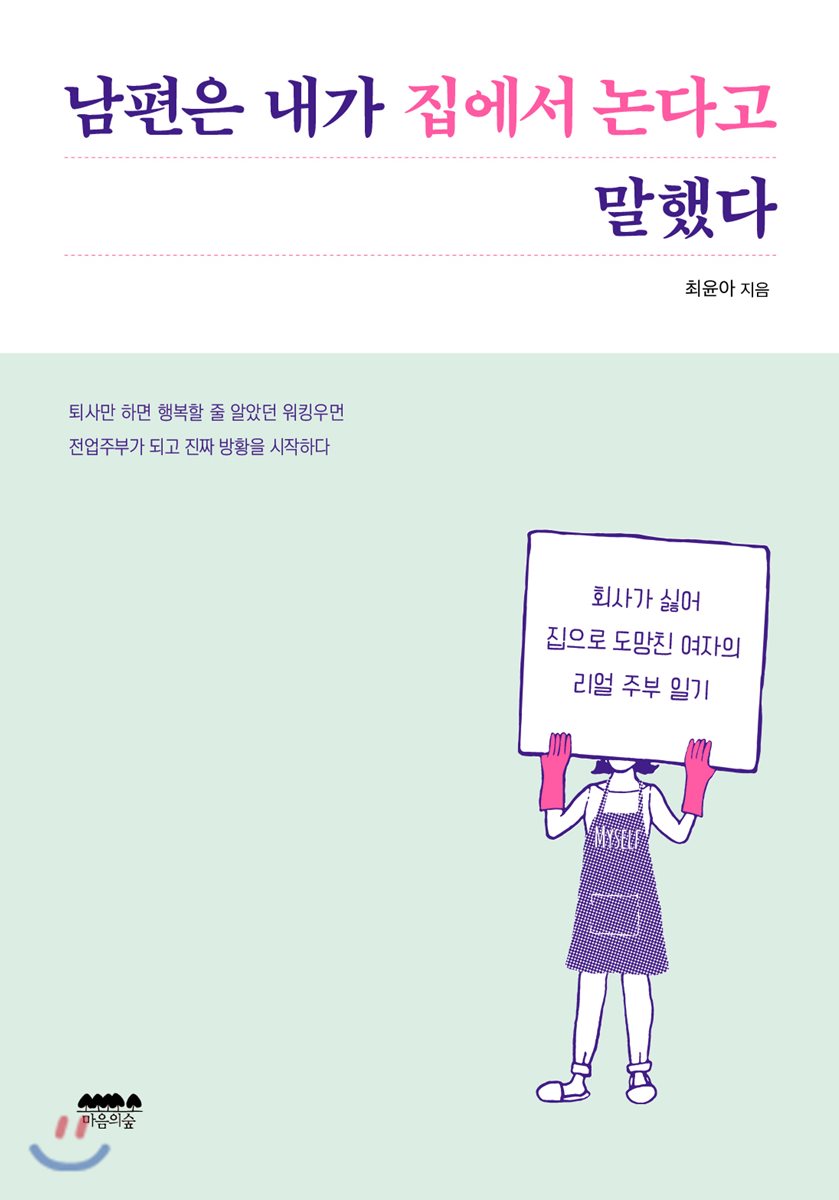
My husband said I was playing at home.
 |
Description
Book Introduction
A working woman who thought she would be happy just by quitting her job
Becoming a full-time housewife and starting to truly wander
Any working woman dreams of owning a house or becoming a full-time professional at least once.
Why do married women give up work and return home more easily than men?
I see many women who become full-time housewives after marriage for the sake of their children or to be faithful to their families.
Did they quit their jobs voluntarily or involuntarily?
This book is not a story about a 'mother' raising a child, but a story about a 'woman' who has lived without earning money.
When the company's consideration for women after marriage feels like exclusion, when doubts about their own talents arise, when they are too exhausted to bear the brunt of the competition, and when the added burden of being a wife and daughter-in-law makes everything too overwhelming, women consider quitting.
Wouldn't it be easier to make a decision if you could first get a glimpse into the real life of a woman who has lived as a housewife?
This is the story of a woman who experienced firsthand that while married men become 'fully usable human resources,' married women become 'temporarily excluded human resources' who can become pregnant and quit their jobs at any time.
It begins with the realistic story of a woman exhausted from work becoming a full-time housewife.
It contains everything from the things that happen when a woman relies on her husband for economic activities, the inexplicable sense of victimization and conflict toward her in-laws, the lowered self-esteem, and even the discrimination from fellow women who say that a stay-at-home mother cannot discuss feminism.
If you are a woman who is contemplating whether to continue working or quit after marriage, I highly recommend reading this.
Becoming a full-time housewife and starting to truly wander
Any working woman dreams of owning a house or becoming a full-time professional at least once.
Why do married women give up work and return home more easily than men?
I see many women who become full-time housewives after marriage for the sake of their children or to be faithful to their families.
Did they quit their jobs voluntarily or involuntarily?
This book is not a story about a 'mother' raising a child, but a story about a 'woman' who has lived without earning money.
When the company's consideration for women after marriage feels like exclusion, when doubts about their own talents arise, when they are too exhausted to bear the brunt of the competition, and when the added burden of being a wife and daughter-in-law makes everything too overwhelming, women consider quitting.
Wouldn't it be easier to make a decision if you could first get a glimpse into the real life of a woman who has lived as a housewife?
This is the story of a woman who experienced firsthand that while married men become 'fully usable human resources,' married women become 'temporarily excluded human resources' who can become pregnant and quit their jobs at any time.
It begins with the realistic story of a woman exhausted from work becoming a full-time housewife.
It contains everything from the things that happen when a woman relies on her husband for economic activities, the inexplicable sense of victimization and conflict toward her in-laws, the lowered self-esteem, and even the discrimination from fellow women who say that a stay-at-home mother cannot discuss feminism.
If you are a woman who is contemplating whether to continue working or quit after marriage, I highly recommend reading this.
- You can preview some of the book's contents.
Preview
index
prolog
Chapter 1.
Becoming a full-time housewife
The woman in my dream
A world of 100 to 1, a social life that began with exhaustion
Betrayal of Talent
I didn't want to be a spoiled adult.
A housewife doesn't reveal her shadow.
The "Quit Highway" opened at the same time as marriage
After marriage, they recommended less important things.
Chapter 2.
Living as a full-time housewife
orgasm
I quit my job and found the lost season.
Careers build, but lyrics evaporate.
Why Coffee Time Was More Important Than Aerobics
I used to be an alpha girl, but now I live as a housewife.
The Woman Who Sells Dreams
The Pitfalls of Plan B
The life of a cheerleader, not a player
A complex problem, filial piety is self-centered
The trap of collecting
The Blurring Line Between Dependence and Love
Is a daughter-in-law who doesn't work a sinner?
A woman who is a true gender equality advocate living as a full-time housewife
I wasn't proud of being a full-time housewife.
The Poshashi filter called resignation
My husband's rise to fame complicated things for me.
Are housewives really rich in time?
A girl who didn't do her homework
Watching the women leaving the ground
Chapter 3.
Quit being a housewife
In the end, what makes me rise is my desire to do well
If you throw it away properly, you won't throw it all away.
My dream wasn't just mine
A room of one's own, a gift from my husband
To me who will waver again someday
Direction over dreams
Work is a matter of will, not emotion
I won't give in to 'fake peace'
Epilogue
Chapter 1.
Becoming a full-time housewife
The woman in my dream
A world of 100 to 1, a social life that began with exhaustion
Betrayal of Talent
I didn't want to be a spoiled adult.
A housewife doesn't reveal her shadow.
The "Quit Highway" opened at the same time as marriage
After marriage, they recommended less important things.
Chapter 2.
Living as a full-time housewife
orgasm
I quit my job and found the lost season.
Careers build, but lyrics evaporate.
Why Coffee Time Was More Important Than Aerobics
I used to be an alpha girl, but now I live as a housewife.
The Woman Who Sells Dreams
The Pitfalls of Plan B
The life of a cheerleader, not a player
A complex problem, filial piety is self-centered
The trap of collecting
The Blurring Line Between Dependence and Love
Is a daughter-in-law who doesn't work a sinner?
A woman who is a true gender equality advocate living as a full-time housewife
I wasn't proud of being a full-time housewife.
The Poshashi filter called resignation
My husband's rise to fame complicated things for me.
Are housewives really rich in time?
A girl who didn't do her homework
Watching the women leaving the ground
Chapter 3.
Quit being a housewife
In the end, what makes me rise is my desire to do well
If you throw it away properly, you won't throw it all away.
My dream wasn't just mine
A room of one's own, a gift from my husband
To me who will waver again someday
Direction over dreams
Work is a matter of will, not emotion
I won't give in to 'fake peace'
Epilogue
Into the book
I wasn't happy at all.
Just a little while ago, I was having the absurd thought that the taxi I was riding in had been in an accident and I just wanted to rest in the hospital for a few days.
I always felt guilty because even though I was giving 120 percent of my ability, I couldn't meet my boss' expectations.
Every night, I juggled the blame for my shortcomings with the harsh company's.
Even though I was working hard every day, it seemed like the work was just piled up on me, so I felt like throwing a party.
As summer deepened, the guilt and sense of victimization grew.
Above all, I couldn't accept that I had achieved my dream and was so unhappy.
---From "The Woman in My Dream"
I asked myself one last question before throwing the white towel into the ring.
'Are you okay with never having to work again?'
Two resignations might have branded me a 'misfit'.
If I quit now, I'll be a 'married woman without children', the lowest-ranking member of the labor market.
(Organizations are most reluctant to hire married women without children who have not yet resolved their 'parental leave risk.') It will not be easy to get back to work.
Still, I threw in the towel.
It was when I decided that I would never have to work again.
---From "The 100 vs. 1 World: Starting Social Life After Exhaustion"
Looking back, there were signs.
After I got married, the questions I received from my seniors at work changed.
“Do you cook for your husband? When are you going to have a baby?” I knew they were casual questions, but they felt a bit strange to me.
Before marriage, conversations that started with "What department do you want to work in in the future?" and ended with career counseling were now filled with topics about "household management" and "childbirth."
After getting married, I started answering questions about things other than work more often.
---From "After marriage, they recommended less important things"
Since becoming a full-time housewife, I've felt a slight sense of guilt every time I spend money.
I felt bad about spending money without earning it.
This guilt led to a feeling of pressure to 'save as much as possible'.
I thought that the only contribution I could make to the household budget, since I didn't earn any money, was to 'save'.
Constant guilt and 'saving compulsion' were just other names for the gloomy.
---From "What it's like for me, once an alpha girl, to live as a full-time housewife"
I thought I could get people while being a housewife.
I was hoping to make a chance encounter with a friend at a yoga studio or a cafe I frequent.
It wasn't as easy as I thought.
Of course, there was a way.
In women's communities, there are often advertisements for friends like, "Looking for a friend who is a full-time housewife preparing for pregnancy."
But I, who insisted on a 'love marriage', wanted to make friends naturally.
---From "Why Coffee Time Was More Important Than Aerobics"
Before I quit, I planned to have a nice meal with my stay-at-home mom, go shopping at a department store, and travel to Southeast Asia.
But, I felt complicated about spending these expenses with my husband's salary instead of my own.
I felt sorry for him and sometimes even felt indebted to him.
Conversely, saying I owe him something also means that he 'gave' me something.
I began to think that my filial piety might depend on my husband's 'goodwill' (or favor).
Posts like “husbands who don’t let their wives spend money on their parents’ house” that frequently appear in women’s communities have fanned a vague sense of anxiety.
---From "Complex Problems of Filial Piety: Self-Reliance"
The comments that often appear on posts on women's communities asking whether the demands of in-laws are excessive or not are, "Why are you doing that when you're both working and not full-time?"
These words sounded to me like, 'If you don't earn money, you have to put up with some of your in-laws' unreasonable demands.'
In the same situation as '乙', one must engage in economic activities in order to be 'qualified to speak' in a place where '甲' is being criticized.
I went there to be comforted, but ended up feeling discouraged instead.
---From "Is a Daughter-in-Law Who Doesn't Work a Sinner?"
On the other hand, I, who had boldly demanded that my husband do housework because I was busier, had to transform into a traditional woman who had to clean up my husband's traces without complaint.
I understood in my head that this transition was natural, as a full-time housewife is the one in charge of housework, but to me, who had been calling for gender equality for nearly 30 years, this felt like a regression rather than a transition.
My head and heart were out of sync.
---From "A Deep-Bone Gender Equality Advocate Living as a Full-Time Housewife"
In the five years before and after turning thirty, women experience the major events of their lives in a compressed manner.
You choose a career, you choose a man to spend the rest of your life with, and you choose whether to become a mother (or not).
There is no time to think, but you are faced with a series of choices.
This may be why French novelist Honoré Balzac said, “The thirties are the most dangerous time for women.”
---From "If you throw it away well, you won't throw it all away"
On the other hand, I prepared dinner, did laundry, and cleaned in the name of 'housekeeping'.
I also gave him nutritional supplements like multivitamins and omega-3.
I thought it was helpful for me to take care of the housework so that he could focus fully on his work.
But my husband didn't seem to appreciate it that much.
Rather, he told me to spend that time meeting friends, reading more books, and writing more.
It felt like both encouragement and pressure to stop trying to do something for me and use that energy to rebuild your life.
---From "My Own Room, a Gift from My Husband"
What work gave me was more than I thought.
It gave me the confidence and voice in relationships that only someone who takes responsibility for their own living can have, and it left behind some pretty significant memories as time went by.
More than anything, the mere fact that I had my own space in society, big or small, made my life more vibrant.
I cried a lot, got hurt, and panted a lot at work, but at the same time, I gave it my all.
Now I know.
If you don't take risks, you won't be energetic.
---From "Work is not a matter of emotion, but of will"
The world is still tilted too far for women to stand tall.
Quite a few women consider running away from work and running home.
Hoping to find the peace I so desperately longed for at home.
But I never found it.
The peace without dignity was temporary.
I enjoyed a moment of peace as I spread out the blanket on a fine afternoon, but I ended up tossing and turning in the stiff blanket for several times longer.
Just a little while ago, I was having the absurd thought that the taxi I was riding in had been in an accident and I just wanted to rest in the hospital for a few days.
I always felt guilty because even though I was giving 120 percent of my ability, I couldn't meet my boss' expectations.
Every night, I juggled the blame for my shortcomings with the harsh company's.
Even though I was working hard every day, it seemed like the work was just piled up on me, so I felt like throwing a party.
As summer deepened, the guilt and sense of victimization grew.
Above all, I couldn't accept that I had achieved my dream and was so unhappy.
---From "The Woman in My Dream"
I asked myself one last question before throwing the white towel into the ring.
'Are you okay with never having to work again?'
Two resignations might have branded me a 'misfit'.
If I quit now, I'll be a 'married woman without children', the lowest-ranking member of the labor market.
(Organizations are most reluctant to hire married women without children who have not yet resolved their 'parental leave risk.') It will not be easy to get back to work.
Still, I threw in the towel.
It was when I decided that I would never have to work again.
---From "The 100 vs. 1 World: Starting Social Life After Exhaustion"
Looking back, there were signs.
After I got married, the questions I received from my seniors at work changed.
“Do you cook for your husband? When are you going to have a baby?” I knew they were casual questions, but they felt a bit strange to me.
Before marriage, conversations that started with "What department do you want to work in in the future?" and ended with career counseling were now filled with topics about "household management" and "childbirth."
After getting married, I started answering questions about things other than work more often.
---From "After marriage, they recommended less important things"
Since becoming a full-time housewife, I've felt a slight sense of guilt every time I spend money.
I felt bad about spending money without earning it.
This guilt led to a feeling of pressure to 'save as much as possible'.
I thought that the only contribution I could make to the household budget, since I didn't earn any money, was to 'save'.
Constant guilt and 'saving compulsion' were just other names for the gloomy.
---From "What it's like for me, once an alpha girl, to live as a full-time housewife"
I thought I could get people while being a housewife.
I was hoping to make a chance encounter with a friend at a yoga studio or a cafe I frequent.
It wasn't as easy as I thought.
Of course, there was a way.
In women's communities, there are often advertisements for friends like, "Looking for a friend who is a full-time housewife preparing for pregnancy."
But I, who insisted on a 'love marriage', wanted to make friends naturally.
---From "Why Coffee Time Was More Important Than Aerobics"
Before I quit, I planned to have a nice meal with my stay-at-home mom, go shopping at a department store, and travel to Southeast Asia.
But, I felt complicated about spending these expenses with my husband's salary instead of my own.
I felt sorry for him and sometimes even felt indebted to him.
Conversely, saying I owe him something also means that he 'gave' me something.
I began to think that my filial piety might depend on my husband's 'goodwill' (or favor).
Posts like “husbands who don’t let their wives spend money on their parents’ house” that frequently appear in women’s communities have fanned a vague sense of anxiety.
---From "Complex Problems of Filial Piety: Self-Reliance"
The comments that often appear on posts on women's communities asking whether the demands of in-laws are excessive or not are, "Why are you doing that when you're both working and not full-time?"
These words sounded to me like, 'If you don't earn money, you have to put up with some of your in-laws' unreasonable demands.'
In the same situation as '乙', one must engage in economic activities in order to be 'qualified to speak' in a place where '甲' is being criticized.
I went there to be comforted, but ended up feeling discouraged instead.
---From "Is a Daughter-in-Law Who Doesn't Work a Sinner?"
On the other hand, I, who had boldly demanded that my husband do housework because I was busier, had to transform into a traditional woman who had to clean up my husband's traces without complaint.
I understood in my head that this transition was natural, as a full-time housewife is the one in charge of housework, but to me, who had been calling for gender equality for nearly 30 years, this felt like a regression rather than a transition.
My head and heart were out of sync.
---From "A Deep-Bone Gender Equality Advocate Living as a Full-Time Housewife"
In the five years before and after turning thirty, women experience the major events of their lives in a compressed manner.
You choose a career, you choose a man to spend the rest of your life with, and you choose whether to become a mother (or not).
There is no time to think, but you are faced with a series of choices.
This may be why French novelist Honoré Balzac said, “The thirties are the most dangerous time for women.”
---From "If you throw it away well, you won't throw it all away"
On the other hand, I prepared dinner, did laundry, and cleaned in the name of 'housekeeping'.
I also gave him nutritional supplements like multivitamins and omega-3.
I thought it was helpful for me to take care of the housework so that he could focus fully on his work.
But my husband didn't seem to appreciate it that much.
Rather, he told me to spend that time meeting friends, reading more books, and writing more.
It felt like both encouragement and pressure to stop trying to do something for me and use that energy to rebuild your life.
---From "My Own Room, a Gift from My Husband"
What work gave me was more than I thought.
It gave me the confidence and voice in relationships that only someone who takes responsibility for their own living can have, and it left behind some pretty significant memories as time went by.
More than anything, the mere fact that I had my own space in society, big or small, made my life more vibrant.
I cried a lot, got hurt, and panted a lot at work, but at the same time, I gave it my all.
Now I know.
If you don't take risks, you won't be energetic.
---From "Work is not a matter of emotion, but of will"
The world is still tilted too far for women to stand tall.
Quite a few women consider running away from work and running home.
Hoping to find the peace I so desperately longed for at home.
But I never found it.
The peace without dignity was temporary.
I enjoyed a moment of peace as I spread out the blanket on a fine afternoon, but I ended up tossing and turning in the stiff blanket for several times longer.
---From "I will not give up my dignity to 'false peace'"
Publisher's Review
'Gungsang' is better than 'Brunch'
The reality of stay-at-home moms: "Sacrifice" comes before "leisure."
After I got married, the questions I received from my seniors at work changed.
“Do you cook for your husband? When are you going to have a baby?” I knew they were casual questions, but they felt a bit strange to me.
Before marriage, conversations that started with "What department do you want to work in in the future?" and ended with career counseling were now filled with topics about "household management" and "childbirth."
After getting married, I started answering questions about things other than work more often.
- From the text
A woman's life changes after marriage.
The real worry about childbirth begins, and the burden of having to balance work and household chores arises.
In addition, with marriage, the refuge of being a 'full-time housewife' has emerged, so the reality is that whenever you get tired of work, you end up looking back at the option of being a 'housewife.'
Indeed, are those who quit their jobs happy?
Is it over if I just quit my job?
How are the women who left the field and returned home exhausted?
This is a 'real housewife's diary' that only a woman who has lived as a full-time housewife can write about the anxiety that arises when relying on her husband financially and what she gives up by not earning money.
The reality that women become compulsively 'worried' to save as much as possible because of the guilt of not earning money, and that even small acts of filial piety towards their parents require the husband's good intentions and permission to feel at ease, resonated with many people even before the series was published.
The housewife who thought she would be at peace was not as comfortable as she thought.
Housewives who don't need to be mindful of others but end up being mindful, and who don't need to make sacrifices but end up making them.
They thought they would be happy if they quit their jobs, but now that they have become housewives, they are wandering in a different way.
No one told me
The story behind the stay-at-home mom
Even among women, there is a distinction between those who work and those who do not.
Even among full-time housewives, there is discrimination between women who have given birth and those who have not.
There are also housewives living in a blind spot where they have lost the right to speak out because they do not have children and are not dual-income households.
The comments that often appear on posts on women's communities asking whether the demands of in-laws are excessive or not are, "Why are you doing that when you're both working and not full-time?"
These words sounded to me like, 'If you don't earn money, you have to put up with some of your in-laws' unreasonable demands.'
Only by engaging in economic activity can one be given the 'right to speak'.
I went there to be comforted, but ended up feeling discouraged instead.
- From the text
This book discusses the social system that excludes married women, and what happens to women when they become stay-at-home mothers due to their obligations to childbirth or family.
It's different from what I imagined.
Times have changed, and some might think of 'leisure' when they hear the word 'housewife,' but the time the author lived was closer to 'sacrifice.'
The gap between imagination and reality was as wide as the distance between brunch and the leftover stew from the day before.
This book talks about the sacrifices, dependence, isolation, helplessness, filial piety, and the problems of time for full-time housewives.
Above all, there are many parts that give a glimpse into the concerns of full-time housewives.
There is no 'me', only family remains
Comfort and encouragement for stay-at-home moms
For women, the thirties are a difficult and cautious time when they are pressed into making important life decisions.
You choose a career, you choose a man to spend the rest of your life with, and after marriage, you choose whether or not to become a mother.
Amidst all the choices and worries, she is once again faced with a crossroads, wondering whether to continue working or to live as a housewife.
Thoughts like, 'Women who are better than me have quit and are living off of their jobs, so what's so great about me that I'm still holding on to my job?' may be what makes women even more exhausted.
It is true that housewives are easily hurt by the prejudice that they have a lot of time, the discrimination that they cannot discuss gender equality, and the stereotype that housewives are lucky women.
There are many people who steal the time of housewives by saying things like, “What’s the use of having a daughter-in-law who plays around?” and “Your sister-in-law is just playing around,” as if housewives are rich in time.
“If you don’t have children, how can you be a housewife?” It has become difficult to advocate for gender equality and it is difficult to live as a feminist, and the reality of ‘childless housewives’ has been thoroughly captured.
“I am not here.
Should I say that it felt like the boundaries of my life were collapsing and I was being sucked into theirs?” The women I met after quitting their jobs spoke so candidly about their hardships that I wondered how they had endured them.
- From the text
Aren't the duties that women are given after marriage—they have to take care of the household because they're married, they have to have children because they're married, they have to be good to their in-laws because they're married—eaten away at the self-esteem of women who have become "housewives" after marriage?
A housewife never just sits idle.
The voices of full-time housewives who say, 'The boundaries of life have collapsed, leaving me alone with my family.'
I wanted to say, 'You should have been honest with me earlier,' but on the other hand, I also want to look at the shadow of the housewife who is so understandable.
For women who are thinking about getting married, planning to get married, or already married, or are contemplating whether to continue working or quit, I hope the story of a woman who has lived as a full-time housewife will offer some comfort or help in making a decision.
We also convey the author's message to fellow housewives who are already living as housewives and wandering, saying, "You are not alone. Let's think about this together."
The reality of stay-at-home moms: "Sacrifice" comes before "leisure."
After I got married, the questions I received from my seniors at work changed.
“Do you cook for your husband? When are you going to have a baby?” I knew they were casual questions, but they felt a bit strange to me.
Before marriage, conversations that started with "What department do you want to work in in the future?" and ended with career counseling were now filled with topics about "household management" and "childbirth."
After getting married, I started answering questions about things other than work more often.
- From the text
A woman's life changes after marriage.
The real worry about childbirth begins, and the burden of having to balance work and household chores arises.
In addition, with marriage, the refuge of being a 'full-time housewife' has emerged, so the reality is that whenever you get tired of work, you end up looking back at the option of being a 'housewife.'
Indeed, are those who quit their jobs happy?
Is it over if I just quit my job?
How are the women who left the field and returned home exhausted?
This is a 'real housewife's diary' that only a woman who has lived as a full-time housewife can write about the anxiety that arises when relying on her husband financially and what she gives up by not earning money.
The reality that women become compulsively 'worried' to save as much as possible because of the guilt of not earning money, and that even small acts of filial piety towards their parents require the husband's good intentions and permission to feel at ease, resonated with many people even before the series was published.
The housewife who thought she would be at peace was not as comfortable as she thought.
Housewives who don't need to be mindful of others but end up being mindful, and who don't need to make sacrifices but end up making them.
They thought they would be happy if they quit their jobs, but now that they have become housewives, they are wandering in a different way.
No one told me
The story behind the stay-at-home mom
Even among women, there is a distinction between those who work and those who do not.
Even among full-time housewives, there is discrimination between women who have given birth and those who have not.
There are also housewives living in a blind spot where they have lost the right to speak out because they do not have children and are not dual-income households.
The comments that often appear on posts on women's communities asking whether the demands of in-laws are excessive or not are, "Why are you doing that when you're both working and not full-time?"
These words sounded to me like, 'If you don't earn money, you have to put up with some of your in-laws' unreasonable demands.'
Only by engaging in economic activity can one be given the 'right to speak'.
I went there to be comforted, but ended up feeling discouraged instead.
- From the text
This book discusses the social system that excludes married women, and what happens to women when they become stay-at-home mothers due to their obligations to childbirth or family.
It's different from what I imagined.
Times have changed, and some might think of 'leisure' when they hear the word 'housewife,' but the time the author lived was closer to 'sacrifice.'
The gap between imagination and reality was as wide as the distance between brunch and the leftover stew from the day before.
This book talks about the sacrifices, dependence, isolation, helplessness, filial piety, and the problems of time for full-time housewives.
Above all, there are many parts that give a glimpse into the concerns of full-time housewives.
There is no 'me', only family remains
Comfort and encouragement for stay-at-home moms
For women, the thirties are a difficult and cautious time when they are pressed into making important life decisions.
You choose a career, you choose a man to spend the rest of your life with, and after marriage, you choose whether or not to become a mother.
Amidst all the choices and worries, she is once again faced with a crossroads, wondering whether to continue working or to live as a housewife.
Thoughts like, 'Women who are better than me have quit and are living off of their jobs, so what's so great about me that I'm still holding on to my job?' may be what makes women even more exhausted.
It is true that housewives are easily hurt by the prejudice that they have a lot of time, the discrimination that they cannot discuss gender equality, and the stereotype that housewives are lucky women.
There are many people who steal the time of housewives by saying things like, “What’s the use of having a daughter-in-law who plays around?” and “Your sister-in-law is just playing around,” as if housewives are rich in time.
“If you don’t have children, how can you be a housewife?” It has become difficult to advocate for gender equality and it is difficult to live as a feminist, and the reality of ‘childless housewives’ has been thoroughly captured.
“I am not here.
Should I say that it felt like the boundaries of my life were collapsing and I was being sucked into theirs?” The women I met after quitting their jobs spoke so candidly about their hardships that I wondered how they had endured them.
- From the text
Aren't the duties that women are given after marriage—they have to take care of the household because they're married, they have to have children because they're married, they have to be good to their in-laws because they're married—eaten away at the self-esteem of women who have become "housewives" after marriage?
A housewife never just sits idle.
The voices of full-time housewives who say, 'The boundaries of life have collapsed, leaving me alone with my family.'
I wanted to say, 'You should have been honest with me earlier,' but on the other hand, I also want to look at the shadow of the housewife who is so understandable.
For women who are thinking about getting married, planning to get married, or already married, or are contemplating whether to continue working or quit, I hope the story of a woman who has lived as a full-time housewife will offer some comfort or help in making a decision.
We also convey the author's message to fellow housewives who are already living as housewives and wandering, saying, "You are not alone. Let's think about this together."
GOODS SPECIFICS
- Date of publication: March 16, 2018
- Page count, weight, size: 240 pages | 362g | 140*200*20mm
- ISBN13: 9791162850008
- ISBN10: 1162850000
You may also like
카테고리
korean


korean

![GQ KOREA Mark (Monthly): December [2025]](http://librairie.coreenne.fr/cdn/shop/files/8ef265dbbfbf186523ed75ba7319009d.jpg?v=1765340328&width=3840)


