

The Lost Honor of Katharina Blum
 |
Description
Book Introduction
The Lost Honor of Katharina Blum, a controversial work by Heinrich Böll, winner of the 1972 Nobel Prize in Literature. This novel, which sold 150,000 copies in just six weeks after its publication and was made into a film by Volker Schlöndorff, a pioneer of New German Cinema, was a huge hit. It is still a classic that is always cited when discussing the evils of the press. On Sunday, February 24, 1974, a reporter for a daily newspaper was murdered. The murderer is an ordinary 27-year-old woman named Katharina Blum. She goes to the police on her own two feet and confesses that she shot him to death. Katarina, a brilliant woman who grew up in difficult circumstances and worked as a housekeeper, took pride in her work, and was always liked by those around her for her honest and sincere attitude, why on earth did she commit murder? To uncover the truth behind this murder, the narrator reconstructs and reports on her whereabouts over the five days from Wednesday, February 20th to Sunday. Katarina, who was living each day to the fullest, finds out that the man she had a one-night stand with is being chased by the police, and is taken into custody and questioned for the mere fact that she gave him an escape route. The news is caught in the eyes of Totges, a daily newspaper reporter who is on the lookout for a scoop like a hyena. She becomes the prey of the persistent scoop hunter, Tötges, and in an instant she becomes a “murderer’s mistress,” a “terrorist collaborator,” and a “lewd communist.” In this work, Bol brutally shows how sensational media that stimulates the public's vulgar curiosity can destroy an individual's reputation and life. |
- You can preview some of the book's contents.
Preview
index
The Lost Honor of Katharina Blum
Ten Years Later - Heinrich Böll's Afterword
Commentary on the work
Author's chronology
Ten Years Later - Heinrich Böll's Afterword
Commentary on the work
Author's chronology
Publisher's Review
A problematic work by Nobel Prize-winning author Heinrich Böll
A report on the reputation of an individual who was brutally trampled by the yellow press.
How did the humble Katharina Blum end up committing murder?
On Sunday, February 24, 1974, a reporter for a daily newspaper was murdered.
The murderer is an ordinary 27-year-old woman named Katharina Blum.
She goes to the police on her own two feet and confesses that she shot him to death.
Katarina, a brilliant woman who grew up in difficult circumstances and worked as a housekeeper, took pride in her work, and was always liked by those around her for her honest and sincere attitude, why on earth did she commit murder?
To uncover the truth behind this murder, the narrator reconstructs and reports on her whereabouts over the five days from Wednesday, February 20th to Sunday.
The police interrogation records, information from prosecutors and lawyers, and statements from various witnesses form the basis.
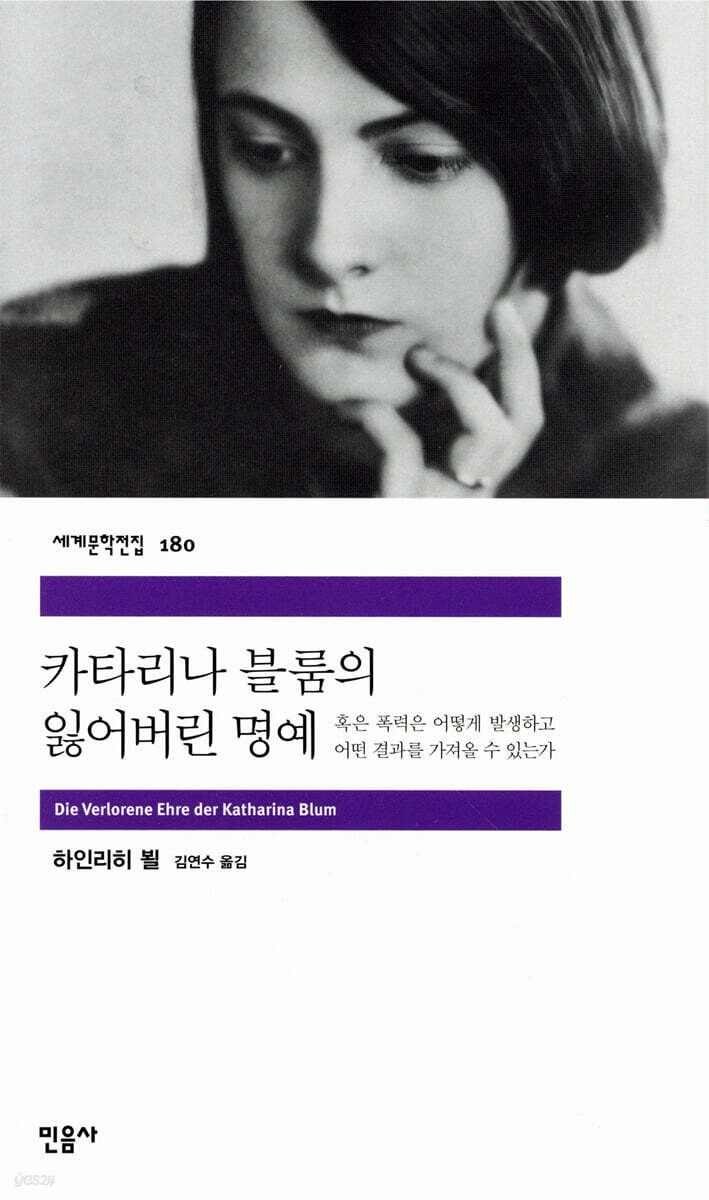
Heinrich Böll's novel, The Lost Honor of Katharina Blum, which sold 150,000 copies in just six weeks after its release and was made into a huge hit film by Volker Schlöndorff, the leader of New German Cinema, has been published as the 180th volume of Minumsa's World Literature Series.
Böll, a writer who faced the spiritual ruins of post-war Germany and always stood on the side of the abused and mercilessly criticized violent power, won the Nobel Prize in Literature in 1972.
The statement of an ordinary woman who lived a hard and simple life Vs.
Media reports that overuse distortion and false information
In this work, Bol brutally shows how sensational media that stimulates the public's vulgar curiosity can destroy an individual's reputation and life.
Returning to the story, on Wednesday, February 20th, before the incident, Katharina Blum meets a man named Goethe at a dance party and spends the night with him.
He was the rare, genuine and affectionate man she had been waiting for.
But the next day, the police raided her house, searched it, and eventually took her away.
Goethe was a bad guy, suspected of bank robbery and murder, and the media and police had been chasing him all along.
Katarina becomes the object of public curiosity when the press reports that she is being questioned by the police and is exercising her right to remain silent.
Katarina is a simple and hard-working woman who was born into a poor family in a rural village, barely finished school, came to the city, and worked as a waitress and housekeeper to save up money to buy a small apartment and a used car.
She strives not to live in debt to others, carries out her assigned tasks perfectly, and is also generous, earning the unconditional trust of those around her.
One day, while living each day to the fullest, she finds out that the man she had a one-night stand with is being chased by the police, and she is taken away by the police and interrogated for the mere fact that she gave him an escape route.
And the news is caught in the eyes of daily newspaper reporter Totges, who is on the hunt for a scoop like a hyena.
She becomes the prey of the persistent scoop hunter, Tötges, and in an instant she becomes a “murderer’s mistress,” a “terrorist collaborator,” and a “lewd communist.”
"Was her apartment a headquarters for the conspiracy, a hideout for the gang, or a place for arms dealing? How did a twenty-seven-year-old housekeeper come to own an apartment worth an estimated 110,000 marks? Was she involved in the distribution of the money stolen from the bank?
The murderer's adopted wife remains stubborn! She's avoiding mention of Goethe's whereabouts! Police on high alert!
Tötges's novel writing does not end here.
In his articles, her father becomes a disguised communist, her mother a shameless criminal who stole church property, and she herself becomes a "whore" who is born "cold and calculating" and who does not hesitate to have affairs with criminals.
But Katharina has no power to refute these fabricated articles, and her honor and dignity are trampled upon.
And what she chose at the edge of that despair was murder.
Amidst a barrage of media reports full of outrageous fabrications and distortions, Katarina continues to calmly give her statement during police questioning.
She refuses to allow inaccurate statements to be included in the report, and remains sensitive throughout the interrogation process, seeking words that are as true as possible.
A similar debate arose over the word “good” in reference to the Blorna couple.
The statement read, “Kind to me,” but Bloom insisted on the word “good.”
When the word "good" was suggested instead, on the grounds that it sounded out of style, she became angry, insisting that kindness and favor had nothing to do with goodness, and that she had perceived the actions of the Blornas toward her as goodness.
Katarina's language, which does not state anything that is not true, stands in stark contrast to the manipulative language of the media, and has a powerful effect.
Even from today's perspective, it is a scene that is not at all unfamiliar.
How far can media violence go? Hence the subtitle of this book: "How Violence Occurs and What Consequences Can It Bring?"
The neglect of those around you and the torrent of insults and criticism from unspecified people
What frustrated Katarina more than the absurd content of Totges's article was the reaction of the world.
“Good” acquaintances who were once close to her testify:
"The priest of Gemmelsbroich stated:
“I believe she can do anything.
Her father was a disguised communist, and her mother, out of pity, let me work as a cleaner for a while, but then she stole some unused wine and had a drinking party with her mistress in the sacristy.”
Her ex-husband, Wilhelm Bretlow, a diligent weaver who divorced her because of Bloom's deliberate departure, was even more willing to give information.
He said, trying to swallow his tears.
“Now I understand.
Why she left me secretly.
… …She wanted to get ahead.
How could an upright and simple worker drive a Porsche? … … When I hear that she preferred the tender caresses of a murderer and robber to my simple affection for her, I still want to appeal to her.
“My dear Katarina, how I wish you were by my side.”
As the old farmer Mepels said, the other members were also horrified and turned away from Katarina.
She said she was always weird and always acting strange.
Moreover, invisible people pour out insulting words to her over the phone and in anonymous letters, and even lump the few people who defend her together and label them as "communists."
The distorted and fabricated news articles written by the media to stimulate the public's vulgar curiosity were the perfect material for the public to mutter and pass the time, and thus Katarina became prey to the people of the world.
This scene, which shows that what is more frightening than the media wielding all power is the gossip of the world, is even more significant in today's age where unreliable information is spread and disseminated in an instant via the Internet.
A flood of rumors and comments surrounding those rumors.
The frightening nature of mob psychology, which buries individuals under the guise of anonymity, remains unchanged even as times change.
A dry and sober report tracing the truth of the incident.
In the afterword to the work and under the title on the cover, Heinrich Böll specifically emphasizes that this work is a 'story' and not a 'novel'.
Translator Kim Yeon-su explains this as follows:
“A ‘story’ allows the speaker to use his or her own life experiences as content, and allows the listener to also have that story as their own experience.
However, with the development of industry and printing, the novel, which became widely distributed, was no longer a story of a solitary individual written in a closet by an isolated writer who could not seek advice from others, and could neither share his experiences with others nor give advice to others… .
"This work is not a text produced independently of world affairs, but rather was written to approach the truth more closely by sharing experiences with readers about a certain realistic situation. Therefore, it can be seen that the author rejects the genre of 'novel' and hopes to be accepted as a 'story', and that he has adopted a work format that suits that intention."
“To share with readers the experience of a realistic situation,” Bol employs a unique narrative format in this work.
It takes the form of a report in which an anonymous speaker appears and reconstructs a murder case based on the information he has investigated and the statements of several witnesses.
As the story of Katarina's murder of a journalist, the final event of the story, is revealed at the beginning of the novel, the reader of this work gradually discovers the gruesome aspects of reality as he or she reads the narrator's report and traces the motive and background of the murder.
A classic that is always cited when discussing the evils of the media.
"The Lost Honor of Katharina Blum" immediately attracted public attention and became a bestseller upon its publication. It was also adapted into a film by German film giant Volker Schlöndorff, and is still a classic that is always cited when discussing the evils of the press.
The reason this work caught the attention of readers is related to the characteristics of Bol's literary world, which is closely intertwined with the discourse of contemporary reality.
Even in the 1970s, when defeated Germany was transforming into a democratic and welfare state, Böll's literary interest remained directed toward those who had been marginalized, humiliated, or insulted by society, and he did not hesitate to speak out with an awakened conscience about social oppression and human rights violations.
In this line of literary interest, Böll did not remain silent about the debate on terrorism and the violence of the media that heated up German society in the 1970s.
Heinrich Böll's work, which addressed the structural violence of the media, a form of violence with a greater ripple effect than any other power, was not only the most progressive and critical work of its time, but it is still very effective in exposing the reality of commercial media that lives and breathes on viewer ratings and circulation sales.
A report on the reputation of an individual who was brutally trampled by the yellow press.
How did the humble Katharina Blum end up committing murder?
On Sunday, February 24, 1974, a reporter for a daily newspaper was murdered.
The murderer is an ordinary 27-year-old woman named Katharina Blum.
She goes to the police on her own two feet and confesses that she shot him to death.
Katarina, a brilliant woman who grew up in difficult circumstances and worked as a housekeeper, took pride in her work, and was always liked by those around her for her honest and sincere attitude, why on earth did she commit murder?
To uncover the truth behind this murder, the narrator reconstructs and reports on her whereabouts over the five days from Wednesday, February 20th to Sunday.
The police interrogation records, information from prosecutors and lawyers, and statements from various witnesses form the basis.
Heinrich Böll's novel, The Lost Honor of Katharina Blum, which sold 150,000 copies in just six weeks after its release and was made into a huge hit film by Volker Schlöndorff, the leader of New German Cinema, has been published as the 180th volume of Minumsa's World Literature Series.
Böll, a writer who faced the spiritual ruins of post-war Germany and always stood on the side of the abused and mercilessly criticized violent power, won the Nobel Prize in Literature in 1972.
The statement of an ordinary woman who lived a hard and simple life Vs.
Media reports that overuse distortion and false information
In this work, Bol brutally shows how sensational media that stimulates the public's vulgar curiosity can destroy an individual's reputation and life.
Returning to the story, on Wednesday, February 20th, before the incident, Katharina Blum meets a man named Goethe at a dance party and spends the night with him.
He was the rare, genuine and affectionate man she had been waiting for.
But the next day, the police raided her house, searched it, and eventually took her away.
Goethe was a bad guy, suspected of bank robbery and murder, and the media and police had been chasing him all along.
Katarina becomes the object of public curiosity when the press reports that she is being questioned by the police and is exercising her right to remain silent.
Katarina is a simple and hard-working woman who was born into a poor family in a rural village, barely finished school, came to the city, and worked as a waitress and housekeeper to save up money to buy a small apartment and a used car.
She strives not to live in debt to others, carries out her assigned tasks perfectly, and is also generous, earning the unconditional trust of those around her.
One day, while living each day to the fullest, she finds out that the man she had a one-night stand with is being chased by the police, and she is taken away by the police and interrogated for the mere fact that she gave him an escape route.
And the news is caught in the eyes of daily newspaper reporter Totges, who is on the hunt for a scoop like a hyena.
She becomes the prey of the persistent scoop hunter, Tötges, and in an instant she becomes a “murderer’s mistress,” a “terrorist collaborator,” and a “lewd communist.”
"Was her apartment a headquarters for the conspiracy, a hideout for the gang, or a place for arms dealing? How did a twenty-seven-year-old housekeeper come to own an apartment worth an estimated 110,000 marks? Was she involved in the distribution of the money stolen from the bank?
The murderer's adopted wife remains stubborn! She's avoiding mention of Goethe's whereabouts! Police on high alert!
Tötges's novel writing does not end here.
In his articles, her father becomes a disguised communist, her mother a shameless criminal who stole church property, and she herself becomes a "whore" who is born "cold and calculating" and who does not hesitate to have affairs with criminals.
But Katharina has no power to refute these fabricated articles, and her honor and dignity are trampled upon.
And what she chose at the edge of that despair was murder.
Amidst a barrage of media reports full of outrageous fabrications and distortions, Katarina continues to calmly give her statement during police questioning.
She refuses to allow inaccurate statements to be included in the report, and remains sensitive throughout the interrogation process, seeking words that are as true as possible.
A similar debate arose over the word “good” in reference to the Blorna couple.
The statement read, “Kind to me,” but Bloom insisted on the word “good.”
When the word "good" was suggested instead, on the grounds that it sounded out of style, she became angry, insisting that kindness and favor had nothing to do with goodness, and that she had perceived the actions of the Blornas toward her as goodness.
Katarina's language, which does not state anything that is not true, stands in stark contrast to the manipulative language of the media, and has a powerful effect.
Even from today's perspective, it is a scene that is not at all unfamiliar.
How far can media violence go? Hence the subtitle of this book: "How Violence Occurs and What Consequences Can It Bring?"
The neglect of those around you and the torrent of insults and criticism from unspecified people
What frustrated Katarina more than the absurd content of Totges's article was the reaction of the world.
“Good” acquaintances who were once close to her testify:
"The priest of Gemmelsbroich stated:
“I believe she can do anything.
Her father was a disguised communist, and her mother, out of pity, let me work as a cleaner for a while, but then she stole some unused wine and had a drinking party with her mistress in the sacristy.”
Her ex-husband, Wilhelm Bretlow, a diligent weaver who divorced her because of Bloom's deliberate departure, was even more willing to give information.
He said, trying to swallow his tears.
“Now I understand.
Why she left me secretly.
… …She wanted to get ahead.
How could an upright and simple worker drive a Porsche? … … When I hear that she preferred the tender caresses of a murderer and robber to my simple affection for her, I still want to appeal to her.
“My dear Katarina, how I wish you were by my side.”
As the old farmer Mepels said, the other members were also horrified and turned away from Katarina.
She said she was always weird and always acting strange.
Moreover, invisible people pour out insulting words to her over the phone and in anonymous letters, and even lump the few people who defend her together and label them as "communists."
The distorted and fabricated news articles written by the media to stimulate the public's vulgar curiosity were the perfect material for the public to mutter and pass the time, and thus Katarina became prey to the people of the world.
This scene, which shows that what is more frightening than the media wielding all power is the gossip of the world, is even more significant in today's age where unreliable information is spread and disseminated in an instant via the Internet.
A flood of rumors and comments surrounding those rumors.
The frightening nature of mob psychology, which buries individuals under the guise of anonymity, remains unchanged even as times change.
A dry and sober report tracing the truth of the incident.
In the afterword to the work and under the title on the cover, Heinrich Böll specifically emphasizes that this work is a 'story' and not a 'novel'.
Translator Kim Yeon-su explains this as follows:
“A ‘story’ allows the speaker to use his or her own life experiences as content, and allows the listener to also have that story as their own experience.
However, with the development of industry and printing, the novel, which became widely distributed, was no longer a story of a solitary individual written in a closet by an isolated writer who could not seek advice from others, and could neither share his experiences with others nor give advice to others… .
"This work is not a text produced independently of world affairs, but rather was written to approach the truth more closely by sharing experiences with readers about a certain realistic situation. Therefore, it can be seen that the author rejects the genre of 'novel' and hopes to be accepted as a 'story', and that he has adopted a work format that suits that intention."
“To share with readers the experience of a realistic situation,” Bol employs a unique narrative format in this work.
It takes the form of a report in which an anonymous speaker appears and reconstructs a murder case based on the information he has investigated and the statements of several witnesses.
As the story of Katarina's murder of a journalist, the final event of the story, is revealed at the beginning of the novel, the reader of this work gradually discovers the gruesome aspects of reality as he or she reads the narrator's report and traces the motive and background of the murder.
A classic that is always cited when discussing the evils of the media.
"The Lost Honor of Katharina Blum" immediately attracted public attention and became a bestseller upon its publication. It was also adapted into a film by German film giant Volker Schlöndorff, and is still a classic that is always cited when discussing the evils of the press.
The reason this work caught the attention of readers is related to the characteristics of Bol's literary world, which is closely intertwined with the discourse of contemporary reality.
Even in the 1970s, when defeated Germany was transforming into a democratic and welfare state, Böll's literary interest remained directed toward those who had been marginalized, humiliated, or insulted by society, and he did not hesitate to speak out with an awakened conscience about social oppression and human rights violations.
In this line of literary interest, Böll did not remain silent about the debate on terrorism and the violence of the media that heated up German society in the 1970s.
Heinrich Böll's work, which addressed the structural violence of the media, a form of violence with a greater ripple effect than any other power, was not only the most progressive and critical work of its time, but it is still very effective in exposing the reality of commercial media that lives and breathes on viewer ratings and circulation sales.
GOODS SPECIFICS
- Date of issue: May 30, 2008
- Page count, weight, size: 170 pages | 268g | 132*223*20mm
- ISBN13: 9788937461804
- ISBN10: 8937461803
You may also like
카테고리
korean


korean

![ELLE 엘르 스페셜 에디션 A형 : 12월 [2025]](http://librairie.coreenne.fr/cdn/shop/files/b8e27a3de6c9538896439686c6b0e8fb.jpg?v=1766436872&width=3840)


