

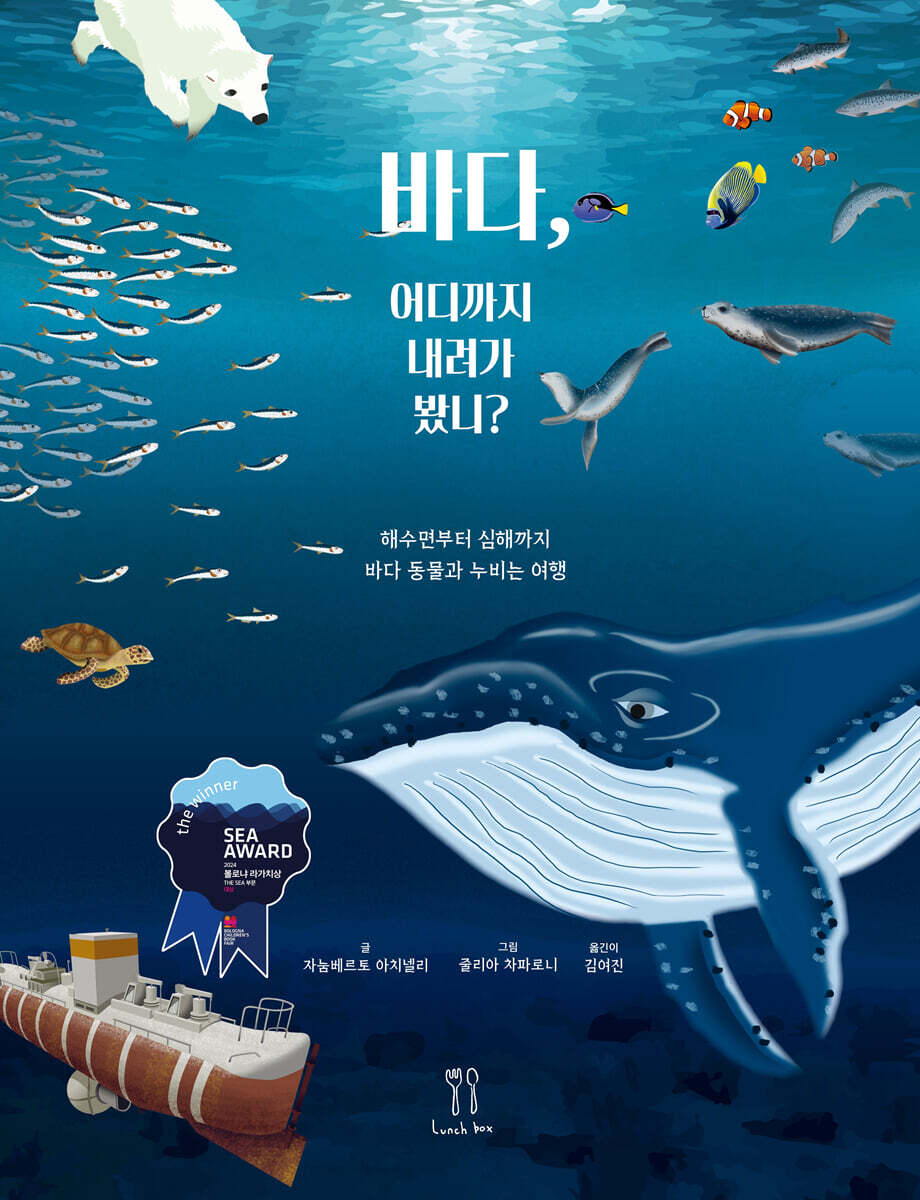
Sea, how far down have you been?
 |
Description
Book Introduction
A journey with marine life from the surface to the depths!
From the sunlit shallows to the darkest depths, peer into every nook and cranny, including emperor penguins, giant squid, submarines, blue whales, black devils, and ocean ridges.
Let's explore the world from the vibrant realm of life to the depths of the ocean, where only silence and solitude await. Our final destination is the Mariana Trench, located 10,920 meters below the surface.
A complete ocean guide for children and adults in one volume
Winner of the 2023 Bologna Ragazzi Award in the Nonfiction category!
You can tell just by the brightness of the water and the increasingly deepening blue, but the ocean depth is marked in meters on each page, so you can quickly find out where the marine life lives!!
"How Far Have You Going Down the Sea?" is a new and unique book.
The story includes the ocean where life began, the bizarre marine life that lives within it, the crumbling ecosystem, the submarine Trieste that descended deep into the ocean, and even the Mariana Trench, a deep valley under the sea.
The ocean, which we have only known fragmentarily until now, is organized into this one book.
In addition, it divides the sea into different zones and explains their characteristics.
Next to each page, the depth of the sea is indicated in meters and 78 representative species of fish are drawn to show what sea creatures live there.
Polar bears, emperor penguins, giant squid, sperm whales, dumbo octopuses, ghost fish… … .
Looking at the picture, it feels like I'm wearing a diving suit and exploring the ocean.
The 'Find the Animal' section at the very end is also fun.
From the sunlit shallows to the darkest depths, peer into every nook and cranny, including emperor penguins, giant squid, submarines, blue whales, black devils, and ocean ridges.
Let's explore the world from the vibrant realm of life to the depths of the ocean, where only silence and solitude await. Our final destination is the Mariana Trench, located 10,920 meters below the surface.
A complete ocean guide for children and adults in one volume
Winner of the 2023 Bologna Ragazzi Award in the Nonfiction category!
You can tell just by the brightness of the water and the increasingly deepening blue, but the ocean depth is marked in meters on each page, so you can quickly find out where the marine life lives!!
"How Far Have You Going Down the Sea?" is a new and unique book.
The story includes the ocean where life began, the bizarre marine life that lives within it, the crumbling ecosystem, the submarine Trieste that descended deep into the ocean, and even the Mariana Trench, a deep valley under the sea.
The ocean, which we have only known fragmentarily until now, is organized into this one book.
In addition, it divides the sea into different zones and explains their characteristics.
Next to each page, the depth of the sea is indicated in meters and 78 representative species of fish are drawn to show what sea creatures live there.
Polar bears, emperor penguins, giant squid, sperm whales, dumbo octopuses, ghost fish… … .
Looking at the picture, it feels like I'm wearing a diving suit and exploring the ocean.
The 'Find the Animal' section at the very end is also fun.
- You can preview some of the book's contents.
Preview
index
From here
Go down
Before we begin: Introduction
800 meters below: (plastic)
Below 8,000 meters: (The disappearing diversity of marine life)
Before you go: Find all the sea creatures in the world (Animal Spotting)
0-200m surface water zone
white bear
daegu
Green slimy sea squirt
pike
Clownfish
200~1,000m central seawater zone
Emperor penguin
coelacanth
Snow crab
Humans (Homo sapiens)
Oarfish
1,000~4,000m lunch seawater zone
Monodont
giant squid
sperm whale
Chiasmodon
viperfish
4,000~6,000m deep-sea zone
zombie bug
Dumbo octopus
faceless clown
Ghost meat
Atola jellyfish
Ultra-deep seabed zone of 6,000 to 110,920 m
Aluminum shrimp
Rattail fish
Mariana Komchi
eutherian or comb jelly
Deep-sea submersible Trieste
Go down
Before we begin: Introduction
800 meters below: (plastic)
Below 8,000 meters: (The disappearing diversity of marine life)
Before you go: Find all the sea creatures in the world (Animal Spotting)
0-200m surface water zone
white bear
daegu
Green slimy sea squirt
pike
Clownfish
200~1,000m central seawater zone
Emperor penguin
coelacanth
Snow crab
Humans (Homo sapiens)
Oarfish
1,000~4,000m lunch seawater zone
Monodont
giant squid
sperm whale
Chiasmodon
viperfish
4,000~6,000m deep-sea zone
zombie bug
Dumbo octopus
faceless clown
Ghost meat
Atola jellyfish
Ultra-deep seabed zone of 6,000 to 110,920 m
Aluminum shrimp
Rattail fish
Mariana Komchi
eutherian or comb jelly
Deep-sea submersible Trieste
Detailed image

Into the book
“Millions of years ago, comets roamed deep space.
After a long journey, these comets encountered a young planet with no atmosphere or other barriers.
Needless to say, these comets shook the Earth's surface violently.”
--- From the text
“Comets and magma plumes actually contained unique substances.
It's water.
In this way, the Earth became a planet that embraced the primordial ocean, and became the blue Earth we see today.”
--- From the text
“Where there is light, plants grow, and where there are plants, there is photosynthesis.
Where there is photosynthesis, there is life.
“So the most diverse life forms live in the lower intertidal zone of the ocean.”
--- From the text
“The polar bear is the largest predator on land.
However, they swim slowly and are not good at diving.
So what's it doing underwater right now? This mammal can confidently be called an aquatic animal.
They jump into the Arctic Ocean and swim up to 30 kilometers a day.
“Why do we do this?”
--- From the text
“The home of the clownfish is among the slippery, poisonous tentacles of the sea anemone.
The sea anemone lives on the rocks of the tropical sea.”
--- From the text
“Sea serpents have always appeared in the legends of sailors.
But in June 2008, this strange tale was put to rest by the discovery of a giant 'saltfish' that actually appeared.”
--- From the text
“Jellyfish mainly live near the surface of the sea, but there are some that prefer the deep seabed.
It's the Atola jellyfish.
This animal uses its bioluminescent organs to illuminate the sea.”
--- From the text
“Hades actually means ‘invisible,’ and in reality, very few people have ever descended to this deep-sea zone.
“There are exactly three people.”
--- From the text
“You have reached a depth equivalent to the height of Mount Everest (8,848 meters).”
After a long journey, these comets encountered a young planet with no atmosphere or other barriers.
Needless to say, these comets shook the Earth's surface violently.”
--- From the text
“Comets and magma plumes actually contained unique substances.
It's water.
In this way, the Earth became a planet that embraced the primordial ocean, and became the blue Earth we see today.”
--- From the text
“Where there is light, plants grow, and where there are plants, there is photosynthesis.
Where there is photosynthesis, there is life.
“So the most diverse life forms live in the lower intertidal zone of the ocean.”
--- From the text
“The polar bear is the largest predator on land.
However, they swim slowly and are not good at diving.
So what's it doing underwater right now? This mammal can confidently be called an aquatic animal.
They jump into the Arctic Ocean and swim up to 30 kilometers a day.
“Why do we do this?”
--- From the text
“The home of the clownfish is among the slippery, poisonous tentacles of the sea anemone.
The sea anemone lives on the rocks of the tropical sea.”
--- From the text
“Sea serpents have always appeared in the legends of sailors.
But in June 2008, this strange tale was put to rest by the discovery of a giant 'saltfish' that actually appeared.”
--- From the text
“Jellyfish mainly live near the surface of the sea, but there are some that prefer the deep seabed.
It's the Atola jellyfish.
This animal uses its bioluminescent organs to illuminate the sea.”
--- From the text
“Hades actually means ‘invisible,’ and in reality, very few people have ever descended to this deep-sea zone.
“There are exactly three people.”
--- From the text
“You have reached a depth equivalent to the height of Mount Everest (8,848 meters).”
--- From the text
Publisher's Review
After reading this book, the ocean looks different.
Author Giannimberto Accinelli explains the history of the universe starting with the Big Bang, the birth of life in the ocean, and the exciting stories that followed in a concise and entertaining way.
Julia Zapparoni, an artist who beautifully and meticulously depicts underwater landscapes and the marine life swimming leisurely through them.
There have been many books published about the ocean and marine life, but when you open this book, you will be captivated by the new world of the ocean, and you will wonder, "Why did this book come out so soon?"
It divides the ocean floor into the surface, mid-ocean, mid-ocean, deep-ocean, and deep-ocean zones according to depth, and explains the characteristics of each zone and the marine life that lives there, providing food for thought about the ocean that we humans have studied, explored, learned about, and must preserve together.
This is a great book for adults to read first and then read with children, and it is also great for children to read over and over again as if they were playing a quiz game.
The sea is scary when you don't know it well, but it becomes friendly when you know it. If you have any questions, just ask.
From the surface waters (0-200 meters) to 50 meters below, sunlight shines, photosynthesis occurs, and above all, a wide variety of animals and plants exist.
In the mid-ocean zone (200-1,000 meters deep), we must now forget about the sunlight that used to penetrate the blue sea water.
Although there is no such thing as a faint dawn in the central ocean, we can still encounter many animals in this dark sea.
But plants do not exist.
So how can deep-sea creatures survive without plants?
The waters offshore, far from the swimmers, become unimaginably deep.
The first deep-sea layer, the nocturnal zone (1,000–4,000 meters deep), has low salinity and virtually no light.
The water temperature is low at around 4 degrees, it is difficult to find food, and above all, it is as quiet as space.
What kind of creatures are there here?
The word 'abyss', which refers to the deep sea floor (4,000 to 6,000 meters deep), comes from Greek and means 'bottomless'.
The environment here is harsh, but despite this, life triumphs even in this dark place.
The mysteries of the deep-sea zone (6,000–10,920 meters deep) remain unsolved for several reasons.
The environment of the deep-sea zone is similar to that of the mid-ocean zone, but a little harsher.
The water density and pressure are higher, and the probability of food being present is very low.
But even in this hellish sea, life lives, breathes, and expands its territory.
Some scientists say that the presence of life in such harsh environments in the deep sea suggests that there is a high possibility that life exists on other planets in the solar system.
Let's go to the deep seabed, where there are alien-like creatures and the Mariana Trench, a valley on the ocean floor.
Author Giannimberto Accinelli explains the history of the universe starting with the Big Bang, the birth of life in the ocean, and the exciting stories that followed in a concise and entertaining way.
Julia Zapparoni, an artist who beautifully and meticulously depicts underwater landscapes and the marine life swimming leisurely through them.
There have been many books published about the ocean and marine life, but when you open this book, you will be captivated by the new world of the ocean, and you will wonder, "Why did this book come out so soon?"
It divides the ocean floor into the surface, mid-ocean, mid-ocean, deep-ocean, and deep-ocean zones according to depth, and explains the characteristics of each zone and the marine life that lives there, providing food for thought about the ocean that we humans have studied, explored, learned about, and must preserve together.
This is a great book for adults to read first and then read with children, and it is also great for children to read over and over again as if they were playing a quiz game.
The sea is scary when you don't know it well, but it becomes friendly when you know it. If you have any questions, just ask.
From the surface waters (0-200 meters) to 50 meters below, sunlight shines, photosynthesis occurs, and above all, a wide variety of animals and plants exist.
In the mid-ocean zone (200-1,000 meters deep), we must now forget about the sunlight that used to penetrate the blue sea water.
Although there is no such thing as a faint dawn in the central ocean, we can still encounter many animals in this dark sea.
But plants do not exist.
So how can deep-sea creatures survive without plants?
The waters offshore, far from the swimmers, become unimaginably deep.
The first deep-sea layer, the nocturnal zone (1,000–4,000 meters deep), has low salinity and virtually no light.
The water temperature is low at around 4 degrees, it is difficult to find food, and above all, it is as quiet as space.
What kind of creatures are there here?
The word 'abyss', which refers to the deep sea floor (4,000 to 6,000 meters deep), comes from Greek and means 'bottomless'.
The environment here is harsh, but despite this, life triumphs even in this dark place.
The mysteries of the deep-sea zone (6,000–10,920 meters deep) remain unsolved for several reasons.
The environment of the deep-sea zone is similar to that of the mid-ocean zone, but a little harsher.
The water density and pressure are higher, and the probability of food being present is very low.
But even in this hellish sea, life lives, breathes, and expands its territory.
Some scientists say that the presence of life in such harsh environments in the deep sea suggests that there is a high possibility that life exists on other planets in the solar system.
Let's go to the deep seabed, where there are alien-like creatures and the Mariana Trench, a valley on the ocean floor.
GOODS SPECIFICS
- Date of issue: November 1, 2024
- Format: Hardcover book binding method guide
- Page count, weight, size: 80 pages | 225*293*15mm
- ISBN13: 9791197534379
- ISBN10: 1197534377
- KC Certification: Certification Type: Conformity Confirmation
You may also like
카테고리
korean


korean

![GQ KOREA Mark (Monthly): December [2025]](http://librairie.coreenne.fr/cdn/shop/files/8ef265dbbfbf186523ed75ba7319009d.jpg?v=1765340328&width=3840)


