

A Midsummer Night's Dream
 |
Description
Book Introduction
A Midsummer Night's Dream, one of Shakespeare's four major comedies, has been consistently performed and loved by the public due to its many dreams and fantastical elements.
Disregarding her father Egeus's expectations that she marry Demetrius, Hermia runs away to Oberon's forest with her chosen one, Lysander. Demetrius follows Hermia, and Helena follows Lysander to Oberon's forest as well.
Meanwhile, Oberon, the king of the fairies, sends his subordinate Puck on an errand to tease Queen Titania, but Puck's mistake causes Lysander and Demetrius, who had been drawn to Hermia, to suddenly turn their hearts toward Helena.
Titania also falls in love with the horse-clad Bartholomew and serves him.
In this twisted situation, a commotion breaks out, and Puck finally intervenes again, bringing the three couples to a happy ending.
Shakespeare, with his outstanding ability to create comedy, humorously portrayed the commotion caused by the young man and woman shedding tears over their misguided love and the fairies casting spells on them.
The master's overflowing imagination opens up an optimistic and hopeful world for readers through the protagonists who, after going through a period of hardship, find true love.
Furthermore, the translator meticulously reviewed numerous editions to ensure that the translation was in the original verse form in which Shakespeare wrote, and the translator's efforts to reflect Shakespeare's linguistic characteristics have made Shakespeare's characteristics more distinct.
Disregarding her father Egeus's expectations that she marry Demetrius, Hermia runs away to Oberon's forest with her chosen one, Lysander. Demetrius follows Hermia, and Helena follows Lysander to Oberon's forest as well.
Meanwhile, Oberon, the king of the fairies, sends his subordinate Puck on an errand to tease Queen Titania, but Puck's mistake causes Lysander and Demetrius, who had been drawn to Hermia, to suddenly turn their hearts toward Helena.
Titania also falls in love with the horse-clad Bartholomew and serves him.
In this twisted situation, a commotion breaks out, and Puck finally intervenes again, bringing the three couples to a happy ending.
Shakespeare, with his outstanding ability to create comedy, humorously portrayed the commotion caused by the young man and woman shedding tears over their misguided love and the fairies casting spells on them.
The master's overflowing imagination opens up an optimistic and hopeful world for readers through the protagonists who, after going through a period of hardship, find true love.
Furthermore, the translator meticulously reviewed numerous editions to ensure that the translation was in the original verse form in which Shakespeare wrote, and the translator's efforts to reflect Shakespeare's linguistic characteristics have made Shakespeare's characteristics more distinct.
- You can preview some of the book's contents.
Preview
Publisher's Review
The forest of Oberon, ruled by darkness, moon, and the magic of fantasy,
Another magical world unfolds through sleep, dreams, desires, and imagination.
A delightful commotion between lovers seeking true love, one of Shakespeare's four major comedies.
“Shakespeare's first masterpiece, without a single flaw.” —Harold Bloom
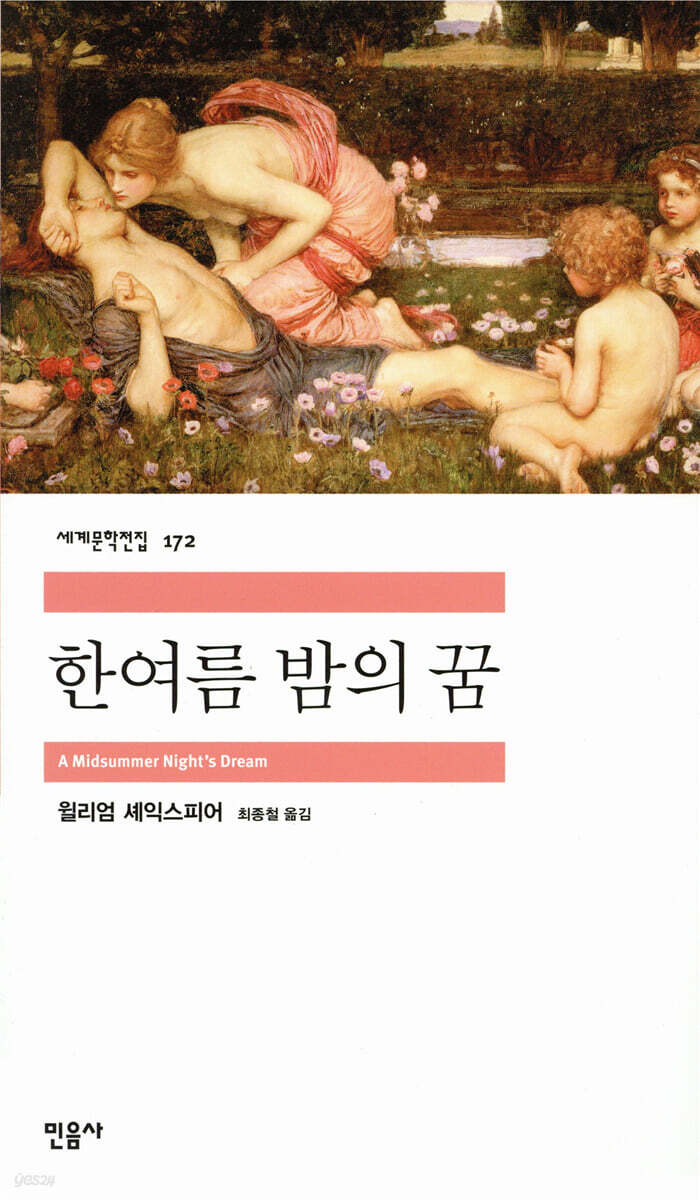
A Midsummer Night's Dream, one of Shakespeare's four major comedies, was published as volume 172 in Minumsa's World Literature Collection.
This play, which is one of Shakespeare's early works, has been consistently performed and loved by the public due to its many dreamlike and fantastical elements.
Shakespeare, with his outstanding ability to create comedy, humorously portrayed the commotion caused by the young man and woman shedding tears over their misguided love and the fairies casting spells on them.
The master's overflowing imagination opens up an optimistic and hopeful world for readers through the protagonists who, after going through a period of hardship, find true love.
Additionally, the recently published 『A Midsummer Night's Dream』 is significant in that it was translated in the original verse form in which Shakespeare wrote it.
Professor Choi Jong-cheol of Yonsei University's English Department, who translated all of Shakespeare's four major tragedies into verse, also translated this work into verse, preserving the Korean rhythm.
The first domestic verse translation by Shakespearean scholar Professor Choi Jong-cheol
A lively rhythm that reflects the characteristics of the play
The recently published 『A Midsummer Night's Dream』 is presented in verse translation by Professor Choi Jong-cheol (English Literature, Yonsei University), who has translated all four of Shakespeare's major tragedies: 『Hamlet』, 『Othello』, 『Macbeth』, and 『King Lear』.
Like his previous works, A Midsummer Night's Dream was also translated into verse exactly as Shakespeare wrote it.
Professor Choi Jong-cheol meticulously reviewed numerous editions to reflect Shakespeare's linguistic characteristics and expressed the original text in Korean as naturally as possible.
Shakespeare's dialogue consists of both verse and prose.
Except for some comedic scenes, dialogues by low-status characters, vulgar content, or prose used to express mental disorders, most of the poetry is in a verse form called iambic pentameter blank verse.
Professor Choi Jong-cheol, when translating these lines into Korean, limited each line to about 16 characters and used a verse format that maintained a 3-4 verse or a modified version of it.
The translator believes that this is “the most effective way to convey the various characteristics of the poetic lines of Shakespeare’s plays, especially their musicality.”
As a result of this translation, readers can also feel the rhythm of the poetry when they read the lines out loud.
Moreover, the rhythm between the lines is so vivid that it would be perfectly fine to use this book as a play script.
The translation of A Midsummer Night's Dream is considered to be the most faithful to Shakespeare's original text by the British Arden Shakespeare.
Harold F. Brooks
Based on the work of Blakemore Evans (G. Brooks, ed.)
It was completed by comparing and reviewing The Riverside Shakespeare, edited by Blakemore Evans, and the New Penguin Shakespeare, edited by Stanley Wells.
In addition, by providing detailed footnotes explaining meanings that can vary depending on interpretation, it helps to provide a deeper understanding of Shakespeare.
Additionally, to reflect the performance practices of Shakespeare's time as much as possible, only the act and scene numbers are indicated at the beginning of the scene, and the stage of each scene is specified.
A delightful commotion between lovers searching for true love.
A Midsummer Night's Dream is one of Shakespeare's most beloved plays, completed between 1595 and 1596.
This work, which fully demonstrates Shakespeare's ability to create delightful comedies, is called one of Shakespeare's four great comedies, along with The Taming of the Shrew, As You Like It, and Twelfth Night.
The person Hermia chose, disobeying her father Egeus's expectations of marrying Demetrius, was Lysander.
The two secretly escape to Oberon's Forest.
Demetrius follows Hermia, and Helena follows Lysander, both coming to Oberon's forest.
Meanwhile, Oberon, the king of the fairies, sends his subordinate Puck on an errand to tease Queen Titania.
However, due to Puck's mistake, Lysander and Demetrius' hearts, which had been directed towards Hermia, suddenly turn towards Helena.
Titania also falls in love with the horse-clad Bartholomew and serves him.
In this twisted situation, a commotion breaks out, and Puck finally intervenes again, bringing the three couples to a happy ending.
One interesting fact is that while Shakespeare was writing such a delightful comedy, he also wrote Romeo and Juliet, a tragic love story.
The story of "Pyramus and Thisbe," a play within a play that appears in "A Midsummer Night's Dream," is the story of Romeo and Juliet.
So it is no coincidence that the content of the two works overlaps somewhat.
In both works, the true love of the main characters encounters opposition from their families and faces desperate situations.
Another thing that both works have in common is that their theme is true love, a theme that Shakespeare has consistently pursued in his works.
Another magical world unfolds through sleep, dreams, desires, and imagination.
A delightful commotion between lovers seeking true love, one of Shakespeare's four major comedies.
“Shakespeare's first masterpiece, without a single flaw.” —Harold Bloom
A Midsummer Night's Dream, one of Shakespeare's four major comedies, was published as volume 172 in Minumsa's World Literature Collection.
This play, which is one of Shakespeare's early works, has been consistently performed and loved by the public due to its many dreamlike and fantastical elements.
Shakespeare, with his outstanding ability to create comedy, humorously portrayed the commotion caused by the young man and woman shedding tears over their misguided love and the fairies casting spells on them.
The master's overflowing imagination opens up an optimistic and hopeful world for readers through the protagonists who, after going through a period of hardship, find true love.
Additionally, the recently published 『A Midsummer Night's Dream』 is significant in that it was translated in the original verse form in which Shakespeare wrote it.
Professor Choi Jong-cheol of Yonsei University's English Department, who translated all of Shakespeare's four major tragedies into verse, also translated this work into verse, preserving the Korean rhythm.
The first domestic verse translation by Shakespearean scholar Professor Choi Jong-cheol
A lively rhythm that reflects the characteristics of the play
The recently published 『A Midsummer Night's Dream』 is presented in verse translation by Professor Choi Jong-cheol (English Literature, Yonsei University), who has translated all four of Shakespeare's major tragedies: 『Hamlet』, 『Othello』, 『Macbeth』, and 『King Lear』.
Like his previous works, A Midsummer Night's Dream was also translated into verse exactly as Shakespeare wrote it.
Professor Choi Jong-cheol meticulously reviewed numerous editions to reflect Shakespeare's linguistic characteristics and expressed the original text in Korean as naturally as possible.
Shakespeare's dialogue consists of both verse and prose.
Except for some comedic scenes, dialogues by low-status characters, vulgar content, or prose used to express mental disorders, most of the poetry is in a verse form called iambic pentameter blank verse.
Professor Choi Jong-cheol, when translating these lines into Korean, limited each line to about 16 characters and used a verse format that maintained a 3-4 verse or a modified version of it.
The translator believes that this is “the most effective way to convey the various characteristics of the poetic lines of Shakespeare’s plays, especially their musicality.”
As a result of this translation, readers can also feel the rhythm of the poetry when they read the lines out loud.
Moreover, the rhythm between the lines is so vivid that it would be perfectly fine to use this book as a play script.
The translation of A Midsummer Night's Dream is considered to be the most faithful to Shakespeare's original text by the British Arden Shakespeare.
Harold F. Brooks
Based on the work of Blakemore Evans (G. Brooks, ed.)
It was completed by comparing and reviewing The Riverside Shakespeare, edited by Blakemore Evans, and the New Penguin Shakespeare, edited by Stanley Wells.
In addition, by providing detailed footnotes explaining meanings that can vary depending on interpretation, it helps to provide a deeper understanding of Shakespeare.
Additionally, to reflect the performance practices of Shakespeare's time as much as possible, only the act and scene numbers are indicated at the beginning of the scene, and the stage of each scene is specified.
A delightful commotion between lovers searching for true love.
A Midsummer Night's Dream is one of Shakespeare's most beloved plays, completed between 1595 and 1596.
This work, which fully demonstrates Shakespeare's ability to create delightful comedies, is called one of Shakespeare's four great comedies, along with The Taming of the Shrew, As You Like It, and Twelfth Night.
The person Hermia chose, disobeying her father Egeus's expectations of marrying Demetrius, was Lysander.
The two secretly escape to Oberon's Forest.
Demetrius follows Hermia, and Helena follows Lysander, both coming to Oberon's forest.
Meanwhile, Oberon, the king of the fairies, sends his subordinate Puck on an errand to tease Queen Titania.
However, due to Puck's mistake, Lysander and Demetrius' hearts, which had been directed towards Hermia, suddenly turn towards Helena.
Titania also falls in love with the horse-clad Bartholomew and serves him.
In this twisted situation, a commotion breaks out, and Puck finally intervenes again, bringing the three couples to a happy ending.
One interesting fact is that while Shakespeare was writing such a delightful comedy, he also wrote Romeo and Juliet, a tragic love story.
The story of "Pyramus and Thisbe," a play within a play that appears in "A Midsummer Night's Dream," is the story of Romeo and Juliet.
So it is no coincidence that the content of the two works overlaps somewhat.
In both works, the true love of the main characters encounters opposition from their families and faces desperate situations.
Another thing that both works have in common is that their theme is true love, a theme that Shakespeare has consistently pursued in his works.
GOODS SPECIFICS
- Date of issue: February 28, 2008
- Page count, weight, size: 139 pages | 220g | 132*224*20mm
- ISBN13: 9788937461729
- ISBN10: 8937461722
You may also like
카테고리
korean


korean

![GQ KOREA Mark (Monthly): December [2025]](http://librairie.coreenne.fr/cdn/shop/files/8ef265dbbfbf186523ed75ba7319009d.jpg?v=1765340328&width=3840)


