

All Days of the Week (100,000-Copy Commemorative Recover Edition)
 |
Description
Book Introduction
Bestselling essay series "Record of Every Day of the Week" and "Travel of Every Day of the Week"
Recover edition published to commemorate sales of 100,000 copies!
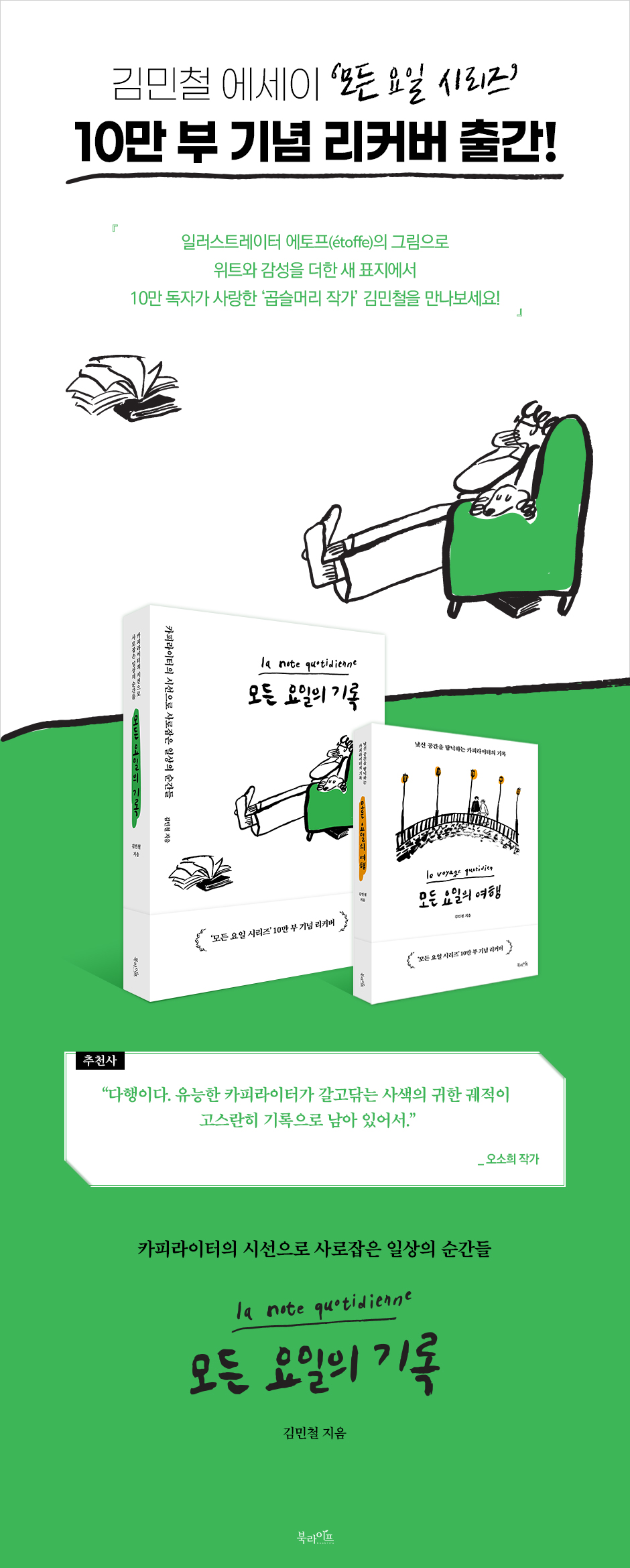
『Record of Every Day of the Week』, which has been consistently loved by readers since its publication in 2015 and has become a steady seller, and 『Travel of Every Day of the Week』, which was published in 2016, have been reborn as a recovered edition to commemorate exceeding 100,000 copies sold.
If author Kim Min-cheol's first essay, "Record of Every Day of the Week," shows the perspective of a copywriter who nurtures the seeds of ideas in everyday life in simple and truthful sentences, then his subsequent essay, "Travel of Every Day of the Week," is a book that allows one to fully experience the heart of a traveler who searches for "myself" in the cracks of an unfamiliar life.
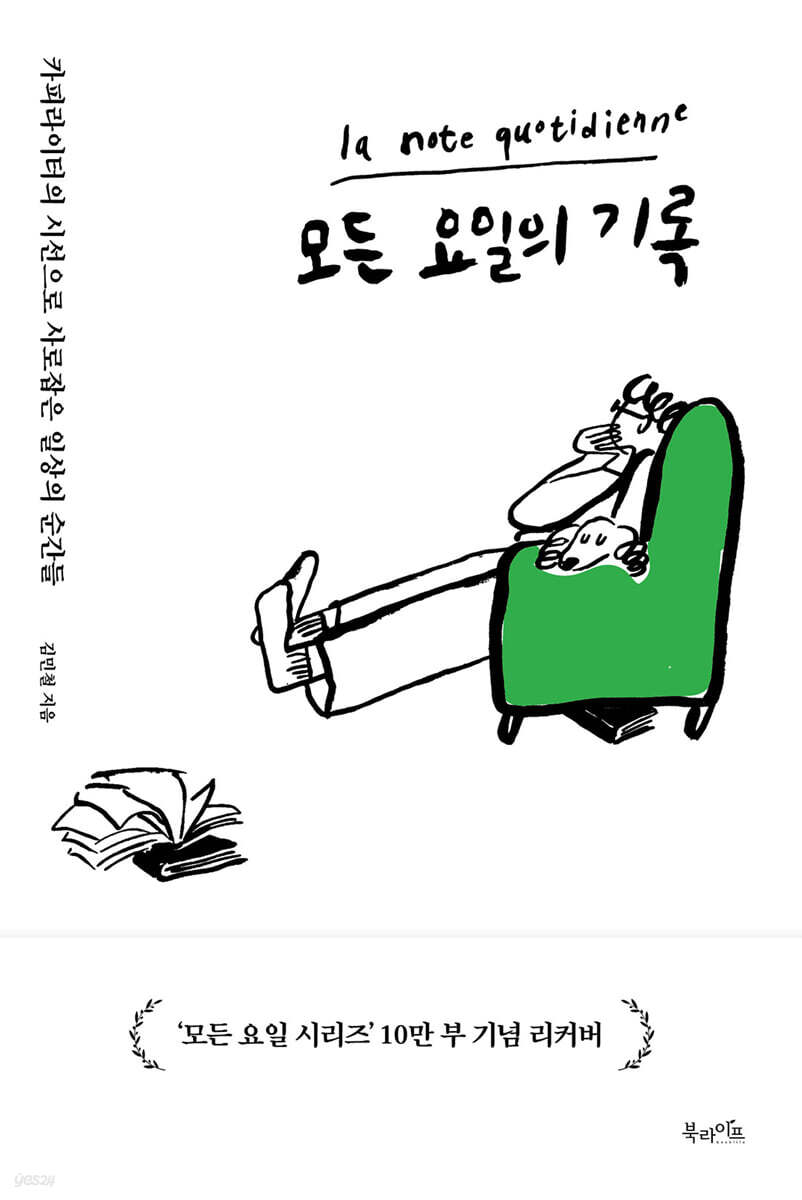
The cover of the Recover Edition features a drawing by illustrator etoffe, adding wit and a comfortable sensibility reminiscent of the image of 'curly-haired author' Kim Min-cheol.
Even now, six years after its publication, 『Record of Every Day of the Week』, which is still loved by many readers, is a book that provides a glimpse into the daily life of a copywriter who “uses hundreds of senses and memories to compose a single sentence.”
The author, a copywriter at TBWA KOREA, Korea's largest independent advertising agency and the forefront of creativity, shares his unique record-keeping methods, adding excitement and joy to our stagnant daily lives.
I have the ability to read the same passage hundreds of times and still forget it.
This is no exaggeration.
She says, “I am a copywriter who cannot memorize even a single line of copy that I write,” and she overcame all these adverse conditions with her sincere ‘record keeping.’
And this book meticulously depicts the process by which a copywriter with 17 years of experience develops ideas.
Recover edition published to commemorate sales of 100,000 copies!
『Record of Every Day of the Week』, which has been consistently loved by readers since its publication in 2015 and has become a steady seller, and 『Travel of Every Day of the Week』, which was published in 2016, have been reborn as a recovered edition to commemorate exceeding 100,000 copies sold.
If author Kim Min-cheol's first essay, "Record of Every Day of the Week," shows the perspective of a copywriter who nurtures the seeds of ideas in everyday life in simple and truthful sentences, then his subsequent essay, "Travel of Every Day of the Week," is a book that allows one to fully experience the heart of a traveler who searches for "myself" in the cracks of an unfamiliar life.
The cover of the Recover Edition features a drawing by illustrator etoffe, adding wit and a comfortable sensibility reminiscent of the image of 'curly-haired author' Kim Min-cheol.
Even now, six years after its publication, 『Record of Every Day of the Week』, which is still loved by many readers, is a book that provides a glimpse into the daily life of a copywriter who “uses hundreds of senses and memories to compose a single sentence.”
The author, a copywriter at TBWA KOREA, Korea's largest independent advertising agency and the forefront of creativity, shares his unique record-keeping methods, adding excitement and joy to our stagnant daily lives.
I have the ability to read the same passage hundreds of times and still forget it.
This is no exaggeration.
She says, “I am a copywriter who cannot memorize even a single line of copy that I write,” and she overcame all these adverse conditions with her sincere ‘record keeping.’
And this book meticulously depicts the process by which a copywriter with 17 years of experience develops ideas.
- You can preview some of the book's contents.
Preview
index
Prologue / On the Usefulness of All My Records
Chapter 1: Reading: A Record of Life
read
Forever New Bookshelf
Romantic misunderstanding
Each person's truth
Tragedy teaches us a positive attitude
Just being born that way
Minimum courtesy for everyday life
Be happy here and now
Chapter 2: Listening: A Record of Emotions
listen
My favorite place in Lisbon
Music as big as a chest of drawers
Distortion of the senses, music of distortion
One day, suddenly, I cried
The moment the piano stopped
Chapter 3: Taking Pictures: The Record of the Eye
hew
Wall Story
The Color of Time
Chapter 4: Learning: The Body's Records
learn
Conquering six languages
Sometimes workshop
“Bottle caps are worth collecting.”
How a Copywriter Who Doesn't Know Baseball Creates a Baseball Cheering Song
full grazing
How to Write Copy from a Book You Haven't Read
Chapter 5: Writing: The Record of Language
Live to write
I write to live
Chapter 1: Reading: A Record of Life
read
Forever New Bookshelf
Romantic misunderstanding
Each person's truth
Tragedy teaches us a positive attitude
Just being born that way
Minimum courtesy for everyday life
Be happy here and now
Chapter 2: Listening: A Record of Emotions
listen
My favorite place in Lisbon
Music as big as a chest of drawers
Distortion of the senses, music of distortion
One day, suddenly, I cried
The moment the piano stopped
Chapter 3: Taking Pictures: The Record of the Eye
hew
Wall Story
The Color of Time
Chapter 4: Learning: The Body's Records
learn
Conquering six languages
Sometimes workshop
“Bottle caps are worth collecting.”
How a Copywriter Who Doesn't Know Baseball Creates a Baseball Cheering Song
full grazing
How to Write Copy from a Book You Haven't Read
Chapter 5: Writing: The Record of Language
Live to write
I write to live
Detailed image
Into the book
I continue to read novels.
By reading novels, we learn vaguely about humanity through events that occur between people who do not exist in reality.
Learn emotions.
It explores why that person has no choice but to act that way, why they have no choice but to make that judgment, why they don't get angry, why they react so violently, why they are different from me, and why they have no choice but to live a different life by making different choices.
When I meet people in real life, I read novels with the hope that I can slightly increase the possibility of understanding them.
Anyway, I'm a copywriter.
--- p.
49, from “Each One’s Truth”
But my daily life is here, now.
So, I have to take a moment to breathe in the coffee I drink, be thankful for the trees drenched in morning dew on my way to school, and feel my heart ache at the sunset as I stand on the company railing.
You have to be able to genuinely laugh when someone tells you that your idea is good, and have the passion to write again when you feel like it's not yours.
You have to feel the autumn by buttoning up your collar against the cool breeze, and you have to enjoy the summer even though you are sick of the sweat dripping down.
I need to feel happy while sitting next to that person and drinking beer with that person, find myself again in that person's eyes, and gain the strength to go on with my daily life.
That's how it has to be.
Because that's my daily routine.
Because travel can't become a routine.
Because the place you dream of is not here.
If you are not satisfied here, now, you will be dissatisfied there, then.
--- p.
73, from “Minimum Courtesy for Everyday Life”
Travel distorts the senses.
It distorts not only the ears, but also the eyes, mouth, and all the senses.
And we are happy to indulge in that distortion.
In search of that distortion, I constantly travel to newer places, places no one has been to, places that only I want to know about.
In that place, prima donnas sing in every alley.
Radiohead plays in every unknown club.
Even the leaves rustle, making an unforgettable sound.
And what about sunlight?
The world is overflowing with music you've never heard before.
I'm planning a trip today to listen to that distorted music.
Today, I can't help but dream of traveling again, to meet myself, who has ears and a heart that are open enough not to miss even the smallest details of music.
--- p.
130-131, from “Distortion of Sense, Music of Distortion”
I wanted to be 60.
That was a dream.
But can simply growing old become a dream as time goes by?
Do you just want to grow old?
Isn't that right?
I drew a detailed picture of what I would look like when I was 60 years old.
I wanted to have a calm face.
I wanted to have a deep and warm face that no storm in the world could dare to destroy.
So, instead of just growing old, you had to grow old well.
By then, everything will be engraved on your face.
I wanted to take responsibility for that face, which must have been engraved with all the time, encounters, choices, and feelings I had until now.
I thought that if I could just do that, it would be a good life.
--- p.
181, from "The Color of Time"
Just as Kang Baek-ho had the fundamentals that made him good at basketball, I hope I have the fundamentals that will allow me to live a good life.
To develop those basic skills, I read books, listen to music, take photos, travel, and do something constantly.
I believe that only with such fertile soil can a company come up with new ideas, write new copy, and try new things.
Above all, I believe that I can live a happy life.
I wish I were a person with fertile soil.
I don't know what kind of tree will grow here, but I hope it will be strong and beautiful.
Of course, a tree called copywriter has already grown.
I am putting in my own efforts to grow that tree strong.
--- p.
199, from "Learning"
What does writing mean to me?
Why did I instinctively put my diary in my bag when I went to my father's funeral?
How is it that I, who has never even received an elementary school 100-day award like everyone else, am writing about the meaning of ‘writing’?
How did I end up making a living by writing?
Perhaps it is a natural conclusion that all the acts of reading, listening, seeing, and experiencing that I have mentioned so far have finally reached the point of ‘writing.’
I write after reading, write reports, write after listening, and write after experiencing.
--- p.
259, from “Living to Write”
The first piece of advice my team leader gave me, knowing nothing about copywriting, was, “Read it out loud after you write it.”
That advice was a clear summary of the world I had come across.
It should read naturally, like water flowing, without a single line of research being clunky, it should be understandable to people, it should be able to persuade people, there should be no ambiguity, there should be no frills. This is advertising copy.
All that meaning was contained in that one piece of advice.
'Write while reading out loud.'
By reading novels, we learn vaguely about humanity through events that occur between people who do not exist in reality.
Learn emotions.
It explores why that person has no choice but to act that way, why they have no choice but to make that judgment, why they don't get angry, why they react so violently, why they are different from me, and why they have no choice but to live a different life by making different choices.
When I meet people in real life, I read novels with the hope that I can slightly increase the possibility of understanding them.
Anyway, I'm a copywriter.
--- p.
49, from “Each One’s Truth”
But my daily life is here, now.
So, I have to take a moment to breathe in the coffee I drink, be thankful for the trees drenched in morning dew on my way to school, and feel my heart ache at the sunset as I stand on the company railing.
You have to be able to genuinely laugh when someone tells you that your idea is good, and have the passion to write again when you feel like it's not yours.
You have to feel the autumn by buttoning up your collar against the cool breeze, and you have to enjoy the summer even though you are sick of the sweat dripping down.
I need to feel happy while sitting next to that person and drinking beer with that person, find myself again in that person's eyes, and gain the strength to go on with my daily life.
That's how it has to be.
Because that's my daily routine.
Because travel can't become a routine.
Because the place you dream of is not here.
If you are not satisfied here, now, you will be dissatisfied there, then.
--- p.
73, from “Minimum Courtesy for Everyday Life”
Travel distorts the senses.
It distorts not only the ears, but also the eyes, mouth, and all the senses.
And we are happy to indulge in that distortion.
In search of that distortion, I constantly travel to newer places, places no one has been to, places that only I want to know about.
In that place, prima donnas sing in every alley.
Radiohead plays in every unknown club.
Even the leaves rustle, making an unforgettable sound.
And what about sunlight?
The world is overflowing with music you've never heard before.
I'm planning a trip today to listen to that distorted music.
Today, I can't help but dream of traveling again, to meet myself, who has ears and a heart that are open enough not to miss even the smallest details of music.
--- p.
130-131, from “Distortion of Sense, Music of Distortion”
I wanted to be 60.
That was a dream.
But can simply growing old become a dream as time goes by?
Do you just want to grow old?
Isn't that right?
I drew a detailed picture of what I would look like when I was 60 years old.
I wanted to have a calm face.
I wanted to have a deep and warm face that no storm in the world could dare to destroy.
So, instead of just growing old, you had to grow old well.
By then, everything will be engraved on your face.
I wanted to take responsibility for that face, which must have been engraved with all the time, encounters, choices, and feelings I had until now.
I thought that if I could just do that, it would be a good life.
--- p.
181, from "The Color of Time"
Just as Kang Baek-ho had the fundamentals that made him good at basketball, I hope I have the fundamentals that will allow me to live a good life.
To develop those basic skills, I read books, listen to music, take photos, travel, and do something constantly.
I believe that only with such fertile soil can a company come up with new ideas, write new copy, and try new things.
Above all, I believe that I can live a happy life.
I wish I were a person with fertile soil.
I don't know what kind of tree will grow here, but I hope it will be strong and beautiful.
Of course, a tree called copywriter has already grown.
I am putting in my own efforts to grow that tree strong.
--- p.
199, from "Learning"
What does writing mean to me?
Why did I instinctively put my diary in my bag when I went to my father's funeral?
How is it that I, who has never even received an elementary school 100-day award like everyone else, am writing about the meaning of ‘writing’?
How did I end up making a living by writing?
Perhaps it is a natural conclusion that all the acts of reading, listening, seeing, and experiencing that I have mentioned so far have finally reached the point of ‘writing.’
I write after reading, write reports, write after listening, and write after experiencing.
--- p.
259, from “Living to Write”
The first piece of advice my team leader gave me, knowing nothing about copywriting, was, “Read it out loud after you write it.”
That advice was a clear summary of the world I had come across.
It should read naturally, like water flowing, without a single line of research being clunky, it should be understandable to people, it should be able to persuade people, there should be no ambiguity, there should be no frills. This is advertising copy.
All that meaning was contained in that one piece of advice.
'Write while reading out loud.'
--- p.268, from “Writing to Live”
Publisher's Review
★ 'Every Day of the Week Series' 100,000-Copy Commemorative Recover ★
“Even today, hundreds of senses and memories are used to construct a single sentence.”
The daily life of a copywriter who lives to write and writes to live.
“In my experience of listening to music and shedding tears, my head does not ‘remember’ the song, but my body ‘records’ the tears.
Even after reading a book, I don't 'remember' the plot or the name of the main character, but even after a long time has passed, when I think of the book, a part of my heart feels a tingle because the book is 'recorded' in my body.
It's like learning to ride a bike; once an experience is deeply ingrained in your body, it's not easily erased."
"Record of Every Day" is a story about a copywriter's records of reading and writing, listening and writing, taking pictures and writing, learning and writing, and writing for the sake of writing.
Chapter 1, “Reading,” tells stories of how books expanded into new worlds.
The author says that through books, he learns about emotions, people, and another life he was unable to live.
In Chapter 2, “Listen,” he reveals his musical tastes in detail.
She says she has a music world that is 'as small as a chest of drawers' and doesn't really have any particular taste, and even if she listens to a song hundreds of times for days, she still can't memorize a single line of lyrics. However, the melodies and stories of that day are recorded in her emotions.
Chapter 3, “Taking Pictures,” records the world seen through a film camera older than one’s age.
It shows that 'taking pictures of walls', which started with a chance encounter with a wall, becomes a clue that leads directly to the inner workings of a city.
Chapter 4, “Learning,” features various episodes of “learning” by the author, who was born with the “learning” gene.
The story of the author, who didn't even know the 'ya' in 'baseball', writing a cheering song for baseball players and ending up at the baseball stadium, and the behind-the-scenes stories of 'advertising with humanities' with CCO Park Woong-hyun, with whom he has worked for 17 years, are laughable.
When the end of emotions becomes blunt,
When your thoughts seem to have stopped
Creative ways to use everyday life to stimulate the ambiguous 'me'!
All of this reading, listening, taking pictures, and learning is ultimately concluded with ‘writing.’
We look back on the meaning of writing in the world of 'advertising', where even a single period requires days of thought, and get a glimpse into the true nature of copywriters, who use hundreds of memories and emotions to write a single sentence that dominates a fleeting moment called '15 seconds'.
No one knows how all these everyday records will connect with copywriting.
But in the end, to write well, you have to live well, and isn't that the foundation of knowing how to enjoy a happy life?
The story of the author, who indulges in daily life, indulges in learning, and 'makes a living' by writing, provides a small stimulus to the vague daily life where thoughts seem to have stopped and emotions have become dull.
With the belief that anyone can become a little more 'creative' if they observe their daily lives more closely and look at them with affection.
“Even today, hundreds of senses and memories are used to construct a single sentence.”
The daily life of a copywriter who lives to write and writes to live.
“In my experience of listening to music and shedding tears, my head does not ‘remember’ the song, but my body ‘records’ the tears.
Even after reading a book, I don't 'remember' the plot or the name of the main character, but even after a long time has passed, when I think of the book, a part of my heart feels a tingle because the book is 'recorded' in my body.
It's like learning to ride a bike; once an experience is deeply ingrained in your body, it's not easily erased."
"Record of Every Day" is a story about a copywriter's records of reading and writing, listening and writing, taking pictures and writing, learning and writing, and writing for the sake of writing.
Chapter 1, “Reading,” tells stories of how books expanded into new worlds.
The author says that through books, he learns about emotions, people, and another life he was unable to live.
In Chapter 2, “Listen,” he reveals his musical tastes in detail.
She says she has a music world that is 'as small as a chest of drawers' and doesn't really have any particular taste, and even if she listens to a song hundreds of times for days, she still can't memorize a single line of lyrics. However, the melodies and stories of that day are recorded in her emotions.
Chapter 3, “Taking Pictures,” records the world seen through a film camera older than one’s age.
It shows that 'taking pictures of walls', which started with a chance encounter with a wall, becomes a clue that leads directly to the inner workings of a city.
Chapter 4, “Learning,” features various episodes of “learning” by the author, who was born with the “learning” gene.
The story of the author, who didn't even know the 'ya' in 'baseball', writing a cheering song for baseball players and ending up at the baseball stadium, and the behind-the-scenes stories of 'advertising with humanities' with CCO Park Woong-hyun, with whom he has worked for 17 years, are laughable.
When the end of emotions becomes blunt,
When your thoughts seem to have stopped
Creative ways to use everyday life to stimulate the ambiguous 'me'!
All of this reading, listening, taking pictures, and learning is ultimately concluded with ‘writing.’
We look back on the meaning of writing in the world of 'advertising', where even a single period requires days of thought, and get a glimpse into the true nature of copywriters, who use hundreds of memories and emotions to write a single sentence that dominates a fleeting moment called '15 seconds'.
No one knows how all these everyday records will connect with copywriting.
But in the end, to write well, you have to live well, and isn't that the foundation of knowing how to enjoy a happy life?
The story of the author, who indulges in daily life, indulges in learning, and 'makes a living' by writing, provides a small stimulus to the vague daily life where thoughts seem to have stopped and emotions have become dull.
With the belief that anyone can become a little more 'creative' if they observe their daily lives more closely and look at them with affection.
GOODS SPECIFICS
- Date of issue: July 6, 2021
- Page count, weight, size: 280 pages | 388g | 140*205*17mm
- ISBN13: 9791185459271
- ISBN10: 1185459278
You may also like
카테고리
korean


korean

![GQ KOREA Mark (Monthly): December [2025]](http://librairie.coreenne.fr/cdn/shop/files/8ef265dbbfbf186523ed75ba7319009d.jpg?v=1765340328&width=3840)


