

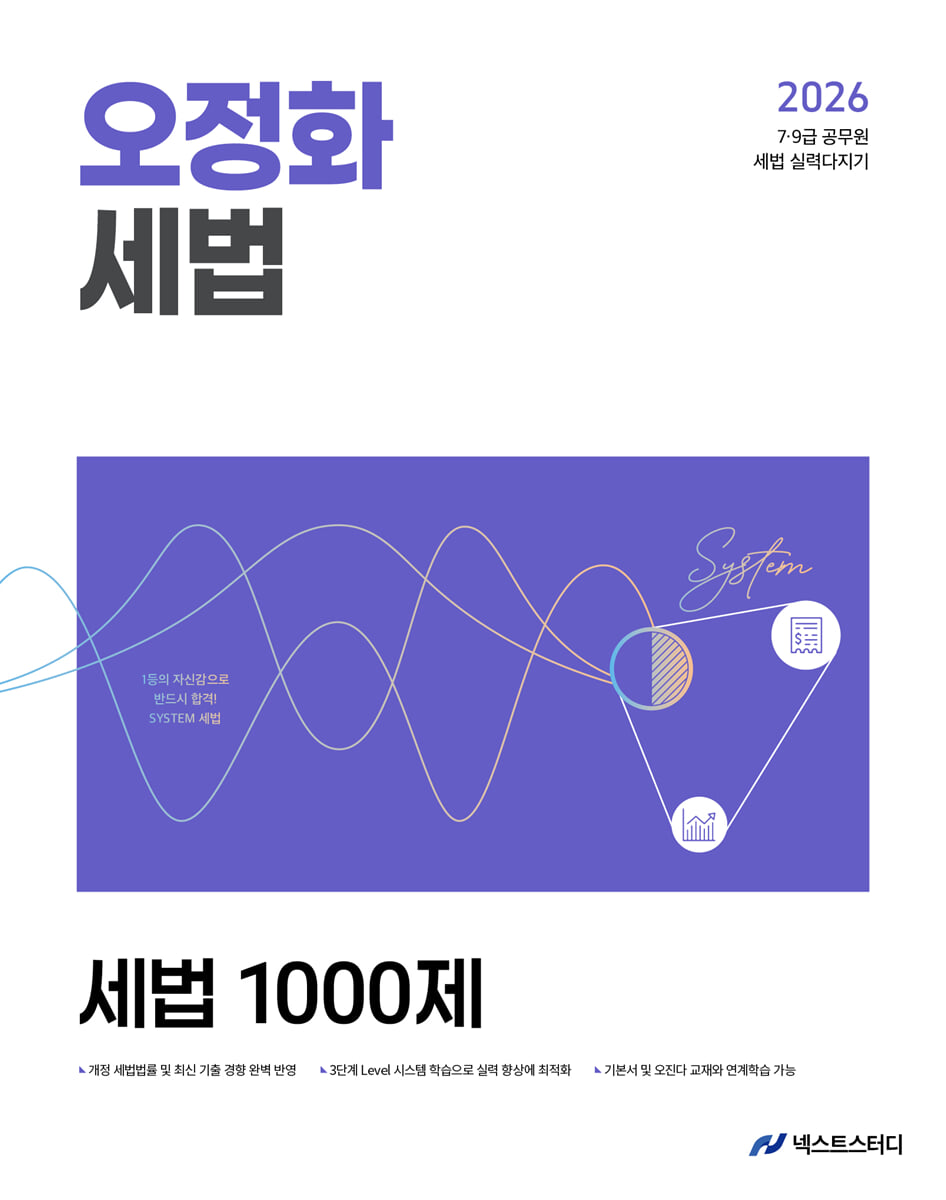
2026 Oh Jeong-hwa Tax Law 1000 Tax Laws
 |
Description
Book Introduction
"2026 Oh Jeong-hwa Tax Law 1,000 Tax Law Questions" is a textbook designed to help you confirm your basic skills built through theory and past exam questions, and maximize your problem-solving ability through a three-level system optimized for skill improvement.
All questions display relevant pages from the textbook and Ojinda, strengthening cross-reference learning between textbooks. The exam fully reflects the latest exam trends and revised tax laws.
Additionally, it is structured in a step-by-step manner so that you can immediately check detailed explanations after solving a problem.
All questions display relevant pages from the textbook and Ojinda, strengthening cross-reference learning between textbooks. The exam fully reflects the latest exam trends and revised tax laws.
Additionally, it is structured in a step-by-step manner so that you can immediately check detailed explanations after solving a problem.
- You can preview some of the book's contents.
Preview
index
Part 1: General Tax Law
01 General Tax Law
Part 2 National Tax Basic Act
01 General Provisions
02 Principles of National Taxation and Application of Tax Law
03 Establishment, confirmation, and extinction of tax obligations
04 Expansion of tax obligations
05 Relationship between national taxes and general bonds
06 Taxation
07 Tax refund and tax refund surcharge
08 Tax Complaint System
09 Taxpayer Rights and Provisions
Part 3 National Tax Collection Act
01 General Provisions and Supplementary Provisions
02 Arbitrary collection procedures
03 Compulsory collection procedures
Part 4 Value Added Tax Act
01 General Provisions and Supplementary Provisions
02 Taxable Transactions
03 Supply period and place
04 Tax rates and exemptions
05 Tax invoices and receipts
06 Tax base
07 Calculation of purchase tax and deductible tax
08 Value Added Tax Reporting and Payment
09 Distribution calculation for concurrent business operators
10 Simplified Taxation
Part 5 Corporate Tax Law
01 General Provisions
02 Corporate Tax Calculation Structure
03 Profit and loss exclusion
04 Hand and wrist expenses and non-inclusion of hand and wrist expenses
05 Timing of profit and loss attribution
06 Acquisition price of assets and valuation of assets and liabilities
07 Agenda Allocation
08 Depreciation
09 Non-deduction of interest paid
10 Corporate business expenses and donations
11 Reserves
12 reserve funds
13 Denial of Unfair Act Calculation
14 Calculation of tax base
15 Calculation of tax amount and deductible tax amount
16 Corporate Tax Payment Procedures
17 Other corporate taxes
18 Mergers and Divisions
19 Consolidated Tax System
Part 6 Income Tax Act
01 General Provisions
02 Financial Income
03 Business Income
04 Earned Income
05 Pension income and other income
06 Special Cases for Calculating Income Amount
07 Calculation of Comprehensive Income Tax Base
08 Calculation of deductible tax amount
09 Retirement Income Tax
10. Capital gains tax
11 Income tax payment procedures
Part 7 Inheritance Tax and Gift Tax Act
01 Inheritance tax
02 Gift tax
03 Inheritance tax and gift tax payment procedures
04 Valuation of property
01 General Tax Law
Part 2 National Tax Basic Act
01 General Provisions
02 Principles of National Taxation and Application of Tax Law
03 Establishment, confirmation, and extinction of tax obligations
04 Expansion of tax obligations
05 Relationship between national taxes and general bonds
06 Taxation
07 Tax refund and tax refund surcharge
08 Tax Complaint System
09 Taxpayer Rights and Provisions
Part 3 National Tax Collection Act
01 General Provisions and Supplementary Provisions
02 Arbitrary collection procedures
03 Compulsory collection procedures
Part 4 Value Added Tax Act
01 General Provisions and Supplementary Provisions
02 Taxable Transactions
03 Supply period and place
04 Tax rates and exemptions
05 Tax invoices and receipts
06 Tax base
07 Calculation of purchase tax and deductible tax
08 Value Added Tax Reporting and Payment
09 Distribution calculation for concurrent business operators
10 Simplified Taxation
Part 5 Corporate Tax Law
01 General Provisions
02 Corporate Tax Calculation Structure
03 Profit and loss exclusion
04 Hand and wrist expenses and non-inclusion of hand and wrist expenses
05 Timing of profit and loss attribution
06 Acquisition price of assets and valuation of assets and liabilities
07 Agenda Allocation
08 Depreciation
09 Non-deduction of interest paid
10 Corporate business expenses and donations
11 Reserves
12 reserve funds
13 Denial of Unfair Act Calculation
14 Calculation of tax base
15 Calculation of tax amount and deductible tax amount
16 Corporate Tax Payment Procedures
17 Other corporate taxes
18 Mergers and Divisions
19 Consolidated Tax System
Part 6 Income Tax Act
01 General Provisions
02 Financial Income
03 Business Income
04 Earned Income
05 Pension income and other income
06 Special Cases for Calculating Income Amount
07 Calculation of Comprehensive Income Tax Base
08 Calculation of deductible tax amount
09 Retirement Income Tax
10. Capital gains tax
11 Income tax payment procedures
Part 7 Inheritance Tax and Gift Tax Act
01 Inheritance tax
02 Gift tax
03 Inheritance tax and gift tax payment procedures
04 Valuation of property
Publisher's Review
Pass with confidence! SYSTEM Tax Law
Oh Jeong-hwa's tax law
The features of 『2026 Oh Jeong-hwa Tax Law 1000 Tax Laws』 are as follows.
1.
Structured problem-solving and linking with the textbook and Ojinda
We've structured the exam questions to allow you to thoroughly practice applied problems by modifying them from civil service exams and tax law subjects, and we've structured it so that you can identify pitfalls and areas of weakness simply by reading the explanations.
In addition, all questions in the Tax Law Examination have the relevant pages in the Basic Book and Ojinda displayed so that students can study the Basic Book and Ojinda in parallel according to the progress of the Basic Book.
2.
3-level system for step-by-step learning
To provide step-by-step learning based on the test taker's learning difficulty and whether they are prepared for levels 7 and 9, the questions are divided into Levels 1, 2, and 3 based on difficulty.
This book consists of a total of 1,000 questions that reflect the latest exam trends, and the weightings for Levels 1, 2, and 3 are 20%, 60%, and 20%, respectively.
3.
The final stages of the tax system
This book concludes the System Tax Law curriculum, and is designed to help you review the basic skills you've built through theory and past exam questions, and improve your level of completion in a short period of time.
It is composed of applied problems that cover all previous civil service exam questions and previous exam questions, so it is ideal for improving your skills.
4.
Problems and Explanations of the Structure of the Upper and Lower Levels for Skill Improvement
The tax law section of the civil service exam tends to be based on the exact text of the tax law, so if you practice frequently to familiarize yourself with the text in the textbook, you will be able to read the options and make the right judgment quickly during the exam.
However, in order to quickly select the correct answer, it is important to solve the problem by looking at various options and then identify at a glance where you may have made a mistake.
Because this is a highly volatile subject, we have structured it in a step-by-step format so that you can check the explanation immediately after solving the problem.
By solving problems while maintaining the tension of a real-life situation and quickly identifying and supplementing any shortcomings through answers and explanations, you can improve your skills.
Oh Jeong-hwa's tax law
The features of 『2026 Oh Jeong-hwa Tax Law 1000 Tax Laws』 are as follows.
1.
Structured problem-solving and linking with the textbook and Ojinda
We've structured the exam questions to allow you to thoroughly practice applied problems by modifying them from civil service exams and tax law subjects, and we've structured it so that you can identify pitfalls and areas of weakness simply by reading the explanations.
In addition, all questions in the Tax Law Examination have the relevant pages in the Basic Book and Ojinda displayed so that students can study the Basic Book and Ojinda in parallel according to the progress of the Basic Book.
2.
3-level system for step-by-step learning
To provide step-by-step learning based on the test taker's learning difficulty and whether they are prepared for levels 7 and 9, the questions are divided into Levels 1, 2, and 3 based on difficulty.
This book consists of a total of 1,000 questions that reflect the latest exam trends, and the weightings for Levels 1, 2, and 3 are 20%, 60%, and 20%, respectively.
3.
The final stages of the tax system
This book concludes the System Tax Law curriculum, and is designed to help you review the basic skills you've built through theory and past exam questions, and improve your level of completion in a short period of time.
It is composed of applied problems that cover all previous civil service exam questions and previous exam questions, so it is ideal for improving your skills.
4.
Problems and Explanations of the Structure of the Upper and Lower Levels for Skill Improvement
The tax law section of the civil service exam tends to be based on the exact text of the tax law, so if you practice frequently to familiarize yourself with the text in the textbook, you will be able to read the options and make the right judgment quickly during the exam.
However, in order to quickly select the correct answer, it is important to solve the problem by looking at various options and then identify at a glance where you may have made a mistake.
Because this is a highly volatile subject, we have structured it in a step-by-step format so that you can check the explanation immediately after solving the problem.
By solving problems while maintaining the tension of a real-life situation and quickly identifying and supplementing any shortcomings through answers and explanations, you can improve your skills.
GOODS SPECIFICS
- Date of issue: November 19, 2025
- Page count, weight, size: 700 pages | 205*260*35mm
- ISBN13: 9791173602702
- ISBN10: 1173602704
You may also like
카테고리
korean


korean

![ELLE 엘르 스페셜 에디션 A형 : 12월 [2025]](http://librairie.coreenne.fr/cdn/shop/files/b8e27a3de6c9538896439686c6b0e8fb.jpg?v=1766436872&width=3840)


