

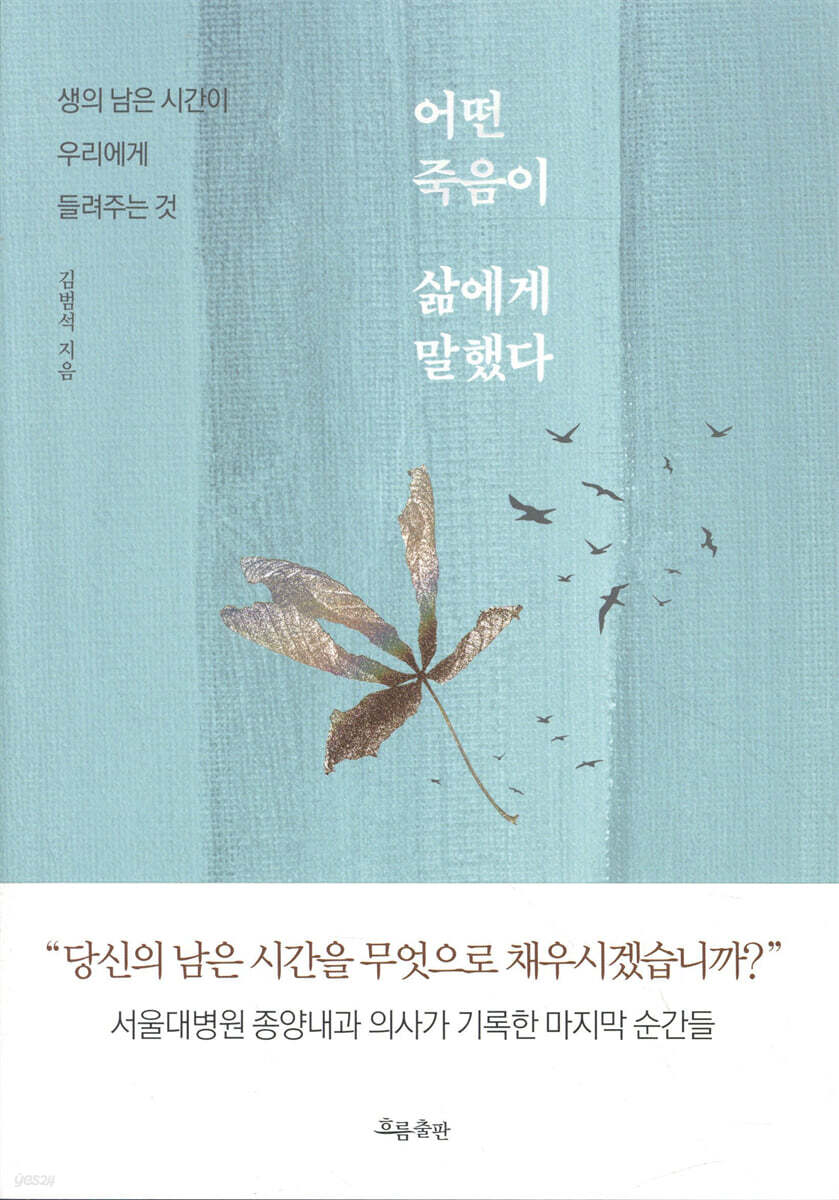
What death said to life
 |
Description
Book Introduction
The last trace recorded by an oncologist at Seoul National University Hospital Our choices reveal our attitude toward life and death. An essay by Professor Kim Beom-seok, an oncologist with 18 years of experience at Seoul National University Hospital, about cancer patients he has met, the people around them, and his honest thoughts as a doctor. Patients diagnosed with cancer fill their remaining time in different ways. Some people calmly organize their lives, seeking small happiness; others stubbornly try to postpone the death that approaches them every moment; and some overcome cancer and look at life from a different perspective. The same goes for the family members around them. A son who respects his father's will to donate his brain after death, siblings who cannot let go of their unconscious mother even when her ribs are broken during CPR, a daughter who ignores her violent father, and a man who chooses to marry his lover despite knowing she has cancer—all of those around the patient make different choices. Looking back on the choices made by such patients, their guardians, and medical staff, the author asks himself, "Was doing one's best really the best?" The author says that watching the patients and their families go through their final moments made him reflect on his attitude toward life and death, and learned a lot. This book is a record of the author's experiences from time to time, so as not to forget the enlightenment he gained about life and death. Parts 1 and 2 of the book tell the stories of patients the author has met, providing a glimpse into how patients and their families deal with their impending death and the rest of their lives. Parts 3 and 4 provide a glimpse into the concerns and thoughts of a doctor treating cancer patients. The people in the book are a reflection of us, living here and now, in this era. Their attitudes toward life and death raise the same questions for us. How do we prepare for the inevitable death? How do we live the rest of our lives? |
- You can preview some of the book's contents.
Preview
index
Starting the story
Part 1.
In the face of impending death
The wrath of those who lived too hard / Pay back my 200 million won / A special and great last / The shackles of blood ties / Brain donation after death / I don't want to receive chemotherapy / I have to live 10 more years / We need to talk / An unbelievable death / Delay of death
Part 2.
Still, living is
Life Reset / Miracle / Cut Off at School / Cruel Life / Child's Shoes / Today I Prepare for the Civil Service Exam / Yogurt Man / The Marriage of a Terminally Ill Patient / My Life is Not My Own
Part 3.
The profession of a doctor
Between the Stars: The 600 to 1 Relationship / Understanding Someone / People Who Don't Meet Eyes / Fabius Maximus / Isn't It Too Late to Tell You / The March Bride / The Ethical Man / Selfishness and Altruism
Part 4.
On the border of life and death
Each for himself, find someone who knows him / Was doing one's best the best? / For a dignified death: Regarding the law on life-sustaining treatment decisions / The right to cry / The time waiting for death / The last look back
In conclusion to the story
Part 1.
In the face of impending death
The wrath of those who lived too hard / Pay back my 200 million won / A special and great last / The shackles of blood ties / Brain donation after death / I don't want to receive chemotherapy / I have to live 10 more years / We need to talk / An unbelievable death / Delay of death
Part 2.
Still, living is
Life Reset / Miracle / Cut Off at School / Cruel Life / Child's Shoes / Today I Prepare for the Civil Service Exam / Yogurt Man / The Marriage of a Terminally Ill Patient / My Life is Not My Own
Part 3.
The profession of a doctor
Between the Stars: The 600 to 1 Relationship / Understanding Someone / People Who Don't Meet Eyes / Fabius Maximus / Isn't It Too Late to Tell You / The March Bride / The Ethical Man / Selfishness and Altruism
Part 4.
On the border of life and death
Each for himself, find someone who knows him / Was doing one's best the best? / For a dignified death: Regarding the law on life-sustaining treatment decisions / The right to cry / The time waiting for death / The last look back
In conclusion to the story
Detailed image
.jpg)
Into the book
People think that doctors treat patients, but that's not always the case.
If you think about it, patients feed doctors, and sometimes patients even treat doctors.
The choices of the patients I've met so far, the time they spend, their every word and action have served as both negative and positive lessons for me.
The patients I met told me many stories about living and dying.
The process of finding the meaning contained within it felt like solving a life's homework.
They were my teachers.
--- p.6
A life of moving forward while somehow overcoming obstacles.
A life of gritting one's teeth and running forward, looking only forward, making the impossible possible and finding a reason for existence.
Wasn't life a battlefield for him that he had to fight hard for? (...) I later heard the news of his death through the hospice room.
It is said that he passed away alone on a cold winter day in December.
I don't know if he passed away peacefully, surrounded by his family, in his final moments, or if he passed away lonely, neglected by his family.
Considering the life I've watched over him, it wouldn't be strange if it were the latter.
When I heard the news, I really wanted to ask him if I ever met him again after I died.
“What did you live so hard for?”
--- p.24
The many blood relations I have witnessed have been more tragic than the others.
At times like that, I thought.
The first sentence of Tolstoy's novel Anna Karenina, "All happy families are alike; every unhappy family is unhappy in its own way," is correct.
For some, family is the most reliable thing, but for others, it is nothing more than a burden and a chain that strangles their lives.
--- p.39
Anyway, I was very surprised that an octogenarian patient had applied for postmortem brain donation, something that even doctors were unfamiliar with.
He may have also researched organ donation and known that organ donation is not possible for cancer patients.
He didn't stop there, and after searching for a way, he probably chose this postmortem brain donation.
That one choice alone showed how much he had thought about and prepared for death before leaving this world.
--- p.50
Getting cancer is like walking through a vast plain and being hit by a torrential downpour without warning.
There is no umbrella and no place to hide.
All you can do is stand there in the pouring rain.
(…) If it’s going to rain anyway, it’s better to walk while getting rained on.
Of course, you might trip over a rock or get scratched by a thorn bush while walking.
However, you may come across a place where you can take shelter from the rain.
Or you might find something to block the rain.
Above all, if you accept the sudden rain and everything you encounter along the way as part of the journey, you will develop inner strength.
--- p.56
Since it is something beyond the realm of science anyway, I would like to ask the patient who cannot answer when the end of life is delayed.
What are you waiting for, what is keeping you from taking a step forward?
If only I could find out, I would love to find out and help relieve some of that frustration.
As a person, before being a doctor, I hope that I can leave this difficult life and the difficult struggle with illness as lightly as possible.
--- p.84
Fighting cancer is exhausting for both the patient and their family.
As the long and painful struggle with illness continues, the remaining love can easily fade and hope can be easily lost.
I have seen countless cases where the inevitable end of a long illness is a ruin filled with wounds.
So, the fact that I didn't lose that love even in the midst of hopelessness was as miraculous as the shrinking of the cancerous lump.
--- p.106
Putting your children first is something that parents can never be complacent about.
This is not uncommon in cancer hospitals either.
When we think of cancer patients, we tend to think of middle-aged or elderly patients, but in reality, cancer does not strike regardless of age.
Naturally, there are many young cancer patients, and some of them pass away without being cured.
In the end, the parents also have to bear the full pain of sending their children away first.
--- p.121
· It is inherently impossible to fully understand someone other than the patient or the doctor.
It's nothing more than 'Based on my experience, I'm guessing your situation is probably like this.'
Because we are essentially different people, it is impossible for us to have the same experiences in exactly the same situations and circumstances.
--- p.163
I sometimes adopt the same strategy as Fabius.
There are times when it feels like the cancer cells are putting up a fight, and in those times, I often just try to hold out for as long as possible.
Regardless of the size of the tumor, the focus is on maintaining the basic functions of the organ.
It allows patients to breathe, eat and stay pain-free for longer.
It's a way to avoid a head-on confrontation and just hold out.
(…) The goal of this strategy is to keep the patient alive regardless of whether the cancer grows or not.
Since death is imminent, this operation will eventually become meaningless, but at least I can avoid the difficult situation of harsh chemotherapy, maintain a certain quality of life, and even buy time by holding on.
The time thus earned can be used to encourage patients to do other useful things.
--- p.176
There are other factors involved in continuing chemotherapy until the end.
Convincing patients and their guardians who cannot accept stopping chemotherapy is a time-consuming and energy-consuming task, and it does not help the hospital's profits at all.
If you perform chemotherapy, CT scans, and other medical procedures, the hospital generates revenue, but if you deliver bad news and stop meaningless life-prolonging treatment, the hospital generates zero revenue.
So, the fact that cancer patients in our country receive chemotherapy up to two weeks before death is the result of a combination of several factors.
--- p.183
When caring for someone, you have to be somewhat selfish to be altruistic.
After all, selfishness and altruism are two sides of the same coin.
What I am saying is that we need selfishness that allows us to take care of ourselves and find peace on our own, rather than selfishness that disregards others for our own comfort.
Because we are someone's protector and someone who must take care of someone, but we are also our own protectors who must take care of ourselves before that.
The only person who can take care of me first is me.
When you can take care of yourself, you have the ability and capacity to take care of others.
It is never desirable to try to be altruistic and then fail to take care of yourself and thus fail to take care of others.
--- p.210~211
Everyone was just waiting for their guardians and family members to arrive quickly.
When the guardian arrives, the attending physician will go out and explain the situation to the guardian and family.
Once the family understands the situation and accepts the patient's death, the show ends and the attending physician can declare death.
The patient's path to the afterlife was so difficult and arduous.
The family and medical staff did everything modern medicine could to help the patient.
But no one was happy, and the patient went to the afterlife with great difficulty.
In this whole situation, I kept asking myself:
I wonder if doing my best was really the best.
--- p.232
With the consent of the family, I stopped the patient's oxygen and pressor infusion, and he died.
If it were before February 2018, I would have been a murderer, but if it were after February 2018, I would have been a medical professional who legally withheld life-sustaining treatment.
Although the actions are the same, the line between legal and illegal is ambiguous, and human judgment is artificial.
The more ambiguous the line between legality and illegality, the more chaotic the situation becomes.
Ambiguity in the law breeds power, and more and more people seek to judge right and wrong through the law.
There are many people who discuss the law, but not many who truly care for patients.
Those who want to follow the law do not step into the field and only try to judge later in the name of the law when a problem arises.
But things that are unknown at the desk always happen in the field.
--- p.240
What's even sadder is that this same system is taming us.
When something is abnormal for a long time, it becomes difficult to know what is normal.
The system becomes more and more rigid, and within this system, patients, guardians, and doctors alike come to take it for granted that one person enters and leaves the examination room every three minutes, like a conveyor belt.
As a result, we come to accept the strange reality that when the given short time is over, the guardian drags the crying patient out, the sound of crying leaks in from outside, and the people waiting next to them get angry.
Within this vast system, is there no right to grieve or cry? Is it too ambitious to even discuss the right to cry freely in this factory-style, mass-market, low-profit medical practice? Is change in this system impossible? The tiny cogs within this complex system continue to turn relentlessly, yet they remain a source of questions.
--- p.245
The last sight I saw was sometimes a mess of money and sometimes people, and they were usually a noisy and chaotic mess that ended in anger and disarray beyond grief for the deceased.
There were countless cases where the deceased's unresolved relationships tormented those who survived.
In the end, if you look closely, whatever is left unfinished is usually not something that can be remembered beautifully, and becomes something that the people left behind have to deal with.
And that was what remained of the deceased's back.
--- p.258~259
Listen to the stories of patients who have passed away when life was forgotten.
Their last words always ask me:
You too will reach this point someday. How are you living? What kind of person do you want to be when you get there? Every time I'm asked that question, I'm struck by a sense of awakening, and my sense of life is once again heightened.
Perhaps we live as close to life as death.
If you think about it, patients feed doctors, and sometimes patients even treat doctors.
The choices of the patients I've met so far, the time they spend, their every word and action have served as both negative and positive lessons for me.
The patients I met told me many stories about living and dying.
The process of finding the meaning contained within it felt like solving a life's homework.
They were my teachers.
--- p.6
A life of moving forward while somehow overcoming obstacles.
A life of gritting one's teeth and running forward, looking only forward, making the impossible possible and finding a reason for existence.
Wasn't life a battlefield for him that he had to fight hard for? (...) I later heard the news of his death through the hospice room.
It is said that he passed away alone on a cold winter day in December.
I don't know if he passed away peacefully, surrounded by his family, in his final moments, or if he passed away lonely, neglected by his family.
Considering the life I've watched over him, it wouldn't be strange if it were the latter.
When I heard the news, I really wanted to ask him if I ever met him again after I died.
“What did you live so hard for?”
--- p.24
The many blood relations I have witnessed have been more tragic than the others.
At times like that, I thought.
The first sentence of Tolstoy's novel Anna Karenina, "All happy families are alike; every unhappy family is unhappy in its own way," is correct.
For some, family is the most reliable thing, but for others, it is nothing more than a burden and a chain that strangles their lives.
--- p.39
Anyway, I was very surprised that an octogenarian patient had applied for postmortem brain donation, something that even doctors were unfamiliar with.
He may have also researched organ donation and known that organ donation is not possible for cancer patients.
He didn't stop there, and after searching for a way, he probably chose this postmortem brain donation.
That one choice alone showed how much he had thought about and prepared for death before leaving this world.
--- p.50
Getting cancer is like walking through a vast plain and being hit by a torrential downpour without warning.
There is no umbrella and no place to hide.
All you can do is stand there in the pouring rain.
(…) If it’s going to rain anyway, it’s better to walk while getting rained on.
Of course, you might trip over a rock or get scratched by a thorn bush while walking.
However, you may come across a place where you can take shelter from the rain.
Or you might find something to block the rain.
Above all, if you accept the sudden rain and everything you encounter along the way as part of the journey, you will develop inner strength.
--- p.56
Since it is something beyond the realm of science anyway, I would like to ask the patient who cannot answer when the end of life is delayed.
What are you waiting for, what is keeping you from taking a step forward?
If only I could find out, I would love to find out and help relieve some of that frustration.
As a person, before being a doctor, I hope that I can leave this difficult life and the difficult struggle with illness as lightly as possible.
--- p.84
Fighting cancer is exhausting for both the patient and their family.
As the long and painful struggle with illness continues, the remaining love can easily fade and hope can be easily lost.
I have seen countless cases where the inevitable end of a long illness is a ruin filled with wounds.
So, the fact that I didn't lose that love even in the midst of hopelessness was as miraculous as the shrinking of the cancerous lump.
--- p.106
Putting your children first is something that parents can never be complacent about.
This is not uncommon in cancer hospitals either.
When we think of cancer patients, we tend to think of middle-aged or elderly patients, but in reality, cancer does not strike regardless of age.
Naturally, there are many young cancer patients, and some of them pass away without being cured.
In the end, the parents also have to bear the full pain of sending their children away first.
--- p.121
· It is inherently impossible to fully understand someone other than the patient or the doctor.
It's nothing more than 'Based on my experience, I'm guessing your situation is probably like this.'
Because we are essentially different people, it is impossible for us to have the same experiences in exactly the same situations and circumstances.
--- p.163
I sometimes adopt the same strategy as Fabius.
There are times when it feels like the cancer cells are putting up a fight, and in those times, I often just try to hold out for as long as possible.
Regardless of the size of the tumor, the focus is on maintaining the basic functions of the organ.
It allows patients to breathe, eat and stay pain-free for longer.
It's a way to avoid a head-on confrontation and just hold out.
(…) The goal of this strategy is to keep the patient alive regardless of whether the cancer grows or not.
Since death is imminent, this operation will eventually become meaningless, but at least I can avoid the difficult situation of harsh chemotherapy, maintain a certain quality of life, and even buy time by holding on.
The time thus earned can be used to encourage patients to do other useful things.
--- p.176
There are other factors involved in continuing chemotherapy until the end.
Convincing patients and their guardians who cannot accept stopping chemotherapy is a time-consuming and energy-consuming task, and it does not help the hospital's profits at all.
If you perform chemotherapy, CT scans, and other medical procedures, the hospital generates revenue, but if you deliver bad news and stop meaningless life-prolonging treatment, the hospital generates zero revenue.
So, the fact that cancer patients in our country receive chemotherapy up to two weeks before death is the result of a combination of several factors.
--- p.183
When caring for someone, you have to be somewhat selfish to be altruistic.
After all, selfishness and altruism are two sides of the same coin.
What I am saying is that we need selfishness that allows us to take care of ourselves and find peace on our own, rather than selfishness that disregards others for our own comfort.
Because we are someone's protector and someone who must take care of someone, but we are also our own protectors who must take care of ourselves before that.
The only person who can take care of me first is me.
When you can take care of yourself, you have the ability and capacity to take care of others.
It is never desirable to try to be altruistic and then fail to take care of yourself and thus fail to take care of others.
--- p.210~211
Everyone was just waiting for their guardians and family members to arrive quickly.
When the guardian arrives, the attending physician will go out and explain the situation to the guardian and family.
Once the family understands the situation and accepts the patient's death, the show ends and the attending physician can declare death.
The patient's path to the afterlife was so difficult and arduous.
The family and medical staff did everything modern medicine could to help the patient.
But no one was happy, and the patient went to the afterlife with great difficulty.
In this whole situation, I kept asking myself:
I wonder if doing my best was really the best.
--- p.232
With the consent of the family, I stopped the patient's oxygen and pressor infusion, and he died.
If it were before February 2018, I would have been a murderer, but if it were after February 2018, I would have been a medical professional who legally withheld life-sustaining treatment.
Although the actions are the same, the line between legal and illegal is ambiguous, and human judgment is artificial.
The more ambiguous the line between legality and illegality, the more chaotic the situation becomes.
Ambiguity in the law breeds power, and more and more people seek to judge right and wrong through the law.
There are many people who discuss the law, but not many who truly care for patients.
Those who want to follow the law do not step into the field and only try to judge later in the name of the law when a problem arises.
But things that are unknown at the desk always happen in the field.
--- p.240
What's even sadder is that this same system is taming us.
When something is abnormal for a long time, it becomes difficult to know what is normal.
The system becomes more and more rigid, and within this system, patients, guardians, and doctors alike come to take it for granted that one person enters and leaves the examination room every three minutes, like a conveyor belt.
As a result, we come to accept the strange reality that when the given short time is over, the guardian drags the crying patient out, the sound of crying leaks in from outside, and the people waiting next to them get angry.
Within this vast system, is there no right to grieve or cry? Is it too ambitious to even discuss the right to cry freely in this factory-style, mass-market, low-profit medical practice? Is change in this system impossible? The tiny cogs within this complex system continue to turn relentlessly, yet they remain a source of questions.
--- p.245
The last sight I saw was sometimes a mess of money and sometimes people, and they were usually a noisy and chaotic mess that ended in anger and disarray beyond grief for the deceased.
There were countless cases where the deceased's unresolved relationships tormented those who survived.
In the end, if you look closely, whatever is left unfinished is usually not something that can be remembered beautifully, and becomes something that the people left behind have to deal with.
And that was what remained of the deceased's back.
--- p.258~259
Listen to the stories of patients who have passed away when life was forgotten.
Their last words always ask me:
You too will reach this point someday. How are you living? What kind of person do you want to be when you get there? Every time I'm asked that question, I'm struck by a sense of awakening, and my sense of life is once again heightened.
Perhaps we live as close to life as death.
--- p.261
Publisher's Review
“There are many beginnings and endings in life, but the very beginning and the very end of our lives are birth and death.
This beginning and end remain in the memories of others, not mine.
Birth is something that happens regardless of my will, but I can prepare for death.
It is true that the moment of 'death' will definitely come someday, and we know that fact.
I think that's very fortunate.
But I think most people end up thinking of this ‘death that can be prepared for’ as ‘death that happens suddenly.’” - Part 4.
From "The Last Back View"
The final appearances of cancer patients, recorded by an oncologist with 18 years of experience at Seoul National University Hospital.
“What makes the rest of my life meaningful?”
As of 2019, the number of cancer deaths was 78,863, an increase of nearly 10,000 from 2018, and the percentage of Koreans who die in hospitals has changed dramatically, from 25.2 percent in 1996 to 77.1 percent in 2019.
The number of 'life-sustaining treatment plans' expressing the intention to not provide or discontinue life-sustaining treatment increased by more than 20,000 in 2019 compared to 2017.
(Refer to the current issue, 'The Future of Death') What this fact tells us is that the hospital is where most cancer patients die, and that people's attitudes toward death are also changing.
In fact, the author, an oncologist with 18 years of experience at Seoul National University Hospital, said in this book, “Of the 280,000 people who died in Korea in 2016, 210,000 died in hospitals, and 90 percent of terminally ill cancer patients die in hospitals.”
The author says that as an oncologist, he has learned much about life and death from observing the choices and time spent by countless cancer patients and their families.
In that sense, this book is a kind of memoir written to remember the meaning of life that he realized as a doctor and a human being, what he learned and felt through his final choice that cannot be judged by the moral standards of right and wrong, and to remember his patients.
“The choices of the patients I have met so far, the time they spend, and every word and action they take have served as both negative and positive examples for me.
The patients I met told me many stories about living and dying.
The process of finding the meaning contained within felt like solving a life's homework.
They were my teachers.
(…) I wanted to talk about how we can look back on ourselves through the images of the deceased, that their deaths are not something that disappears, but rather a death that is remembered by some, and further, that someone’s death can become life for someone else.” (pp. 6-8)
The choices of patients and their families facing death,
Makes you think about your attitude toward life and death
All of the patients mentioned in "A Certain Death Spoke to Life" are cancer patients, but after being diagnosed with cancer, each of them makes their own choices and heads to their final destination in different ways.
Rather than trying to rekindle the bonds of blood ties that were severed because of money, some people leave behind a will that says, “Pay back the 200 million won you lent me,” while others, on the verge of death, fail to realize the meaning of life and only wish to live for 10 more years.
One elderly patient in his seventies realizes the value of everyday life by doing things he had never done before, and another elderly patient leaves after applying for 'posthumous brain donation' without the doctor's knowledge.
Everyone hears about life expectancy, saying, “You have about ○○ days left,” but how we fill that remaining time varies from person to person.
How patients approach their remaining lives and their impending deaths questions our own attitudes toward life and death.
Regarding this, the author says, “Everyone is born with the question, ‘How meaningful will I live my given life?’
If it's a kind of homework, then it is homework, and we are all solving our own homework.
Of course, whether or not you solve this life's homework, no matter how you solve it, the result will ultimately be something you embrace when you die.
Finding out your life expectancy can be heartbreaking, but if you think about it a little differently, it can be a special bonus.
This is because people usually live and die without knowing how much longer they will live.
Of course, no one would criticize us for not solving all of these problems, but it would be a shame to leave them blank” (pp. 62-63).
Moreover, the patient's journey to the final destination is not limited to the patient alone.
His family is together.
There is a wife who traveled back and forth between Seoul and Busan, never giving up hope, until her husband, who suffered from cancer of unknown origin, was cured. There is also a daughter who could not turn away from her violent father and took responsibility for him until the end, even while cursing her blood relatives.
There is a son who shuttles between hospitals and work to care for his divorced parents, each battling cancer, and there is a daughter who is nearly sixty and has to care for her 88-year-old father who suffers from cancer and dementia.
The families of patients observed by the author each tell their own stories and choices, just like the patients themselves.
The images of patients and their families are not far from us.
Because we too are someone's parents, children, and companions.
That is why their story is not passed over lightly.
Their choices make me think about how I should let go of my family, how I should accompany them in their final moments, and in another sense, they make me reflect on life and death.
Was doing one's best really the best?
Thinking about the patient's remaining life and death together
The place where cancer patients spend the most time is the hospital, and there are doctors here who do their best to be with the patients and their families until the very end.
The concerns of a doctor who has to watch over and treat a person's life and death and remaining days are deep.
He thinks about the relationship between a doctor and a patient when he sees a patient who says, “To you, I may be one of 600, but to me, you are the only one.” He questions the role of society when he sees young cancer patients who are cured but are disadvantaged in employment because they have cancer, and he feels sorry for patients who refuse chemotherapy and only ask for treatment when they are no longer able to receive it.
The patient's whole body swelled and she lost consciousness due to the four siblings who refused to stop life-prolonging treatment for their 80-year-old mother. Even when her ribs were broken, CPR could not be stopped. The patient, her family, and the medical staff all did their best. However, they ask themselves, "Was doing their best really the best?"
He also confesses his belief that palliative care, which both patients and hospitals dislike, may be the best choice for the patient's remaining life, and expresses bitterness about Korea's factory-style, low-profit, high-volume medical treatment, where he is forced to see patients at a rate of '10 per hour'.
Moreover, some of the stories the author tells make us think about the 'Life-sustaining Treatment Decision Act'.
When a patient is alive but in a condition worse than death, when dignity is fading away, guardians and medical staff face a moment of choice.
Should I send the patient away or keep him in this world even if the worst happens?
In the story "For a Dignified Death," the patient's son takes his father to the deathbed so that he can pass away in peace, but the father gradually loses his human appearance and gives off a foul odor, yet he does not pass away.
The son who was by his side sobs, saying that it would be better to just let him go, and the author, the doctor in charge, is worried about whether to remove the oxygen respirator.
Although the law allows for the discontinuation of life-sustaining treatment, it is not easy for doctors or guardians to make that choice at that moment, and the author expresses the weight of that choice through this story.
As an oncologist, the author deeply considers ways to make the remaining life of patients meaningful and to ensure a dignified death.
Most of us are people before we are readers, and as people we are not far from illness.
That is why we may one day find ourselves in the position of the patient and guardian that the author encountered, and we may have to go through that process together.
This is why the story the author tells as a doctor is not just a 'doctor's' story, but also our story.
In this book, Professor Kim Beom-seok said, “When I think of people who unexpectedly found out when they were leaving and people who still don’t know when to leave, I wanted to share that story.
“It is because it makes us reconsider the weight of the time given to us and makes us face ‘my death’ that will come someday,” he said.
As he said, "A Certain Death Spoke to Life" is a book that makes me look back on my life and my attitude toward death through the choices and appearances of the author, a cancer patient, his family, and a doctor.
It also makes me think deeply about what choices I will make, how I will fill the remaining time, and how I will head to the final destination when the end comes for me and my family.
This beginning and end remain in the memories of others, not mine.
Birth is something that happens regardless of my will, but I can prepare for death.
It is true that the moment of 'death' will definitely come someday, and we know that fact.
I think that's very fortunate.
But I think most people end up thinking of this ‘death that can be prepared for’ as ‘death that happens suddenly.’” - Part 4.
From "The Last Back View"
The final appearances of cancer patients, recorded by an oncologist with 18 years of experience at Seoul National University Hospital.
“What makes the rest of my life meaningful?”
As of 2019, the number of cancer deaths was 78,863, an increase of nearly 10,000 from 2018, and the percentage of Koreans who die in hospitals has changed dramatically, from 25.2 percent in 1996 to 77.1 percent in 2019.
The number of 'life-sustaining treatment plans' expressing the intention to not provide or discontinue life-sustaining treatment increased by more than 20,000 in 2019 compared to 2017.
(Refer to the current issue, 'The Future of Death') What this fact tells us is that the hospital is where most cancer patients die, and that people's attitudes toward death are also changing.
In fact, the author, an oncologist with 18 years of experience at Seoul National University Hospital, said in this book, “Of the 280,000 people who died in Korea in 2016, 210,000 died in hospitals, and 90 percent of terminally ill cancer patients die in hospitals.”
The author says that as an oncologist, he has learned much about life and death from observing the choices and time spent by countless cancer patients and their families.
In that sense, this book is a kind of memoir written to remember the meaning of life that he realized as a doctor and a human being, what he learned and felt through his final choice that cannot be judged by the moral standards of right and wrong, and to remember his patients.
“The choices of the patients I have met so far, the time they spend, and every word and action they take have served as both negative and positive examples for me.
The patients I met told me many stories about living and dying.
The process of finding the meaning contained within felt like solving a life's homework.
They were my teachers.
(…) I wanted to talk about how we can look back on ourselves through the images of the deceased, that their deaths are not something that disappears, but rather a death that is remembered by some, and further, that someone’s death can become life for someone else.” (pp. 6-8)
The choices of patients and their families facing death,
Makes you think about your attitude toward life and death
All of the patients mentioned in "A Certain Death Spoke to Life" are cancer patients, but after being diagnosed with cancer, each of them makes their own choices and heads to their final destination in different ways.
Rather than trying to rekindle the bonds of blood ties that were severed because of money, some people leave behind a will that says, “Pay back the 200 million won you lent me,” while others, on the verge of death, fail to realize the meaning of life and only wish to live for 10 more years.
One elderly patient in his seventies realizes the value of everyday life by doing things he had never done before, and another elderly patient leaves after applying for 'posthumous brain donation' without the doctor's knowledge.
Everyone hears about life expectancy, saying, “You have about ○○ days left,” but how we fill that remaining time varies from person to person.
How patients approach their remaining lives and their impending deaths questions our own attitudes toward life and death.
Regarding this, the author says, “Everyone is born with the question, ‘How meaningful will I live my given life?’
If it's a kind of homework, then it is homework, and we are all solving our own homework.
Of course, whether or not you solve this life's homework, no matter how you solve it, the result will ultimately be something you embrace when you die.
Finding out your life expectancy can be heartbreaking, but if you think about it a little differently, it can be a special bonus.
This is because people usually live and die without knowing how much longer they will live.
Of course, no one would criticize us for not solving all of these problems, but it would be a shame to leave them blank” (pp. 62-63).
Moreover, the patient's journey to the final destination is not limited to the patient alone.
His family is together.
There is a wife who traveled back and forth between Seoul and Busan, never giving up hope, until her husband, who suffered from cancer of unknown origin, was cured. There is also a daughter who could not turn away from her violent father and took responsibility for him until the end, even while cursing her blood relatives.
There is a son who shuttles between hospitals and work to care for his divorced parents, each battling cancer, and there is a daughter who is nearly sixty and has to care for her 88-year-old father who suffers from cancer and dementia.
The families of patients observed by the author each tell their own stories and choices, just like the patients themselves.
The images of patients and their families are not far from us.
Because we too are someone's parents, children, and companions.
That is why their story is not passed over lightly.
Their choices make me think about how I should let go of my family, how I should accompany them in their final moments, and in another sense, they make me reflect on life and death.
Was doing one's best really the best?
Thinking about the patient's remaining life and death together
The place where cancer patients spend the most time is the hospital, and there are doctors here who do their best to be with the patients and their families until the very end.
The concerns of a doctor who has to watch over and treat a person's life and death and remaining days are deep.
He thinks about the relationship between a doctor and a patient when he sees a patient who says, “To you, I may be one of 600, but to me, you are the only one.” He questions the role of society when he sees young cancer patients who are cured but are disadvantaged in employment because they have cancer, and he feels sorry for patients who refuse chemotherapy and only ask for treatment when they are no longer able to receive it.
The patient's whole body swelled and she lost consciousness due to the four siblings who refused to stop life-prolonging treatment for their 80-year-old mother. Even when her ribs were broken, CPR could not be stopped. The patient, her family, and the medical staff all did their best. However, they ask themselves, "Was doing their best really the best?"
He also confesses his belief that palliative care, which both patients and hospitals dislike, may be the best choice for the patient's remaining life, and expresses bitterness about Korea's factory-style, low-profit, high-volume medical treatment, where he is forced to see patients at a rate of '10 per hour'.
Moreover, some of the stories the author tells make us think about the 'Life-sustaining Treatment Decision Act'.
When a patient is alive but in a condition worse than death, when dignity is fading away, guardians and medical staff face a moment of choice.
Should I send the patient away or keep him in this world even if the worst happens?
In the story "For a Dignified Death," the patient's son takes his father to the deathbed so that he can pass away in peace, but the father gradually loses his human appearance and gives off a foul odor, yet he does not pass away.
The son who was by his side sobs, saying that it would be better to just let him go, and the author, the doctor in charge, is worried about whether to remove the oxygen respirator.
Although the law allows for the discontinuation of life-sustaining treatment, it is not easy for doctors or guardians to make that choice at that moment, and the author expresses the weight of that choice through this story.
As an oncologist, the author deeply considers ways to make the remaining life of patients meaningful and to ensure a dignified death.
Most of us are people before we are readers, and as people we are not far from illness.
That is why we may one day find ourselves in the position of the patient and guardian that the author encountered, and we may have to go through that process together.
This is why the story the author tells as a doctor is not just a 'doctor's' story, but also our story.
In this book, Professor Kim Beom-seok said, “When I think of people who unexpectedly found out when they were leaving and people who still don’t know when to leave, I wanted to share that story.
“It is because it makes us reconsider the weight of the time given to us and makes us face ‘my death’ that will come someday,” he said.
As he said, "A Certain Death Spoke to Life" is a book that makes me look back on my life and my attitude toward death through the choices and appearances of the author, a cancer patient, his family, and a doctor.
It also makes me think deeply about what choices I will make, how I will fill the remaining time, and how I will head to the final destination when the end comes for me and my family.
GOODS SPECIFICS
- Publication date: January 18, 2021
- Pages, weight, size: 264 pages | 400g | 140*200*15mm
- ISBN13: 9788965964230
- ISBN10: 8965964237
You may also like
카테고리
korean


korean

![GQ KOREA Mark (Monthly): December [2025]](http://librairie.coreenne.fr/cdn/shop/files/8ef265dbbfbf186523ed75ba7319009d.jpg?v=1765340328&width=3840)


