

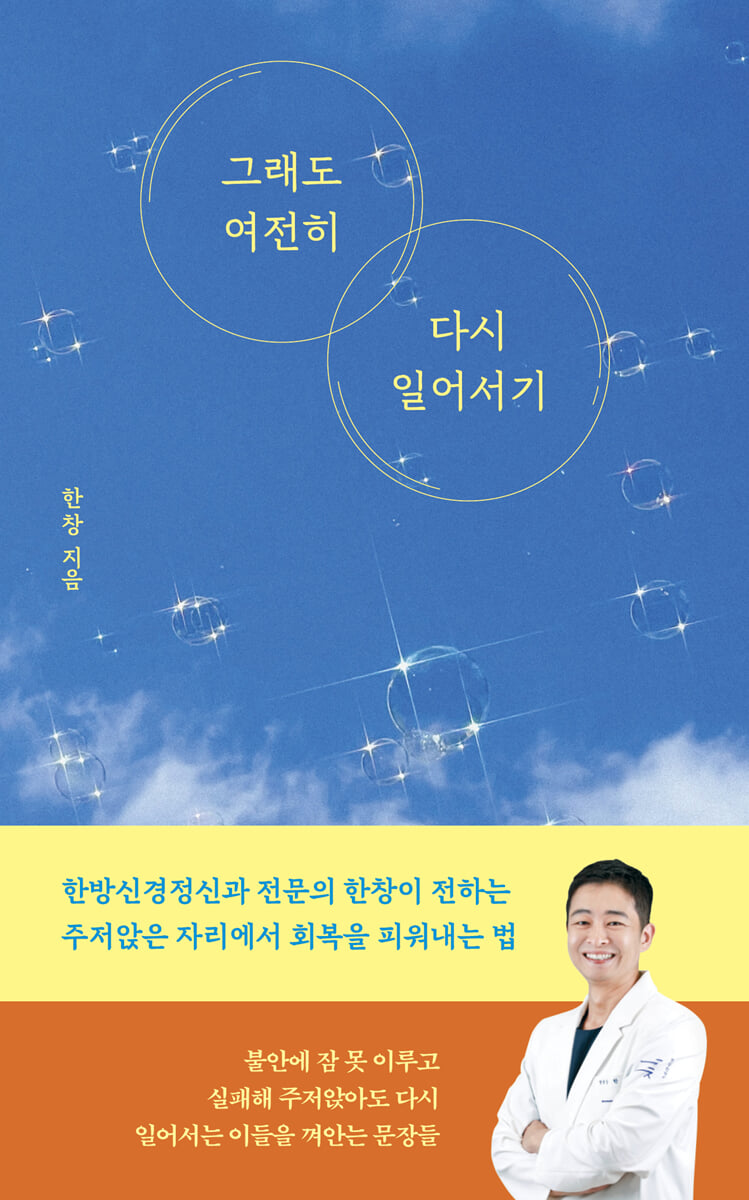
Still getting back up again
 |
Description
Book Introduction
Han Chang, a specialist in oriental neuropsychiatry, tells us
A hymn for those who endure failure!
A prescription for those who can't sleep due to anxiety and failure.
Are you confused by countless wounds and failures?
But in the midst of chaos, we are faced with something we never knew before.
You will meet me in the form of
The first essay, "Still Rising Again," by Han Chang, a specialist in oriental medicine neuropsychiatry and a familiar figure to the public as the husband of oriental medicine doctor and broadcaster Jang Young-ran, has been published.
Having treated patients in various medical settings for 18 years, the author now seeks to heal readers suffering from the pain of failure through writing.
In this book, the author includes stories from all generations and perspectives, including students preparing for college entrance exams, college students contemplating their career paths, young adults just entering the workforce and feeling lost, young adults preparing to marry their loved ones, couples struggling with the struggles of having and raising children, and entrepreneurs facing difficulties after starting a business.
This essay introduces the realistic difficulties and mental pain experienced by people of all ages, from adolescence to adulthood, through the author's own story.
And by introducing psychiatric knowledge in three stages: reading wounds, prescribing the mind, and small recovery, it naturally leads to growth in the reader.
A hymn for those who endure failure!
A prescription for those who can't sleep due to anxiety and failure.
Are you confused by countless wounds and failures?
But in the midst of chaos, we are faced with something we never knew before.
You will meet me in the form of
The first essay, "Still Rising Again," by Han Chang, a specialist in oriental medicine neuropsychiatry and a familiar figure to the public as the husband of oriental medicine doctor and broadcaster Jang Young-ran, has been published.
Having treated patients in various medical settings for 18 years, the author now seeks to heal readers suffering from the pain of failure through writing.
In this book, the author includes stories from all generations and perspectives, including students preparing for college entrance exams, college students contemplating their career paths, young adults just entering the workforce and feeling lost, young adults preparing to marry their loved ones, couples struggling with the struggles of having and raising children, and entrepreneurs facing difficulties after starting a business.
This essay introduces the realistic difficulties and mental pain experienced by people of all ages, from adolescence to adulthood, through the author's own story.
And by introducing psychiatric knowledge in three stages: reading wounds, prescribing the mind, and small recovery, it naturally leads to growth in the reader.
- You can preview some of the book's contents.
Preview
index
Entering - Relearning Myself Through the Language of Failure
Chapter 1: The Mind of a Young Person
The feeling of failure quietly destroys the inner self.
The process of creating a prison called helplessness
A method to restore the mind that wakes me up
Your failure is not the end
Obsession with perfection is another name for self-destruction.
Taking care of your body, mind, and environment
A self-care system for me
For a quiet victory
Chapter 2 The Heart of a Young Man
Loneliness is the fastest form of emotional erosion.
Wandering on a set path
Three Practices to Protect Myself
The most honest compass
Finding the purpose of my life at the end of wandering
Discovery of Intrinsic Motivation
How to find your own map
Wandering is the beginning of a new path
Running away is not a sign of weakness, it's the beginning of recovery.
Finding My Calling Where I Lost Myself
A mental defense technique that protects me in an absurd world
Finding the motivation to rise from the fallen
When the discrepancy in speed shakes the ego
The anxiety of stopping, the trap called "boreout"
How to find your own pace in a world that has stopped
Every speed has its meaning
Chapter 3: The Heart of Marriage
Between family and love, the self is torn and grows again.
How Love Makes Us Adults
A mindset that protects love in the face of the world's opposition
Until choice becomes faith
The birth of parents that no one told about
From Couple to Comrades: Reconstructing Relationships
How to Protect Us on the Path to Parenthood
A new family is born in the midst of chaos.
Chapter 4: The Independent Human Mind
A leader's heart also needs care.
When you have to endure misunderstandings
Sometimes new milestones are established amidst misunderstandings.
Sometimes the worst card becomes the best weapon.
Quitting a job isn't giving up, it's a declaration of self-recovery.
When the organization's evaluation and my values conflict
How to Reset Myself When I'm Swayed by External Evaluation
Who evaluates my worth?
Failure is not the end, but the beginning of emotional readjustment.
The Anatomy of Failure: Losing Everything and Gaining Everything
How to get back on your feet when everything falls apart
Things you only see when you lose them
In closing - Your failures are okay too.
Chapter 1: The Mind of a Young Person
The feeling of failure quietly destroys the inner self.
The process of creating a prison called helplessness
A method to restore the mind that wakes me up
Your failure is not the end
Obsession with perfection is another name for self-destruction.
Taking care of your body, mind, and environment
A self-care system for me
For a quiet victory
Chapter 2 The Heart of a Young Man
Loneliness is the fastest form of emotional erosion.
Wandering on a set path
Three Practices to Protect Myself
The most honest compass
Finding the purpose of my life at the end of wandering
Discovery of Intrinsic Motivation
How to find your own map
Wandering is the beginning of a new path
Running away is not a sign of weakness, it's the beginning of recovery.
Finding My Calling Where I Lost Myself
A mental defense technique that protects me in an absurd world
Finding the motivation to rise from the fallen
When the discrepancy in speed shakes the ego
The anxiety of stopping, the trap called "boreout"
How to find your own pace in a world that has stopped
Every speed has its meaning
Chapter 3: The Heart of Marriage
Between family and love, the self is torn and grows again.
How Love Makes Us Adults
A mindset that protects love in the face of the world's opposition
Until choice becomes faith
The birth of parents that no one told about
From Couple to Comrades: Reconstructing Relationships
How to Protect Us on the Path to Parenthood
A new family is born in the midst of chaos.
Chapter 4: The Independent Human Mind
A leader's heart also needs care.
When you have to endure misunderstandings
Sometimes new milestones are established amidst misunderstandings.
Sometimes the worst card becomes the best weapon.
Quitting a job isn't giving up, it's a declaration of self-recovery.
When the organization's evaluation and my values conflict
How to Reset Myself When I'm Swayed by External Evaluation
Who evaluates my worth?
Failure is not the end, but the beginning of emotional readjustment.
The Anatomy of Failure: Losing Everything and Gaining Everything
How to get back on your feet when everything falls apart
Things you only see when you lose them
In closing - Your failures are okay too.
Detailed image

Into the book
Now that I'm a neuropsychiatrist, looking back on my teenage years, I feel like I was trapped in a prison of endless "social comparison."
When we are constantly exposed to an environment where external standards evaluate us, such as a grade board, we end up internalizing those standards.
Failure is no longer an event that 'received a low score', but rather an event that 'proved my shortcomings'.
This is the beginning of the process of creating a prison called helplessness.
--- p.19
In Oriental medicine, it is believed that this continuous stress and suppressed emotions cause 'liver qi stagnation'.
It is a condition in which the liver's energy is blocked and clumped together, preventing it from flowing smoothly, and this manifests as physical symptoms such as abdominal pain before an exam or stiffness in the back of the neck.
Problems of the mind manifest as symptoms of the body.
The important thing is to understand that all these symptoms are not due to weak will, but rather a malfunction of the mental system.
--- pp.20-21
The body is the most honest mirror that reflects the state of the mind.
Don't ignore the little signals your body sends you, such as fatigue, indigestion, or sleep problems, by saying they are due to weak willpower.
It is objective data that energy is being depleted and needs to be recharged.
Your study schedule should include Korean, English, and math as major subjects, as well as rest, exercise, and sufficient sleep.
Consciously filling myself before I'm exhausted - this is the first secret of those who don't collapse.
--- p.35
Although I had a socially recognized identity as a 'medical student,' I was ignorant of what 'Hanchang,' an individual, truly wanted.
This is similar to what psychologist James Marcia calls “identity foreclosure.”
Without going through the crisis of deep thought and exploration, we simply accept the values and roles presented by our parents or society.
I was walking on the well-worn path of becoming a Korean medicine doctor, but I had no confidence that the scenery I wanted would unfold at the end.
Perhaps my wandering was a painful but necessary struggle to crack open my established identity and find the answer to who I really am.
--- p.50
It is a natural human instinct to crave the approval and love of others, but when it goes too far, we end up handing over control of our lives to others.
Setting healthy boundaries isn't selfish; it's the beginning of a mature relationship that respects both yourself and others.
If we can honestly express our desires and learn to reject unreasonable demands from others, we can finally build a solid foundation for our self that is not swayed by others.
--- p.55
If you're going through a tough time, you need to consciously make appointments with people who will be your safe haven.
It is not just a simple meeting, but an important therapeutic act that restores my broken inner self and gives me the strength to fight again.
--- p.83
If there is anyone who is feeling helpless in the face of an unjust reality or struggling with the desire to run away, I want to talk to you.
There is no shame in running away.
Sometimes, you have to run far away to see where you were, and sometimes, when you think you've lost everything, you find something precious.
--- p.86
True love cracks open the self-centered world.
My relationship with my wife was the first time I introduced the concept of the first-person plural "we" into my life, rather than the first-person singular "I."
The respect and support she gave me allowed me to look into my own vulnerability without shame.
In that warmth, I began to realize that love was not a feeling of excitement or passion, but rather a sacred will to take full responsibility for one's world.
--- p.110
We don't want to disappoint those who love us, but at the same time, we can't give up our desire to live as ourselves.
It is at this point that we encounter the deepest loneliness.
But as I have experienced, it is in moments of solitude that we learn to rely solely on our own choices, not on anyone else's permission.
Our life is a process of making our own choices into strong beliefs.
That faith is only strengthened through the fierce process of fighting against all the opposition and doubts of the world and defending what I have chosen with my whole being.
When we are constantly exposed to an environment where external standards evaluate us, such as a grade board, we end up internalizing those standards.
Failure is no longer an event that 'received a low score', but rather an event that 'proved my shortcomings'.
This is the beginning of the process of creating a prison called helplessness.
--- p.19
In Oriental medicine, it is believed that this continuous stress and suppressed emotions cause 'liver qi stagnation'.
It is a condition in which the liver's energy is blocked and clumped together, preventing it from flowing smoothly, and this manifests as physical symptoms such as abdominal pain before an exam or stiffness in the back of the neck.
Problems of the mind manifest as symptoms of the body.
The important thing is to understand that all these symptoms are not due to weak will, but rather a malfunction of the mental system.
--- pp.20-21
The body is the most honest mirror that reflects the state of the mind.
Don't ignore the little signals your body sends you, such as fatigue, indigestion, or sleep problems, by saying they are due to weak willpower.
It is objective data that energy is being depleted and needs to be recharged.
Your study schedule should include Korean, English, and math as major subjects, as well as rest, exercise, and sufficient sleep.
Consciously filling myself before I'm exhausted - this is the first secret of those who don't collapse.
--- p.35
Although I had a socially recognized identity as a 'medical student,' I was ignorant of what 'Hanchang,' an individual, truly wanted.
This is similar to what psychologist James Marcia calls “identity foreclosure.”
Without going through the crisis of deep thought and exploration, we simply accept the values and roles presented by our parents or society.
I was walking on the well-worn path of becoming a Korean medicine doctor, but I had no confidence that the scenery I wanted would unfold at the end.
Perhaps my wandering was a painful but necessary struggle to crack open my established identity and find the answer to who I really am.
--- p.50
It is a natural human instinct to crave the approval and love of others, but when it goes too far, we end up handing over control of our lives to others.
Setting healthy boundaries isn't selfish; it's the beginning of a mature relationship that respects both yourself and others.
If we can honestly express our desires and learn to reject unreasonable demands from others, we can finally build a solid foundation for our self that is not swayed by others.
--- p.55
If you're going through a tough time, you need to consciously make appointments with people who will be your safe haven.
It is not just a simple meeting, but an important therapeutic act that restores my broken inner self and gives me the strength to fight again.
--- p.83
If there is anyone who is feeling helpless in the face of an unjust reality or struggling with the desire to run away, I want to talk to you.
There is no shame in running away.
Sometimes, you have to run far away to see where you were, and sometimes, when you think you've lost everything, you find something precious.
--- p.86
True love cracks open the self-centered world.
My relationship with my wife was the first time I introduced the concept of the first-person plural "we" into my life, rather than the first-person singular "I."
The respect and support she gave me allowed me to look into my own vulnerability without shame.
In that warmth, I began to realize that love was not a feeling of excitement or passion, but rather a sacred will to take full responsibility for one's world.
--- p.110
We don't want to disappoint those who love us, but at the same time, we can't give up our desire to live as ourselves.
It is at this point that we encounter the deepest loneliness.
But as I have experienced, it is in moments of solitude that we learn to rely solely on our own choices, not on anyone else's permission.
Our life is a process of making our own choices into strong beliefs.
That faith is only strengthened through the fierce process of fighting against all the opposition and doubts of the world and defending what I have chosen with my whole being.
--- p.119
Publisher's Review
From adolescence to young adulthood,
From marriage to becoming a leader
The author does not hide his numerous failures and breakdowns, but willingly shares them with his readers.
It presents the emotions of failure and the process of recovery we experience step by step, such as the high school days when we were constantly plagued by inferiority complex due to our college entrance exam scores, the anxiety we endured while preparing for the college entrance exam again, the wandering we experienced after entering the university we so desperately wanted, the frustration we felt after finding a job at a hospital where we had difficulty finding a job, the conflict with our parents who opposed our marriage, and the pressure we felt as a leader after starting a business.
As a doctor, he diagnoses the situations of those suffering, and based on his experience as a human being, he suggests recovery methods such as emotional observation notes, small success journals, and growth questions to help people recover mentally.
The author says, “‘Failure’ is not something that shames me, but rather an honest word that allows me to face myself again” (p. 10), and, like the title of the book, suggests a clear way to rise up from the various psychological difficulties that come at any time.
In Oriental medicine, it is believed that this continuous stress and suppressed emotions cause 'liver qi stagnation'.
It is a condition in which the liver's energy is blocked and clumped together, preventing it from flowing smoothly, and this manifests as physical symptoms such as abdominal pain before an exam or stiffness in the back of the neck.
Problems of the mind manifest as symptoms of the body.
The important thing is to understand that all these symptoms are not due to weak will, but rather a malfunction of the mental system.
(Pages 20-21)
Husband of a famous celebrity and father of two children
A failed businessman and a fragile boy at the same time
Everyone has an 'inner child'.
We all live as mature adults, having developed a social self, but at the same time, we have a childlike inner self that has not been comforted.
It has always been believed that humans grow and achieve in stages.
But there comes a time in everyone's life when they encounter their own child, the one they must embrace forever.
The author shows his boyish inner self in the book.
He is a doctor of Oriental medicine, the husband of a famous celebrity, and the father of two children, but he still tries hard to take care of his inner child.
He confesses that he cried and hugged his spouse because he was exhausted from raising children, and he also reveals his true face as an anxious father struggling with frustration over not being able to successfully run a hospital.
The author's pure, boyish confession, which seemed to sparkle and shine, approaches the reader without any sense of distance and soothes their hearts.
Because I am standing on the manuscript as an individual named Hanchang, not as a successful doctor or the spouse of a celebrity.
Therefore, readers will also be able to encounter their own children while reading the book and begin to communicate reconciliation.
Just as the author's last sentence in this book is full of encouragement.
“If this book can comfort someone’s heart even a little, then all my failures will be meaningful.
thanks.
And I want to say it again.
“Your failures are really okay, too.” (pp. 189-190)
In the past, I always thought that I had to do well.
Now I can say it a little differently.
The important thing is that it is closer to ‘feeling well’ than ‘living well.’
Only when we fully feel and accept our joys and sorrows, successes and failures, strengths and weaknesses, can we truly understand the lives of others.
That is probably why my experience of failure can be a comfort to someone.
(Page 188)
A 3-step prescription to apply in real life
Three stages of mind care
The author begins by telling a story about a time when he was going through psychological difficulties.
The story is something that everyone experiences as they arrive at a certain time, but it also touches on the author's own unique failures.
The author graduated from a Korean medical school and successfully landed a job at a large Korean medicine hospital that only hires a very small number of people.
But it was a place with vertical discipline and an absurd culture.
The environment was so unbearable that half of the interns quit, as they were ordered to write dozens of unnecessary handwritten charts, tore them up in front of their eyes because they didn't like the handwriting, and even called out to drinks on their days off to harass them.
There happened to be a meeting with his juniors, and they treated him with admiration, as if he were working at the best job that everyone envied.
Although he is called a respectable senior, the author feels confused.
Because I knew it well.
That I am the person at the bottom of the class at work, the person who is always hesitating whether to run away or not, the person who is always worried about whether to give up.
At the end of the chaos, the author decides to hide and not go to work.
I decided to run away.
However, the author soon hears encouragement from his juniors, telling him not to give up and to keep up the good work, and he accepts the reprimand and returns to work.
What struck him when he returned was not criticism, but a stinging rebuke.
“You must reflect for the rest of your life on the fact that you have not only abandoned your colleagues, but also abandoned your patients.” (p. 76) The author says in the chapter on “Reading Wounds” that this is an experience in which identity “shifted from an ego-centered identity of ‘me who wants to be recognized’ and ‘me who does not want to be ignored’ to a larger and stronger sense of calling as ‘the person who must take responsibility for the patient’” (p. 78).
Based on this experience, the author says that we must separate the me who performs social roles from the me who lives while maintaining the value of existence.
It means that I should keep in mind that the evaluation that the organization gives me is based on my role, not on the country as a person.
In this way, the author expands on his own experience and presents a three-step method for protecting oneself within an organization in 'Mind Prescription'.
This allows readers to gradually apply concrete self-care methodologies to their daily lives.
Even after that, the absurd bullying from my seniors continued, but it didn't hurt as deeply as before.
Because caring for my patients was far more important and meaningful than their criticism.
The moment my core value changed from 'recognized junior' to 'responsible doctor,' I was able to free myself from their evaluation.
(Page 82)
As readers read a book, they project the author's personal story onto their own lives.
It resonates with a person who has a stable job as a doctor of Oriental medicine and a stable status as a husband to a celebrity and a father of two children.
We were all students who failed the college entrance exam, young people who were lost in their career path, fresh graduates who were frustrated in society, people who struggled to protect their love, and people who are still struggling to achieve and succeed.
We are fragile children who have fallen, collapsed, and cried for a long time along the way, and at the same time, we are adults who have clenched their fists and decided to stand up again after countless losses.
“Please don’t hate your failures.
In the sentence “The traces of that failure are the most beautiful medals that show how fiercely you lived your life” (p. 189), we feel that we are in an intersection.
And realize one value.
Let's live our own way.
Like the author, who wants to be remembered as a loving father rather than a successful doctor.
If this book can comfort someone's heart even a little, then all my failures will be worth it.
thanks.
And I want to say it again.
Your failures are really okay too.
(Pages 189-190)
From marriage to becoming a leader
The author does not hide his numerous failures and breakdowns, but willingly shares them with his readers.
It presents the emotions of failure and the process of recovery we experience step by step, such as the high school days when we were constantly plagued by inferiority complex due to our college entrance exam scores, the anxiety we endured while preparing for the college entrance exam again, the wandering we experienced after entering the university we so desperately wanted, the frustration we felt after finding a job at a hospital where we had difficulty finding a job, the conflict with our parents who opposed our marriage, and the pressure we felt as a leader after starting a business.
As a doctor, he diagnoses the situations of those suffering, and based on his experience as a human being, he suggests recovery methods such as emotional observation notes, small success journals, and growth questions to help people recover mentally.
The author says, “‘Failure’ is not something that shames me, but rather an honest word that allows me to face myself again” (p. 10), and, like the title of the book, suggests a clear way to rise up from the various psychological difficulties that come at any time.
In Oriental medicine, it is believed that this continuous stress and suppressed emotions cause 'liver qi stagnation'.
It is a condition in which the liver's energy is blocked and clumped together, preventing it from flowing smoothly, and this manifests as physical symptoms such as abdominal pain before an exam or stiffness in the back of the neck.
Problems of the mind manifest as symptoms of the body.
The important thing is to understand that all these symptoms are not due to weak will, but rather a malfunction of the mental system.
(Pages 20-21)
Husband of a famous celebrity and father of two children
A failed businessman and a fragile boy at the same time
Everyone has an 'inner child'.
We all live as mature adults, having developed a social self, but at the same time, we have a childlike inner self that has not been comforted.
It has always been believed that humans grow and achieve in stages.
But there comes a time in everyone's life when they encounter their own child, the one they must embrace forever.
The author shows his boyish inner self in the book.
He is a doctor of Oriental medicine, the husband of a famous celebrity, and the father of two children, but he still tries hard to take care of his inner child.
He confesses that he cried and hugged his spouse because he was exhausted from raising children, and he also reveals his true face as an anxious father struggling with frustration over not being able to successfully run a hospital.
The author's pure, boyish confession, which seemed to sparkle and shine, approaches the reader without any sense of distance and soothes their hearts.
Because I am standing on the manuscript as an individual named Hanchang, not as a successful doctor or the spouse of a celebrity.
Therefore, readers will also be able to encounter their own children while reading the book and begin to communicate reconciliation.
Just as the author's last sentence in this book is full of encouragement.
“If this book can comfort someone’s heart even a little, then all my failures will be meaningful.
thanks.
And I want to say it again.
“Your failures are really okay, too.” (pp. 189-190)
In the past, I always thought that I had to do well.
Now I can say it a little differently.
The important thing is that it is closer to ‘feeling well’ than ‘living well.’
Only when we fully feel and accept our joys and sorrows, successes and failures, strengths and weaknesses, can we truly understand the lives of others.
That is probably why my experience of failure can be a comfort to someone.
(Page 188)
A 3-step prescription to apply in real life
Three stages of mind care
The author begins by telling a story about a time when he was going through psychological difficulties.
The story is something that everyone experiences as they arrive at a certain time, but it also touches on the author's own unique failures.
The author graduated from a Korean medical school and successfully landed a job at a large Korean medicine hospital that only hires a very small number of people.
But it was a place with vertical discipline and an absurd culture.
The environment was so unbearable that half of the interns quit, as they were ordered to write dozens of unnecessary handwritten charts, tore them up in front of their eyes because they didn't like the handwriting, and even called out to drinks on their days off to harass them.
There happened to be a meeting with his juniors, and they treated him with admiration, as if he were working at the best job that everyone envied.
Although he is called a respectable senior, the author feels confused.
Because I knew it well.
That I am the person at the bottom of the class at work, the person who is always hesitating whether to run away or not, the person who is always worried about whether to give up.
At the end of the chaos, the author decides to hide and not go to work.
I decided to run away.
However, the author soon hears encouragement from his juniors, telling him not to give up and to keep up the good work, and he accepts the reprimand and returns to work.
What struck him when he returned was not criticism, but a stinging rebuke.
“You must reflect for the rest of your life on the fact that you have not only abandoned your colleagues, but also abandoned your patients.” (p. 76) The author says in the chapter on “Reading Wounds” that this is an experience in which identity “shifted from an ego-centered identity of ‘me who wants to be recognized’ and ‘me who does not want to be ignored’ to a larger and stronger sense of calling as ‘the person who must take responsibility for the patient’” (p. 78).
Based on this experience, the author says that we must separate the me who performs social roles from the me who lives while maintaining the value of existence.
It means that I should keep in mind that the evaluation that the organization gives me is based on my role, not on the country as a person.
In this way, the author expands on his own experience and presents a three-step method for protecting oneself within an organization in 'Mind Prescription'.
This allows readers to gradually apply concrete self-care methodologies to their daily lives.
Even after that, the absurd bullying from my seniors continued, but it didn't hurt as deeply as before.
Because caring for my patients was far more important and meaningful than their criticism.
The moment my core value changed from 'recognized junior' to 'responsible doctor,' I was able to free myself from their evaluation.
(Page 82)
As readers read a book, they project the author's personal story onto their own lives.
It resonates with a person who has a stable job as a doctor of Oriental medicine and a stable status as a husband to a celebrity and a father of two children.
We were all students who failed the college entrance exam, young people who were lost in their career path, fresh graduates who were frustrated in society, people who struggled to protect their love, and people who are still struggling to achieve and succeed.
We are fragile children who have fallen, collapsed, and cried for a long time along the way, and at the same time, we are adults who have clenched their fists and decided to stand up again after countless losses.
“Please don’t hate your failures.
In the sentence “The traces of that failure are the most beautiful medals that show how fiercely you lived your life” (p. 189), we feel that we are in an intersection.
And realize one value.
Let's live our own way.
Like the author, who wants to be remembered as a loving father rather than a successful doctor.
If this book can comfort someone's heart even a little, then all my failures will be worth it.
thanks.
And I want to say it again.
Your failures are really okay too.
(Pages 189-190)
GOODS SPECIFICS
- Date of issue: November 21, 2025
- Pages, weight, size: 192 pages | 212g | 120*192*12mm
- ISBN13: 9791199393462
- ISBN10: 1199393460
You may also like
카테고리
korean


korean

![GQ KOREA Mark (Monthly): December [2025]](http://librairie.coreenne.fr/cdn/shop/files/8ef265dbbfbf186523ed75ba7319009d.jpg?v=1765340328&width=3840)


