

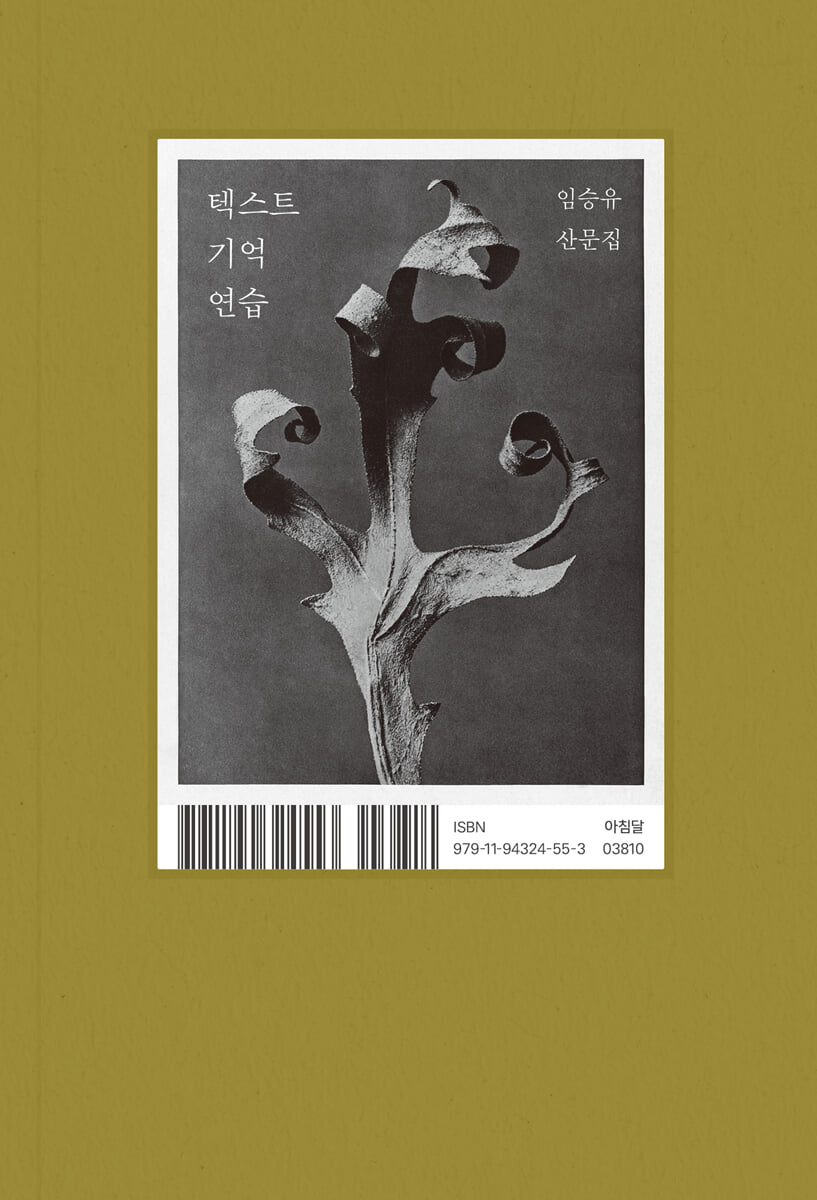
Text memory practice
 |
Description
Book Introduction
Poet Seung-yu Lim's prose collection, "Text Memory Practice," which questions stories believed to be stereotypical and plants blank spaces to open up a unique sense of tension with the world, has been published by Achimdal.
This book is the first collection of prose published by a poet who began his writing career in 2011.
The 'position of female speech' that the poet has been contemplating and delving into over the past four volumes of poetry is depicted in specific scenes.
The process of picking up fragments of childhood that were too vivid to be brought up vividly and fitting fragmented utterances into memory clearly demonstrates the time when the sentences the poet agonized over while writing poetry could have been the seeds that sprouted into his poetic world.
The keywords that this book, which is composed of four parts, gives us are ‘scene,’ ‘object,’ ‘novel,’ and ‘person.’
He willingly starts from a scene from his tragic childhood to speak for himself.
The poet rejects self-pity and simply enumerates the scenes that have constituted his life.
Here, there are only facts, and the stories that develop into increasingly concrete forms are written not as a poet looking into the past, but as a way for memory itself to practice the text.
Objects as a clear world act as vivid images in the text that memory practices.
The novels that a poet who loves novelists consistently reads actually shed more light on his poetry and life.
So the poet returns to people again.
This is why Seung-Yu Lim's prose, which says that speaking to many people is no different from speaking to just one person, is so precious to us today.
These four words will be essential elements to concisely assemble the world of Seungyu Lim.
The memories of Seung-yu Lim, who tells stories in a uniquely individual style, are still freely practicing sentences.
Readers will be captivated by the unadorned eloquence of this book, and will find themselves writing new texts from their own memories.
This book is the first collection of prose published by a poet who began his writing career in 2011.
The 'position of female speech' that the poet has been contemplating and delving into over the past four volumes of poetry is depicted in specific scenes.
The process of picking up fragments of childhood that were too vivid to be brought up vividly and fitting fragmented utterances into memory clearly demonstrates the time when the sentences the poet agonized over while writing poetry could have been the seeds that sprouted into his poetic world.
The keywords that this book, which is composed of four parts, gives us are ‘scene,’ ‘object,’ ‘novel,’ and ‘person.’
He willingly starts from a scene from his tragic childhood to speak for himself.
The poet rejects self-pity and simply enumerates the scenes that have constituted his life.
Here, there are only facts, and the stories that develop into increasingly concrete forms are written not as a poet looking into the past, but as a way for memory itself to practice the text.
Objects as a clear world act as vivid images in the text that memory practices.
The novels that a poet who loves novelists consistently reads actually shed more light on his poetry and life.
So the poet returns to people again.
This is why Seung-Yu Lim's prose, which says that speaking to many people is no different from speaking to just one person, is so precious to us today.
These four words will be essential elements to concisely assemble the world of Seungyu Lim.
The memories of Seung-yu Lim, who tells stories in a uniquely individual style, are still freely practicing sentences.
Readers will be captivated by the unadorned eloquence of this book, and will find themselves writing new texts from their own memories.
- You can preview some of the book's contents.
Preview
index
Prologue Miwon
Part 1 scene
Enumeration 1
Jeon Mi-rae
wash
plants
house
Part 2 Things
Umbrella worries
Clothes to wear at home
Good memories
Pick up a pencil
Use a handkerchief
Don't drink beer
Gurye, Gurye
Winter Dream
Part 3 novel
narrow world
Novel sentences
I'm doing well
Enumeration 2
It's repetitive, but it's okay
light, shade
What is your name?
If you don't have to think about becoming something, that's probably the best thing.
Part 4 People
Seasonal Memory
Matter and sleep
Repetition that saves
My favorite sentence
somewhat false
What happens to us
A person who only I know
What's left behind in the epilogue
Part 1 scene
Enumeration 1
Jeon Mi-rae
wash
plants
house
Part 2 Things
Umbrella worries
Clothes to wear at home
Good memories
Pick up a pencil
Use a handkerchief
Don't drink beer
Gurye, Gurye
Winter Dream
Part 3 novel
narrow world
Novel sentences
I'm doing well
Enumeration 2
It's repetitive, but it's okay
light, shade
What is your name?
If you don't have to think about becoming something, that's probably the best thing.
Part 4 People
Seasonal Memory
Matter and sleep
Repetition that saves
My favorite sentence
somewhat false
What happens to us
A person who only I know
What's left behind in the epilogue
Detailed image

Into the book
I mean, I'm trying to write in a way that doesn't involve recalling memories through sentences, but rather, where the memories themselves become sentences, finding a narrative style.
As I wrote the articles grouped here, I experienced memories.
Rather than reliving past events, I experienced them through the texture of the sentences being written.
--- From "Prologue - Miwon"
After she's been scolded enough, will the girl wake up from her deep sleep, wash her face, hair, change her clothes, and go to school after the sports day as if nothing happened?
When a friend asks you behind your back, "Why haven't you been coming to school?", will you turn around and say, "Oh, my father passed away?"
Instead of pretending not to hear and running away.
He might not have secretly picked up a gold mechanical pencil that had fallen on the floor of a stationery store, brought it home, and then hidden it deep in a desk drawer for fear that anyone would see it.
--- From "Enumeration 1"
When it rains in the summer, girls gather at the stream, bowing and raising their heads, just as the grass in the fields grows tall.
Time seems to flow like that.
As if one garment is washed, another garment appears, and one day follows another, and one season passes and the next season comes.
I walked away from the scene and then came back into it.
--- From "Laundry"
Memories are such a blessing.
Everything else that happened that day was deleted, leaving only the couple's conversation.
That I only remember that part sensually.
Could that memory be a longing for those days?
If so.
If it had been so horrible that it was impossible to remember it, so horrible that it was impossible to live while remembering it, I should have just turned a blind eye and acted as if nothing had happened, but I remembered and remembered, and in my dreams I even stood in the yard of that house and looked at the door.
What kind of person am I?
What am I holding onto and can't put down? What am I, who, terrified to see myself standing in that house's yard, runs back home, covers myself with the blanket, and wakes from my dream?
--- From "Home"
Life, the boundary that the word life functions on, may not cross over to either side, but rather be a tangled, faintly clinging scent.
The thought that I grew taller little by little, eating food and feeling anxious, clinging to that smell that changed slightly with each season.
--- From "Clothes to Wear at Home"
The plants are there.
Alive.
Live every moment.
Me too.
The problem is that it's not easy to focus on the feeling of being alive in every moment, to accept that that's all there is to it.
The expectation that there will be something more, so we keep trying to create that something, and if that doesn't happen, we feel like we're not alive.
Plants, more than anything else, constantly reminded me that my sense of speed was alienating me.
--- From "I'm doing well"
How much I have tormented myself by being harsh to you, who is harsh to me.
How much more must you have tormented yourself by being so harsh to me, who was so cruel to you?
That's why I sometimes think of myself, who hasn't been able to come back yet.
I came back home, struggling to live, eating, drinking coffee, brushing my teeth, and looking in the mirror, I became someone who had lost the sense of dressing, but I also remember what you said.
You smile so brightly.
So, I see.
That I am a person who smiles brightly.
--- From "People Only I Know"
I think it's time to say this now.
I decided not to tell the kid who was lying down to sleep to get up and come over here.
I am both there and here.
There is a me who had no choice but to leave something behind, who had the ability to leave something behind, and there is a me who remembers that.
As I wrote the articles grouped here, I experienced memories.
Rather than reliving past events, I experienced them through the texture of the sentences being written.
--- From "Prologue - Miwon"
After she's been scolded enough, will the girl wake up from her deep sleep, wash her face, hair, change her clothes, and go to school after the sports day as if nothing happened?
When a friend asks you behind your back, "Why haven't you been coming to school?", will you turn around and say, "Oh, my father passed away?"
Instead of pretending not to hear and running away.
He might not have secretly picked up a gold mechanical pencil that had fallen on the floor of a stationery store, brought it home, and then hidden it deep in a desk drawer for fear that anyone would see it.
--- From "Enumeration 1"
When it rains in the summer, girls gather at the stream, bowing and raising their heads, just as the grass in the fields grows tall.
Time seems to flow like that.
As if one garment is washed, another garment appears, and one day follows another, and one season passes and the next season comes.
I walked away from the scene and then came back into it.
--- From "Laundry"
Memories are such a blessing.
Everything else that happened that day was deleted, leaving only the couple's conversation.
That I only remember that part sensually.
Could that memory be a longing for those days?
If so.
If it had been so horrible that it was impossible to remember it, so horrible that it was impossible to live while remembering it, I should have just turned a blind eye and acted as if nothing had happened, but I remembered and remembered, and in my dreams I even stood in the yard of that house and looked at the door.
What kind of person am I?
What am I holding onto and can't put down? What am I, who, terrified to see myself standing in that house's yard, runs back home, covers myself with the blanket, and wakes from my dream?
--- From "Home"
Life, the boundary that the word life functions on, may not cross over to either side, but rather be a tangled, faintly clinging scent.
The thought that I grew taller little by little, eating food and feeling anxious, clinging to that smell that changed slightly with each season.
--- From "Clothes to Wear at Home"
The plants are there.
Alive.
Live every moment.
Me too.
The problem is that it's not easy to focus on the feeling of being alive in every moment, to accept that that's all there is to it.
The expectation that there will be something more, so we keep trying to create that something, and if that doesn't happen, we feel like we're not alive.
Plants, more than anything else, constantly reminded me that my sense of speed was alienating me.
--- From "I'm doing well"
How much I have tormented myself by being harsh to you, who is harsh to me.
How much more must you have tormented yourself by being so harsh to me, who was so cruel to you?
That's why I sometimes think of myself, who hasn't been able to come back yet.
I came back home, struggling to live, eating, drinking coffee, brushing my teeth, and looking in the mirror, I became someone who had lost the sense of dressing, but I also remember what you said.
You smile so brightly.
So, I see.
That I am a person who smiles brightly.
--- From "People Only I Know"
I think it's time to say this now.
I decided not to tell the kid who was lying down to sleep to get up and come over here.
I am both there and here.
There is a me who had no choice but to leave something behind, who had the ability to leave something behind, and there is a me who remembers that.
--- From "Epilogue - What's Left Behind"
Publisher's Review
“How much have you changed and then gone back to where you were?”
Opening the margins of the story with delicate language
Poet Im Seung-yu's first collection of prose
Poet Seung-Yu Lim's first prose collection, "Text Memory Practice," which opens up a story of a clear but not yet fixed, opaque future in the most distinct and delicate language, and constructs a unique space of tension with the world, has been published by Achimdal.
The poet, who began his career through Literature and Society in 2011, has published his first collection of prose in 14 years. The world of poetry and life that the poet has penetrated over the years are told in more vivid and specific stories.
This book, finally born after a long period of writing, opens the way for a deeper exploration of the stories of female characters that the poet has repeatedly told in his poetry, and calmly shows the events that took place in the neighborhood where the poet lived and the people he met.
Lim Seung-yu's prose has many similarities to his poetry.
Readers who have been following the poet's poetry for a long time will be very pleased with this collection of prose.
This is because, through prose, we can obtain a more certain origin of the path through which the poems written by Seungyu Lim came to us.
But the poet's prose is unique in another way.
He usually lightly escapes the idea that prose is a writing that can show and prove an individual's life.
The reason this is possible is because I wrote the text in a way that my memory practices the text from the moment the sentences are written, rather than in a way that I write the text to remember the scene.
In other words, the world of prose unfolded by poet Seung-yu Lim guarantees the life of an individual, but strictly speaking, it is woven anew in the form of memories rewriting life.
For the poet, reality is full of countless gaps.
Poets have always lived as writers, feeling a sense of dissonance with this reality.
Just as his poetry maintains appropriate spacing between lines while subtly leaving a distance between stanzas, he adopts the same attitude in his prose.
He does not describe the places he once visited in a 're-experience' manner.
Instead, the story starts with sentences that make the story somewhat disjointed, such as, “Do you know who I met when I went to Miwon a while ago?” (Prologue “Miwon”), which the mother never said, or “If I’m going to write something about a girl, I should write it in enumeration form” (Enumeration 1), without going into the details of the scene.
Lim Seung-yu calls this “practice,” because for him, texts are always “things imagined beyond reality” (“I’m Doing Well”), and the poet himself only perceives reality belatedly through sentences, so later, memory becomes the subject and tries to rescue scenes from the past that were once lost.
The poet speaks of the space he creates:
“I tried to create a margin by making sentences with large strides.
“Imagine what might be in that space later.” (Laundry)
Seung-Yu Lim tells his story in a rather lumpy manner.
These lumps do not interfere with the specificity of the story, but rather show that the margins that are inevitably written into reality create space, rejecting sentences as tools for describing scenes and taking steps further than memory, along a different path.
From the scene to the person
A unique enumeration of strides
In this collection of essays, the scene on which poet Seung-yu Lim spends the most time is the fragments of childhood.
The first poem, “The Effect of a Hat,” included in her first poetry collection, “I Gave Birth to a Child, But I Was Not Enough,” begins with the first sentence, “Go to your relatives’ house.”
These words are directly connected to the poet's childhood.
The experience of living at a relative's house and washing my brother's sneakers that my relative's aunt gave me to wash, squatting by the faucet and washing them with soap, is a passage that allows me to directly understand where the position of speech as a woman has usually been.
For Seung-yu Lim, childhood is the background and basis for repeatedly speaking of a 'girl', an unfamiliar place that can barely be reached through sentences.
The poet begins this book by talking about a 'house' that he was afraid to enter.
Only by starting from the death of the father I wanted to ignore can I rescue the “me I left behind” in my memories (“The Person Only I Know”).
The poet presents four keywords to the reader to help them examine his own life.
This book is divided into four parts, each of which refers to ‘scenes,’ ‘objects,’ ‘novels,’ and ‘people.’
Part 1, 'Scenes', is mainly about childhood, starting with the death of the father and continuing with the story of the mother leaving home, and recalling memories of going to the stream with the mother before she left home and doing laundry under the moonlight, as well as the countless houses they visited.
In "Plants," which touches on the life of a poet who actually loves and grows plants, life is broadly contemplated through the determination of plants that grow silently.
Part 2, 'Things', introduces stories made with familiar objects from everyday life, such as an umbrella left behind after not meeting the person you were supposed to meet, clothes, shoes, pencils, handkerchiefs, and beer.
For the poet, things become “a means to reach people” (“A Certain False”).
Part 3, 'Novels', introduces various texts that have helped the poet advance his life, including novels he enjoyed reading, and fully displays the poet's writing sensibility that he has been contemplating.
In this part in particular, the poet expresses his deep understanding and thoughts about 'sentences'.
For a poet, the sense of repeating something is very important.
“I keep doing something over and over again to try to do it well somehow.
“It creates a form that repeats.” (“It’s Repetitive, But It’s Okay”) As the poet had wished, in the last sentence of the prose “Only the Bones Remain” included in his second poetry collection “Something Else,” he said, “I wish places would repeat infinitely.” Through this, he willingly dedicates sentences to memories that cannot help but fall into the shackles of infinite repetition as he continues to live in a form that continues to repeat the places he has lived.
Part 4, ‘People’, consists of writings that reflect the poet’s inner self, which returns to people after going through objects.
There are things like trying to transfer memories of the mysterious being called 'mother', whom I wanted to talk about at length at least once, by mixing in "some lies" and calling her "you", and trying to reach out to myself completely.
The rhetorical device primarily used in this collection of essays, which starts from a scene and reaches a person, is 'enumeration.'
According to the poet, enumeration is “one of the ways to avoid falling into a hole.”
Instead of writing in detail about the scenes he was in, Seung-Yu Lim simply lists the events as they happened.
Enumeration gives a sense of speed to the sentence and is a “non-serious technique” (“Enumeration 2”), so even if objects of the same hierarchy are listed, at some point objects of a different level are placed side by side, dramatically changing the situation.
This is the stride that Seung-yu Lim takes with a keen sense, and the repeated scenes of life are an escape route that is “good for escaping from situations with language.”
For Seung-yu Lim, memory means “not being able to enter that scene right away.”
To remember something, you need post-mortem sentences.
So the poet begins with a sentence.
“Don’t take that, Unnie.” “Where’s the Vaseline?” “That’s a really good memory.” “I picked a flower.” Sentences like these go before memories and find the characters in the scene.
The reason the poet's words are often tilted may mean that they are on the verge of falling over due to a precarious slope, but it may also be to reveal the "place" (from "A Person Only I Know") where there should be memories that keep watch over the words so that they can rest a little.
That is why Seung-Yu Lim is not someone who doubts his memory.
Seung-Yu Lim is a person who becomes a blank slate and a margin so that memory can practice text.
Opening the margins of the story with delicate language
Poet Im Seung-yu's first collection of prose
Poet Seung-Yu Lim's first prose collection, "Text Memory Practice," which opens up a story of a clear but not yet fixed, opaque future in the most distinct and delicate language, and constructs a unique space of tension with the world, has been published by Achimdal.
The poet, who began his career through Literature and Society in 2011, has published his first collection of prose in 14 years. The world of poetry and life that the poet has penetrated over the years are told in more vivid and specific stories.
This book, finally born after a long period of writing, opens the way for a deeper exploration of the stories of female characters that the poet has repeatedly told in his poetry, and calmly shows the events that took place in the neighborhood where the poet lived and the people he met.
Lim Seung-yu's prose has many similarities to his poetry.
Readers who have been following the poet's poetry for a long time will be very pleased with this collection of prose.
This is because, through prose, we can obtain a more certain origin of the path through which the poems written by Seungyu Lim came to us.
But the poet's prose is unique in another way.
He usually lightly escapes the idea that prose is a writing that can show and prove an individual's life.
The reason this is possible is because I wrote the text in a way that my memory practices the text from the moment the sentences are written, rather than in a way that I write the text to remember the scene.
In other words, the world of prose unfolded by poet Seung-yu Lim guarantees the life of an individual, but strictly speaking, it is woven anew in the form of memories rewriting life.
For the poet, reality is full of countless gaps.
Poets have always lived as writers, feeling a sense of dissonance with this reality.
Just as his poetry maintains appropriate spacing between lines while subtly leaving a distance between stanzas, he adopts the same attitude in his prose.
He does not describe the places he once visited in a 're-experience' manner.
Instead, the story starts with sentences that make the story somewhat disjointed, such as, “Do you know who I met when I went to Miwon a while ago?” (Prologue “Miwon”), which the mother never said, or “If I’m going to write something about a girl, I should write it in enumeration form” (Enumeration 1), without going into the details of the scene.
Lim Seung-yu calls this “practice,” because for him, texts are always “things imagined beyond reality” (“I’m Doing Well”), and the poet himself only perceives reality belatedly through sentences, so later, memory becomes the subject and tries to rescue scenes from the past that were once lost.
The poet speaks of the space he creates:
“I tried to create a margin by making sentences with large strides.
“Imagine what might be in that space later.” (Laundry)
Seung-Yu Lim tells his story in a rather lumpy manner.
These lumps do not interfere with the specificity of the story, but rather show that the margins that are inevitably written into reality create space, rejecting sentences as tools for describing scenes and taking steps further than memory, along a different path.
From the scene to the person
A unique enumeration of strides
In this collection of essays, the scene on which poet Seung-yu Lim spends the most time is the fragments of childhood.
The first poem, “The Effect of a Hat,” included in her first poetry collection, “I Gave Birth to a Child, But I Was Not Enough,” begins with the first sentence, “Go to your relatives’ house.”
These words are directly connected to the poet's childhood.
The experience of living at a relative's house and washing my brother's sneakers that my relative's aunt gave me to wash, squatting by the faucet and washing them with soap, is a passage that allows me to directly understand where the position of speech as a woman has usually been.
For Seung-yu Lim, childhood is the background and basis for repeatedly speaking of a 'girl', an unfamiliar place that can barely be reached through sentences.
The poet begins this book by talking about a 'house' that he was afraid to enter.
Only by starting from the death of the father I wanted to ignore can I rescue the “me I left behind” in my memories (“The Person Only I Know”).
The poet presents four keywords to the reader to help them examine his own life.
This book is divided into four parts, each of which refers to ‘scenes,’ ‘objects,’ ‘novels,’ and ‘people.’
Part 1, 'Scenes', is mainly about childhood, starting with the death of the father and continuing with the story of the mother leaving home, and recalling memories of going to the stream with the mother before she left home and doing laundry under the moonlight, as well as the countless houses they visited.
In "Plants," which touches on the life of a poet who actually loves and grows plants, life is broadly contemplated through the determination of plants that grow silently.
Part 2, 'Things', introduces stories made with familiar objects from everyday life, such as an umbrella left behind after not meeting the person you were supposed to meet, clothes, shoes, pencils, handkerchiefs, and beer.
For the poet, things become “a means to reach people” (“A Certain False”).
Part 3, 'Novels', introduces various texts that have helped the poet advance his life, including novels he enjoyed reading, and fully displays the poet's writing sensibility that he has been contemplating.
In this part in particular, the poet expresses his deep understanding and thoughts about 'sentences'.
For a poet, the sense of repeating something is very important.
“I keep doing something over and over again to try to do it well somehow.
“It creates a form that repeats.” (“It’s Repetitive, But It’s Okay”) As the poet had wished, in the last sentence of the prose “Only the Bones Remain” included in his second poetry collection “Something Else,” he said, “I wish places would repeat infinitely.” Through this, he willingly dedicates sentences to memories that cannot help but fall into the shackles of infinite repetition as he continues to live in a form that continues to repeat the places he has lived.
Part 4, ‘People’, consists of writings that reflect the poet’s inner self, which returns to people after going through objects.
There are things like trying to transfer memories of the mysterious being called 'mother', whom I wanted to talk about at length at least once, by mixing in "some lies" and calling her "you", and trying to reach out to myself completely.
The rhetorical device primarily used in this collection of essays, which starts from a scene and reaches a person, is 'enumeration.'
According to the poet, enumeration is “one of the ways to avoid falling into a hole.”
Instead of writing in detail about the scenes he was in, Seung-Yu Lim simply lists the events as they happened.
Enumeration gives a sense of speed to the sentence and is a “non-serious technique” (“Enumeration 2”), so even if objects of the same hierarchy are listed, at some point objects of a different level are placed side by side, dramatically changing the situation.
This is the stride that Seung-yu Lim takes with a keen sense, and the repeated scenes of life are an escape route that is “good for escaping from situations with language.”
For Seung-yu Lim, memory means “not being able to enter that scene right away.”
To remember something, you need post-mortem sentences.
So the poet begins with a sentence.
“Don’t take that, Unnie.” “Where’s the Vaseline?” “That’s a really good memory.” “I picked a flower.” Sentences like these go before memories and find the characters in the scene.
The reason the poet's words are often tilted may mean that they are on the verge of falling over due to a precarious slope, but it may also be to reveal the "place" (from "A Person Only I Know") where there should be memories that keep watch over the words so that they can rest a little.
That is why Seung-Yu Lim is not someone who doubts his memory.
Seung-Yu Lim is a person who becomes a blank slate and a margin so that memory can practice text.
GOODS SPECIFICS
- Date of issue: November 18, 2025
- Page count, weight, size: 212 pages | 282g | 128*188*14mm
- ISBN13: 9791194324553
- ISBN10: 119432455X
You may also like
카테고리
korean


korean

![GQ KOREA Mark (Monthly): December [2025]](http://librairie.coreenne.fr/cdn/shop/files/8ef265dbbfbf186523ed75ba7319009d.jpg?v=1765340328&width=3840)


