

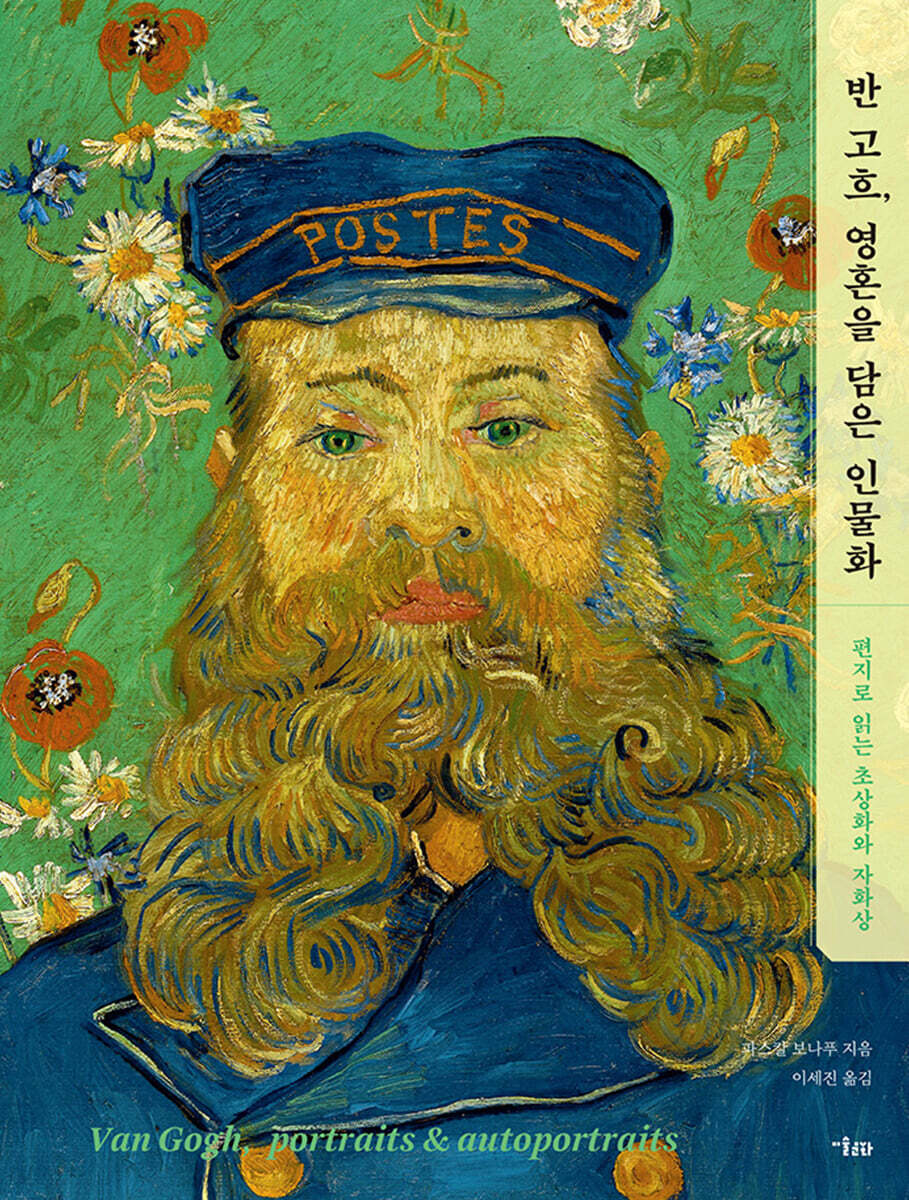
Van Gogh, Portraits Filled with Soul
 |
Description
Book Introduction
Vincent van Gogh, a painter loved by people all over the world.
His works, of which only one was sold during his lifetime, are recognized as some of the most expensive masterpieces representing the art market today.
Sunflowers, Starry Night, Almond Trees in Bloom, Wheat Field with Crows… Most of his works that we remember are landscapes, but in fact, the subject he was most attached to throughout his life was people.
This appears in a letter to his sister Villemin in June 1888:
“I am a landscape painter now, but I am actually better at portrait painting.”
So why did he draw people, and what did he want to find in those pictures?
『Van Gogh: Portraits with a Soul』, written by renowned French art historian Pascal Bonafou, is an art humanities book that focuses solely on Vincent's portraits and self-portraits.
From the darkness of Northern Europe to the dazzling light of Arles and finally to his final destination, Auvers-sur-Oise, it follows the places he has visited, showing a journey of intense and patient artistic exploration.
Hundreds of letters and over 150 portraits and self-portraits will provide a glimpse into Van Gogh's inner self and artistic world, and will be of great help in understanding his true nature.
His works, of which only one was sold during his lifetime, are recognized as some of the most expensive masterpieces representing the art market today.
Sunflowers, Starry Night, Almond Trees in Bloom, Wheat Field with Crows… Most of his works that we remember are landscapes, but in fact, the subject he was most attached to throughout his life was people.
This appears in a letter to his sister Villemin in June 1888:
“I am a landscape painter now, but I am actually better at portrait painting.”
So why did he draw people, and what did he want to find in those pictures?
『Van Gogh: Portraits with a Soul』, written by renowned French art historian Pascal Bonafou, is an art humanities book that focuses solely on Vincent's portraits and self-portraits.
From the darkness of Northern Europe to the dazzling light of Arles and finally to his final destination, Auvers-sur-Oise, it follows the places he has visited, showing a journey of intense and patient artistic exploration.
Hundreds of letters and over 150 portraits and self-portraits will provide a glimpse into Van Gogh's inner self and artistic world, and will be of great help in understanding his true nature.
- You can preview some of the book's contents.
Preview
index
Introduction: Vincent's Ambition
Early Figure Studies: Eton & Hague (April 1881–September 1883)
1.
I can't stand dark photos
2.
A chance to conserve energy and reform yourself
3.
She has just what I need.
4.
I have to feel some kind of self-dissatisfaction
5.
I don't know any other way
6.
With this passion within you
Figures in the Dark: Nuenen (December 1883–November 1885)
1.
Like everywhere else, people here hate modeling.
2.
This cemetery with its old crosses won't leave my mind.
Between Resemblance and Ambition: Antwerp (November 1885–February 1886)
1.
I'm sure there's something for me to do here
Dialogue between Color and Self: Paris (February 1886–February 1888)
1.
I have to create a masterpiece
2.
He has more of an ordinary merchant's temperament than an extraordinary artist's.
3.
Be sure to convey my greetings.
4.
The brain is made of flint
5.
She claimed that I started a fight.
6.
I gave it to you as a souvenir
7.
A colored sketch of my face
The Reinvention of Color: Arles (February 1888–May 1889)
1.
Frans Hals's Yellow
2.
The future of new art lies in the South.
3.
I started using colors more arbitrarily.
4.
I painted a portrait of the whole family.
5.
I might be better at getting along with poor people or middle class people.
6.
I wish I could paint his portrait
7.
A combination of ash and reddish gray
Solitude and the Inner World: Saint-Rémy-de-Provence (May 1889–May 1890)
1.
For me, work is a better distraction than anything else.
2.
It's not easy to draw yourself
Final destination: Auvers-sur-Oise (May 1890-July 1890)
1.
At first glance, it seems like that person is in more pain than me.
Letters | Legendary Paintings | References | Index of Names | Acknowledgements
Early Figure Studies: Eton & Hague (April 1881–September 1883)
1.
I can't stand dark photos
2.
A chance to conserve energy and reform yourself
3.
She has just what I need.
4.
I have to feel some kind of self-dissatisfaction
5.
I don't know any other way
6.
With this passion within you
Figures in the Dark: Nuenen (December 1883–November 1885)
1.
Like everywhere else, people here hate modeling.
2.
This cemetery with its old crosses won't leave my mind.
Between Resemblance and Ambition: Antwerp (November 1885–February 1886)
1.
I'm sure there's something for me to do here
Dialogue between Color and Self: Paris (February 1886–February 1888)
1.
I have to create a masterpiece
2.
He has more of an ordinary merchant's temperament than an extraordinary artist's.
3.
Be sure to convey my greetings.
4.
The brain is made of flint
5.
She claimed that I started a fight.
6.
I gave it to you as a souvenir
7.
A colored sketch of my face
The Reinvention of Color: Arles (February 1888–May 1889)
1.
Frans Hals's Yellow
2.
The future of new art lies in the South.
3.
I started using colors more arbitrarily.
4.
I painted a portrait of the whole family.
5.
I might be better at getting along with poor people or middle class people.
6.
I wish I could paint his portrait
7.
A combination of ash and reddish gray
Solitude and the Inner World: Saint-Rémy-de-Provence (May 1889–May 1890)
1.
For me, work is a better distraction than anything else.
2.
It's not easy to draw yourself
Final destination: Auvers-sur-Oise (May 1890-July 1890)
1.
At first glance, it seems like that person is in more pain than me.
Letters | Legendary Paintings | References | Index of Names | Acknowledgements
Into the book
He says.
“We can only tell with our pictures.” The story of who Vincent was and what he wanted must be constructed from what he claimed, said, and confessed in his letters.
It's a story about his clarity and his demands.
--- p.20
The artist's intense gaze may also have been exemplified in two self-portraits painted by Vincent in Antwerp.
That gaze always caught Vincent's attention and always brought him back to the portrait.
--- p.32-33
“I don’t want to keep the photo because I think it’s ugly.
Especially photos of people I know and like.
Portraits fade faster than we ourselves.
But the portrait painted by the artist remains the same even after several generations.
Moreover, the portrait feels like it was created with love and respect for the person.”
--- p.41
Vincent believed that he could make a living as an artist through portraiture.
--- p.42
Vincent painted the portrait of his master Tanguy out of gratitude for his hospitality, for providing him with good paints and for displaying his paintings in the window of his shop on Rue de Clozel, among other reasons.
Before fighting Segatori, he painted her portrait because he was grateful that she hung his painting in her Tangburin Cafe.
Vincent was always like that.
--- p.53
Vincent made it his mission to give space to those who had never been important.
--- p.67
“When I draw female farmers, I want to draw them like female farmers.
When I draw a prostitute, I want to express her as a prostitute.
That is precisely why I was particularly impressed by Rembrandt's painting of a prostitute's head.”
--- p.78
“I want to draw people, people, still people.
I can't control that longing.
“I would like to work in a series of these bipedal peoples, from babies to Socrates, from women with white skin and black hair to blondes with sun-kissed brick skin.”
--- p.177
Vincent had an early insight into the world he was in.
“I don’t know how to get along with people who are very strict about manners, but I may be better at getting along with poor people or the common people.”
--- p.196
“People say it’s difficult to know yourself, but it’s not easy to draw yourself either.
I'm working on two portraits of myself these days because I don't have any other models.
“Now it’s time to spend more time drawing characters.”
--- p.238
“I hope I can paint portraits that will be welcome to people a century from now.
So I try to do that not with a photographic resemblance, but with an expression imbued with our emotions, using my knowledge of color and my modern sense of color as a means of elevating and expressing individuality.”
“We can only tell with our pictures.” The story of who Vincent was and what he wanted must be constructed from what he claimed, said, and confessed in his letters.
It's a story about his clarity and his demands.
--- p.20
The artist's intense gaze may also have been exemplified in two self-portraits painted by Vincent in Antwerp.
That gaze always caught Vincent's attention and always brought him back to the portrait.
--- p.32-33
“I don’t want to keep the photo because I think it’s ugly.
Especially photos of people I know and like.
Portraits fade faster than we ourselves.
But the portrait painted by the artist remains the same even after several generations.
Moreover, the portrait feels like it was created with love and respect for the person.”
--- p.41
Vincent believed that he could make a living as an artist through portraiture.
--- p.42
Vincent painted the portrait of his master Tanguy out of gratitude for his hospitality, for providing him with good paints and for displaying his paintings in the window of his shop on Rue de Clozel, among other reasons.
Before fighting Segatori, he painted her portrait because he was grateful that she hung his painting in her Tangburin Cafe.
Vincent was always like that.
--- p.53
Vincent made it his mission to give space to those who had never been important.
--- p.67
“When I draw female farmers, I want to draw them like female farmers.
When I draw a prostitute, I want to express her as a prostitute.
That is precisely why I was particularly impressed by Rembrandt's painting of a prostitute's head.”
--- p.78
“I want to draw people, people, still people.
I can't control that longing.
“I would like to work in a series of these bipedal peoples, from babies to Socrates, from women with white skin and black hair to blondes with sun-kissed brick skin.”
--- p.177
Vincent had an early insight into the world he was in.
“I don’t know how to get along with people who are very strict about manners, but I may be better at getting along with poor people or the common people.”
--- p.196
“People say it’s difficult to know yourself, but it’s not easy to draw yourself either.
I'm working on two portraits of myself these days because I don't have any other models.
“Now it’s time to spend more time drawing characters.”
--- p.238
“I hope I can paint portraits that will be welcome to people a century from now.
So I try to do that not with a photographic resemblance, but with an expression imbued with our emotions, using my knowledge of color and my modern sense of color as a means of elevating and expressing individuality.”
--- p.247
Publisher's Review
The faces his gaze lingered on, the people his heart drew
In 1873, at the age of twenty, Vincent was already fascinated by portraits even before he began painting in earnest.
I traveled to European art museums, including those in Dordrecht, Amsterdam, and Paris, and spent a long time in front of portraits by Rembrandt, Frans Hals, Adrian Brouwer, and Jan Lievens.
He wanted to be a portrait painter from an early age, took the works of the great masters as his standards, and shared their artistic ambitions.
“That’s why I was particularly impressed by Rembrandt’s painting of the prostitute’s head.
The artist has captured that enigmatic smile so well, with a sincerity that only he, the wizard of wizards, can achieve.
There's something new there for me, and I want to do whatever it takes to make it happen.
Manet did it, and so did Courbet.
“Damn, I have the same ambition.”
However, painting portraits meant competing with the masters, and it was bound to be a great challenge for Vincent.
After constantly having internal conversations while looking at their work, he decides to take a different path from others.
At the time, portraiture was considered the preserve of the privileged, and while Rembrandt actually painted for the aristocracy of Amsterdam, Vincent chose as his models the nameless, petit bourgeois, the poor, whom he called the Third Estate.
The old man, the fisherman, the prostitute, the farmer… they stood before the canvas for one reason only.
It was more meaningful to have their existence recorded in Van Gogh's paintings than in their difficult daily lives.
In this way, “Vincent made it his mission to give space to people who had never been important.”
The question Van Gogh asked the world: “Who am I?”
The act of repeatedly drawing one's own face was not simply narcissism.
It was a fierce experiment to prove his existence to the world and train himself as an artist.
Finding models was always a big challenge for him, who wanted to paint portraits and become a portrait artist.
Due to financial constraints, he was unable to find a model, so he ended up choosing the closest subject: himself.
“I bought a nice mirror on purpose so I could draw myself when there was no model.
“If I can paint my own face well, other people will be able to paint it well too.”
The 30 or so self-portraits he left behind during his short life fully capture Van Gogh's anxiety, loneliness, will to hold on to life, and endless self-exploration.
Looking at his own face in the mirror, he analyzed his emotions and expressions, reproduced them with a brush, and simultaneously explored the meaning of human existence and art.
Van Gogh's sincerity contained in hundreds of letters
Van Gogh's letters were not mere records or reports of everyday life.
His thoughts, feelings, interpersonal relationships, and artistic concerns are vividly captured here.
He constantly shared his explorations of painting, color, and figures with his friends and family, especially his brother Theo, and recorded his inner thoughts.
In the letter, he describes in detail the emotions, impressions, and even traces of life he felt while drawing a single person, confirming that a painting is not a simple visual representation but a tool for understanding humanity.
At times, he honestly confessed his anxieties, loneliness, artistic failures and conflicts, and reflected on his own growth as an artist.
“The character I drew is so repulsive that even I find it disgusting, so it must be even more so for others.
But what strengthens your skills the most is practicing on characters.”
“Portraits have their own unique vitality that comes from deep within the artist’s soul.
The machine never reaches its vitality.
“The more I look at the photos, the more I feel that way.”
In 1873, at the age of twenty, Vincent was already fascinated by portraits even before he began painting in earnest.
I traveled to European art museums, including those in Dordrecht, Amsterdam, and Paris, and spent a long time in front of portraits by Rembrandt, Frans Hals, Adrian Brouwer, and Jan Lievens.
He wanted to be a portrait painter from an early age, took the works of the great masters as his standards, and shared their artistic ambitions.
“That’s why I was particularly impressed by Rembrandt’s painting of the prostitute’s head.
The artist has captured that enigmatic smile so well, with a sincerity that only he, the wizard of wizards, can achieve.
There's something new there for me, and I want to do whatever it takes to make it happen.
Manet did it, and so did Courbet.
“Damn, I have the same ambition.”
However, painting portraits meant competing with the masters, and it was bound to be a great challenge for Vincent.
After constantly having internal conversations while looking at their work, he decides to take a different path from others.
At the time, portraiture was considered the preserve of the privileged, and while Rembrandt actually painted for the aristocracy of Amsterdam, Vincent chose as his models the nameless, petit bourgeois, the poor, whom he called the Third Estate.
The old man, the fisherman, the prostitute, the farmer… they stood before the canvas for one reason only.
It was more meaningful to have their existence recorded in Van Gogh's paintings than in their difficult daily lives.
In this way, “Vincent made it his mission to give space to people who had never been important.”
The question Van Gogh asked the world: “Who am I?”
The act of repeatedly drawing one's own face was not simply narcissism.
It was a fierce experiment to prove his existence to the world and train himself as an artist.
Finding models was always a big challenge for him, who wanted to paint portraits and become a portrait artist.
Due to financial constraints, he was unable to find a model, so he ended up choosing the closest subject: himself.
“I bought a nice mirror on purpose so I could draw myself when there was no model.
“If I can paint my own face well, other people will be able to paint it well too.”
The 30 or so self-portraits he left behind during his short life fully capture Van Gogh's anxiety, loneliness, will to hold on to life, and endless self-exploration.
Looking at his own face in the mirror, he analyzed his emotions and expressions, reproduced them with a brush, and simultaneously explored the meaning of human existence and art.
Van Gogh's sincerity contained in hundreds of letters
Van Gogh's letters were not mere records or reports of everyday life.
His thoughts, feelings, interpersonal relationships, and artistic concerns are vividly captured here.
He constantly shared his explorations of painting, color, and figures with his friends and family, especially his brother Theo, and recorded his inner thoughts.
In the letter, he describes in detail the emotions, impressions, and even traces of life he felt while drawing a single person, confirming that a painting is not a simple visual representation but a tool for understanding humanity.
At times, he honestly confessed his anxieties, loneliness, artistic failures and conflicts, and reflected on his own growth as an artist.
“The character I drew is so repulsive that even I find it disgusting, so it must be even more so for others.
But what strengthens your skills the most is practicing on characters.”
“Portraits have their own unique vitality that comes from deep within the artist’s soul.
The machine never reaches its vitality.
“The more I look at the photos, the more I feel that way.”
GOODS SPECIFICS
- Date of issue: October 24, 2025
- Page count, weight, size: 296 pages | 752g | 172*225*20mm
- ISBN13: 9791192768427
- ISBN10: 1192768426
You may also like
카테고리
korean


korean

![GQ KOREA Mark (Monthly): December [2025]](http://librairie.coreenne.fr/cdn/shop/files/8ef265dbbfbf186523ed75ba7319009d.jpg?v=1765340328&width=3840)


