

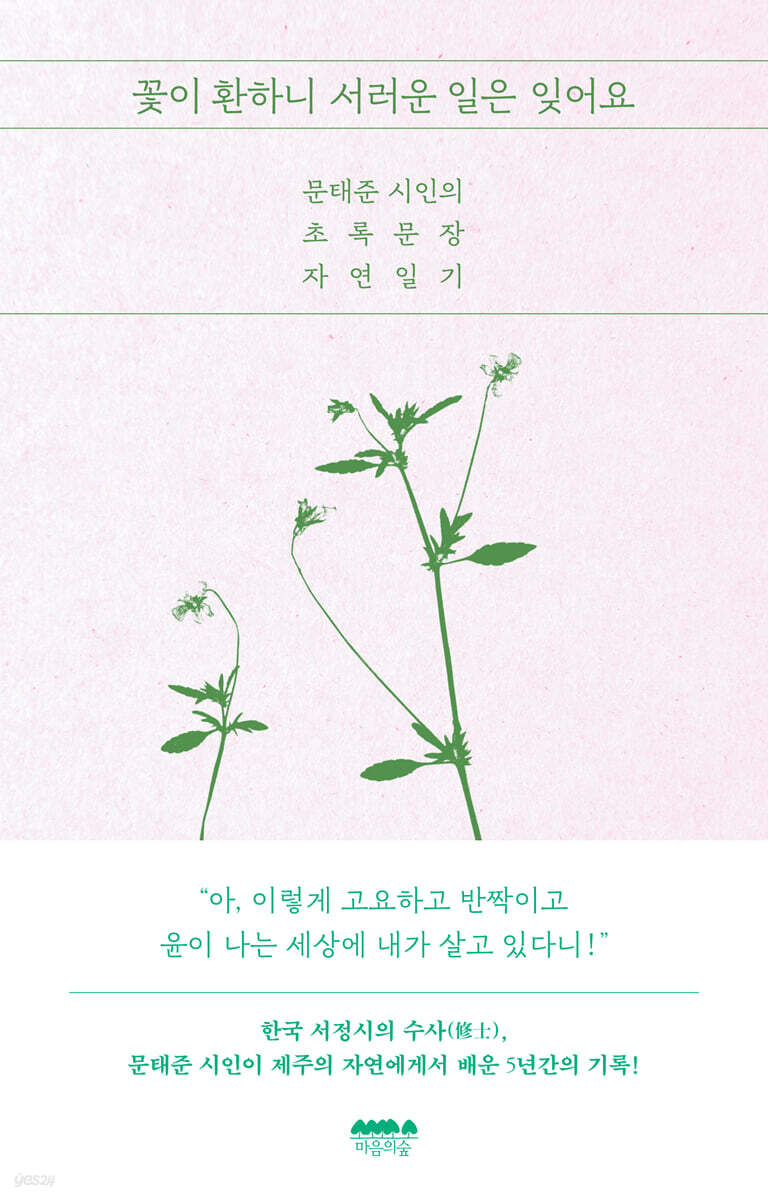
The flowers are bright, so I forget about the sad things.
 |
Description
Book Introduction
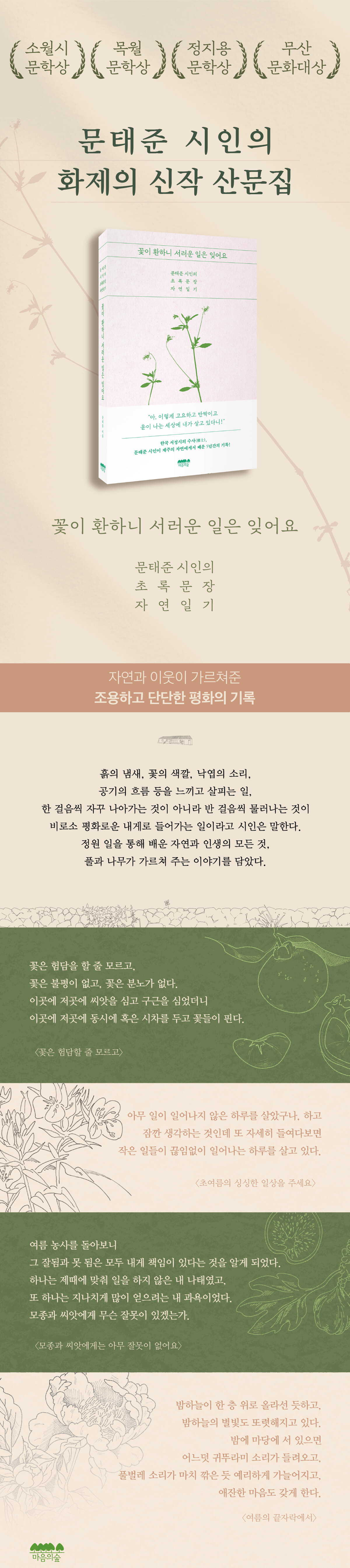
★ Winner of the Sowol Poetry Literature Award, Mokwol Literature Award, Jeong Ji-yong Literature Award, and Musan Cultural Award! Poet Taejun Moon's hot new prose collection!
★ A record of 5 years of learning from nature while living in a rural village in Jeju!
★ Read the essence of poetic prose!
★ A green story pulled from the soil, a comfort to the heart!
Poet Taejun Moon's new collection of essays, "The Flowers Are Bright, So I Forget Sad Things," which he wrote about in his Jeju countryside home, where he cultivated an old field, pulled out weeds, and recorded flowers, trees, and nature, is full of sentences that will purify the minds of modern people weary of civilization.
The poet's sentences are a green comfort found in nature, like a shower pouring down on a hot summer day, the sound of a refreshing breeze, a clearing in the forest, or the bright silence of flowers blooming.
This collection of essays by poet Taejun Moon, winner of Korea's top literary awards including the Sowol Poetry Literature Award, Mokwol Literature Award, Jeong Jiyong Literature Award, and Musan Cultural Award, shows the poet's maturity as he discovers and understands the source of life in nature.
The poet says that feeling and observing the smell of the earth, the color of flowers, the sound of fallen leaves, and the flow of air, and taking half a step back rather than continuously moving forward, is the way to finally enter a peaceful self.
It contains everything about nature and life learned through gardening, and stories taught by grass and trees.
★ A record of 5 years of learning from nature while living in a rural village in Jeju!
★ Read the essence of poetic prose!
★ A green story pulled from the soil, a comfort to the heart!
Poet Taejun Moon's new collection of essays, "The Flowers Are Bright, So I Forget Sad Things," which he wrote about in his Jeju countryside home, where he cultivated an old field, pulled out weeds, and recorded flowers, trees, and nature, is full of sentences that will purify the minds of modern people weary of civilization.
The poet's sentences are a green comfort found in nature, like a shower pouring down on a hot summer day, the sound of a refreshing breeze, a clearing in the forest, or the bright silence of flowers blooming.
This collection of essays by poet Taejun Moon, winner of Korea's top literary awards including the Sowol Poetry Literature Award, Mokwol Literature Award, Jeong Jiyong Literature Award, and Musan Cultural Award, shows the poet's maturity as he discovers and understands the source of life in nature.
The poet says that feeling and observing the smell of the earth, the color of flowers, the sound of fallen leaves, and the flow of air, and taking half a step back rather than continuously moving forward, is the way to finally enter a peaceful self.
It contains everything about nature and life learned through gardening, and stories taught by grass and trees.
- You can preview some of the book's contents.
Preview
index
Introduction - 6
Summer: Galaxy-like hydrangeas bloom in the summer garden.
Time for a Rainy Day - 21
Living by pulling out grass - 24
Flowers don't know how to gossip - 26
Even if thunder passes through our lives - 28
A House Where Nights Crying Cicadas Enter - 31
What You Gain from Being Immature - 34
Give me the freshness of early summer - 39
Time of Great Heat - 43
Blue Rain and the Croaking of Frogs - 47
When the face of summer is glimpsed - 49
Page 53 of Memories
When the wind blows hard, the strong grass knows - 55
Hanging clothes on a clothesline - 56
Color and Fragrance in Words and Writing - 58
Homie - 62
I love you because you're a child - 64
Horizon - 65
In the garden when it drizzles - 67
Even if you suddenly don't recognize me - 68
Lotus Pond - 70
Island - 72
Two Bicycles - 73
Like an Invited Guest - 75
Peach Tree - 77
My Burst - 79
There's nothing wrong with the seedlings and seeds - 81
Stone wall and green moss - 83
A Special Scene on a Summer Day - 85
I retreat to the earth, the stones, the forest, and myself - 87
At the End of Summer - 91
Autumn: Purple figs hang in clusters on every branch.
We have plenty of fruit left to share - 95
Two Blackened Faces - 99
Record of the Fields - 102
The World Embraced by the Pond - 103
Things My Life Depends On - 104
A Moment of Luxury, Tranquility, and Excitement - 105
Avoiding the Stones - 106
Thank You or Sorry - 108
Quiet Encounter - 112
The moment you open the front door and step in - 114
Caring for My Body and Mind, Inside and Out - 115
Things Awakened by the Sound of Autumn Dawn Rain - 117
On the Narrow - 120
Beyond the Realm - 121
Kanna - 123
To keep your face from being obscured - 126
Autumn, White Shades, and Van Gogh - 128
This is how human roots should be - 134
When the fragrance returns - 136
Fig Tree in Autumn - 138
The season of tangerine-colored leaves - 141
The Neighbor's Dog - 143
Garden Time - 145
Learning to Grow a Small Autumn Garden - 147
Grandma dragging a bag of fertilizer - 150
Now is the time - 151
The End of Autumn, Encountered Inside Autumn - 153
Sweeping Fallen Leaves - 156
Winter: Even in a snowstorm, footprints like ice remain
If you cultivate in winter, you can grow crops as if they were in spring - 161
Self-delighting height - 164
First Snow - 166
Under the Sun - 167
Snowman Time - 168
Words Said for No Reason - 171
Blue Bamboo Leaf Shinwoo-dae - 172
We Must Live in a Bright World - 175
First Full Moon - 179
Time to Find Peace - 180
Facing the Cold Wind - 185
Red Bean Porridge - 188
Voices of the Winter Wind - 189
Yuzu Scent - 190
Received a new calendar - 191
Three Raw Rice Balls - 193
May new grass sprout in your heart - 194
Clear and Fragrant Things - 196
Finding the Honey in Your Own Flower - 199
Dried Flowers and Leaves - 202
A calm and unchanging inner living room beneath the lake ice - 204
A Snowy Winter Night - 207
White and Winter Garden - 208
Small but sometimes heavier than a rock - 211
Chusa's Exile - 213
The Time of the Red Camellia - 217
Living in the Time of Heavy Snow - 218
Reflecting on the End - 220
Spring: Like bright light gathered in the palms of your hands
Spring Under Thin Ice - 223
New shoots on a fig tree branch - 226
Spring Snow and Spring Sunshine - 228
Grandma's Spring Herbs - 231
In the shade of spring soaked with fox rain - 233
Beginning of Spring Scenery - 236
Garden Story - 237
Life and death are like water and ice - 240
Sleep for Seven Nights - 242
Guest - 243
A village that plants flowers even outside the fence - 244
Sunflowers that Bloomed Without Us Knowing - 246
A Voice Like Yellow Revenge Grass - 248
Old Couple's Restaurant - 249
Everyday Music That Sparkles Like Gold and Silver - 251
How to Stop Thinking - 255
If it's a love that will walk together until we turn gray - 256
Falling Flowers Snowstorm - 260
Sprinkle water on the stone - 261
I don't want to go far - 263
Just say nice things - 264
The Road That Turns Nine Times in a Hundred Steps - 266
Peonies are like cathedrals and temples - 268
Three Resolutions - 271
Things We Can Control - 273
I need to laugh harder - 274
Garden and Pomegranate Pots - 278
Peonies are blooming in my heart - 282
Praise of the Veranda - 284
Stone - 286
If only I had remembered the advice I heard back then longer - 288
Summer: Galaxy-like hydrangeas bloom in the summer garden.
Time for a Rainy Day - 21
Living by pulling out grass - 24
Flowers don't know how to gossip - 26
Even if thunder passes through our lives - 28
A House Where Nights Crying Cicadas Enter - 31
What You Gain from Being Immature - 34
Give me the freshness of early summer - 39
Time of Great Heat - 43
Blue Rain and the Croaking of Frogs - 47
When the face of summer is glimpsed - 49
Page 53 of Memories
When the wind blows hard, the strong grass knows - 55
Hanging clothes on a clothesline - 56
Color and Fragrance in Words and Writing - 58
Homie - 62
I love you because you're a child - 64
Horizon - 65
In the garden when it drizzles - 67
Even if you suddenly don't recognize me - 68
Lotus Pond - 70
Island - 72
Two Bicycles - 73
Like an Invited Guest - 75
Peach Tree - 77
My Burst - 79
There's nothing wrong with the seedlings and seeds - 81
Stone wall and green moss - 83
A Special Scene on a Summer Day - 85
I retreat to the earth, the stones, the forest, and myself - 87
At the End of Summer - 91
Autumn: Purple figs hang in clusters on every branch.
We have plenty of fruit left to share - 95
Two Blackened Faces - 99
Record of the Fields - 102
The World Embraced by the Pond - 103
Things My Life Depends On - 104
A Moment of Luxury, Tranquility, and Excitement - 105
Avoiding the Stones - 106
Thank You or Sorry - 108
Quiet Encounter - 112
The moment you open the front door and step in - 114
Caring for My Body and Mind, Inside and Out - 115
Things Awakened by the Sound of Autumn Dawn Rain - 117
On the Narrow - 120
Beyond the Realm - 121
Kanna - 123
To keep your face from being obscured - 126
Autumn, White Shades, and Van Gogh - 128
This is how human roots should be - 134
When the fragrance returns - 136
Fig Tree in Autumn - 138
The season of tangerine-colored leaves - 141
The Neighbor's Dog - 143
Garden Time - 145
Learning to Grow a Small Autumn Garden - 147
Grandma dragging a bag of fertilizer - 150
Now is the time - 151
The End of Autumn, Encountered Inside Autumn - 153
Sweeping Fallen Leaves - 156
Winter: Even in a snowstorm, footprints like ice remain
If you cultivate in winter, you can grow crops as if they were in spring - 161
Self-delighting height - 164
First Snow - 166
Under the Sun - 167
Snowman Time - 168
Words Said for No Reason - 171
Blue Bamboo Leaf Shinwoo-dae - 172
We Must Live in a Bright World - 175
First Full Moon - 179
Time to Find Peace - 180
Facing the Cold Wind - 185
Red Bean Porridge - 188
Voices of the Winter Wind - 189
Yuzu Scent - 190
Received a new calendar - 191
Three Raw Rice Balls - 193
May new grass sprout in your heart - 194
Clear and Fragrant Things - 196
Finding the Honey in Your Own Flower - 199
Dried Flowers and Leaves - 202
A calm and unchanging inner living room beneath the lake ice - 204
A Snowy Winter Night - 207
White and Winter Garden - 208
Small but sometimes heavier than a rock - 211
Chusa's Exile - 213
The Time of the Red Camellia - 217
Living in the Time of Heavy Snow - 218
Reflecting on the End - 220
Spring: Like bright light gathered in the palms of your hands
Spring Under Thin Ice - 223
New shoots on a fig tree branch - 226
Spring Snow and Spring Sunshine - 228
Grandma's Spring Herbs - 231
In the shade of spring soaked with fox rain - 233
Beginning of Spring Scenery - 236
Garden Story - 237
Life and death are like water and ice - 240
Sleep for Seven Nights - 242
Guest - 243
A village that plants flowers even outside the fence - 244
Sunflowers that Bloomed Without Us Knowing - 246
A Voice Like Yellow Revenge Grass - 248
Old Couple's Restaurant - 249
Everyday Music That Sparkles Like Gold and Silver - 251
How to Stop Thinking - 255
If it's a love that will walk together until we turn gray - 256
Falling Flowers Snowstorm - 260
Sprinkle water on the stone - 261
I don't want to go far - 263
Just say nice things - 264
The Road That Turns Nine Times in a Hundred Steps - 266
Peonies are like cathedrals and temples - 268
Three Resolutions - 271
Things We Can Control - 273
I need to laugh harder - 274
Garden and Pomegranate Pots - 278
Peonies are blooming in my heart - 282
Praise of the Veranda - 284
Stone - 286
If only I had remembered the advice I heard back then longer - 288
Detailed image
Into the book
Don't be too greedy, don't think the situation is too bad, think that it's enough, that's enough, that's enough, that kind of thing happens too.
Even when living through the boring rainy season, we must see what is wet as wet and what is dry as dry.
Even if a bigger thunder passes through our lives.
--- From "Even if thunder passes through our lives"
Watching moss grow on a stone wall or on the damp soil of a flower bed, we feel that time in our lives is growing, flowing, and accumulating just like that.
--- From "Stone Wall and Green Moss"
You will leisurely enjoy the scenery of leaves changing color and falling as the trees surrounding your house give up their desire to grow further.
Then, if you place a chair under that tree and sit on it, you will be able to keenly feel the autumn time flowing like a river.
Meanwhile, the crickets will chirp in the autumn.
So I too will retreat to the earth, to the stones, to the forest, and to myself.
--- From "I retreat to the earth, the stones, the forest, and myself"
Natural things that are created on their own without human intervention are so calm and cozy.
Where is the discernment here?
Where is the lie and strife here?
I return home, take off my coat, dust myself off, wash my hands and feet, and quietly face the snowy landscape.
The heat in my body and mind subsides, my breathing returns to normal, and the inside and outside, once as thorny as a bush, settles down like a calm surface of water, and before I know it, I am filled with a pure fullness that seems ready to overflow.
--- From "First Snow"
Now that winter has come, there is more white in the world.
Even the mountain peaks visible in the distance are already covered in snow, revealing their white foreheads.
White light could be said to be the color of empty space and time.
The fire of life in vines and grass has all died out, and the time of ash has arrived.
The time has come for us to empty ourselves rather than fill ourselves.
Even when living through the boring rainy season, we must see what is wet as wet and what is dry as dry.
Even if a bigger thunder passes through our lives.
--- From "Even if thunder passes through our lives"
Watching moss grow on a stone wall or on the damp soil of a flower bed, we feel that time in our lives is growing, flowing, and accumulating just like that.
--- From "Stone Wall and Green Moss"
You will leisurely enjoy the scenery of leaves changing color and falling as the trees surrounding your house give up their desire to grow further.
Then, if you place a chair under that tree and sit on it, you will be able to keenly feel the autumn time flowing like a river.
Meanwhile, the crickets will chirp in the autumn.
So I too will retreat to the earth, to the stones, to the forest, and to myself.
--- From "I retreat to the earth, the stones, the forest, and myself"
Natural things that are created on their own without human intervention are so calm and cozy.
Where is the discernment here?
Where is the lie and strife here?
I return home, take off my coat, dust myself off, wash my hands and feet, and quietly face the snowy landscape.
The heat in my body and mind subsides, my breathing returns to normal, and the inside and outside, once as thorny as a bush, settles down like a calm surface of water, and before I know it, I am filled with a pure fullness that seems ready to overflow.
--- From "First Snow"
Now that winter has come, there is more white in the world.
Even the mountain peaks visible in the distance are already covered in snow, revealing their white foreheads.
White light could be said to be the color of empty space and time.
The fire of life in vines and grass has all died out, and the time of ash has arrived.
The time has come for us to empty ourselves rather than fill ourselves.
--- From "Time to Find Quietness"
Publisher's Review
Poet Taejun Moon's green sentence nature diary!
The highlight of poet Moon Tae-jun's new collection of essays is the pleasure of reading the poems about nature, written while observing nature through labor, along with the excellent poetic sentences.
While building a house, building a stone wall, and cultivating a field in a rural village in Jeju, he spent five springs, summers, fall, and winters, becoming a poet of grass and a farmer poet.
Before I knew it, I was holding a hoe in my hand.
Looking through the farming journal, it is recorded that green onions, leeks, and cabbage seedlings were planted in October, and that barley or rapeseed seeds were planted in early November.
The name of the old field with many earthworms was named 'Gugujeon (??田)'.
The meaning is literally a field of earthworms in Chinese characters, and contains the exclamation, 'Oh! Earthworms, earthworms!'
When you step into a garden, you really get a sense of how diverse and dramatic things are happening in the soil.
Getting in closer contact with the subjects of nature is a unique experience.
Sensing the mysterious changes in nature can be a refreshing stimulus to our lives.
But to get a special stimulus, we must also look closely at the changes in the subjects that make up nature.
The wood pigeons are crying, the cuckoos are following suit, the corn is ripening, the watermelon vines are crawling along the ground, the sunflowers are growing taller, the daylight hours are getting longer, and the towels around my neck are soaking wet. This is the time when I can glimpse the face of summer.
- From "When the Face of Summer Glances Through"
The poet directly touches with his own hands the diverse and dramatic events that occur in the soil and sees the true face of summer.
In his farmer's diary, he writes that the mysterious life forms that are constantly reborn are interconnected as he observes life sprouting, growing, blooming, and falling throughout the four seasons of Jeju.
When I see flowers blooming, my mind becomes peaceful and boundless peace arises in my heart. I see that the flowers and their blooming are my appearance and my nature.
I didn't realize it before, but living in the countryside, tending flower beds, and farming, I've come to realize that I'm connected to living beings and that I influence and are influenced by them.
- From “Peonies are blooming in my heart”
The poet does not stop at the beauty of life and the peace of mind that these lives connect, but goes one step further into nature.
Just as Hermann Hesse said that kneeling on the ground and pulling out weeds is like performing a ritual, and that the physical labor of pulling out weeds every day keeps the mind healthy, the poet endlessly reflects on his inner self while pulling out weeds, and he uses the following metaphor of a meadow for the readers.
I tried to get out of the meadow by pulling out and cutting grass, but soon I found myself in the meadow again pulling out and cutting grass.
But if you think about it carefully, this metaphor of the grass is actually a condition of life and an environment that everyone has.
It makes me think that this meadow is where we live and where we will live.
It is a place that is chaotic, scary, and exhausting, but at other times it is also a place that is well-organized, that presents flowers of pleasure like wild flowers, and where labor is sure to pay off.
We will never be able to escape this living environment called the grass.
You can also call this field of grass our family, our workplace, our gathering, or even our very personal 'me'.
Even as the year changes, the grass will still be there, and we will eat, sleep, and live there.
- From "I Live by Pulling Grass"
Literary insight, profound thoughts and the power of reasoning that contemplate nature enrich the readers of this book and stimulate their imagination.
In particular, through the stories in the middle of the text where the poet practices nature and tells the poems he obtains from it, we can learn where the poet's recent pure poetic experiences come from.
Read the essence of poetic sentences!
The peony flower bloomed in a shape like two cupped palms, and contained a very bright light inside.
The peonies were like a cathedral, like a temple.
It seemed as if a clear and bright heart was living within that flower.
I thought that if there was a spirit we needed to perfect, it would be something like this.
- From “Peonies are like cathedrals and temples”
When I listen to the sound of the temple bell coming from a distant temple, it feels as if the world is inside the sound of the large bell.
The sound of the bell sounds like the words of a kind grandmother.
The sound of the bell collects at the bottom of the pond dug by the neighbor next door, covers the dry bushes and the sleep of the weary, caresses the haggard face, comes over to the roof of my house, hangs on the icicles at the end of the eaves, falls and flows like drops of water, walks slowly across the yard without a shadow, stands on the cypress tree with its dense blue-green scales, shakes and sways the naive me, and passes through each and every leaf of the bamboo.
- From “Facing the Cold Wind”
This collection of prose, which sublimates Moon Tae-jun's traditional lyricism into poetic sentences, uses poetic images and symbols with restrained language within the logical structure and development of the story, thereby conveying a deep emotional resonance and the allure of a sense of space.
He writes that he sees a cathedral-like, temple-like tranquility and sacredness inside the peony flower that contains bright light, and that this is the kind of heart and appearance we must perfect.
The poet describes the harsh winds of Jeju Island, where the blizzard rages like a hungry wild animal or a swarm of bees, and on some days, he feels that the snowflakes falling from the sky are so slow and careful.
Then, suddenly, at dawn, when the poet wakes up, the sound of a bell from a temple not far from his house is heard. The imagination and metaphor of the sound blending with nature give the impression that this world exists within a single sound.
Poet Moon Tae-jun's Green Book, a work of sensory imagery and poetic imagination, unfolds! The value of nature he discovered, a work worthy of slow, long reading, offers readers a new literary experience.
Living at a height that pleases oneself
"The flowers are so bright that I forget the sad things" is composed of four parts, starting with summer, and continuing through fall, winter, and spring, depicting the four seasons in which the poet encounters nature alone.
The poet says that all four seasons in Jeju are intense.
Spring is splendid, summer is like a life of thunder, autumn is vast and beautiful, and winter is as desolate as the footprints of a wild animal left in the snow, but it is said that this is the harmony of nature, and that by living through each season, we find a height of joy in ourselves.
Hallabong fruits grow at different heights.
They hang on the lower branches, the western branches, the inside, and the top of the tree respectively.
I like each of their different heights.
That is why the height is called the ‘height at which the Hallabong fruit rejoices itself.’
It is thought that each Hallabong fruit grows to its own height of pleasure.
Just because a fruit grows higher doesn't mean it's better.
Each fruit, at its own height, is simply ripening into a good fruit, filling itself with its own sweetness.
- From “The Height of Self-Rejoicing”
Finding inner peace of mind
Henry David Thoreau, Helen Nearing, Scott Nearing, Hermann Hesse, Gary Snyder, Sensei Yamao… … .
All of these poets who were popular in their time were poets who abandoned civilization and entered nature.
They are also intellectuals who are deeply engrossed in Eastern philosophy and Buddhist philosophy.
Like the lives of those who are frequently quoted in the text, poet Moon Tae-jun does not neglect the work of examining and governing his mind.
The poet, who has worked at the Buddhist Broadcasting Station for over 30 years, frequently shares in this book the Buddhist thought he studied, the lives of great monks, and the study of the mind that seeks happiness from small, loose, and simple things.
As I live through the year, I feel like I've taken a half step back in everything.
It feels like a half-step back from intense emotions, from the desire to grasp more with a grudge, from harsh language and discontented looks, from things that have happened or are happening, from food and clothing, from lavish hospitality and praise, from neglect and criticism, from the small or large harvests.
- From “Reflecting at the End”
I'm very pleased that I've had less anger in my heart this year.
I got angry less than last year, and I gradually realized that getting angry was useless.
And even when I get angry, I get to the point where I can be a little aware that I'm angry.
Perhaps I too have come to see that within me lies the same peaceful inner living room that Henry David Thoreau discovered beneath the surface of the frozen lake.
- From “The Calm and Consistent Inner Living Room Beneath the Lake Ice”
So, like Henry David Thoreau, we seek and discover the inner peace deep within the lake.
The bright light blooming from within the flower feels like a cathedral or a temple, and as we stay in the flower's peaceful living room, we write in this book about the heart we must learn and reach.
Flowers do not gossip, flowers do not complain, flowers do not get angry.
The pale petals are blooming shyly.
I sit in front of that flower, my family sits, a guest sits, a butterfly sits, and time sits.
Sit still, catch your breath, and take in the peaceful, beautiful energy.
When flowers are bright, people are bright and the world is bright.
Sad things can be forgotten.
- From “Flowers Don’t Know How to Gossip”
The highlight of poet Moon Tae-jun's new collection of essays is the pleasure of reading the poems about nature, written while observing nature through labor, along with the excellent poetic sentences.
While building a house, building a stone wall, and cultivating a field in a rural village in Jeju, he spent five springs, summers, fall, and winters, becoming a poet of grass and a farmer poet.
Before I knew it, I was holding a hoe in my hand.
Looking through the farming journal, it is recorded that green onions, leeks, and cabbage seedlings were planted in October, and that barley or rapeseed seeds were planted in early November.
The name of the old field with many earthworms was named 'Gugujeon (??田)'.
The meaning is literally a field of earthworms in Chinese characters, and contains the exclamation, 'Oh! Earthworms, earthworms!'
When you step into a garden, you really get a sense of how diverse and dramatic things are happening in the soil.
Getting in closer contact with the subjects of nature is a unique experience.
Sensing the mysterious changes in nature can be a refreshing stimulus to our lives.
But to get a special stimulus, we must also look closely at the changes in the subjects that make up nature.
The wood pigeons are crying, the cuckoos are following suit, the corn is ripening, the watermelon vines are crawling along the ground, the sunflowers are growing taller, the daylight hours are getting longer, and the towels around my neck are soaking wet. This is the time when I can glimpse the face of summer.
- From "When the Face of Summer Glances Through"
The poet directly touches with his own hands the diverse and dramatic events that occur in the soil and sees the true face of summer.
In his farmer's diary, he writes that the mysterious life forms that are constantly reborn are interconnected as he observes life sprouting, growing, blooming, and falling throughout the four seasons of Jeju.
When I see flowers blooming, my mind becomes peaceful and boundless peace arises in my heart. I see that the flowers and their blooming are my appearance and my nature.
I didn't realize it before, but living in the countryside, tending flower beds, and farming, I've come to realize that I'm connected to living beings and that I influence and are influenced by them.
- From “Peonies are blooming in my heart”
The poet does not stop at the beauty of life and the peace of mind that these lives connect, but goes one step further into nature.
Just as Hermann Hesse said that kneeling on the ground and pulling out weeds is like performing a ritual, and that the physical labor of pulling out weeds every day keeps the mind healthy, the poet endlessly reflects on his inner self while pulling out weeds, and he uses the following metaphor of a meadow for the readers.
I tried to get out of the meadow by pulling out and cutting grass, but soon I found myself in the meadow again pulling out and cutting grass.
But if you think about it carefully, this metaphor of the grass is actually a condition of life and an environment that everyone has.
It makes me think that this meadow is where we live and where we will live.
It is a place that is chaotic, scary, and exhausting, but at other times it is also a place that is well-organized, that presents flowers of pleasure like wild flowers, and where labor is sure to pay off.
We will never be able to escape this living environment called the grass.
You can also call this field of grass our family, our workplace, our gathering, or even our very personal 'me'.
Even as the year changes, the grass will still be there, and we will eat, sleep, and live there.
- From "I Live by Pulling Grass"
Literary insight, profound thoughts and the power of reasoning that contemplate nature enrich the readers of this book and stimulate their imagination.
In particular, through the stories in the middle of the text where the poet practices nature and tells the poems he obtains from it, we can learn where the poet's recent pure poetic experiences come from.
Read the essence of poetic sentences!
The peony flower bloomed in a shape like two cupped palms, and contained a very bright light inside.
The peonies were like a cathedral, like a temple.
It seemed as if a clear and bright heart was living within that flower.
I thought that if there was a spirit we needed to perfect, it would be something like this.
- From “Peonies are like cathedrals and temples”
When I listen to the sound of the temple bell coming from a distant temple, it feels as if the world is inside the sound of the large bell.
The sound of the bell sounds like the words of a kind grandmother.
The sound of the bell collects at the bottom of the pond dug by the neighbor next door, covers the dry bushes and the sleep of the weary, caresses the haggard face, comes over to the roof of my house, hangs on the icicles at the end of the eaves, falls and flows like drops of water, walks slowly across the yard without a shadow, stands on the cypress tree with its dense blue-green scales, shakes and sways the naive me, and passes through each and every leaf of the bamboo.
- From “Facing the Cold Wind”
This collection of prose, which sublimates Moon Tae-jun's traditional lyricism into poetic sentences, uses poetic images and symbols with restrained language within the logical structure and development of the story, thereby conveying a deep emotional resonance and the allure of a sense of space.
He writes that he sees a cathedral-like, temple-like tranquility and sacredness inside the peony flower that contains bright light, and that this is the kind of heart and appearance we must perfect.
The poet describes the harsh winds of Jeju Island, where the blizzard rages like a hungry wild animal or a swarm of bees, and on some days, he feels that the snowflakes falling from the sky are so slow and careful.
Then, suddenly, at dawn, when the poet wakes up, the sound of a bell from a temple not far from his house is heard. The imagination and metaphor of the sound blending with nature give the impression that this world exists within a single sound.
Poet Moon Tae-jun's Green Book, a work of sensory imagery and poetic imagination, unfolds! The value of nature he discovered, a work worthy of slow, long reading, offers readers a new literary experience.
Living at a height that pleases oneself
"The flowers are so bright that I forget the sad things" is composed of four parts, starting with summer, and continuing through fall, winter, and spring, depicting the four seasons in which the poet encounters nature alone.
The poet says that all four seasons in Jeju are intense.
Spring is splendid, summer is like a life of thunder, autumn is vast and beautiful, and winter is as desolate as the footprints of a wild animal left in the snow, but it is said that this is the harmony of nature, and that by living through each season, we find a height of joy in ourselves.
Hallabong fruits grow at different heights.
They hang on the lower branches, the western branches, the inside, and the top of the tree respectively.
I like each of their different heights.
That is why the height is called the ‘height at which the Hallabong fruit rejoices itself.’
It is thought that each Hallabong fruit grows to its own height of pleasure.
Just because a fruit grows higher doesn't mean it's better.
Each fruit, at its own height, is simply ripening into a good fruit, filling itself with its own sweetness.
- From “The Height of Self-Rejoicing”
Finding inner peace of mind
Henry David Thoreau, Helen Nearing, Scott Nearing, Hermann Hesse, Gary Snyder, Sensei Yamao… … .
All of these poets who were popular in their time were poets who abandoned civilization and entered nature.
They are also intellectuals who are deeply engrossed in Eastern philosophy and Buddhist philosophy.
Like the lives of those who are frequently quoted in the text, poet Moon Tae-jun does not neglect the work of examining and governing his mind.
The poet, who has worked at the Buddhist Broadcasting Station for over 30 years, frequently shares in this book the Buddhist thought he studied, the lives of great monks, and the study of the mind that seeks happiness from small, loose, and simple things.
As I live through the year, I feel like I've taken a half step back in everything.
It feels like a half-step back from intense emotions, from the desire to grasp more with a grudge, from harsh language and discontented looks, from things that have happened or are happening, from food and clothing, from lavish hospitality and praise, from neglect and criticism, from the small or large harvests.
- From “Reflecting at the End”
I'm very pleased that I've had less anger in my heart this year.
I got angry less than last year, and I gradually realized that getting angry was useless.
And even when I get angry, I get to the point where I can be a little aware that I'm angry.
Perhaps I too have come to see that within me lies the same peaceful inner living room that Henry David Thoreau discovered beneath the surface of the frozen lake.
- From “The Calm and Consistent Inner Living Room Beneath the Lake Ice”
So, like Henry David Thoreau, we seek and discover the inner peace deep within the lake.
The bright light blooming from within the flower feels like a cathedral or a temple, and as we stay in the flower's peaceful living room, we write in this book about the heart we must learn and reach.
Flowers do not gossip, flowers do not complain, flowers do not get angry.
The pale petals are blooming shyly.
I sit in front of that flower, my family sits, a guest sits, a butterfly sits, and time sits.
Sit still, catch your breath, and take in the peaceful, beautiful energy.
When flowers are bright, people are bright and the world is bright.
Sad things can be forgotten.
- From “Flowers Don’t Know How to Gossip”
GOODS SPECIFICS
- Date of issue: July 15, 2025
- Page count, weight, size: 292 pages | 344g | 128*200*18mm
- ISBN13: 9791162851753
- ISBN10: 1162851759
You may also like
카테고리
korean


korean

![GQ KOREA Mark (Monthly): December [2025]](http://librairie.coreenne.fr/cdn/shop/files/8ef265dbbfbf186523ed75ba7319009d.jpg?v=1765340328&width=3840)


