

I walked a little deeper than yesterday
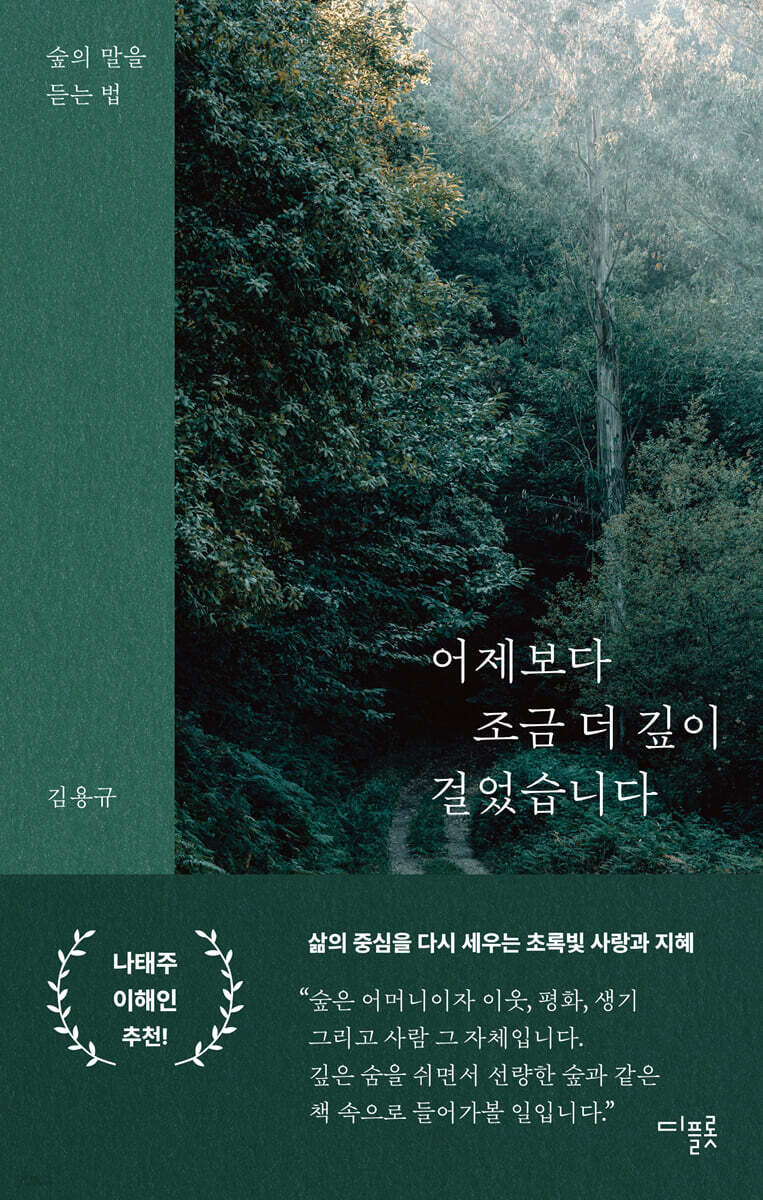 |
Description
Book Introduction
- A word from MD
- The culmination of the thoughts of forest philosopher Yonggyu Kim.
The author's mature worldview, which has been reflected on the subject of forests for over 20 years, is expressed in delicate and affectionate language.
As this book points out, when you look at the forest, you see people and you see the world.
Just as life continues even in barren land, humans can become greater through hardship.
- Son Min-gyu, Humanities PD
★Recommended by Na Tae-joo and Lee Hae-in★
The "Forest Philosopher" who suddenly left the city in search of a full life
This volume contains the culmination of over 20 years of thought.
A life where things don't go as planned and unexpected hardships come,
The wisdom of the forest for those passing through the rough and dry heart of life.
The author, who has explored the secrets of a better life with the forest as his teacher for over 20 years, invites us through this book to a forest we have never walked through before.
Since ancient times, people have treated forests as 'Mujacheonseo', meaning 'a book without words written by heaven'.
Because the wisdom of a proper and abundant life is engraved right there, and the order that moves the world flows.
However, because it was always there, we were so used to it that we took it for granted and failed to learn from its teachings.
If you face the forest with a new perspective and a long breath, you can find the strength to love yourself and others.
If you delve deep into the forest, you may be able to reach the truth of the world.
If you are looking for clues to the big and small questions that shake up your life, this book is the first place to open.
Kim Yong-gyu, the 'Forest Man', dreams of a world where, by learning about the forest, a condensed form of the vast and mysterious universe, individual lives are transformed, a sense of community is restored, and all living, breathing beings become vibrant.
The author teaches the adage, "Never postpone or avoid the life tasks given to all beings," and "Never give up on the potential and possibilities we are born with," through stories of grass, trees, and seeds he encounters in the forest.
The forest interpreters and forest instructors he has trained are spreading the wisdom of forests to people all over the country.
The "Forest Philosopher" who suddenly left the city in search of a full life
This volume contains the culmination of over 20 years of thought.
A life where things don't go as planned and unexpected hardships come,
The wisdom of the forest for those passing through the rough and dry heart of life.
The author, who has explored the secrets of a better life with the forest as his teacher for over 20 years, invites us through this book to a forest we have never walked through before.
Since ancient times, people have treated forests as 'Mujacheonseo', meaning 'a book without words written by heaven'.
Because the wisdom of a proper and abundant life is engraved right there, and the order that moves the world flows.
However, because it was always there, we were so used to it that we took it for granted and failed to learn from its teachings.
If you face the forest with a new perspective and a long breath, you can find the strength to love yourself and others.
If you delve deep into the forest, you may be able to reach the truth of the world.
If you are looking for clues to the big and small questions that shake up your life, this book is the first place to open.
Kim Yong-gyu, the 'Forest Man', dreams of a world where, by learning about the forest, a condensed form of the vast and mysterious universe, individual lives are transformed, a sense of community is restored, and all living, breathing beings become vibrant.
The author teaches the adage, "Never postpone or avoid the life tasks given to all beings," and "Never give up on the potential and possibilities we are born with," through stories of grass, trees, and seeds he encounters in the forest.
The forest interpreters and forest instructors he has trained are spreading the wisdom of forests to people all over the country.
- You can preview some of the book's contents.
Preview
index
As we enter, we see that blue forest
Part 1: Asking the Forest for Directions
Chapter 1: An Invitation to the Forest That Makes You Love Life
Chapter 2: The Language of the Forest
Chapter 3: Vitality and the Two Things Necessary for Life
Chapter 4 Every life has a story
Chapter 5: Warmth and vitality brought about by a new perspective
Chapter 6: Encountering the Wisdom of the Forest
Part 2: Portraits of All Forgotten Life
Chapter 7 Before Meeting the Source of Life
Chapter 8: The Germinating Universe: On Its Possibilities
Chapter 9 Each has its own place and time
Part 3: Here, the homework given to all of us
Chapter 10: Between Surrender and Overcoming
Chapter 11: How to Live by Grabbing the Sunlight and Following the Wind
Chapter 12: Only Relationships, Only Relationships
Chapter 13: If you tell me to go forward, I go forward, and if you tell me to retreat, I retreat.
Part 4: A Feast of Life and Drama, Four Seasons
Chapter 14 Even if I get hit in the eye, even if I am in a low position
Chapter 15: Summer is no exception
Chapter 16: The color of passion blooming in the dense greenery, the fragrance of pure white
Chapter 17: When to Stop Resentment
Chapter 18: How to Face the Storms on the Flower Road
Chapter 19: Po-wol, embracing the wind
Part 5: Where Should We Flow?
Chapter 20: The Purpose of Life
Chapter 21: Two Questions the Dead Must Answer
Chapter 22: Living Enough
Chapter 23 If you believe that eating is everything
Chapter 24: Freedom from Emptiness: A Full Life
Chapter 25: Like a Flower That Raises Other Life: The Sublime Life
Chapter 26: Don't Strive for Perfection: Living a Whole Life
Chapter 27: Breaking the Edge: A Life of Transcendence
Go out and just love
Part 1: Asking the Forest for Directions
Chapter 1: An Invitation to the Forest That Makes You Love Life
Chapter 2: The Language of the Forest
Chapter 3: Vitality and the Two Things Necessary for Life
Chapter 4 Every life has a story
Chapter 5: Warmth and vitality brought about by a new perspective
Chapter 6: Encountering the Wisdom of the Forest
Part 2: Portraits of All Forgotten Life
Chapter 7 Before Meeting the Source of Life
Chapter 8: The Germinating Universe: On Its Possibilities
Chapter 9 Each has its own place and time
Part 3: Here, the homework given to all of us
Chapter 10: Between Surrender and Overcoming
Chapter 11: How to Live by Grabbing the Sunlight and Following the Wind
Chapter 12: Only Relationships, Only Relationships
Chapter 13: If you tell me to go forward, I go forward, and if you tell me to retreat, I retreat.
Part 4: A Feast of Life and Drama, Four Seasons
Chapter 14 Even if I get hit in the eye, even if I am in a low position
Chapter 15: Summer is no exception
Chapter 16: The color of passion blooming in the dense greenery, the fragrance of pure white
Chapter 17: When to Stop Resentment
Chapter 18: How to Face the Storms on the Flower Road
Chapter 19: Po-wol, embracing the wind
Part 5: Where Should We Flow?
Chapter 20: The Purpose of Life
Chapter 21: Two Questions the Dead Must Answer
Chapter 22: Living Enough
Chapter 23 If you believe that eating is everything
Chapter 24: Freedom from Emptiness: A Full Life
Chapter 25: Like a Flower That Raises Other Life: The Sublime Life
Chapter 26: Don't Strive for Perfection: Living a Whole Life
Chapter 27: Breaking the Edge: A Life of Transcendence
Go out and just love
Detailed image

Into the book
But where is there a season that comes without twists and turns?
The leaves that sprout in spring bloom with dazzling flowers and quickly bear fruit, but drought, heavy rain, and typhoons inevitably come with each season.
Only those things that have been endured and barely managed to hold on to can mature.
This is one of the truths of life I have learned from leaning against the forest.
Only after enduring all kinds of hardships can a time of peace come.
Diffusion again leads to convergence.
Perhaps all the principles that govern life are so simple.
--- From "Chapter 1: An Invitation to the Forest That Makes You Love Life"
Life is alone, but it cannot be alone.
No living thing can draw its own pattern of life.
Therefore, if we wish to experience the mystery of life and gain wisdom from the creatures of the forest, we must expand our perspective from 'individual life' to the scale of 'all life.'
--- From "Chapter 2: Language of the Forest"
All life has a story.
There is no life without a story.
But today, we are increasingly losing the desire to understand the circumstances of beings other than ourselves.
Is it because we've come to view the effort to connect the stories of others with our own hearts as cumbersome or worthless? Is this why we abandon the life-giving instincts of openness and connection, opting instead for isolation and disconnection? If so, perhaps it's a misunderstanding stemming from experiencing only a part, not the whole.
--- From “Chapter 4: Every Life Has a Story”
A willow tree can be happy living as a willow tree, not pretending to be a pine tree.
A thorn does not imitate a rose.
Every flower that blooms on a plant is an expression of its nature.
We are amazed and moved when we encounter the beautiful expression of that nature.
It's for the same reason we're captivated by beautiful works of art, and moved by the stories of people who have truly created (or are creating) their own worlds.
--- From "Chapter 6: Encountering the Wisdom of the Forest"
The insight reached through the life of a flower, 'Hwamusipilhong', is very concise.
The saying, "There are no red flowers for ten days," captures important clues about the order and rhythm of nature from flowers, and then suggests the immutable truth that there is an inevitable limit to the desire to expand.
The proverb, ‘power doesn’t last ten years’, may have also been found that way.
Lao Tzu's words about 'the best medicine' can also be said to be an example of abstracting the ultimate principle of goodness by comparing it to water after deeply examining it.
--- From "Chapter 8: The Germinating Universe, Its Possibilities"
Where there is sky, there is land, where there is ridge, there is valley.
Just as there is an equator because there is a North Pole and a South Pole, just as there is a day when we are born, there is a day when we die, and just as there are clear days, there are days when it rains or snows.
While there is asceticism within us, lust also takes root within us.
If you live once, you must die once.
That is the strict order of yin and yang that permeates all things and life.
--- From "Chapter 10: Between Surrender and Overcoming"
Heaven, Earth, and Man, God is merciless.
Heaven cannot bestow its grace only on certain lives.
What would happen if God, seeing the pitiful life of bamboo in the forest, completely eliminated the dangerous winds or allowed only gentle breezes to blow? Without wind, there would be no breath, and all life would perish.
A gentle breeze alone will prevent seeds and migratory birds from making long journeys.
The sky is merciless, but it illuminates all things with order and rhythm.
Some people align themselves with God's order by emptying their hearts, others by becoming soft.
--- From "Chapter 11: How to Live by Grabbing the Sunlight and Following the Wind"
The reason our lives often feel like we're faltering or running away is because we often fall into the foolishness of viewing that mysterious truth in a dichotomous way.
That is, most people only want relationships that will save them, and not relationships that will stop them or bring them down.
Because it divides the world into two, which cannot be neatly divided into two.
--- From "Chapter 12: Only Relationships, Only Relationships"
Those who fully understand the finiteness of life only value the world and cherish it.
This fall, when he can see the red leaves again, is so precious to him.
So it's really a shame.
The new spring is precious and it's a shame to waste it.
He doesn't think that fall and spring will just come back every time.
Because I truly know that the autumn leaves I see now may be the last autumn leaves I see in my life.
So, the song of the migratory birds that I hear now is precious and a pity, and the laughter and cries of those young ones who have just begun to speak are precious and a pity.
We approach life with all its events and existences with great care, as if they were precious and precious to us.
--- From "Chapter 13: When I'm told to go forward, I go forward, and when I'm told to retreat, I retreat"
When I meet people who love life despite anxiety and uncertainty, I find one important characteristic in them.
The perpetrator does not live in their hearts.
People who don't love life live with the abuser in their hearts for a long time.
Their hearts are filled with resentment, resentment, and blame.
Even if you are a person who loves life, there are bound to be times when things get unfair.
But they do not allow the abuser to enter the room of their heart and live together with them.
--- From Chapter 14, “Even if I get hit in the eye, even if I am in a low position”
“May you only walk on flower paths.” This is a loving greeting we often hear these days.
But it is also the most vain greeting.
Because there is no world where you can only walk on a flower path.
As with all living things, trials and tribulations come to everyone.
Because the universe creates harmony and substance by adding adversity to prosperity.
Adversity comes regardless of age, education, wealth, level of education, or physical condition.
Everyone has days when they walk on a flowery path, but I can say with certainty that no one lives a life that only walks on a flowery path.
So, like the paulownia tree, we must cultivate the wisdom to deal with adversity and live.
--- From "Chapter 18: Facing the Storm on the Flower Road"
The forest is full of the dance of life, born, living its own path, and eventually reaching the sea of death.
I encourage you to look deeply, touch it gently, and close your eyes and smell it deeply.
And I hope you can also imagine the life trajectory of that being.
I hope you will visit often and walk slowly until you hear the words of life and death.
If you do that, one day you will eventually come to know.
That all that has been achieved with effort, all that has not yet been completed, all that has not yet been fully quenched, all that has not yet been reconciled, all is meaningless in the face of death…
--- From "Chapter 21: Two Questions the Dead Must Answer"
Not all of us can undertake the grand self-transcendence of the characters in biographies.
But you can act according to the love and sincerity within you.
All we have to do is do that.
It doesn't have to be as huge as the heroes'.
Just don't give up on your potential, don't betray yourself.
Mencius's 'self-abandonment', as mentioned earlier, is the most rude and irresponsible attitude toward one's own life.
If a person does not strive to bring out into the world the bright light that is waiting to burst within him, then, unfortunately, he is a person who does not love himself.
--- From "Chapter 25: Like a Flower That Raises Other Life: A Sublime Life"
Perfection or completeness is neither the reality of life nor an illusion that runs counter to the truth of life.
Rather, the pursuit of perfection is a kind of pathological phenomenon observed only in humans.
The forest proves that there is no such thing as a perfect life, that it is a fictional world.
If we pursue this non-existent world day and night, we will waste or ruin our lives, which we can never recover.
If you want to live a little more fully, you shouldn't try to be perfect.
The leaves that sprout in spring bloom with dazzling flowers and quickly bear fruit, but drought, heavy rain, and typhoons inevitably come with each season.
Only those things that have been endured and barely managed to hold on to can mature.
This is one of the truths of life I have learned from leaning against the forest.
Only after enduring all kinds of hardships can a time of peace come.
Diffusion again leads to convergence.
Perhaps all the principles that govern life are so simple.
--- From "Chapter 1: An Invitation to the Forest That Makes You Love Life"
Life is alone, but it cannot be alone.
No living thing can draw its own pattern of life.
Therefore, if we wish to experience the mystery of life and gain wisdom from the creatures of the forest, we must expand our perspective from 'individual life' to the scale of 'all life.'
--- From "Chapter 2: Language of the Forest"
All life has a story.
There is no life without a story.
But today, we are increasingly losing the desire to understand the circumstances of beings other than ourselves.
Is it because we've come to view the effort to connect the stories of others with our own hearts as cumbersome or worthless? Is this why we abandon the life-giving instincts of openness and connection, opting instead for isolation and disconnection? If so, perhaps it's a misunderstanding stemming from experiencing only a part, not the whole.
--- From “Chapter 4: Every Life Has a Story”
A willow tree can be happy living as a willow tree, not pretending to be a pine tree.
A thorn does not imitate a rose.
Every flower that blooms on a plant is an expression of its nature.
We are amazed and moved when we encounter the beautiful expression of that nature.
It's for the same reason we're captivated by beautiful works of art, and moved by the stories of people who have truly created (or are creating) their own worlds.
--- From "Chapter 6: Encountering the Wisdom of the Forest"
The insight reached through the life of a flower, 'Hwamusipilhong', is very concise.
The saying, "There are no red flowers for ten days," captures important clues about the order and rhythm of nature from flowers, and then suggests the immutable truth that there is an inevitable limit to the desire to expand.
The proverb, ‘power doesn’t last ten years’, may have also been found that way.
Lao Tzu's words about 'the best medicine' can also be said to be an example of abstracting the ultimate principle of goodness by comparing it to water after deeply examining it.
--- From "Chapter 8: The Germinating Universe, Its Possibilities"
Where there is sky, there is land, where there is ridge, there is valley.
Just as there is an equator because there is a North Pole and a South Pole, just as there is a day when we are born, there is a day when we die, and just as there are clear days, there are days when it rains or snows.
While there is asceticism within us, lust also takes root within us.
If you live once, you must die once.
That is the strict order of yin and yang that permeates all things and life.
--- From "Chapter 10: Between Surrender and Overcoming"
Heaven, Earth, and Man, God is merciless.
Heaven cannot bestow its grace only on certain lives.
What would happen if God, seeing the pitiful life of bamboo in the forest, completely eliminated the dangerous winds or allowed only gentle breezes to blow? Without wind, there would be no breath, and all life would perish.
A gentle breeze alone will prevent seeds and migratory birds from making long journeys.
The sky is merciless, but it illuminates all things with order and rhythm.
Some people align themselves with God's order by emptying their hearts, others by becoming soft.
--- From "Chapter 11: How to Live by Grabbing the Sunlight and Following the Wind"
The reason our lives often feel like we're faltering or running away is because we often fall into the foolishness of viewing that mysterious truth in a dichotomous way.
That is, most people only want relationships that will save them, and not relationships that will stop them or bring them down.
Because it divides the world into two, which cannot be neatly divided into two.
--- From "Chapter 12: Only Relationships, Only Relationships"
Those who fully understand the finiteness of life only value the world and cherish it.
This fall, when he can see the red leaves again, is so precious to him.
So it's really a shame.
The new spring is precious and it's a shame to waste it.
He doesn't think that fall and spring will just come back every time.
Because I truly know that the autumn leaves I see now may be the last autumn leaves I see in my life.
So, the song of the migratory birds that I hear now is precious and a pity, and the laughter and cries of those young ones who have just begun to speak are precious and a pity.
We approach life with all its events and existences with great care, as if they were precious and precious to us.
--- From "Chapter 13: When I'm told to go forward, I go forward, and when I'm told to retreat, I retreat"
When I meet people who love life despite anxiety and uncertainty, I find one important characteristic in them.
The perpetrator does not live in their hearts.
People who don't love life live with the abuser in their hearts for a long time.
Their hearts are filled with resentment, resentment, and blame.
Even if you are a person who loves life, there are bound to be times when things get unfair.
But they do not allow the abuser to enter the room of their heart and live together with them.
--- From Chapter 14, “Even if I get hit in the eye, even if I am in a low position”
“May you only walk on flower paths.” This is a loving greeting we often hear these days.
But it is also the most vain greeting.
Because there is no world where you can only walk on a flower path.
As with all living things, trials and tribulations come to everyone.
Because the universe creates harmony and substance by adding adversity to prosperity.
Adversity comes regardless of age, education, wealth, level of education, or physical condition.
Everyone has days when they walk on a flowery path, but I can say with certainty that no one lives a life that only walks on a flowery path.
So, like the paulownia tree, we must cultivate the wisdom to deal with adversity and live.
--- From "Chapter 18: Facing the Storm on the Flower Road"
The forest is full of the dance of life, born, living its own path, and eventually reaching the sea of death.
I encourage you to look deeply, touch it gently, and close your eyes and smell it deeply.
And I hope you can also imagine the life trajectory of that being.
I hope you will visit often and walk slowly until you hear the words of life and death.
If you do that, one day you will eventually come to know.
That all that has been achieved with effort, all that has not yet been completed, all that has not yet been fully quenched, all that has not yet been reconciled, all is meaningless in the face of death…
--- From "Chapter 21: Two Questions the Dead Must Answer"
Not all of us can undertake the grand self-transcendence of the characters in biographies.
But you can act according to the love and sincerity within you.
All we have to do is do that.
It doesn't have to be as huge as the heroes'.
Just don't give up on your potential, don't betray yourself.
Mencius's 'self-abandonment', as mentioned earlier, is the most rude and irresponsible attitude toward one's own life.
If a person does not strive to bring out into the world the bright light that is waiting to burst within him, then, unfortunately, he is a person who does not love himself.
--- From "Chapter 25: Like a Flower That Raises Other Life: A Sublime Life"
Perfection or completeness is neither the reality of life nor an illusion that runs counter to the truth of life.
Rather, the pursuit of perfection is a kind of pathological phenomenon observed only in humans.
The forest proves that there is no such thing as a perfect life, that it is a fictional world.
If we pursue this non-existent world day and night, we will waste or ruin our lives, which we can never recover.
If you want to live a little more fully, you shouldn't try to be perfect.
--- From "Chapter 26: Don't Try to Be Perfect: A Whole Life"
Publisher's Review
★Recommended by Na Tae-joo and Lee Hae-in★
The "Forest Philosopher" who suddenly left the city in search of a full life
This volume contains the culmination of over 20 years of thought.
A life where things don't go as planned and unexpected hardships come,
The wisdom of the forest for those passing through the rough and dry heart of life.
The author, who has explored the secrets of a better life with the forest as his teacher for over 20 years, invites us through this book to a forest we have never walked through before.
Since ancient times, people have treated forests as 'Mujacheonseo', meaning 'a book without words written by heaven'.
Because the wisdom of a proper and abundant life is engraved right there, and the order that moves the world flows.
However, because it was always there, we were so used to it that we took it for granted and failed to learn from its teachings.
If you face the forest with a new perspective and a long breath, you can find the strength to love yourself and others.
If you delve deep into the forest, you may be able to reach the truth of the world.
If you are looking for clues to the big and small questions that shake up your life, this book is the first place to open.
Kim Yong-gyu, the 'Forest Man', dreams of a world where, by learning about the forest, a condensed form of the vast and mysterious universe, individual lives are transformed, a sense of community is restored, and all living, breathing beings become vibrant.
The author teaches the adage, "Do not postpone or avoid the life tasks given to all beings," and "Do not give up on the potential and possibilities we are born with," through stories of grass, trees, and seeds he encounters in the forest.
The forest interpreters and forest instructors he has trained are spreading the wisdom of forests to people all over the country.
The forest path next to you that I always walked along,
But for the first time, I encountered the insight of a forest I had never encountered before.
In its introduction, the book asks for a correction of perspective “to come to terms with one’s own life and meet the forest that makes one love life.”
The author argues that “there is some fundamental unconsciousness flowing through us.”
For example, he points out that most people only see san-guk as an ingredient for making tea or alcohol, or as an ornamental object to be placed in a vase.
It means that only the efficacy or aesthetic pleasure of a certain existence is important and no other meaning is of interest.
He adds that this is because he not only regards the flower as an object, but also recognizes himself as a being greater than the flower.
In an age where we are immersed in this perspective and where the belief that anything can be bought with money is widespread, the fact that everything other than ourselves is treated as mere 'objects' is a fact that has been around for quite some time.
The author consistently states throughout the book that we must quickly break away from the bleak perspective that can be summarized as 'objectification of others.'
So what should we do? When we open our hearts to recognize others as equals and consider their circumstances, we can reach pure joy and comfort.
The author noted that the mountain chrysanthemum bloomed around the time of frost.
He asks questions like, "Why does the mountain chrysanthemum bloom even when it is exposed to frost?" and "What is the reason it has to do that?" and says that meaning can be found in the story of how the mountain chrysanthemum came to live that way.
In short, a new perspective is a mind that understands the story of others.
The author says that if you start walking through the forest you were only familiar with with this mind, you will see things you had never seen before.
That we will be able to find the precious things we have forgotten and lost, such as joy, admiration, and comfort.
There is no life where you can only walk on a flower path.
Why every living being has challenges to overcome
The author defines “the homework of life” as “something that each living being, including humans, must overcome.”
For that reason, he says, “Living is no different from the process of gradually solving the homework assigned to you.”
Why do these life challenges exist? The author explains that it's because this world wasn't created perfectly.
This is explained based on the ‘logos of the habitat’.
That is, because the place where all living things stand and live is not perfect, problems that must be solved are bound to arise.
For example, places with abundant nutrients may lack sunlight or have difficulty getting wind, and conversely, places with ample sunlight may lack nutrients or have difficulty obtaining water.
Where all the elements are in place, fierce competition awaits.
The author takes a close look at the stories of the grasses and trees that make up the forest and tells the story of a single grass that is familiar to us.
Shepherd's purse, a representative herald of spring, blooms after enduring pouring snowstorms and harsh cold.
Tall grasses that compete with the dandelion for habitat block the sunlight that should reach the dandelion to a height that exceeds the height of an adult.
So, the radish must grow its stems and flowers before them and bear fruit quickly.
The author explains that this desperation is why the radish sprouts in the fall and has a life cycle that allows it to survive the frozen season.
As you read the stories of bamboo that grasps sunlight and lives by following the wind (Chapter 11), summer flowers that show off their 'ultimate moves' to reveal their presence even in the midst of the lush greenery of the forest (Chapters 16-17), and the paulownia tree that finds a way to live with the typhoon (Chapter 18), you can feel the indomitable life that emerges from the forest.
What can we learn from the struggles of plants, which, rather than complaining and grumbling between surrender and overcoming, struggle to somehow navigate life and never give up?
Through the image of grass and trees faithfully completing the homework assigned to them, the author conveys the message that, "Only when we stop complaining will a new path appear."
The forest is the person itself,
Recovering the lost forest is saving people.
At the end, the book poses the question, “Is South Korea heading towards a wasteland?”
It is a metaphorical expression of human life that has lost its vitality and become worn out, and it also reflects the reality of nature, including forests, being destroyed.
The forest fires that broke out in Gyeongbuk in March 2025 resulted in the largest loss of forest since the founding of the Republic of Korea.
According to an announcement by the Central Disaster and Safety Countermeasures Headquarters, the area is 48,150 hectares (about 67,400 soccer fields, 166 times the area of Yeouido).
Not only was the forest completely burned down, but there were also about 60 casualties.
Many people were angry and saddened by the fact that all this was due to one person's reckless actions.
The miserable 'dark history' of mankind cannot be discussed separately from the devastation of nature.
In the end, they are both the same problem.
Looking at the burned forest, what should we do next?
The author says, “It makes you question the laws of nature to figure out how the wasteland can recover.”
When you look at the forest, you see people and you see the world.
The universal order from which no one can be an exception, the example of a sublime and transcendent life that goes beyond the mere act of making a living, and the secrets of living together are all recorded there.
Our lives can change simply by taking a slow, leisurely walk into the depths of the forest.
In an age where meaning is being lost, there is a sense of urgency in the exhortation to reflect on life by paying attention to the stories of forest life.
It is precisely through this reflection that we can begin the work of reviving those who have lost their vitality and are wandering, that is, the work of saving people.
The forest speaks quietly and quietly.
When we hear the words of the lost forest, we will come back to life.
As the leader of all creation, welcoming today better than yesterday.
The "Forest Philosopher" who suddenly left the city in search of a full life
This volume contains the culmination of over 20 years of thought.
A life where things don't go as planned and unexpected hardships come,
The wisdom of the forest for those passing through the rough and dry heart of life.
The author, who has explored the secrets of a better life with the forest as his teacher for over 20 years, invites us through this book to a forest we have never walked through before.
Since ancient times, people have treated forests as 'Mujacheonseo', meaning 'a book without words written by heaven'.
Because the wisdom of a proper and abundant life is engraved right there, and the order that moves the world flows.
However, because it was always there, we were so used to it that we took it for granted and failed to learn from its teachings.
If you face the forest with a new perspective and a long breath, you can find the strength to love yourself and others.
If you delve deep into the forest, you may be able to reach the truth of the world.
If you are looking for clues to the big and small questions that shake up your life, this book is the first place to open.
Kim Yong-gyu, the 'Forest Man', dreams of a world where, by learning about the forest, a condensed form of the vast and mysterious universe, individual lives are transformed, a sense of community is restored, and all living, breathing beings become vibrant.
The author teaches the adage, "Do not postpone or avoid the life tasks given to all beings," and "Do not give up on the potential and possibilities we are born with," through stories of grass, trees, and seeds he encounters in the forest.
The forest interpreters and forest instructors he has trained are spreading the wisdom of forests to people all over the country.
The forest path next to you that I always walked along,
But for the first time, I encountered the insight of a forest I had never encountered before.
In its introduction, the book asks for a correction of perspective “to come to terms with one’s own life and meet the forest that makes one love life.”
The author argues that “there is some fundamental unconsciousness flowing through us.”
For example, he points out that most people only see san-guk as an ingredient for making tea or alcohol, or as an ornamental object to be placed in a vase.
It means that only the efficacy or aesthetic pleasure of a certain existence is important and no other meaning is of interest.
He adds that this is because he not only regards the flower as an object, but also recognizes himself as a being greater than the flower.
In an age where we are immersed in this perspective and where the belief that anything can be bought with money is widespread, the fact that everything other than ourselves is treated as mere 'objects' is a fact that has been around for quite some time.
The author consistently states throughout the book that we must quickly break away from the bleak perspective that can be summarized as 'objectification of others.'
So what should we do? When we open our hearts to recognize others as equals and consider their circumstances, we can reach pure joy and comfort.
The author noted that the mountain chrysanthemum bloomed around the time of frost.
He asks questions like, "Why does the mountain chrysanthemum bloom even when it is exposed to frost?" and "What is the reason it has to do that?" and says that meaning can be found in the story of how the mountain chrysanthemum came to live that way.
In short, a new perspective is a mind that understands the story of others.
The author says that if you start walking through the forest you were only familiar with with this mind, you will see things you had never seen before.
That we will be able to find the precious things we have forgotten and lost, such as joy, admiration, and comfort.
There is no life where you can only walk on a flower path.
Why every living being has challenges to overcome
The author defines “the homework of life” as “something that each living being, including humans, must overcome.”
For that reason, he says, “Living is no different from the process of gradually solving the homework assigned to you.”
Why do these life challenges exist? The author explains that it's because this world wasn't created perfectly.
This is explained based on the ‘logos of the habitat’.
That is, because the place where all living things stand and live is not perfect, problems that must be solved are bound to arise.
For example, places with abundant nutrients may lack sunlight or have difficulty getting wind, and conversely, places with ample sunlight may lack nutrients or have difficulty obtaining water.
Where all the elements are in place, fierce competition awaits.
The author takes a close look at the stories of the grasses and trees that make up the forest and tells the story of a single grass that is familiar to us.
Shepherd's purse, a representative herald of spring, blooms after enduring pouring snowstorms and harsh cold.
Tall grasses that compete with the dandelion for habitat block the sunlight that should reach the dandelion to a height that exceeds the height of an adult.
So, the radish must grow its stems and flowers before them and bear fruit quickly.
The author explains that this desperation is why the radish sprouts in the fall and has a life cycle that allows it to survive the frozen season.
As you read the stories of bamboo that grasps sunlight and lives by following the wind (Chapter 11), summer flowers that show off their 'ultimate moves' to reveal their presence even in the midst of the lush greenery of the forest (Chapters 16-17), and the paulownia tree that finds a way to live with the typhoon (Chapter 18), you can feel the indomitable life that emerges from the forest.
What can we learn from the struggles of plants, which, rather than complaining and grumbling between surrender and overcoming, struggle to somehow navigate life and never give up?
Through the image of grass and trees faithfully completing the homework assigned to them, the author conveys the message that, "Only when we stop complaining will a new path appear."
The forest is the person itself,
Recovering the lost forest is saving people.
At the end, the book poses the question, “Is South Korea heading towards a wasteland?”
It is a metaphorical expression of human life that has lost its vitality and become worn out, and it also reflects the reality of nature, including forests, being destroyed.
The forest fires that broke out in Gyeongbuk in March 2025 resulted in the largest loss of forest since the founding of the Republic of Korea.
According to an announcement by the Central Disaster and Safety Countermeasures Headquarters, the area is 48,150 hectares (about 67,400 soccer fields, 166 times the area of Yeouido).
Not only was the forest completely burned down, but there were also about 60 casualties.
Many people were angry and saddened by the fact that all this was due to one person's reckless actions.
The miserable 'dark history' of mankind cannot be discussed separately from the devastation of nature.
In the end, they are both the same problem.
Looking at the burned forest, what should we do next?
The author says, “It makes you question the laws of nature to figure out how the wasteland can recover.”
When you look at the forest, you see people and you see the world.
The universal order from which no one can be an exception, the example of a sublime and transcendent life that goes beyond the mere act of making a living, and the secrets of living together are all recorded there.
Our lives can change simply by taking a slow, leisurely walk into the depths of the forest.
In an age where meaning is being lost, there is a sense of urgency in the exhortation to reflect on life by paying attention to the stories of forest life.
It is precisely through this reflection that we can begin the work of reviving those who have lost their vitality and are wandering, that is, the work of saving people.
The forest speaks quietly and quietly.
When we hear the words of the lost forest, we will come back to life.
As the leader of all creation, welcoming today better than yesterday.
GOODS SPECIFICS
- Date of issue: May 22, 2025
- Page count, weight, size: 308 pages | 372g | 130*205*23mm
- ISBN13: 9791193591369
- ISBN10: 1193591368
You may also like
카테고리
korean


korean

![GQ KOREA Mark (Monthly): December [2025]](http://librairie.coreenne.fr/cdn/shop/files/8ef265dbbfbf186523ed75ba7319009d.jpg?v=1765340328&width=3840)


