

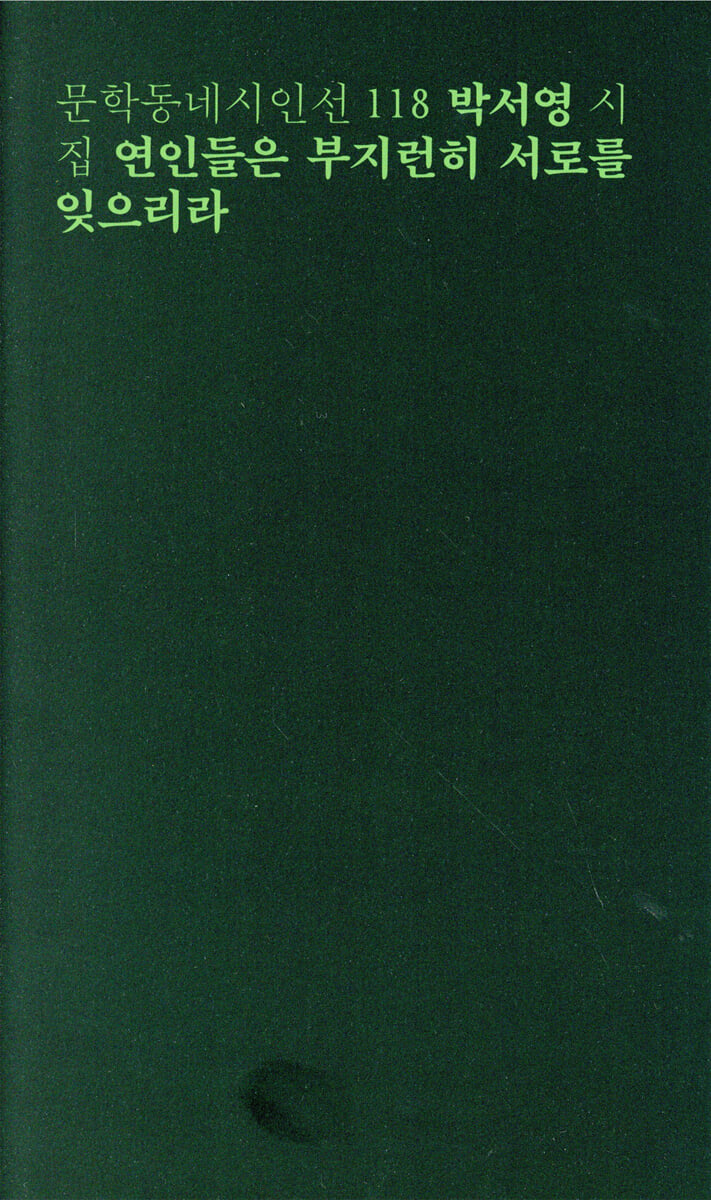
Lovers will diligently forget each other
 |
Description
Book Introduction
“The road has been crooked since I met you
“Whether I go to the right or to the left, I will meet you.”
Poet Park Seo-young, who debuted in 1995 with 『Modern Poetry』 and has been showcasing her imagination of 'time' and 'death' with a fierce self-consciousness about the body that is wearing away, has published her third poetry collection, 『Lovers Will Diligently Forget Each Other』, as the 118th poetry collection in the Munhakdongne Poet Selection.
This is a posthumous collection of poems published on the first anniversary of the poet's death from a chronic illness on February 3, 2018.
The poet's note was added on October 18, 2017, when the final manuscript was sent.
His early poetry, which maintained outstanding aesthetic thinking and sensibility and explored the pain inherent in the vanishing point of objects, was filled with a beating heart of love that deeply imprinted the times that spread and mixed like watercolors (Yoo Seong-ho).
In this third poetry collection, published after five years, Park Seo-young writes diaries and letters with her missing hands in a room where love is absent and only the material for love remains.
As snowflakes fall, briefly touching his cheeks with coldness and then leaving, the poet thinks of a poem in which a moment becomes eternity, of the only room he can have.
This third collection of poems speaks of love and separation. Could we call that love the process of saying goodbye to my body and this life?
In a world soaked in tears, it was the process of parting with the one and only person on Earth who was beautiful to me, round and fragrant and juicy.
In the poet's eyes, everything that has life does not disappear without a wound.
Those who have gained a body must be crushed until they lose that body in order to be reborn.
Being alive is another name for the possibility of being hurt.
The body reflected in the poet's gaze, which tenaciously follows the pain of living things, was a coffin, but now it goes a step further and reflects the golden shell of a cicada that has shed all its cries.
The poet now becomes an empty parenthesis, peeking into the world behind it.
For him, our bodies are buses traveling along a precise route, each with its own stop waiting for its scheduled arrival.
On the crossroads between life and death, we sometimes look at each other like faces passing by.
The poet's gaze now turns to the profile of the person who is looking together in the direction of what is to come.
The loneliness and fear of being alone becomes the strength to fill the surroundings with warm presence.
“Whether I go to the right or to the left, I will meet you.”
Poet Park Seo-young, who debuted in 1995 with 『Modern Poetry』 and has been showcasing her imagination of 'time' and 'death' with a fierce self-consciousness about the body that is wearing away, has published her third poetry collection, 『Lovers Will Diligently Forget Each Other』, as the 118th poetry collection in the Munhakdongne Poet Selection.
This is a posthumous collection of poems published on the first anniversary of the poet's death from a chronic illness on February 3, 2018.
The poet's note was added on October 18, 2017, when the final manuscript was sent.
His early poetry, which maintained outstanding aesthetic thinking and sensibility and explored the pain inherent in the vanishing point of objects, was filled with a beating heart of love that deeply imprinted the times that spread and mixed like watercolors (Yoo Seong-ho).
In this third poetry collection, published after five years, Park Seo-young writes diaries and letters with her missing hands in a room where love is absent and only the material for love remains.
As snowflakes fall, briefly touching his cheeks with coldness and then leaving, the poet thinks of a poem in which a moment becomes eternity, of the only room he can have.
This third collection of poems speaks of love and separation. Could we call that love the process of saying goodbye to my body and this life?
In a world soaked in tears, it was the process of parting with the one and only person on Earth who was beautiful to me, round and fragrant and juicy.
In the poet's eyes, everything that has life does not disappear without a wound.
Those who have gained a body must be crushed until they lose that body in order to be reborn.
Being alive is another name for the possibility of being hurt.
The body reflected in the poet's gaze, which tenaciously follows the pain of living things, was a coffin, but now it goes a step further and reflects the golden shell of a cicada that has shed all its cries.
The poet now becomes an empty parenthesis, peeking into the world behind it.
For him, our bodies are buses traveling along a precise route, each with its own stop waiting for its scheduled arrival.
On the crossroads between life and death, we sometimes look at each other like faces passing by.
The poet's gaze now turns to the profile of the person who is looking together in the direction of what is to come.
The loneliness and fear of being alone becomes the strength to fill the surroundings with warm presence.
- You can preview some of the book's contents.
Preview
index
Poet's words
Part 1: It's all a long time ago
Tailing / Salt Warehouse / Breath / Odd-Numbered Room / House in the Forest / White Black Girl / Chair / Door / Room, Submerged in Water / Time to Love Odd Numbers / Surplus / Into the Waves / Creating Fire and Ice / Window Washer / Snowman's Spring Day / Painter's Shoes / Sun Theater Bus Stop
Part 2: There is a love that embraces eternity but disappears forever.
Three people sitting at a bus stop / A bus running with a kiss / A sparrow / A lunar calendar / A star / A sea urchin / Sad, sad / Waltz of the moon / A heart caught in a spider's web / Whose world is this? / Unable to fold a paper boat / An island / An empty lot / A wildcat / A map of the tongue / A fishbowl / Shoes
I'm writing a sentence saying I know nothing even though I know all three parts.
Tongue / Lips, in front of a dead flower tree / Hidden room / Fireplace / Wild goose / Golden cry / Today's faith / When tears flow through empty bones / Diary of another person / Greetings / Haeundae night view / Morning at the port / Marine Theater bus stop / Flight in a dream / Cloudchi bus stop / March / A face with a long history
Commentary | Is love a mutual exile? Park Seo-young's Poetry
Jang Seok-ju (poet and literary critic)
Part 1: It's all a long time ago
Tailing / Salt Warehouse / Breath / Odd-Numbered Room / House in the Forest / White Black Girl / Chair / Door / Room, Submerged in Water / Time to Love Odd Numbers / Surplus / Into the Waves / Creating Fire and Ice / Window Washer / Snowman's Spring Day / Painter's Shoes / Sun Theater Bus Stop
Part 2: There is a love that embraces eternity but disappears forever.
Three people sitting at a bus stop / A bus running with a kiss / A sparrow / A lunar calendar / A star / A sea urchin / Sad, sad / Waltz of the moon / A heart caught in a spider's web / Whose world is this? / Unable to fold a paper boat / An island / An empty lot / A wildcat / A map of the tongue / A fishbowl / Shoes
I'm writing a sentence saying I know nothing even though I know all three parts.
Tongue / Lips, in front of a dead flower tree / Hidden room / Fireplace / Wild goose / Golden cry / Today's faith / When tears flow through empty bones / Diary of another person / Greetings / Haeundae night view / Morning at the port / Marine Theater bus stop / Flight in a dream / Cloudchi bus stop / March / A face with a long history
Commentary | Is love a mutual exile? Park Seo-young's Poetry
Jang Seok-ju (poet and literary critic)
Into the book
I picked up a rag doll
Sit on a chair
I prepare a meal for one person
If the doll disappears, if it disappears
Disappearing doesn't mean going very far.
The doll fell off the chair
If it's out of sight, it's gone.
The doll will experience a cliff
I go out to pick chives and cosmos to put in a vase.
From the doll's point of view, I have disappeared.
The doll will experience the cliff of separation
To disappear is to open the door and go out
It might be something that's waiting forever behind the door
Without even going that far
The cold hearts of those who have gone too far
The doll sits on the chair until I bring the flowers.
That he had been thrown into the trash can
A rag doll who remembers that there was a flower garden right next to it.
Sitting on a chair and smiling --- from "Chair"
The night sky that illuminated the trees was shattered
It's easier to break a window than to remove it.
Someone threw a stone and the dead bodies of birds through my open window.
The room is filled with feathers that are slowly sprouting.
The window was one of the precious relics that the other world sent me.
After exploring countless sufferings,
There is a hole in the back of my head that will never be filled.
If a human body passes through all those holes, it will be reduced to ashes. ---From "The Window Cleaner"
Why aren't missing persons cases treated as deaths?
Make me wait forever
Why is the loss of contact affecting us?
Let's sit in the harbor from sunrise to sunset
Make them sit from the time the moon rises until the time it sets
Until the raindrops that fell on the sea wrote clear letters
Makes you stare into the water --- from "Sea Urchin"
My ears hang on either side of my face like fishbowl.
Two small fish tanks with tears swimming in them
Every time someone looks in and tries to talk to the fish
Turns red
If you try to hide the fish in your ear
Fish flow out of the eyes --- from "Fishbowl"
I'm thinking more and more
The idea that beauty is an illusion that comes back from afar
The moon rises like the boundary between you and me
When the water traces on both cheeks become clear
I saw lips burning like withered grass and borders
Red, wet, wet things burn too
I knew at first, but there was a fire that couldn't be caught
I knew there were stories that ended when they turned to ashes
Oh, of course, now the story of Ashes begins.
Sit on a chair
I prepare a meal for one person
If the doll disappears, if it disappears
Disappearing doesn't mean going very far.
The doll fell off the chair
If it's out of sight, it's gone.
The doll will experience a cliff
I go out to pick chives and cosmos to put in a vase.
From the doll's point of view, I have disappeared.
The doll will experience the cliff of separation
To disappear is to open the door and go out
It might be something that's waiting forever behind the door
Without even going that far
The cold hearts of those who have gone too far
The doll sits on the chair until I bring the flowers.
That he had been thrown into the trash can
A rag doll who remembers that there was a flower garden right next to it.
Sitting on a chair and smiling --- from "Chair"
The night sky that illuminated the trees was shattered
It's easier to break a window than to remove it.
Someone threw a stone and the dead bodies of birds through my open window.
The room is filled with feathers that are slowly sprouting.
The window was one of the precious relics that the other world sent me.
After exploring countless sufferings,
There is a hole in the back of my head that will never be filled.
If a human body passes through all those holes, it will be reduced to ashes. ---From "The Window Cleaner"
Why aren't missing persons cases treated as deaths?
Make me wait forever
Why is the loss of contact affecting us?
Let's sit in the harbor from sunrise to sunset
Make them sit from the time the moon rises until the time it sets
Until the raindrops that fell on the sea wrote clear letters
Makes you stare into the water --- from "Sea Urchin"
My ears hang on either side of my face like fishbowl.
Two small fish tanks with tears swimming in them
Every time someone looks in and tries to talk to the fish
Turns red
If you try to hide the fish in your ear
Fish flow out of the eyes --- from "Fishbowl"
I'm thinking more and more
The idea that beauty is an illusion that comes back from afar
The moon rises like the boundary between you and me
When the water traces on both cheeks become clear
I saw lips burning like withered grass and borders
Red, wet, wet things burn too
I knew at first, but there was a fire that couldn't be caught
I knew there were stories that ended when they turned to ashes
Oh, of course, now the story of Ashes begins.
---From "The Hidden Room"
Publisher's Review
“The road has been crooked since I met you
“Whether I go to the right or to the left, I will meet you.”
A poem of wounds that spread to each other
A forest that reveals the brilliant patterns and stories of love.
Poet Park Seo-young, who debuted in 1995 with 『Modern Poetry』 and has been showcasing her imagination of 'time' and 'death' with a fierce self-consciousness about the body that is wearing away, has published her third poetry collection, 『Lovers Will Diligently Forget Each Other』, as the 118th poetry collection in the Munhakdongne Poet Selection.
This is a posthumous collection of poems published on the first anniversary of the poet's death from a chronic illness on February 3, 2018.
The poet's note was added on October 18, 2017, when the final manuscript was sent.
His early poetry, which maintained outstanding aesthetic thinking and sensibility and explored the pain inherent in the vanishing point of objects, was filled with a beating heart of love that deeply imprinted the times that spread and mixed like watercolors (Yoo Seong-ho).
In this third poetry collection, published after five years, Park Seo-young writes diaries and letters with her missing hands in a room where love is absent and only the material for love remains.
As snowflakes fall, briefly touching his cheeks with coldness and then leaving, the poet thinks of a poem in which a moment becomes eternity, of the only room he can have.
The poet, who suffered from a bright body aches by drawing the roots of light into the painful and miserable landscape, has revealed the tragedy that is destined to happen even more dramatically through the unique positionality and hesitant power of the poetic speaker.
For him, living was like standing in front of an elevator that promised to lead to the grave, wondering whether to press 'life' or 'death' ("Alone, even the grave is a scary interior", "The Red Sun Bites the Spider", Millennium's Beginning, 2006).
He, who had once sung with a poignant voice that life is a process of moving towards death that no one can avoid, while looking at the arrow heading towards a funeral home.
This is the path I came on while crying and dozing off, while loving and in pain. Now that I've come this far, I must have to go on this path again and again ("Death School," the book above). But I must have been afraid because death is something I must face alone, without anyone to hold my hand.
The feeling of being pushed to one side of the world, unable to live or die.
What disappears is not complete, it is in the process of disappearing, and no matter how much you wave your hand, you cannot say goodbye.
The leaf should fall, but it should fall from the branch and touch the ground, but it is caught in the spider web and hangs in the air.
Even after 10 or 20 years, they still have forgotten each other, and in a world of disappearances that are not processed as death, the speaker waits forever.
You are not gone until I open my eyes and see your absence.
What else could the process of accepting this separation be but a metaphor for life and death, something that poet Park Seo-young has been grappling with since her first collection of poems?
This third collection of poems speaks of love and separation. Could we call that love the process of saying goodbye to my body and this life?
In a world soaked in tears, it was the process of parting with the one and only person on Earth who was beautiful to me, round and fragrant and juicy.
In the poet's eyes, everything that has life does not disappear without a wound.
Those who have gained a body must be crushed until they lose that body in order to be reborn.
Being alive is another name for the possibility of being hurt.
The body reflected in the poet's gaze, which tenaciously follows the pain of living things, was a coffin, but now it goes a step further and reflects the golden shell of a cicada that has shed all its cries.
The poet now becomes an empty parenthesis, peeking into the world behind it.
For him, our bodies are buses traveling along a precise route, each with its own stop waiting for its scheduled arrival.
On the crossroads between life and death, we sometimes look at each other like faces passing by.
The poet's gaze now turns to the profile of the person who is looking together in the direction of what is to come.
The loneliness and fear of being alone becomes the strength to fill the surroundings with warm presence.
In this book, which is divided into three parts, the poet, as if anticipating his own death, goes back and forth between the beginning and end of his life, constantly reflecting on his life.
What is surprising is the passion to continue on without guidance, to reaffirm the path that leads to somewhere, with the mental grip that this is not the end.
These are poems that I warmly accepted what I saw, heard, felt, and said while walking along, following my body's lead, without any regrets, no longing, and no attachment.
So maybe the subtitles read like some kind of signpost for life.
“It’s all in the past” “There is a love that embraced eternity but disappeared forever” “I know everything, but I’m writing sentences that say I don’t know anything”… … It must be because my eyes were wide open to this awakening, the attitude of the heart or the mental attitude that poetry makes me realize that it’s not just painful.
When we say we will diligently forget each other, it does not mean that we have forgotten, but when we examine the promise to forget, we cannot help but feel the sincerity and devotion of how much we must have loved each other before.
I wonder if the next thing after missing someone is not wanting to see them, the next thing after remembering is forgetting, and the next thing after meeting is parting. This naturalness, this natural order, is what strangely gives strength to the correct method of this poetry collection.
This is a collection of poems that will be a great answer to those who find life difficult and love difficult.
It will also be tailored to those who are afraid of life and death.
“Wasn’t it beautiful that those who were close were shamefully close and those who were far away never approached in the first place?
“I feel sad, like the evening I went to see a dead magnolia tree in the yard of an unknown house.” (From “Sparrow”) My heart today is like this, underlining this passage again.
Beyond the love between a man and a woman, I hope that everyone will reflect on the subjectivity and active yet flexible resilience of life's experiences, which this collection of poems represents with the word "love."
It's a night when I find myself wondering alone whether the poet would have liked this collection of poems if he had held it in his hands.
I pray once again for the poet's soul to rest in peace.
My heart ached the whole time I was reading this beautiful and sad collection of poems by Park Seo-young.
It is not because it is a song of broken love, but because of the endless and profound love that embraces the non-existent 'you'.
Love is each person's own fantasy.
What love swallows is not the object, but the love itself.
Therefore, in the phrase “Who will wash and sing the bare feet that are laid on love” (“When tears flow through empty bones”), the sadness reached its peak and the zither in my heart suddenly trembled and wept.
―From Jang Seok-ju's commentary, "Love is a mutual exile - Park Seo-young's Poetry World"
I don't agree with the saying that only death is splendid.
However, for others, it is a simple tragedy
When it came to me tragically more than anything else
The feelings of an undertaker who looks into death in detail
I have understood.
I loved and was willing to die
The night waves left behind a story to be written.
--- October 18, 2017, Park Seo-young
“Whether I go to the right or to the left, I will meet you.”
A poem of wounds that spread to each other
A forest that reveals the brilliant patterns and stories of love.
Poet Park Seo-young, who debuted in 1995 with 『Modern Poetry』 and has been showcasing her imagination of 'time' and 'death' with a fierce self-consciousness about the body that is wearing away, has published her third poetry collection, 『Lovers Will Diligently Forget Each Other』, as the 118th poetry collection in the Munhakdongne Poet Selection.
This is a posthumous collection of poems published on the first anniversary of the poet's death from a chronic illness on February 3, 2018.
The poet's note was added on October 18, 2017, when the final manuscript was sent.
His early poetry, which maintained outstanding aesthetic thinking and sensibility and explored the pain inherent in the vanishing point of objects, was filled with a beating heart of love that deeply imprinted the times that spread and mixed like watercolors (Yoo Seong-ho).
In this third poetry collection, published after five years, Park Seo-young writes diaries and letters with her missing hands in a room where love is absent and only the material for love remains.
As snowflakes fall, briefly touching his cheeks with coldness and then leaving, the poet thinks of a poem in which a moment becomes eternity, of the only room he can have.
The poet, who suffered from a bright body aches by drawing the roots of light into the painful and miserable landscape, has revealed the tragedy that is destined to happen even more dramatically through the unique positionality and hesitant power of the poetic speaker.
For him, living was like standing in front of an elevator that promised to lead to the grave, wondering whether to press 'life' or 'death' ("Alone, even the grave is a scary interior", "The Red Sun Bites the Spider", Millennium's Beginning, 2006).
He, who had once sung with a poignant voice that life is a process of moving towards death that no one can avoid, while looking at the arrow heading towards a funeral home.
This is the path I came on while crying and dozing off, while loving and in pain. Now that I've come this far, I must have to go on this path again and again ("Death School," the book above). But I must have been afraid because death is something I must face alone, without anyone to hold my hand.
The feeling of being pushed to one side of the world, unable to live or die.
What disappears is not complete, it is in the process of disappearing, and no matter how much you wave your hand, you cannot say goodbye.
The leaf should fall, but it should fall from the branch and touch the ground, but it is caught in the spider web and hangs in the air.
Even after 10 or 20 years, they still have forgotten each other, and in a world of disappearances that are not processed as death, the speaker waits forever.
You are not gone until I open my eyes and see your absence.
What else could the process of accepting this separation be but a metaphor for life and death, something that poet Park Seo-young has been grappling with since her first collection of poems?
This third collection of poems speaks of love and separation. Could we call that love the process of saying goodbye to my body and this life?
In a world soaked in tears, it was the process of parting with the one and only person on Earth who was beautiful to me, round and fragrant and juicy.
In the poet's eyes, everything that has life does not disappear without a wound.
Those who have gained a body must be crushed until they lose that body in order to be reborn.
Being alive is another name for the possibility of being hurt.
The body reflected in the poet's gaze, which tenaciously follows the pain of living things, was a coffin, but now it goes a step further and reflects the golden shell of a cicada that has shed all its cries.
The poet now becomes an empty parenthesis, peeking into the world behind it.
For him, our bodies are buses traveling along a precise route, each with its own stop waiting for its scheduled arrival.
On the crossroads between life and death, we sometimes look at each other like faces passing by.
The poet's gaze now turns to the profile of the person who is looking together in the direction of what is to come.
The loneliness and fear of being alone becomes the strength to fill the surroundings with warm presence.
In this book, which is divided into three parts, the poet, as if anticipating his own death, goes back and forth between the beginning and end of his life, constantly reflecting on his life.
What is surprising is the passion to continue on without guidance, to reaffirm the path that leads to somewhere, with the mental grip that this is not the end.
These are poems that I warmly accepted what I saw, heard, felt, and said while walking along, following my body's lead, without any regrets, no longing, and no attachment.
So maybe the subtitles read like some kind of signpost for life.
“It’s all in the past” “There is a love that embraced eternity but disappeared forever” “I know everything, but I’m writing sentences that say I don’t know anything”… … It must be because my eyes were wide open to this awakening, the attitude of the heart or the mental attitude that poetry makes me realize that it’s not just painful.
When we say we will diligently forget each other, it does not mean that we have forgotten, but when we examine the promise to forget, we cannot help but feel the sincerity and devotion of how much we must have loved each other before.
I wonder if the next thing after missing someone is not wanting to see them, the next thing after remembering is forgetting, and the next thing after meeting is parting. This naturalness, this natural order, is what strangely gives strength to the correct method of this poetry collection.
This is a collection of poems that will be a great answer to those who find life difficult and love difficult.
It will also be tailored to those who are afraid of life and death.
“Wasn’t it beautiful that those who were close were shamefully close and those who were far away never approached in the first place?
“I feel sad, like the evening I went to see a dead magnolia tree in the yard of an unknown house.” (From “Sparrow”) My heart today is like this, underlining this passage again.
Beyond the love between a man and a woman, I hope that everyone will reflect on the subjectivity and active yet flexible resilience of life's experiences, which this collection of poems represents with the word "love."
It's a night when I find myself wondering alone whether the poet would have liked this collection of poems if he had held it in his hands.
I pray once again for the poet's soul to rest in peace.
My heart ached the whole time I was reading this beautiful and sad collection of poems by Park Seo-young.
It is not because it is a song of broken love, but because of the endless and profound love that embraces the non-existent 'you'.
Love is each person's own fantasy.
What love swallows is not the object, but the love itself.
Therefore, in the phrase “Who will wash and sing the bare feet that are laid on love” (“When tears flow through empty bones”), the sadness reached its peak and the zither in my heart suddenly trembled and wept.
―From Jang Seok-ju's commentary, "Love is a mutual exile - Park Seo-young's Poetry World"
I don't agree with the saying that only death is splendid.
However, for others, it is a simple tragedy
When it came to me tragically more than anything else
The feelings of an undertaker who looks into death in detail
I have understood.
I loved and was willing to die
The night waves left behind a story to be written.
--- October 18, 2017, Park Seo-young
GOODS SPECIFICS
- Date of issue: February 3, 2019
- Page count, weight, size: 124 pages | 164g | 130*224*20mm
- ISBN13: 9788954654845
- ISBN10: 8954654843
You may also like
카테고리
korean


korean

![ELLE 엘르 스페셜 에디션 A형 : 12월 [2025]](http://librairie.coreenne.fr/cdn/shop/files/b8e27a3de6c9538896439686c6b0e8fb.jpg?v=1766436872&width=3840)


