

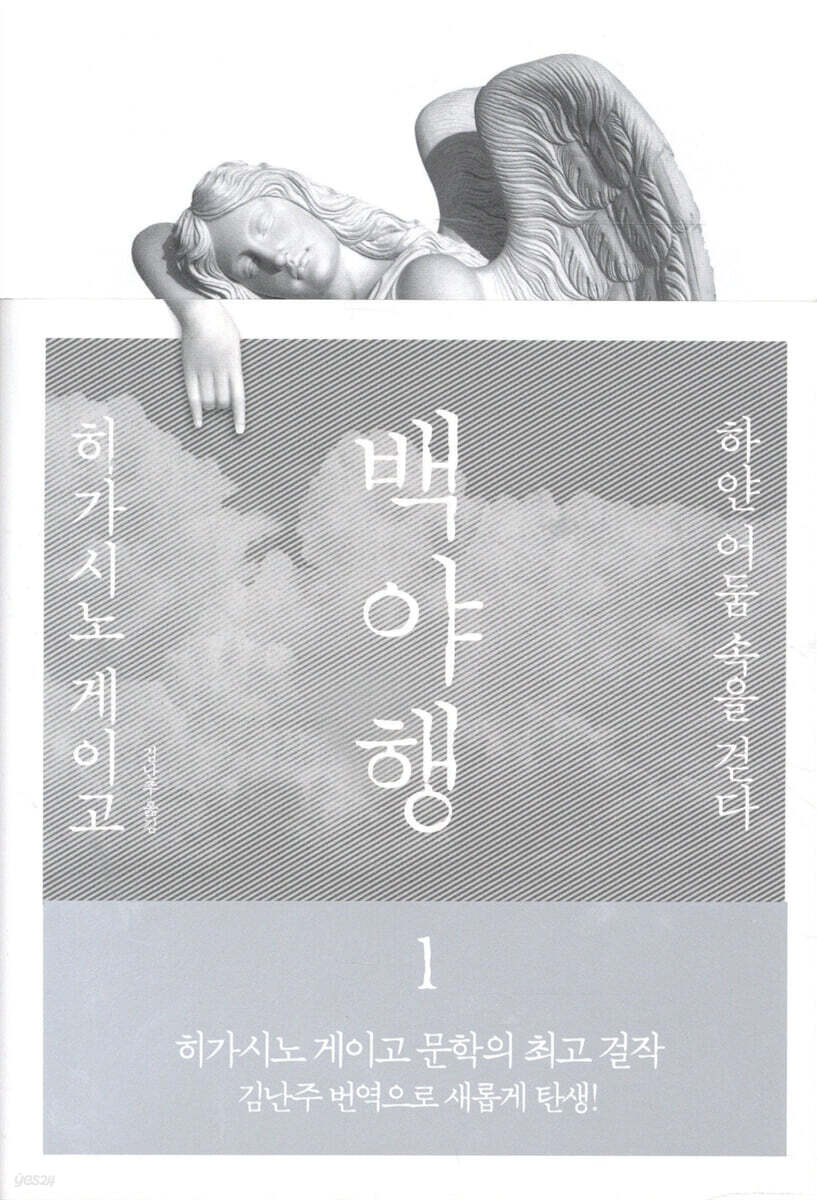
White Night Walk 1
 |
Description
Book Introduction
The pinnacle of Keigo Higashino's literature, depicting the tragedy of a wounded soul with breathtaking composition and epic scale, is reborn with a new translation by Nanju Kim!
Performed as a play in Japan in 2005
Aired as a Japanese TBS television drama series in 2006
Made into a movie in South Korea in 2009, starring Son Ye-jin and Go Soo.
Made into a movie in Japan in 2011
As of 2016, the cumulative circulation in Japan is 2.3 million copies.
Keigo Higashino's masterpiece, "White Night Walk" (2 volumes), has been republished, translated by Nanju Kim.
Translator Kim Nan-ju is a leading expert in this field, having translated numerous Japanese literary works into Korean. She is particularly skilled in translating the Japanese classic literature, The Tale of Genji, for the first time in Korea.
His smooth translation of "White Night Walk," which was reborn, fully preserves the literary characteristics of the original work, including its delicate nuances, subtle foreshadowing, and poetic allusions.
"White Night Walk" is a mystery novel that was first published in Japan in 1999 and was nominated for the Naoki Prize the following year. It is a bestseller that sold over 1 million copies in January 2006 and boasts a cumulative circulation of 2.3 million copies in Japan as of April 2016.
In 2005, it was staged in Japan, and in 2006, it was made into a Japanese TBS television drama series and aired.
In 2009, it was made into a film in Korea before Japan, which was unusual.
It was a popular production starring Son Ye-jin, Go Soo, and Han Suk-kyu.
It was made into a movie in Japan in 2011.
This is the pinnacle of Keigo Higashino's literature, acknowledged by all in the Japanese reading market as "a masterpiece mystery novel that depicts the tragedy of wounded humanity with breathtaking composition and epic scale" (Japanese Amazon work commentary).
Performed as a play in Japan in 2005
Aired as a Japanese TBS television drama series in 2006
Made into a movie in South Korea in 2009, starring Son Ye-jin and Go Soo.
Made into a movie in Japan in 2011
As of 2016, the cumulative circulation in Japan is 2.3 million copies.
Keigo Higashino's masterpiece, "White Night Walk" (2 volumes), has been republished, translated by Nanju Kim.
Translator Kim Nan-ju is a leading expert in this field, having translated numerous Japanese literary works into Korean. She is particularly skilled in translating the Japanese classic literature, The Tale of Genji, for the first time in Korea.
His smooth translation of "White Night Walk," which was reborn, fully preserves the literary characteristics of the original work, including its delicate nuances, subtle foreshadowing, and poetic allusions.
"White Night Walk" is a mystery novel that was first published in Japan in 1999 and was nominated for the Naoki Prize the following year. It is a bestseller that sold over 1 million copies in January 2006 and boasts a cumulative circulation of 2.3 million copies in Japan as of April 2016.
In 2005, it was staged in Japan, and in 2006, it was made into a Japanese TBS television drama series and aired.
In 2009, it was made into a film in Korea before Japan, which was unusual.
It was a popular production starring Son Ye-jin, Go Soo, and Han Suk-kyu.
It was made into a movie in Japan in 2011.
This is the pinnacle of Keigo Higashino's literature, acknowledged by all in the Japanese reading market as "a masterpiece mystery novel that depicts the tragedy of wounded humanity with breathtaking composition and epic scale" (Japanese Amazon work commentary).
The second volume of Keigo Higashino's masterpiece, "White Night Walk," newly published with translation by Nanju Kim.
This mystery novel was first published in Japan in 1999 and was nominated for the Naoki Prize the following year. It is a bestseller that sold over 1 million copies in January 2006 and boasts a cumulative circulation of 2.3 million copies in Japan as of April 2016.
In 2005, it was staged in Japan, and in 2006, it was made into a Japanese TBS television drama series and aired.
In 2009, it was made into a film in Korea before Japan, which was unusual.
In 1973, Yosuke Kirihara, the owner of a nearby pawn shop, was found murdered in an abandoned building on the outskirts of Osaka.
A woman he met just before he was murdered becomes a suspect, but soon after, she too dies from gas poisoning, presumed to be suicide.
Afterwards, the case became a cold case without any conclusive evidence and gradually faded from people's memories, and the victim's son, Ryoji Kirihara, and the suspect's daughter, Yukiho Nishimoto, also seemed to go on to live ordinary lives.
However, at some point, the shadows of horrific crimes such as murder and rape begin to loom over Ryoji and Yukiho, and clues begin to emerge one by one, revealing that these two are bound together by an inescapable string of fate.
Meanwhile, detective Sasagaki, who was in charge of the initial investigation into the murder of a former pawn shop owner, tenaciously tracks the movements of two people shrouded in mystery.
The second volume of Keigo Higashino's masterpiece, "White Night Walk," newly published with translation by Nanju Kim.
This mystery novel was first published in Japan in 1999 and was nominated for the Naoki Prize the following year. It is a bestseller that sold over 1 million copies in January 2006 and boasts a cumulative circulation of 2.3 million copies in Japan as of April 2016.
In 2005, it was staged in Japan, and in 2006, it was made into a Japanese TBS television drama series and aired.
In 2009, it was made into a film in Korea before Japan, which was unusual.
In 1973, Yosuke Kirihara, the owner of a nearby pawn shop, was found murdered in an abandoned building on the outskirts of Osaka.
A woman he met just before he was murdered becomes a suspect, but soon after, she too dies from gas poisoning, presumed to be suicide.
Afterwards, the case became a cold case without any conclusive evidence and gradually faded from people's memories, and the victim's son, Ryoji Kirihara, and the suspect's daughter, Yukiho Nishimoto, also seemed to go on to live ordinary lives.
However, at some point, the shadows of horrific crimes such as murder and rape begin to loom over Ryoji and Yukiho, and clues begin to emerge one by one, revealing that these two are bound together by an inescapable string of fate.
Meanwhile, detective Sasagaki, who was in charge of the initial investigation into the murder of a former pawn shop owner, tenaciously tracks the movements of two people shrouded in mystery.
This mystery novel was first published in Japan in 1999 and was nominated for the Naoki Prize the following year. It is a bestseller that sold over 1 million copies in January 2006 and boasts a cumulative circulation of 2.3 million copies in Japan as of April 2016.
In 2005, it was staged in Japan, and in 2006, it was made into a Japanese TBS television drama series and aired.
In 2009, it was made into a film in Korea before Japan, which was unusual.
In 1973, Yosuke Kirihara, the owner of a nearby pawn shop, was found murdered in an abandoned building on the outskirts of Osaka.
A woman he met just before he was murdered becomes a suspect, but soon after, she too dies from gas poisoning, presumed to be suicide.
Afterwards, the case became a cold case without any conclusive evidence and gradually faded from people's memories, and the victim's son, Ryoji Kirihara, and the suspect's daughter, Yukiho Nishimoto, also seemed to go on to live ordinary lives.
However, at some point, the shadows of horrific crimes such as murder and rape begin to loom over Ryoji and Yukiho, and clues begin to emerge one by one, revealing that these two are bound together by an inescapable string of fate.
Meanwhile, detective Sasagaki, who was in charge of the initial investigation into the murder of a former pawn shop owner, tenaciously tracks the movements of two people shrouded in mystery.
The second volume of Keigo Higashino's masterpiece, "White Night Walk," newly published with translation by Nanju Kim.
This mystery novel was first published in Japan in 1999 and was nominated for the Naoki Prize the following year. It is a bestseller that sold over 1 million copies in January 2006 and boasts a cumulative circulation of 2.3 million copies in Japan as of April 2016.
In 2005, it was staged in Japan, and in 2006, it was made into a Japanese TBS television drama series and aired.
In 2009, it was made into a film in Korea before Japan, which was unusual.
In 1973, Yosuke Kirihara, the owner of a nearby pawn shop, was found murdered in an abandoned building on the outskirts of Osaka.
A woman he met just before he was murdered becomes a suspect, but soon after, she too dies from gas poisoning, presumed to be suicide.
Afterwards, the case became a cold case without any conclusive evidence and gradually faded from people's memories, and the victim's son, Ryoji Kirihara, and the suspect's daughter, Yukiho Nishimoto, also seemed to go on to live ordinary lives.
However, at some point, the shadows of horrific crimes such as murder and rape begin to loom over Ryoji and Yukiho, and clues begin to emerge one by one, revealing that these two are bound together by an inescapable string of fate.
Meanwhile, detective Sasagaki, who was in charge of the initial investigation into the murder of a former pawn shop owner, tenaciously tracks the movements of two people shrouded in mystery.
- You can preview some of the book's contents.
Preview
Publisher's Review
The pinnacle of Keigo Higashino's literature, depicting the tragedy of a wounded soul with breathtaking composition and epic scale, is reborn with a new translation by Nanju Kim!
Performed as a play in Japan in 2005
Aired as a Japanese TBS television drama series in 2006
Made into a movie in South Korea in 2009, starring Son Ye-jin and Go Soo.
Made into a movie in Japan in 2011
As of 2016, the cumulative circulation in Japan is 2.3 million copies.
Keigo Higashino's masterpiece, "White Night Walk" (2 volumes), has been republished, translated by Nanju Kim.
Translator Kim Nan-ju is a leading expert in this field, having translated numerous Japanese literary works into Korean. She is particularly skilled in translating the Japanese classic literature, The Tale of Genji, for the first time in Korea.
His smooth translation of "White Night Walk," which was reborn, fully preserves the literary characteristics of the original work, including its delicate nuances, subtle foreshadowing, and poetic allusions.
"White Night Walk" is a mystery novel that was first published in Japan in 1999 and was nominated for the Naoki Prize the following year. It is a bestseller that sold over 1 million copies in January 2006 and boasts a cumulative circulation of 2.3 million copies in Japan as of April 2016.
In 2005, it was staged in Japan, and in 2006, it was made into a Japanese TBS television drama series and aired.
In 2009, it was made into a film in Korea before Japan, which was unusual.
It was a popular film starring Son Ye-jin, Go Soo, and Han Suk-kyu.
It was made into a movie in Japan in 2011.
This is the pinnacle of Keigo Higashino's literature, acknowledged by all in the Japanese reading market as "a masterpiece mystery novel that depicts the tragedy of wounded humanity with breathtaking composition and epic scale" (Japanese Amazon work commentary).
A brief synopsis of "White Night Walk" is as follows.
In 1973, Yosuke Kirihara, the owner of a nearby pawn shop, was found murdered in an abandoned building on the outskirts of Osaka.
A woman he met just before he was murdered becomes a suspect, but soon after, she too dies from gas poisoning, presumed to be suicide.
Afterwards, the case became a cold case without any conclusive evidence and gradually faded from people's memories, and the victim's son, Ryoji Kirihara, and the suspect's daughter, Yukiho Nishimoto, also seemed to go on to live ordinary lives.
However, at some point, the shadows of horrific crimes such as murder and rape begin to loom over Ryoji and Yukiho, and clues begin to emerge one by one, revealing that these two are bound together by an inescapable string of fate.
Meanwhile, detective Sasagaki, who was in charge of the initial investigation into the murder of a former pawn shop owner, tenaciously tracks the movements of two people shrouded in mystery.
The novel begins as a simple mystery and gradually develops into a youth novel or a coming-of-age novel.
The story follows the two people's growth process in 19-year increments until they become adults.
In this way, the story progresses breathlessly with various incidents, but on the contrary, the two people are always heading towards the dark past where the pawn shop owner's murder occurred.
What on earth happened to these two people at that time?
『White Night Walk』 is like a giant puzzle.
The big picture rarely comes to mind until the last puzzle piece falls into place.
Of course, there are hints at each corner that reveal parts of the picture, and they make you slap your knees, but soon you are once again drawn into a complex labyrinth.
Moreover, the author does not describe the psychology of Ryoji and Yukiho, the two people who hold the key to the incident, even in a single line until the very end.
Even the two people never meet once in the novel.
The author simply follows their path and focuses on realistic descriptions.
Keigo Higashino's meticulous narrative strategy keeps the novel in a state of constant tension.
And this is the highlight of the novel “White Night Walk.”
Only when the final puzzle piece finally falls into place does the full story of the vast story begin to unfold, leaving readers in awe.
That is why leading Japanese writers praised "White Night Walk" highly, saying, "The novel's blueprint is ingenious and political" (Kyogoku Natsuhiko) and "It has a level of perfection that makes you think of precision machinery" (Kitakata Kenzo).
The title of 『White Night Walk』 well encapsulates the dark and heavy emotions that dominate the entire novel.
The title symbolically shows the fate of the two main characters who live with painful trauma from their childhood.
There is a brief monologue in the novel where the protagonist reveals his feelings.
Ryoji said, “I want to walk outside during the day.
(Omitted) “Because my life is like walking in the white night.”
Yukiho, on the other hand, said, “But it wasn’t dark.
There was something that replaced the sun.
(Omitted) Thanks to that light, I was able to live thinking that night was day.
(Omitted) In the first place, there was no sun for me.
“So there is no fear of losing something,” he mutters.
One person expresses a desire to escape from the white night, while the other is resigned to life in the white night.
But the two wounded souls are tightly bound by a common fate, having to walk through the white night, neither day nor night.
The keyword that runs through 『White Night Walk』 is devotion.
Unconditional devotion to a loved one is a supreme act of self-sacrifice that transcends the boundaries of good and evil.
Devotion is one of the favorite themes of the Japanese.
This theme is also well expressed in another masterpiece by Keigo Higashino, The Devotion of Suspect X.
What is important, beyond the rightness or wrongness of an action or good or evil, is the purity of the motive.
The story of the deaths of 47 samurai who set out for revenge to restore their lord's honor, "Kushinjura," is still continuously being made into plays and movies, and this is why the Japanese are so enthusiastic about this story.
Unlike Keigo Higashino's other novels, "White Night Walk" frequently features scenes of death and sex.
One of the great characteristics of Japanese literature is that the protagonists of Japanese literature, wounded and frustrated by the corrupt adults, choose sex and death as an escape route to preserve the innocence and personal truth of their childhood.
This sentiment is also well expressed in 『White Night Walk』.
Childhood trauma serves as the driving force behind the actions of the two main characters, Ryoji and Yukiho.
This structure is also a strong critique of the Japanese bubble economy of the 1970s, the period set in 『White Night Walk』.
In this respect, 『White Night Walk』 can be seen as a work that sharply displays the socially critical nature that is one of the characteristics of Keigo Higashino's novels.
The novel ends without the truth being revealed on the surface even at the end.
The final scene concludes with the following description:
“Yukiho was walking up the escalator.
The back of his figure appeared as a white shadow.
“She never looked back.”
The ending is left to the reader.
Because of this, readers are left wondering, “Did Yukiho truly love Ryoji, or was Ryoji just a convenient tool for her?” and “Was Ryoji a mental slave, possessed by Yukiho’s magic?”
Either way, Keigo Higashino seems to have succeeded in creating a powerful and unforgettable character, Yukiho, in "White Night Walk."
“There was no sun above me.
It was always night.
But it wasn't dark.
Because there was a being that replaced the sun.
It didn't shine as brightly as the sun, but it was enough for me.
“Thanks to that light, I was able to live thinking that night was day.”
― From the text
Performed as a play in Japan in 2005
Aired as a Japanese TBS television drama series in 2006
Made into a movie in South Korea in 2009, starring Son Ye-jin and Go Soo.
Made into a movie in Japan in 2011
As of 2016, the cumulative circulation in Japan is 2.3 million copies.
Keigo Higashino's masterpiece, "White Night Walk" (2 volumes), has been republished, translated by Nanju Kim.
Translator Kim Nan-ju is a leading expert in this field, having translated numerous Japanese literary works into Korean. She is particularly skilled in translating the Japanese classic literature, The Tale of Genji, for the first time in Korea.
His smooth translation of "White Night Walk," which was reborn, fully preserves the literary characteristics of the original work, including its delicate nuances, subtle foreshadowing, and poetic allusions.
"White Night Walk" is a mystery novel that was first published in Japan in 1999 and was nominated for the Naoki Prize the following year. It is a bestseller that sold over 1 million copies in January 2006 and boasts a cumulative circulation of 2.3 million copies in Japan as of April 2016.
In 2005, it was staged in Japan, and in 2006, it was made into a Japanese TBS television drama series and aired.
In 2009, it was made into a film in Korea before Japan, which was unusual.
It was a popular film starring Son Ye-jin, Go Soo, and Han Suk-kyu.
It was made into a movie in Japan in 2011.
This is the pinnacle of Keigo Higashino's literature, acknowledged by all in the Japanese reading market as "a masterpiece mystery novel that depicts the tragedy of wounded humanity with breathtaking composition and epic scale" (Japanese Amazon work commentary).
A brief synopsis of "White Night Walk" is as follows.
In 1973, Yosuke Kirihara, the owner of a nearby pawn shop, was found murdered in an abandoned building on the outskirts of Osaka.
A woman he met just before he was murdered becomes a suspect, but soon after, she too dies from gas poisoning, presumed to be suicide.
Afterwards, the case became a cold case without any conclusive evidence and gradually faded from people's memories, and the victim's son, Ryoji Kirihara, and the suspect's daughter, Yukiho Nishimoto, also seemed to go on to live ordinary lives.
However, at some point, the shadows of horrific crimes such as murder and rape begin to loom over Ryoji and Yukiho, and clues begin to emerge one by one, revealing that these two are bound together by an inescapable string of fate.
Meanwhile, detective Sasagaki, who was in charge of the initial investigation into the murder of a former pawn shop owner, tenaciously tracks the movements of two people shrouded in mystery.
The novel begins as a simple mystery and gradually develops into a youth novel or a coming-of-age novel.
The story follows the two people's growth process in 19-year increments until they become adults.
In this way, the story progresses breathlessly with various incidents, but on the contrary, the two people are always heading towards the dark past where the pawn shop owner's murder occurred.
What on earth happened to these two people at that time?
『White Night Walk』 is like a giant puzzle.
The big picture rarely comes to mind until the last puzzle piece falls into place.
Of course, there are hints at each corner that reveal parts of the picture, and they make you slap your knees, but soon you are once again drawn into a complex labyrinth.
Moreover, the author does not describe the psychology of Ryoji and Yukiho, the two people who hold the key to the incident, even in a single line until the very end.
Even the two people never meet once in the novel.
The author simply follows their path and focuses on realistic descriptions.
Keigo Higashino's meticulous narrative strategy keeps the novel in a state of constant tension.
And this is the highlight of the novel “White Night Walk.”
Only when the final puzzle piece finally falls into place does the full story of the vast story begin to unfold, leaving readers in awe.
That is why leading Japanese writers praised "White Night Walk" highly, saying, "The novel's blueprint is ingenious and political" (Kyogoku Natsuhiko) and "It has a level of perfection that makes you think of precision machinery" (Kitakata Kenzo).
The title of 『White Night Walk』 well encapsulates the dark and heavy emotions that dominate the entire novel.
The title symbolically shows the fate of the two main characters who live with painful trauma from their childhood.
There is a brief monologue in the novel where the protagonist reveals his feelings.
Ryoji said, “I want to walk outside during the day.
(Omitted) “Because my life is like walking in the white night.”
Yukiho, on the other hand, said, “But it wasn’t dark.
There was something that replaced the sun.
(Omitted) Thanks to that light, I was able to live thinking that night was day.
(Omitted) In the first place, there was no sun for me.
“So there is no fear of losing something,” he mutters.
One person expresses a desire to escape from the white night, while the other is resigned to life in the white night.
But the two wounded souls are tightly bound by a common fate, having to walk through the white night, neither day nor night.
The keyword that runs through 『White Night Walk』 is devotion.
Unconditional devotion to a loved one is a supreme act of self-sacrifice that transcends the boundaries of good and evil.
Devotion is one of the favorite themes of the Japanese.
This theme is also well expressed in another masterpiece by Keigo Higashino, The Devotion of Suspect X.
What is important, beyond the rightness or wrongness of an action or good or evil, is the purity of the motive.
The story of the deaths of 47 samurai who set out for revenge to restore their lord's honor, "Kushinjura," is still continuously being made into plays and movies, and this is why the Japanese are so enthusiastic about this story.
Unlike Keigo Higashino's other novels, "White Night Walk" frequently features scenes of death and sex.
One of the great characteristics of Japanese literature is that the protagonists of Japanese literature, wounded and frustrated by the corrupt adults, choose sex and death as an escape route to preserve the innocence and personal truth of their childhood.
This sentiment is also well expressed in 『White Night Walk』.
Childhood trauma serves as the driving force behind the actions of the two main characters, Ryoji and Yukiho.
This structure is also a strong critique of the Japanese bubble economy of the 1970s, the period set in 『White Night Walk』.
In this respect, 『White Night Walk』 can be seen as a work that sharply displays the socially critical nature that is one of the characteristics of Keigo Higashino's novels.
The novel ends without the truth being revealed on the surface even at the end.
The final scene concludes with the following description:
“Yukiho was walking up the escalator.
The back of his figure appeared as a white shadow.
“She never looked back.”
The ending is left to the reader.
Because of this, readers are left wondering, “Did Yukiho truly love Ryoji, or was Ryoji just a convenient tool for her?” and “Was Ryoji a mental slave, possessed by Yukiho’s magic?”
Either way, Keigo Higashino seems to have succeeded in creating a powerful and unforgettable character, Yukiho, in "White Night Walk."
“There was no sun above me.
It was always night.
But it wasn't dark.
Because there was a being that replaced the sun.
It didn't shine as brightly as the sun, but it was enough for me.
“Thanks to that light, I was able to live thinking that night was day.”
― From the text
GOODS SPECIFICS
- Date of issue: April 6, 2016
- Format: Hardcover book binding method guide
- Page count, weight, size: 592 pages | 608g | 130*198*35mm
- ISBN13: 9788990982612
- ISBN10: 8990982618
You may also like
카테고리
korean


korean

![ELLE 엘르 스페셜 에디션 A형 : 12월 [2025]](http://librairie.coreenne.fr/cdn/shop/files/b8e27a3de6c9538896439686c6b0e8fb.jpg?v=1766436872&width=3840)


