

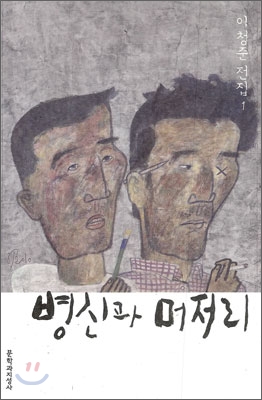
Idiots and idiots
 |
Description
Book Introduction
The complete works of author Lee Cheong-jun, who struggled throughout his life to sublimate the sorrow and pain of our times into love and reconciliation, including 『Seopyeonje』, 『Snow Road』, and 『Your Heaven』.
This is the first volume of the 『Lee Cheong-jun Complete Works』, a project to preserve and re-examine the literature of novelist Lee Cheong-jun, who passed away in July 2008, and is a collection of his early short stories in the order of their publication.
This collection includes 12 short stories, including the title work, "The Idiot and the Idiot," as well as his debut work, "Discharge," which became the signal for Lee Cheong-jun's literary career and won the Sasanggye New Writer's Award.
Lee Cheong-jun's works reach far and deep into the collective unconscious of Koreans as a place of enduring hardship, as well as into the personal and microscopic structures of the most complex entanglements of the minds beneath, weaving together a panorama of human life.
In particular, Lee Cheong-jun's early novels have the character of expressing disillusionment with the situation in which the April 19 Revolution was not concluded by the May 16 Revolution and exploring the possibility of healing the wounds related to this.
Each volume of the anthology includes a work, newly written commentary, and an article that explains the process of text transformation of each work and the interrelationships among Lee Cheong-jun's works.
This annotation will be an invaluable resource for those studying Lee Cheong-jun's literature by showing the characteristics and major transformations of the material, thematic, and stylistic aspects of his works, along with changes in chronological flow, publisher, and format.
This is the first volume of the 『Lee Cheong-jun Complete Works』, a project to preserve and re-examine the literature of novelist Lee Cheong-jun, who passed away in July 2008, and is a collection of his early short stories in the order of their publication.
This collection includes 12 short stories, including the title work, "The Idiot and the Idiot," as well as his debut work, "Discharge," which became the signal for Lee Cheong-jun's literary career and won the Sasanggye New Writer's Award.
Lee Cheong-jun's works reach far and deep into the collective unconscious of Koreans as a place of enduring hardship, as well as into the personal and microscopic structures of the most complex entanglements of the minds beneath, weaving together a panorama of human life.
In particular, Lee Cheong-jun's early novels have the character of expressing disillusionment with the situation in which the April 19 Revolution was not concluded by the May 16 Revolution and exploring the possibility of healing the wounds related to this.
Each volume of the anthology includes a work, newly written commentary, and an article that explains the process of text transformation of each work and the interrelationships among Lee Cheong-jun's works.
This annotation will be an invaluable resource for those studying Lee Cheong-jun's literature by showing the characteristics and major transformations of the material, thematic, and stylistic aspects of his works, along with changes in chronological flow, publisher, and format.
- You can preview some of the book's contents.
Preview
index
discharge
Ai Van Man
tightrope walker
Scary Saturday
Beach people
bridle
Idiots and idiots
Transfer order
I'll show you the stars
accomplice
mountaineering equipment
Jesus of the Garden of Happiness
Commentary - Icarus' Dream/Kwon Oh-ryong
Materials - Transformation and Interrelationship of Texts / Lee Yun-ok
Ai Van Man
tightrope walker
Scary Saturday
Beach people
bridle
Idiots and idiots
Transfer order
I'll show you the stars
accomplice
mountaineering equipment
Jesus of the Garden of Happiness
Commentary - Icarus' Dream/Kwon Oh-ryong
Materials - Transformation and Interrelationship of Texts / Lee Yun-ok
Publisher's Review
A relentless passion for human truth and destiny
A grand mountain of Korean fiction, the culmination of 40 years of literary achievement by novelist Lee Cheong-jun.
The first fruits of the 『Lee Cheong-jun Complete Works』, prepared with a new structure and cover by Munhak-kwa-Jiseongsa to preserve and re-examine the literature of novelist Lee Cheong-jun, who passed away in July 2008, are now presented to readers.
The first volume of the 『Lee Cheong-jun Complete Works』, published on July 31, 2010, the second anniversary of the author Lee Cheong-jun's death, is a collection of his early short stories in chronological order: Volume 1, 『The Idiot and the Fool』 (2010), and Volume 2, 『The Hawk Catcher』 (2010).
“A novel is an act of discourse that reflectively perceives and interprets life through the order of language, creatively loves, and dreams of a new world of freedom and harmony.”
_Lee Cheong-jun, from 『The Secret Words of Silent Marks』
Lee Cheong-jun, the writer who struggled throughout his life to sublimate the sorrow and pain of our times into love and reconciliation, including works such as 『Seopyeonje』, 『Snow Road』, and 『Your Heaven』.
He is a true symbol of Korean literary history, a writer with a strong sense of identity, an intellectual with character, a person with humility, a caring spirit for others, and strictness toward himself. He quietly lived by our side, setting many examples of life that we have all come to appreciate.
The world of Lee Cheong-jun's works, which placed the love of life through words and the order of words as the ultimate act and value of literature, touches far and deep on macroscopic and social issues such as the conflict between power and humans, discord between groups and individuals, and the antagonism between language and society, as well as the collective unconscious of Koreans as a place to endure hardship and the personal and microscopic structure of the most complex entanglement of the minds underneath, weaving a panorama of human life.
In other words, the scope of Lee Cheong-jun's literature, from the intellectual politics perfected in "Your Heaven" to the world of indigenous love and resentment unraveled in "Seopyeonje," encompasses all aspects of our lives.
This time, 『The Idiot and the Fool』 and 『The Hawk Catcher』, which are available in two editions, wireless and hardcover, contain 12 short stories in Volume 1 and 9 short stories in Volume 2, starting with "Discharge," which was Lee Cheong-jun's debut work and winner of the Sasanggye New Writer's Award, and which became the signal for his literary career.
The Lee Cheong-jun Memorial Society, launched on July 28, 2009, and Munhak-kwa-Jiseongsa joined forces to publish a new edition of the Lee Cheong-jun Complete Works as the definitive edition. Through the Lee Cheong-jun Complete Works Publication Committee, comprised of seven people including literary critics Kwon Oh-ryong, Jeong Gwa-ri, Woo Chan-je, Lee Yun-ok, and Hong Jeong-seon, novelist Lee In-seong, and Munhak-kwa-Jiseongsa CEO Kim Su-yeong, the foundation for organizing all of Lee Cheong-jun's works and bibliographic materials and the basic composition of the complete works was laid after several rounds of discussion and consultation.
Through regular meetings of the publication committee held over the past two years, 1) a list of Lee Cheong-jun's works (including both published and unpublished works), 2) a chronology of Lee Cheong-jun, and 3) a preliminary detailed list of the serialized pages, publishers, and volume of each work was investigated and organized. In addition, it was decided that the cover illustrations and illustrations for each volume would be done by artist Kim Seon-du, a close friend and hometown junior of the late Lee Cheong-jun.
Literary critic Lee Yun-ok, who has long been closely involved in Lee Cheong-jun's literature and has devoted her critical insight and effort to it, has researched and compiled detailed data that reveals the textual transformations and interrelationships of each individual work.
This annotation will be an invaluable resource for those studying Lee Cheong-jun's literature by showing the characteristics and major transformations of the material, thematic, and stylistic aspects of his works, along with changes in chronological flow, publisher, and format.
The composition and characteristics of the 『Lee Cheong-jun Complete Works』 published by Munhak-kwa-Jiseongsa, compiled by the 『Lee Cheong-jun Complete Works Publication Committee』, are as follows.
The Editorial System and Features of the Complete Works of Lee Cheong-jun
1.
The Munhak-kwa-Jiseongsa edition of 『Lee Cheong-jun Complete Works』 compiles all of the author's novels, short stories, and works that the author has serialized but not yet published as a single volume, as well as unfinished works.
2.
The numbering of each volume in the anthology follows the order in which the individual works were published. For long novels, the numbering is based on the end of serialization, and for short and medium-length novels, the numbering is based on the date of first publication in the publication journal.
However, in the case of unfinished serialized works, the date of publication of the first volume was used as the standard.
The works included in the short story collection are also included in the order of publication, and the year of publication is indicated at the end of each work.
3.
The text of the complete works was finalized by reflecting the author's new corrections and supplements made after the publication of the 『Lee Cheong-jun Literature Complete Works』 (Yeollimwon).
In particular, in the case of unpublished works, we would like to state that the information included is faithfully based on the relevant materials left behind by the author.
4.
Each volume of the anthology includes a work, newly written commentary, and an article that explains the process of text transformation of each work and the interrelationships among Lee Cheong-jun's works.
This analysis only includes the very characteristic transformations that led up to the final text of the current Munhak-kwa-Jiseongsa edition.
5.
The spelling of this book follows the National Institute of the Korean Language's 'Korean Spelling Rules' in principle, but in the case of spacing, the company's internal regulations were followed.
However, dialects, colloquial expressions, onomatopoeia, and mimetic words that are judged to affect the atmosphere of the work have been left as is to preserve the author's writing intention (in parentheses: current spelling notation).
Example) ① Dialects and onomatopoeia/mimetic words: half-and-half, ...
Run (run) like a dog (like a dog) tumble tumble (round and round) denggang (dengung) kkajang kkajang (kkojang kkojang)
② The author's unique expression:
-Not that (not that) extraordinary (not ordinary) to bring up (to bring up)
-The dog puts its mouth on the ground and makes a careless gesture to the neck.
③ Other: The person in front, the guy next to me, the person in front, the person on the boat, the person behind me
And then (and then) and then (and then)
6.
The foreign language notation in this book was changed according to the ‘Foreign Language Notation Rules’ of the National Institute of the Korean Language.
However, in cases where it appears as the title of the work or as an important word, the original was preserved.
Example) ① Mammoth Women's University / Seine Tea House / Dessang ② Regi (refined to 'employee')
Munhak-kwa-Jiseongsa, which has published the complete works of representative Korean literary figures such as 『Choi In-hun Complete Works』, 『Hwang Sun-won Complete Works』, 『Kim Hyeon Literature Complete Works』, and 『Korean Literature Complete Works』, will compile 『Lee Cheong-jun Complete Works』 over the next five years. This will be a meaningful opportunity to view Lee Cheong-jun's literature as a whole, look back on the trajectory of modern Korean novels at a glance, and seek future directions.
A grand mountain of Korean fiction, the culmination of 40 years of literary achievement by novelist Lee Cheong-jun.
The first fruits of the 『Lee Cheong-jun Complete Works』, prepared with a new structure and cover by Munhak-kwa-Jiseongsa to preserve and re-examine the literature of novelist Lee Cheong-jun, who passed away in July 2008, are now presented to readers.
The first volume of the 『Lee Cheong-jun Complete Works』, published on July 31, 2010, the second anniversary of the author Lee Cheong-jun's death, is a collection of his early short stories in chronological order: Volume 1, 『The Idiot and the Fool』 (2010), and Volume 2, 『The Hawk Catcher』 (2010).
“A novel is an act of discourse that reflectively perceives and interprets life through the order of language, creatively loves, and dreams of a new world of freedom and harmony.”
_Lee Cheong-jun, from 『The Secret Words of Silent Marks』
Lee Cheong-jun, the writer who struggled throughout his life to sublimate the sorrow and pain of our times into love and reconciliation, including works such as 『Seopyeonje』, 『Snow Road』, and 『Your Heaven』.
He is a true symbol of Korean literary history, a writer with a strong sense of identity, an intellectual with character, a person with humility, a caring spirit for others, and strictness toward himself. He quietly lived by our side, setting many examples of life that we have all come to appreciate.
The world of Lee Cheong-jun's works, which placed the love of life through words and the order of words as the ultimate act and value of literature, touches far and deep on macroscopic and social issues such as the conflict between power and humans, discord between groups and individuals, and the antagonism between language and society, as well as the collective unconscious of Koreans as a place to endure hardship and the personal and microscopic structure of the most complex entanglement of the minds underneath, weaving a panorama of human life.
In other words, the scope of Lee Cheong-jun's literature, from the intellectual politics perfected in "Your Heaven" to the world of indigenous love and resentment unraveled in "Seopyeonje," encompasses all aspects of our lives.
This time, 『The Idiot and the Fool』 and 『The Hawk Catcher』, which are available in two editions, wireless and hardcover, contain 12 short stories in Volume 1 and 9 short stories in Volume 2, starting with "Discharge," which was Lee Cheong-jun's debut work and winner of the Sasanggye New Writer's Award, and which became the signal for his literary career.
The Lee Cheong-jun Memorial Society, launched on July 28, 2009, and Munhak-kwa-Jiseongsa joined forces to publish a new edition of the Lee Cheong-jun Complete Works as the definitive edition. Through the Lee Cheong-jun Complete Works Publication Committee, comprised of seven people including literary critics Kwon Oh-ryong, Jeong Gwa-ri, Woo Chan-je, Lee Yun-ok, and Hong Jeong-seon, novelist Lee In-seong, and Munhak-kwa-Jiseongsa CEO Kim Su-yeong, the foundation for organizing all of Lee Cheong-jun's works and bibliographic materials and the basic composition of the complete works was laid after several rounds of discussion and consultation.
Through regular meetings of the publication committee held over the past two years, 1) a list of Lee Cheong-jun's works (including both published and unpublished works), 2) a chronology of Lee Cheong-jun, and 3) a preliminary detailed list of the serialized pages, publishers, and volume of each work was investigated and organized. In addition, it was decided that the cover illustrations and illustrations for each volume would be done by artist Kim Seon-du, a close friend and hometown junior of the late Lee Cheong-jun.
Literary critic Lee Yun-ok, who has long been closely involved in Lee Cheong-jun's literature and has devoted her critical insight and effort to it, has researched and compiled detailed data that reveals the textual transformations and interrelationships of each individual work.
This annotation will be an invaluable resource for those studying Lee Cheong-jun's literature by showing the characteristics and major transformations of the material, thematic, and stylistic aspects of his works, along with changes in chronological flow, publisher, and format.
The composition and characteristics of the 『Lee Cheong-jun Complete Works』 published by Munhak-kwa-Jiseongsa, compiled by the 『Lee Cheong-jun Complete Works Publication Committee』, are as follows.
The Editorial System and Features of the Complete Works of Lee Cheong-jun
1.
The Munhak-kwa-Jiseongsa edition of 『Lee Cheong-jun Complete Works』 compiles all of the author's novels, short stories, and works that the author has serialized but not yet published as a single volume, as well as unfinished works.
2.
The numbering of each volume in the anthology follows the order in which the individual works were published. For long novels, the numbering is based on the end of serialization, and for short and medium-length novels, the numbering is based on the date of first publication in the publication journal.
However, in the case of unfinished serialized works, the date of publication of the first volume was used as the standard.
The works included in the short story collection are also included in the order of publication, and the year of publication is indicated at the end of each work.
3.
The text of the complete works was finalized by reflecting the author's new corrections and supplements made after the publication of the 『Lee Cheong-jun Literature Complete Works』 (Yeollimwon).
In particular, in the case of unpublished works, we would like to state that the information included is faithfully based on the relevant materials left behind by the author.
4.
Each volume of the anthology includes a work, newly written commentary, and an article that explains the process of text transformation of each work and the interrelationships among Lee Cheong-jun's works.
This analysis only includes the very characteristic transformations that led up to the final text of the current Munhak-kwa-Jiseongsa edition.
5.
The spelling of this book follows the National Institute of the Korean Language's 'Korean Spelling Rules' in principle, but in the case of spacing, the company's internal regulations were followed.
However, dialects, colloquial expressions, onomatopoeia, and mimetic words that are judged to affect the atmosphere of the work have been left as is to preserve the author's writing intention (in parentheses: current spelling notation).
Example) ① Dialects and onomatopoeia/mimetic words: half-and-half, ...
Run (run) like a dog (like a dog) tumble tumble (round and round) denggang (dengung) kkajang kkajang (kkojang kkojang)
② The author's unique expression:
-Not that (not that) extraordinary (not ordinary) to bring up (to bring up)
-The dog puts its mouth on the ground and makes a careless gesture to the neck.
③ Other: The person in front, the guy next to me, the person in front, the person on the boat, the person behind me
And then (and then) and then (and then)
6.
The foreign language notation in this book was changed according to the ‘Foreign Language Notation Rules’ of the National Institute of the Korean Language.
However, in cases where it appears as the title of the work or as an important word, the original was preserved.
Example) ① Mammoth Women's University / Seine Tea House / Dessang ② Regi (refined to 'employee')
Munhak-kwa-Jiseongsa, which has published the complete works of representative Korean literary figures such as 『Choi In-hun Complete Works』, 『Hwang Sun-won Complete Works』, 『Kim Hyeon Literature Complete Works』, and 『Korean Literature Complete Works』, will compile 『Lee Cheong-jun Complete Works』 over the next five years. This will be a meaningful opportunity to view Lee Cheong-jun's literature as a whole, look back on the trajectory of modern Korean novels at a glance, and seek future directions.
GOODS SPECIFICS
- Date of issue: July 30, 2010
- Page count, weight, size: 424 pages | 510g | 138*210*30mm
- ISBN13: 9788932020815
- ISBN10: 8932020817
You may also like
카테고리
korean


korean

![GQ KOREA Mark (Monthly): December [2025]](http://librairie.coreenne.fr/cdn/shop/files/8ef265dbbfbf186523ed75ba7319009d.jpg?v=1765340328&width=3840)


