

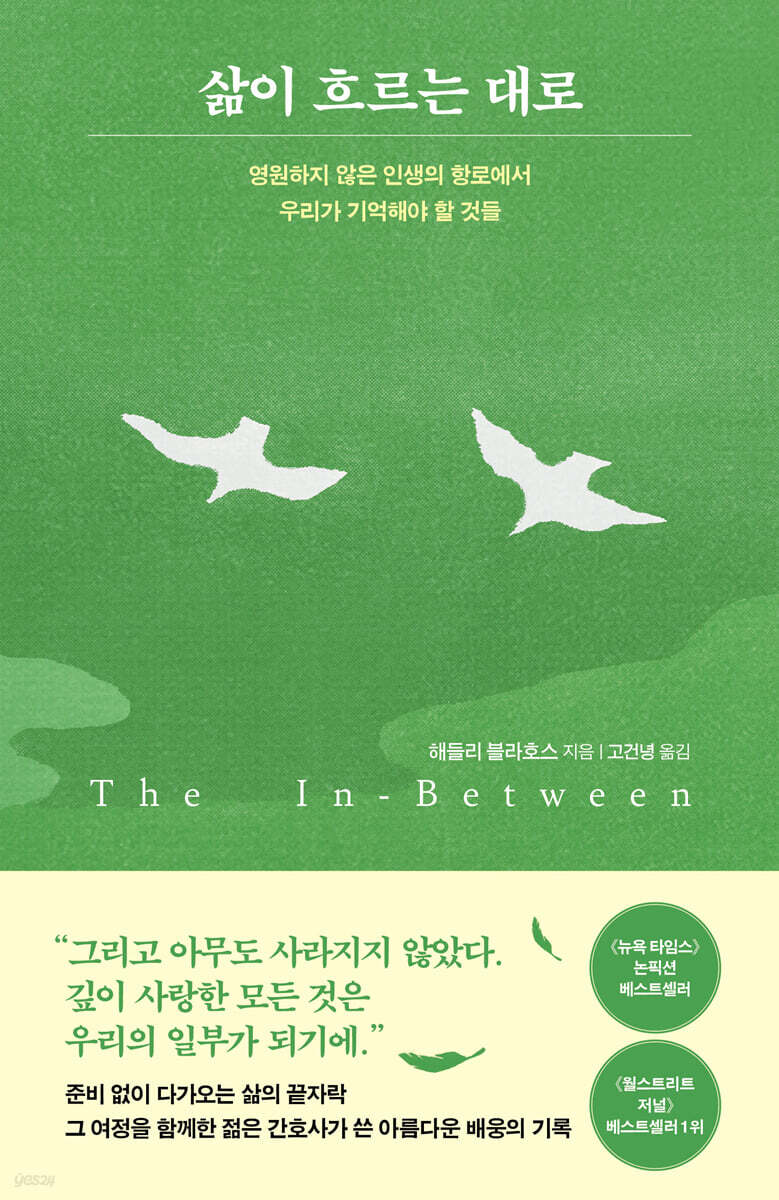
As life flows
 |
Description
Book Introduction
“I am the one who cares for them, sends them off, and remembers them.” A Hospice Nurse's Record of Tears and Love Important truths about life shared by those facing death ★ New York Times Nonfiction Bestseller ★ #1 Wall Street Journal Bestseller Does death always come suddenly? Is death always horrific and painful? Is death a medical failure? One hospice nurse answers "no" to all these myths surrounding death. Hadley Vlahos, author of "Life Flows," shares her experiences and feelings from her years as a hospice nurse in this book, which seeks to bring a deep and honest perspective to the socially taboo topic of death. This book, which beautifully depicts the final journey of a thirty-two-year-old hospice nurse with her patients, and contains the wisdom and inspiration of life shared by those facing death, became a non-fiction bestseller on Amazon and the New York Times immediately after its publication, and was selected as the number one bestseller by the Wall Street Journal, receiving an enthusiastic response from all over the United States, leaving readers with an unforgettable impression. |
- You can preview some of the book's contents.
Preview
index
Entering
1. Please say I love you one more time · Glenda
2 May the waiting not be only death · Sword
3 Everything passes eventually. · Wed
4 Each of us was someone's love · Sandra
5. Always eat cake · Elizabeth
6 The Impossible Happens · Edith
7 There are burdens that cannot be carried alone · Reggie
8 Some answers don't change with time · Lily
9 Life and Death Are Unpredictable · Babette
10 Things you love deeply never die · Albert
11. I hope no one is left to die alone. Frank
12 Everything happens for a reason · Adam
Going out
Acknowledgements
Translator's Note
1. Please say I love you one more time · Glenda
2 May the waiting not be only death · Sword
3 Everything passes eventually. · Wed
4 Each of us was someone's love · Sandra
5. Always eat cake · Elizabeth
6 The Impossible Happens · Edith
7 There are burdens that cannot be carried alone · Reggie
8 Some answers don't change with time · Lily
9 Life and Death Are Unpredictable · Babette
10 Things you love deeply never die · Albert
11. I hope no one is left to die alone. Frank
12 Everything happens for a reason · Adam
Going out
Acknowledgements
Translator's Note
Detailed image
.jpg)
Into the book
“Mom, it’s me.
I'm sorry I was so harsh to you yesterday.
It was because my mind was so complicated.
Mom taught me everything I know, but she forgot the one most important thing.
You never told me how to cope when the most important person in my life passes away.
How can I live without my mother?
--- pp.48~49 From "Please Say I Love You One More Time"
"sorry.
Grandma, I'm so sorry.
“I have to comfort my grandmother,” I said, sobbing.
My grandmother pulled away, looked into my eyes, and spoke firmly.
“We need to comfort each other.
Don't apologize.
How much we both love our teacher.
It was like a gift from God to us.
“I thought so too, Carl.”
I nodded silently.
Tears kept flowing and it was difficult to open my mouth.
I was held in Grandma Mary's arms and remembered the first time I saw her and was scared.
Now, that incident seems funny.
--- p.79 From “I hope waiting is not just death”
Grandma Su had a smile on her face.
Grandma said with her eyes still closed.
“When the time comes for you to leave this world, there will be a long line of people waiting to greet you in heaven, but you will all have to get out of the way.
“Because I’ll be the first to hug you, teacher.”
For months, I had tried with all my might to comfort Grandma Su, to let her know that I truly cared for her, and now she was comforting me instead.
--- p.121 From “Everything Passes in the End”
Watching them made me realize every time that no matter what their circumstances, no one can escape death.
No fence is strong enough to protect us from nature's forces.
When death is imminent, everyone wants the same thing.
It was about concern, comfort, and connection.
--- p.146 From “Everyone was someone’s love”
“I wanted to tell you this because whenever I look at you, it feels like I’m looking at myself.
I didn't know I would die at forty.
I always thought there was still plenty of time.
I regret not spending more time with my loved ones.
“I guess I should have just eaten that damn cake then.”
“That’s good advice,” I said quietly.
“Eat cake.”
“Yes, I definitely have cake,” Elizabeth repeated as she lay back down on the bed.
--- pp.167~168 From "Make sure to eat cake"
It wasn't just strangers who found my job difficult.
Even some of my friends and family didn't understand how much this meant to me, no matter how much I told them.
What really broke my heart was when my dad asked me when I planned to return to being a 'real nurse'.
When I replied that I was still a real nurse, my father said this.
“No, not the nurses who just let patients die, but the nurses who actually save lives.”
--- p.231 From “There are burdens that cannot be carried alone”
What was once deeply loved never fades away.
Because everything we love deeply becomes a part of us.
--- p.321 From “What you love deeply never disappears”
Having cared for many terminally ill patients from diverse religious backgrounds, I have come to believe that what matters is not religion, but the life a person has lived.
I've seen countless people live wonderful, fulfilling lives, whether they are religious or not.
I don't think either is better.
But if there is one thing that is most important, it is finding inner peace and happiness.
Whatever that means to you.
In my experience, the people who are happiest at the end of their lives are those who have made peace with their lives and found inner peace, those who are comfortable with their beliefs about the afterlife and who do not doubt them.
I'm sorry I was so harsh to you yesterday.
It was because my mind was so complicated.
Mom taught me everything I know, but she forgot the one most important thing.
You never told me how to cope when the most important person in my life passes away.
How can I live without my mother?
--- pp.48~49 From "Please Say I Love You One More Time"
"sorry.
Grandma, I'm so sorry.
“I have to comfort my grandmother,” I said, sobbing.
My grandmother pulled away, looked into my eyes, and spoke firmly.
“We need to comfort each other.
Don't apologize.
How much we both love our teacher.
It was like a gift from God to us.
“I thought so too, Carl.”
I nodded silently.
Tears kept flowing and it was difficult to open my mouth.
I was held in Grandma Mary's arms and remembered the first time I saw her and was scared.
Now, that incident seems funny.
--- p.79 From “I hope waiting is not just death”
Grandma Su had a smile on her face.
Grandma said with her eyes still closed.
“When the time comes for you to leave this world, there will be a long line of people waiting to greet you in heaven, but you will all have to get out of the way.
“Because I’ll be the first to hug you, teacher.”
For months, I had tried with all my might to comfort Grandma Su, to let her know that I truly cared for her, and now she was comforting me instead.
--- p.121 From “Everything Passes in the End”
Watching them made me realize every time that no matter what their circumstances, no one can escape death.
No fence is strong enough to protect us from nature's forces.
When death is imminent, everyone wants the same thing.
It was about concern, comfort, and connection.
--- p.146 From “Everyone was someone’s love”
“I wanted to tell you this because whenever I look at you, it feels like I’m looking at myself.
I didn't know I would die at forty.
I always thought there was still plenty of time.
I regret not spending more time with my loved ones.
“I guess I should have just eaten that damn cake then.”
“That’s good advice,” I said quietly.
“Eat cake.”
“Yes, I definitely have cake,” Elizabeth repeated as she lay back down on the bed.
--- pp.167~168 From "Make sure to eat cake"
It wasn't just strangers who found my job difficult.
Even some of my friends and family didn't understand how much this meant to me, no matter how much I told them.
What really broke my heart was when my dad asked me when I planned to return to being a 'real nurse'.
When I replied that I was still a real nurse, my father said this.
“No, not the nurses who just let patients die, but the nurses who actually save lives.”
--- p.231 From “There are burdens that cannot be carried alone”
What was once deeply loved never fades away.
Because everything we love deeply becomes a part of us.
--- p.321 From “What you love deeply never disappears”
Having cared for many terminally ill patients from diverse religious backgrounds, I have come to believe that what matters is not religion, but the life a person has lived.
I've seen countless people live wonderful, fulfilling lives, whether they are religious or not.
I don't think either is better.
But if there is one thing that is most important, it is finding inner peace and happiness.
Whatever that means to you.
In my experience, the people who are happiest at the end of their lives are those who have made peace with their lives and found inner peace, those who are comfortable with their beliefs about the afterlife and who do not doubt them.
--- pp.408~409 From "Going Out"
Publisher's Review
A moment of true healing discovered by a hospice nurse
Embracing the end of life with love and solidarity
Hadley Vlahos, twenty-two, just starting out on her career as a hospice nurse.
One day, a patient she was in charge of developed severe difficulty breathing.
Bewildered by the symptoms she had never experienced before, she asked her doctor what to do, but the answer she received was unexpected.
“If the patient doesn’t feel pain, nothing needs to be done.
“Just let them eat whatever they want and help them do whatever they want.” Hadley, who had learned from working as an emergency room nurse that treatment was the most important, stamped her feet in a strange sense of anxiety.
The doctor, who read her mind, gave her this advice.
“We are doing what we have to do.
Because grandma is already comfortable at home.
Don't forget that you are doing important work, teacher.
Even if the world doesn't acknowledge it."
Hospice, or end-of-life care, refers to activities in which patients with limited time left to live are surrounded by loved ones and receive comfortable care in their final days, instead of discontinuing treatment at hospitals or other medical institutions.
Hospice nurses guide patients and their families through this process and help patients remain as pain-free and comfortable as possible.
We believe that allowing patients to face death in their own way is the way to regain their life, and we help them prepare well for their final moments.
The author of this book, Hadley Vlahos, worked as a hospice nurse for many years and learned firsthand that sometimes giving up or doing nothing at all can help patients.
After acknowledging this, I was able to build new relationships with my patients.
In the past, she was busy going around the hospital wards handing out medicine without saying a word, but now, being there for the patients, comforting them, showing solidarity, and listening to their stories has become her most important job.
Then, the patients gradually opened up and began to tell stories about their lives.
They honestly shared what they regretted most in life, what values in life became important as they faced death, and how they wanted to face their final moments. As the countless conversations they had accumulated, Hadley's life began to change little by little.
A young nurse who was unfamiliar with life and death,
Turning SNS into a sea of hot tears
It was a very ordinary day, no different from any other day.
The day my best friend suddenly passed away.
At fifteen, Hadley was too young to understand the meaning of death, and this shocking loss changed her life forever.
She believed that death came only at the end of life, and she asked countless questions about death, which she could not understand at all.
'Why did God allow pedophiles and murderers to live in this world, but take the life of my good friend so soon?'
Hadley, who had been living with a deep sense of anger over death and loss, became a single mother at the age of 19, just before entering her second year of college.
When she, an ordinary college student, decided to have a child on her own, everyone around her, including her close family, turned their backs on her.
Hadley, who had to bear the burden of childbirth and childcare alone, was unable to return to school and had to immediately find a job to support herself and her child.
At first, nursing was just a means of making a living, but for Hadley, who had so much to ask and say about life and death, it gradually became a calling.
As time passed, the unfamiliar tasks gradually became familiar, and dealing with patients became natural.
Even patients who had been holding onto their illness and had closed their hearts tightly began to open up to the warm and affectionate Hadley and share their innermost stories. As a nurse, I received even greater comfort and love from patients and their families than I could have given them.
However, even as I gained more experience and years of experience, I never got used to seeing off patients I had grown attached to.
Every time, Hadley consoled herself by taking to heart these words she had once heard in the hospital.
“What you once loved deeply never goes away.
Because everything we love deeply becomes a part of us.”
As a hospice nurse, I wanted to share with more people the truths and inspirations I gained from spending time with patients.
When Hadley first began to cautiously discuss death on social media, she was surprised by how many people wanted to hear it.
Hadley and her patients' stories quickly spread across YouTube, TikTok, and Instagram, garnering empathy and support from over 3 million followers.
I finally realized that talking about death, a topic that had long been taboo, could actually bring hope to people and comfort those who had lost a loved one.
“To let go and love more deeply,
“I should have just eaten that damn cake…”
On the value of life becoming clearer in the face of death
When people near death realize that their time is short, they often look back on their lives and eagerly share the lessons that have had the greatest impact.
Hadley, who has been unable to fully enjoy life due to an eating disorder, is told by her patient, Elizabeth, that she feels like she has wasted too much of her life on the treadmill and that this is her biggest regret in life.
“I can’t stop thinking about the time when my friends asked me to go to the beach, but I didn’t go because I was embarrassed by my belly fat.
There were birthday parties I couldn't attend because I was so obsessed with counting calories that I only ate food I made myself.
Even my birthday, I skipped it without inviting my friends.
I didn't want to force myself to eat cake.
(…) Whenever I see you, it feels like I’m seeing myself, so I really wanted to tell you this.
I didn't know I would die at forty.
I always thought there was still plenty of time.
I regret not spending more time with my loved ones.
“I guess I should have just eaten that damn cake then.” (p. 168)
In this way, patients share their life stories in the face of death, and Hadley treasures the wisdom and lessons they willingly share.
And you come to understand your own life more deeply.
Perhaps that is why, despite being a story about death, this book makes you think deeply about the meaning of life.
In the stories of those nearing the end of their lives, as they face death, they reflect on their greatest regrets, the people they miss most, and the things they hold most dear, we are reminded of the question, "What must we remember on the impermanent journey of life?"
In the end, we realize the truth of life that the things we will regret in the end are the things we should value most in this moment.
Embracing the end of life with love and solidarity
Hadley Vlahos, twenty-two, just starting out on her career as a hospice nurse.
One day, a patient she was in charge of developed severe difficulty breathing.
Bewildered by the symptoms she had never experienced before, she asked her doctor what to do, but the answer she received was unexpected.
“If the patient doesn’t feel pain, nothing needs to be done.
“Just let them eat whatever they want and help them do whatever they want.” Hadley, who had learned from working as an emergency room nurse that treatment was the most important, stamped her feet in a strange sense of anxiety.
The doctor, who read her mind, gave her this advice.
“We are doing what we have to do.
Because grandma is already comfortable at home.
Don't forget that you are doing important work, teacher.
Even if the world doesn't acknowledge it."
Hospice, or end-of-life care, refers to activities in which patients with limited time left to live are surrounded by loved ones and receive comfortable care in their final days, instead of discontinuing treatment at hospitals or other medical institutions.
Hospice nurses guide patients and their families through this process and help patients remain as pain-free and comfortable as possible.
We believe that allowing patients to face death in their own way is the way to regain their life, and we help them prepare well for their final moments.
The author of this book, Hadley Vlahos, worked as a hospice nurse for many years and learned firsthand that sometimes giving up or doing nothing at all can help patients.
After acknowledging this, I was able to build new relationships with my patients.
In the past, she was busy going around the hospital wards handing out medicine without saying a word, but now, being there for the patients, comforting them, showing solidarity, and listening to their stories has become her most important job.
Then, the patients gradually opened up and began to tell stories about their lives.
They honestly shared what they regretted most in life, what values in life became important as they faced death, and how they wanted to face their final moments. As the countless conversations they had accumulated, Hadley's life began to change little by little.
A young nurse who was unfamiliar with life and death,
Turning SNS into a sea of hot tears
It was a very ordinary day, no different from any other day.
The day my best friend suddenly passed away.
At fifteen, Hadley was too young to understand the meaning of death, and this shocking loss changed her life forever.
She believed that death came only at the end of life, and she asked countless questions about death, which she could not understand at all.
'Why did God allow pedophiles and murderers to live in this world, but take the life of my good friend so soon?'
Hadley, who had been living with a deep sense of anger over death and loss, became a single mother at the age of 19, just before entering her second year of college.
When she, an ordinary college student, decided to have a child on her own, everyone around her, including her close family, turned their backs on her.
Hadley, who had to bear the burden of childbirth and childcare alone, was unable to return to school and had to immediately find a job to support herself and her child.
At first, nursing was just a means of making a living, but for Hadley, who had so much to ask and say about life and death, it gradually became a calling.
As time passed, the unfamiliar tasks gradually became familiar, and dealing with patients became natural.
Even patients who had been holding onto their illness and had closed their hearts tightly began to open up to the warm and affectionate Hadley and share their innermost stories. As a nurse, I received even greater comfort and love from patients and their families than I could have given them.
However, even as I gained more experience and years of experience, I never got used to seeing off patients I had grown attached to.
Every time, Hadley consoled herself by taking to heart these words she had once heard in the hospital.
“What you once loved deeply never goes away.
Because everything we love deeply becomes a part of us.”
As a hospice nurse, I wanted to share with more people the truths and inspirations I gained from spending time with patients.
When Hadley first began to cautiously discuss death on social media, she was surprised by how many people wanted to hear it.
Hadley and her patients' stories quickly spread across YouTube, TikTok, and Instagram, garnering empathy and support from over 3 million followers.
I finally realized that talking about death, a topic that had long been taboo, could actually bring hope to people and comfort those who had lost a loved one.
“To let go and love more deeply,
“I should have just eaten that damn cake…”
On the value of life becoming clearer in the face of death
When people near death realize that their time is short, they often look back on their lives and eagerly share the lessons that have had the greatest impact.
Hadley, who has been unable to fully enjoy life due to an eating disorder, is told by her patient, Elizabeth, that she feels like she has wasted too much of her life on the treadmill and that this is her biggest regret in life.
“I can’t stop thinking about the time when my friends asked me to go to the beach, but I didn’t go because I was embarrassed by my belly fat.
There were birthday parties I couldn't attend because I was so obsessed with counting calories that I only ate food I made myself.
Even my birthday, I skipped it without inviting my friends.
I didn't want to force myself to eat cake.
(…) Whenever I see you, it feels like I’m seeing myself, so I really wanted to tell you this.
I didn't know I would die at forty.
I always thought there was still plenty of time.
I regret not spending more time with my loved ones.
“I guess I should have just eaten that damn cake then.” (p. 168)
In this way, patients share their life stories in the face of death, and Hadley treasures the wisdom and lessons they willingly share.
And you come to understand your own life more deeply.
Perhaps that is why, despite being a story about death, this book makes you think deeply about the meaning of life.
In the stories of those nearing the end of their lives, as they face death, they reflect on their greatest regrets, the people they miss most, and the things they hold most dear, we are reminded of the question, "What must we remember on the impermanent journey of life?"
In the end, we realize the truth of life that the things we will regret in the end are the things we should value most in this moment.
GOODS SPECIFICS
- Date of issue: September 24, 2024
- Page count, weight, size: 428 pages | 488g | 130*200*26mm
- ISBN13: 9791130653280
- ISBN10: 1130653285
You may also like
카테고리
korean


korean

![GQ KOREA Mark (Monthly): December [2025]](http://librairie.coreenne.fr/cdn/shop/files/8ef265dbbfbf186523ed75ba7319009d.jpg?v=1765340328&width=3840)


