

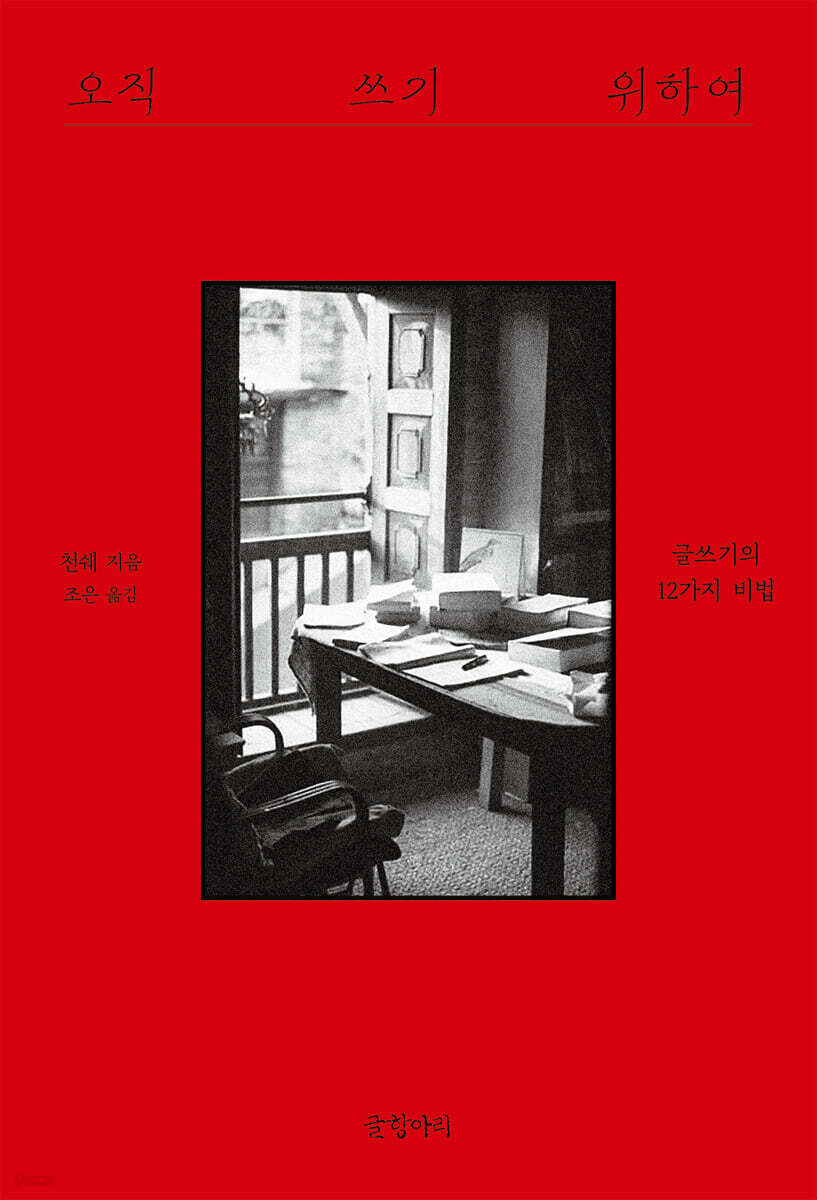
Just to write
 |
Description
Book Introduction
The process of becoming a writer, as told by a writer with 30 years of experience.
The Unwavering Principles of Solid Writing
Selling clothes in the market, his transformation into a businessman and his frustrations,
In the drama of life where I put everything down and devoted myself to writing,
Demonstrates the principles of writing and the process of developing a writer's spirit.
This book is a special lecture on writing and a class on becoming a writer by veteran writer Chen Xue, who burst onto the literary scene with “The Villainess” and has been active at the center of Taiwanese novels for 30 years.
The author, who devoted his life to his work to the point where it could be said that he was born to write novels, boldly revealed the dignity of a writer and the art of survival.
The usefulness of this book can be summarized in several points:
First, this is a guide for those who feel they must write and consider writing to be the core of their lives, but who struggle to complete it.
Second, it is a guideline for those who are juggling work and writing to help them find a balance between the two.
Third, here's some advice for professional writers who want to keep their balance between the work they're writing and outside work (commissioned manuscripts, lectures, reviewing).
People who feel like they can become themselves only when they write, as a senior who has gone through that stage, point out and solve various problems they face in reality.
Chen Xue has published twenty books, won numerous awards, and is famous as a queer writer who married her lover, who was an editor.
He emphasizes that when writing while taking responsibility for one's livelihood, writing should also be viewed as 'labor'.
Because without works, the title of author is of no use.
Moreover, even those who have published a book must always start from zero for their next work.
A writer is always faced with a blank sheet of paper.
Therefore, it is important to overcome the fear of facing a blank page and continue writing, and the know-how for this part is presented in depth.
The Unwavering Principles of Solid Writing
Selling clothes in the market, his transformation into a businessman and his frustrations,
In the drama of life where I put everything down and devoted myself to writing,
Demonstrates the principles of writing and the process of developing a writer's spirit.
This book is a special lecture on writing and a class on becoming a writer by veteran writer Chen Xue, who burst onto the literary scene with “The Villainess” and has been active at the center of Taiwanese novels for 30 years.
The author, who devoted his life to his work to the point where it could be said that he was born to write novels, boldly revealed the dignity of a writer and the art of survival.
The usefulness of this book can be summarized in several points:
First, this is a guide for those who feel they must write and consider writing to be the core of their lives, but who struggle to complete it.
Second, it is a guideline for those who are juggling work and writing to help them find a balance between the two.
Third, here's some advice for professional writers who want to keep their balance between the work they're writing and outside work (commissioned manuscripts, lectures, reviewing).
People who feel like they can become themselves only when they write, as a senior who has gone through that stage, point out and solve various problems they face in reality.
Chen Xue has published twenty books, won numerous awards, and is famous as a queer writer who married her lover, who was an editor.
He emphasizes that when writing while taking responsibility for one's livelihood, writing should also be viewed as 'labor'.
Because without works, the title of author is of no use.
Moreover, even those who have published a book must always start from zero for their next work.
A writer is always faced with a blank sheet of paper.
Therefore, it is important to overcome the fear of facing a blank page and continue writing, and the know-how for this part is presented in depth.
- You can preview some of the book's contents.
Preview
index
Preface: To trust me, you must dedicate yourself to me.
Part 1: The Creative Path I've Walked
Accepting the lowest reality and moving towards the highest ideal
Create a routine and train yourself repeatedly.
I revise as I write, and I grow as I write.
Rather than reading good books, let's write something that doesn't work.
Embracing the wounds that won't go away
Literature is what illuminates the eyes of despair.
Why do you write, for whom do you write?
I just want to write better
Ten Tips for Creators of Part 2
The power of routine
What if you have high expectations but your skills don't match up?
The importance of self-control
How to deal with stress?
What to do when getting started is difficult?
What to do when you lack talent?
Where does inspiration come from?
Four principles that have been maintained for 30 years
Let's write a piece that only I can write.
The most beautiful thing is to return to your desk.
Part 3 Freelance Work Guide
How to plan your workload?
Freelancer Note 1: Ghostwriting, Interviews, Thematic Articles, Lectures, and Seminars
Freelancer Note 2: Literary Award Judging and Other Work
Part 1: The Creative Path I've Walked
Accepting the lowest reality and moving towards the highest ideal
Create a routine and train yourself repeatedly.
I revise as I write, and I grow as I write.
Rather than reading good books, let's write something that doesn't work.
Embracing the wounds that won't go away
Literature is what illuminates the eyes of despair.
Why do you write, for whom do you write?
I just want to write better
Ten Tips for Creators of Part 2
The power of routine
What if you have high expectations but your skills don't match up?
The importance of self-control
How to deal with stress?
What to do when getting started is difficult?
What to do when you lack talent?
Where does inspiration come from?
Four principles that have been maintained for 30 years
Let's write a piece that only I can write.
The most beautiful thing is to return to your desk.
Part 3 Freelance Work Guide
How to plan your workload?
Freelancer Note 1: Ghostwriting, Interviews, Thematic Articles, Lectures, and Seminars
Freelancer Note 2: Literary Award Judging and Other Work
Into the book
“Let’s keep writing, let’s build up our own works, and then our works will protect us.”
--- p.10
You weren't scared? I didn't have time to be scared back then.
Perhaps it was because I had set goals for myself.
That was my goal to write three full-length novels within three to five years.
Until then, I just wanted to earn a living and write nonstop.
--- pp.19~20
What I want to say is this.
If I hadn't closed my eyes and moved forward like this from the beginning, if I hadn't written important works like "The Child on the Bridge" and "Old Spring" in succession, if instead I had wasted time and energy worrying about not having enough money, not being recognized, not being talented, and all sorts of other vague worries, then with my strength back then, I probably wouldn't have been able to face the tremendous pressure of reality.
--- pp.20~21
So I decided early on.
I decided to set a time to write and let others know about it.
I am not unemployed.
You have to prove to yourself that you work at set hours like an office worker.
Otherwise, others won't take my writing seriously.
I've always put novels first, and then I write things that make money.
It wasn't easy.
Because novels don't have deadlines, but commissioned manuscripts do.
It is for this very reason that I decided to start writing novels.
To maintain efficiency, we have established a rule that we will never drag out requested manuscripts.
--- pp.25~26
We must pour all our talents into our work.
You must build a solid foundation and practice diligently.
You need to master the basics well.
No fashion or trend lasts long.
Far more important than writing well is to keep writing.
Only then can I get closer to what my heart truly desires.
Don't procrastinate or put down your pen in pursuit of perfection.
Only the written manuscript is mine.
--- p.35
The year I spent writing "You Can't Die Again" was filled with difficult times, but even when I felt like I was facing a wall, I always sat down in front of the computer when the time came.
When the novel wasn't going well, I put the story aside and wrote about the external parts.
For example, I first described Song Dongnian's appearance and wrote about Li Haiyan and Ding Xiaochen's childhood episodes.
Or maybe I just drew some completely unnecessary wallpapers and made myself get to know this little town better.
Sometimes there are days when I just can't write.
Then, I get out of the novel I'm writing and practice writing dialogue.
Try writing a 500-character conversation.
As I write, it's strange how letters always give me something.
Whether it's useful or not, there are things that come out of your mind that you can't do with just thinking about it.
--- pp.41~42
Over the past 30 years, I have experienced many transitions.
The controversy at the time of his debut, the subsequent 2-3 year hiatus, being too busy with his work to write novels, becoming depressed because he couldn't write, and after coming to Taipei, he suffered from loneliness and fear due to financial stress.
Later, I was crushed by the worry that I would become ill and not be able to live, let alone become independent.
But even in my darkest moments, I never once thought about not writing.
My novel creation also went through many stages.
I was constantly changing myself, and each time I lost some readers.
I endured these processes one by one.
I didn't give up, and my inner passion burned even more intensely.
The poor times continued.
After a while, things started to get better and I was able to live a little more freely.
--- p.62
Excluding work-related travel and business trips, I maintain a regular routine of writing novels five days a week, no matter what problems I encounter when writing a draft.
I try to solve the problems in the novel as much as possible while writing steadily every day, and even if I can't solve them, I still try to fill a certain amount.
It doesn't matter if you write a few hundred useless characters.
Even if I end up deleting it, I still consider this as practice and continue to tap the keyboard.
I like a regular life.
With practice, you can maintain your writing skills.
--- p.78
The most fascinating part of writing is that, before I started writing, I was just an ordinary person, but as I spent each day like that, I saw that the work, polished over a long period of time, became much more beautiful than the writer himself.
If you keep trying like this for a long time, you will eventually feel like you have ascended to heaven and stolen a little bit of divine power, like the god of fiction has given us back, little by little, something invaluable and put it into our works.
--- p.80
I'm gradually realizing that stress is always there, that stress makes us more focused and flexible, and that going through it brings me closer to myself.
In this way, stress becomes a force that forces you to face yourself again, and you become more aware of how to choose and allocate work, and how to overcome ambivalence.
Stress is our mirror.
The image reflected in the mirror is ourselves.
Whatever face we have, it is our truest self.
Only by looking at yourself clearly can you complement and improve yourself.
--- pp.104~105
Who can say which is better in life, light or darkness? Darkness makes light shine brighter, and light reveals the depth of darkness.
The most beautiful thing is to return to your desk and face your manuscript persistently, faithfully, earnestly, and sincerely.
--- p.10
You weren't scared? I didn't have time to be scared back then.
Perhaps it was because I had set goals for myself.
That was my goal to write three full-length novels within three to five years.
Until then, I just wanted to earn a living and write nonstop.
--- pp.19~20
What I want to say is this.
If I hadn't closed my eyes and moved forward like this from the beginning, if I hadn't written important works like "The Child on the Bridge" and "Old Spring" in succession, if instead I had wasted time and energy worrying about not having enough money, not being recognized, not being talented, and all sorts of other vague worries, then with my strength back then, I probably wouldn't have been able to face the tremendous pressure of reality.
--- pp.20~21
So I decided early on.
I decided to set a time to write and let others know about it.
I am not unemployed.
You have to prove to yourself that you work at set hours like an office worker.
Otherwise, others won't take my writing seriously.
I've always put novels first, and then I write things that make money.
It wasn't easy.
Because novels don't have deadlines, but commissioned manuscripts do.
It is for this very reason that I decided to start writing novels.
To maintain efficiency, we have established a rule that we will never drag out requested manuscripts.
--- pp.25~26
We must pour all our talents into our work.
You must build a solid foundation and practice diligently.
You need to master the basics well.
No fashion or trend lasts long.
Far more important than writing well is to keep writing.
Only then can I get closer to what my heart truly desires.
Don't procrastinate or put down your pen in pursuit of perfection.
Only the written manuscript is mine.
--- p.35
The year I spent writing "You Can't Die Again" was filled with difficult times, but even when I felt like I was facing a wall, I always sat down in front of the computer when the time came.
When the novel wasn't going well, I put the story aside and wrote about the external parts.
For example, I first described Song Dongnian's appearance and wrote about Li Haiyan and Ding Xiaochen's childhood episodes.
Or maybe I just drew some completely unnecessary wallpapers and made myself get to know this little town better.
Sometimes there are days when I just can't write.
Then, I get out of the novel I'm writing and practice writing dialogue.
Try writing a 500-character conversation.
As I write, it's strange how letters always give me something.
Whether it's useful or not, there are things that come out of your mind that you can't do with just thinking about it.
--- pp.41~42
Over the past 30 years, I have experienced many transitions.
The controversy at the time of his debut, the subsequent 2-3 year hiatus, being too busy with his work to write novels, becoming depressed because he couldn't write, and after coming to Taipei, he suffered from loneliness and fear due to financial stress.
Later, I was crushed by the worry that I would become ill and not be able to live, let alone become independent.
But even in my darkest moments, I never once thought about not writing.
My novel creation also went through many stages.
I was constantly changing myself, and each time I lost some readers.
I endured these processes one by one.
I didn't give up, and my inner passion burned even more intensely.
The poor times continued.
After a while, things started to get better and I was able to live a little more freely.
--- p.62
Excluding work-related travel and business trips, I maintain a regular routine of writing novels five days a week, no matter what problems I encounter when writing a draft.
I try to solve the problems in the novel as much as possible while writing steadily every day, and even if I can't solve them, I still try to fill a certain amount.
It doesn't matter if you write a few hundred useless characters.
Even if I end up deleting it, I still consider this as practice and continue to tap the keyboard.
I like a regular life.
With practice, you can maintain your writing skills.
--- p.78
The most fascinating part of writing is that, before I started writing, I was just an ordinary person, but as I spent each day like that, I saw that the work, polished over a long period of time, became much more beautiful than the writer himself.
If you keep trying like this for a long time, you will eventually feel like you have ascended to heaven and stolen a little bit of divine power, like the god of fiction has given us back, little by little, something invaluable and put it into our works.
--- p.80
I'm gradually realizing that stress is always there, that stress makes us more focused and flexible, and that going through it brings me closer to myself.
In this way, stress becomes a force that forces you to face yourself again, and you become more aware of how to choose and allocate work, and how to overcome ambivalence.
Stress is our mirror.
The image reflected in the mirror is ourselves.
Whatever face we have, it is our truest self.
Only by looking at yourself clearly can you complement and improve yourself.
--- pp.104~105
Who can say which is better in life, light or darkness? Darkness makes light shine brighter, and light reveals the depth of darkness.
The most beautiful thing is to return to your desk and face your manuscript persistently, faithfully, earnestly, and sincerely.
--- p.152
Publisher's Review
From Beginner to Professional Writer
Do you feel like you're nothing if you don't write? If so, let's start by stepping out of your comfort zone.
Such a person must believe in me and devote himself to me.
The author emphasizes:
“Your writing is something only you can do.
You also have to pay the price of not writing.
“You have to be yourself first.” The author’s words added then are a great comfort.
“Your writing is always better than your own.”
Tian Xue tells the story of his journey in eight stories.
The author wrote the novel while earning money as a clothes seller at a night market.
I decided to become a writer when I was twenty and have never given up on that goal.
I wrote in my spare time at the street stall and conceived stories on the delivery truck.
Even after I came home from work, I spent two hours a day, two to three days a week.
Each and every novel and short story written by Tian Xue began from a single piece of land beneath his feet.
No matter how small the land was, she could stand on it.
In fact, it wasn't this firm from the beginning.
The author, who grew up in the market as a child, had excellent business acumen and her family hoped she would expand her business.
As I had a strong sense of responsibility, I worked day and night to meet the demands of those around me, and then suddenly I felt like I was on a runaway train.
And then I completely broke down mentally.
After that, he continued to receive treatment for depression, and while he was away from business, his parents' investment failure left him in deep debt.
The lover who took advantage of the author ended up betraying him and leaving him.
At this time, what the author desperately clung to was writing.
Fortunately, there were friends around me who supported that idea.
“The novels you write are so precious.
So it's really important that you live well." "Your hands are precious.
“You should use it for writing.” “You, from now on, do what you like.
“That way I can do it for a long time.” From then on, the author only made money for writing.
Let's take a look at the strategies the author offers for those who are at a similar crossroads.
First, you must acknowledge your own insignificant reality and talents and prepare to step forward toward your highest ideals.
Want to write your own? Saying you'll read and grow before you write is nothing more than an excuse.
The best way is to revise as you write, and grow as you write.
Are you constantly reading good books because there are so many around you? The author advises that instead of reading good books, you should write your own unwritten works.
If you like reading more than writing, you will fall into a vicious cycle of becoming increasingly worse at writing.
Of course, this is not to disparage reading.
To write, you must read widely and deeply.
The author attempted self-transformation several times as he moved from one work to the next, and one of the methods he used was to study the classics.
I read Kenzaburo Oe, Dostoevsky, Borges, Proust, Kafka, and Nabokov, and with this qualitative leap, I was able to move on to my next work.
What are some practical ways to help you write?
As we all know, the author also emphasizes creating a routine.
If I train myself repeatedly and devote all my energy to writing, I will reach the highest level of my potential.
The author was not originally a person with high concentration.
But now, I follow the routine and make sure to write what I plan to write.
It's okay if the first draft is bad.
Although he has already published twenty books, the author's first drafts are still terrible.
That doesn't mean there's any reason to despair.
The fun in writing is that it gets better, so you just have to keep revising it.
“The most important thing in writing is to write,” says the author.
Whether the writing is good or bad is a secondary question.
You have to maintain the feeling that your hands are faster than your head.
Rather than thinking everything through and then writing, I think after writing and adjust my writing as I write.
Ten Tips for Creative Writers
First, believe in the power of routine.
Writing is labor.
The first draft is always a failure, and most of the time it takes the third or fourth version to produce anything decent.
Especially if you want to become a long-form writer, you have to face your writing again and again, even if you fall down several times during the writing process.
Let us keep in mind that the work that is completed by piling up like this is much more beautiful than ourselves.
Second, even if you have high expectations but lack skills, use them a lot anyway.
It is more important to write than to read a lot.
If it's hard to get started, try it, even if it's rough.
The person who should be the strongest advocate for my work is myself.
Third, live a stable and moderate life.
The writer's emotional ups and downs are clearly conveyed to the reader.
The way to make a novel stable is through regularity in life.
The novel is an art of restraint.
Only by slowly emptying myself and making myself as small and low as possible can I become a vessel capable of containing a novel.
Fourth, when you feel stressed, immediately relieve the cause of the stress.
For example, if there is a request for a manuscript, I write it; if there is a review, I read the submissions; if there is a lecture, I prepare in advance.
However, the time when I can concentrate the best is always spent writing.
If you feel stressed while writing a novel, try writing an essay at the same time.
This method has an unexpected effect.
Fifth, if you are someone who has trouble getting started because you are afraid of writing poorly, learn to persevere.
That is, tolerating oneself for not being able to write a good introduction.
The author also offers his own solution.
If the introduction is not written, start from Chapter 2.
Another option is to first sketch the characters or create a log of key events.
Sixth, even if you lack talent, if you have a passionate love for writing, don't hesitate.
The author was told by a close friend, “Stop writing novels.
I heard the advice, “You can clearly see the hardships ahead,” and my literature teacher said, “You don’t know what a novel is.”
But I couldn't help but write, so I wrote.
What if, despite years of hard work, you remain unknown and your books aren't selling? The author encourages you, saying, "All the time you've spent has been dazzling, as it was all voluntary."
Even if you don't get any real benefit, the work remains, so that's enough.
Seventh, writing is a task that relies more on self-control and regular practice than inspiration.
Also, materials and inspiration are best found in everyday life.
So, when you have a chance to work, take that experience and apply it to your writing.
Alternatively, it may be helpful to observe your surroundings carefully.
If you can't write, take a bus and visit an unfamiliar neighborhood.
The moment the surrounding scenery changes, the brain becomes activated.
Eighth, don't break the four principles (don't borrow money, don't have a secret garden, be flexible between writing and your career, and protect yourself from rejection or harsh criticism).
With this practical mindset, let's strive towards our ideal life.
Ninth, let's write a piece that only I can write.
The author says that the only person who believed in him was himself.
Whether I won an award or not, whether my book sold or not, I faced my own writing.
The author says:
“Writing is a long river and it is our life.
“In the end, we will live our own lives thanks to the works we write.”
Tenth, the most beautiful thing of all is to return to your desk and sit down.
If you want to write a novel, change your constitution to one that suits it.
The author also spent several years optimizing his body for feature-length writing.
I started doing yoga and swimming in 2007.
People around him say he has strong willpower, but in reality, it's because he's developed all sorts of methods to keep writing despite the pain of enduring illness (he suffered from an autoimmune disease).
Protecting your body is very important for your ability to continue working.
The author eats regularly, gets eight hours of sleep every day, and exercises at a moderate intensity.
Freelance Work Guide
Part 3 of this book contains practical guidelines.
How to determine your workload, how to establish a routine of taking 3-4 months off a year, how to adjust your daily rhythm, how to coordinate creative grants, lecture requests, and commissioned manuscripts.
For full-time writers, or freelancers, the art of acceptance and rejection is important.
Always prioritize your own creation, but you must also find a way to make a living.
While writing novels, Tian Xue never once missed out on earning a living or sending money to her parents.
In fact, that is the secret to his ability to live as a full-time writer without giving up writing.
Even now, the author cannot live on royalties alone.
As such, the book is full of advice on how to strike a balance between being a writer and a lifelong learner.
For example, not all manuscripts are of equal importance.
There are some things that are more important and require less energy.
Therefore, the allocation of time and energy must be finely tuned towards the goal of creation, of producing the best work possible.
The author has constantly changed the world of his work in order to advance to the next stage.
Every time that happened, I actually lost a little bit of readers.
But I didn't give up, and my inner passion burned more and more.
“Promise yourself that you will never give up writing, that you will never walk away from writing,” Chen Xue advises.
If we promise to become better people for writing, writing will reward us.
We are all just people stealing time to write.
Do you feel like you're nothing if you don't write? If so, let's start by stepping out of your comfort zone.
Such a person must believe in me and devote himself to me.
The author emphasizes:
“Your writing is something only you can do.
You also have to pay the price of not writing.
“You have to be yourself first.” The author’s words added then are a great comfort.
“Your writing is always better than your own.”
Tian Xue tells the story of his journey in eight stories.
The author wrote the novel while earning money as a clothes seller at a night market.
I decided to become a writer when I was twenty and have never given up on that goal.
I wrote in my spare time at the street stall and conceived stories on the delivery truck.
Even after I came home from work, I spent two hours a day, two to three days a week.
Each and every novel and short story written by Tian Xue began from a single piece of land beneath his feet.
No matter how small the land was, she could stand on it.
In fact, it wasn't this firm from the beginning.
The author, who grew up in the market as a child, had excellent business acumen and her family hoped she would expand her business.
As I had a strong sense of responsibility, I worked day and night to meet the demands of those around me, and then suddenly I felt like I was on a runaway train.
And then I completely broke down mentally.
After that, he continued to receive treatment for depression, and while he was away from business, his parents' investment failure left him in deep debt.
The lover who took advantage of the author ended up betraying him and leaving him.
At this time, what the author desperately clung to was writing.
Fortunately, there were friends around me who supported that idea.
“The novels you write are so precious.
So it's really important that you live well." "Your hands are precious.
“You should use it for writing.” “You, from now on, do what you like.
“That way I can do it for a long time.” From then on, the author only made money for writing.
Let's take a look at the strategies the author offers for those who are at a similar crossroads.
First, you must acknowledge your own insignificant reality and talents and prepare to step forward toward your highest ideals.
Want to write your own? Saying you'll read and grow before you write is nothing more than an excuse.
The best way is to revise as you write, and grow as you write.
Are you constantly reading good books because there are so many around you? The author advises that instead of reading good books, you should write your own unwritten works.
If you like reading more than writing, you will fall into a vicious cycle of becoming increasingly worse at writing.
Of course, this is not to disparage reading.
To write, you must read widely and deeply.
The author attempted self-transformation several times as he moved from one work to the next, and one of the methods he used was to study the classics.
I read Kenzaburo Oe, Dostoevsky, Borges, Proust, Kafka, and Nabokov, and with this qualitative leap, I was able to move on to my next work.
What are some practical ways to help you write?
As we all know, the author also emphasizes creating a routine.
If I train myself repeatedly and devote all my energy to writing, I will reach the highest level of my potential.
The author was not originally a person with high concentration.
But now, I follow the routine and make sure to write what I plan to write.
It's okay if the first draft is bad.
Although he has already published twenty books, the author's first drafts are still terrible.
That doesn't mean there's any reason to despair.
The fun in writing is that it gets better, so you just have to keep revising it.
“The most important thing in writing is to write,” says the author.
Whether the writing is good or bad is a secondary question.
You have to maintain the feeling that your hands are faster than your head.
Rather than thinking everything through and then writing, I think after writing and adjust my writing as I write.
Ten Tips for Creative Writers
First, believe in the power of routine.
Writing is labor.
The first draft is always a failure, and most of the time it takes the third or fourth version to produce anything decent.
Especially if you want to become a long-form writer, you have to face your writing again and again, even if you fall down several times during the writing process.
Let us keep in mind that the work that is completed by piling up like this is much more beautiful than ourselves.
Second, even if you have high expectations but lack skills, use them a lot anyway.
It is more important to write than to read a lot.
If it's hard to get started, try it, even if it's rough.
The person who should be the strongest advocate for my work is myself.
Third, live a stable and moderate life.
The writer's emotional ups and downs are clearly conveyed to the reader.
The way to make a novel stable is through regularity in life.
The novel is an art of restraint.
Only by slowly emptying myself and making myself as small and low as possible can I become a vessel capable of containing a novel.
Fourth, when you feel stressed, immediately relieve the cause of the stress.
For example, if there is a request for a manuscript, I write it; if there is a review, I read the submissions; if there is a lecture, I prepare in advance.
However, the time when I can concentrate the best is always spent writing.
If you feel stressed while writing a novel, try writing an essay at the same time.
This method has an unexpected effect.
Fifth, if you are someone who has trouble getting started because you are afraid of writing poorly, learn to persevere.
That is, tolerating oneself for not being able to write a good introduction.
The author also offers his own solution.
If the introduction is not written, start from Chapter 2.
Another option is to first sketch the characters or create a log of key events.
Sixth, even if you lack talent, if you have a passionate love for writing, don't hesitate.
The author was told by a close friend, “Stop writing novels.
I heard the advice, “You can clearly see the hardships ahead,” and my literature teacher said, “You don’t know what a novel is.”
But I couldn't help but write, so I wrote.
What if, despite years of hard work, you remain unknown and your books aren't selling? The author encourages you, saying, "All the time you've spent has been dazzling, as it was all voluntary."
Even if you don't get any real benefit, the work remains, so that's enough.
Seventh, writing is a task that relies more on self-control and regular practice than inspiration.
Also, materials and inspiration are best found in everyday life.
So, when you have a chance to work, take that experience and apply it to your writing.
Alternatively, it may be helpful to observe your surroundings carefully.
If you can't write, take a bus and visit an unfamiliar neighborhood.
The moment the surrounding scenery changes, the brain becomes activated.
Eighth, don't break the four principles (don't borrow money, don't have a secret garden, be flexible between writing and your career, and protect yourself from rejection or harsh criticism).
With this practical mindset, let's strive towards our ideal life.
Ninth, let's write a piece that only I can write.
The author says that the only person who believed in him was himself.
Whether I won an award or not, whether my book sold or not, I faced my own writing.
The author says:
“Writing is a long river and it is our life.
“In the end, we will live our own lives thanks to the works we write.”
Tenth, the most beautiful thing of all is to return to your desk and sit down.
If you want to write a novel, change your constitution to one that suits it.
The author also spent several years optimizing his body for feature-length writing.
I started doing yoga and swimming in 2007.
People around him say he has strong willpower, but in reality, it's because he's developed all sorts of methods to keep writing despite the pain of enduring illness (he suffered from an autoimmune disease).
Protecting your body is very important for your ability to continue working.
The author eats regularly, gets eight hours of sleep every day, and exercises at a moderate intensity.
Freelance Work Guide
Part 3 of this book contains practical guidelines.
How to determine your workload, how to establish a routine of taking 3-4 months off a year, how to adjust your daily rhythm, how to coordinate creative grants, lecture requests, and commissioned manuscripts.
For full-time writers, or freelancers, the art of acceptance and rejection is important.
Always prioritize your own creation, but you must also find a way to make a living.
While writing novels, Tian Xue never once missed out on earning a living or sending money to her parents.
In fact, that is the secret to his ability to live as a full-time writer without giving up writing.
Even now, the author cannot live on royalties alone.
As such, the book is full of advice on how to strike a balance between being a writer and a lifelong learner.
For example, not all manuscripts are of equal importance.
There are some things that are more important and require less energy.
Therefore, the allocation of time and energy must be finely tuned towards the goal of creation, of producing the best work possible.
The author has constantly changed the world of his work in order to advance to the next stage.
Every time that happened, I actually lost a little bit of readers.
But I didn't give up, and my inner passion burned more and more.
“Promise yourself that you will never give up writing, that you will never walk away from writing,” Chen Xue advises.
If we promise to become better people for writing, writing will reward us.
We are all just people stealing time to write.
GOODS SPECIFICS
- Date of issue: September 2, 2024
- Page count, weight, size: 188 pages | 128*188*12mm
- ISBN13: 9791169092883
You may also like
카테고리
korean


korean

![GQ KOREA Mark (Monthly): December [2025]](http://librairie.coreenne.fr/cdn/shop/files/8ef265dbbfbf186523ed75ba7319009d.jpg?v=1765340328&width=3840)


