

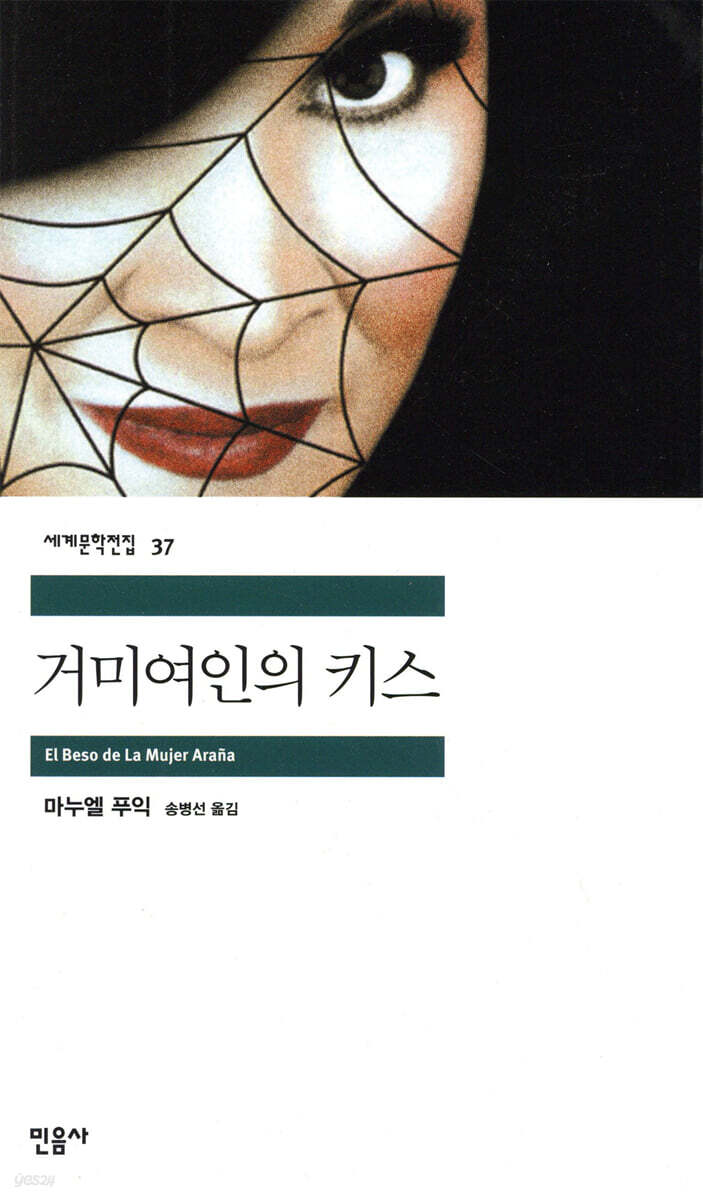
Kiss of the Spider Woman
 |
Description
Book Introduction
Manuel Puig, a world-renowned Argentine writer with both artistic and popular appeal A homosexual and a political prisoner meet in a cramped, damp prison cell, their own melodrama. A fascinating work about sexual oppression and prejudice, love and freedom. “I want to stay with you. “My only wish right now is to be with you.” The world-renowned Argentine author Manuel Puig's work, "Kiss of the Spider Woman," is a remarkable work that has been a huge success not only in novels but also in films, musicals, and plays. Manuel Puig is also well known as the writer of the original novel for director Wong Kar-wai's film "Happy Together." Because Puig's works were banned in his home country because of their depiction of homosexuality and political prisoners, Kiss of the Spider Woman was first published in Spain in 1976, where it became an immediate bestseller. In the United States and Europe, he has been praised as a writer who boldly breaks away from the great distinction between popular culture and serious literature. In 1985, Hector Babenco's film Kiss of the Spider Woman was nominated for Academy Awards for Best Picture, Best Director, and Best Screenplay, and William Hurt, who played Molina, won Best Actor. In 1993, the musical "Kiss of the Spider Woman" won seven Tony Awards and has since become a Broadway staple. This work was also made into a play and published under the title ‘Under the Star’s Mantle’. Puig is a world-renowned writer who represents Latin America along with Isabel Allende, and is the next generation after Borges and Marquez in the history of modern Latin American literature. He is also well known among film enthusiasts in Korea as a rare writer who possesses both artistic quality and commercial potential. |
- You can preview some of the book's contents.
Preview
Into the book
A European woman, an intelligent woman, a beautiful woman, an educated woman, a woman knowledgeable about international politics, a woman who knows Marxism, a woman who doesn't have to explain everything from beginning to end, a woman who makes a man think with her sharp questions, a woman of integrity and innocence, a woman with refined tastes, a woman who dresses elegantly according to the occasion, a woman who is young but at the same time mature, a woman who knows the culture of drinking, a woman who knows how to choose the right dish, a woman who knows how to order wine according to the occasion, a woman who knows how to entertain guests at home, a woman who knows how to manage servants, a woman who can properly prepare a party for a hundred people, a woman who is calm and affectionate, a woman who stimulates desire, a European woman who understands the problems of Latin Americans, a European woman who appreciates Latin American revolutionaries, but a woman who is more concerned about the traffic in Paris than the problems of colonized Latin American countries, a charming woman, a woman who is completely unfazed by the news of someone's death, a woman who hides a telegram for hours telling her lover that his father has died, a woman who refuses to follow her young lover back to the jungle where the coffee plantations are. A woman, a woman who never slackens off from her editorial work in Paris, a woman who rarely forgets a true person, a woman who knows what she wants, a woman who rarely regrets her decisions, a dangerous woman, a woman who can easily forget everything, a woman who can forget painful memories, a woman who can even forget the death of a young man who returned to his homeland, a young man flying to his homeland, a young man looking at the green mountains of his homeland from an airplane, a young man shedding tears of emotion...
--- p.169
'Wouldn't it be more painful if you were happy and then lost everything?'
'Molina, there's one thing you have to keep in mind.
A person's life may be short or long, but it is all temporary.
Nothing lasts forever.'
'Yeah, that's right.
But there are some that last a little longer.'
'We have to be able to accept reality as it is.
When good things happen, you have to learn to cherish them even if they don't last long.
Because nothing lasts forever.'
--- p.342
'But there is a reason in the heart that reason cannot understand.
This is what a very famous French philosopher said.
That's why I'm laughing at you.
I can even remember his name.
It's Pascal.
How about it, I lost'
'I think I'll miss you.
Molina.....'
'And promise me one more thing...
Act so that others do not ignore you, do not let anyone treat you badly, and do not let anyone exploit you.
No one has the right to exploit people.
--- pp.342-344
'Kiss of the Spider Woman' uses elements of popular culture while also criticizing the oppressive social conditions of the time through guerrillas and homosexuals.
That is, by paradoxically combining popular culture and historical subjects, it challenges the pretense of 'serious' art. (Omitted) Puik artistically sublimates popular culture, a subculture, through a process of reproduction that transforms popular culture.
--- p.393-394
You're wearing a mask, and it's silver, but...
Poor thing...
She can't move, she's stuck in a spider web in the thickest part of the jungle, baby, the web is growing out of her body and it's coming out of her waist and buttocks, the web is part of her body, it's full of sticky rope-like hairs.
It's such a disgusting hair.
But if you stroke it, it will feel like a very soft thread.
It was very impressive when I touched it.
--- From the text
'Valentine, I'm tired, I'm sick and tired of suffering and enduring.
You don't know that everything inside my body hurts.'
'Where does it hurt?'
'Chest, and inside the neck...
Why does sadness always feel like that?'
'That's true'
'But now you...
I wanted to cry, but I was prevented from crying.
I can't keep crying.
Moreover, it feels like every joint in my cervical spine is tightening.
It's so painful'
--- p.169
'Wouldn't it be more painful if you were happy and then lost everything?'
'Molina, there's one thing you have to keep in mind.
A person's life may be short or long, but it is all temporary.
Nothing lasts forever.'
'Yeah, that's right.
But there are some that last a little longer.'
'We have to be able to accept reality as it is.
When good things happen, you have to learn to cherish them even if they don't last long.
Because nothing lasts forever.'
--- p.342
'But there is a reason in the heart that reason cannot understand.
This is what a very famous French philosopher said.
That's why I'm laughing at you.
I can even remember his name.
It's Pascal.
How about it, I lost'
'I think I'll miss you.
Molina.....'
'And promise me one more thing...
Act so that others do not ignore you, do not let anyone treat you badly, and do not let anyone exploit you.
No one has the right to exploit people.
--- pp.342-344
'Kiss of the Spider Woman' uses elements of popular culture while also criticizing the oppressive social conditions of the time through guerrillas and homosexuals.
That is, by paradoxically combining popular culture and historical subjects, it challenges the pretense of 'serious' art. (Omitted) Puik artistically sublimates popular culture, a subculture, through a process of reproduction that transforms popular culture.
--- p.393-394
You're wearing a mask, and it's silver, but...
Poor thing...
She can't move, she's stuck in a spider web in the thickest part of the jungle, baby, the web is growing out of her body and it's coming out of her waist and buttocks, the web is part of her body, it's full of sticky rope-like hairs.
It's such a disgusting hair.
But if you stroke it, it will feel like a very soft thread.
It was very impressive when I touched it.
--- From the text
'Valentine, I'm tired, I'm sick and tired of suffering and enduring.
You don't know that everything inside my body hurts.'
'Where does it hurt?'
'Chest, and inside the neck...
Why does sadness always feel like that?'
'That's true'
'But now you...
I wanted to cry, but I was prevented from crying.
I can't keep crying.
Moreover, it feels like every joint in my cervical spine is tightening.
It's so painful'
--- From the text
Publisher's Review
Why is the world watching Manuel Puig?
A writer who boldly broke away from the distinction between popular culture and serious literature and created high art through popular culture.
Leslie A. Fiedler, a pioneer of postmodern criticism,
Fiedler) explains the difference between pure literature and popular literature as follows:
“The difference between the two is whether it gives literature’s unique pleasure and emotion to the few or to the many, and I think the greatest literature is the one that can satisfy both types of readers at the same time.” I don’t know how the debate about high culture versus popular culture will unfold in the future, but from Fiedler’s perspective on the “greatest literature,” Kiss of the Spider Woman can certainly be called a “great work.”
The function of literature is to enable humans to escape from everyday consciousness and enter another world of consciousness.
That is, it allows the reader to escape from the world of the ego and enter the world of the superego.
By pushing two completely opposite protagonists to extremes, Puik allows us to feel the essence of human nature through their dreams and fantasies.
Molina's struggle to escape from confinement, and Valentin, who had sneered at Molina's story as "nonsense steeped in cheap romanticism," eventually falling into the illusion Molina created, we find ourselves trapped in reality, our freedom of thought rigidified.
Why is Kiss of the Spider Woman beautiful?
In Kiss of the Spider Woman, we hear the voices of those suffering alone in the darkness, but what we see is the magic and romance of the film.
―The New York Times
Puik confronts social issues head-on in an original and provocative way.
However, this work is “a very beautiful work that shows, with its unsentimental and precise style, that there is still hope for the human world.” (Time Literary Supplement) Poet Hwang In-sook wrote the following poem about this work.
“The reason Molina’s love is not unpleasant is because Molina is a beautiful person.
He did not think of the body as a wall.
Molina's heart was filled with peace, grace, and smiles.
Molina was a true woman and a true human being.
“As I listened to this strange love story, I thought of a pantomime.”
Molina is a woman who is only a man in name, living her whole life with a man, accepting him as her master, and feeling fear when he hugs her.
However, this attitude is a repetition of the bourgeois heterosexual model, and homosexuals are also distorted by the exploitative male/female model.
Moreover, the guilt over homosexuality, which is morally taboo, adds a double burden.
Valentin says, "Being a woman does not mean being a martyr, and being a man does not mean having special rights."
Moreover, it asserts that “sexual orientation cannot harm human dignity.”
Just as Marcuse likens homosexuals to critical philosophers who remind us of the oppressive elements of society, we see in Molina the possibility of a pathetic fantasy, yet a beautiful relationship.
Latin American contemporary novels have had a significant influence on contemporary writers around the world since the 1960s and have also achieved commercial success, but it was not until the early 1990s that they began to attract interest and be introduced in earnest in Korea.
These 'boom' writers, including Marquez, appropriately combined local and global aspects and approached the situations faced by modern people through various narrative forms.
Meanwhile, the 'post-boom' generation, which began to reach its peak in the 1980s and 1990s, strongly showed a tendency to raise issues with the novel genre itself, criticizing 'boom' writers for being elitist in pursuing difficult and difficult novels and for ignoring the realities of Latin America due to their excessive globalism.
Manuel Puig is a representative writer who exemplifies these characteristics of the 'post-boom' and is receiving attention as a writer with both artistic quality and popularity.
Performance politics
The suppression of sexuality is considered the most important factor in understanding modern times.
In his works, he problematizes human customs and institutions surrounding sex through characters oppressed by male supremacy and the dichotomous gender ideology of masculinity/femininity.
Puik criticizes that this sexual repression is carried out in the name of 'love', which Hollywood movies and melodramas present as the highest value.
Puik says he writes to demystify everything that is taboo and negative in sex.
The novel's main characters are Molina, a homosexual, and Valentin, a left-wing guerrilla.
They are imprisoned in the same cell, and to relieve the boredom of prison life, Molina tells Valentin about the movies he has watched, and in the meantime, the relationship between the two prisoners develops.
At first, the film Molina tells is merely a target of criticism for the rational and political Valentin.
In his view, this is a kind of trivial mass culture of bourgeois society, and at the same time, it brainwashes people into becoming apolitical.
However, Valentin, who prides himself on being a progressive man and despises Molina as a woman who clings to cheap emotions, discovers true human affection in Molina.
The development of this relationship provides the novel's dynamic, culminating in the sexual love between the two characters in the latter half of the novel.
Through the structure of human unity, the author questions the existing notion that homosexuality is taboo as a sexual perversion, and the sexual ideology that confines women and men to the contrast of femininity and masculinity.
At first, Molina and Valentin seem to represent femininity and masculinity, respectively, but as genuine understanding and affection blossom between them, ultimately leading to sexual union, we learn that the author's intention is to prove the fiction of such notions.
To support this intention, Puik presents psychoanalysts' theories and counterarguments on sexuality in the form of footnotes, and readers are encouraged to play an active role by continuously contrasting and comparing the academic text presented in the footnotes with the fictional text presented as dialogue between characters.
Film and Literature
As a child, Puik recalls that for him, “film was a language system that could replace reality.”
"The Betrayal of Rita Hayworth," written in the form of a recollection of a movie watched with her mother, is the author's autobiographical novel.
The films he watched to pass the time in his small town later had a great influence on his novels.
The novels of Puik, who started out as a screenwriter, cannot be discussed without mentioning films.
"The Buenos Aires Incident" is also widely known as the original work of director Wong Kar-wai's film "Happy Together."
In the film "The Kiss of the Spider Woman," the film within the film is exquisitely adapted by Molina.
The film's role is to hint at the relationship and themes between Molina and Valentin in the novel.
The second film in the novel is set in Nazi-occupied France and tells the tragic love story between Captain Berner, a German intelligence officer, and Lenny, a beautiful singer who sings in a café.
Lenny approaches Burner at the request of the Resistance, but Lenny falls in love with Burner.
And he is torn between the reality that he must betray Burner for his homeland, France.
Lenny ends up getting shot and dying in Burner's arms.
In fact, Molina was put in the same cell as Valentin by the chief investigator's scheme, and his mission was to uncover the secrets of Valentin's organization.
However, in the eyes of Molina, a homosexual who longs for a 'real man', Valentin appears as an ideal man, and Molina soon falls in love with Valentin.
As the film's story progresses in reality, Molina and Lenny become more and more identified, and we can foresee Molina's fate through this story.
Another unique pleasure of this work is connecting the themes of the six film stories presented here.
A writer who boldly broke away from the distinction between popular culture and serious literature and created high art through popular culture.
Leslie A. Fiedler, a pioneer of postmodern criticism,
Fiedler) explains the difference between pure literature and popular literature as follows:
“The difference between the two is whether it gives literature’s unique pleasure and emotion to the few or to the many, and I think the greatest literature is the one that can satisfy both types of readers at the same time.” I don’t know how the debate about high culture versus popular culture will unfold in the future, but from Fiedler’s perspective on the “greatest literature,” Kiss of the Spider Woman can certainly be called a “great work.”
The function of literature is to enable humans to escape from everyday consciousness and enter another world of consciousness.
That is, it allows the reader to escape from the world of the ego and enter the world of the superego.
By pushing two completely opposite protagonists to extremes, Puik allows us to feel the essence of human nature through their dreams and fantasies.
Molina's struggle to escape from confinement, and Valentin, who had sneered at Molina's story as "nonsense steeped in cheap romanticism," eventually falling into the illusion Molina created, we find ourselves trapped in reality, our freedom of thought rigidified.
Why is Kiss of the Spider Woman beautiful?
In Kiss of the Spider Woman, we hear the voices of those suffering alone in the darkness, but what we see is the magic and romance of the film.
―The New York Times
Puik confronts social issues head-on in an original and provocative way.
However, this work is “a very beautiful work that shows, with its unsentimental and precise style, that there is still hope for the human world.” (Time Literary Supplement) Poet Hwang In-sook wrote the following poem about this work.
“The reason Molina’s love is not unpleasant is because Molina is a beautiful person.
He did not think of the body as a wall.
Molina's heart was filled with peace, grace, and smiles.
Molina was a true woman and a true human being.
“As I listened to this strange love story, I thought of a pantomime.”
Molina is a woman who is only a man in name, living her whole life with a man, accepting him as her master, and feeling fear when he hugs her.
However, this attitude is a repetition of the bourgeois heterosexual model, and homosexuals are also distorted by the exploitative male/female model.
Moreover, the guilt over homosexuality, which is morally taboo, adds a double burden.
Valentin says, "Being a woman does not mean being a martyr, and being a man does not mean having special rights."
Moreover, it asserts that “sexual orientation cannot harm human dignity.”
Just as Marcuse likens homosexuals to critical philosophers who remind us of the oppressive elements of society, we see in Molina the possibility of a pathetic fantasy, yet a beautiful relationship.
Latin American contemporary novels have had a significant influence on contemporary writers around the world since the 1960s and have also achieved commercial success, but it was not until the early 1990s that they began to attract interest and be introduced in earnest in Korea.
These 'boom' writers, including Marquez, appropriately combined local and global aspects and approached the situations faced by modern people through various narrative forms.
Meanwhile, the 'post-boom' generation, which began to reach its peak in the 1980s and 1990s, strongly showed a tendency to raise issues with the novel genre itself, criticizing 'boom' writers for being elitist in pursuing difficult and difficult novels and for ignoring the realities of Latin America due to their excessive globalism.
Manuel Puig is a representative writer who exemplifies these characteristics of the 'post-boom' and is receiving attention as a writer with both artistic quality and popularity.
Performance politics
The suppression of sexuality is considered the most important factor in understanding modern times.
In his works, he problematizes human customs and institutions surrounding sex through characters oppressed by male supremacy and the dichotomous gender ideology of masculinity/femininity.
Puik criticizes that this sexual repression is carried out in the name of 'love', which Hollywood movies and melodramas present as the highest value.
Puik says he writes to demystify everything that is taboo and negative in sex.
The novel's main characters are Molina, a homosexual, and Valentin, a left-wing guerrilla.
They are imprisoned in the same cell, and to relieve the boredom of prison life, Molina tells Valentin about the movies he has watched, and in the meantime, the relationship between the two prisoners develops.
At first, the film Molina tells is merely a target of criticism for the rational and political Valentin.
In his view, this is a kind of trivial mass culture of bourgeois society, and at the same time, it brainwashes people into becoming apolitical.
However, Valentin, who prides himself on being a progressive man and despises Molina as a woman who clings to cheap emotions, discovers true human affection in Molina.
The development of this relationship provides the novel's dynamic, culminating in the sexual love between the two characters in the latter half of the novel.
Through the structure of human unity, the author questions the existing notion that homosexuality is taboo as a sexual perversion, and the sexual ideology that confines women and men to the contrast of femininity and masculinity.
At first, Molina and Valentin seem to represent femininity and masculinity, respectively, but as genuine understanding and affection blossom between them, ultimately leading to sexual union, we learn that the author's intention is to prove the fiction of such notions.
To support this intention, Puik presents psychoanalysts' theories and counterarguments on sexuality in the form of footnotes, and readers are encouraged to play an active role by continuously contrasting and comparing the academic text presented in the footnotes with the fictional text presented as dialogue between characters.
Film and Literature
As a child, Puik recalls that for him, “film was a language system that could replace reality.”
"The Betrayal of Rita Hayworth," written in the form of a recollection of a movie watched with her mother, is the author's autobiographical novel.
The films he watched to pass the time in his small town later had a great influence on his novels.
The novels of Puik, who started out as a screenwriter, cannot be discussed without mentioning films.
"The Buenos Aires Incident" is also widely known as the original work of director Wong Kar-wai's film "Happy Together."
In the film "The Kiss of the Spider Woman," the film within the film is exquisitely adapted by Molina.
The film's role is to hint at the relationship and themes between Molina and Valentin in the novel.
The second film in the novel is set in Nazi-occupied France and tells the tragic love story between Captain Berner, a German intelligence officer, and Lenny, a beautiful singer who sings in a café.
Lenny approaches Burner at the request of the Resistance, but Lenny falls in love with Burner.
And he is torn between the reality that he must betray Burner for his homeland, France.
Lenny ends up getting shot and dying in Burner's arms.
In fact, Molina was put in the same cell as Valentin by the chief investigator's scheme, and his mission was to uncover the secrets of Valentin's organization.
However, in the eyes of Molina, a homosexual who longs for a 'real man', Valentin appears as an ideal man, and Molina soon falls in love with Valentin.
As the film's story progresses in reality, Molina and Lenny become more and more identified, and we can foresee Molina's fate through this story.
Another unique pleasure of this work is connecting the themes of the six film stories presented here.
GOODS SPECIFICS
- Date of issue: June 30, 2000
- Page count, weight, size: 396 pages | 528g | 132*225*30mm
- ISBN13: 9788937460371
- ISBN10: 8937460378
You may also like
카테고리
korean


korean

![ELLE 엘르 스페셜 에디션 A형 : 12월 [2025]](http://librairie.coreenne.fr/cdn/shop/files/b8e27a3de6c9538896439686c6b0e8fb.jpg?v=1766436872&width=3840)


