

A month in Siena
 |
Description
Book Introduction
This unique essay by Hisham Matar, a Libyan-British author known for his Pulitzer Prize-winning work The Return, depicts his journey of healing a deep and long-standing sense of loss in his own way.
His father, Jabala Matar, was a Libyan soldier and diplomat who was labeled an anti-Gaddafi dissident and lived in exile in Egypt with his family from 1979.
Then, in 1990, he was kidnapped in Cairo and imprisoned in Abu Salim Prison in Libya, and after a massacre of political prisoners there in 1996, he disappeared without a trace.
Matar was nineteen when his father was kidnapped.
For some reason, from then on, Siena School paintings became a refuge for him and a passageway to the outside world.
After nearly thirty years without knowing his father's whereabouts, he finally finds the home of these paintings.
Immersed in the allegory of Siena, the 'Mourner Without a Grave' discovers, one by one, ways to survive loss in this city.
His father, Jabala Matar, was a Libyan soldier and diplomat who was labeled an anti-Gaddafi dissident and lived in exile in Egypt with his family from 1979.
Then, in 1990, he was kidnapped in Cairo and imprisoned in Abu Salim Prison in Libya, and after a massacre of political prisoners there in 1996, he disappeared without a trace.
Matar was nineteen when his father was kidnapped.
For some reason, from then on, Siena School paintings became a refuge for him and a passageway to the outside world.
After nearly thirty years without knowing his father's whereabouts, he finally finds the home of these paintings.
Immersed in the allegory of Siena, the 'Mourner Without a Grave' discovers, one by one, ways to survive loss in this city.
- You can preview some of the book's contents.
Preview
index
The Gate of Two Seconds
Room shape
Where to stay
David and Goliath
Armor? What armor?
bench
"evidence"
art gallery security guards
blue ribbon
Sit down
A question of faith
fire
Turkish Bath
Angel's Plight
Paradise
Translator's note
List of illustrations
Room shape
Where to stay
David and Goliath
Armor? What armor?
bench
"evidence"
art gallery security guards
blue ribbon
Sit down
A question of faith
fire
Turkish Bath
Angel's Plight
Paradise
Translator's note
List of illustrations
Publisher's Review
A painting that demands time
These days, with so much exhibitions and related information pouring in, we can't even bring ourselves to look at a single painting with our own eyes.
Even if we manage to find time to go to an art gallery, we can only briefly glance at the paintings that have arrived before us after enduring the long wait.
Modern people seem to be obsessed with experiencing and consuming art quickly and in large quantities.
But why were pictures drawn, and why do we look at them?
Hisham Matar, a Libyan-British writer, finds answers to these questions as he works to heal his own wounds.
He spends a long time looking at a single painting, three or four months is the norm, and sometimes even a year is not uncommon.
“Even now, a quarter of a century later, with no clues to my father’s whereabouts, I continue to look at the pictures in this way, one at a time.
I have benefited a lot from looking at it this way.
As I looked at the picture, it changed in a way I never expected.
I came to realize that painting requires time.” In this way, painting gradually became not only his physical dwelling place in life, but also his spiritual dwelling place.
Mourners without a grave
Matar's father, Jaballa Matar (1939-?), was a Libyan soldier and diplomat who was labeled an anti-Gaddafi regime dissident and lived in exile in Egypt with his family from 1979.
Then, in March 1990, he was kidnapped in Cairo and imprisoned in Abu Salim Prison in Libya. After the massacre of political prisoners there on June 29, 1996, he disappeared without a trace.
Matar was nineteen when his father was kidnapped.
For some reason, from then on, Sienese paintings became a refuge for him and a passageway to the outside world.
After nearly thirty years without knowing his father's whereabouts, he finally finds the home of these paintings.
It was around the time he finished writing The Return, which recorded his journey to find his father, that he decided to go to Siena.
Why did he become so absorbed in Sienese paintings?
The Sienese School is a school of painting that flourished in Siena, Italy, from the 13th to the 15th centuries. Representative painters include Duccio di Buoninsegna, who is said to be its founder; the brothers Pietro and Ambrogio Lorenzetti, who incorporated the Gothic style; Taddeo di Bartolo; and Matteo di Giovanni.
Neither Byzantine nor Renaissance, nor as dramatic as the Florentine school, these paintings stand alone as a kind of mutant, with a somewhat awkward yet human, detailed yet emotional technique.
Matar also didn't know how to approach the paintings at first.
The symmetrical compositions and explicit gazes often seen in the paintings felt rude and hostile, as if they belonged to a secluded world of Christian conventions and symbols.
Still, I kept going to see it.
And the colors, the delicate forms, the still drama of those paintings became increasingly indispensable.
Ever since his days at university in London, Matar has been going to the National Gallery every few months to see Duccio's "Annunciation" and "The Healing of the Blind Man."
Before leaving for Siena, Matar opens his story with The Healing of the Blind, a painting that 'ironically questions what it means to truly see'.
Sienese paintings, which seem to ask the viewer for something rather than showing the finished product, do not provide clear answers.
This could be said to be an early example of art that requires the viewer's interpretation to complete a painting.
“We can discern that these paintings ask how profoundly a painting influences the emotional state of the viewer, how shared human experiences alter the contract between artist and viewer, artist and subject, and what creative possibilities this new form of collaboration offers.”
Into the Allegory of Siena
Matar, who arrived in Siena, heads to the Palazzo Pubblico in Piazza del Campo.
Before Italy became a unified nation, it was divided into several city-states ruled by hereditary monarchs, but Siena was unique in its preference for civil rule.
The city was free from the authority of the church, and the Siena government took over, deciding and collecting taxes and enforcing laws.
It was a wealthy, well-governed, and democratic place by the standards of the time.
Built in the 13th century as the seat of government for the Republic of Siena, the Palazzo Pubblico was the administrative center of the Republic of Siena.
It is currently used as a city hall and a municipal art gallery, and has many frescoes painted inside.
Perhaps Matar chose this place as the first stop on his journey because he wanted to start from Siena's unique origins.
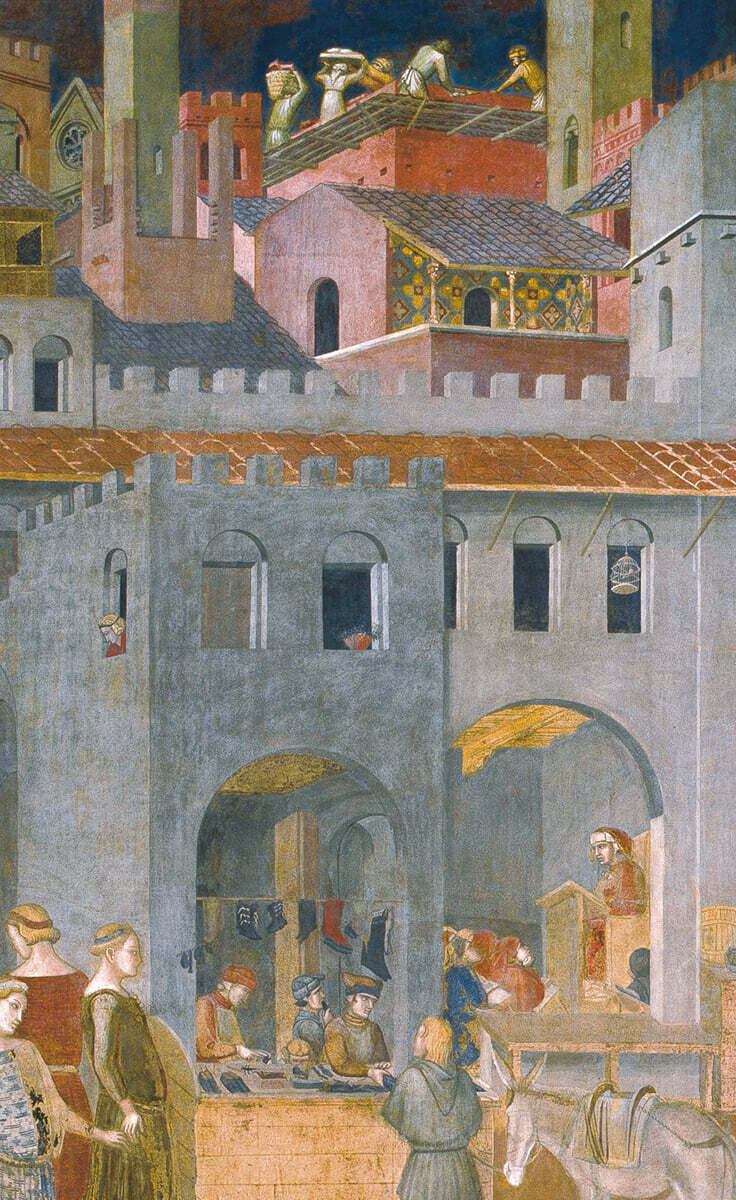
In the Sala dei Nove, or the 'Nine Rooms', three walls are filled with 'Allegories' and their resulting landscapes, all completed by Ambrogio Lorenzetti.
The central Allegory of Good Government is the most important and decisive work of the secularists, a hymn to justice and a demonstration of what civil government is.
There is no dominant god-like being to be seen here.
“The way the activities in the picture are distributed frustrates the desire to find a sole authority.
Instead, the painting presents a visual march of a political declaration.” On the long walls on either side are painted “The Consequences of Good Politics,” which shows what the world would be like if the Allegory’s advice were followed, and “The Consequences of Bad Politics,” which shows what would happen if the Allegory’s advice were not followed.
To deny something one must first state clearly what it means, and this paradox is one way of reading Lorenzetti's frescoes.
His paintings are both praised and condemned.
'Allegory' seeks to make explicit the hierarchy of virtues and their relationship to power, and the resulting landscapes are definitive.
It resembles Siena and all cities.
Matar recalls graffiti on Tripoli walls satirizing Libyan dictator Muammar Gaddafi in "tyranny", where he is depicted as a demon.
“It may be quite natural, but this only serves to emphasize the feeling that being in Siena makes you see Siena as the only city, or the city of all cities, or not really a city at all but an allegory of cities.”
The self as a city in constant motion
Matar is deeply immersed in the place called Siena, beyond just looking at the painting.
While there are places that tourists would visit at least once, such as the Chigiana Conservatory, Piazza del Campo, Palazzo Pubblico, Siena Cathedral, Pinacoteca Gallery, and San Bernardino Oratory Gallery, I also enjoy spending time at my old Palazzo, where I stay, sitting on a bench in the city cemetery, or walking to the city walls surrounding Siena.
One day, to keep my sense of touch with the city fresh, I walk to one end of the city, pass through one of the many gates, and then return to Siena, where the city is no longer visible.
“I have never been anywhere where there was so much determination, so much intention, so much interest in my existence.
Whichever path I took, Sienna seemed to determine the speed and direction of my steps.
At that time, I felt like I could live my whole life in that strange city I had longed to visit for so long for some unknown reason.”
While he strives to keep his time completely to himself, he finds unexpected comfort in the people he encounters in this city.
In Piazza del Duomo, he exchanges greetings with a respectable Nigerian woman, and on the hill where the city walls stand, he meets Adam and his son Karim, immigrants from Jordan, and invites them to his home.
They were all people who had the generous attitude that foreigners show to other foreigners.
Sabrina, the Italian teacher with whom he quickly became close and nicknamed 'Sabri'; the Pinacoteca Museum security guard who gives him a chair as he stands all day looking at paintings; Beatrice, an old Italian friend celebrating her 90th birthday; and even the voice of his wife Diana recorded on his cell phone - these unfamiliar and familiar beings he encounters in a foreign land accompany him while maintaining an appropriate distance.
The path of intimate pilgrimage
During his stay in Siena, Matar visits the paintings he has been keeping in his mind.
Duccio's "Madonna of the Franciscans", which seems to be much more interested in human life than in God's, Lorenzetti's "Madonna Giving Milk", which is hard to imagine a more disturbing representation of the Virgin and the Son, and Sano di Pietro's "Angel of the Annunciation", which causes a deep pain in the heart the more you look at it - these are all strange paintings that are a little strange in some way, but also leave room for the viewer's thoughts and emotions to enter.
Of course, Siena is at the center, but London, Tripoli, Rome, New York, and other places and their paintings appear, either in real life or recalled.
“It all seemed to fold up like a time-honored accordion made from a single sheet of cloth.
Here we were, at the same time, in Siena, Rome, and Tripoli.” And one day, sitting on a cemetery bench, he realized that he had come to Siena not only to see paintings, but also to mourn alone, to survey the new terrain and figure out how to live from here on out.
After a month-long journey, Matar returns to his daily life and visits the Metropolitan Museum of Art on a business trip to New York, exhausted from his busy schedule.
And we stand again before Giovanni di Paolo's "Paradise," painted around 1445, nearly a century after the outbreak of the Black Death.
I sincerely hope that, like the people in this painting who imagine their reunion in the afterlife, they will recognize each other when they reunite with their father.
He is thus seeking his own intimate path of pilgrimage.
These days, with so much exhibitions and related information pouring in, we can't even bring ourselves to look at a single painting with our own eyes.
Even if we manage to find time to go to an art gallery, we can only briefly glance at the paintings that have arrived before us after enduring the long wait.
Modern people seem to be obsessed with experiencing and consuming art quickly and in large quantities.
But why were pictures drawn, and why do we look at them?
Hisham Matar, a Libyan-British writer, finds answers to these questions as he works to heal his own wounds.
He spends a long time looking at a single painting, three or four months is the norm, and sometimes even a year is not uncommon.
“Even now, a quarter of a century later, with no clues to my father’s whereabouts, I continue to look at the pictures in this way, one at a time.
I have benefited a lot from looking at it this way.
As I looked at the picture, it changed in a way I never expected.
I came to realize that painting requires time.” In this way, painting gradually became not only his physical dwelling place in life, but also his spiritual dwelling place.
Mourners without a grave
Matar's father, Jaballa Matar (1939-?), was a Libyan soldier and diplomat who was labeled an anti-Gaddafi regime dissident and lived in exile in Egypt with his family from 1979.
Then, in March 1990, he was kidnapped in Cairo and imprisoned in Abu Salim Prison in Libya. After the massacre of political prisoners there on June 29, 1996, he disappeared without a trace.
Matar was nineteen when his father was kidnapped.
For some reason, from then on, Sienese paintings became a refuge for him and a passageway to the outside world.
After nearly thirty years without knowing his father's whereabouts, he finally finds the home of these paintings.
It was around the time he finished writing The Return, which recorded his journey to find his father, that he decided to go to Siena.
Why did he become so absorbed in Sienese paintings?
The Sienese School is a school of painting that flourished in Siena, Italy, from the 13th to the 15th centuries. Representative painters include Duccio di Buoninsegna, who is said to be its founder; the brothers Pietro and Ambrogio Lorenzetti, who incorporated the Gothic style; Taddeo di Bartolo; and Matteo di Giovanni.
Neither Byzantine nor Renaissance, nor as dramatic as the Florentine school, these paintings stand alone as a kind of mutant, with a somewhat awkward yet human, detailed yet emotional technique.
Matar also didn't know how to approach the paintings at first.
The symmetrical compositions and explicit gazes often seen in the paintings felt rude and hostile, as if they belonged to a secluded world of Christian conventions and symbols.
Still, I kept going to see it.
And the colors, the delicate forms, the still drama of those paintings became increasingly indispensable.
Ever since his days at university in London, Matar has been going to the National Gallery every few months to see Duccio's "Annunciation" and "The Healing of the Blind Man."
Before leaving for Siena, Matar opens his story with The Healing of the Blind, a painting that 'ironically questions what it means to truly see'.
Sienese paintings, which seem to ask the viewer for something rather than showing the finished product, do not provide clear answers.
This could be said to be an early example of art that requires the viewer's interpretation to complete a painting.
“We can discern that these paintings ask how profoundly a painting influences the emotional state of the viewer, how shared human experiences alter the contract between artist and viewer, artist and subject, and what creative possibilities this new form of collaboration offers.”
Into the Allegory of Siena
Matar, who arrived in Siena, heads to the Palazzo Pubblico in Piazza del Campo.
Before Italy became a unified nation, it was divided into several city-states ruled by hereditary monarchs, but Siena was unique in its preference for civil rule.
The city was free from the authority of the church, and the Siena government took over, deciding and collecting taxes and enforcing laws.
It was a wealthy, well-governed, and democratic place by the standards of the time.
Built in the 13th century as the seat of government for the Republic of Siena, the Palazzo Pubblico was the administrative center of the Republic of Siena.
It is currently used as a city hall and a municipal art gallery, and has many frescoes painted inside.
Perhaps Matar chose this place as the first stop on his journey because he wanted to start from Siena's unique origins.
In the Sala dei Nove, or the 'Nine Rooms', three walls are filled with 'Allegories' and their resulting landscapes, all completed by Ambrogio Lorenzetti.
The central Allegory of Good Government is the most important and decisive work of the secularists, a hymn to justice and a demonstration of what civil government is.
There is no dominant god-like being to be seen here.
“The way the activities in the picture are distributed frustrates the desire to find a sole authority.
Instead, the painting presents a visual march of a political declaration.” On the long walls on either side are painted “The Consequences of Good Politics,” which shows what the world would be like if the Allegory’s advice were followed, and “The Consequences of Bad Politics,” which shows what would happen if the Allegory’s advice were not followed.
To deny something one must first state clearly what it means, and this paradox is one way of reading Lorenzetti's frescoes.
His paintings are both praised and condemned.
'Allegory' seeks to make explicit the hierarchy of virtues and their relationship to power, and the resulting landscapes are definitive.
It resembles Siena and all cities.
Matar recalls graffiti on Tripoli walls satirizing Libyan dictator Muammar Gaddafi in "tyranny", where he is depicted as a demon.
“It may be quite natural, but this only serves to emphasize the feeling that being in Siena makes you see Siena as the only city, or the city of all cities, or not really a city at all but an allegory of cities.”
The self as a city in constant motion
Matar is deeply immersed in the place called Siena, beyond just looking at the painting.
While there are places that tourists would visit at least once, such as the Chigiana Conservatory, Piazza del Campo, Palazzo Pubblico, Siena Cathedral, Pinacoteca Gallery, and San Bernardino Oratory Gallery, I also enjoy spending time at my old Palazzo, where I stay, sitting on a bench in the city cemetery, or walking to the city walls surrounding Siena.
One day, to keep my sense of touch with the city fresh, I walk to one end of the city, pass through one of the many gates, and then return to Siena, where the city is no longer visible.
“I have never been anywhere where there was so much determination, so much intention, so much interest in my existence.
Whichever path I took, Sienna seemed to determine the speed and direction of my steps.
At that time, I felt like I could live my whole life in that strange city I had longed to visit for so long for some unknown reason.”
While he strives to keep his time completely to himself, he finds unexpected comfort in the people he encounters in this city.
In Piazza del Duomo, he exchanges greetings with a respectable Nigerian woman, and on the hill where the city walls stand, he meets Adam and his son Karim, immigrants from Jordan, and invites them to his home.
They were all people who had the generous attitude that foreigners show to other foreigners.
Sabrina, the Italian teacher with whom he quickly became close and nicknamed 'Sabri'; the Pinacoteca Museum security guard who gives him a chair as he stands all day looking at paintings; Beatrice, an old Italian friend celebrating her 90th birthday; and even the voice of his wife Diana recorded on his cell phone - these unfamiliar and familiar beings he encounters in a foreign land accompany him while maintaining an appropriate distance.
The path of intimate pilgrimage
During his stay in Siena, Matar visits the paintings he has been keeping in his mind.
Duccio's "Madonna of the Franciscans", which seems to be much more interested in human life than in God's, Lorenzetti's "Madonna Giving Milk", which is hard to imagine a more disturbing representation of the Virgin and the Son, and Sano di Pietro's "Angel of the Annunciation", which causes a deep pain in the heart the more you look at it - these are all strange paintings that are a little strange in some way, but also leave room for the viewer's thoughts and emotions to enter.
Of course, Siena is at the center, but London, Tripoli, Rome, New York, and other places and their paintings appear, either in real life or recalled.
“It all seemed to fold up like a time-honored accordion made from a single sheet of cloth.
Here we were, at the same time, in Siena, Rome, and Tripoli.” And one day, sitting on a cemetery bench, he realized that he had come to Siena not only to see paintings, but also to mourn alone, to survey the new terrain and figure out how to live from here on out.
After a month-long journey, Matar returns to his daily life and visits the Metropolitan Museum of Art on a business trip to New York, exhausted from his busy schedule.
And we stand again before Giovanni di Paolo's "Paradise," painted around 1445, nearly a century after the outbreak of the Black Death.
I sincerely hope that, like the people in this painting who imagine their reunion in the afterlife, they will recognize each other when they reunite with their father.
He is thus seeking his own intimate path of pilgrimage.
GOODS SPECIFICS
- Date of issue: May 1, 2024
- Format: Hardcover book binding method guide
- Page count, weight, size: 168 pages | 110*180*20mm
- ISBN13: 9788930107853
- ISBN10: 8930107850
You may also like
카테고리
korean


korean

![GQ KOREA Mark (Monthly): December [2025]](http://librairie.coreenne.fr/cdn/shop/files/8ef265dbbfbf186523ed75ba7319009d.jpg?v=1765340328&width=3840)


