

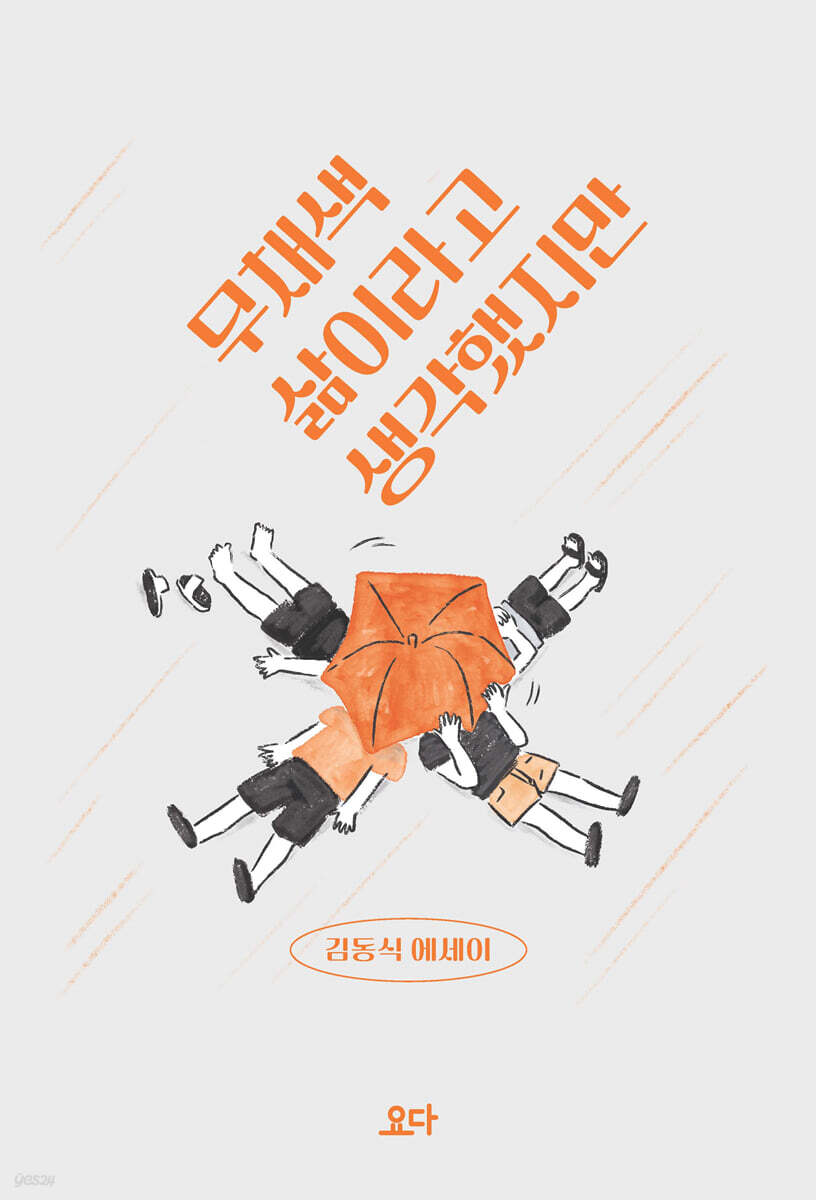
I thought it was a colorless life
 |
Description
Book Introduction
Novelist Kim Dong-sik's first collection of essays, "Gray Man," has been published.
Kim Dong-sik, who has given a great shock to the Korean literary world and readers with his unique world of works, has recorded his personal life and life as a writer for the first time.
Chapter 1, which begins with a story about my childhood spent on the Yeongdo Mountain Road in Busan, can be summarized as 'Who am I?'
The author, who had never paid attention to himself, recorded every moment of discovering and understanding himself.
He candidly revealed his difficult but enjoyable childhood due to poverty, his unique tastes in food and content that he was not aware of, his innate personality and interpersonal characteristics, and his priorities in life.
Chapter 2, which records life after becoming a writer, is summarized as “Writing was my friend, my happiness, and my salvation.”
He talks about his changed lifestyle, quality of life, interpersonal relationships, and self-esteem since his debut in 2017.
The author explores how writing can dramatically change a person's life and what kind of novelist he wants to become, sometimes wittily, sometimes bluntly, and sometimes with depth, giving readers laughter, emotion, and food for thought.
Kim Dong-sik, who has given a great shock to the Korean literary world and readers with his unique world of works, has recorded his personal life and life as a writer for the first time.
Chapter 1, which begins with a story about my childhood spent on the Yeongdo Mountain Road in Busan, can be summarized as 'Who am I?'
The author, who had never paid attention to himself, recorded every moment of discovering and understanding himself.
He candidly revealed his difficult but enjoyable childhood due to poverty, his unique tastes in food and content that he was not aware of, his innate personality and interpersonal characteristics, and his priorities in life.
Chapter 2, which records life after becoming a writer, is summarized as “Writing was my friend, my happiness, and my salvation.”
He talks about his changed lifestyle, quality of life, interpersonal relationships, and self-esteem since his debut in 2017.
The author explores how writing can dramatically change a person's life and what kind of novelist he wants to become, sometimes wittily, sometimes bluntly, and sometimes with depth, giving readers laughter, emotion, and food for thought.
- You can preview some of the book's contents.
Preview
index
Chapter 1 │ In a Sloping Alley
In a sloping alley │ The most delicious ramen I've ever had │ Doubt │ In search of absolute tteokbokki │ Tanker │ Soul food │ The term mental victory │ Unproductive curiosity │ On the ceiling before falling asleep │ When Pyongyang cold noodles and waiting meet │ The moment I ring the bell at my hometown │ Not trusting people, but trusting events │ Motion sickness │ The world of introverts │ Understanding and mental health │ Easy people │ Healing methods │ The era of cutting ties │ Things I like │ Image management │ In Sangju
Chapter 2 │I thought it was a colorless life
The existence of me │Being a writer wasn't my dream │The greatness of time │It's okay to fail │Inbok │When you think of Seongju, you think of melons, and when you think of short stories? │The relationship between arcades and self-esteem │Respected │I won't get fired │A judge with a high sense of entitlement │When even what I like becomes work │School is to me │I only have one friend │The inefficient act of reading novels │From a writer in a small room to a writer who communicates │A horror novel writer │A person who has tasted foreign food even after seeing this │Kim Dong-sik Search results │I want to be a macaron
In a sloping alley │ The most delicious ramen I've ever had │ Doubt │ In search of absolute tteokbokki │ Tanker │ Soul food │ The term mental victory │ Unproductive curiosity │ On the ceiling before falling asleep │ When Pyongyang cold noodles and waiting meet │ The moment I ring the bell at my hometown │ Not trusting people, but trusting events │ Motion sickness │ The world of introverts │ Understanding and mental health │ Easy people │ Healing methods │ The era of cutting ties │ Things I like │ Image management │ In Sangju
Chapter 2 │I thought it was a colorless life
The existence of me │Being a writer wasn't my dream │The greatness of time │It's okay to fail │Inbok │When you think of Seongju, you think of melons, and when you think of short stories? │The relationship between arcades and self-esteem │Respected │I won't get fired │A judge with a high sense of entitlement │When even what I like becomes work │School is to me │I only have one friend │The inefficient act of reading novels │From a writer in a small room to a writer who communicates │A horror novel writer │A person who has tasted foreign food even after seeing this │Kim Dong-sik Search results │I want to be a macaron
Detailed image
.jpg)
Into the book
It's a bit embarrassing to say this, but I'm pretty upright.
Perhaps it was because of those kinds of gazes I had as a child that I became like that.
I know a little about what it feels like to be doubted by someone.
So, I am very careful about suspecting someone.
--- From "Doubt"
The thing is, I never really overcame my introversion.
When I search for restaurant reviews, I search for the keyword 'eating alone' before the keyword 'taste'.
Even though I did my research before buying something, if there is an item recommended by an employee, I choose that.
People around me find this frustrating, but are these aspects truly problematic enough to warrant the word "overcoming"? A timid person's world can be ruined if you try to force it on them from the outside, so even if it's frustrating, I hope they'll at least show some respect.
--- From "The World of Introverts"
I've always been envious of others for having their own healing methods, but I'm not entirely happy that I've actually found my own healing method.
Because I realized why I didn't have a healing method for so long.
There aren't many things in life that are so painful that they can't be endured.
If you don't need healing, why would you need a way to overcome it?
It wasn't something I should envy others for, it was something others should envy me for.
--- From "Healing Method"
For me, writing was a friend, a happiness, and a salvation.
If I hadn't written, I would have lived and died as a ghost in the basement of Seongsu-dong.
Until I die, I will have closed my eyes without ever seeing what color I am, and without even knowing why I am alive.
Writing is so precious to me that I can't say it enough.
--- From "Being a Writer Wasn't My Dream"
When I worked in the factory for 10 years, I had no identity.
It was just a part of a machine.
I was a part fitted into a machine at one stage of its process of making an object.
There were no humans on the scene of the work, which was the same every day, work that didn't change even if a different part came instead of me, work that didn't require thinking.
What made me Kim Dong-sik human was my identity as a writer.
I am happiest when I introduce or describe myself with this identity.
I am an irreplaceable being, a unique entity with a reason to be born and live.
So I think I will continue to live my life explaining myself to others and to myself.
--- From "When you think of Seongju, you think of melons, and when you think of short stories?"
I never imagined that I would ever hear someone say they respect me in my life.
Why…? Wouldn't it be better to respect a banana than me? I don't understand, but I am someone's object of respect.
That's the serious problem.
There is so much pressure to be respectable.
--- From "Respected"
I was scared, but I agreed.
Because I felt so good.
Because of my background, I was obsessed with anything that could increase my self-awareness as a writer.
But what could a novel contest judge say? I wondered if there was anything more writerly than that.
Perhaps it was because of those kinds of gazes I had as a child that I became like that.
I know a little about what it feels like to be doubted by someone.
So, I am very careful about suspecting someone.
--- From "Doubt"
The thing is, I never really overcame my introversion.
When I search for restaurant reviews, I search for the keyword 'eating alone' before the keyword 'taste'.
Even though I did my research before buying something, if there is an item recommended by an employee, I choose that.
People around me find this frustrating, but are these aspects truly problematic enough to warrant the word "overcoming"? A timid person's world can be ruined if you try to force it on them from the outside, so even if it's frustrating, I hope they'll at least show some respect.
--- From "The World of Introverts"
I've always been envious of others for having their own healing methods, but I'm not entirely happy that I've actually found my own healing method.
Because I realized why I didn't have a healing method for so long.
There aren't many things in life that are so painful that they can't be endured.
If you don't need healing, why would you need a way to overcome it?
It wasn't something I should envy others for, it was something others should envy me for.
--- From "Healing Method"
For me, writing was a friend, a happiness, and a salvation.
If I hadn't written, I would have lived and died as a ghost in the basement of Seongsu-dong.
Until I die, I will have closed my eyes without ever seeing what color I am, and without even knowing why I am alive.
Writing is so precious to me that I can't say it enough.
--- From "Being a Writer Wasn't My Dream"
When I worked in the factory for 10 years, I had no identity.
It was just a part of a machine.
I was a part fitted into a machine at one stage of its process of making an object.
There were no humans on the scene of the work, which was the same every day, work that didn't change even if a different part came instead of me, work that didn't require thinking.
What made me Kim Dong-sik human was my identity as a writer.
I am happiest when I introduce or describe myself with this identity.
I am an irreplaceable being, a unique entity with a reason to be born and live.
So I think I will continue to live my life explaining myself to others and to myself.
--- From "When you think of Seongju, you think of melons, and when you think of short stories?"
I never imagined that I would ever hear someone say they respect me in my life.
Why…? Wouldn't it be better to respect a banana than me? I don't understand, but I am someone's object of respect.
That's the serious problem.
There is so much pressure to be respectable.
--- From "Respected"
I was scared, but I agreed.
Because I felt so good.
Because of my background, I was obsessed with anything that could increase my self-awareness as a writer.
But what could a novel contest judge say? I wondered if there was anything more writerly than that.
--- Among the "judges with a strong sense of qualification"
Publisher's Review
“If this is true, it is an incredible story.”
A man who had been diligently working at a factory for 10 years suddenly found a miraculous life.
Discovered between the creation of over 1000 novels and everyday life
Life, Dreams, and the Precious Meaning of Everyday Life
In an age where anyone can become a writer, it is difficult for everyone to gain great love from readers and be recognized for their literary quality.
This is especially true for novelists who debuted through online community bulletin boards rather than through contests that emphasize authenticity.
There is a writer who has accomplished that difficult task.
The protagonist is novelist Kim Dong-sik, who debuted in 2017 with “Gray Man,” and has since broken the record of selling over 300,000 copies, becoming an increasingly popular topic among both literary circles and readers.
Having published 14 individual short story collections over the past six years, he presents his 15th solo book, an essay rather than a fiction.
The author, who was often described as a former foundry worker or a middle school dropout, took a close look at himself and his life as a whole for the first time, and wrote about his life as a pure individual before becoming a novelist and his life as a novelist in chapters 1 and 2.
According to the author's words, "the story of Kim Dong-sik, who took such an unconventional path that it makes you wonder how he could become a novelist," is, like his novels, lighthearted yet serious, sharp yet warm.
Anecdotes like meeting a reader while eating hotteok on the street, going to eat Pyongyang cold noodles, a food of the day, and unintentionally getting cut off, and a story about going to a gambling house to get writing material and spending hundreds of thousands of won in an instant and then reflecting on it, all bring laughter and emotion to readers, and give them food for thought about the impact that seemingly insignificant small attitudes toward life can have on one's entire life.
The first question in life for a writer who had been absorbed solely in novels: "Who am I?"
- The personal story of Kim Dong-sik, a novelist, lecturer, and former foundry worker.
The very act of immersing myself in what I like was a very refreshing experience.
Also, writing it down makes it more relatable, and I feel a little proud of spending my time getting to know myself.
Why have I never been this preoccupied before?
My tastes were somewhat influenced by the lifestyle I pursued, but I don't think I was curious about myself.
(Page 126)
When readers think of Kim Dong-sik, the first thing that comes to mind is his debut novel, "The Gray Man," followed by his story as a former foundry worker and middle school dropout.
Even though the world has been descriptive of him and has invited him to hundreds of lectures a year, the author has been faithful to writing and lectures and has never thought deeply about himself outside of those descriptive words. For the first time, he has faced the question, "Who am I?" and recorded his thoughts in various stories.
Chapter 1, which begins with a story about my childhood spent on the Yeongdo Mountain Road in Busan, can be summarized as “Who am I?”
The author finally comes to realize what kind of person he is by telling specific anecdotes about his difficult but still cheerful and enjoyable childhood due to his exceptional poverty, special anecdotes from his days working in a factory, his unique tastes in food and content that he was not aware of, his innate personality and interpersonal characteristics, and his priorities in life.
If we remember that one person connects with others, and that those connections form society and a nation, wouldn't the question "Who am I?" posed by a certain writer who devoted himself solely to novels spread to countless others and society, giving many people time to reflect deeply on themselves?
A look at the incredible transformation that writing can bring to a person's life.
- Writing is my friend, my happiness, and my savior.
“When I worked in the factory for 10 years, I had no identity.
It was just a part of a machine.
“What made me Kim Dong-sik human was my identity as a writer.” (p. 183)
Chapter 2, which records life after becoming a writer, can be summarized as “Writing was my friend, my happiness, and my salvation.”
The author says that after debuting with the simultaneous publication of three novel collections in 2017, thanks to the strong support of readers for the novels posted on an online community bulletin board since 2016, there have been great changes in her life, quality of life, interpersonal relationships, and self-esteem.
The author's previous life can be summarized as "I was just a machine part when I worked in a factory for 10 years," but later, through his identity as a novelist, he came to realize that he was a unique, irreplaceable being, a unique subject with a reason to live.
That process was also accomplished through people.
Through encounters with readers from online communities who sent her their pure enthusiasm and support, author Kim Min-seop and publisher Yoda Publishing who led her into the publishing world, the one-of-a-kind friends she made while giving lectures, and above all, the countless readers she met at lecture venues, she vividly witnessed how a person's life can expand and deepen through writing.
It is also interesting to record how his lifestyle and quality of life have changed since he became a much-loved writer, from his teenage days as a part-time worker desperate to survive, to his days of working diligently for a small salary as compensation, and how his consciousness as a writer has also changed.
The anecdotes about not being able to sit in the seat for the elderly or disabled because he met a reader on the bus after a lecture, worrying about not being that kind of person when told he was respected, and judging a novel contest because it raised his self-esteem as a writer are amusing, but also provide a glimpse into how seriously the author lives his life as a writer.
Surprise, laughter, hope, and emotion delivered with unvarnished honesty
- The world of a writer whose goal is to become a novelist like a macaron
I never imagined that I would ever hear someone say they respect me in my life.
Why…? Wouldn't it be better to respect a banana than me? I don't understand, but I am someone's object of respect.
That's the serious problem.
There is so much pressure to be respectable.
Page 194
The most powerful feature of this book is its honesty, almost to the point of feeling crude.
The author surprised readers by calmly saying that he became famous because he was a factory worker and a middle school dropout.
He says he would rather respect a banana than himself, and confesses to being “crazy” about anything that might heighten his sense of self as a writer.
And that's not all.
He develops his story, with sincerity and logic, that his high self-esteem came from his childhood experience of being a successful arcade player, and he confesses that he had a hard time hiding the pretense he felt when he went to Russia as a visiting writer and when his book was translated and published, making readers laugh.
The most honest confession of these would be my goals as a writer.
He says he doesn't have the confidence to write like those who create dense works in the Korean literary world, and his goal as a writer is to write like macarons, which are sweet and flashy but not easy to eat a lot of, but come to mind when you forget them.
It may seem bland and humble, but if you look at the context, it is not.
The writer, who often rewatches old sitcoms that comforted him during difficult times, wants to write something that is “fun and peaceful to watch again after a long time, even after watching it several times.”
A man who faithfully went to work for 10 years without missing a single day, one day, found himself in the miraculous life of a novelist. This collection of essays, filled with the precious meaning of life, dreams, and everyday life discovered between the creation of over 1,000 novels and the ordinary days, is confident that it will bring joy, hope, laughter, and comfort to readers, just as the author hoped.
A man who had been diligently working at a factory for 10 years suddenly found a miraculous life.
Discovered between the creation of over 1000 novels and everyday life
Life, Dreams, and the Precious Meaning of Everyday Life
In an age where anyone can become a writer, it is difficult for everyone to gain great love from readers and be recognized for their literary quality.
This is especially true for novelists who debuted through online community bulletin boards rather than through contests that emphasize authenticity.
There is a writer who has accomplished that difficult task.
The protagonist is novelist Kim Dong-sik, who debuted in 2017 with “Gray Man,” and has since broken the record of selling over 300,000 copies, becoming an increasingly popular topic among both literary circles and readers.
Having published 14 individual short story collections over the past six years, he presents his 15th solo book, an essay rather than a fiction.
The author, who was often described as a former foundry worker or a middle school dropout, took a close look at himself and his life as a whole for the first time, and wrote about his life as a pure individual before becoming a novelist and his life as a novelist in chapters 1 and 2.
According to the author's words, "the story of Kim Dong-sik, who took such an unconventional path that it makes you wonder how he could become a novelist," is, like his novels, lighthearted yet serious, sharp yet warm.
Anecdotes like meeting a reader while eating hotteok on the street, going to eat Pyongyang cold noodles, a food of the day, and unintentionally getting cut off, and a story about going to a gambling house to get writing material and spending hundreds of thousands of won in an instant and then reflecting on it, all bring laughter and emotion to readers, and give them food for thought about the impact that seemingly insignificant small attitudes toward life can have on one's entire life.
The first question in life for a writer who had been absorbed solely in novels: "Who am I?"
- The personal story of Kim Dong-sik, a novelist, lecturer, and former foundry worker.
The very act of immersing myself in what I like was a very refreshing experience.
Also, writing it down makes it more relatable, and I feel a little proud of spending my time getting to know myself.
Why have I never been this preoccupied before?
My tastes were somewhat influenced by the lifestyle I pursued, but I don't think I was curious about myself.
(Page 126)
When readers think of Kim Dong-sik, the first thing that comes to mind is his debut novel, "The Gray Man," followed by his story as a former foundry worker and middle school dropout.
Even though the world has been descriptive of him and has invited him to hundreds of lectures a year, the author has been faithful to writing and lectures and has never thought deeply about himself outside of those descriptive words. For the first time, he has faced the question, "Who am I?" and recorded his thoughts in various stories.
Chapter 1, which begins with a story about my childhood spent on the Yeongdo Mountain Road in Busan, can be summarized as “Who am I?”
The author finally comes to realize what kind of person he is by telling specific anecdotes about his difficult but still cheerful and enjoyable childhood due to his exceptional poverty, special anecdotes from his days working in a factory, his unique tastes in food and content that he was not aware of, his innate personality and interpersonal characteristics, and his priorities in life.
If we remember that one person connects with others, and that those connections form society and a nation, wouldn't the question "Who am I?" posed by a certain writer who devoted himself solely to novels spread to countless others and society, giving many people time to reflect deeply on themselves?
A look at the incredible transformation that writing can bring to a person's life.
- Writing is my friend, my happiness, and my savior.
“When I worked in the factory for 10 years, I had no identity.
It was just a part of a machine.
“What made me Kim Dong-sik human was my identity as a writer.” (p. 183)
Chapter 2, which records life after becoming a writer, can be summarized as “Writing was my friend, my happiness, and my salvation.”
The author says that after debuting with the simultaneous publication of three novel collections in 2017, thanks to the strong support of readers for the novels posted on an online community bulletin board since 2016, there have been great changes in her life, quality of life, interpersonal relationships, and self-esteem.
The author's previous life can be summarized as "I was just a machine part when I worked in a factory for 10 years," but later, through his identity as a novelist, he came to realize that he was a unique, irreplaceable being, a unique subject with a reason to live.
That process was also accomplished through people.
Through encounters with readers from online communities who sent her their pure enthusiasm and support, author Kim Min-seop and publisher Yoda Publishing who led her into the publishing world, the one-of-a-kind friends she made while giving lectures, and above all, the countless readers she met at lecture venues, she vividly witnessed how a person's life can expand and deepen through writing.
It is also interesting to record how his lifestyle and quality of life have changed since he became a much-loved writer, from his teenage days as a part-time worker desperate to survive, to his days of working diligently for a small salary as compensation, and how his consciousness as a writer has also changed.
The anecdotes about not being able to sit in the seat for the elderly or disabled because he met a reader on the bus after a lecture, worrying about not being that kind of person when told he was respected, and judging a novel contest because it raised his self-esteem as a writer are amusing, but also provide a glimpse into how seriously the author lives his life as a writer.
Surprise, laughter, hope, and emotion delivered with unvarnished honesty
- The world of a writer whose goal is to become a novelist like a macaron
I never imagined that I would ever hear someone say they respect me in my life.
Why…? Wouldn't it be better to respect a banana than me? I don't understand, but I am someone's object of respect.
That's the serious problem.
There is so much pressure to be respectable.
Page 194
The most powerful feature of this book is its honesty, almost to the point of feeling crude.
The author surprised readers by calmly saying that he became famous because he was a factory worker and a middle school dropout.
He says he would rather respect a banana than himself, and confesses to being “crazy” about anything that might heighten his sense of self as a writer.
And that's not all.
He develops his story, with sincerity and logic, that his high self-esteem came from his childhood experience of being a successful arcade player, and he confesses that he had a hard time hiding the pretense he felt when he went to Russia as a visiting writer and when his book was translated and published, making readers laugh.
The most honest confession of these would be my goals as a writer.
He says he doesn't have the confidence to write like those who create dense works in the Korean literary world, and his goal as a writer is to write like macarons, which are sweet and flashy but not easy to eat a lot of, but come to mind when you forget them.
It may seem bland and humble, but if you look at the context, it is not.
The writer, who often rewatches old sitcoms that comforted him during difficult times, wants to write something that is “fun and peaceful to watch again after a long time, even after watching it several times.”
A man who faithfully went to work for 10 years without missing a single day, one day, found himself in the miraculous life of a novelist. This collection of essays, filled with the precious meaning of life, dreams, and everyday life discovered between the creation of over 1,000 novels and the ordinary days, is confident that it will bring joy, hope, laughter, and comfort to readers, just as the author hoped.
GOODS SPECIFICS
- Date of issue: February 15, 2024
- Page count, weight, size: 264 pages | 282g | 128*188*17mm
- ISBN13: 9791190749701
- ISBN10: 119074970X
You may also like
카테고리
korean


korean

![GQ KOREA Mark (Monthly): December [2025]](http://librairie.coreenne.fr/cdn/shop/files/8ef265dbbfbf186523ed75ba7319009d.jpg?v=1765340328&width=3840)


