

Rhythm Nanbada
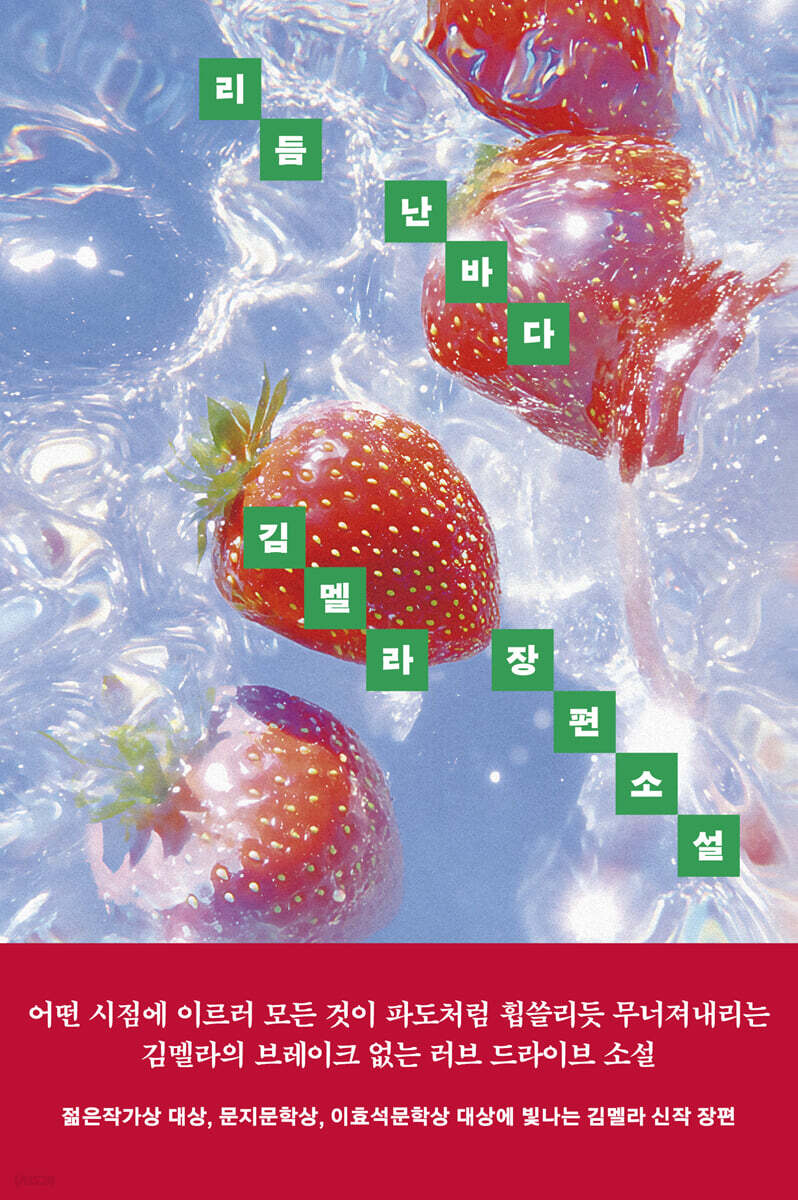 |
Description
Book Introduction
“I have never seen such a full and fierce flood of emotion.” _Song Seom-byeol (translator)
“Gathering all the dirty words in the world and turning them into the beautiful rhythm of waves.
"Rhythm Nanbada" does just that.
“In such a vulgar and yet so sublime way.” _Inayoung (literary critic)
At some point everything comes crashing down like a wave
Kim Mela's Unstoppable Love Drive Novel
Kim Mella's new novel, winner of the Young Writer's Award, the Munji Literary Award, and the Lee Hyo-seok Literary Award
Kim Mela's new full-length novel, "Rhythm Nanbada," has been published, allowing you to experience the pure pleasure of reading a novel through deep immersion, and savor that sweet and unique joy.
The scene where the surrounding noise suddenly disappears and you find yourself immersed in the characters in the book is often described as a common scene while reading a book, but it is also an experience that is difficult to achieve in these times when it is not easy to focus intently on one thing.
"Rhythm Nanbada" is a novel that was serialized in "Weekly Munhakdongne" for approximately six months from July to December 2024, and then completely revised with new content added. It is a novel that strongly attracts readers as it unfolds a panorama of intense love and hatred against the backdrop of a seemingly quiet seaside village.
This is a masterpiece overflowing with things that are possible only because it is written by 'Kim Mela of Today', who has been building up a dazzling achievement by winning the Young Writer's Award four times in a row over the past four to five years, as well as the Munji Literary Award and the Lee Hyo-seok Literary Award grand prize. It contains lovely and captivating characters, movements surrounding political aspirations that are important topics of our time, and even a structure that makes you go back and read it again at some point.
“Gathering all the dirty words in the world and turning them into the beautiful rhythm of waves.
"Rhythm Nanbada" does just that.
“In such a vulgar and yet so sublime way.” _Inayoung (literary critic)
At some point everything comes crashing down like a wave
Kim Mela's Unstoppable Love Drive Novel
Kim Mella's new novel, winner of the Young Writer's Award, the Munji Literary Award, and the Lee Hyo-seok Literary Award
Kim Mela's new full-length novel, "Rhythm Nanbada," has been published, allowing you to experience the pure pleasure of reading a novel through deep immersion, and savor that sweet and unique joy.
The scene where the surrounding noise suddenly disappears and you find yourself immersed in the characters in the book is often described as a common scene while reading a book, but it is also an experience that is difficult to achieve in these times when it is not easy to focus intently on one thing.
"Rhythm Nanbada" is a novel that was serialized in "Weekly Munhakdongne" for approximately six months from July to December 2024, and then completely revised with new content added. It is a novel that strongly attracts readers as it unfolds a panorama of intense love and hatred against the backdrop of a seemingly quiet seaside village.
This is a masterpiece overflowing with things that are possible only because it is written by 'Kim Mela of Today', who has been building up a dazzling achievement by winning the Young Writer's Award four times in a row over the past four to five years, as well as the Munji Literary Award and the Lee Hyo-seok Literary Award grand prize. It contains lovely and captivating characters, movements surrounding political aspirations that are important topics of our time, and even a structure that makes you go back and read it again at some point.
- You can preview some of the book's contents.
Preview
index
6 water… 7
7 water… 85
1 water…99
2nd water… 153
8 water… 201
3 water… 223
9 water… 263
4 water… 281
10 water… 325
11 Water … 377
12 waters… 407
5 water… 457
13 Water … 481
Water flow… 513
1 water… 535
Author's Note … 563
7 water… 85
1 water…99
2nd water… 153
8 water… 201
3 water… 223
9 water… 263
4 water… 281
10 water… 325
11 Water … 377
12 waters… 407
5 water… 457
13 Water … 481
Water flow… 513
1 water… 535
Author's Note … 563
Into the book
It was my first love.
If love is something that makes your heart race, makes you want to sit down and talk about how hellish life is, and at the same time makes you want to protect someone so that no one can treat you badly, then I loved those older sisters back then.
--- p.14
I thought that the reason humans form families, raise plants and animals, and create objects to constantly care for is because one person's will alone cannot sustain life.
If I didn't take responsibility, if I didn't force myself to be tied down to another being, life was so harsh that I wanted to throw myself away at any moment, and I became more and more worn out day by day.
To survive, you need a strong motivation for perseverance that cannot be thrown away.
--- p.37
There was another word from the sea that Eulju liked.
The open sea and the deep sea.
The sea far from the land was called 'Nanbada', and the sea close to the land was called 'Deunbada'.
When he was young, Eulju would sit alone on a rock by the sea, look at the yellow sunlight, and mutter, "Sea, sea, sea."
That big water has its 'time', so my 'time' will come too.
I consoled myself that someday this loneliness would fade away like the vast ocean.
'Sea sea, rain rain, sea sea', when I sang along to the rhythm, the sadness that made my heart ache became a little lighter.
--- p.76
Part of you will be torn and bruised, but through that pain another light will rise.
As your body ages and weakens, your dreams become more powerful and vivid.
So please don't repeat the same hatred and resentment that comes at you.
Take hold of the strong, shining sword that will break the chain of revenge.
Rather than lying down and groaning, follow the invisible flow, the voice that calls you.
Even if you find yourself covered in wounds at the end of that path, you must continue on in the direction where Han Ki-yeon is.
--- pp.140-141
I was afraid of where my youth, which I didn't know where it would lead me, would lead me to where it would lead me to.
--- p.141
Yes, there are still people who can die for love.
--- p.146
You wonder if you can give Han Ki-yeon your cell phone number.
I can't bring myself to ask Han Ki-yeon for my number, but I feel like I could wait the rest of my life for her to contact me after giving her my contact information.
--- p.180
I was glad to be able to confirm your affection for me.
Because no matter how passionately two people give and receive love, there always needs to be another gaze to admire that love.
--- p.230
Eulju's weakness was that when he saw someone working very hard, he would unconsciously lose focus.
--- pp.352-353
When I answered that question in the house, I felt a strange sense of elation.
Eulju's self-esteem, which had been tightly folded, finally unfolded and fluttered lightly like a cabbage white butterfly fluttering between strawberry leaves.
This is me.
This is what I look like.
You have to accept me as I am.
Without any conditions or choices, I must breathe in my true self like air and accept it like the seasons.
--- p.369
Eulju had a premonition that no matter what the anonymous people said, whether it was hundreds or thousands, it would not be able to hurt her, but a single indifferent glance would be fatal.
--- p.371
As time passes and memories fade, will this moment also become a story?
If we keep thinking about it over and over again and repeat it more often, will it become a movie closer to fiction than fact?
If love is something that makes your heart race, makes you want to sit down and talk about how hellish life is, and at the same time makes you want to protect someone so that no one can treat you badly, then I loved those older sisters back then.
--- p.14
I thought that the reason humans form families, raise plants and animals, and create objects to constantly care for is because one person's will alone cannot sustain life.
If I didn't take responsibility, if I didn't force myself to be tied down to another being, life was so harsh that I wanted to throw myself away at any moment, and I became more and more worn out day by day.
To survive, you need a strong motivation for perseverance that cannot be thrown away.
--- p.37
There was another word from the sea that Eulju liked.
The open sea and the deep sea.
The sea far from the land was called 'Nanbada', and the sea close to the land was called 'Deunbada'.
When he was young, Eulju would sit alone on a rock by the sea, look at the yellow sunlight, and mutter, "Sea, sea, sea."
That big water has its 'time', so my 'time' will come too.
I consoled myself that someday this loneliness would fade away like the vast ocean.
'Sea sea, rain rain, sea sea', when I sang along to the rhythm, the sadness that made my heart ache became a little lighter.
--- p.76
Part of you will be torn and bruised, but through that pain another light will rise.
As your body ages and weakens, your dreams become more powerful and vivid.
So please don't repeat the same hatred and resentment that comes at you.
Take hold of the strong, shining sword that will break the chain of revenge.
Rather than lying down and groaning, follow the invisible flow, the voice that calls you.
Even if you find yourself covered in wounds at the end of that path, you must continue on in the direction where Han Ki-yeon is.
--- pp.140-141
I was afraid of where my youth, which I didn't know where it would lead me, would lead me to where it would lead me to.
--- p.141
Yes, there are still people who can die for love.
--- p.146
You wonder if you can give Han Ki-yeon your cell phone number.
I can't bring myself to ask Han Ki-yeon for my number, but I feel like I could wait the rest of my life for her to contact me after giving her my contact information.
--- p.180
I was glad to be able to confirm your affection for me.
Because no matter how passionately two people give and receive love, there always needs to be another gaze to admire that love.
--- p.230
Eulju's weakness was that when he saw someone working very hard, he would unconsciously lose focus.
--- pp.352-353
When I answered that question in the house, I felt a strange sense of elation.
Eulju's self-esteem, which had been tightly folded, finally unfolded and fluttered lightly like a cabbage white butterfly fluttering between strawberry leaves.
This is me.
This is what I look like.
You have to accept me as I am.
Without any conditions or choices, I must breathe in my true self like air and accept it like the seasons.
--- p.369
Eulju had a premonition that no matter what the anonymous people said, whether it was hundreds or thousands, it would not be able to hurt her, but a single indifferent glance would be fatal.
--- p.371
As time passes and memories fade, will this moment also become a story?
If we keep thinking about it over and over again and repeat it more often, will it become a movie closer to fiction than fact?
--- p.498
Publisher's Review
“But, but why does this person keep coming towards me?
Without fear, without mask,
“And the fragrant scent of fruit filled my whole body.”
The first character to appear in the novel, who exudes bright and healthy energy like the midday sun, is Eulju, a young farmer in his thirties.
Eulju, who runs a strawberry farm in a seaside village with red, eroded rocks to the south and a mountain called Oknyeosan to the north, enjoys walking with her adult Doberman, Obok-i, who lives with her.
Today, after finishing farm work, I planned to take a walk along the beach with Obongi.
But the truck's starter just won't respond, and after a long struggle, the truck finally gets going and leaves the dark beach.
Of course, for Eulju, a failure of this magnitude is so trivial that it is embarrassing to even call it a failure.
Before coming to my hometown, I worked as a web designer in Seoul and tasted the bitterness of corporate life at an early age. Even younger, I was a promising Taekwondo athlete, but I lost to a powerful roundhouse kick in the semifinals of the Youth Sports Festival.
But there is another joy that allows Eulju to continue living.
It is the existence of Doolhee, the object of one's unrequited love.
Dool-hee, a mysterious outsider living in a three-story house on Oknyeo Mountain, is a character who is secretly and greatly interested in the villagers as she is believed to be related to the incident in which a man fell to his death from a cliff the winter before last. She caught Eul-ju's attention with her round, white face like a honey cake and a nuance of a story full of stories.
Eulju and Doolhee had a few chance encounters at the beach, and while they were feeling that their relationship was progressing little by little, he had to secretly suffer from heartache when Doolhee suddenly changed her attitude and started treating him and Obok as if they were meeting for the first time.
Eul-ju, who was suffering from Dool-hee's neglect and indifference, decided that she could no longer continue like this and "decided to rush to the person's hideout" (p. 19).
The place where Doolhee is, that is, the place where suspicious outsiders come and go from time to time and arouse the curiosity and questions of the townspeople, is the site of a live internet broadcast called [Yok+Bad-ee].
As the name suggests, it is a broadcast where people are exposed to all kinds of abuse from beyond the monitor.
Perhaps the only silver lining is that in exchange for the abuse, they receive a so-called "mutual support fund." The team leader in charge of that broadcast is none other than Doolhee.
According to another employee of the company, the purpose of the broadcast is this:
“The company said that it was doing a kind of hate labor to sound the alarm in this rotten society where money is everything.
“The idea is to boost your immunity by getting a hate vaccine to prevent the highly contagious hate virus, but the real goal is to stop poking fun at others and making fun of them.” (p. 332)
Eul-ju is completely unconvinced by the specious excuse, but since the only way to meet Dool-hee is to go to the very place where she works, he decides to appear and become the butt of the insults.
The toughness he developed as a Taekwondo athlete in his childhood, his unique optimism, and his deep love for Doolhee make this possible.
The form of composition and reconstruction in which the sea and the moon seem to pull each other
Kim Mela's unique writing style overturns conventions and common sense.
While Eul-ju's plan to head to the three-story house on Oknyeo Mountain to properly face Dool-hee and meet again and ask, "Why do you pretend not to know us, Obok and I? Is it okay for people to be so fickle?" (p. 398) is progressing steadily, the story unfolds from Dool-hee's perspective.
Doolhee was captivated by the movie [The Long-Living Crab] in her early twenties, 14 years ago, and became a passionate fan of the director who created the film.
The film director's name is Han Ki-yeon, a person who attracted people's attention with his "engineering background, late debut, tall stature that seemed to have risen to the top of a staircase, and an attitude that rarely smiled" (p. 111).
Above all, she is the subject of a major scandal that shook society, and is now at the center of a scandal as her debut work [Full Belly Cloud] is embroiled in a plagiarism controversy following a rumor of her romantic relationship with a member of the National Assembly who already has a family.
Doolhee grows her affection for Han Ki-yeon regardless of people's evaluations of her, or rather, fueled by those harsh and unfair evaluations.
The way to show affection is to archive everything about Han Ki-yeon on a fan site.
As I was going through my twenties, still harboring feelings for Han Ki-yeon, I received an unbelievable call from the object of my admiration.
“I’m okay.
“Don’t worry” (page 141)
Dool-hee, who had been chewing over the sentence left as a secret comment on the fan site countless times, meets Han Ki-yeon through it and becomes her lover as planned.
What makes the love that these two people create so special is that Han Ki-yeon has a dream of making a new film and “making a change in the world” (p. 195).
Just as any powerful typhoon eventually dissipates, Han Ki-yeon said he would create a temporary film that would change the world with strong winds and heavy rains and then fade from people's attention.
For Han Ki-yeon, film was a persistent pursuit of uncertain possibilities.
And that dedication and devotion made you believe in 'love'.
Love, movies, typhoons… … whatever name you give to that blindness, it all looks the same to you, it means the same thing.
Even if the movie or the typhoon were only fleeting disturbances, you wanted to follow Han Ki-yeon to a destination beyond that. (Same story)
Doolhee is also enthusiastic about making a film that can overturn existing customs and common sense, and realize that dream of overturning it, but it is not easy to create a crack in the existing order.
The two people gradually become exhausted through repeated challenges and failures, and cracks naturally appear in their once strong relationship.
What's interesting is that the past story with Han Ki-yeon is completely reconstructed and written anew from the perspective of Dool-hee in the present.
Writing by distancing yourself from your past self by calling yourself "you," actively using all kinds of materials related to Han Ki-yeon - interviews, emails, court decisions, etc. - and thus writing fiction more vividly than fact.
If, as the novel suggests, "humans make stories out of what they cannot understand" (p. 498), then what is Dool-hee trying to achieve through this passionate rewriting? As Dool-hee's story progresses, the complex and vast structure hidden within the novel gradually becomes apparent, and it is at this point that "Rhythm Nanbada" acquires a unique quality that distinguishes it from any other novel.
I'm looking through the materials from that time and reconstructing what happened at that time.
No, I don't think 'reconstruction' is the right word.
Rather, I would tear those records apart, shred them, and remake them into the stories we need. (p. 128)
At the beginning of the relationship between Eulju and Doolhee, Doolhee and Han Kiyeon, there was an intense attraction towards each other, like the sea and the moon pulling each other.
And that attraction drove the characters forward as it transformed into a desire to dream each other's dreams together and a desire to make those dreams come true.
What awaits at the end?
"Rhythm Nanbada" is like waves that start out calm but then become rough at other times, going back and forth between innocence and passion, making the ending unpredictable. But what's important is that, on the thick layers of this story that Kim Mela has built up, we will all dream true dreams together with the characters.
One dream that everyone dreams at the same time.
I think of the word 'Nanbaada'.
Nanbada is a word meaning 'far sea'.
It is not the sea seen from the land, but the 'sea seen' of a person who has gone far away on a boat, leaving the sea behind.
I feel the relief of someone who has lived through a period of time in these words.
On the sea where I set out to bring back the novel, I was immersed in the power of time and people.
When I close my eyes, I feel as if I have been overwhelmed by the shimmering waves and rays of light.
Suddenly, I realized that the novel, like the sea, flows with its own flow, but it was my own heart that was swept away and floundered.
_From the author's note
Without fear, without mask,
“And the fragrant scent of fruit filled my whole body.”
The first character to appear in the novel, who exudes bright and healthy energy like the midday sun, is Eulju, a young farmer in his thirties.
Eulju, who runs a strawberry farm in a seaside village with red, eroded rocks to the south and a mountain called Oknyeosan to the north, enjoys walking with her adult Doberman, Obok-i, who lives with her.
Today, after finishing farm work, I planned to take a walk along the beach with Obongi.
But the truck's starter just won't respond, and after a long struggle, the truck finally gets going and leaves the dark beach.
Of course, for Eulju, a failure of this magnitude is so trivial that it is embarrassing to even call it a failure.
Before coming to my hometown, I worked as a web designer in Seoul and tasted the bitterness of corporate life at an early age. Even younger, I was a promising Taekwondo athlete, but I lost to a powerful roundhouse kick in the semifinals of the Youth Sports Festival.
But there is another joy that allows Eulju to continue living.
It is the existence of Doolhee, the object of one's unrequited love.
Dool-hee, a mysterious outsider living in a three-story house on Oknyeo Mountain, is a character who is secretly and greatly interested in the villagers as she is believed to be related to the incident in which a man fell to his death from a cliff the winter before last. She caught Eul-ju's attention with her round, white face like a honey cake and a nuance of a story full of stories.
Eulju and Doolhee had a few chance encounters at the beach, and while they were feeling that their relationship was progressing little by little, he had to secretly suffer from heartache when Doolhee suddenly changed her attitude and started treating him and Obok as if they were meeting for the first time.
Eul-ju, who was suffering from Dool-hee's neglect and indifference, decided that she could no longer continue like this and "decided to rush to the person's hideout" (p. 19).
The place where Doolhee is, that is, the place where suspicious outsiders come and go from time to time and arouse the curiosity and questions of the townspeople, is the site of a live internet broadcast called [Yok+Bad-ee].
As the name suggests, it is a broadcast where people are exposed to all kinds of abuse from beyond the monitor.
Perhaps the only silver lining is that in exchange for the abuse, they receive a so-called "mutual support fund." The team leader in charge of that broadcast is none other than Doolhee.
According to another employee of the company, the purpose of the broadcast is this:
“The company said that it was doing a kind of hate labor to sound the alarm in this rotten society where money is everything.
“The idea is to boost your immunity by getting a hate vaccine to prevent the highly contagious hate virus, but the real goal is to stop poking fun at others and making fun of them.” (p. 332)
Eul-ju is completely unconvinced by the specious excuse, but since the only way to meet Dool-hee is to go to the very place where she works, he decides to appear and become the butt of the insults.
The toughness he developed as a Taekwondo athlete in his childhood, his unique optimism, and his deep love for Doolhee make this possible.
The form of composition and reconstruction in which the sea and the moon seem to pull each other
Kim Mela's unique writing style overturns conventions and common sense.
While Eul-ju's plan to head to the three-story house on Oknyeo Mountain to properly face Dool-hee and meet again and ask, "Why do you pretend not to know us, Obok and I? Is it okay for people to be so fickle?" (p. 398) is progressing steadily, the story unfolds from Dool-hee's perspective.
Doolhee was captivated by the movie [The Long-Living Crab] in her early twenties, 14 years ago, and became a passionate fan of the director who created the film.
The film director's name is Han Ki-yeon, a person who attracted people's attention with his "engineering background, late debut, tall stature that seemed to have risen to the top of a staircase, and an attitude that rarely smiled" (p. 111).
Above all, she is the subject of a major scandal that shook society, and is now at the center of a scandal as her debut work [Full Belly Cloud] is embroiled in a plagiarism controversy following a rumor of her romantic relationship with a member of the National Assembly who already has a family.
Doolhee grows her affection for Han Ki-yeon regardless of people's evaluations of her, or rather, fueled by those harsh and unfair evaluations.
The way to show affection is to archive everything about Han Ki-yeon on a fan site.
As I was going through my twenties, still harboring feelings for Han Ki-yeon, I received an unbelievable call from the object of my admiration.
“I’m okay.
“Don’t worry” (page 141)
Dool-hee, who had been chewing over the sentence left as a secret comment on the fan site countless times, meets Han Ki-yeon through it and becomes her lover as planned.
What makes the love that these two people create so special is that Han Ki-yeon has a dream of making a new film and “making a change in the world” (p. 195).
Just as any powerful typhoon eventually dissipates, Han Ki-yeon said he would create a temporary film that would change the world with strong winds and heavy rains and then fade from people's attention.
For Han Ki-yeon, film was a persistent pursuit of uncertain possibilities.
And that dedication and devotion made you believe in 'love'.
Love, movies, typhoons… … whatever name you give to that blindness, it all looks the same to you, it means the same thing.
Even if the movie or the typhoon were only fleeting disturbances, you wanted to follow Han Ki-yeon to a destination beyond that. (Same story)
Doolhee is also enthusiastic about making a film that can overturn existing customs and common sense, and realize that dream of overturning it, but it is not easy to create a crack in the existing order.
The two people gradually become exhausted through repeated challenges and failures, and cracks naturally appear in their once strong relationship.
What's interesting is that the past story with Han Ki-yeon is completely reconstructed and written anew from the perspective of Dool-hee in the present.
Writing by distancing yourself from your past self by calling yourself "you," actively using all kinds of materials related to Han Ki-yeon - interviews, emails, court decisions, etc. - and thus writing fiction more vividly than fact.
If, as the novel suggests, "humans make stories out of what they cannot understand" (p. 498), then what is Dool-hee trying to achieve through this passionate rewriting? As Dool-hee's story progresses, the complex and vast structure hidden within the novel gradually becomes apparent, and it is at this point that "Rhythm Nanbada" acquires a unique quality that distinguishes it from any other novel.
I'm looking through the materials from that time and reconstructing what happened at that time.
No, I don't think 'reconstruction' is the right word.
Rather, I would tear those records apart, shred them, and remake them into the stories we need. (p. 128)
At the beginning of the relationship between Eulju and Doolhee, Doolhee and Han Kiyeon, there was an intense attraction towards each other, like the sea and the moon pulling each other.
And that attraction drove the characters forward as it transformed into a desire to dream each other's dreams together and a desire to make those dreams come true.
What awaits at the end?
"Rhythm Nanbada" is like waves that start out calm but then become rough at other times, going back and forth between innocence and passion, making the ending unpredictable. But what's important is that, on the thick layers of this story that Kim Mela has built up, we will all dream true dreams together with the characters.
One dream that everyone dreams at the same time.
I think of the word 'Nanbaada'.
Nanbada is a word meaning 'far sea'.
It is not the sea seen from the land, but the 'sea seen' of a person who has gone far away on a boat, leaving the sea behind.
I feel the relief of someone who has lived through a period of time in these words.
On the sea where I set out to bring back the novel, I was immersed in the power of time and people.
When I close my eyes, I feel as if I have been overwhelmed by the shimmering waves and rays of light.
Suddenly, I realized that the novel, like the sea, flows with its own flow, but it was my own heart that was swept away and floundered.
_From the author's note
GOODS SPECIFICS
- Date of issue: November 11, 2025
- Page count, weight, size: 568 pages | 646g | 133*200*35mm
- ISBN13: 9791141613976
- ISBN10: 1141613972
You may also like
카테고리
korean


korean

![GQ KOREA Mark (Monthly): December [2025]](http://librairie.coreenne.fr/cdn/shop/files/8ef265dbbfbf186523ed75ba7319009d.jpg?v=1765340328&width=3840)


