

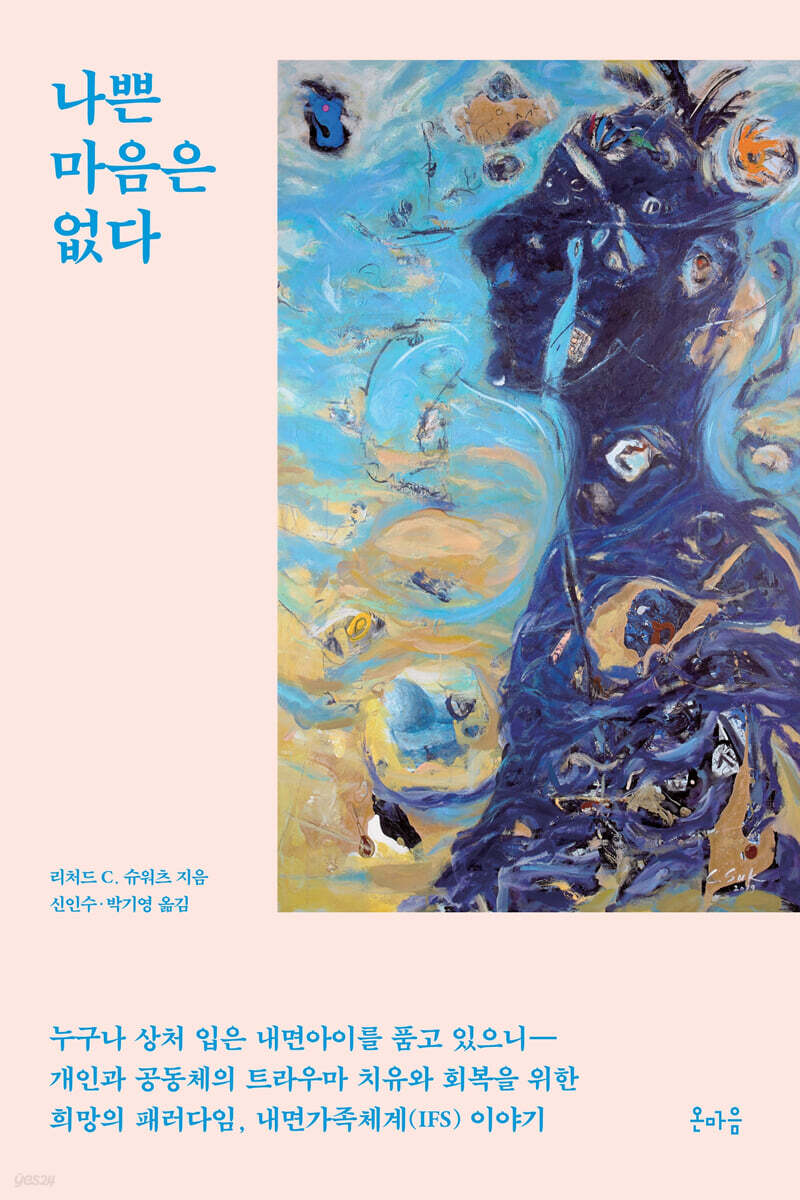
There is no evil intention
 |
Description
Book Introduction
"There Is No Evil Mind" introduces the general reader to the Internal Family Systems (IFS) model, which has revolutionized the field of psychotherapy and psychological counseling.
Contrary to the prevailing paradigm, which holds that each of us possesses a single mind, the author of this book proposes a multi-mind paradigm, arguing that we possess multiple minds. Many counselors and psychotherapists have responded to the views of Dr. Richard Schwartz, who developed the IFS model and is currently a professor of psychiatry at Harvard Medical School, and are applying this model to their own healing practices, finding effective results.
Dr. Schwartz discovered that healing occurs very quickly and effectively when we approach each of our inner parts, commonly known as our "inner child," with respect as individuals, and has confirmed its effectiveness by applying this clinically.
Another important discovery was that we all have within us the true self, the 'true self' that has been mentioned in many religions and spiritualities, and that through this, we can fundamentally heal our hearts.
What does this multi-mind paradigm mean for us? There's a Korean proverb that says, "Hate the sin, not the sinner," and the basis for this can be found in the IFS model.
Our inner child, trying to protect us during a traumatic event, becomes wounded and sometimes repeats extreme thoughts, attitudes, and behaviors.
They sometimes act in a way that the world points fingers at, but that is because they are stuck in a time of trauma.
So, no matter how heinous a criminal is, if these wounds are healed, he can be reborn as a completely new person.
The same goes for the injured victims.
Each person becomes aware of the power within them and is able to utilize that energy.
What makes this fundamental change possible is the ‘true energy’ within all of us.
We can use this not only for personal healing and growth, but also for our wounded communities.
Therefore, the Internal Family Systems (IFS) model is a new paradigm that can bring about fundamental changes to humans and society.
"There Is No Evil Mind" presented here can be said to contain an important vision for fundamental change in the right direction at a time when polarization, various social conflicts, and instability for humanity and the entire planet are increasing day by day.
It includes interesting counseling cases along with various practical methods, allowing readers to experience the internal family system model directly and indirectly.
Contrary to the prevailing paradigm, which holds that each of us possesses a single mind, the author of this book proposes a multi-mind paradigm, arguing that we possess multiple minds. Many counselors and psychotherapists have responded to the views of Dr. Richard Schwartz, who developed the IFS model and is currently a professor of psychiatry at Harvard Medical School, and are applying this model to their own healing practices, finding effective results.
Dr. Schwartz discovered that healing occurs very quickly and effectively when we approach each of our inner parts, commonly known as our "inner child," with respect as individuals, and has confirmed its effectiveness by applying this clinically.
Another important discovery was that we all have within us the true self, the 'true self' that has been mentioned in many religions and spiritualities, and that through this, we can fundamentally heal our hearts.
What does this multi-mind paradigm mean for us? There's a Korean proverb that says, "Hate the sin, not the sinner," and the basis for this can be found in the IFS model.
Our inner child, trying to protect us during a traumatic event, becomes wounded and sometimes repeats extreme thoughts, attitudes, and behaviors.
They sometimes act in a way that the world points fingers at, but that is because they are stuck in a time of trauma.
So, no matter how heinous a criminal is, if these wounds are healed, he can be reborn as a completely new person.
The same goes for the injured victims.
Each person becomes aware of the power within them and is able to utilize that energy.
What makes this fundamental change possible is the ‘true energy’ within all of us.
We can use this not only for personal healing and growth, but also for our wounded communities.
Therefore, the Internal Family Systems (IFS) model is a new paradigm that can bring about fundamental changes to humans and society.
"There Is No Evil Mind" presented here can be said to contain an important vision for fundamental change in the right direction at a time when polarization, various social conflicts, and instability for humanity and the entire planet are increasing day by day.
It includes interesting counseling cases along with various practical methods, allowing readers to experience the internal family system model directly and indirectly.
- You can preview some of the book's contents.
Preview
index
Recommendation Seo Gwang 11
Recommended by Alanis Morissette 15
Introduction 25
Part 1: The Inner Family System Within Us
Chapter 1 We Are All Multiple 33
Single Mind vs. Multiple Minds 33 / A Brief History of the 'Single Mind Belief System' 37 / Willpower and Shame 38 / Our Inner Parts Are Not Blockages 42 / How I Learned About Our Inner Parts 46 / The Burden of Our Inner Parts 53 / Our Inner Parts and Their Burdens Are Not the Same 56 / There Are No Bad Parts or Bad Minds 57 / Our Inner Self 60 / Your Turn 64
Practice: Getting to Know Your Inner Guardian 64
Drawing a map of the inner parts of the practice 69
Chapter 2 Why Do Inner Parts Blend Into Us? 72
Beliefs of the Protective Parts 73 / The Four Basic Goals of the IFS 81 / Learning More About the Inner Parts 83 / Five Things to Know About the Inner Parts 87
Breaking free from the tangle of practice and embodying your true self 79
Case 1: Sam - The Bullied Inner Child 89
Chapter 3: A New Paradigm That Will Change Everything 104
God or the Ultimate Self 104 / Check 112
Practical Dilemma Meditation 109
Working with Difficult Parents 114
Chapter 4: Why Systems Thinking Is Necessary 114
The Development of Systems Thinking 119 / Context is Everything 121 / Negative (But Wrong) Views of Human Nature 122 / Why Negative Perspectives Don't Work 126 / Feedback Loops 128 / Everything is Connected 132 / The Need for a Systematic Paradigm Shift 133
Practice IFS Daily Meditation 135
Chapter 5: Drawing My Inner Family System 139
Outcast 139 / Manager 145 / Firefighter 147
Case 2: Mona's Manic Episode 157
Part 2 True Leadership
Chapter 6: True Love Offers Healing and Transformation 169
The Meaning of Healing 171 / The Characteristics of the True Self 183 / Spirituality and the True Self 189 / My Spiritual Journey 195
Journey on the Path of Practice 176
Breaking free from the tangle of practice and connecting with the true self 182
Chapter 7: The truth is alive and moving...
199
Parenting with True Self 199 / Letting True Self Lead 232
Case 3: Social Activists Lee Seon and Sarah 204
Chapter 8: My True Vision and a Purposeful Life 237
True Vision 239 / Life's Transformation and the Rebellion of the Inner Part 242 / Immanence and Transcendence 252 / Servant Leadership and Transmission 255 / Immersion 258
Practical Firefighting Training 246
Meditation on the Grief-stricken Person 249
Part 3: The True Self in the Body, the True Self in the World
Chapter 9: Welcome Your Teacher of Afflictions 269
Sacred Beings 270 / The Master of Afflictions 273
Drawing a Map of the Inner Parts of the Practice (Advanced) 277
Working with Practice Triggers 281
Chapter 10: The Workings of the Inner World 284
Beautiful Mind 284 / Check 290
Working with Your Inner Guardian (Advanced) 292
Case 4: Andy: The Paradox of Racism 296
Chapter 11: Embodiment of the True Self 303
IFS and Body 304
Case 5: TJ 313, Suffering Aftereffects of a Traffic Accident
Meditation on the Body 324
Article 327
Acknowledgments 336
Note 339
Translator's Note 343
Translator's Note 358
Recommended by Alanis Morissette 15
Introduction 25
Part 1: The Inner Family System Within Us
Chapter 1 We Are All Multiple 33
Single Mind vs. Multiple Minds 33 / A Brief History of the 'Single Mind Belief System' 37 / Willpower and Shame 38 / Our Inner Parts Are Not Blockages 42 / How I Learned About Our Inner Parts 46 / The Burden of Our Inner Parts 53 / Our Inner Parts and Their Burdens Are Not the Same 56 / There Are No Bad Parts or Bad Minds 57 / Our Inner Self 60 / Your Turn 64
Practice: Getting to Know Your Inner Guardian 64
Drawing a map of the inner parts of the practice 69
Chapter 2 Why Do Inner Parts Blend Into Us? 72
Beliefs of the Protective Parts 73 / The Four Basic Goals of the IFS 81 / Learning More About the Inner Parts 83 / Five Things to Know About the Inner Parts 87
Breaking free from the tangle of practice and embodying your true self 79
Case 1: Sam - The Bullied Inner Child 89
Chapter 3: A New Paradigm That Will Change Everything 104
God or the Ultimate Self 104 / Check 112
Practical Dilemma Meditation 109
Working with Difficult Parents 114
Chapter 4: Why Systems Thinking Is Necessary 114
The Development of Systems Thinking 119 / Context is Everything 121 / Negative (But Wrong) Views of Human Nature 122 / Why Negative Perspectives Don't Work 126 / Feedback Loops 128 / Everything is Connected 132 / The Need for a Systematic Paradigm Shift 133
Practice IFS Daily Meditation 135
Chapter 5: Drawing My Inner Family System 139
Outcast 139 / Manager 145 / Firefighter 147
Case 2: Mona's Manic Episode 157
Part 2 True Leadership
Chapter 6: True Love Offers Healing and Transformation 169
The Meaning of Healing 171 / The Characteristics of the True Self 183 / Spirituality and the True Self 189 / My Spiritual Journey 195
Journey on the Path of Practice 176
Breaking free from the tangle of practice and connecting with the true self 182
Chapter 7: The truth is alive and moving...
199
Parenting with True Self 199 / Letting True Self Lead 232
Case 3: Social Activists Lee Seon and Sarah 204
Chapter 8: My True Vision and a Purposeful Life 237
True Vision 239 / Life's Transformation and the Rebellion of the Inner Part 242 / Immanence and Transcendence 252 / Servant Leadership and Transmission 255 / Immersion 258
Practical Firefighting Training 246
Meditation on the Grief-stricken Person 249
Part 3: The True Self in the Body, the True Self in the World
Chapter 9: Welcome Your Teacher of Afflictions 269
Sacred Beings 270 / The Master of Afflictions 273
Drawing a Map of the Inner Parts of the Practice (Advanced) 277
Working with Practice Triggers 281
Chapter 10: The Workings of the Inner World 284
Beautiful Mind 284 / Check 290
Working with Your Inner Guardian (Advanced) 292
Case 4: Andy: The Paradox of Racism 296
Chapter 11: Embodiment of the True Self 303
IFS and Body 304
Case 5: TJ 313, Suffering Aftereffects of a Traffic Accident
Meditation on the Body 324
Article 327
Acknowledgments 336
Note 339
Translator's Note 343
Translator's Note 358
Into the book
We often find that the more we try to get rid of a feeling or thought, the stronger it becomes.
This is because, like people, inner parts also fight against being shamed or ostracized.
--- p.40
In every client I met, a presence would suddenly appear, displaying the same mindfulness, curiosity, serenity, confidence, and often even compassion, as if it knew how to establish a healing relationship within itself.
When my clients are in this state, I often ask them:
“So what part of you is that?” Clients then say, “That’s not in the same category as the other parts.
“It’s closer to myself,” he answers, “It’s more like something essential to me,” “It’s the real me.”
This is the being I call the Self.
True love exists within everyone.
--- p.63
We now know that the inner parts are not diseases, pains, or mere egos.
Parts are little beings inside you that are doing their best to keep you safe.
They also do their best to keep each other safe and protect their inner world together.
The inner parts contain all the elements of personality.
They each have different needs, ages, opinions, talents, and resources.
They may seem like mere annoyances, or a source of suffering when they play an extreme role, but they are actually wonderful beings within us.
--- p.85
We need leaders who can remind us, through systems thinking, that we are all in this together.
--- p.132
In Chapter 1, we talked about spiritual bypassing, and many people seek out meditation centers and other places to escape their emotions.
Even in the communities where I do healing work, I often see people using spiritual practices as a means to transcend their exile.
One of the reasons firefighters get addicted to spiritual practice is because it seems like a great solution.
--- p.148-149
When you become curious about a part of yourself, you naturally become more aware of it, and that in turn leads to compassion for what it has experienced and the heavy burdens it still carries.
When people feel connected to humanity, they become more curious about others and more willing to help.
In this way, simply connecting to one of the characteristics of the true self often leads to the emergence and activity of another characteristic.
--- p.185
Developmental psychology and attachment theory have helped us understand what children need from their caregivers as they grow.
The Internal Family Systems (IFS) model can be considered our own internal attachment theory.
This is because the client's true self serves as an excellent attachment figure for the parts of the client that are anxious or avoidant within the client.
--- p.199
So many interactions are actually civil wars between [inner] guardians.
We see such examples in business, in families, and in politics.
Countries like the United States are experiencing widespread polarization, with factions within each camp dominating and speaking out against each other.
When one person's part becomes extreme, the guardian of the person talking to them also becomes equally or more extreme.
This vicious cycle becomes more serious over time.
This phenomenon is especially aggravated when neither faction has confidence in the leadership that governs the whole, and when there are many outcasts in each faction.
In other words, this phenomenon occurs equally at all levels of the human system.
--- p.283
The way it works is that if you are in a state of true self and fearless, nothing within you can exert control.
This principle has never gone wrong in the decades that I have been applying IFS.
--- p.288
One of the primary goals of the Inner Family Systems Model is to develop your capacity to lead from within and outside your true self.
The more abundantly the True Self is present in both realms, the more the beings of both realms become reconnected, harmonized, and balanced.
But for the True Self to function fully in both the inner and outer worlds, it must be connected to your body.
The truth must be embodied in our bodies.
--- p.304
If you can love every part of yourself, you can love everyone.
When the inner parts feel loved, they allow you to live a life guided by your true self.
When that happens, you feel connected to the Earth and a desire to protect it from the exploitative parts of people arises.
Furthermore, you will expand the field of your true self to the Earth dimension, which will contribute to the healing of the Earth.
You will also feel connected to a larger field called 'Ultimate Self'.
This is because, like people, inner parts also fight against being shamed or ostracized.
--- p.40
In every client I met, a presence would suddenly appear, displaying the same mindfulness, curiosity, serenity, confidence, and often even compassion, as if it knew how to establish a healing relationship within itself.
When my clients are in this state, I often ask them:
“So what part of you is that?” Clients then say, “That’s not in the same category as the other parts.
“It’s closer to myself,” he answers, “It’s more like something essential to me,” “It’s the real me.”
This is the being I call the Self.
True love exists within everyone.
--- p.63
We now know that the inner parts are not diseases, pains, or mere egos.
Parts are little beings inside you that are doing their best to keep you safe.
They also do their best to keep each other safe and protect their inner world together.
The inner parts contain all the elements of personality.
They each have different needs, ages, opinions, talents, and resources.
They may seem like mere annoyances, or a source of suffering when they play an extreme role, but they are actually wonderful beings within us.
--- p.85
We need leaders who can remind us, through systems thinking, that we are all in this together.
--- p.132
In Chapter 1, we talked about spiritual bypassing, and many people seek out meditation centers and other places to escape their emotions.
Even in the communities where I do healing work, I often see people using spiritual practices as a means to transcend their exile.
One of the reasons firefighters get addicted to spiritual practice is because it seems like a great solution.
--- p.148-149
When you become curious about a part of yourself, you naturally become more aware of it, and that in turn leads to compassion for what it has experienced and the heavy burdens it still carries.
When people feel connected to humanity, they become more curious about others and more willing to help.
In this way, simply connecting to one of the characteristics of the true self often leads to the emergence and activity of another characteristic.
--- p.185
Developmental psychology and attachment theory have helped us understand what children need from their caregivers as they grow.
The Internal Family Systems (IFS) model can be considered our own internal attachment theory.
This is because the client's true self serves as an excellent attachment figure for the parts of the client that are anxious or avoidant within the client.
--- p.199
So many interactions are actually civil wars between [inner] guardians.
We see such examples in business, in families, and in politics.
Countries like the United States are experiencing widespread polarization, with factions within each camp dominating and speaking out against each other.
When one person's part becomes extreme, the guardian of the person talking to them also becomes equally or more extreme.
This vicious cycle becomes more serious over time.
This phenomenon is especially aggravated when neither faction has confidence in the leadership that governs the whole, and when there are many outcasts in each faction.
In other words, this phenomenon occurs equally at all levels of the human system.
--- p.283
The way it works is that if you are in a state of true self and fearless, nothing within you can exert control.
This principle has never gone wrong in the decades that I have been applying IFS.
--- p.288
One of the primary goals of the Inner Family Systems Model is to develop your capacity to lead from within and outside your true self.
The more abundantly the True Self is present in both realms, the more the beings of both realms become reconnected, harmonized, and balanced.
But for the True Self to function fully in both the inner and outer worlds, it must be connected to your body.
The truth must be embodied in our bodies.
--- p.304
If you can love every part of yourself, you can love everyone.
When the inner parts feel loved, they allow you to live a life guided by your true self.
When that happens, you feel connected to the Earth and a desire to protect it from the exploitative parts of people arises.
Furthermore, you will expand the field of your true self to the Earth dimension, which will contribute to the healing of the Earth.
You will also feel connected to a larger field called 'Ultimate Self'.
--- p.328
Publisher's Review
An innovative paradigm for inner communication and inner child healing,
Providing vision and hope to individuals and communities!
―The Story of the Internal Family System (IFS)―
Dr. Richard Schwartz, a professor of psychiatry at Harvard Medical School, developed the Internal Family Systems (IFS) model, which is considered to have revolutionized the field of psychotherapy/psychological counseling, and has applied it clinically for over 40 years, healing many people.
It is gaining popularity and receiving support from numerous psychotherapists and counselors around the world.
"There Is No Evil Mind" was written to introduce the IFS model, which has been recognized as an evidence-based psychotherapy by the U.S. health authorities, to the general reader.
Are our hearts one or many?
Dr. Schwartz begins by talking about two paradigms for looking at the human mind.
That is, we introduce the old paradigm that regards our mind as a single entity and contrast it with the recently emerging multiple-mind model, namely the inner family system model.
In fact, it can be said that it was from the early days of psychotherapy that we began to view our minds as being divided into many parts.
It is well known that Sigmund Freud, the founder of 'psychoanalysis', divided the human mind into Es (id), Ich (ego), and Uberich (superego).
Although these parts are not viewed as having personality as the internal family systems model suggests, it is significant in that it suggests the idea that our minds are divided into several parts.
Besides Freud, Carl Gustav Jung also distinguished various aspects of the human psyche, such as the ego, Self, anima, animus, and complex.
Also, Roberto Assagioli, an Italian psychiatrist and founder of 'psychosynthesis', proposed the concept of subpersonalities along with the concept of the Higher Self.
Carl Rogers, famous as the founder of person-centered therapy, and Irvin Yalom, considered one of the best psychiatrists in the United States, also mentioned that the inner 'parts' of the client/patient can be usefully utilized in therapeutic settings.
John Rowan, a psychotherapist and counselor, has researched the topic of 'subpersonalities' in depth and has conducted numerous workshops.
There have been consistent attempts to view the possibility of having multiple personalities within us as a normal state, rather than a pathological condition, that is, a mental health problem such as the past termed 'multiple personality disorder' or the recent term 'dissociative identity disorder'.
Dr. Schwartz, who developed a sophisticated way of dealing with inner parts, originally started out as a family therapist.
So, I believed that the problem could be solved by correcting the relationships between family members, mainly from the perspective of the 'family system'.
However, as I met clients whose problems were not resolved even after doing so, I began to pay attention to their inner selves and as a result, I began to witness their inner 'sub-personalities'.
Dr. Schwartz sought solutions while respecting them as individuals.
We found out why they behave maladaptive, empathized with their pain, and found a way to heal them.
The author wanted to communicate smoothly with clients/patients by calling the 'sub-personalities' within us 'parts' to make them easier to understand.
For reference, in the translated version of “There is no bad heart,” the word “part” is so common that it is sometimes translated as “inner part” or “inner part” to draw the reader’s attention.
The degree to which we feel our 'inner self' varies from person to person.
In another IFS introduction, Dr. Schwartz mentions that some clients feel their "inner parts" vaguely, while others feel them vividly, as if watching a movie.
This is similar to the fact that each person has different 'hypnotic susceptibility', so some people are easily hypnotized and some are not.
How is our inner world structured?
Dr. Schwartz calls the problematic inner parts related to the system he calls the 'inner system' or 'inner family system' when it is not functioning smoothly and there is a problem with 'inner communication' the protective role parts ('guardians') such as 'managers' and 'firefighters', and the wounded inner parts ('outcasts') which we commonly call the 'inner child'.
Although managers and firefighters have the same basic goal of protecting the inner system, they differ in how they deal with outcasts.
Because of these differences, they are prone to polarization.
It is similar to human society, where people argue over social issues, each claiming that their own way is right due to different worldviews.
Just as 'tribalism' is running rampant in our society, leading to polarization, so too are 'alliances' formed between like-minded groups within our inner world.
When the entire nation is shaken by deep conflicts between social forces, when our inner parts are out of harmony and polarization or conflict becomes unbearable, we seek out counselors or psychotherapists.
Another characteristic of the inner family systems model is that it allows the 'true Self' within the client/patient (and all of us) to take the lead as the subject of healing.
For those interested in religion or spirituality, the term 'true self' may be somewhat familiar, but at the same time, it may sound a bit metaphysical.
However, the 'true self' referred to in the IFS model is not something that comes from philosophical speculation or some 'belief' in religion or spirituality, but rather it is the reality within us that the author discovered through clinical experience with numerous clients.
'True' seemed to have characteristics that were on a different level from the various parts of the client's inner self.
Dr. Schwartz summarized the characteristics of the true self discovered phenomenologically through clinical practice into eight words starting with the English letter 'C'.
These are Calmness, Clarity, Curiosity, Compassion, Confidence, Courage, Creativity, and Connectedness.
The author has lived his life as a scientist (psychologist) with no connection to religion or spirituality, but rather used Transcendental Meditation (TM) for psychological stability in his youth.
However, as I discovered voices with these characteristics within my clients, I actively explored the reality and meaning of such phenomena.
In the process, I saw that what has been called the 'true self' in various religious and spiritual traditions, including Hinduism, Buddhism, and Christianity, was revealed in the psychotherapy scene.
Of course, it wasn't perceived that way from the beginning.
As I accumulated such experiences phenomenologically and studied them, I came to that conclusion.
The author named this phenomenon 'Self' with the first letter capitalized.
The translator considered the translation 'true self' to be appropriate, considering the spiritual aspect of 'self' and the nuance it conveys in Korean.
Of course, there are some aspects that are similar to Carl Jung's concept of 'Self', but as the saying goes, 'new wine in new wineskins', I thought that the expression 'true self' was more appropriate if it reflected the purpose of the IFS model.
Moreover, 'true' is a term widely used by various religions, religious scholars, and major spiritual fields.
How is the inner world healed?
The IFS model believes that true healing occurs through the true self, which is characterized by serenity, genuine curiosity, creativity, and a heart of compassion.
True healing begins when the true self, always present within each of us, reaches out and connects with our inner children, or our inner managers, firefighters, and outcasts.
When they experienced trauma, they thought they were alone, but now, Chamna is there to listen to their pain, empathize with them, and even help them let go of their burdens.
So, we guide them to be released from ‘then and there’ and come to ‘now and here.’
As a result of this healing process, past traumas are not forgotten, but they can be recalled without the intense pain they once felt.
You can just calmly recall it and say, 'That happened back then.'
Once your mind is healed in this way, you can move forward in life without dwelling on the past.
You will be able to live fully savoring this moment.
Interaction between the inner and outer worlds
Freud once said, “Individual psychology is also social psychology from the beginning.”
It points out that individual psychology and social/group psychology cannot be separated.
So, it is from this perspective that Dr. Schwartz discusses social change along with individual psychotherapy in this book.
This is because an individual's inner system and the social system interact and influence each other.
In fact, our inner and social systems also interact with our planetary systems.
This is also why the author mentions the spaceship Earth or Gaia.
Today, we watch with concern as the attitude of regarding others as 'enemies' plunges our society into a whirlpool of polarization and conflict.
Rather than advancing toward nation-states and 'spaceship Earth', we are regressing to tribal states, policies that lead to war or heighten the risk of war through international divisions...
Freud discovered that we repress or project outward (onto others) things that we find difficult to bear or want to deny.
When we view others as enemies, we are actually overlooking the "enemy" within ourselves, says Dr. Schwartz.
Therefore, in order to achieve peace in the external world along with inner peace, I believe that it is necessary to actively embrace and listen to the 'enemies' within our hearts and the 'enemies' in the external world.
In the “Coming Out” section of this book, “There Is No Bad Mind,” the author makes two suggestions.
1.
We seek to help more and more people embrace the leadership of the True Self, while allowing the True Self to lead as much as possible in our lives.
2.
We heal ourselves and each other (let go of our burdens).
And then he says the following:
Likewise, I am convinced that there are ways to help large groups expose and let go of the sociocultural baggage we have inherited, such as racism, individualism, consumerism, materialism, and sexism.
But I think it would be a mistake to minimize the importance of each person putting down their personal baggage while undertaking such a large-scale undertaking.
In other words, the author believes that the healing work of our inner world and the 'healing work' of the external world must go hand in hand.
What do you think, readers?
Providing vision and hope to individuals and communities!
―The Story of the Internal Family System (IFS)―
Dr. Richard Schwartz, a professor of psychiatry at Harvard Medical School, developed the Internal Family Systems (IFS) model, which is considered to have revolutionized the field of psychotherapy/psychological counseling, and has applied it clinically for over 40 years, healing many people.
It is gaining popularity and receiving support from numerous psychotherapists and counselors around the world.
"There Is No Evil Mind" was written to introduce the IFS model, which has been recognized as an evidence-based psychotherapy by the U.S. health authorities, to the general reader.
Are our hearts one or many?
Dr. Schwartz begins by talking about two paradigms for looking at the human mind.
That is, we introduce the old paradigm that regards our mind as a single entity and contrast it with the recently emerging multiple-mind model, namely the inner family system model.
In fact, it can be said that it was from the early days of psychotherapy that we began to view our minds as being divided into many parts.
It is well known that Sigmund Freud, the founder of 'psychoanalysis', divided the human mind into Es (id), Ich (ego), and Uberich (superego).
Although these parts are not viewed as having personality as the internal family systems model suggests, it is significant in that it suggests the idea that our minds are divided into several parts.
Besides Freud, Carl Gustav Jung also distinguished various aspects of the human psyche, such as the ego, Self, anima, animus, and complex.
Also, Roberto Assagioli, an Italian psychiatrist and founder of 'psychosynthesis', proposed the concept of subpersonalities along with the concept of the Higher Self.
Carl Rogers, famous as the founder of person-centered therapy, and Irvin Yalom, considered one of the best psychiatrists in the United States, also mentioned that the inner 'parts' of the client/patient can be usefully utilized in therapeutic settings.
John Rowan, a psychotherapist and counselor, has researched the topic of 'subpersonalities' in depth and has conducted numerous workshops.
There have been consistent attempts to view the possibility of having multiple personalities within us as a normal state, rather than a pathological condition, that is, a mental health problem such as the past termed 'multiple personality disorder' or the recent term 'dissociative identity disorder'.
Dr. Schwartz, who developed a sophisticated way of dealing with inner parts, originally started out as a family therapist.
So, I believed that the problem could be solved by correcting the relationships between family members, mainly from the perspective of the 'family system'.
However, as I met clients whose problems were not resolved even after doing so, I began to pay attention to their inner selves and as a result, I began to witness their inner 'sub-personalities'.
Dr. Schwartz sought solutions while respecting them as individuals.
We found out why they behave maladaptive, empathized with their pain, and found a way to heal them.
The author wanted to communicate smoothly with clients/patients by calling the 'sub-personalities' within us 'parts' to make them easier to understand.
For reference, in the translated version of “There is no bad heart,” the word “part” is so common that it is sometimes translated as “inner part” or “inner part” to draw the reader’s attention.
The degree to which we feel our 'inner self' varies from person to person.
In another IFS introduction, Dr. Schwartz mentions that some clients feel their "inner parts" vaguely, while others feel them vividly, as if watching a movie.
This is similar to the fact that each person has different 'hypnotic susceptibility', so some people are easily hypnotized and some are not.
How is our inner world structured?
Dr. Schwartz calls the problematic inner parts related to the system he calls the 'inner system' or 'inner family system' when it is not functioning smoothly and there is a problem with 'inner communication' the protective role parts ('guardians') such as 'managers' and 'firefighters', and the wounded inner parts ('outcasts') which we commonly call the 'inner child'.
Although managers and firefighters have the same basic goal of protecting the inner system, they differ in how they deal with outcasts.
Because of these differences, they are prone to polarization.
It is similar to human society, where people argue over social issues, each claiming that their own way is right due to different worldviews.
Just as 'tribalism' is running rampant in our society, leading to polarization, so too are 'alliances' formed between like-minded groups within our inner world.
When the entire nation is shaken by deep conflicts between social forces, when our inner parts are out of harmony and polarization or conflict becomes unbearable, we seek out counselors or psychotherapists.
Another characteristic of the inner family systems model is that it allows the 'true Self' within the client/patient (and all of us) to take the lead as the subject of healing.
For those interested in religion or spirituality, the term 'true self' may be somewhat familiar, but at the same time, it may sound a bit metaphysical.
However, the 'true self' referred to in the IFS model is not something that comes from philosophical speculation or some 'belief' in religion or spirituality, but rather it is the reality within us that the author discovered through clinical experience with numerous clients.
'True' seemed to have characteristics that were on a different level from the various parts of the client's inner self.
Dr. Schwartz summarized the characteristics of the true self discovered phenomenologically through clinical practice into eight words starting with the English letter 'C'.
These are Calmness, Clarity, Curiosity, Compassion, Confidence, Courage, Creativity, and Connectedness.
The author has lived his life as a scientist (psychologist) with no connection to religion or spirituality, but rather used Transcendental Meditation (TM) for psychological stability in his youth.
However, as I discovered voices with these characteristics within my clients, I actively explored the reality and meaning of such phenomena.
In the process, I saw that what has been called the 'true self' in various religious and spiritual traditions, including Hinduism, Buddhism, and Christianity, was revealed in the psychotherapy scene.
Of course, it wasn't perceived that way from the beginning.
As I accumulated such experiences phenomenologically and studied them, I came to that conclusion.
The author named this phenomenon 'Self' with the first letter capitalized.
The translator considered the translation 'true self' to be appropriate, considering the spiritual aspect of 'self' and the nuance it conveys in Korean.
Of course, there are some aspects that are similar to Carl Jung's concept of 'Self', but as the saying goes, 'new wine in new wineskins', I thought that the expression 'true self' was more appropriate if it reflected the purpose of the IFS model.
Moreover, 'true' is a term widely used by various religions, religious scholars, and major spiritual fields.
How is the inner world healed?
The IFS model believes that true healing occurs through the true self, which is characterized by serenity, genuine curiosity, creativity, and a heart of compassion.
True healing begins when the true self, always present within each of us, reaches out and connects with our inner children, or our inner managers, firefighters, and outcasts.
When they experienced trauma, they thought they were alone, but now, Chamna is there to listen to their pain, empathize with them, and even help them let go of their burdens.
So, we guide them to be released from ‘then and there’ and come to ‘now and here.’
As a result of this healing process, past traumas are not forgotten, but they can be recalled without the intense pain they once felt.
You can just calmly recall it and say, 'That happened back then.'
Once your mind is healed in this way, you can move forward in life without dwelling on the past.
You will be able to live fully savoring this moment.
Interaction between the inner and outer worlds
Freud once said, “Individual psychology is also social psychology from the beginning.”
It points out that individual psychology and social/group psychology cannot be separated.
So, it is from this perspective that Dr. Schwartz discusses social change along with individual psychotherapy in this book.
This is because an individual's inner system and the social system interact and influence each other.
In fact, our inner and social systems also interact with our planetary systems.
This is also why the author mentions the spaceship Earth or Gaia.
Today, we watch with concern as the attitude of regarding others as 'enemies' plunges our society into a whirlpool of polarization and conflict.
Rather than advancing toward nation-states and 'spaceship Earth', we are regressing to tribal states, policies that lead to war or heighten the risk of war through international divisions...
Freud discovered that we repress or project outward (onto others) things that we find difficult to bear or want to deny.
When we view others as enemies, we are actually overlooking the "enemy" within ourselves, says Dr. Schwartz.
Therefore, in order to achieve peace in the external world along with inner peace, I believe that it is necessary to actively embrace and listen to the 'enemies' within our hearts and the 'enemies' in the external world.
In the “Coming Out” section of this book, “There Is No Bad Mind,” the author makes two suggestions.
1.
We seek to help more and more people embrace the leadership of the True Self, while allowing the True Self to lead as much as possible in our lives.
2.
We heal ourselves and each other (let go of our burdens).
And then he says the following:
Likewise, I am convinced that there are ways to help large groups expose and let go of the sociocultural baggage we have inherited, such as racism, individualism, consumerism, materialism, and sexism.
But I think it would be a mistake to minimize the importance of each person putting down their personal baggage while undertaking such a large-scale undertaking.
In other words, the author believes that the healing work of our inner world and the 'healing work' of the external world must go hand in hand.
What do you think, readers?
GOODS SPECIFICS
- Date of issue: August 15, 2023
- Page count, weight, size: 360 pages | 145*215*30mm
- ISBN13: 9791197830426
- ISBN10: 1197830421
You may also like
카테고리
korean


korean

![GQ KOREA Mark (Monthly): December [2025]](http://librairie.coreenne.fr/cdn/shop/files/8ef265dbbfbf186523ed75ba7319009d.jpg?v=1765340328&width=3840)


