

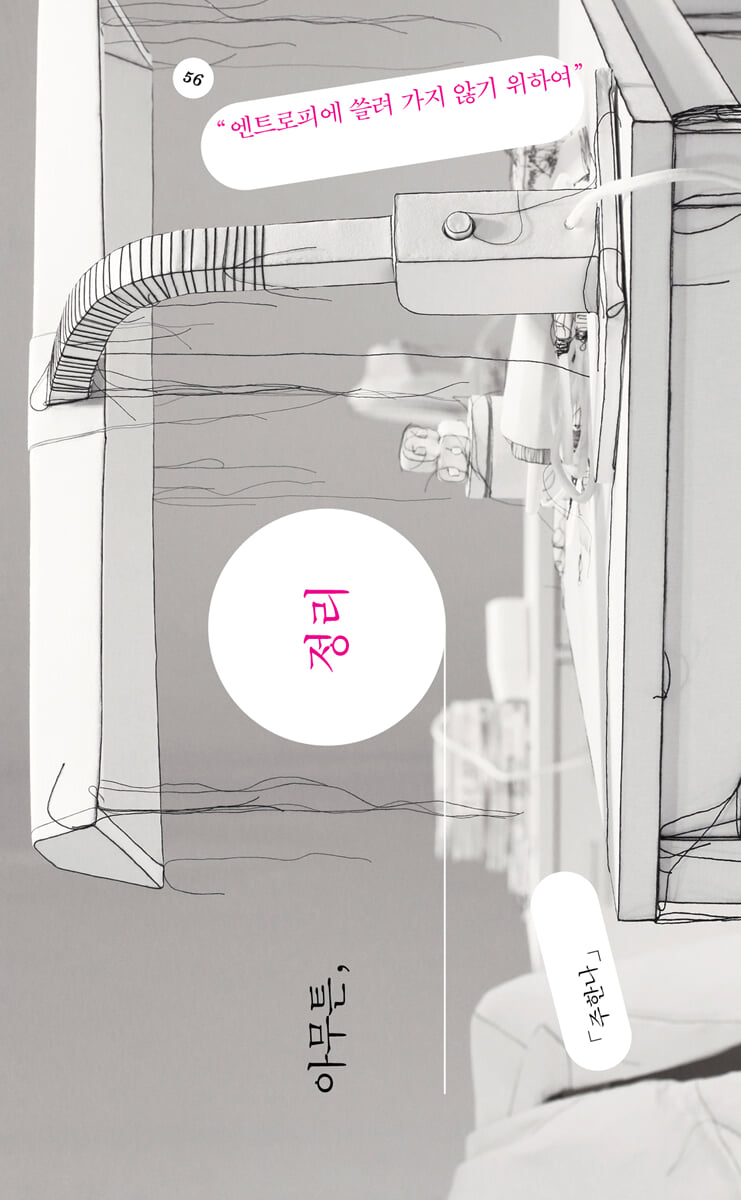
Anyway, to sum it up
 |
Description
Book Introduction
To a life of self-organization
Let's say there is a person who is born very unskilled in organizing.
Moreover, he lives with adult ADHD.
If someone has been working for over 20 years and raising two children under these harsh conditions, what would their daily life be like?
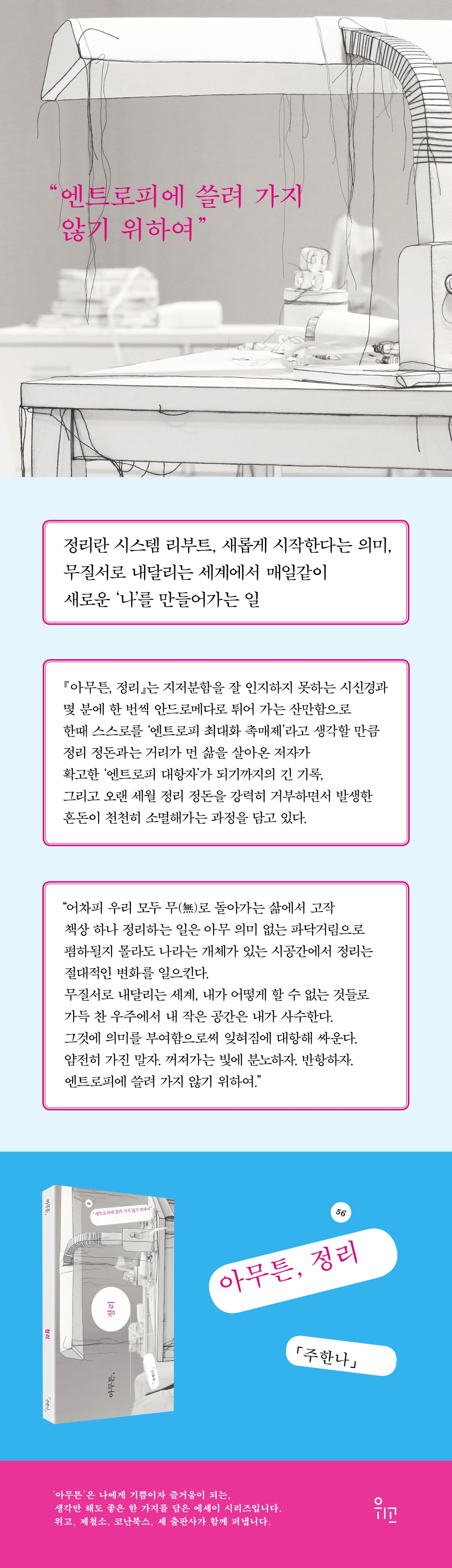
"Anyway, Tidying Up" contains the author's long record of how he, who once lived a life so far removed from organization that he considered himself an "entropy maximizing catalyst" due to his optic nerves that were unable to perceive messiness and his distractions that would jump to Andromeda every few minutes, became a staunch "entropy opponent" and the process of slowly dissipating the chaos caused by his strong rejection of organization.
Let's say there is a person who is born very unskilled in organizing.
Moreover, he lives with adult ADHD.
If someone has been working for over 20 years and raising two children under these harsh conditions, what would their daily life be like?
"Anyway, Tidying Up" contains the author's long record of how he, who once lived a life so far removed from organization that he considered himself an "entropy maximizing catalyst" due to his optic nerves that were unable to perceive messiness and his distractions that would jump to Andromeda every few minutes, became a staunch "entropy opponent" and the process of slowly dissipating the chaos caused by his strong rejection of organization.
- You can preview some of the book's contents.
Preview
index
prolog
The fact that the cleanup filter operation is manual…
A clean and clutter-free room
I can't become a person who 'organizes things on their own'
Paying off cleaning debt
If I don't exist, there won't be any mess.
In an agile way, two weeks is considered one sprint.
Escape to Tidying Up
Things that bother me, things that don't bother me
When I'm depressed, I open the closet
Cleaning Fantasy
He was good at organizing
Salcheondo
I don't know who he is.
Mode switching
neatness and unity
layoffs
Digital Hoarder
Cabinet of Memories
Don't be swallowed up by the dark night
The fact that the cleanup filter operation is manual…
A clean and clutter-free room
I can't become a person who 'organizes things on their own'
Paying off cleaning debt
If I don't exist, there won't be any mess.
In an agile way, two weeks is considered one sprint.
Escape to Tidying Up
Things that bother me, things that don't bother me
When I'm depressed, I open the closet
Cleaning Fantasy
He was good at organizing
Salcheondo
I don't know who he is.
Mode switching
neatness and unity
layoffs
Digital Hoarder
Cabinet of Memories
Don't be swallowed up by the dark night
Detailed image
Into the book
An image of a woman standing in front of a large glass window, looking out at the beautiful night view, with neatly combed hair, wearing an elegant and sophisticated suit, and with a flawless posture.
Her coat will be free of lint, her hair will be unruly, and nowhere in her spacious apartment will you find a full trash can, a pile of unopened laundry, or a comb full of tangled hair.
--- pp.9~10
The reason I can't organize is because I have a habit of not finishing something as planned and moving on to the next thing, and I don't want to admit that I gave up halfway.
It's about leaving room.
I make a false promise that I will be back soon.
So I hate having someone else do the organizing for me.
I know it's a bit messy, but I'm still working on it, so it's a bit of a distraction.
Even if that kind of denial of reality has been going on for months.
--- pp.21~22
I decided to finish the manuscript I had to write over the weekend.
So, on a weekend morning, I chugged down a strong espresso and rolled up my sleeves.
At that moment, the 'organization filter' inside me suddenly started working.
There was a lot of stuff to clean up everywhere.
I was annoyed by the drawers I had left in disarray for so long, using my lack of time and ability as excuses, and the cupboard I had been using without much thought for months was now so disorganized that it seemed like it urgently needed a new classification system.
Stains on appliances such as dishwashers, microwave ovens, ovens, and stainless steel kitchen utensils are also subject to removal.
--- p.51
When life gets so hectic, I open an empty drawer.
Open the closet with plenty of space.
I keep opening and closing the closet for no reason.
And I find peace of mind knowing that there is still empty space.
This game isn't over yet.
There is empty space.
I'm not struggling, trapped in a small, cramped space.
The temporary storage is right here.
There's a place to stretch your legs and a place to put something down for a bit.
Can be organized.
I have free time.
I have the power to control my space.
--- p.66
It is said that in ancient China, there was a torture method called 'Salcheondo (殺千刀)'.
It is said that it is a torture that kills slowly by cutting yourself a thousand times with a knife. I first learned about it in a novel based on Marco Polo's travels in China, and after that, I barely remember the rest of the novel, and only this torture story remains vivid.
Since then, whenever I hear advice about the '5-minute efficiency', the story of Salcheondo comes to mind.
Taking five minutes here and five minutes there to write flawlessly feels like it's slowly giving me a sense of relief and peace, rather than making me a better person.
--- pp.79~80
Consistency, unity, orderliness.
There are very few people who do not enjoy this state at all.
When cheering for a sports team, wearing matching colors somehow makes you feel more energetic.
When I see a parade of people dressed in identical uniforms and moving as one, cheers naturally erupt.
There is a certain pleasure in watching idol groups dance to the rhythm with precise angles.
But when I live in America and see the well-kept gardens in every house, I feel complicated.
--- p.97
Organizational changes are very common within large companies.
When it was frequent, the department name would change once every six months, the person above me would change, and sometimes the company I belonged to would change once every few years.
At times like these, I suddenly wondered if the perspective of those above me was similar to my perspective when I was cleaning up the house.
'I put this in this drawer.
But it's not easy to take it out and use it.
That drawer is overflowing with too many things in it.
I'll take some out and put them somewhere else, and since I don't think I'll use this one, I'll just throw it away, and I think it'd be better to leave this box in that room...'
--- p.107
Everything in the universe is moving towards disorder.
Entropy continues to increase.
As I lie there listlessly doing nothing, I am gradually being swept away by it.
I believe that I am letting things go 'as I please' and that I am ruining them 'as I will', but I am just being swept away by natural entropy.
It is much more anti-entropy to organize books that are scattered around than to smash them with a hammer.
--- p.133
In a life where we all return to nothingness, organizing a desk might be dismissed as a meaningless act of flapping, but in the space and time where we exist as individuals, organizing brings about absolute change.
In a world that runs wild, a universe filled with things I can't do anything about, I defend my small space.
Fight against oblivion by giving it meaning.
Let's keep it quiet.
Let us be angry at the fading light.
Let's rebel.
So as not to be swept away by entropy.
Her coat will be free of lint, her hair will be unruly, and nowhere in her spacious apartment will you find a full trash can, a pile of unopened laundry, or a comb full of tangled hair.
--- pp.9~10
The reason I can't organize is because I have a habit of not finishing something as planned and moving on to the next thing, and I don't want to admit that I gave up halfway.
It's about leaving room.
I make a false promise that I will be back soon.
So I hate having someone else do the organizing for me.
I know it's a bit messy, but I'm still working on it, so it's a bit of a distraction.
Even if that kind of denial of reality has been going on for months.
--- pp.21~22
I decided to finish the manuscript I had to write over the weekend.
So, on a weekend morning, I chugged down a strong espresso and rolled up my sleeves.
At that moment, the 'organization filter' inside me suddenly started working.
There was a lot of stuff to clean up everywhere.
I was annoyed by the drawers I had left in disarray for so long, using my lack of time and ability as excuses, and the cupboard I had been using without much thought for months was now so disorganized that it seemed like it urgently needed a new classification system.
Stains on appliances such as dishwashers, microwave ovens, ovens, and stainless steel kitchen utensils are also subject to removal.
--- p.51
When life gets so hectic, I open an empty drawer.
Open the closet with plenty of space.
I keep opening and closing the closet for no reason.
And I find peace of mind knowing that there is still empty space.
This game isn't over yet.
There is empty space.
I'm not struggling, trapped in a small, cramped space.
The temporary storage is right here.
There's a place to stretch your legs and a place to put something down for a bit.
Can be organized.
I have free time.
I have the power to control my space.
--- p.66
It is said that in ancient China, there was a torture method called 'Salcheondo (殺千刀)'.
It is said that it is a torture that kills slowly by cutting yourself a thousand times with a knife. I first learned about it in a novel based on Marco Polo's travels in China, and after that, I barely remember the rest of the novel, and only this torture story remains vivid.
Since then, whenever I hear advice about the '5-minute efficiency', the story of Salcheondo comes to mind.
Taking five minutes here and five minutes there to write flawlessly feels like it's slowly giving me a sense of relief and peace, rather than making me a better person.
--- pp.79~80
Consistency, unity, orderliness.
There are very few people who do not enjoy this state at all.
When cheering for a sports team, wearing matching colors somehow makes you feel more energetic.
When I see a parade of people dressed in identical uniforms and moving as one, cheers naturally erupt.
There is a certain pleasure in watching idol groups dance to the rhythm with precise angles.
But when I live in America and see the well-kept gardens in every house, I feel complicated.
--- p.97
Organizational changes are very common within large companies.
When it was frequent, the department name would change once every six months, the person above me would change, and sometimes the company I belonged to would change once every few years.
At times like these, I suddenly wondered if the perspective of those above me was similar to my perspective when I was cleaning up the house.
'I put this in this drawer.
But it's not easy to take it out and use it.
That drawer is overflowing with too many things in it.
I'll take some out and put them somewhere else, and since I don't think I'll use this one, I'll just throw it away, and I think it'd be better to leave this box in that room...'
--- p.107
Everything in the universe is moving towards disorder.
Entropy continues to increase.
As I lie there listlessly doing nothing, I am gradually being swept away by it.
I believe that I am letting things go 'as I please' and that I am ruining them 'as I will', but I am just being swept away by natural entropy.
It is much more anti-entropy to organize books that are scattered around than to smash them with a hammer.
--- p.133
In a life where we all return to nothingness, organizing a desk might be dismissed as a meaningless act of flapping, but in the space and time where we exist as individuals, organizing brings about absolute change.
In a world that runs wild, a universe filled with things I can't do anything about, I defend my small space.
Fight against oblivion by giving it meaning.
Let's keep it quiet.
Let us be angry at the fading light.
Let's rebel.
So as not to be swept away by entropy.
--- p.135
Publisher's Review
Why should I keep books neatly tucked away on the bookshelf if I'm going to take them out again anyway?
The author said that he was a child who always lost and forgot things.
I was always told that I spoke too quickly and was distracted, and I was especially nagged a lot for not keeping my surroundings organized.
It wasn't until I became an adult and was diagnosed with ADHD that things started to make sense.
However, this alone does not explain the author's strong aversion to organization, and his life history played a role in this.
The author has immigrated three times and moved forty times in his life of about forty years.
When he was a teenager, his family immigrated to South Africa, and after he got married, he immigrated to England, and later to the United States, where he now lives.
In South Africa, low prices and cheap labor have allowed people to use every inch of their home with ease, and to perform the housework essential to survival at a low price.
It was a situation where there was no need for any self-care arrangements.
Moreover, because I had a science and engineering-oriented mindset from an early age, I analyzed everything in the world using efficiency-based algorithms.
The daily routine of organizing and cleaning felt inefficient.
"Why do I have to neatly put away books I'm going to take out again anyway?", "Wouldn't it be more efficient to just leave the bag I'm going to take out tomorrow by the front door?" In addition, I opened my eyes early on to the social structure that shifts housework and caregiving to women, further distancing women from social achievements. As I began to reject all behaviors that were considered "feminine," I became increasingly distant from a "life of self-organization."
Creating a new 'me' every day in a world that runs wild with chaos
After having a child, organizing and cleaning became a matter of survival.
In the cramped living spaces of England, if you didn't tidy up, there was no room to move.
At the same time as having to constantly do the work of organizing, loading, and storing, I also had to constantly do the work that had been looked down upon as “feminine” for childcare.
Meanwhile, the author's perception of organization changes as he learns to respect his own space.
Organizing meant defining the space I wanted to exist in and reorganizing the things I wanted to remember and love.
The country was in the process of reinventing itself every day.
To avoid being swept away by entropy… I'm tidying up my desk again today.
As a data scientist, the author organizes code and data, feeds it to AI models, and organizes the results derived from it.
Perhaps because of this, the author has somewhat complicated feelings about the various actions that converge into the thought process of 'organization' as well as the physical act of organizing.
This is because organizing is not far from the self-help proposition, “When you wake up in the morning, make your bed first.”
He says that if you only see organizing as the first step to a big life achievement, you will constantly be hurt by the blade of the five-minute efficiency, such as "spend five minutes cleaning the bathroom faucet."
I am also skeptical of efforts to maintain homes in hotel-like condition.
He asks what use is a space so clean that it erases its meaning as a space where I and my family exist?
For a writer, organizing is like rebooting a system.
It means starting anew, but it also means defending my small space in a world that is running wild and full of things I can't do anything about.
The author counters mortality and forgetfulness by giving it meaning.
According to the author, organizing a few books scattered around is a far more anti-entropy act than smashing them with a hammer, so it's right to start by organizing your desk today.
“Let’s keep it quiet.
Let's rebel.
“To avoid being swept away by entropy.”
The author said that he was a child who always lost and forgot things.
I was always told that I spoke too quickly and was distracted, and I was especially nagged a lot for not keeping my surroundings organized.
It wasn't until I became an adult and was diagnosed with ADHD that things started to make sense.
However, this alone does not explain the author's strong aversion to organization, and his life history played a role in this.
The author has immigrated three times and moved forty times in his life of about forty years.
When he was a teenager, his family immigrated to South Africa, and after he got married, he immigrated to England, and later to the United States, where he now lives.
In South Africa, low prices and cheap labor have allowed people to use every inch of their home with ease, and to perform the housework essential to survival at a low price.
It was a situation where there was no need for any self-care arrangements.
Moreover, because I had a science and engineering-oriented mindset from an early age, I analyzed everything in the world using efficiency-based algorithms.
The daily routine of organizing and cleaning felt inefficient.
"Why do I have to neatly put away books I'm going to take out again anyway?", "Wouldn't it be more efficient to just leave the bag I'm going to take out tomorrow by the front door?" In addition, I opened my eyes early on to the social structure that shifts housework and caregiving to women, further distancing women from social achievements. As I began to reject all behaviors that were considered "feminine," I became increasingly distant from a "life of self-organization."
Creating a new 'me' every day in a world that runs wild with chaos
After having a child, organizing and cleaning became a matter of survival.
In the cramped living spaces of England, if you didn't tidy up, there was no room to move.
At the same time as having to constantly do the work of organizing, loading, and storing, I also had to constantly do the work that had been looked down upon as “feminine” for childcare.
Meanwhile, the author's perception of organization changes as he learns to respect his own space.
Organizing meant defining the space I wanted to exist in and reorganizing the things I wanted to remember and love.
The country was in the process of reinventing itself every day.
To avoid being swept away by entropy… I'm tidying up my desk again today.
As a data scientist, the author organizes code and data, feeds it to AI models, and organizes the results derived from it.
Perhaps because of this, the author has somewhat complicated feelings about the various actions that converge into the thought process of 'organization' as well as the physical act of organizing.
This is because organizing is not far from the self-help proposition, “When you wake up in the morning, make your bed first.”
He says that if you only see organizing as the first step to a big life achievement, you will constantly be hurt by the blade of the five-minute efficiency, such as "spend five minutes cleaning the bathroom faucet."
I am also skeptical of efforts to maintain homes in hotel-like condition.
He asks what use is a space so clean that it erases its meaning as a space where I and my family exist?
For a writer, organizing is like rebooting a system.
It means starting anew, but it also means defending my small space in a world that is running wild and full of things I can't do anything about.
The author counters mortality and forgetfulness by giving it meaning.
According to the author, organizing a few books scattered around is a far more anti-entropy act than smashing them with a hammer, so it's right to start by organizing your desk today.
“Let’s keep it quiet.
Let's rebel.
“To avoid being swept away by entropy.”
GOODS SPECIFICS
- Date of issue: April 15, 2023
- Page count, weight, size: 136 pages | 156g | 110*178*20mm
- ISBN13: 9791193044025
- ISBN10: 1193044022
You may also like
카테고리
korean


korean

![GQ KOREA Mark (Monthly): December [2025]](http://librairie.coreenne.fr/cdn/shop/files/8ef265dbbfbf186523ed75ba7319009d.jpg?v=1765340328&width=3840)


