

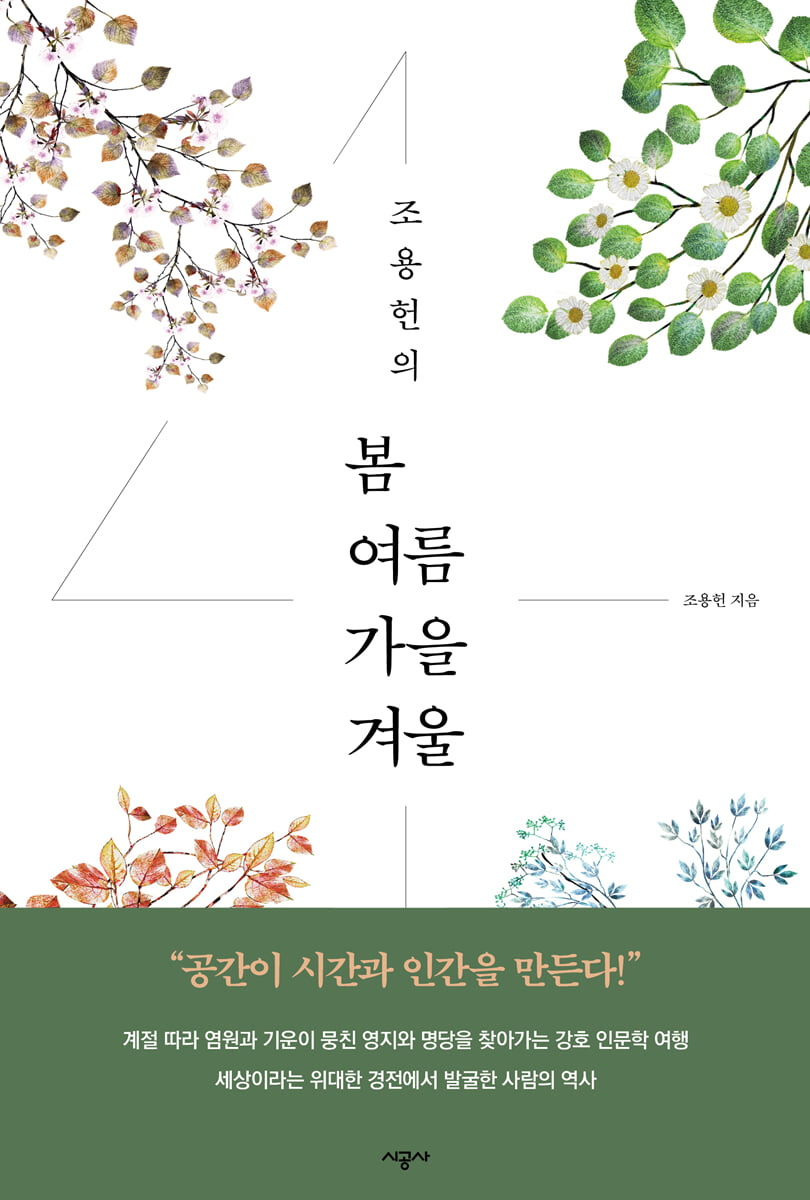
Jo Yong-heon's Spring, Summer, Fall, Winter
 |
Description
Book Introduction
Do you have a ‘my own special place’ that you visit from time to time to gain energy?
Visiting spiritual sites and geomantic sites filled with wishes and energy according to the seasons of spring, summer, fall, and winter
Jo Yong-heon's Journey through the Humanities of Gangho
Before Confucianism, Buddhism, and Taoism were introduced to this land, there existed a crude and powerful 'belief'.
They looked up at the constellations in the night sky to see the future, prayed for worldly peace by placing a bowl of water on a rock or stone, and purified their minds in the deep mountains and valleys.
In order to achieve their goals, the thing that the ancients valued most was ‘space.’
Before civilization developed and senses deteriorated, humans instinctively recognized places where they could receive the energy of the earth, water, and weather, and they practiced and prayed there and experienced spiritual experiences.
He also built a house on a good site and waited for the birth of a great person in the future.
People call these places a geomantic site or spiritual site.
The Korean Peninsula, where soft-textured mountains and rugged, strong-textured mountains are widely distributed, and where streams, rivers, and streams are developed, is a treasure trove of geomantic sites and spiritual sites.
Cho Yong-heon, who once regarded people as scriptures of knowledge, listened to the family traditions of prestigious families and the teachings of masters, high priests, and Taoist priests, and passed on the secrets of life, now leads us on a lofty journey across the country to lands that the ancients held special and sacred.
This book, "Jo Yong-heon's Spring, Summer, Fall, Winter," is a high-quality travel guide that explores and introduces places where you can visit and stay to recharge your energy in each season, and is also a human geography book that traces the process through which the people's wishes and desires were condensed in those places.
While today we talk about location and real estate value in areas with a smooth supply of jobs, education, consumption, and healthcare, the pioneers of the past considered good land to be a place where one could enjoy the benefits of nature, which soothed the body and mind and lifted one's spirits.
If you are someone who has been forced into a city raging with flames to survive, to keep up, to have more, you must have your own auspicious site and spiritual home where you can occasionally visit and provide strength and moisture to your life, which is like dry firewood.
The author has gone through the trouble of finding and experiencing the mountain himself, using up dozens of pairs of hiking boots, so we just have to follow along.
Visiting spiritual sites and geomantic sites filled with wishes and energy according to the seasons of spring, summer, fall, and winter
Jo Yong-heon's Journey through the Humanities of Gangho
Before Confucianism, Buddhism, and Taoism were introduced to this land, there existed a crude and powerful 'belief'.
They looked up at the constellations in the night sky to see the future, prayed for worldly peace by placing a bowl of water on a rock or stone, and purified their minds in the deep mountains and valleys.
In order to achieve their goals, the thing that the ancients valued most was ‘space.’
Before civilization developed and senses deteriorated, humans instinctively recognized places where they could receive the energy of the earth, water, and weather, and they practiced and prayed there and experienced spiritual experiences.
He also built a house on a good site and waited for the birth of a great person in the future.
People call these places a geomantic site or spiritual site.
The Korean Peninsula, where soft-textured mountains and rugged, strong-textured mountains are widely distributed, and where streams, rivers, and streams are developed, is a treasure trove of geomantic sites and spiritual sites.
Cho Yong-heon, who once regarded people as scriptures of knowledge, listened to the family traditions of prestigious families and the teachings of masters, high priests, and Taoist priests, and passed on the secrets of life, now leads us on a lofty journey across the country to lands that the ancients held special and sacred.
This book, "Jo Yong-heon's Spring, Summer, Fall, Winter," is a high-quality travel guide that explores and introduces places where you can visit and stay to recharge your energy in each season, and is also a human geography book that traces the process through which the people's wishes and desires were condensed in those places.
While today we talk about location and real estate value in areas with a smooth supply of jobs, education, consumption, and healthcare, the pioneers of the past considered good land to be a place where one could enjoy the benefits of nature, which soothed the body and mind and lifted one's spirits.
If you are someone who has been forced into a city raging with flames to survive, to keep up, to have more, you must have your own auspicious site and spiritual home where you can occasionally visit and provide strength and moisture to your life, which is like dry firewood.
The author has gone through the trouble of finding and experiencing the mountain himself, using up dozens of pairs of hiking boots, so we just have to follow along.
- You can preview some of the book's contents.
Preview
index
Author's Preface: Space Rules Time and Man
spring
The Secret of a Temple Visited by World-renowned Chefs _ Jinkwansa Temple in Jinkwan-dong, Seoul
The mountain of the gods that illuminated the sea route, a place where the energy of the maekbanseok gathers _ Wolchulsan Mountain in Yeongam, Jeollanam-do
The rock that gave birth to three tycoons - Namgang Sotbawi in Uiryeong, Gyeongnam
The place where Seosan Daesa's teachers studied _ Byeoksongsa Temple in Hamyang, Gyeongnam
The site chosen by Jinpyo Yulsa, the founder of the Maitreya faith _ Geumsansa Temple, Gimje, Jeollabuk-do 1
From Baekje refugees to the people of Jeolla Province, where they waited for the Messiah - Geumsansa Temple in Gimje, North Jeolla Province 2
A white Buddha in a geomantic site where the energy of Bukhansan Mountain is concentrated like a fruit at the end of a branch… _ Okcheonam, Hongun-dong, Seoul
The Battle at the Most Powerful Temple in Jirisan _ Hwaeomsa Temple in Gurye, Jeollanam-do
summer
When you come here, your worries melt away like snow melting away _ Hyangil-am, Yeosu, Jeollanam-do
If you're feeling burnout, find the water where dragons play - Jirisan Yongyu Dam
Hidden gems in a bottle hole - Beopgyesa Temple in Jirisan Mountain 1
Why did the two-thousand-year-old goddess of Yeosan settle in a Buddhist temple? _ Beopgyesa Temple, Jirisan Mountain, Part 2
A place that hot-tempered and impatient people should visit occasionally - Seongryu Cave in Uljin, Gyeongbuk
The place where the pulse of Nogodan came down and stopped _ Yonghojeong Pavilion in Gurye, Jeollanam-do
The Annals of the Joseon Dynasty: A Site That Avoided All Harm _ Anguk Temple in Muju, Jeollabuk-do
A place of practice for Taoists hidden deep in the mountains - Myohyangam Temple in Jirisan Mountain
Why is the Sanshin-gak, a shrine dedicated to the deity of the temple, located higher than the Daeungjeon? _ Sanshin-gak
autumn
The place where Yi Seong-gye received the king's 'Golden Ruler' _ Geumdangsa Temple in Maisan, Jeollabuk-do
If there's someone you find hard to forgive, go here - Dosol Am on Mt. Dalmasan
Sometimes we must befriend solitude - Jirisan Seoseokpyeongjeon 1
A mountain of the defeated, but a mountain that saves lives _ Jirisan Seoseokpyeongjeon 2
Praying here grants supernatural powers? _ Gyejoam Hermitage, Seoraksan Mountain
When you're feeling angry, ask the turtle rock at the water's edge. _ Geochang Susungdae Turtle Rock, Gyeongnam
A fortress guarded by iron fingers - Jirisan's Uisin Village and Wontongam
A hideout for cultivators and revolutionaries - Yeongoksa Temple in Jirisan
The place where a tree buried in mud 1,700 years ago was reborn as Buddha - Suhyosa Temple, Gogumdo, Wando, Jeollanam-do
winter
Jirisan's best viewpoint _ Jirisan Geumdaeam
The land that conceived the resilience of the people of Amtaedo _ Nomansa Temple, Amtaedo, Sinan-gun, Jeollanam-do
The identity of a three-thousand-year-old martial art revealed through the wolf boy of Seoraksan Mountain _ The text of Gyeryongsan Gicheonmun
The 'Old General' with 30 Caves _ Nojangdae, Jirisan
Joseon's strongest fortress on a rocky cliff, where the blood of Gyeongsang Province residents is bound together - Hwangseoksanseong Fortress in Hamyang, Gyeongsangnam-do
The Secret Hidden in the Octagonal Pillars of the Kitchen of Chunghyodang, Andong Old House _ Chunghyodang, Pungsan-eup, Andong-si, Gyeongsangbuk-do
spring
The Secret of a Temple Visited by World-renowned Chefs _ Jinkwansa Temple in Jinkwan-dong, Seoul
The mountain of the gods that illuminated the sea route, a place where the energy of the maekbanseok gathers _ Wolchulsan Mountain in Yeongam, Jeollanam-do
The rock that gave birth to three tycoons - Namgang Sotbawi in Uiryeong, Gyeongnam
The place where Seosan Daesa's teachers studied _ Byeoksongsa Temple in Hamyang, Gyeongnam
The site chosen by Jinpyo Yulsa, the founder of the Maitreya faith _ Geumsansa Temple, Gimje, Jeollabuk-do 1
From Baekje refugees to the people of Jeolla Province, where they waited for the Messiah - Geumsansa Temple in Gimje, North Jeolla Province 2
A white Buddha in a geomantic site where the energy of Bukhansan Mountain is concentrated like a fruit at the end of a branch… _ Okcheonam, Hongun-dong, Seoul
The Battle at the Most Powerful Temple in Jirisan _ Hwaeomsa Temple in Gurye, Jeollanam-do
summer
When you come here, your worries melt away like snow melting away _ Hyangil-am, Yeosu, Jeollanam-do
If you're feeling burnout, find the water where dragons play - Jirisan Yongyu Dam
Hidden gems in a bottle hole - Beopgyesa Temple in Jirisan Mountain 1
Why did the two-thousand-year-old goddess of Yeosan settle in a Buddhist temple? _ Beopgyesa Temple, Jirisan Mountain, Part 2
A place that hot-tempered and impatient people should visit occasionally - Seongryu Cave in Uljin, Gyeongbuk
The place where the pulse of Nogodan came down and stopped _ Yonghojeong Pavilion in Gurye, Jeollanam-do
The Annals of the Joseon Dynasty: A Site That Avoided All Harm _ Anguk Temple in Muju, Jeollabuk-do
A place of practice for Taoists hidden deep in the mountains - Myohyangam Temple in Jirisan Mountain
Why is the Sanshin-gak, a shrine dedicated to the deity of the temple, located higher than the Daeungjeon? _ Sanshin-gak
autumn
The place where Yi Seong-gye received the king's 'Golden Ruler' _ Geumdangsa Temple in Maisan, Jeollabuk-do
If there's someone you find hard to forgive, go here - Dosol Am on Mt. Dalmasan
Sometimes we must befriend solitude - Jirisan Seoseokpyeongjeon 1
A mountain of the defeated, but a mountain that saves lives _ Jirisan Seoseokpyeongjeon 2
Praying here grants supernatural powers? _ Gyejoam Hermitage, Seoraksan Mountain
When you're feeling angry, ask the turtle rock at the water's edge. _ Geochang Susungdae Turtle Rock, Gyeongnam
A fortress guarded by iron fingers - Jirisan's Uisin Village and Wontongam
A hideout for cultivators and revolutionaries - Yeongoksa Temple in Jirisan
The place where a tree buried in mud 1,700 years ago was reborn as Buddha - Suhyosa Temple, Gogumdo, Wando, Jeollanam-do
winter
Jirisan's best viewpoint _ Jirisan Geumdaeam
The land that conceived the resilience of the people of Amtaedo _ Nomansa Temple, Amtaedo, Sinan-gun, Jeollanam-do
The identity of a three-thousand-year-old martial art revealed through the wolf boy of Seoraksan Mountain _ The text of Gyeryongsan Gicheonmun
The 'Old General' with 30 Caves _ Nojangdae, Jirisan
Joseon's strongest fortress on a rocky cliff, where the blood of Gyeongsang Province residents is bound together - Hwangseoksanseong Fortress in Hamyang, Gyeongsangnam-do
The Secret Hidden in the Octagonal Pillars of the Kitchen of Chunghyodang, Andong Old House _ Chunghyodang, Pungsan-eup, Andong-si, Gyeongsangbuk-do
Detailed image
.jpg)
Into the book
Human life is done in three spaces.
Time, space, and humans.
Gan (間) is a gap.
Our world is woven like warp and weft in the gaps of time, space, and humanity.
Among these three spaces, the part that we can change with our will is space.
Depending on the space you are in, the flow of time changes and the types of people you meet also change.
---From the author's preface
Recently, Jinwansa Temple has been receiving attention as the birthplace of Korean temple cuisine.
This is the result of the monk Gyeho, who has been carefully preserving the tradition of temple food for decades.
Whether people know it or not, silently maintaining the tradition of Buddhist cuisine for decades is also a great achievement.
As a result of that practice, Western royalty and celebrities began to visit Jinquansa Temple one after another to taste its temple food.
Jill Biden, First Lady of the United States, is a representative example.
---From "The Secrets of Temples Seeked Out by World-Famous Chefs"
In the old days, there was no GPS.
What could the sailors have seen to determine their destination? A mountain rising high above the sea.
Wolchulsan is a rocky mountain that stands tall on a plain, right on the seashore.
It is clearly visible even from over 100 kilometers out to sea.
The conditions were perfectly suited to become a milestone on this sea route.
---From "The Mountain of God that Lights the Way, the Place Where the Energy of Macbanseok Gathers"
If you were to take a boat from the mouth of the Yeongsan River and look at Wolchulsan Mountain, the sight of the moon rising round above the mountain would have been spectacular.
In a time when there were no streetlights, the sight of the moon rising over the sacred mountain must have been a scene that evoked religious inspiration.
Wouldn't it have looked like the "Water-Moon Avalokiteshvara Painting"?
---From "The Mountain of God that Lights the Way, the Place Where the Energy of Macbanseok Gathers"
Anyway, in the late Joseon Dynasty, a Taoist priest climbed up on this cauldron-shaped rock, took a short nap, and then left a prophecy.
“Within a twenty-mile radius of this cauldron, three wealthy men who will feed the nation will emerge.” Why three of them? Because the cauldron has three legs.
There are cauldrons without legs and cauldrons with legs.
A pot with three legs is called a tripod.
This cauldron rock is called Jeongam (鼎巖) in Chinese characters.
It was prophesied that three rich people would emerge from the three legs of the rock.
---From "The Rock That Gave Birth to Three Chaebols"
The Joseon Dynasty was a country that oppressed Buddhism.
Driven out of the city.
Byeoksongsa Temple, located at the foot of Cheonwangbong Peak of Jirisan Mountain, Manhakcheonbong Peak, was a great place to practice Taoism in seclusion.
It was a position where students could avoid exploitation to some extent.
The person who lit a candle during the dark ages of Buddhism was Byeoksong Ji-eom.
Byeoksong gained enlightenment from his teacher and built Byeoksongsa Temple in 1520.
Under him, many brilliant figures of Joseon Seon Buddhism, including Seosan Daesa, emerged.
Time, space, and humans.
Gan (間) is a gap.
Our world is woven like warp and weft in the gaps of time, space, and humanity.
Among these three spaces, the part that we can change with our will is space.
Depending on the space you are in, the flow of time changes and the types of people you meet also change.
---From the author's preface
Recently, Jinwansa Temple has been receiving attention as the birthplace of Korean temple cuisine.
This is the result of the monk Gyeho, who has been carefully preserving the tradition of temple food for decades.
Whether people know it or not, silently maintaining the tradition of Buddhist cuisine for decades is also a great achievement.
As a result of that practice, Western royalty and celebrities began to visit Jinquansa Temple one after another to taste its temple food.
Jill Biden, First Lady of the United States, is a representative example.
---From "The Secrets of Temples Seeked Out by World-Famous Chefs"
In the old days, there was no GPS.
What could the sailors have seen to determine their destination? A mountain rising high above the sea.
Wolchulsan is a rocky mountain that stands tall on a plain, right on the seashore.
It is clearly visible even from over 100 kilometers out to sea.
The conditions were perfectly suited to become a milestone on this sea route.
---From "The Mountain of God that Lights the Way, the Place Where the Energy of Macbanseok Gathers"
If you were to take a boat from the mouth of the Yeongsan River and look at Wolchulsan Mountain, the sight of the moon rising round above the mountain would have been spectacular.
In a time when there were no streetlights, the sight of the moon rising over the sacred mountain must have been a scene that evoked religious inspiration.
Wouldn't it have looked like the "Water-Moon Avalokiteshvara Painting"?
---From "The Mountain of God that Lights the Way, the Place Where the Energy of Macbanseok Gathers"
Anyway, in the late Joseon Dynasty, a Taoist priest climbed up on this cauldron-shaped rock, took a short nap, and then left a prophecy.
“Within a twenty-mile radius of this cauldron, three wealthy men who will feed the nation will emerge.” Why three of them? Because the cauldron has three legs.
There are cauldrons without legs and cauldrons with legs.
A pot with three legs is called a tripod.
This cauldron rock is called Jeongam (鼎巖) in Chinese characters.
It was prophesied that three rich people would emerge from the three legs of the rock.
---From "The Rock That Gave Birth to Three Chaebols"
The Joseon Dynasty was a country that oppressed Buddhism.
Driven out of the city.
Byeoksongsa Temple, located at the foot of Cheonwangbong Peak of Jirisan Mountain, Manhakcheonbong Peak, was a great place to practice Taoism in seclusion.
It was a position where students could avoid exploitation to some extent.
The person who lit a candle during the dark ages of Buddhism was Byeoksong Ji-eom.
Byeoksong gained enlightenment from his teacher and built Byeoksongsa Temple in 1520.
Under him, many brilliant figures of Joseon Seon Buddhism, including Seosan Daesa, emerged.
---From "Where Ambassador Seoseon's Teachers Studied"
Publisher's Review
“Space influences humans!”
A customized trip to a famous place based on your occupation, temperament, and individual circumstances.
The biggest dividing line between humans and beasts is religion.
Primitive religion created a form of life called ritual and sacrifice, and was a powerful medium for forming a community.
The head of the nation performed a ritual in a land where spiritual energy flowed and asked for the will of heaven.
Shamanism was the most important political act.
Shamanism is broadly divided into three categories.
The Seven Stars, the Dragon King, and the Mountain God.
The people of the dry and vast desert followed the Seven Stars, who used the constellations of the night sky as a guide for their lives. The maritime people who traded by boat had a strong belief in the Dragon King, and in mountainous regions like ours, they relied on the mountain god.
In the mountain god belief system that values topography, feng shui, which considers mountains, water, and directions, had to develop.
Feng Shui is a primitive discipline that seeks to uncover the secret storehouses of luck and energy hidden in nature.
Since time immemorial, people have searched for hidden acupuncture points in various places to preserve life, ensure the well-being of themselves and future generations, gain more wealth, change their fate, and open their inner eyes toward enlightenment.
It was believed that space influenced human history.
The place where shamans of the shamanistic faith prayed became a place of training for high-ranking monks when Buddhism was introduced during the Three Kingdoms period.
The early monks were shamans, Taoists, and masters of feng shui.
They used places where they could increase their magical and Buddhist powers as their training grounds, and during the Joseon Dynasty, temples that were driven out to the mountains due to the policy of promoting Confucianism and suppressing Buddhism were mostly located in places like these.
The author of this book, Cho Yong-heon, leads readers to the temples where great monks and Taoist priests practiced, the villages where great figures were born, the places that escaped chaos, the places where the people's wishes and aspirations gathered, the sites chosen by masters of feng shui, the final places where the energy of nature gathered, and the lands where the losers of history finally leaned.
Rather than simply visiting famous geomantic sites and sacred sites, we reveal the reasons why those sites are bound to be geomantic sites and sacred sites in the context of feng shui, astronomy, and the flow of history.
On the one hand, they also prescribe prescriptions that are tailored to each individual's circumstances.
People whose jobs involve handling money should go to places near the water, people who are usually angry should go to places with beautiful sunsets, and people who suffer from depression should go to places with strong rock energy.
“There’s a reason why it happened there!”
A journey through the humanities of Gangho, tracing the interconnectedness of land, people, and history.
Monks, who were a noble class even during the Goryeo Dynasty, were reduced to commoners during the Joseon Dynasty.
The temples that were near the palace and in the marketplace were all hidden in the mountains, away from the houses.
Ironically, from this time on, monks and temples began to settle on sacred grounds that had been passed down from ancient times.
Monks who practice in a strong temple form a dangchui.
Dangchwi was a secret society of monks, and from the perspective of the Confucian-respecting government, it was an anti-government force.
The term 'Ddaengchu', which is used to belittle someone who is not a good person, originated from this Dangchui.
Representative organizations include Geumgangsan Dangchwi, Myohyangsan Dangchwi, and Jirisan Dangchwi.
The well-known Seosan Ambassador and Samyeongdang were the leaders of the Tang Dynasty.
In times of emergency, Tangchwi established temples along appropriate routes to convey news, and exchanged information closely with each other.
If you can properly control the powerful energy of the land where the temple is located, you will become a great monk, but if you can't, you will become a martial arts monk.
The events that properly demonstrated the organizational power and military force of the Tang Dynasty were the Imjin War and the Byeongja War.
When the king and his ministers fled to Uiju to save their lives, the monks who stepped forward to protect the country were none other than the monks of Dangchui.
The irony of history unfolded as monks who had practiced and trained in the territory where they were driven out due to political oppression came to the forefront as protagonists in defending their country.
The land produces people.
From a feng shui perspective, it is no coincidence that the founders of Samsung, Goldstar (now LG), and Hyosung were born near Jeongam Rock, also known as Cauldron Rock, in Namgang, Uiryeong, Gyeongsangnam-do.
The story of a Taoist who woke up from his sleep on this rock and predicted that three wealthy people would be born in this area in the future was probably based on a mysterious interaction between the land and people.
Space is not just an object that remains passively, but is the most fundamental basis for various uses.
Author Jo Yong-heon says this:
“Human life is accomplished in three spaces.
Time, space, and humans.
Gan (間) is a gap.
Our world is woven like warp and weft in the gaps of time, space, and humanity.
Among these three spaces, the part that we can change with our will is space.
“Depending on the space you are in, the flow of time changes and the types of people you meet change.”
Feng Shui, the Five Elements, the Four Pillars of Destiny, and shamanism, which were labeled as “superstitions” by institutionalized religion and academia, were essential everyday tools for living in an uncivilized world.
Visiting the sacred sites and spiritual realms where countless people's prayers, wishes, and hopes have been gathered since the distant past is not stepping into an uncivilized world, but rather a journey to recover the raw and powerful primitiveness within us.
And it is the work of excavating the history of the people who lived on that land.
『Jo Yong-heon's Spring, Summer, Fall, Winter』 leads us down that path.
A customized trip to a famous place based on your occupation, temperament, and individual circumstances.
The biggest dividing line between humans and beasts is religion.
Primitive religion created a form of life called ritual and sacrifice, and was a powerful medium for forming a community.
The head of the nation performed a ritual in a land where spiritual energy flowed and asked for the will of heaven.
Shamanism was the most important political act.
Shamanism is broadly divided into three categories.
The Seven Stars, the Dragon King, and the Mountain God.
The people of the dry and vast desert followed the Seven Stars, who used the constellations of the night sky as a guide for their lives. The maritime people who traded by boat had a strong belief in the Dragon King, and in mountainous regions like ours, they relied on the mountain god.
In the mountain god belief system that values topography, feng shui, which considers mountains, water, and directions, had to develop.
Feng Shui is a primitive discipline that seeks to uncover the secret storehouses of luck and energy hidden in nature.
Since time immemorial, people have searched for hidden acupuncture points in various places to preserve life, ensure the well-being of themselves and future generations, gain more wealth, change their fate, and open their inner eyes toward enlightenment.
It was believed that space influenced human history.
The place where shamans of the shamanistic faith prayed became a place of training for high-ranking monks when Buddhism was introduced during the Three Kingdoms period.
The early monks were shamans, Taoists, and masters of feng shui.
They used places where they could increase their magical and Buddhist powers as their training grounds, and during the Joseon Dynasty, temples that were driven out to the mountains due to the policy of promoting Confucianism and suppressing Buddhism were mostly located in places like these.
The author of this book, Cho Yong-heon, leads readers to the temples where great monks and Taoist priests practiced, the villages where great figures were born, the places that escaped chaos, the places where the people's wishes and aspirations gathered, the sites chosen by masters of feng shui, the final places where the energy of nature gathered, and the lands where the losers of history finally leaned.
Rather than simply visiting famous geomantic sites and sacred sites, we reveal the reasons why those sites are bound to be geomantic sites and sacred sites in the context of feng shui, astronomy, and the flow of history.
On the one hand, they also prescribe prescriptions that are tailored to each individual's circumstances.
People whose jobs involve handling money should go to places near the water, people who are usually angry should go to places with beautiful sunsets, and people who suffer from depression should go to places with strong rock energy.
“There’s a reason why it happened there!”
A journey through the humanities of Gangho, tracing the interconnectedness of land, people, and history.
Monks, who were a noble class even during the Goryeo Dynasty, were reduced to commoners during the Joseon Dynasty.
The temples that were near the palace and in the marketplace were all hidden in the mountains, away from the houses.
Ironically, from this time on, monks and temples began to settle on sacred grounds that had been passed down from ancient times.
Monks who practice in a strong temple form a dangchui.
Dangchwi was a secret society of monks, and from the perspective of the Confucian-respecting government, it was an anti-government force.
The term 'Ddaengchu', which is used to belittle someone who is not a good person, originated from this Dangchui.
Representative organizations include Geumgangsan Dangchwi, Myohyangsan Dangchwi, and Jirisan Dangchwi.
The well-known Seosan Ambassador and Samyeongdang were the leaders of the Tang Dynasty.
In times of emergency, Tangchwi established temples along appropriate routes to convey news, and exchanged information closely with each other.
If you can properly control the powerful energy of the land where the temple is located, you will become a great monk, but if you can't, you will become a martial arts monk.
The events that properly demonstrated the organizational power and military force of the Tang Dynasty were the Imjin War and the Byeongja War.
When the king and his ministers fled to Uiju to save their lives, the monks who stepped forward to protect the country were none other than the monks of Dangchui.
The irony of history unfolded as monks who had practiced and trained in the territory where they were driven out due to political oppression came to the forefront as protagonists in defending their country.
The land produces people.
From a feng shui perspective, it is no coincidence that the founders of Samsung, Goldstar (now LG), and Hyosung were born near Jeongam Rock, also known as Cauldron Rock, in Namgang, Uiryeong, Gyeongsangnam-do.
The story of a Taoist who woke up from his sleep on this rock and predicted that three wealthy people would be born in this area in the future was probably based on a mysterious interaction between the land and people.
Space is not just an object that remains passively, but is the most fundamental basis for various uses.
Author Jo Yong-heon says this:
“Human life is accomplished in three spaces.
Time, space, and humans.
Gan (間) is a gap.
Our world is woven like warp and weft in the gaps of time, space, and humanity.
Among these three spaces, the part that we can change with our will is space.
“Depending on the space you are in, the flow of time changes and the types of people you meet change.”
Feng Shui, the Five Elements, the Four Pillars of Destiny, and shamanism, which were labeled as “superstitions” by institutionalized religion and academia, were essential everyday tools for living in an uncivilized world.
Visiting the sacred sites and spiritual realms where countless people's prayers, wishes, and hopes have been gathered since the distant past is not stepping into an uncivilized world, but rather a journey to recover the raw and powerful primitiveness within us.
And it is the work of excavating the history of the people who lived on that land.
『Jo Yong-heon's Spring, Summer, Fall, Winter』 leads us down that path.
GOODS SPECIFICS
- Date of issue: March 13, 2023
- Page count, weight, size: 348 pages | 638g | 152*225*30mm
- ISBN13: 9791169256032
- ISBN10: 1169256031
You may also like
카테고리
korean


korean

![GQ KOREA Mark (Monthly): December [2025]](http://librairie.coreenne.fr/cdn/shop/files/8ef265dbbfbf186523ed75ba7319009d.jpg?v=1765340328&width=3840)


