

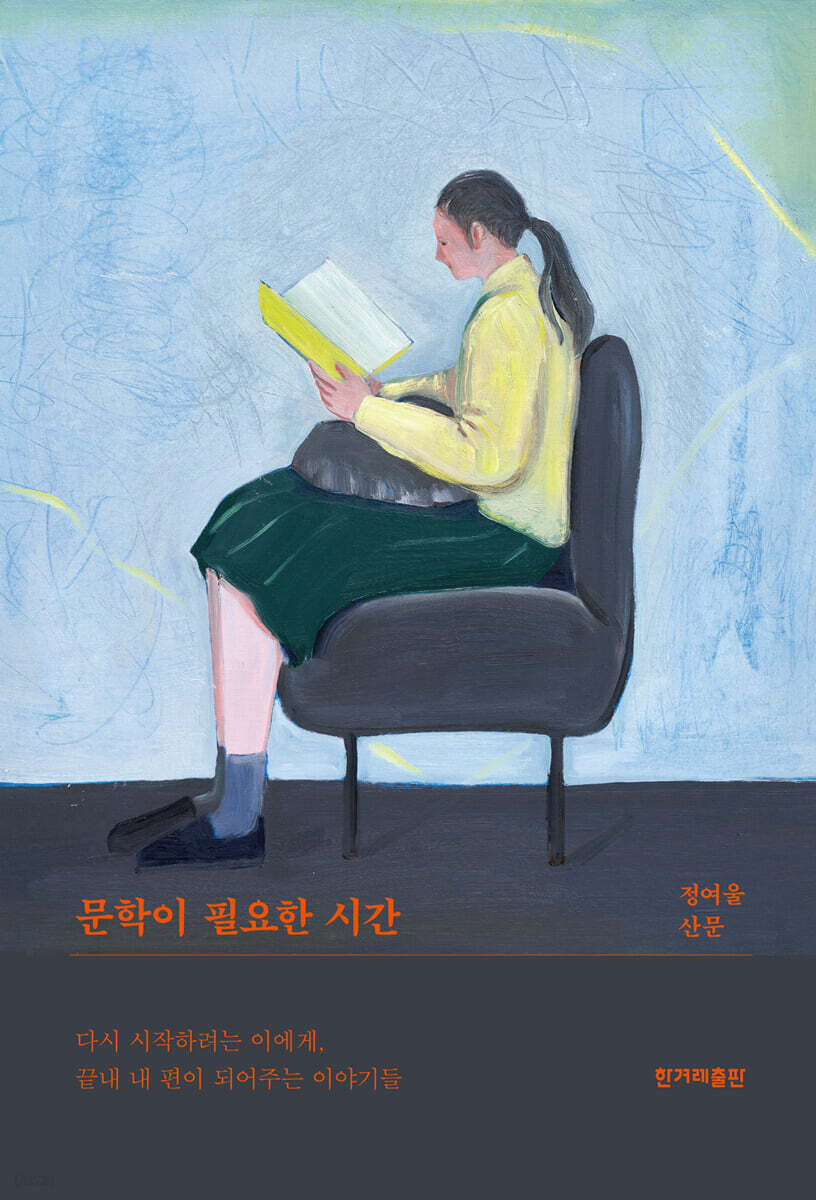
A time when literature is needed
 |
Description
Book Introduction
- A word from MD
-
What only literature can healAn essay on the power of literature and stories, written by author Jeong Yeo-ul.
From 『Demian』 to 『Baridegi』, he lovingly shares with readers the stories that became his roots.
There is a certain joy in the writer who says that literature must still exist and that only literature has the inner power to change.
January 6, 2023. Essay PD Lee Na-young
"There are truths about life that emerge brightly in moments when everything seems over."
The power of all the stories in the world that have given us light
New prose by life-explorer Jeong Yeo-ul
On the Mind Restored by Literature
“The strength that protected my life, no, the strength that protected my life, came from literature.” This is what author Jeong Yeo-ul often says.
The treasure trove of author Jeong Yeo-ul, who writes in a variety of genres, including humanities, psychology, philosophy, travel, and criticism, such as 『The Top 10 Europeans I Love』, 『To Me Who Doesn't Care About Myself』, and 『Things I Wish I Knew Then』, has always come from literature.
This book contains the light of all the stories in the world that became the roots of author Jeong Yeo-ul's passion, from "The Catcher in the Rye" and "Demian," which accompanied her through her wandering adolescence, to "The English Patient" and "Night Train to Lisbon," which taught her the wisdom of love and separation, to "Momo" and "Baridegi," which taught her the wisdom of overcoming life's crises.
Why do we continue to seek out literature despite repeated concerns about the crisis of literature?
In this age where even the death of literature is being discussed, what can we expect from literature?
Author Jeong Yeo-ul, who has collected and read all the writings in the world and read the world through 'looking into the heart', speaks confidently.
“Literature is more meaningful in times of despair when the future is unpredictable.”
Therefore, I want to gather all the warmth of life accumulated through literature and “hold your shoulder as you sob alone in the swamp of deep sorrow.”
The author confesses that literature was the force that protected him in a world filled with sadness, from comforting him when he was tired of social masks to discovering the lost potential within him.
Jeong Yeo-ul's new prose work, "A Time for Literature," is a kind gesture from the author, who seeks to share with readers her valuable experience of being healed by literature.
The author guides readers through a time when literature speaks to them, crossing over from Eastern and Western classics to contemporary literature by Kwon Yeo-seon, Yoon I-hyung, Ian McEwan, and Nicole Krauss, as well as popular culture such as film and music.
In "A Time for Literature," we encounter the warm and courageous world of literature captured by author Jeong Yeo-ul, who has explored the world, and within it, we will find a clue to the "resolution to live differently from before" that will save us.
The power of all the stories in the world that have given us light
New prose by life-explorer Jeong Yeo-ul
On the Mind Restored by Literature
“The strength that protected my life, no, the strength that protected my life, came from literature.” This is what author Jeong Yeo-ul often says.
The treasure trove of author Jeong Yeo-ul, who writes in a variety of genres, including humanities, psychology, philosophy, travel, and criticism, such as 『The Top 10 Europeans I Love』, 『To Me Who Doesn't Care About Myself』, and 『Things I Wish I Knew Then』, has always come from literature.
This book contains the light of all the stories in the world that became the roots of author Jeong Yeo-ul's passion, from "The Catcher in the Rye" and "Demian," which accompanied her through her wandering adolescence, to "The English Patient" and "Night Train to Lisbon," which taught her the wisdom of love and separation, to "Momo" and "Baridegi," which taught her the wisdom of overcoming life's crises.
Why do we continue to seek out literature despite repeated concerns about the crisis of literature?
In this age where even the death of literature is being discussed, what can we expect from literature?
Author Jeong Yeo-ul, who has collected and read all the writings in the world and read the world through 'looking into the heart', speaks confidently.
“Literature is more meaningful in times of despair when the future is unpredictable.”
Therefore, I want to gather all the warmth of life accumulated through literature and “hold your shoulder as you sob alone in the swamp of deep sorrow.”
The author confesses that literature was the force that protected him in a world filled with sadness, from comforting him when he was tired of social masks to discovering the lost potential within him.
Jeong Yeo-ul's new prose work, "A Time for Literature," is a kind gesture from the author, who seeks to share with readers her valuable experience of being healed by literature.
The author guides readers through a time when literature speaks to them, crossing over from Eastern and Western classics to contemporary literature by Kwon Yeo-seon, Yoon I-hyung, Ian McEwan, and Nicole Krauss, as well as popular culture such as film and music.
In "A Time for Literature," we encounter the warm and courageous world of literature captured by author Jeong Yeo-ul, who has explored the world, and within it, we will find a clue to the "resolution to live differently from before" that will save us.
- You can preview some of the book's contents.
Preview
index
Preface_The power of all the stories in the world that gave me light
Prologue: When the runaway train called life suddenly becomes unfamiliar
Part 1: The desire to start life again
A Step Toward What We've Lost But Can't Give Up: Night Train to Lisbon
Prometheus, the hope that overcomes daily suffering. 《Prometheus Bound》
The Descendants: What You See Only When Everything Seems Over
Oedipus the King has no Oedipus complex. Oedipus the King
About recovering love in The English Patient
Part 2: Stories that finally win me over
If you're standing on the edge right now, The Catcher in the Rye
For those who feel the coldness of their hearts even in midsummer: "That Year, Summer Guest"
Marx's sentences to regain the heart that feels beauty
The endless yearning for the next story, "The Story of Your Life"
Sometimes the supporting role is more beautiful than the lead role. Hillbilly Elegy
Part 3: Where Did the Adult I Dreamed of Go?
It's not just a fairy tale, The Happy Prince.
The One Who Recognizes the Light Within Me (To My Little Poet)
If My Happiness Stings You (Garden Party)
People Who Have Too Much and Still Are Unhappy (The Grammar of Possession)
We Didn't Hear When They Screamed (Fingernails)
Is there anything extraordinary left in me? Mrs. Dalloway
A Letter to You Who Hate Your Roots: Paper Menagerie
Part 4: Protecting the Alien Language Within Me
The Madwoman in the Attic Comes Out into the World: The Vast Sargasso Sea
The Power of Rewriting Pygmalion
Very small and dazzling wings 《Lee Saeng-gyu Jang-jeon》
Madame Bovary: Depicting a Being No One Understands
The Greater Love of the Unloved: "Baridegi"
There is literature even outside of literature: Lee So-ra's music
Part 5: In Search of Momo's Lost Time
Momo, the Eyes That Discover a One-Time Moment 《Momo》
Reading and Writing: A Showdown with Nihilism: The History of Love
The Beautiful Prince, the Confession Unspoken Back then (Small Heart Club)
The Life-Changing Joy of Reading: The Ninth Wave
The Courage to Let Go of What You Love Most: Children's Act
Can we transcend 'circumstances' and 'exist'? Cinderella
Longing for Things That Can Never Be Reached: The Odyssey
Epilogue: People Afflicted with the Terrible Disease of Literature
Books and movies referenced
Prologue: When the runaway train called life suddenly becomes unfamiliar
Part 1: The desire to start life again
A Step Toward What We've Lost But Can't Give Up: Night Train to Lisbon
Prometheus, the hope that overcomes daily suffering. 《Prometheus Bound》
The Descendants: What You See Only When Everything Seems Over
Oedipus the King has no Oedipus complex. Oedipus the King
About recovering love in The English Patient
Part 2: Stories that finally win me over
If you're standing on the edge right now, The Catcher in the Rye
For those who feel the coldness of their hearts even in midsummer: "That Year, Summer Guest"
Marx's sentences to regain the heart that feels beauty
The endless yearning for the next story, "The Story of Your Life"
Sometimes the supporting role is more beautiful than the lead role. Hillbilly Elegy
Part 3: Where Did the Adult I Dreamed of Go?
It's not just a fairy tale, The Happy Prince.
The One Who Recognizes the Light Within Me (To My Little Poet)
If My Happiness Stings You (Garden Party)
People Who Have Too Much and Still Are Unhappy (The Grammar of Possession)
We Didn't Hear When They Screamed (Fingernails)
Is there anything extraordinary left in me? Mrs. Dalloway
A Letter to You Who Hate Your Roots: Paper Menagerie
Part 4: Protecting the Alien Language Within Me
The Madwoman in the Attic Comes Out into the World: The Vast Sargasso Sea
The Power of Rewriting Pygmalion
Very small and dazzling wings 《Lee Saeng-gyu Jang-jeon》
Madame Bovary: Depicting a Being No One Understands
The Greater Love of the Unloved: "Baridegi"
There is literature even outside of literature: Lee So-ra's music
Part 5: In Search of Momo's Lost Time
Momo, the Eyes That Discover a One-Time Moment 《Momo》
Reading and Writing: A Showdown with Nihilism: The History of Love
The Beautiful Prince, the Confession Unspoken Back then (Small Heart Club)
The Life-Changing Joy of Reading: The Ninth Wave
The Courage to Let Go of What You Love Most: Children's Act
Can we transcend 'circumstances' and 'exist'? Cinderella
Longing for Things That Can Never Be Reached: The Odyssey
Epilogue: People Afflicted with the Terrible Disease of Literature
Books and movies referenced
Detailed image

Into the book
When our visible selves become shabby, when the task of putting on the social mask we must show others becomes truly arduous, we need another invisible self, another self that protects us forever in our hearts.
Another me, much wiser and stronger than I, holds my hand as I stumble and fall.
--- p.15
And to me, the question posed by this sentence sounds like a beautiful answer to the question, 'Why do we still need literature?'
If we have a thousand possibilities within us, countless people will leave this world without even realizing ten of them.
What about the remaining 990 possibilities?
Wouldn't it be unfortunate that it will disappear without ever seeing the light of day?
We live each day throwing away a thousand possibilities that breathe within us, citing difficult circumstances or a lack of talent.
Literature awakens us to the preciousness of the 'rest', the 990 beautiful dreams.
Literature constantly reminds us that all the potential possibilities that are unfortunately fading away without ever being able to come into the world are ourselves.
So, isn't it literature that finally makes us realize 'the right to live differently from before'?
--- p.18
Literature is brimming with infinite possibilities for us to transcend the confines of our narrow lives, where we risk being trapped in a single-person life, and for us to create a larger self, a deeper and more complex self, a new self that ultimately transcends "me" and connects with others.
I want to tear down the walls of literature and create a beautiful playground of literature there, a huge communal mural called literature where anyone can sketch, color, add, and create together.
To those of you who still feel that literature is something too distant, grandiose, profound, and difficult to approach, I would like to start the conversation with a smile, saying that literature is not like that.
--- p.22
Filling the void left by loss is never a waste of energy.
Through the process of reliving the pain of loss, we certainly grow into greater and deeper beings.
Through the power of literature to mourn what has been lost, we become beings who embrace the differences in a more colorful world.
Through literature, I regain lost love, people, and the world.
--- p.26
Literature has the power to constantly bring back to life what we lost long ago, right here and now.
That is why we must constantly reflect on the Jeju April 3 Incident, the Gwangju Incident of 1980, and the Sewol Ferry Disaster through the mirror of literature.
As long as we vividly remember the pain of that day, those responsible will never be able to escape the guilt, and those who left will live forever in our hearts.
Literature is the last bastion for all those who have been wounded and are trying to embrace and cherish the lost time.
Literature invites us into a time we must never forget, healing our wounded hearts with the fireflies of stories and the torches of metaphor and symbolism.
--- p.30
Matt, who appears cold and dull at the beginning of the story, becomes a more attractive protagonist as time goes by.
After experiencing trauma, Matt grows into a more beautiful person than before.
This character demonstrates post-traumatic growth. It's only in moments of catastrophe, when everything seems over, that one finally realizes what one truly needs to protect.
Matt, who believed that a father's role was to work hard and protect his own interests, realizes how much he had missed out on while immersed in his work.
--- p.44
What destroyed him was his love for someone he shouldn't have loved, but in the end, it was love that saved him.
And he preserved human dignity by not avoiding pain until the end.
Oedipus is not a story about the fall of a great man.
It is a story about the courage of a man who saved his life despite the fate of falling.
This is the story of a great man who embraced the sins of his parents even though he had done nothing wrong.
--- p.55
Sometimes the compulsion to heal a wound is more painful than the pain of the moment of being hurt.
The healing process is more painful than the wound and can even break our knees.
Even in such moments, literature, the beautiful stories of others, are finally with us.
Every moment that warms your frozen heart with the bonfire of the story, the story will light a new spark of hope in your chest.
The protagonists who never break down from their wounds, and thus the protagonists of stories in which even their wounds are captivating, extend a warm hand of support.
The warmth of those hands will protect you.
--- pp.64~65
When I was young, I used to read The Catcher in the Rye and I used to get anxious, wondering what on earth this kid would do.
Even though my nose is only three feet long, I was worried about what this guy would become when he grew up.
But when I read it again as an adult, I realized that what Holden needed most was not worry, but faith.
Holden was me.
I just needed one person to believe in me, no matter what I was or what I was not.
What Holden and I desperately needed was not some grand piece of advice, but simply a warm message of well-being.
--- p.72
Literature was like that to me.
When I was abusing myself, loving no one, and trusting no one, literature whispered to me with infinitely tender eyes.
I love your anxiety, your despair, and even your hatred.
Literature taught me that our absurdity, our unevenness, our helplessness are the starting point of all the world's stories.
--- p.76
To rediscover the thrill of life, to rediscover the wonder of the world, to rediscover the heart of sensitivity that feels it all.
That is the joy of life we can achieve through literature.
--- pp.91~92
Whenever I feel consumed by anger or sink into the abyss of despair, I listen to the invisible voice whispering within me.
My poor friend, why do you abandon the world in such a terrible way?
I hope that voice reaches all the suffering people who want to leave the earth.
Because what myths, stories, and literature gave me was the courage to live in this world again, the courage to never give up, no matter what the circumstances.
That's how literature touches my heart.
Get up again.
To love again.
To fight against all obstacles and win again.
--- p.103
In all the times of despair and weariness, reading and writing kept me strong.
If you can create your own little space of thought and creativity without being swayed by the storms of the world, the world will never erase you.
--- p.127
Today, too, I read poetry, novels, and essays.
Not with the mental skills to avoid danger and gain stability, but with the prayer that my soul will not be destroyed even after experiencing danger with my whole body.
I pray that you will not lose the strength to love life, people, and the world even after enduring all the dangers.
--- p.194
Deep depression is sometimes healed by the power of another depression, deeper and more bitter.
Thus, literature is a journey into the sorrow of others who suffer more than we do.
The miracle of traveling through the sorrows of all the people of the world from a seated position is possible in the world of literature.
--- p.222
When the daily life I have to endure feels like a long tunnel that never ends.
I find myself unable to bear without writing, unable to endure without reading.
Through the time I can't stand not writing, the time I can't stand not reading, I become a better person little by little.
I am driven by the belief that by reading, writing, writing, and reading again, we become better beings each time.
I want to be someone who can withstand the pain that comes my way now better than the last time, someone who was inevitably hit by the first arrow but has the inner strength to avoid the second and third arrows.
--- pp.252~253
Where does all the sadness we haven't been able to comfort go?
Where do all those wounds go that no one can soothe?
It comes back as a beautiful story.
Those who suffer must not remain mere victims, but must return as 'people who, despite everything, tell their stories.'
I am a person who believes in the dazzling rise of people who have finally returned as beautiful stories.
You must have endured this terrifying day today, pretending not to be crazy, even though you couldn't bear it any longer.
To you, who will not reply tomorrow either, I write this letter today as always, filled with all the love and hope I have received through literature.
Another me, much wiser and stronger than I, holds my hand as I stumble and fall.
--- p.15
And to me, the question posed by this sentence sounds like a beautiful answer to the question, 'Why do we still need literature?'
If we have a thousand possibilities within us, countless people will leave this world without even realizing ten of them.
What about the remaining 990 possibilities?
Wouldn't it be unfortunate that it will disappear without ever seeing the light of day?
We live each day throwing away a thousand possibilities that breathe within us, citing difficult circumstances or a lack of talent.
Literature awakens us to the preciousness of the 'rest', the 990 beautiful dreams.
Literature constantly reminds us that all the potential possibilities that are unfortunately fading away without ever being able to come into the world are ourselves.
So, isn't it literature that finally makes us realize 'the right to live differently from before'?
--- p.18
Literature is brimming with infinite possibilities for us to transcend the confines of our narrow lives, where we risk being trapped in a single-person life, and for us to create a larger self, a deeper and more complex self, a new self that ultimately transcends "me" and connects with others.
I want to tear down the walls of literature and create a beautiful playground of literature there, a huge communal mural called literature where anyone can sketch, color, add, and create together.
To those of you who still feel that literature is something too distant, grandiose, profound, and difficult to approach, I would like to start the conversation with a smile, saying that literature is not like that.
--- p.22
Filling the void left by loss is never a waste of energy.
Through the process of reliving the pain of loss, we certainly grow into greater and deeper beings.
Through the power of literature to mourn what has been lost, we become beings who embrace the differences in a more colorful world.
Through literature, I regain lost love, people, and the world.
--- p.26
Literature has the power to constantly bring back to life what we lost long ago, right here and now.
That is why we must constantly reflect on the Jeju April 3 Incident, the Gwangju Incident of 1980, and the Sewol Ferry Disaster through the mirror of literature.
As long as we vividly remember the pain of that day, those responsible will never be able to escape the guilt, and those who left will live forever in our hearts.
Literature is the last bastion for all those who have been wounded and are trying to embrace and cherish the lost time.
Literature invites us into a time we must never forget, healing our wounded hearts with the fireflies of stories and the torches of metaphor and symbolism.
--- p.30
Matt, who appears cold and dull at the beginning of the story, becomes a more attractive protagonist as time goes by.
After experiencing trauma, Matt grows into a more beautiful person than before.
This character demonstrates post-traumatic growth. It's only in moments of catastrophe, when everything seems over, that one finally realizes what one truly needs to protect.
Matt, who believed that a father's role was to work hard and protect his own interests, realizes how much he had missed out on while immersed in his work.
--- p.44
What destroyed him was his love for someone he shouldn't have loved, but in the end, it was love that saved him.
And he preserved human dignity by not avoiding pain until the end.
Oedipus is not a story about the fall of a great man.
It is a story about the courage of a man who saved his life despite the fate of falling.
This is the story of a great man who embraced the sins of his parents even though he had done nothing wrong.
--- p.55
Sometimes the compulsion to heal a wound is more painful than the pain of the moment of being hurt.
The healing process is more painful than the wound and can even break our knees.
Even in such moments, literature, the beautiful stories of others, are finally with us.
Every moment that warms your frozen heart with the bonfire of the story, the story will light a new spark of hope in your chest.
The protagonists who never break down from their wounds, and thus the protagonists of stories in which even their wounds are captivating, extend a warm hand of support.
The warmth of those hands will protect you.
--- pp.64~65
When I was young, I used to read The Catcher in the Rye and I used to get anxious, wondering what on earth this kid would do.
Even though my nose is only three feet long, I was worried about what this guy would become when he grew up.
But when I read it again as an adult, I realized that what Holden needed most was not worry, but faith.
Holden was me.
I just needed one person to believe in me, no matter what I was or what I was not.
What Holden and I desperately needed was not some grand piece of advice, but simply a warm message of well-being.
--- p.72
Literature was like that to me.
When I was abusing myself, loving no one, and trusting no one, literature whispered to me with infinitely tender eyes.
I love your anxiety, your despair, and even your hatred.
Literature taught me that our absurdity, our unevenness, our helplessness are the starting point of all the world's stories.
--- p.76
To rediscover the thrill of life, to rediscover the wonder of the world, to rediscover the heart of sensitivity that feels it all.
That is the joy of life we can achieve through literature.
--- pp.91~92
Whenever I feel consumed by anger or sink into the abyss of despair, I listen to the invisible voice whispering within me.
My poor friend, why do you abandon the world in such a terrible way?
I hope that voice reaches all the suffering people who want to leave the earth.
Because what myths, stories, and literature gave me was the courage to live in this world again, the courage to never give up, no matter what the circumstances.
That's how literature touches my heart.
Get up again.
To love again.
To fight against all obstacles and win again.
--- p.103
In all the times of despair and weariness, reading and writing kept me strong.
If you can create your own little space of thought and creativity without being swayed by the storms of the world, the world will never erase you.
--- p.127
Today, too, I read poetry, novels, and essays.
Not with the mental skills to avoid danger and gain stability, but with the prayer that my soul will not be destroyed even after experiencing danger with my whole body.
I pray that you will not lose the strength to love life, people, and the world even after enduring all the dangers.
--- p.194
Deep depression is sometimes healed by the power of another depression, deeper and more bitter.
Thus, literature is a journey into the sorrow of others who suffer more than we do.
The miracle of traveling through the sorrows of all the people of the world from a seated position is possible in the world of literature.
--- p.222
When the daily life I have to endure feels like a long tunnel that never ends.
I find myself unable to bear without writing, unable to endure without reading.
Through the time I can't stand not writing, the time I can't stand not reading, I become a better person little by little.
I am driven by the belief that by reading, writing, writing, and reading again, we become better beings each time.
I want to be someone who can withstand the pain that comes my way now better than the last time, someone who was inevitably hit by the first arrow but has the inner strength to avoid the second and third arrows.
--- pp.252~253
Where does all the sadness we haven't been able to comfort go?
Where do all those wounds go that no one can soothe?
It comes back as a beautiful story.
Those who suffer must not remain mere victims, but must return as 'people who, despite everything, tell their stories.'
I am a person who believes in the dazzling rise of people who have finally returned as beautiful stories.
You must have endured this terrifying day today, pretending not to be crazy, even though you couldn't bear it any longer.
To you, who will not reply tomorrow either, I write this letter today as always, filled with all the love and hope I have received through literature.
--- p.291
Publisher's Review
Literature is powerful
The Joy of a Writer Bridging the 'Breakpoints' Between the World and Literature
People who are comforted and strengthened by literature are also people who believe in the power of literature.
Jeong Yeo-ul said that literature was what “saved me from the bottom of my self-esteem, which seemed to know no end.” People who have been comforted and strengthened by literature are also people who believe in the power of literature.
Jeong Yeo-ul says that literature was what “saved me from the bottom of my self-esteem, which seemed to know no bounds,” and she willingly shares this precious experience with readers.
The author emphasizes that literature in particular teaches us how to “exist in between,” and that this gives us “the power to come into contact with a richer world by existing between myself and others.”
This is the source of strength that allows us to “endure pain by discovering countless threads of connection and empathy.”
In a world where everyone is sharply polarized, I wanted to be a mediator and a balancer.
Like Baridegi, I wanted to learn how to exist between the living and the dead.
I wanted to be like Odysseus, a bridge between humans and gods.
Like Anne of Green Gables, I wanted to be a warm messenger who bridges the eternal gap between those who have homes and those who are homeless.
_From the 'Preface'
Literature goes beyond enduring pain and allows us to “dream of a life of empathy and solidarity with the suffering of others.”
That is why, when we read a work of literature, we can empathize with the suffering of the characters in it, accompany them in their journey of overcoming hardship, and ultimately resolve to start our own lives anew.
With such a fervent heart, Jeong Yeo-ul “searches for a mentor in literature” and loves “the moment when the boundary between me and others, and between me and literature, is erased.”
Literature contains countless potential possibilities that have not been realized in reality, and this makes us realize our 'right to live differently from before.'
Reading "Night Train to Lisbon" feels like discovering another me whispering, "You can live differently now. Don't cling so much to the life you've lived so far."
Perhaps I'm berating myself for never having taken an impulsive trip, like getting on a train without even knowing where I'm going.
_From page 18
In Kauai Hart Hemmings' novel "The Descendants," the author reads a protagonist who realizes the preciousness of a moment of catastrophe and maintains his own dignity, and in Sophocles' "Oedipus the King," he discovers a mythical figure who faces suffering without losing his noble character.
Reading Michael Ondaatje's The English Patient, I realized that there is a greater love that heals the wounds of those who have been hurt.
Stories in literature are always “connected to the present, our lives, and my current concerns,” and the author says he wants to be a messenger who conveys this with all his might.
To those who criticize literature as being completely impractical and saying that becoming a "literary person" means starving, I want to show Phoebe's warmth and Holden's innocence.
Literature embraces with its whole body those who, like Holden, have dreams that the world finds difficult to name.
Literature warmly embraces those who, like Phoebe, have nowhere to lean on in the world.
The power to embrace someone's despair with your whole body and turn it into hope is a more beautiful value than any flashy practicality.
Literature is the watchman in the rye field, supporting us with all its might, never knowing when we might fall off the cliff of despair.
_From pages 76-77
The preciousness of "its absurdity, its bumpiness, and its helplessness"
Protecting the alien language within me
The reason we can broaden our horizons through literature is also because of literature's "diverse ways of speaking."
“Literature is the expression of human struggles to finally express in words ‘things that cannot be easily put into words.’”
He read the love story of Alio, a boy who falls in love with a young man, in André Aciman's novel, "The Summer Guest," and J.
D. Vance's Hillbilly Elegy ponders the anger and questions the characters pose toward the world, and says that literature indirectly tells us about "our twisted hearts and the complex inner thoughts hidden deep within that we cannot reveal in our daily lives."
Literature brings out the anger that we could not express or tell anyone, and makes us face the truth of life.
Another important value of literature is to ‘stay quietly by our side.’
While reading Kwon Yeo-seon's short story "Fingers", the author discovers that the powerful power of literature lies in the way of "staying quietly with those who are in pain."
This is a special power that only literature can exert in situations where neither the power of religion, the power of family, nor the power of love can be borrowed.
Things that can only be seen when you are with someone who is suffering, this may be “not a matter of writerly talent, but a matter of perspective on life.”
The ‘abandoned beings’ in literature make a “dazzling comeback” thanks to the gaze of the author who is always by their side.
Bertha Mason, who was looked down upon as the madwoman in the attic in Jane Eyre, appears as the main character in Jean Rhys' novel The Wide Sargasso Sea, and Pygmalion, who was a passive figure in the mythical Pygmalion story, is reborn as Eliza, an active woman, in George Bernard Shaw's Pygmalion.
Stories that cannot be translated into the languages of the world can be constantly told anew in the language of literature.
The author says that loving literature is about protecting the 'alien language within me' in various ways, and sheds light on a life that expands through literature.
“We become complete through stories.”
A life healed through literature, a journey toward becoming a better being.
What did the writer who believed in the power of literature hope for?
The author, who confesses that he cannot bear life without reading and writing, exhorts us to never hoard the stories in our hearts along with literature.
I suggest that everyone become the subject and diligently speak, write, and share together.
He emphasizes that “those who suffer should not remain mere victims, but should return as ‘people who stubbornly, despite everything, tell their stories.’”
And I believe in the dazzling rise of those who return with such a beautiful story.
The author's message of comfort to readers who "endured this terrifying day with a heart that couldn't bear it without going crazy, yet pretended not to be crazy" resonates deeply.
When the daily life I have to endure feels like a long tunnel that never ends.
I find myself unable to bear without writing, unable to endure without reading.
Through the time I can't stand not writing, the time I can't stand not reading, I become a better person little by little.
I am driven by the belief that by reading, writing, writing, and reading again, we become better beings each time.
I want to be someone who can withstand the pain that comes my way now better than the last time, someone who was inevitably hit by the first arrow but has the inner strength to avoid the second and third arrows.
Anyone who lives with a secret buried deep in their heart that they can never get out of their mind is a bilingual.
Until the words that were swallowed inside formed a huge volcano and finally exploded like magma.
Let us not remain silent, let us never give up, and let us powerfully send out our sorrow, anger, and hope into this world by placing them in the beautiful time capsule called ‘literature.’ _From pages 252-253
The Joy of a Writer Bridging the 'Breakpoints' Between the World and Literature
People who are comforted and strengthened by literature are also people who believe in the power of literature.
Jeong Yeo-ul said that literature was what “saved me from the bottom of my self-esteem, which seemed to know no end.” People who have been comforted and strengthened by literature are also people who believe in the power of literature.
Jeong Yeo-ul says that literature was what “saved me from the bottom of my self-esteem, which seemed to know no bounds,” and she willingly shares this precious experience with readers.
The author emphasizes that literature in particular teaches us how to “exist in between,” and that this gives us “the power to come into contact with a richer world by existing between myself and others.”
This is the source of strength that allows us to “endure pain by discovering countless threads of connection and empathy.”
In a world where everyone is sharply polarized, I wanted to be a mediator and a balancer.
Like Baridegi, I wanted to learn how to exist between the living and the dead.
I wanted to be like Odysseus, a bridge between humans and gods.
Like Anne of Green Gables, I wanted to be a warm messenger who bridges the eternal gap between those who have homes and those who are homeless.
_From the 'Preface'
Literature goes beyond enduring pain and allows us to “dream of a life of empathy and solidarity with the suffering of others.”
That is why, when we read a work of literature, we can empathize with the suffering of the characters in it, accompany them in their journey of overcoming hardship, and ultimately resolve to start our own lives anew.
With such a fervent heart, Jeong Yeo-ul “searches for a mentor in literature” and loves “the moment when the boundary between me and others, and between me and literature, is erased.”
Literature contains countless potential possibilities that have not been realized in reality, and this makes us realize our 'right to live differently from before.'
Reading "Night Train to Lisbon" feels like discovering another me whispering, "You can live differently now. Don't cling so much to the life you've lived so far."
Perhaps I'm berating myself for never having taken an impulsive trip, like getting on a train without even knowing where I'm going.
_From page 18
In Kauai Hart Hemmings' novel "The Descendants," the author reads a protagonist who realizes the preciousness of a moment of catastrophe and maintains his own dignity, and in Sophocles' "Oedipus the King," he discovers a mythical figure who faces suffering without losing his noble character.
Reading Michael Ondaatje's The English Patient, I realized that there is a greater love that heals the wounds of those who have been hurt.
Stories in literature are always “connected to the present, our lives, and my current concerns,” and the author says he wants to be a messenger who conveys this with all his might.
To those who criticize literature as being completely impractical and saying that becoming a "literary person" means starving, I want to show Phoebe's warmth and Holden's innocence.
Literature embraces with its whole body those who, like Holden, have dreams that the world finds difficult to name.
Literature warmly embraces those who, like Phoebe, have nowhere to lean on in the world.
The power to embrace someone's despair with your whole body and turn it into hope is a more beautiful value than any flashy practicality.
Literature is the watchman in the rye field, supporting us with all its might, never knowing when we might fall off the cliff of despair.
_From pages 76-77
The preciousness of "its absurdity, its bumpiness, and its helplessness"
Protecting the alien language within me
The reason we can broaden our horizons through literature is also because of literature's "diverse ways of speaking."
“Literature is the expression of human struggles to finally express in words ‘things that cannot be easily put into words.’”
He read the love story of Alio, a boy who falls in love with a young man, in André Aciman's novel, "The Summer Guest," and J.
D. Vance's Hillbilly Elegy ponders the anger and questions the characters pose toward the world, and says that literature indirectly tells us about "our twisted hearts and the complex inner thoughts hidden deep within that we cannot reveal in our daily lives."
Literature brings out the anger that we could not express or tell anyone, and makes us face the truth of life.
Another important value of literature is to ‘stay quietly by our side.’
While reading Kwon Yeo-seon's short story "Fingers", the author discovers that the powerful power of literature lies in the way of "staying quietly with those who are in pain."
This is a special power that only literature can exert in situations where neither the power of religion, the power of family, nor the power of love can be borrowed.
Things that can only be seen when you are with someone who is suffering, this may be “not a matter of writerly talent, but a matter of perspective on life.”
The ‘abandoned beings’ in literature make a “dazzling comeback” thanks to the gaze of the author who is always by their side.
Bertha Mason, who was looked down upon as the madwoman in the attic in Jane Eyre, appears as the main character in Jean Rhys' novel The Wide Sargasso Sea, and Pygmalion, who was a passive figure in the mythical Pygmalion story, is reborn as Eliza, an active woman, in George Bernard Shaw's Pygmalion.
Stories that cannot be translated into the languages of the world can be constantly told anew in the language of literature.
The author says that loving literature is about protecting the 'alien language within me' in various ways, and sheds light on a life that expands through literature.
“We become complete through stories.”
A life healed through literature, a journey toward becoming a better being.
What did the writer who believed in the power of literature hope for?
The author, who confesses that he cannot bear life without reading and writing, exhorts us to never hoard the stories in our hearts along with literature.
I suggest that everyone become the subject and diligently speak, write, and share together.
He emphasizes that “those who suffer should not remain mere victims, but should return as ‘people who stubbornly, despite everything, tell their stories.’”
And I believe in the dazzling rise of those who return with such a beautiful story.
The author's message of comfort to readers who "endured this terrifying day with a heart that couldn't bear it without going crazy, yet pretended not to be crazy" resonates deeply.
When the daily life I have to endure feels like a long tunnel that never ends.
I find myself unable to bear without writing, unable to endure without reading.
Through the time I can't stand not writing, the time I can't stand not reading, I become a better person little by little.
I am driven by the belief that by reading, writing, writing, and reading again, we become better beings each time.
I want to be someone who can withstand the pain that comes my way now better than the last time, someone who was inevitably hit by the first arrow but has the inner strength to avoid the second and third arrows.
Anyone who lives with a secret buried deep in their heart that they can never get out of their mind is a bilingual.
Until the words that were swallowed inside formed a huge volcano and finally exploded like magma.
Let us not remain silent, let us never give up, and let us powerfully send out our sorrow, anger, and hope into this world by placing them in the beautiful time capsule called ‘literature.’ _From pages 252-253
GOODS SPECIFICS
- Date of issue: January 5, 2023
- Page count, weight, size: 296 pages | 434g | 136*200*20mm
- ISBN13: 9791160409383
- ISBN10: 1160409382
You may also like
카테고리
korean


korean

![GQ KOREA Mark (Monthly): December [2025]](http://librairie.coreenne.fr/cdn/shop/files/8ef265dbbfbf186523ed75ba7319009d.jpg?v=1765340328&width=3840)


