

2026 A Book of Wisdom
 |
Description
Book Introduction
1.
It is concisely structured into a reading section and a grammar section.
Reading comprehension includes a variety of problems to help you apply and practice real-world reading principles.
You can train yourself to read properly.
2.
For the grammar section, rather than studying by memorizing everything, I hope you grasp the overall flow and thoroughly practice the grammar reading comprehension questions at the end of each section.
You can understand the direction of the questions and develop your application skills.
3.
For the logic section, only questions of a difficulty level that will appear on the exam were included.
These problems are sufficient for exam preparation, but if you are weak in logical reasoning, I strongly recommend following the "Wisdom of Reasoning" textbook and lectures.
4.
This is a very thinly structured textbook.
However, the reason it is thicker than expected is because a lot of reference materials were included in the reading comprehension section, ‘Writing Official Documents.’
This is an example of the 'Guidelines for Writing Official Documents' actually provided to civil servants.
The reason for including so many reference materials is that the sample questions and actual national civil service exam structure presented by the Ministry of Personnel Management after the announcement of a change in the exam question structure were based on these reference materials.
This is something we will cover a lot in future mock exams, but we have included it all in the hopes that you will become accustomed to reading official documents before then.
It is concisely structured into a reading section and a grammar section.
Reading comprehension includes a variety of problems to help you apply and practice real-world reading principles.
You can train yourself to read properly.
2.
For the grammar section, rather than studying by memorizing everything, I hope you grasp the overall flow and thoroughly practice the grammar reading comprehension questions at the end of each section.
You can understand the direction of the questions and develop your application skills.
3.
For the logic section, only questions of a difficulty level that will appear on the exam were included.
These problems are sufficient for exam preparation, but if you are weak in logical reasoning, I strongly recommend following the "Wisdom of Reasoning" textbook and lectures.
4.
This is a very thinly structured textbook.
However, the reason it is thicker than expected is because a lot of reference materials were included in the reading comprehension section, ‘Writing Official Documents.’
This is an example of the 'Guidelines for Writing Official Documents' actually provided to civil servants.
The reason for including so many reference materials is that the sample questions and actual national civil service exam structure presented by the Ministry of Personnel Management after the announcement of a change in the exam question structure were based on these reference materials.
This is something we will cover a lot in future mock exams, but we have included it all in the hopes that you will become accustomed to reading official documents before then.
- You can preview some of the book's contents.
Preview
index
PART 01 ? Reading
Non-Fiction Reading Skills 01: Finding the Main Topic and Main Idea 8
Non-literary reading skills 02 Symbolizing connective expressions 10
Non-Fiction Reading Skills 03: The Importance of Directive Expressions 12
Non-Fiction Reading Skills 04 Contrasting Objects with the Central Topic △ 20
Non-fiction Reading Skills 05: Numerical Display 22
Non-Fiction Reading Skills 06: How to Easily Solve More Difficult Topics (Key Ideas, Central Ideas, Titles) 27
Non-Fiction Reading Skills 07: Speed Reading: 35 Ways to Develop Content
Non-Fiction Reading Skills 08: Principles for Solving Content Matching Problems 44
Non-Fiction Reading Skills 09 Understanding Paragraph Relationships 48
Non-fiction Reading Skills 10: Filling in the Blanks 52
Non-fiction Reading Skills 11: Inferring What Will Be Developed 60
Non-fiction Reading Skills 12 Case Study Inference 61
Nonfiction Reading Skills 13: How to Solve General Reasoning Problems 63
Non-Fiction Reading Skills 14: Solving Sequencing Problems Easier Than You Think 74
Non-Fiction Reading Skills 15: Areas Not Covered - 79 Points to Consider When Reading Long Texts
Non-fiction Reading Skills 16: The Flower of the Korean Language Test? Criticizing and Evaluating 80
Non-literary reading skills 17: Important diachronic developments in the prophetic texts, but not shown in the texts themselves 82
Non-Fiction Reading Skills 18: Speaking Strategies Problem 84
Non-fiction Reading Skills 19 Principles of Conversation 92
Non-fiction Reading Skills 20: Identifying Problems in Speaking 94
Non-Fiction Reading Skills 21 Writing - Content Organization and Development (Outline Writing Problem) 95
Non-fiction Reading Skills 22 Expressing Content (Conditional Problems) 98
Non-fiction Reading Skills 23: 99 Rewriting Questions That Must Be Tested
Non-Fiction Reading Skills 24: Reading and Writing Official Documents 101
Non-Fiction Reading Skills 25 Logical Reasoning
PART 02 ? Grammar
CHAPTER 01 Language and Korean 258
Ⅰ The Nature and Function of Language 258
Ⅱ Characteristics of the Korean Language 259
Ⅲ The Concept and Characteristics of Hangul 261
Ⅳ Purification of the Korean Language 261
CHAPTER 02 Phonology 268
Ⅰ The concept and types of phonemes 268
Ⅱ Phonological Changes 269
CHAPTER 03 Morphology 276
Ⅰ Understanding Parts of Speech 276
Ⅱ Morphemes and Words 283
Ⅲ Word Formation 284
CHAPTER 04 Sentence Theory 290
Ⅰ Sentence Concept 290
Ⅱ Types of Sentence Components 290
Ⅲ Types of Sentences 292
Ⅳ Grammar Elements 295
TEST Grammar Comprehensive Test 302
Answer and explanation? A book within a book
Non-Fiction Reading Skills 01: Finding the Main Topic and Main Idea 8
Non-literary reading skills 02 Symbolizing connective expressions 10
Non-Fiction Reading Skills 03: The Importance of Directive Expressions 12
Non-Fiction Reading Skills 04 Contrasting Objects with the Central Topic △ 20
Non-fiction Reading Skills 05: Numerical Display 22
Non-Fiction Reading Skills 06: How to Easily Solve More Difficult Topics (Key Ideas, Central Ideas, Titles) 27
Non-Fiction Reading Skills 07: Speed Reading: 35 Ways to Develop Content
Non-Fiction Reading Skills 08: Principles for Solving Content Matching Problems 44
Non-Fiction Reading Skills 09 Understanding Paragraph Relationships 48
Non-fiction Reading Skills 10: Filling in the Blanks 52
Non-fiction Reading Skills 11: Inferring What Will Be Developed 60
Non-fiction Reading Skills 12 Case Study Inference 61
Nonfiction Reading Skills 13: How to Solve General Reasoning Problems 63
Non-Fiction Reading Skills 14: Solving Sequencing Problems Easier Than You Think 74
Non-Fiction Reading Skills 15: Areas Not Covered - 79 Points to Consider When Reading Long Texts
Non-fiction Reading Skills 16: The Flower of the Korean Language Test? Criticizing and Evaluating 80
Non-literary reading skills 17: Important diachronic developments in the prophetic texts, but not shown in the texts themselves 82
Non-Fiction Reading Skills 18: Speaking Strategies Problem 84
Non-fiction Reading Skills 19 Principles of Conversation 92
Non-fiction Reading Skills 20: Identifying Problems in Speaking 94
Non-Fiction Reading Skills 21 Writing - Content Organization and Development (Outline Writing Problem) 95
Non-fiction Reading Skills 22 Expressing Content (Conditional Problems) 98
Non-fiction Reading Skills 23: 99 Rewriting Questions That Must Be Tested
Non-Fiction Reading Skills 24: Reading and Writing Official Documents 101
Non-Fiction Reading Skills 25 Logical Reasoning
PART 02 ? Grammar
CHAPTER 01 Language and Korean 258
Ⅰ The Nature and Function of Language 258
Ⅱ Characteristics of the Korean Language 259
Ⅲ The Concept and Characteristics of Hangul 261
Ⅳ Purification of the Korean Language 261
CHAPTER 02 Phonology 268
Ⅰ The concept and types of phonemes 268
Ⅱ Phonological Changes 269
CHAPTER 03 Morphology 276
Ⅰ Understanding Parts of Speech 276
Ⅱ Morphemes and Words 283
Ⅲ Word Formation 284
CHAPTER 04 Sentence Theory 290
Ⅰ Sentence Concept 290
Ⅱ Types of Sentence Components 290
Ⅲ Types of Sentences 292
Ⅳ Grammar Elements 295
TEST Grammar Comprehensive Test 302
Answer and explanation? A book within a book
Publisher's Review
Wisdom Korean that saves your precious time
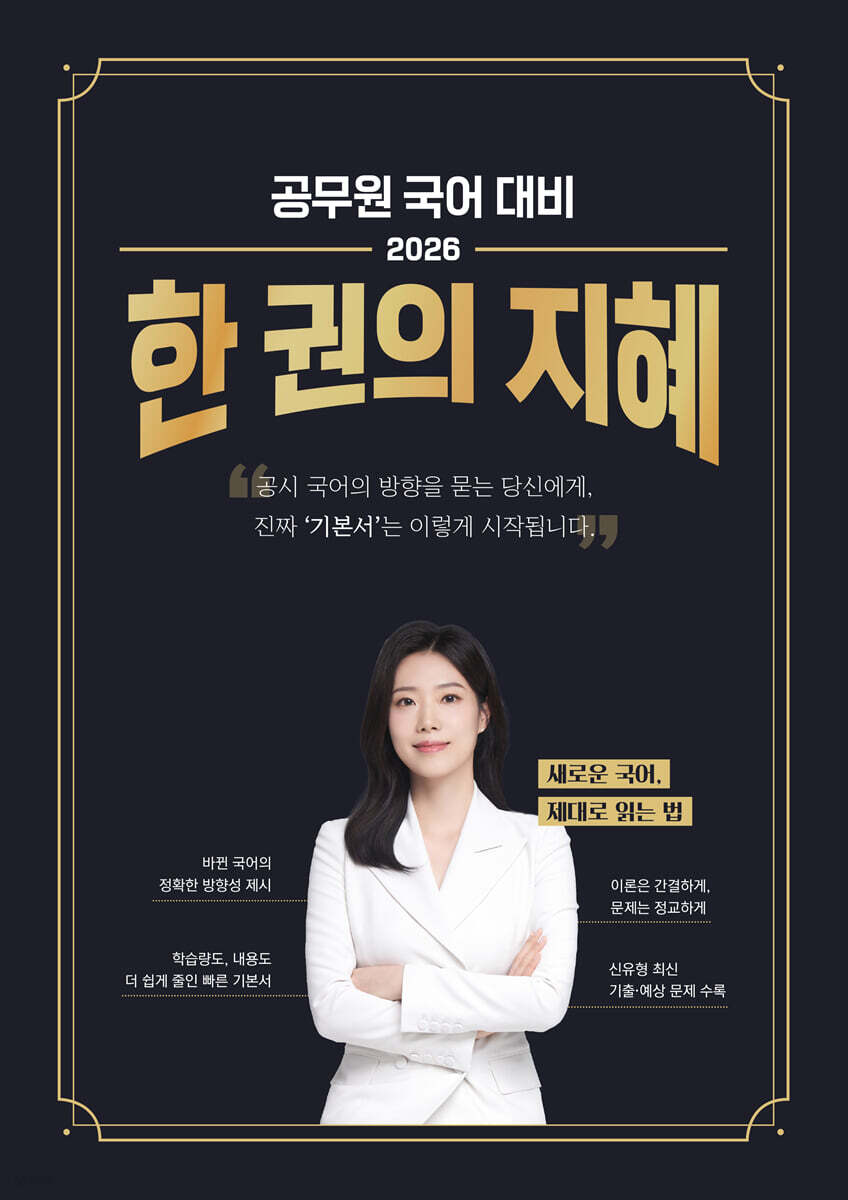
· Presenting the exact direction of the changed Korean language!
· Theory is concise, problems are sophisticated!
· A quick, basic book that reduces the amount of learning and content for easier reading!
· Includes the latest new types of past and expected questions
As I teach the ever-changing civil service Korean language, I've always been concerned with how I can further reduce the amount of learning required for you.
This year, this concern has become even more intense.
The 2025 National Civil Service Examination passing score showed a surprising and shocking result: one out of two candidates scored 95 points in the Korean language subject.
This led to the natural consequence that we needed Korean language textbooks and lectures that were more “easier” to understand.
Accordingly, I boldly organized what to discard and what to include, and tried to compose it only with the content necessary for the exam, and only with the theories and problems necessary for the difficulty level of the 9th grade exam.
However, there may be parts that are difficult to study alone, so we strongly recommend that you study along with the lectures.
1.
It is concisely structured into a reading section and a grammar section.
Reading comprehension includes a variety of problems to help you apply and practice real-world reading principles.
You can train yourself to read properly.
2.
For the grammar section, rather than studying by memorizing everything, I hope you grasp the overall flow and thoroughly practice the grammar reading comprehension questions at the end of each section.
You can understand the direction of the questions and develop your application skills.
3.
For the logic section, only questions of a difficulty level that will appear on the exam were included.
These problems are sufficient for exam preparation, but if you are weak in logical reasoning, I strongly recommend following the "Wisdom of Reasoning" textbook and lectures.
4.
This is a very thinly structured textbook.
However, the reason it is thicker than expected is because a lot of reference materials were included in the reading comprehension section, ‘Writing Official Documents.’
This is an example of the 'Guidelines for Writing Official Documents' actually provided to civil servants.
The reason for including so many reference materials is that the sample questions and actual national civil service exam structure presented by the Ministry of Personnel Management after the announcement of a change in the exam question structure were based on these reference materials.
This is something we will cover a lot in future mock exams, but we have included it all in the hopes that you will become accustomed to reading official documents before then.
Other than that, the actual theoretical content is brief.
We have included a variety of problem types so that you can practice with theories, so we hope you find them helpful.
This textbook is a basic theory book condensed into one volume, so please train by filling in your own shortcomings through 'Wisdom of Reversal (Half Mock Test), Wisdom of Hitting the Target (Same Type Mock Test), and Wisdom of Inference (Logical Inference Questions).
Even though the test has changed several times, we have continued to think about it and research it for a long time.
All those worries have been rewarded with the grateful result of your congratulations on passing the exam.
This year, knowing your earnest desire, I am pleased to meet you again with an even better lecture.
I know you may be anxious and overwhelmed by the exam preparation, but I sincerely hope that your path to passing will be easier and faster.
From Noryangjin, we sincerely pray for your success.
Im Ji-hye Dream
· Presenting the exact direction of the changed Korean language!
· Theory is concise, problems are sophisticated!
· A quick, basic book that reduces the amount of learning and content for easier reading!
· Includes the latest new types of past and expected questions
As I teach the ever-changing civil service Korean language, I've always been concerned with how I can further reduce the amount of learning required for you.
This year, this concern has become even more intense.
The 2025 National Civil Service Examination passing score showed a surprising and shocking result: one out of two candidates scored 95 points in the Korean language subject.
This led to the natural consequence that we needed Korean language textbooks and lectures that were more “easier” to understand.
Accordingly, I boldly organized what to discard and what to include, and tried to compose it only with the content necessary for the exam, and only with the theories and problems necessary for the difficulty level of the 9th grade exam.
However, there may be parts that are difficult to study alone, so we strongly recommend that you study along with the lectures.
1.
It is concisely structured into a reading section and a grammar section.
Reading comprehension includes a variety of problems to help you apply and practice real-world reading principles.
You can train yourself to read properly.
2.
For the grammar section, rather than studying by memorizing everything, I hope you grasp the overall flow and thoroughly practice the grammar reading comprehension questions at the end of each section.
You can understand the direction of the questions and develop your application skills.
3.
For the logic section, only questions of a difficulty level that will appear on the exam were included.
These problems are sufficient for exam preparation, but if you are weak in logical reasoning, I strongly recommend following the "Wisdom of Reasoning" textbook and lectures.
4.
This is a very thinly structured textbook.
However, the reason it is thicker than expected is because a lot of reference materials were included in the reading comprehension section, ‘Writing Official Documents.’
This is an example of the 'Guidelines for Writing Official Documents' actually provided to civil servants.
The reason for including so many reference materials is that the sample questions and actual national civil service exam structure presented by the Ministry of Personnel Management after the announcement of a change in the exam question structure were based on these reference materials.
This is something we will cover a lot in future mock exams, but we have included it all in the hopes that you will become accustomed to reading official documents before then.
Other than that, the actual theoretical content is brief.
We have included a variety of problem types so that you can practice with theories, so we hope you find them helpful.
This textbook is a basic theory book condensed into one volume, so please train by filling in your own shortcomings through 'Wisdom of Reversal (Half Mock Test), Wisdom of Hitting the Target (Same Type Mock Test), and Wisdom of Inference (Logical Inference Questions).
Even though the test has changed several times, we have continued to think about it and research it for a long time.
All those worries have been rewarded with the grateful result of your congratulations on passing the exam.
This year, knowing your earnest desire, I am pleased to meet you again with an even better lecture.
I know you may be anxious and overwhelmed by the exam preparation, but I sincerely hope that your path to passing will be easier and faster.
From Noryangjin, we sincerely pray for your success.
Im Ji-hye Dream
GOODS SPECIFICS
- Date of issue: June 26, 2025
- Page count, weight, size: 360 pages | 210*297*30mm
- ISBN13: 9791194039792
- ISBN10: 1194039790
You may also like
카테고리
korean


korean

![GQ KOREA Mark (Monthly): December [2025]](http://librairie.coreenne.fr/cdn/shop/files/8ef265dbbfbf186523ed75ba7319009d.jpg?v=1765340328&width=3840)


