

Affectionate narrator
 |
Description
Book Introduction
- A word from MD
- [If Our Kindnesses Gather] An essay by Nobel Prize-winning author Olga Tokarczuk.
As she has said, if 'affection' is expressed through infinite solidarity and empathy, the story will always have power.
If we understand each other and move forward through literature, miracles will happen every moment.
May we be able to save each other with that power.
- Essay PD Lee Na-young
The first essay, "The Tender Narrator," by Olga Tokarczuk, the 2018 Nobel Prize winner in Literature and one of the most extraordinary, eccentric, and special storytellers of our time, has been published by Minumsa.
This book is particularly significant in that it is Olga Tokarczuk's first published work since winning the Nobel Prize, and above all, it is the author's first collection of essays to be published in Korea.
The author personally selected and compiled twelve essays, columns, and lecture notes he has published so far.
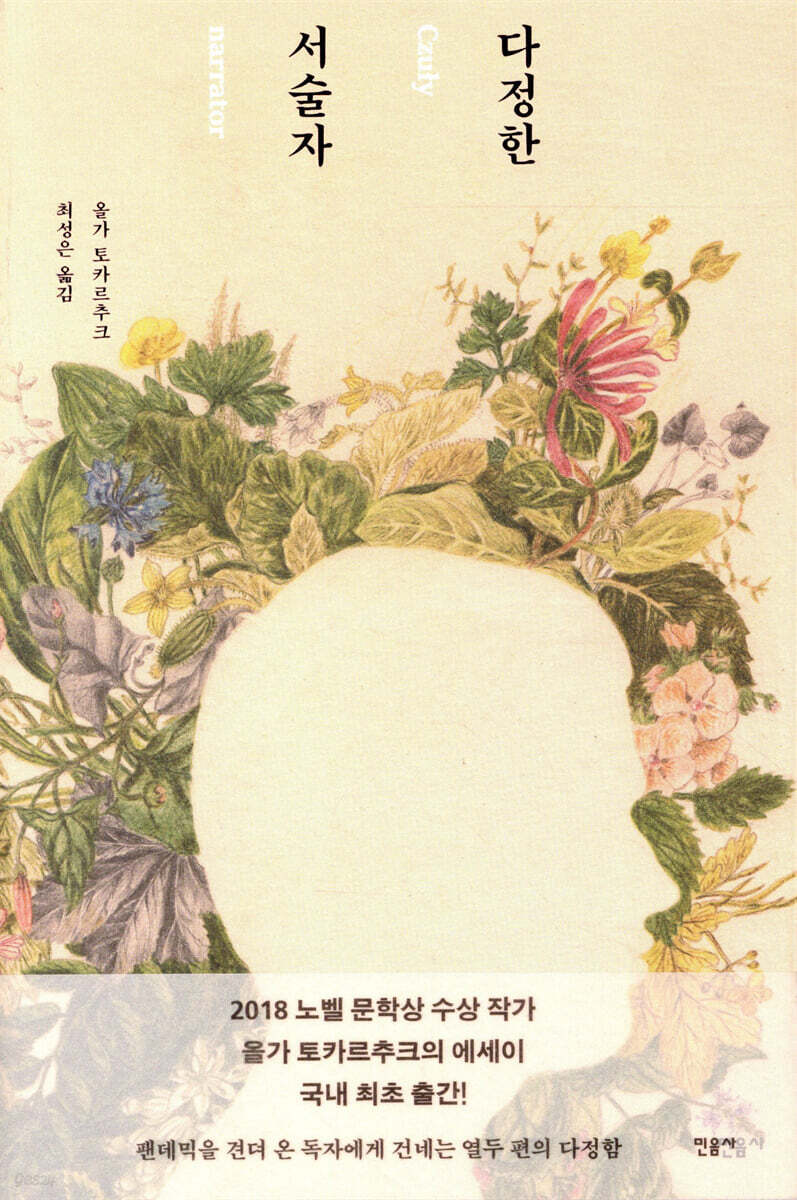
The cover illustration was done by Joanna Conseo, an illustrator who specializes in designing cover editions of Tokarczuk's novels.
A human silhouette, carefully outlined amidst a beautiful vine intertwined with flowers and leaves, this mysterious figure, hollow in the middle and unable to identify its gender, age, or race, reminds us that humans are an inseparable part of nature, and that the ultimate place for humans is in the embrace of nature.
『The Affectionate Narrator』 contains six essays and six lecture notes, and the consistent themes that run through each text are ‘literature’ and ‘writing.’
As we follow Tokarczuk's colorful literary journey, from 'reading' to 'writing,' at some point we feel as if we have been invited into the author's studio and are taking a detailed look at the process of creating a novel.
It offers a glimpse into the author's extensive reading history and artistic tastes, which have served as a source of inspiration, as well as his current literary experiments and astonishingly original imagination.
This book is particularly significant in that it is Olga Tokarczuk's first published work since winning the Nobel Prize, and above all, it is the author's first collection of essays to be published in Korea.
The author personally selected and compiled twelve essays, columns, and lecture notes he has published so far.
The cover illustration was done by Joanna Conseo, an illustrator who specializes in designing cover editions of Tokarczuk's novels.
A human silhouette, carefully outlined amidst a beautiful vine intertwined with flowers and leaves, this mysterious figure, hollow in the middle and unable to identify its gender, age, or race, reminds us that humans are an inseparable part of nature, and that the ultimate place for humans is in the embrace of nature.
『The Affectionate Narrator』 contains six essays and six lecture notes, and the consistent themes that run through each text are ‘literature’ and ‘writing.’
As we follow Tokarczuk's colorful literary journey, from 'reading' to 'writing,' at some point we feel as if we have been invited into the author's studio and are taking a detailed look at the process of creating a novel.
It offers a glimpse into the author's extensive reading history and artistic tastes, which have served as a source of inspiration, as well as his current literary experiments and astonishingly original imagination.
- You can preview some of the book's contents.
Preview
index
Compiling a book 7
Ognozya 11
Practice Unfamiliarity 44
Animal Masks 57
The Task of Hermes: How Translators Save the World Every Day 84
Fingers in Salt, or About My Brief Reading History 107
The Quay Brothers' Amazing Crucible, London's Alchemist Film 134
On the Daimonion and the various motives for writing 147
Narrator's Psychology 189
The Psychology at Work in the Creation of a Literary World: How Was the Book of Jakub Born? (229)
Literary Figures, Dusheiko Case 265
Metaxi's Territory 303
The Affectionate Narrator 332
Translator's Note 366
Ognozya 11
Practice Unfamiliarity 44
Animal Masks 57
The Task of Hermes: How Translators Save the World Every Day 84
Fingers in Salt, or About My Brief Reading History 107
The Quay Brothers' Amazing Crucible, London's Alchemist Film 134
On the Daimonion and the various motives for writing 147
Narrator's Psychology 189
The Psychology at Work in the Creation of a Literary World: How Was the Book of Jakub Born? (229)
Literary Figures, Dusheiko Case 265
Metaxi's Territory 303
The Affectionate Narrator 332
Translator's Note 366
Detailed image

Into the book
We are no longer 'bionts' (physiological entities), but 'holobionts',13 that is, the entire living organism.
In other words, it is a combination of various organisms that live in symbiosis with each other.
Complexity, multiplicity, diversity, interaction, metasymbiosis? These keywords represent a new perspective on the world.
--- p.28
The consequences of the pandemic are truly diverse.
I believe that the most important of these is to break the narrative that is already deeply ingrained within us: the perception that we humans control the world and are the masters of creation.
--- p.35
Let's create a library full of new terms.
Let's fill that space with quirky and bizarre content you've never heard of before.
Eventually, there will be a shortage of words, terms, idioms or phrases.
--- p.43
Translation is not only the process of transferring one language to another, or one culture to another, but it can also be considered a type of horticultural skill.
It is the process of cutting branches from one plant, grafting them onto another plant, and causing them to sprout, gather growth energy, and grow into full-fledged branches.
--- pp.95~96
We must read books.
To perceive a worldview different from the one we have now, and to confirm that the world we live in is actually one of many possible forms, and that this too is not something given to us forever.
--- pp.105~106
If you look closely, you'll see that every good book changes the world a little bit.
Thanks to this, people, questions, and new discoveries that never existed before are created in the world.
After Marcel Proust and Bolesław Pruss, everything was a little different from before.
--- p.186
It (the narrator) is the pure voice itself.
(……) It is something dormant, like an inactive gene passed down from ancient times, that awakens and reveals its power at the moment when conditions and circumstances are optimally combined.
(……) signs of the past, memories, the collective unconscious, layers of old experiences imprinted on our genes in unknown ways.
--- pp.199~200
The narrator is the soul of the story, the speaking voice, the hidden, congenital flaw of the story, and at the same time, the essence of the story.
It is also an additional element that arranges and organizes all the other elements.
So, finally, we must be honest and admit it.
Dear friends, humans have a soul, a body, and a narrator.
--- p.228
The thought that 'the world is longing for this book to be written.'
I know how absurd this claim sounds.
(……) But what does that matter! Writers are, after all, artists, and artists are people with stronger eccentricities than scholars.
Because what they ultimately pursue is not a degree.
--- p.263
Sometimes I think that everyone we know is a kind of constellation, a collection of characters we've all seen before.
We are simply connecting characters to each other according to some pre-existing pattern.
--- p.276
Time resides within all living things.
Therefore, when we commit an act of murder, we stop this inner time.
You leave something unfinished, you rob the future of its entirety, you destroy all potential, you break the chain of amazing diversity and infinite possibilities.
--- p.279
Literary characters are our dreams, and they are higher forms of being created by our experiences and imagination.
They are conscious of their origins, but they are unaware of the presence of our author who was involved in their birth.
Perhaps all of this is part of a larger hierarchical structure, within which we are literature written by nature, a product of the world's dreamlike, if not inorganic, imagination.
--- p.299
The place we first came from, the place where we still meet each other, perhaps in the most real way, a place without borders, passports, or languages – that is the territory of Metaxie.
--- p.331
I believe that the writer's spirit ultimately means a kind of 'synthetic thinking' that tenaciously gathers together all the fragments and pieces and connects them to create a universal whole.
--- p.355
Greed, disrespect for nature, selfishness, lack of imagination, endless conflict, and a lack of responsibility have divided the world, made it abusive, and made it vulnerable to destruction.
--- p.365
Affection is the skill of personifying an object, sharing its emotions, and constantly finding similarities with it.
Creating a story means constantly breathing life into the subject, giving meaning to the little pieces and fragments of this world represented by human experiences, the situations they've been through, and the memories they've had.
In other words, it is a combination of various organisms that live in symbiosis with each other.
Complexity, multiplicity, diversity, interaction, metasymbiosis? These keywords represent a new perspective on the world.
--- p.28
The consequences of the pandemic are truly diverse.
I believe that the most important of these is to break the narrative that is already deeply ingrained within us: the perception that we humans control the world and are the masters of creation.
--- p.35
Let's create a library full of new terms.
Let's fill that space with quirky and bizarre content you've never heard of before.
Eventually, there will be a shortage of words, terms, idioms or phrases.
--- p.43
Translation is not only the process of transferring one language to another, or one culture to another, but it can also be considered a type of horticultural skill.
It is the process of cutting branches from one plant, grafting them onto another plant, and causing them to sprout, gather growth energy, and grow into full-fledged branches.
--- pp.95~96
We must read books.
To perceive a worldview different from the one we have now, and to confirm that the world we live in is actually one of many possible forms, and that this too is not something given to us forever.
--- pp.105~106
If you look closely, you'll see that every good book changes the world a little bit.
Thanks to this, people, questions, and new discoveries that never existed before are created in the world.
After Marcel Proust and Bolesław Pruss, everything was a little different from before.
--- p.186
It (the narrator) is the pure voice itself.
(……) It is something dormant, like an inactive gene passed down from ancient times, that awakens and reveals its power at the moment when conditions and circumstances are optimally combined.
(……) signs of the past, memories, the collective unconscious, layers of old experiences imprinted on our genes in unknown ways.
--- pp.199~200
The narrator is the soul of the story, the speaking voice, the hidden, congenital flaw of the story, and at the same time, the essence of the story.
It is also an additional element that arranges and organizes all the other elements.
So, finally, we must be honest and admit it.
Dear friends, humans have a soul, a body, and a narrator.
--- p.228
The thought that 'the world is longing for this book to be written.'
I know how absurd this claim sounds.
(……) But what does that matter! Writers are, after all, artists, and artists are people with stronger eccentricities than scholars.
Because what they ultimately pursue is not a degree.
--- p.263
Sometimes I think that everyone we know is a kind of constellation, a collection of characters we've all seen before.
We are simply connecting characters to each other according to some pre-existing pattern.
--- p.276
Time resides within all living things.
Therefore, when we commit an act of murder, we stop this inner time.
You leave something unfinished, you rob the future of its entirety, you destroy all potential, you break the chain of amazing diversity and infinite possibilities.
--- p.279
Literary characters are our dreams, and they are higher forms of being created by our experiences and imagination.
They are conscious of their origins, but they are unaware of the presence of our author who was involved in their birth.
Perhaps all of this is part of a larger hierarchical structure, within which we are literature written by nature, a product of the world's dreamlike, if not inorganic, imagination.
--- p.299
The place we first came from, the place where we still meet each other, perhaps in the most real way, a place without borders, passports, or languages – that is the territory of Metaxie.
--- p.331
I believe that the writer's spirit ultimately means a kind of 'synthetic thinking' that tenaciously gathers together all the fragments and pieces and connects them to create a universal whole.
--- p.355
Greed, disrespect for nature, selfishness, lack of imagination, endless conflict, and a lack of responsibility have divided the world, made it abusive, and made it vulnerable to destruction.
--- p.365
Affection is the skill of personifying an object, sharing its emotions, and constantly finding similarities with it.
Creating a story means constantly breathing life into the subject, giving meaning to the little pieces and fragments of this world represented by human experiences, the situations they've been through, and the memories they've had.
--- p.363
Publisher's Review
■ The first essay compiled by Nobel Prize-winning author Olga Tokarczuk
A hymn to literature from a "sweet" storyteller of our time.
“Affection allows us to recognize the bonds that connect us to one another and to recognize our similarities and affinities with others.
It makes us realize that this world is alive, moving, interconnected, cooperating, and interdependent.”
The first essay, "The Tender Narrator," by Olga Tokarczuk, the 2018 Nobel Prize winner in Literature and one of the most extraordinary, eccentric, and special storytellers of our time, has been published by Minumsa.
This book is particularly significant in that it is Olga Tokarczuk's first published work since winning the Nobel Prize, and above all, it is the author's first collection of essays to be published in Korea.
The author personally selected and compiled twelve essays, columns, and lecture notes he has published so far.
The cover illustration was done by Joanna Conseo, an illustrator who specializes in designing cover editions of Tokarczuk's novels.
A human silhouette, carefully outlined amidst a beautiful vine intertwined with flowers and leaves, this mysterious figure, hollow in the middle and unable to identify its gender, age, or race, reminds us that humans are an inseparable part of nature, and that the ultimate place for humans is in the embrace of nature.
『The Affectionate Narrator』 contains six essays and six lecture notes, and the consistent themes that run through each text are ‘literature’ and ‘writing.’
As we follow Tokarczuk's colorful literary journey, from 'reading' to 'writing,' at some point we feel as if we have been invited into the author's studio and are taking a detailed look at the process of creating a novel.
It offers a glimpse into the author's extensive reading history and artistic tastes, which have served as a source of inspiration, as well as his current literary experiments and astonishingly original imagination.
As a literary alternative to the demands of the 21st century, Tokarczuk proposes the innovative concept of the 'affectionate narrator.'
Here, affection is the skill of looking at an object as a person, sharing feelings with him, and constantly finding similarities in him with oneself.
Affection, the most humble form of love, personifies everything we relate to, giving it a voice and the space and time to express itself freely.
Creating a story is the act of constantly breathing life into a subject and giving it value.
The author says that the process of writing must be accompanied by affection, that is, feelings of infinite solidarity and empathy for beings other than oneself.
For Tokarczuk, writing is about finding within oneself the right narrator to tell a story.
The narrator, the speaking voice, the soul and essence of the story.
The new type of narrative style that Tokarczuk pursues in the 21st century is the 'fourth-person point of view.'
Here, 'second person point of view' does not refer to a grammatical form, but rather to a narrator who is both second person and impersonal.
It refers to a narrator who captures the individual perspectives of each character without missing them, while at the same time having a broad perspective that encompasses the whole, a 'holistic storyteller'.
Even in terms of the type of narrator, the author goes beyond the familiar third-person observer narrative form and presents various concepts, such as the 'panopticon narrator' who appears only through voice and viewpoint to see through the essence of the whole, and the 'dissociative narrator' who is a multiple personality separated from the author.
And it helps readers understand through specific creative anecdotes such as 『House of Day, House of Night』(1998), 『Draw the Plow over the Bones of the Dead』(2009), and 『The Book of Yakub』(2004).
■ Reading: The Joy of Reading, the Miracles of Literature
Writing: A Narrator with a 'Second-Person Point of View' Demanded by the New Era
“Thanks to this amazing tool called affection, our most sophisticated form of human communication, our diverse experiences can travel through time to reach someone not yet born.
“Someday they will encounter what we have written and said about ourselves and our world.”
According to Tokarczuk, in the literary universe, the writer plays his role through creation, and the reader plays his role through constant reading and interpretation, each holding equal weight.
Every moment we open a book, an amazing miracle happens.
Those who have briefly experienced the lives of others through reading have a broader perspective than those who have not, and can cultivate the creativity to create a new world of alternatives.
Tokarczuk emphasizes to new writers that he devoured countless books before taking up his pen in earnest.
Also, since the ultimate essence of the phenomenon called literature is 'reading', I advise younger writers to focus on 'reading' rather than 'writing'.
And I assert:
Of all species, only humans have acquired the ability to 'read', so "we are here now to read books"!
Tokarczuk, who has broadened his literary horizons by rejecting the linear flow of storytelling and experimenting with unconventional narrative methods, emphasizes through "The Tender Narrator" that in order to convey a new story suited to the new era, the methodology must first be renewed.
Even in the 21st century, an age of hypertext and artificial intelligence, where paper books are gradually disappearing, the author believes that literature still exerts a powerful force.
In this paradoxical reality where the Internet and networks have developed rapidly, but the bonds of mutual understanding and solidarity between people have become loose, we can endure because of literature.
Literature allows us to understand the motivations behind others' actions, empathize with them, and even identify with them.
Even in the process of portraying the characters in a work, there are moments of fate or irresistible force that do not involve the author's will.
The author believes that characters in literature cannot be considered as purely creative products of the author, created from nothing.
From Tokarczuk's perspective, the characters in a novel are metaphysical objects that reside in a special dimension, a kind of 'repository', as beings with an existential nature different from that of humans.
They are poised in the unknown space (which Tokarczuk calls the "territories of metaxy") to appear on the bookshelf.
So, the author is more appropriately called a 'midwife' who brings characters into the world rather than a 'creator'.
The writer's role is to shed light on those characters who already exist 'somewhere' as complete selves with their own histories and unique tendencies, and to bring them into the realm of literature.
■ The direction of Tokarczuk's literature is towards 'all life'
A message of solidarity and connection told by a caring narrator
“I believe.
When I tell stories, I cannot help but say that this world is a vast, living, moving entity that is constantly forming before our eyes, and that we humans are only a small but powerful part of that world.”
In "The Affectionate Narrator," Tokarczuk presents us with a multifaceted vision: novelist, lecturer, psychology major, avid reader, ecofeminist, vegetarian, social activist, and, until recently, a globetrotting traveler.
The author would say this about himself:
He said he was just an ordinary person who loved reading and writing and was always curious about the world.
But that curiosity is gradually turning into anxiety and fear.
A sharp assessment of the various crises facing humanity, starting with the pandemic, has led to a movement calling for global solidarity to protect environmental issues and animal rights, and culminates in a commitment to extending a helping hand of solidarity to the socially vulnerable and marginalized.
Tokarczuk boldly attempts a paradigm shift, casting aside the conventional notions of subject and object, reality and fiction, by reminding us that gods and humans, humans and animals, and humans and nature are intimately connected by meaningful bonds.
And it urges readers to awaken to a holistic perspective that transcends human-centrism.
From the perspective of a harmoniously interconnected community of life, including plants and animals, humans may be a piece of literature written by nature, or even a product of the world's imagination.
And all this clearly shows us where the direction of Tokarczuk's literature is heading now.
Each human being has not only a soul and a body, but also his or her own unique 'narrator'.
It's like a very old structure within us that hasn't been replaced by evolution, like the reptilian brain.
In the introduction to his keynote speech commemorating the Nobel Prize in Literature, Tokarczuk confesses that it was none other than his mother who gave him “the most affectionate narrator in the world.”
According to Tokarczuk, the narrator is a being derived from the author, but at some point, he becomes an independent personality who speaks autonomously, free from the author's will.
Tokarczuk's unique imagination goes further, viewing all things in the world as a vast, living, moving entity.
It is to recognize reality as a single, organically connected entity that cannot be split or separated.
In "The Affectionate Narrator," Tokarczuk urges us to reflect on this shift in perception, while at the same time asserting that there is still hope.
Because literature stands at the center of the world.
This book, which contains poignant reflections on the new changes that writers and readers will experience together in today's world, where everything changes at breakneck speed, is also filled with a warm heart toward the world and a passion for literature.
Yes, if we want to save the world, we must read, write, and translate diligently!
“It's thrilling to imagine how different the world would be if we all practiced the 'tenderness' Tokarczuk recommends.” (Translator's Note)
A hymn to literature from a "sweet" storyteller of our time.
“Affection allows us to recognize the bonds that connect us to one another and to recognize our similarities and affinities with others.
It makes us realize that this world is alive, moving, interconnected, cooperating, and interdependent.”
The first essay, "The Tender Narrator," by Olga Tokarczuk, the 2018 Nobel Prize winner in Literature and one of the most extraordinary, eccentric, and special storytellers of our time, has been published by Minumsa.
This book is particularly significant in that it is Olga Tokarczuk's first published work since winning the Nobel Prize, and above all, it is the author's first collection of essays to be published in Korea.
The author personally selected and compiled twelve essays, columns, and lecture notes he has published so far.
The cover illustration was done by Joanna Conseo, an illustrator who specializes in designing cover editions of Tokarczuk's novels.
A human silhouette, carefully outlined amidst a beautiful vine intertwined with flowers and leaves, this mysterious figure, hollow in the middle and unable to identify its gender, age, or race, reminds us that humans are an inseparable part of nature, and that the ultimate place for humans is in the embrace of nature.
『The Affectionate Narrator』 contains six essays and six lecture notes, and the consistent themes that run through each text are ‘literature’ and ‘writing.’
As we follow Tokarczuk's colorful literary journey, from 'reading' to 'writing,' at some point we feel as if we have been invited into the author's studio and are taking a detailed look at the process of creating a novel.
It offers a glimpse into the author's extensive reading history and artistic tastes, which have served as a source of inspiration, as well as his current literary experiments and astonishingly original imagination.
As a literary alternative to the demands of the 21st century, Tokarczuk proposes the innovative concept of the 'affectionate narrator.'
Here, affection is the skill of looking at an object as a person, sharing feelings with him, and constantly finding similarities in him with oneself.
Affection, the most humble form of love, personifies everything we relate to, giving it a voice and the space and time to express itself freely.
Creating a story is the act of constantly breathing life into a subject and giving it value.
The author says that the process of writing must be accompanied by affection, that is, feelings of infinite solidarity and empathy for beings other than oneself.
For Tokarczuk, writing is about finding within oneself the right narrator to tell a story.
The narrator, the speaking voice, the soul and essence of the story.
The new type of narrative style that Tokarczuk pursues in the 21st century is the 'fourth-person point of view.'
Here, 'second person point of view' does not refer to a grammatical form, but rather to a narrator who is both second person and impersonal.
It refers to a narrator who captures the individual perspectives of each character without missing them, while at the same time having a broad perspective that encompasses the whole, a 'holistic storyteller'.
Even in terms of the type of narrator, the author goes beyond the familiar third-person observer narrative form and presents various concepts, such as the 'panopticon narrator' who appears only through voice and viewpoint to see through the essence of the whole, and the 'dissociative narrator' who is a multiple personality separated from the author.
And it helps readers understand through specific creative anecdotes such as 『House of Day, House of Night』(1998), 『Draw the Plow over the Bones of the Dead』(2009), and 『The Book of Yakub』(2004).
■ Reading: The Joy of Reading, the Miracles of Literature
Writing: A Narrator with a 'Second-Person Point of View' Demanded by the New Era
“Thanks to this amazing tool called affection, our most sophisticated form of human communication, our diverse experiences can travel through time to reach someone not yet born.
“Someday they will encounter what we have written and said about ourselves and our world.”
According to Tokarczuk, in the literary universe, the writer plays his role through creation, and the reader plays his role through constant reading and interpretation, each holding equal weight.
Every moment we open a book, an amazing miracle happens.
Those who have briefly experienced the lives of others through reading have a broader perspective than those who have not, and can cultivate the creativity to create a new world of alternatives.
Tokarczuk emphasizes to new writers that he devoured countless books before taking up his pen in earnest.
Also, since the ultimate essence of the phenomenon called literature is 'reading', I advise younger writers to focus on 'reading' rather than 'writing'.
And I assert:
Of all species, only humans have acquired the ability to 'read', so "we are here now to read books"!
Tokarczuk, who has broadened his literary horizons by rejecting the linear flow of storytelling and experimenting with unconventional narrative methods, emphasizes through "The Tender Narrator" that in order to convey a new story suited to the new era, the methodology must first be renewed.
Even in the 21st century, an age of hypertext and artificial intelligence, where paper books are gradually disappearing, the author believes that literature still exerts a powerful force.
In this paradoxical reality where the Internet and networks have developed rapidly, but the bonds of mutual understanding and solidarity between people have become loose, we can endure because of literature.
Literature allows us to understand the motivations behind others' actions, empathize with them, and even identify with them.
Even in the process of portraying the characters in a work, there are moments of fate or irresistible force that do not involve the author's will.
The author believes that characters in literature cannot be considered as purely creative products of the author, created from nothing.
From Tokarczuk's perspective, the characters in a novel are metaphysical objects that reside in a special dimension, a kind of 'repository', as beings with an existential nature different from that of humans.
They are poised in the unknown space (which Tokarczuk calls the "territories of metaxy") to appear on the bookshelf.
So, the author is more appropriately called a 'midwife' who brings characters into the world rather than a 'creator'.
The writer's role is to shed light on those characters who already exist 'somewhere' as complete selves with their own histories and unique tendencies, and to bring them into the realm of literature.
■ The direction of Tokarczuk's literature is towards 'all life'
A message of solidarity and connection told by a caring narrator
“I believe.
When I tell stories, I cannot help but say that this world is a vast, living, moving entity that is constantly forming before our eyes, and that we humans are only a small but powerful part of that world.”
In "The Affectionate Narrator," Tokarczuk presents us with a multifaceted vision: novelist, lecturer, psychology major, avid reader, ecofeminist, vegetarian, social activist, and, until recently, a globetrotting traveler.
The author would say this about himself:
He said he was just an ordinary person who loved reading and writing and was always curious about the world.
But that curiosity is gradually turning into anxiety and fear.
A sharp assessment of the various crises facing humanity, starting with the pandemic, has led to a movement calling for global solidarity to protect environmental issues and animal rights, and culminates in a commitment to extending a helping hand of solidarity to the socially vulnerable and marginalized.
Tokarczuk boldly attempts a paradigm shift, casting aside the conventional notions of subject and object, reality and fiction, by reminding us that gods and humans, humans and animals, and humans and nature are intimately connected by meaningful bonds.
And it urges readers to awaken to a holistic perspective that transcends human-centrism.
From the perspective of a harmoniously interconnected community of life, including plants and animals, humans may be a piece of literature written by nature, or even a product of the world's imagination.
And all this clearly shows us where the direction of Tokarczuk's literature is heading now.
Each human being has not only a soul and a body, but also his or her own unique 'narrator'.
It's like a very old structure within us that hasn't been replaced by evolution, like the reptilian brain.
In the introduction to his keynote speech commemorating the Nobel Prize in Literature, Tokarczuk confesses that it was none other than his mother who gave him “the most affectionate narrator in the world.”
According to Tokarczuk, the narrator is a being derived from the author, but at some point, he becomes an independent personality who speaks autonomously, free from the author's will.
Tokarczuk's unique imagination goes further, viewing all things in the world as a vast, living, moving entity.
It is to recognize reality as a single, organically connected entity that cannot be split or separated.
In "The Affectionate Narrator," Tokarczuk urges us to reflect on this shift in perception, while at the same time asserting that there is still hope.
Because literature stands at the center of the world.
This book, which contains poignant reflections on the new changes that writers and readers will experience together in today's world, where everything changes at breakneck speed, is also filled with a warm heart toward the world and a passion for literature.
Yes, if we want to save the world, we must read, write, and translate diligently!
“It's thrilling to imagine how different the world would be if we all practiced the 'tenderness' Tokarczuk recommends.” (Translator's Note)
GOODS SPECIFICS
- Publication date: September 23, 2022
- Format: Paperback book binding method guide
- Page count, weight, size: 380 pages | 428g | 140*210*30mm
- ISBN13: 9788937455971
- ISBN10: 8937455978
You may also like
카테고리
korean


korean

![GQ KOREA Mark (Monthly): December [2025]](http://librairie.coreenne.fr/cdn/shop/files/8ef265dbbfbf186523ed75ba7319009d.jpg?v=1765340328&width=3840)


