

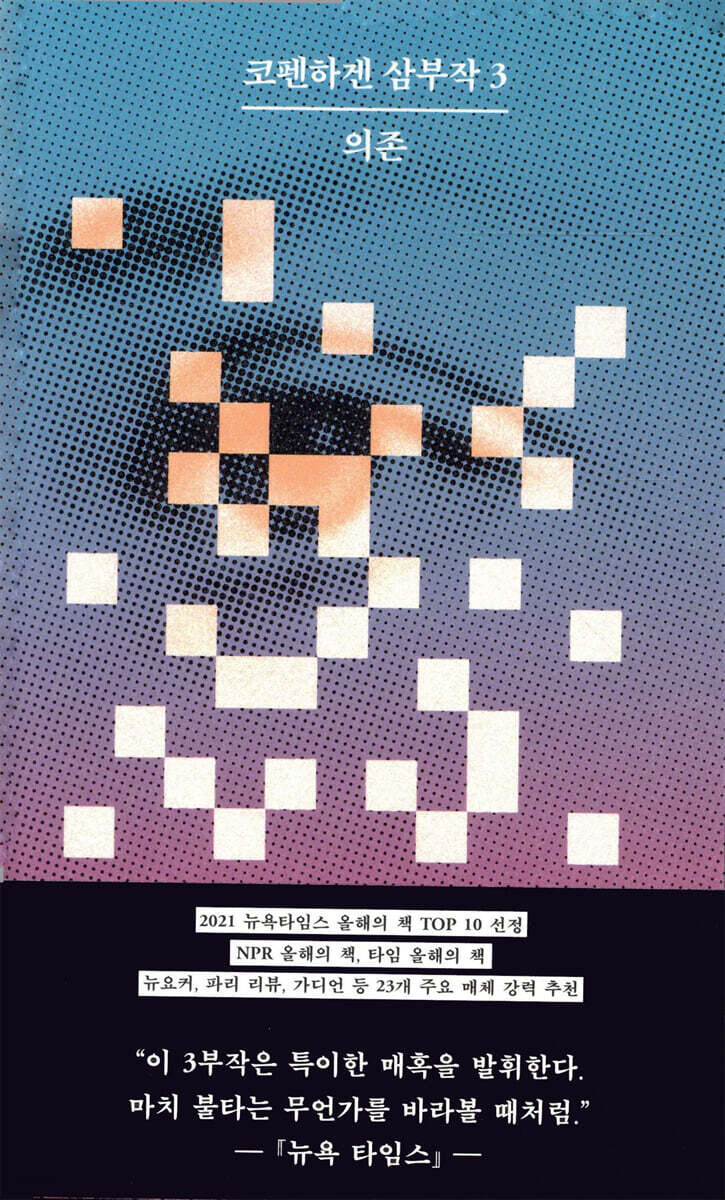
dependence
 |
Description
Book Introduction
Darkness is not something to be understood
It's an experience
Unlike the first two volumes in the trilogy, Dependence, which was first introduced to the English-speaking world in 2019, is considered the most shocking of the three volumes and the quintessential work of the series.
It's not just because the content is dark.
Dependence, the only two-part novel in the trilogy, undergoes a sharp shift in writing style as it moves into its second chapter.
It's like looking at a hard-boiled noir with the flowery descriptions stripped away and a more dry, compressed mass of writing.
The pace of events accelerates and the descriptions become dull and dry.
This period, which contains the most recent story, would likely hold far more memories than childhood, but Dietleusen twists that notion, leaving many moments blank and building only the skeleton of the tragedy, thereby amplifying the desolate scene.
The reader can 'experience' the shock of the unfolding events through the speed and texture of the sentences.
The greatest strength of the 'Copenhagen Trilogy', which is its ability to observe one's own mistakes with a chillingly cool-headedness, is maximized in this latter part.
Tilly Olson, who praised the first two volumes of this trilogy in 1985, had not read the final book, Dependence, but she accurately predicted its character.
In this way, 『Dependence』 is the work that completes the individuality of this trilogy and reveals it most powerfully, forming a particularly sharp contrast with 『Childhood』, which carefully collects beautiful and slow moments, and completes the structure of the entire trilogy.
It's an experience
Unlike the first two volumes in the trilogy, Dependence, which was first introduced to the English-speaking world in 2019, is considered the most shocking of the three volumes and the quintessential work of the series.
It's not just because the content is dark.
Dependence, the only two-part novel in the trilogy, undergoes a sharp shift in writing style as it moves into its second chapter.
It's like looking at a hard-boiled noir with the flowery descriptions stripped away and a more dry, compressed mass of writing.
The pace of events accelerates and the descriptions become dull and dry.
This period, which contains the most recent story, would likely hold far more memories than childhood, but Dietleusen twists that notion, leaving many moments blank and building only the skeleton of the tragedy, thereby amplifying the desolate scene.
The reader can 'experience' the shock of the unfolding events through the speed and texture of the sentences.
The greatest strength of the 'Copenhagen Trilogy', which is its ability to observe one's own mistakes with a chillingly cool-headedness, is maximized in this latter part.
Tilly Olson, who praised the first two volumes of this trilogy in 1985, had not read the final book, Dependence, but she accurately predicted its character.
In this way, 『Dependence』 is the work that completes the individuality of this trilogy and reveals it most powerfully, forming a particularly sharp contrast with 『Childhood』, which carefully collects beautiful and slow moments, and completes the structure of the entire trilogy.
- You can preview some of the book's contents.
Preview
index
Part 1
1
2
3
4
5
6
7
8
9
10
11
12
Part 2
1
2
3
4
5
6
7
8
1
2
3
4
5
6
7
8
9
10
11
12
Part 2
1
2
3
4
5
6
7
8
Detailed image
Into the book
So I ended up sitting across from the doctor.
The doctor's eyes, large and bulging, looked as if they might pop out of their sockets at any moment.
I tell him everything.
“Isn’t it kind of fun being stuck between two different men?” he says.
“Yes,” I answer, surprised.
Because it's true.
--- pp.40~41
I promise Eve that I will never leave him, and I confess that it is difficult to bear when life becomes so complicated these days.
He lifts my chin, kisses it, and whispers:
“Maybe your life is complicated because you are a complicated person.”
--- p.72
I bend over the cradle and touch my little fingers and say:
“Now we are father, mother, and child, that’s it.
“We became a normal, ordinary family.” Then Eve asks.
"Why do you want to be a normal, ordinary person? Everyone knows you're not one of those people." I don't know how to answer him, but being a normal person is something I've wanted to do for as long as I can remember.
--- pp.80~81
“I don’t know about anything else, but you’re putting water in your syringe,” I say.
“You’re going to be in a lot of pain soon,” he says.
“But then you’ll feel better, and eventually you’ll be healthy again.
But you, you need to stop nagging me.
Because I have never been able to bear to watch you suffer.
Everything I do now is for you.
“I want you to recover so you can go back to work and be with your children.” His words fill me with fear.
“I can’t live without Demerol,” I yell at him.
“I can’t live without it.”
“You started it, so you have to continue it.” “No,” he says quietly.
“I’ll cut back slowly.”
--- p.206
“If there’s one thing terrible about love, it’s that,” I said.
“You lose interest in other people.” “That’s right,” he said.
“And in the end, it always ends up being incredibly painful.”
The doctor's eyes, large and bulging, looked as if they might pop out of their sockets at any moment.
I tell him everything.
“Isn’t it kind of fun being stuck between two different men?” he says.
“Yes,” I answer, surprised.
Because it's true.
--- pp.40~41
I promise Eve that I will never leave him, and I confess that it is difficult to bear when life becomes so complicated these days.
He lifts my chin, kisses it, and whispers:
“Maybe your life is complicated because you are a complicated person.”
--- p.72
I bend over the cradle and touch my little fingers and say:
“Now we are father, mother, and child, that’s it.
“We became a normal, ordinary family.” Then Eve asks.
"Why do you want to be a normal, ordinary person? Everyone knows you're not one of those people." I don't know how to answer him, but being a normal person is something I've wanted to do for as long as I can remember.
--- pp.80~81
“I don’t know about anything else, but you’re putting water in your syringe,” I say.
“You’re going to be in a lot of pain soon,” he says.
“But then you’ll feel better, and eventually you’ll be healthy again.
But you, you need to stop nagging me.
Because I have never been able to bear to watch you suffer.
Everything I do now is for you.
“I want you to recover so you can go back to work and be with your children.” His words fill me with fear.
“I can’t live without Demerol,” I yell at him.
“I can’t live without it.”
“You started it, so you have to continue it.” “No,” he says quietly.
“I’ll cut back slowly.”
--- p.206
“If there’s one thing terrible about love, it’s that,” I said.
“You lose interest in other people.” “That’s right,” he said.
“And in the end, it always ends up being incredibly painful.”
--- p.243
Publisher's Review
Darkness is not something to be understood
It's an experience
Unlike the first two volumes in the trilogy, Dependence, which was first introduced to the English-speaking world in 2019, is considered the most shocking of the three volumes and the quintessential work of the series.
It's not just because the content is dark.
Dependence, the only two-part novel in the trilogy, undergoes a sharp shift in writing style as it moves into its second chapter.
It's like looking at a hard-boiled noir with the flowery descriptions stripped away and a more dry, compressed mass of writing.
The pace of events accelerates and the descriptions become dull and dry.
This period, which contains the most recent story, would likely hold far more memories than childhood, but Dietleusen twists that notion, leaving many moments blank and building only the skeleton of the tragedy, thereby amplifying the desolate scene.
The reader can 'experience' the shock of the unfolding events through the speed and texture of the sentences.
The greatest strength of the 'Copenhagen Trilogy', which is its ability to observe one's own mistakes with a chillingly cool-headedness, is maximized in this latter part.
Tilly Olson, who praised the first two volumes of this trilogy in 1985, had not read the final book, Dependence, but she accurately predicted its character.
In this way, 『Dependence』 is the work that completes the individuality of this trilogy and reveals it most powerfully, forming a particularly sharp contrast with 『Childhood』, which carefully collects beautiful and slow moments, and completes the structure of the entire trilogy.
More than 50 years have passed since its publication
A memoir selected as one of the New York Times' 10 best books of the year
The life of a tragic female writer.
Books that address this topic, which has recently received significant attention, face fierce competition.
At this time, the more famous the writer's life is depicted, such as Sylvia Plath or Virginia Woolf, or the more the writer confronts the absurdity of society, the more likely it is to receive attention.
But Tove Dietleusen's memoir, "The Copenhagen Trilogy," which hardly fits that formula, did not disappear quietly, but rather broke the mold like a typhoon.
A memoir written over 50 years ago by an author who was virtually unknown outside Denmark for nearly half a century has received overwhelming acclaim from readers and critics.
By deviating from justice
Escape from definition
This trilogy, which recounts the author's childhood through her early thirties, from the 1930s to the 1950s, begins with a setting and beautiful prose reminiscent of Elena Ferrante.
But the ending is far from nostalgia.
The secret to elevating a memoir, often filled with sorrow and regret, into a special work is cool-headedness.
He observed his own faults more dispassionately than any other man, like a doctor examining a wound, and he added no judgment to his observations.
There is no rationalization, no self-reproach, no resentment.
Even Dietleusen never once asks himself what kind of being he is.
There is no emotional conclusion through retrospection.
This characteristic destroys the psychological tradition of the memoir genre, in which the author's confession leads to the reader's empathy or compassion.
It was a truly avant-garde result.
The American feminist literary world, which first encountered Dietleusen through Childhood and Youth in 1985, praised these characteristics of the two works.
This was because Dietleusen threw away even the political frame of ‘a woman who recognizes injustice and (must) pursue justice’ and presented a woman-human who is willing to expose herself to error and anxiety.
Deviating from the justice and ethics bestowed upon oneself in accordance with one's own desires is both an injustice that invites destruction and a higher level of liberation.
Tillie Olson, one of the leading figures in the American feminist movement at the time, recognized the concerns expressed in Dietleusen's memoir and considered him one of the most important writers of his time.
And this problem awareness is still a new challenge for today's readers, even after more than 30 years.
This coolness and detachment also bring a special kind of warmth.
Dietleusen, who lacks self-pity, does not project his misfortunes onto others and therefore does not make enemies.
He doesn't even hate the German soldiers who occupied his homeland.
It was just that time and fate had led them there, and it was one of the destinies given to all mankind.
Dietleusen, who realized from a young age that all humans must live with the burden of unfair duties and desires imposed on them, quietly looks upon the mistakes and errors of others as if they were his own.
It is not easy to divide people into my side and the other side, but to understand that all people are fundamentally the same species with the same shortcomings.
This paradoxical warmth, contained within the most dispassionate observer in memoir history, will leave a lasting impression that will be difficult to forget.
It's an experience
Unlike the first two volumes in the trilogy, Dependence, which was first introduced to the English-speaking world in 2019, is considered the most shocking of the three volumes and the quintessential work of the series.
It's not just because the content is dark.
Dependence, the only two-part novel in the trilogy, undergoes a sharp shift in writing style as it moves into its second chapter.
It's like looking at a hard-boiled noir with the flowery descriptions stripped away and a more dry, compressed mass of writing.
The pace of events accelerates and the descriptions become dull and dry.
This period, which contains the most recent story, would likely hold far more memories than childhood, but Dietleusen twists that notion, leaving many moments blank and building only the skeleton of the tragedy, thereby amplifying the desolate scene.
The reader can 'experience' the shock of the unfolding events through the speed and texture of the sentences.
The greatest strength of the 'Copenhagen Trilogy', which is its ability to observe one's own mistakes with a chillingly cool-headedness, is maximized in this latter part.
Tilly Olson, who praised the first two volumes of this trilogy in 1985, had not read the final book, Dependence, but she accurately predicted its character.
In this way, 『Dependence』 is the work that completes the individuality of this trilogy and reveals it most powerfully, forming a particularly sharp contrast with 『Childhood』, which carefully collects beautiful and slow moments, and completes the structure of the entire trilogy.
More than 50 years have passed since its publication
A memoir selected as one of the New York Times' 10 best books of the year
The life of a tragic female writer.
Books that address this topic, which has recently received significant attention, face fierce competition.
At this time, the more famous the writer's life is depicted, such as Sylvia Plath or Virginia Woolf, or the more the writer confronts the absurdity of society, the more likely it is to receive attention.
But Tove Dietleusen's memoir, "The Copenhagen Trilogy," which hardly fits that formula, did not disappear quietly, but rather broke the mold like a typhoon.
A memoir written over 50 years ago by an author who was virtually unknown outside Denmark for nearly half a century has received overwhelming acclaim from readers and critics.
By deviating from justice
Escape from definition
This trilogy, which recounts the author's childhood through her early thirties, from the 1930s to the 1950s, begins with a setting and beautiful prose reminiscent of Elena Ferrante.
But the ending is far from nostalgia.
The secret to elevating a memoir, often filled with sorrow and regret, into a special work is cool-headedness.
He observed his own faults more dispassionately than any other man, like a doctor examining a wound, and he added no judgment to his observations.
There is no rationalization, no self-reproach, no resentment.
Even Dietleusen never once asks himself what kind of being he is.
There is no emotional conclusion through retrospection.
This characteristic destroys the psychological tradition of the memoir genre, in which the author's confession leads to the reader's empathy or compassion.
It was a truly avant-garde result.
The American feminist literary world, which first encountered Dietleusen through Childhood and Youth in 1985, praised these characteristics of the two works.
This was because Dietleusen threw away even the political frame of ‘a woman who recognizes injustice and (must) pursue justice’ and presented a woman-human who is willing to expose herself to error and anxiety.
Deviating from the justice and ethics bestowed upon oneself in accordance with one's own desires is both an injustice that invites destruction and a higher level of liberation.
Tillie Olson, one of the leading figures in the American feminist movement at the time, recognized the concerns expressed in Dietleusen's memoir and considered him one of the most important writers of his time.
And this problem awareness is still a new challenge for today's readers, even after more than 30 years.
This coolness and detachment also bring a special kind of warmth.
Dietleusen, who lacks self-pity, does not project his misfortunes onto others and therefore does not make enemies.
He doesn't even hate the German soldiers who occupied his homeland.
It was just that time and fate had led them there, and it was one of the destinies given to all mankind.
Dietleusen, who realized from a young age that all humans must live with the burden of unfair duties and desires imposed on them, quietly looks upon the mistakes and errors of others as if they were his own.
It is not easy to divide people into my side and the other side, but to understand that all people are fundamentally the same species with the same shortcomings.
This paradoxical warmth, contained within the most dispassionate observer in memoir history, will leave a lasting impression that will be difficult to forget.
GOODS SPECIFICS
- Publication date: August 20, 2022
- Page count, weight, size: 256 pages | 246g | 115*190*20mm
- ISBN13: 9788932461335
- ISBN10: 8932461333
You may also like
카테고리
korean


korean

![GQ KOREA Mark (Monthly): December [2025]](http://librairie.coreenne.fr/cdn/shop/files/8ef265dbbfbf186523ed75ba7319009d.jpg?v=1765340328&width=3840)


