

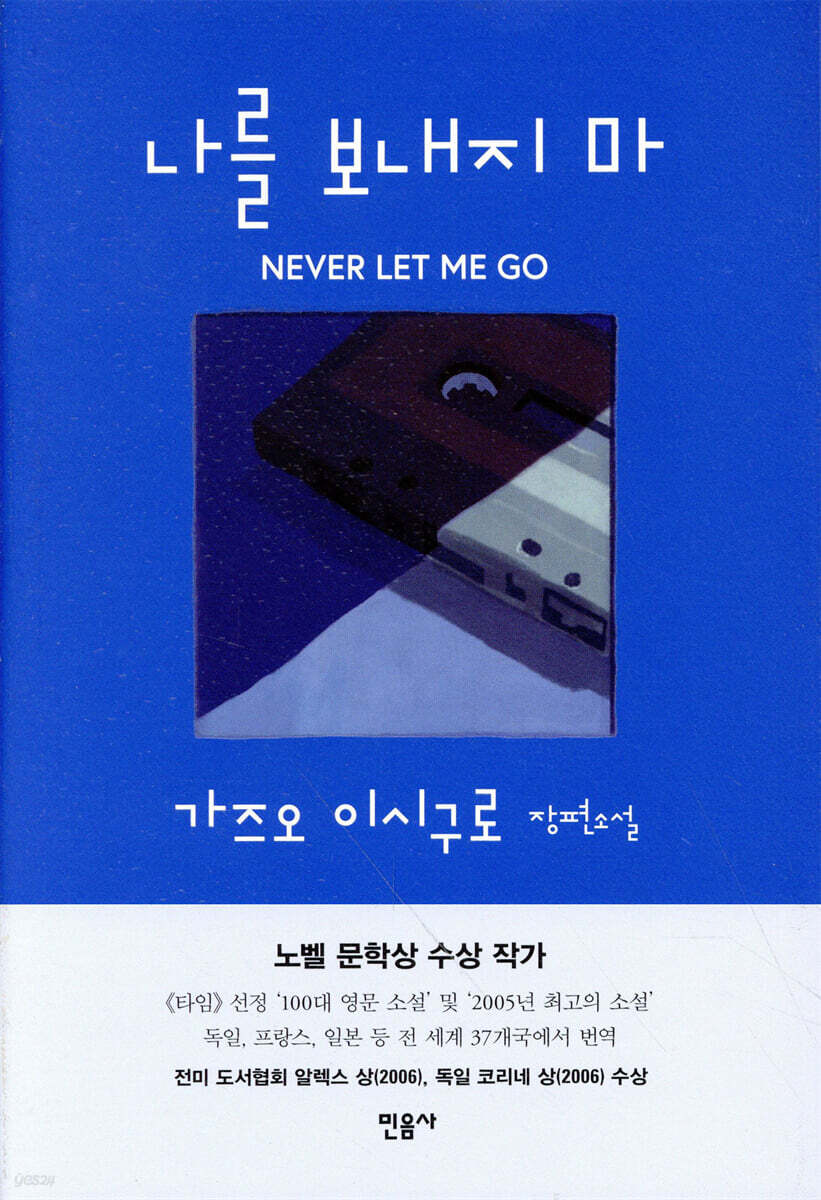
Don't let me go
 |
Description
Book Introduction
“Does anyone think I have no soul?”
A novel that seriously reflects on human dignity through the subject of cloned humans.
Kazuo Ishiguro, winner of the 2017 Nobel Prize in Literature and a leading figure in contemporary English-speaking literature, has published his masterpiece, Never Let Me Go, in a new design and format after a comprehensive translation revision.
This book depicts the love, sex, and sad fate of clones who have been cloned for the purpose of human organ transplantation through the eyes of Cassie, who works as a nurse after graduating from Hailsham, a boarding school cut off from the outside world in the late 1990s in England.
'Hailsham' appears peaceful like any other rural school, but is completely cut off from the outside world.
One day, Teacher Ruth tells her students that their fate has already been decided.
They are beings cloned for human organ transplantation.
The teacher's shocking remarks make the children seriously think about their own existence...
This novel deals with the ethical issues of human cloning and the dignity of cloned humans, as seen in the film The Island.
"Don't Let Me Go" questions the dignity of life through the life of a cloned human who, like humans, is a complete living being but lives on the premise of sacrificing himself for human desires.
The author emphasizes that even cloned humans only have one life, and in this work, reflects on how our way of life is moving into the realm of science.
This work became a hot topic when it was selected as one of Time's '100 Best English Novels' and 'Best Novels of 2005', and won the National Book Association Alex Award and Germany's Corine Prize.
It also received significant attention in the English-speaking world, having been translated into 37 countries around the world, including Germany, France, and Japan, and being made into a film in 2010 by director Mark Romanek, who also directed "Stoker."
A novel that seriously reflects on human dignity through the subject of cloned humans.
Kazuo Ishiguro, winner of the 2017 Nobel Prize in Literature and a leading figure in contemporary English-speaking literature, has published his masterpiece, Never Let Me Go, in a new design and format after a comprehensive translation revision.
This book depicts the love, sex, and sad fate of clones who have been cloned for the purpose of human organ transplantation through the eyes of Cassie, who works as a nurse after graduating from Hailsham, a boarding school cut off from the outside world in the late 1990s in England.
'Hailsham' appears peaceful like any other rural school, but is completely cut off from the outside world.
One day, Teacher Ruth tells her students that their fate has already been decided.
They are beings cloned for human organ transplantation.
The teacher's shocking remarks make the children seriously think about their own existence...
This novel deals with the ethical issues of human cloning and the dignity of cloned humans, as seen in the film The Island.
"Don't Let Me Go" questions the dignity of life through the life of a cloned human who, like humans, is a complete living being but lives on the premise of sacrificing himself for human desires.
The author emphasizes that even cloned humans only have one life, and in this work, reflects on how our way of life is moving into the realm of science.
This work became a hot topic when it was selected as one of Time's '100 Best English Novels' and 'Best Novels of 2005', and won the National Book Association Alex Award and Germany's Corine Prize.
It also received significant attention in the English-speaking world, having been translated into 37 countries around the world, including Germany, France, and Japan, and being made into a film in 2010 by director Mark Romanek, who also directed "Stoker."
index
Part 1, Chapter 11
Part 2 201
Part 3 353
Translator's Note 492
Part 2 201
Part 3 353
Translator's Note 492
Into the book
“Anyway, the teacher was trembling while saying this.”
“What are you talking about?”
“You were shaking.
I mean, in anger.
I could see it.
The teacher was overcome with anger.
“I’m talking about the anger that boils from the depths of my heart.”
--- p.57
But did we really believe that Hwarang existed?
Now I can't be sure.
As I said before, we never talked about such things in front of the teachers.
Looking back now, it seems like it wasn't really a decision the teachers made, but rather a rule we imposed on ourselves.
--- p.63
“Oh baby, baby, never let me go…….”
As the song was almost over, I suddenly opened my eyes, feeling that there was someone else in the room besides me.
Madam was standing in the doorway, looking at me.
I was frozen in shock.
The next moment a new kind of vigilance came over me.
--- p.130
“That wasn’t all.” Tommy’s voice was now almost a whisper.
"Do you remember what the teacher said to Roy back then—I don't think he meant to say it, but it was something he blurted out, Cathy? The teacher told Roy that things like paintings and poetry 'reveal the inner self of a person.'
“It reveals the soul,” he said.
--- p.305
But when we thought of Hailsham disappearing, everything around us seemed to change.
That's why Laura's suggestion that I become Ruth's caregiver that day resonated so deeply with me.
“What are you talking about?”
“You were shaking.
I mean, in anger.
I could see it.
The teacher was overcome with anger.
“I’m talking about the anger that boils from the depths of my heart.”
--- p.57
But did we really believe that Hwarang existed?
Now I can't be sure.
As I said before, we never talked about such things in front of the teachers.
Looking back now, it seems like it wasn't really a decision the teachers made, but rather a rule we imposed on ourselves.
--- p.63
“Oh baby, baby, never let me go…….”
As the song was almost over, I suddenly opened my eyes, feeling that there was someone else in the room besides me.
Madam was standing in the doorway, looking at me.
I was frozen in shock.
The next moment a new kind of vigilance came over me.
--- p.130
“That wasn’t all.” Tommy’s voice was now almost a whisper.
"Do you remember what the teacher said to Roy back then—I don't think he meant to say it, but it was something he blurted out, Cathy? The teacher told Roy that things like paintings and poetry 'reveal the inner self of a person.'
“It reveals the soul,” he said.
--- p.305
But when we thought of Hailsham disappearing, everything around us seemed to change.
That's why Laura's suggestion that I become Ruth's caregiver that day resonated so deeply with me.
--- p.366
Publisher's Review
Through the fate of cloned humans for the purpose of human organ transplantation.
A problematic work that seriously reflects on life, death, and human dignity.
Reflections and Critiques on the “Human Way of Life”
Don't Let Me Go is set in the late 1990s, but it presupposes a world where human cloning is possible.
There are already numerous concentration camps that cultivate cloned humans for the purpose of organ transplantation, and their operating policies and methods vary widely.
Hailsham, a boarding school completely cut off from the outside world, is one such place.
Cathy, Ruth, and Tommy, who spent their school days together in 'Hailsham', are clones, but they have reason, emotions, and can think for themselves.
They constantly think about their 'origin', the source of their being, and while silently accepting the fate of organ donors, they hope to extend their own lives a little longer.
The human desire to extend life has long been expressed through endless experiments in genetic engineering and life sciences, and through works that feature genetic cloning in popular culture, including literature and film.
Dystopian works such as Margaret Atwood's "The End of Man Report," Aldous Huxley's "Brave New World," and Michael Bay's "The Island" warn of the dangers of a new world created by advanced scientific advancements.
But this work doesn't stop there, it goes one step further.
It questions the dignity of life through the life of a cloned human who, like humans, is a complete living being but lives on the premise of sacrificing himself for human desires.
In the final part of the novel, the protagonist and narrator, Cathy, laments, “Does anyone think we have no souls?” after learning of the reality of the lives that are demanded of us differently.
Because for them, as clones, it is “only one life.”
Tommy spits out that "this whole thing is just a shame," as he says that Lucy, the teacher at Hailsham who was fired for trying to make them face the truth, was right.
Tommy's words contain the author's sharp criticism of humanity and civilization.
This work addresses the cutting-edge question of whether future humanity would be happy if it were actually possible to extend one's life by killing a cloned human, a living being with reason and emotion.
And without these concerns, he sternly warns that the future may become a dystopia rather than a utopia.
In an interview, the author said that through this work he wanted to “pay attention to the human way of life.”
The Evening Standard also commented that it was “not a warning about the dangers of human cloning, but rather an insight into how the way we live is moving into the realm of science.”
This perspective also runs through the author's entire world of works, which are based on Eastern philosophy.
Never Let Me Go
'Never Let Me Go', which is also the original title of the novel, was originally the title of a song on the third track of Judy Bridgewater's pop song cassette tape.
In this work, the cassette tape containing "Never Let Me Go" is a major motif that shows the differences in perspective between humans and cloned humans, and is also a motif that leads the novel by continuing the friendship and subtle feelings of love between the three main characters.
One afternoon, in her boarding school bedroom, Cathy puts on the tape, hugs her pillow, closes her eyes, and slowly dances along to the pop song's chorus.
“Oh, baby, baby, never let me go...” Cassie interprets the song differently from its original meaning.
It is a scene where a miracle happens to a woman who has been desperately hoping for a baby all her life but has been unable to have a baby, and she gives birth to a baby. She holds the baby in her arms and recites a refrain to the baby that means, “Don’t abandon me.”
But at this moment, Madame, an outsider involved in the operation of 'Hailsham', witnesses the scene and wipes away tears.
If Cassie projected her own fate as a clone who cannot have children onto the song, Madame felt pity for Cassie's gesture, seeing it as a desperate resistance to a new world where scientific advancements have made human life extension possible.
This also shows the point where the infinitely 'human' perspective of Cash and the coolly rational, 'ordinary' perspective of Madame intersect.
After this incident, Cassie loses her cassette tape, which was a precious treasure to her, and never finds it again.
A few years later, they visit Norfolk, 'the nation's lost and found'.
In a local prop shop, Cassie finds a cassette tape similar to the one she lost earlier, and receives it as a gift from Tommy.
From then on, for Cathy, the cassette tape became 'a memory of Tommy, with whom she once had feelings for each other', and she remembered it for the rest of her life as 'a longing for the Hailsham in her memories', which is now a closed school and gone.
This work provokes serious reflection on the dignity of human life, life and death, in a “unique way that confronts readers with the rawness of death and loss and the unbearable fragility of those we love” (Times Literary Supplement).
This work, which highlights the author's refined writing style, will provide an opportunity to reflect on human dignity, modern society, and the achievements of science and technology.
The media's outpouring of praise for "Don't Let Me Go"
· Ishiguro is a man of overwhelming and original genius.
―The New York Times
· Ishiguro is a poet.
He uses the framework of science fiction to shed light on ordinary human life, the human soul, human sexuality, love, creativity, and the innocence of childhood.
―The Independent
· "Don't Let Me Go" is not a warning about the dangers of human cloning, but rather an insight into how the way we live is moving into the realm of science.
The novel argues that no great knowledge can surpass a warm heart.
Among the novels written in this way, it is particularly pure and profound.
―Evening Standard
· Ishiguro has found an original way to avoid the ordinary and confront readers with the raw realities of death and loss, and the unbearable fragility of those we love.
―The Times Literary Supplement
· Ishiguro is a writer with a unique style who knows that the truth is often not told.
―MacLeans
· Kazuo Ishiguro is one of the poets who best represents loss.
- The Times
· One of the most sophisticated writers of our time.
- Michael Ondaatje
A problematic work that seriously reflects on life, death, and human dignity.
Reflections and Critiques on the “Human Way of Life”
Don't Let Me Go is set in the late 1990s, but it presupposes a world where human cloning is possible.
There are already numerous concentration camps that cultivate cloned humans for the purpose of organ transplantation, and their operating policies and methods vary widely.
Hailsham, a boarding school completely cut off from the outside world, is one such place.
Cathy, Ruth, and Tommy, who spent their school days together in 'Hailsham', are clones, but they have reason, emotions, and can think for themselves.
They constantly think about their 'origin', the source of their being, and while silently accepting the fate of organ donors, they hope to extend their own lives a little longer.
The human desire to extend life has long been expressed through endless experiments in genetic engineering and life sciences, and through works that feature genetic cloning in popular culture, including literature and film.
Dystopian works such as Margaret Atwood's "The End of Man Report," Aldous Huxley's "Brave New World," and Michael Bay's "The Island" warn of the dangers of a new world created by advanced scientific advancements.
But this work doesn't stop there, it goes one step further.
It questions the dignity of life through the life of a cloned human who, like humans, is a complete living being but lives on the premise of sacrificing himself for human desires.
In the final part of the novel, the protagonist and narrator, Cathy, laments, “Does anyone think we have no souls?” after learning of the reality of the lives that are demanded of us differently.
Because for them, as clones, it is “only one life.”
Tommy spits out that "this whole thing is just a shame," as he says that Lucy, the teacher at Hailsham who was fired for trying to make them face the truth, was right.
Tommy's words contain the author's sharp criticism of humanity and civilization.
This work addresses the cutting-edge question of whether future humanity would be happy if it were actually possible to extend one's life by killing a cloned human, a living being with reason and emotion.
And without these concerns, he sternly warns that the future may become a dystopia rather than a utopia.
In an interview, the author said that through this work he wanted to “pay attention to the human way of life.”
The Evening Standard also commented that it was “not a warning about the dangers of human cloning, but rather an insight into how the way we live is moving into the realm of science.”
This perspective also runs through the author's entire world of works, which are based on Eastern philosophy.
Never Let Me Go
'Never Let Me Go', which is also the original title of the novel, was originally the title of a song on the third track of Judy Bridgewater's pop song cassette tape.
In this work, the cassette tape containing "Never Let Me Go" is a major motif that shows the differences in perspective between humans and cloned humans, and is also a motif that leads the novel by continuing the friendship and subtle feelings of love between the three main characters.
One afternoon, in her boarding school bedroom, Cathy puts on the tape, hugs her pillow, closes her eyes, and slowly dances along to the pop song's chorus.
“Oh, baby, baby, never let me go...” Cassie interprets the song differently from its original meaning.
It is a scene where a miracle happens to a woman who has been desperately hoping for a baby all her life but has been unable to have a baby, and she gives birth to a baby. She holds the baby in her arms and recites a refrain to the baby that means, “Don’t abandon me.”
But at this moment, Madame, an outsider involved in the operation of 'Hailsham', witnesses the scene and wipes away tears.
If Cassie projected her own fate as a clone who cannot have children onto the song, Madame felt pity for Cassie's gesture, seeing it as a desperate resistance to a new world where scientific advancements have made human life extension possible.
This also shows the point where the infinitely 'human' perspective of Cash and the coolly rational, 'ordinary' perspective of Madame intersect.
After this incident, Cassie loses her cassette tape, which was a precious treasure to her, and never finds it again.
A few years later, they visit Norfolk, 'the nation's lost and found'.
In a local prop shop, Cassie finds a cassette tape similar to the one she lost earlier, and receives it as a gift from Tommy.
From then on, for Cathy, the cassette tape became 'a memory of Tommy, with whom she once had feelings for each other', and she remembered it for the rest of her life as 'a longing for the Hailsham in her memories', which is now a closed school and gone.
This work provokes serious reflection on the dignity of human life, life and death, in a “unique way that confronts readers with the rawness of death and loss and the unbearable fragility of those we love” (Times Literary Supplement).
This work, which highlights the author's refined writing style, will provide an opportunity to reflect on human dignity, modern society, and the achievements of science and technology.
The media's outpouring of praise for "Don't Let Me Go"
· Ishiguro is a man of overwhelming and original genius.
―The New York Times
· Ishiguro is a poet.
He uses the framework of science fiction to shed light on ordinary human life, the human soul, human sexuality, love, creativity, and the innocence of childhood.
―The Independent
· "Don't Let Me Go" is not a warning about the dangers of human cloning, but rather an insight into how the way we live is moving into the realm of science.
The novel argues that no great knowledge can surpass a warm heart.
Among the novels written in this way, it is particularly pure and profound.
―Evening Standard
· Ishiguro has found an original way to avoid the ordinary and confront readers with the raw realities of death and loss, and the unbearable fragility of those we love.
―The Times Literary Supplement
· Ishiguro is a writer with a unique style who knows that the truth is often not told.
―MacLeans
· Kazuo Ishiguro is one of the poets who best represents loss.
- The Times
· One of the most sophisticated writers of our time.
- Michael Ondaatje
GOODS SPECIFICS
- Publication date: April 9, 2021
- Format: Hardcover book binding method guide
- Page count, weight, size: 500 pages | 712g | 137*195*33mm
- ISBN13: 9788937444371
- ISBN10: 8937444372
You may also like
카테고리
korean


korean

![ELLE 엘르 스페셜 에디션 A형 : 12월 [2025]](http://librairie.coreenne.fr/cdn/shop/files/b8e27a3de6c9538896439686c6b0e8fb.jpg?v=1766436872&width=3840)


