

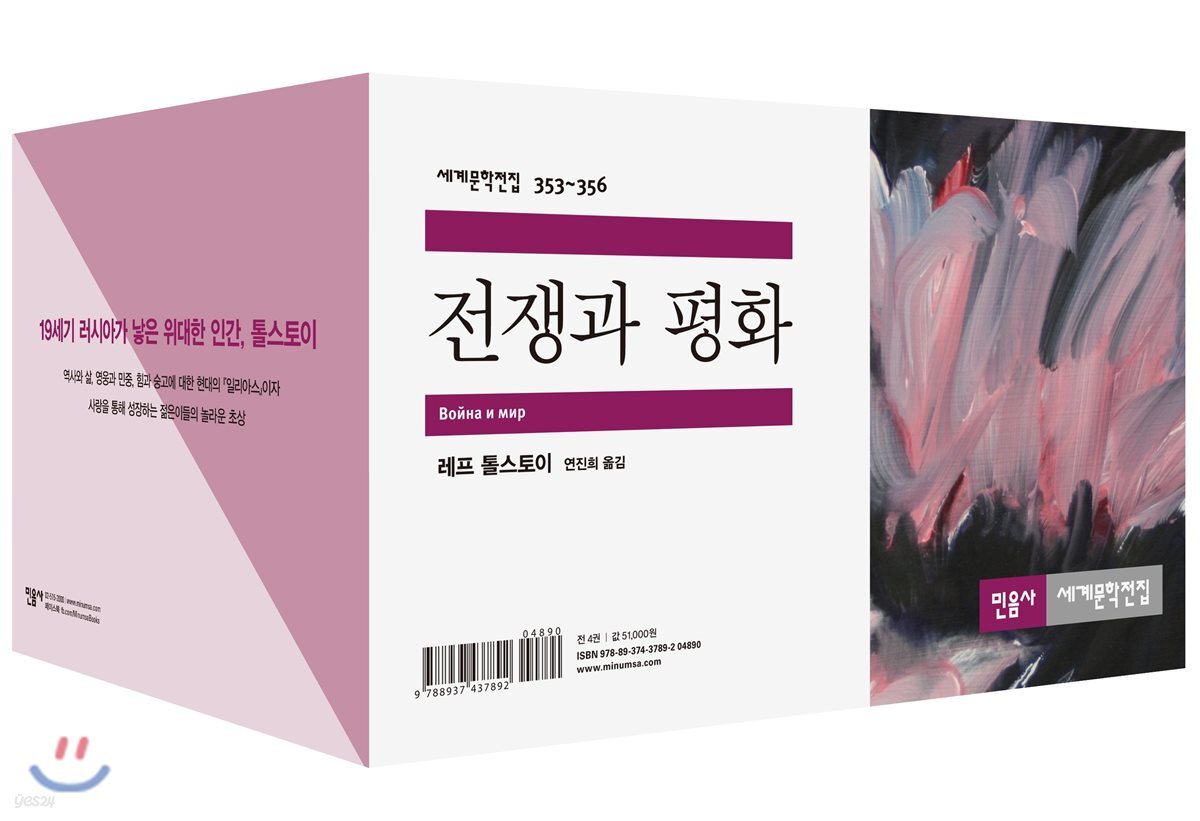
War and Peace Set
 |
Description
Book Introduction
Tolstoy, a great man born in 19th-century Russia
A modern-day Iliad about history and life, heroes and the people, power and sublimity.
A striking portrait of young people growing through love.
The four-volume set of "War and Peace" has been published.
『War and Peace』 by Leo Tolstoy, a representative Russian author, has been published in Minumsa's World Literature Collection.
Yeon Jin-hee, who created a new readership for Russian classics by displaying a youthful and delicate sensibility through 'Anna Karenina', was in charge of the translation.
This work is Tolstoy's representative work, depicting the providence of nature and human history against the backdrop of the vast space of Russia over a period of approximately 15 years from 1805 to 1820.
With a total of 559 characters, the vast narrative entangled in a great war is not only imbued with a natural rhythm, but also the cold gaze that looks down on the fate of humanity on the bloody battlefield creates an epic grandeur comparable to that of the Iliad.
The story of Andrei, the ruthless nihilist, Pierre, the wealthy and dissolute heir, and Natasha, who falls into fatal temptation, overcoming their own trials and discovering their own 'cosmic selves' is not only a story of individual growth, but also a coming-of-age novel of Russia itself, a story of realizing great potential through war and shame.
▶ The Iliad, the most extensive epic poem of our time and a modern-day version.
- Romain Rolland
▶ Tolstoy is the greatest novelist of all novelists.
What other name can one give to the author of War and Peace? - Virginia Woolf
▶ As we continue to read this grand novel, depicting both wars, we are struck by the novel's achievement of totality, and are astonished that a mere 'individual' can ultimately express the 'whole' in this way.
- Kenzaburo Oe
A modern-day Iliad about history and life, heroes and the people, power and sublimity.
A striking portrait of young people growing through love.
The four-volume set of "War and Peace" has been published.
『War and Peace』 by Leo Tolstoy, a representative Russian author, has been published in Minumsa's World Literature Collection.
Yeon Jin-hee, who created a new readership for Russian classics by displaying a youthful and delicate sensibility through 'Anna Karenina', was in charge of the translation.
This work is Tolstoy's representative work, depicting the providence of nature and human history against the backdrop of the vast space of Russia over a period of approximately 15 years from 1805 to 1820.
With a total of 559 characters, the vast narrative entangled in a great war is not only imbued with a natural rhythm, but also the cold gaze that looks down on the fate of humanity on the bloody battlefield creates an epic grandeur comparable to that of the Iliad.
The story of Andrei, the ruthless nihilist, Pierre, the wealthy and dissolute heir, and Natasha, who falls into fatal temptation, overcoming their own trials and discovering their own 'cosmic selves' is not only a story of individual growth, but also a coming-of-age novel of Russia itself, a story of realizing great potential through war and shame.
▶ The Iliad, the most extensive epic poem of our time and a modern-day version.
- Romain Rolland
▶ Tolstoy is the greatest novelist of all novelists.
What other name can one give to the author of War and Peace? - Virginia Woolf
▶ As we continue to read this grand novel, depicting both wars, we are struck by the novel's achievement of totality, and are astonished that a mere 'individual' can ultimately express the 'whole' in this way.
- Kenzaburo Oe
index
Volume 1
Part 1, Chapter 11
Part 2 269
Part 3 475
Map of the Austrian Expedition of 1805
Volume 2
Part 1, Chapter 11
Part 2 137
Part 3 305
Part 4, 479
Part 5 591
Volume 3
Part 1, Chapter 11
Part 2 199
Part 3 515
Map of the War of 1812
Volume 4
Part 1, Chapter 11
Part 2 133
Part 3 237
Part 4, 341
Epilogue Part 1 463
Epilogue Part 2 589
Appendix: Notes on War and Peace 672
Commentary on the work 689
Author's Chronology 714
Part 1, Chapter 11
Part 2 269
Part 3 475
Map of the Austrian Expedition of 1805
Volume 2
Part 1, Chapter 11
Part 2 137
Part 3 305
Part 4, 479
Part 5 591
Volume 3
Part 1, Chapter 11
Part 2 199
Part 3 515
Map of the War of 1812
Volume 4
Part 1, Chapter 11
Part 2 133
Part 3 237
Part 4, 341
Epilogue Part 1 463
Epilogue Part 2 589
Appendix: Notes on War and Peace 672
Commentary on the work 689
Author's Chronology 714
Into the book
Just as the little duchess arrived, a stout, fat man entered.
(…) In fact, Pierre was a little bigger than the other men in the drawing room, but the fear was probably only due to that intelligent yet timid, sharp yet natural gaze that made him different from everyone else in the drawing room.
---From "Volume 1, Part 1, Chapter 2"
Natasha, sitting across from him, was looking at Boris with the same expression a thirteen-year-old girl might have when looking at a boy she'd just kissed and fallen in love with.
The gaze would occasionally turn to Pierre.
Whenever he caught the eye of this fun and lively girl, he felt like smiling for no reason.
---From "Volume 1, Part 1, Chapter 15"
While the twos took their places and the musicians played in unison, Pierre sat down next to the little lady.
Natasha was beyond happy.
Dancing with an adult, and a man who just returned from abroad.
She sat in front of everyone and talked to him like an adult.
---From "Volume 1, Part 1, Chapter 17"
“Well, it’s goodbye!” He said, making his son kiss his hand and hugging him.
“Remember one thing, Prince Andrey.
“If you die, I, this old man, will suffer.” He fell into an unexpected silence, then suddenly spoke in a high, shrill voice.
“But if I find out that you have not behaved properly as the son of Nikolai Bolkonsky, I will be... ashamed!” he cried sharply.
---From "Volume 1, Part 1, Chapter 25"
At this moment, all the interests that had occupied Napoleon seemed utterly pathetic to him.
Compared to the high, fair, and good heavens he had seen and come to understand, his hero, with his low vanity and joy in victory, seemed so pathetic.
---From "Volume 1, Part 3, Chapter 19"
“Sonya! Sonya!” The first voice was heard again.
"Oh, how can you sleep! Look at how beautiful you are! Oh, how beautiful you are! Open your eyes, Sonya," she said, her voice almost tearful.
“Truly, there has never been such a beautiful night, not even once.” ---From “Volume 2, Part 3, Chapter 3”
Natasha returned home and couldn't sleep all night.
Who was it she loved, Anatol or Prince Andrei? This unsolvable question tormented her.
She loved Prince Andrey.
I remembered clearly how passionately I loved him.
But Anatole loved her too.
---From "Volume 2, Part 5, Chapter 13"
The horrifying sight of the battlefield that day overwhelmed the mental strength he had always considered his own strength and greatness.
(…) Napoleon sat in his folding chair with his eyes downcast, listening to the sound of the cannons without realizing it, with his face yellow and swollen, looking miserable, his eyes clouded, his nose red, and his voice cracking.
He waited for the battle to end in a morbid melancholy.
---From "Volume 3, Part 2, Chapter 38"
The Countess was terrified at the thought that Prince Andrei might die in his daughter's arms on the journey (which, according to the doctors, was very likely), but she could not object to Natasha.
(…) The unresolved question of life and death, which hung over not only Bolkonsky but all of Russia, obscured all other predictions.
---From "Volume 3, Part 3, Chapter 32"
But the peaceful and glamorous life of Petersburg, concerned only with the illusion of life and its shadows, continued as before.
In this flow of life, it took a lot of effort to recognize the difficult situation and crisis that the Russian people were facing.
---From "Volume 4, Part 1, Chapter 1"
No one, watching the burning of Moscow, swore revenge on the French.
They were just thinking about their next paycheck, their next camp, and the matryoshka dolls from the military commissary.
---From "Volume 4, Part 1, Chapter 4"
“Brothers! Look here!” cried the old soldiers, weeping and embracing the Cossacks and light cavalry.
Light cavalry and Cossacks surrounded the prisoners and hurriedly offered some clothes, some boots, and some bread.
Pierre sat among them and sobbed.
I couldn't utter a single word.
He hugged the first soldier who approached him and kissed him while crying.
---From "Volume 4, Part 3, Chapter 15"
Freedom, the full and absolute freedom given to man by nature, a freedom he had first realized in his life at his first rest stop after leaving Moscow, filled Pierre's soul during his convalescence.
---From "Volume 4, Part 4, Chapter 12"
Pierre's madness was not that he waited for a personal motive—what he called human virtue—to love someone, as he had done before, but that love filled his heart so that he loved someone without reason and found a clear motive for loving them.
(…) In fact, Pierre was a little bigger than the other men in the drawing room, but the fear was probably only due to that intelligent yet timid, sharp yet natural gaze that made him different from everyone else in the drawing room.
---From "Volume 1, Part 1, Chapter 2"
Natasha, sitting across from him, was looking at Boris with the same expression a thirteen-year-old girl might have when looking at a boy she'd just kissed and fallen in love with.
The gaze would occasionally turn to Pierre.
Whenever he caught the eye of this fun and lively girl, he felt like smiling for no reason.
---From "Volume 1, Part 1, Chapter 15"
While the twos took their places and the musicians played in unison, Pierre sat down next to the little lady.
Natasha was beyond happy.
Dancing with an adult, and a man who just returned from abroad.
She sat in front of everyone and talked to him like an adult.
---From "Volume 1, Part 1, Chapter 17"
“Well, it’s goodbye!” He said, making his son kiss his hand and hugging him.
“Remember one thing, Prince Andrey.
“If you die, I, this old man, will suffer.” He fell into an unexpected silence, then suddenly spoke in a high, shrill voice.
“But if I find out that you have not behaved properly as the son of Nikolai Bolkonsky, I will be... ashamed!” he cried sharply.
---From "Volume 1, Part 1, Chapter 25"
At this moment, all the interests that had occupied Napoleon seemed utterly pathetic to him.
Compared to the high, fair, and good heavens he had seen and come to understand, his hero, with his low vanity and joy in victory, seemed so pathetic.
---From "Volume 1, Part 3, Chapter 19"
“Sonya! Sonya!” The first voice was heard again.
"Oh, how can you sleep! Look at how beautiful you are! Oh, how beautiful you are! Open your eyes, Sonya," she said, her voice almost tearful.
“Truly, there has never been such a beautiful night, not even once.” ---From “Volume 2, Part 3, Chapter 3”
Natasha returned home and couldn't sleep all night.
Who was it she loved, Anatol or Prince Andrei? This unsolvable question tormented her.
She loved Prince Andrey.
I remembered clearly how passionately I loved him.
But Anatole loved her too.
---From "Volume 2, Part 5, Chapter 13"
The horrifying sight of the battlefield that day overwhelmed the mental strength he had always considered his own strength and greatness.
(…) Napoleon sat in his folding chair with his eyes downcast, listening to the sound of the cannons without realizing it, with his face yellow and swollen, looking miserable, his eyes clouded, his nose red, and his voice cracking.
He waited for the battle to end in a morbid melancholy.
---From "Volume 3, Part 2, Chapter 38"
The Countess was terrified at the thought that Prince Andrei might die in his daughter's arms on the journey (which, according to the doctors, was very likely), but she could not object to Natasha.
(…) The unresolved question of life and death, which hung over not only Bolkonsky but all of Russia, obscured all other predictions.
---From "Volume 3, Part 3, Chapter 32"
But the peaceful and glamorous life of Petersburg, concerned only with the illusion of life and its shadows, continued as before.
In this flow of life, it took a lot of effort to recognize the difficult situation and crisis that the Russian people were facing.
---From "Volume 4, Part 1, Chapter 1"
No one, watching the burning of Moscow, swore revenge on the French.
They were just thinking about their next paycheck, their next camp, and the matryoshka dolls from the military commissary.
---From "Volume 4, Part 1, Chapter 4"
“Brothers! Look here!” cried the old soldiers, weeping and embracing the Cossacks and light cavalry.
Light cavalry and Cossacks surrounded the prisoners and hurriedly offered some clothes, some boots, and some bread.
Pierre sat among them and sobbed.
I couldn't utter a single word.
He hugged the first soldier who approached him and kissed him while crying.
---From "Volume 4, Part 3, Chapter 15"
Freedom, the full and absolute freedom given to man by nature, a freedom he had first realized in his life at his first rest stop after leaving Moscow, filled Pierre's soul during his convalescence.
---From "Volume 4, Part 4, Chapter 12"
Pierre's madness was not that he waited for a personal motive—what he called human virtue—to love someone, as he had done before, but that love filled his heart so that he loved someone without reason and found a clear motive for loving them.
---From "Volume 4, Part 4, Chapter 19"
Publisher's Review
A story about all beings growing through love.
The three main characters, Pierre, Andrei, and Natasha, are all going through an immature and anxious youth.
Pierre, who inherits a huge fortune overnight and falls into a life of debauchery, Andrei, who is tormented by regret for his dead wife, and Natasha, who falls into a fatal temptation when her unique vitality becomes a trap, confirm their conflicting feelings in the midst of crises that shake up their respective lives.
In the time of youth when only those who love grow, will they be able to meet again, each with their own unique wounds?
This massive novel, featuring 559 characters including real-life figures such as Alexander I, Napoleon, and Kutuzov, can be summarized in one word: 'growth.'
This is because the process of each character overcoming their own hardships and discovering their own 'cosmic self' soon expands into the growth of Russia itself.
Tolstoy believed that “individual experiences, private relationships between individuals, colors, smells and tastes, sounds and movements, jealousy, love and hate” were the true elements that make up life.
War and Peace shows how he discovered the new Russian power not in its borders but in the multitude of its people.
The human world seen from the perspective of the Iliad
Romain Rolland called War and Peace “the greatest epic of our time, a modern Iliad.”
Indeed, in 1857 Tolstoy wrote in his diary that he was “reading the Iliad and the Gospels with the greatest interest, and that I had just read the unimaginably beautiful ending of the Iliad.”
The skill with which he gives a natural rhythm to the major epics that changed Russia's fate, such as the War of 1805 and the War of 1812, is certainly comparable to that of the Iliad.
Moreover, the cold gaze that looks down on the lives and deaths of humans on the bloody battlefield makes the reader feel an epic grandeur.
Into this sublime and indifferent world, Tolstoy breathed a surprisingly vibrant life force, creating a modern-day Iliad that puts emphasis on humanity rather than heroes.
Tolstoy Discovers the 'Little Russian'
“The purpose of our life is not simply to exist, but to live with dignity.”
-Sergei Grigorievich Bolkonsky
The great story of War and Peace begins with an old man from the Russian upper class who was stripped of all his privileges and released after 30 years of exile.
Sergei Bolkonsky, who paid a heavy price for advocating constitutionalism and the emancipation of serfs at the coronation of Nicholas I.
The goal of his life, to which he had staked everything, was to 'live with dignity', and although he met Tolstoy only once when he was thirty-two, he was an inspiration to him for the rest of his life.
“At this moment, all the interests that had occupied Napoleon seemed utterly pathetic to him.
“Compared to the high, fair, and good heavens that he had seen and come to measure, his hero, with his low vanity and joy in victory, seemed so pathetic.” —Book 1, Part 3, Chapter 19
In War and Peace, Andrei and Pierre, who were Napoleon admirers, wake up from their illusions after experiencing war.
This is because I have personally witnessed that real wars are fought not by the wisdom of individual heroes, but by the will of countless common people.
It was the 'Little Russians' who drove history.
And dignity was their lot.
Tolstoy's interest in the people extended beyond his works and into real life.
To improve the poor educational conditions of the peasants, he published the magazine Yasnaya Polyana, and did not hesitate to confront the Russian authorities in the process of relocating the persecuted Dukhoborites to Canada.
Before he knew it, he had grown old, just like Sergei Bolkonsky.
And he became the model for all humans who struggle to 'live with dignity' on the battlefield called life.
The three main characters, Pierre, Andrei, and Natasha, are all going through an immature and anxious youth.
Pierre, who inherits a huge fortune overnight and falls into a life of debauchery, Andrei, who is tormented by regret for his dead wife, and Natasha, who falls into a fatal temptation when her unique vitality becomes a trap, confirm their conflicting feelings in the midst of crises that shake up their respective lives.
In the time of youth when only those who love grow, will they be able to meet again, each with their own unique wounds?
This massive novel, featuring 559 characters including real-life figures such as Alexander I, Napoleon, and Kutuzov, can be summarized in one word: 'growth.'
This is because the process of each character overcoming their own hardships and discovering their own 'cosmic self' soon expands into the growth of Russia itself.
Tolstoy believed that “individual experiences, private relationships between individuals, colors, smells and tastes, sounds and movements, jealousy, love and hate” were the true elements that make up life.
War and Peace shows how he discovered the new Russian power not in its borders but in the multitude of its people.
The human world seen from the perspective of the Iliad
Romain Rolland called War and Peace “the greatest epic of our time, a modern Iliad.”
Indeed, in 1857 Tolstoy wrote in his diary that he was “reading the Iliad and the Gospels with the greatest interest, and that I had just read the unimaginably beautiful ending of the Iliad.”
The skill with which he gives a natural rhythm to the major epics that changed Russia's fate, such as the War of 1805 and the War of 1812, is certainly comparable to that of the Iliad.
Moreover, the cold gaze that looks down on the lives and deaths of humans on the bloody battlefield makes the reader feel an epic grandeur.
Into this sublime and indifferent world, Tolstoy breathed a surprisingly vibrant life force, creating a modern-day Iliad that puts emphasis on humanity rather than heroes.
Tolstoy Discovers the 'Little Russian'
“The purpose of our life is not simply to exist, but to live with dignity.”
-Sergei Grigorievich Bolkonsky
The great story of War and Peace begins with an old man from the Russian upper class who was stripped of all his privileges and released after 30 years of exile.
Sergei Bolkonsky, who paid a heavy price for advocating constitutionalism and the emancipation of serfs at the coronation of Nicholas I.
The goal of his life, to which he had staked everything, was to 'live with dignity', and although he met Tolstoy only once when he was thirty-two, he was an inspiration to him for the rest of his life.
“At this moment, all the interests that had occupied Napoleon seemed utterly pathetic to him.
“Compared to the high, fair, and good heavens that he had seen and come to measure, his hero, with his low vanity and joy in victory, seemed so pathetic.” —Book 1, Part 3, Chapter 19
In War and Peace, Andrei and Pierre, who were Napoleon admirers, wake up from their illusions after experiencing war.
This is because I have personally witnessed that real wars are fought not by the wisdom of individual heroes, but by the will of countless common people.
It was the 'Little Russians' who drove history.
And dignity was their lot.
Tolstoy's interest in the people extended beyond his works and into real life.
To improve the poor educational conditions of the peasants, he published the magazine Yasnaya Polyana, and did not hesitate to confront the Russian authorities in the process of relocating the persecuted Dukhoborites to Canada.
Before he knew it, he had grown old, just like Sergei Bolkonsky.
And he became the model for all humans who struggle to 'live with dignity' on the battlefield called life.
GOODS SPECIFICS
- Date of publication: June 15, 2018
- Page count, weight, size: 2,988 pages | 132*225*80mm
- ISBN13: 9788937437892
- ISBN10: 8937437899
You may also like
카테고리
korean


korean

![ELLE 엘르 스페셜 에디션 A형 : 12월 [2025]](http://librairie.coreenne.fr/cdn/shop/files/b8e27a3de6c9538896439686c6b0e8fb.jpg?v=1766436872&width=3840)


