

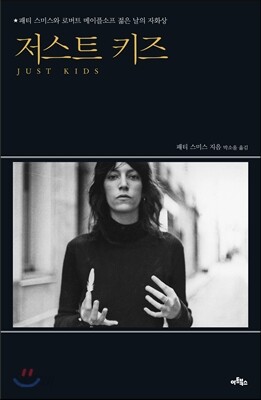
Just Kids
 |
Description
Book Introduction
A special autobiography by Patti Smith, the icon of female rockers.
A look back at his journey as an artist, with his companion Robert Mapplethorpe.
The 'godmother of punk music' and a giant in the history of female musicians, Patti Smith cannot be explained by her identity as a musician alone.
She is a true "all-rounder"—a poet, painter, and, at one time, a music critic, actress, and model. "Just Kids" tells the story of the special place and person that led her to become an artist.
The space is New York in the 1960s and 1970s, a time when artistic sensibility and revolutionary spirit were overflowing, and the person in question is Robert Mapplethorpe, a one-time lover and lifelong artistic comrade.
At the time, Robert Mapplethorpe was a young man as passionate about art as Patty, and he later gained fame as a photographer with bold works that revealed his gay sexuality.
The book begins with Patti Smith's first arrival in New York and meeting Robert, tracing their time together in artistic experimentation and their interactions with contemporary artists, leading up to Robert's death from AIDS in 1989.
In that sense, "Just Kids" is a portrait of Patti Smith and Robert Mapplethorpe, a tribute to the art city of New York, and a loving record of the artists who dominated that era.
The intense youthful journey of these two individuals, now masters of the art world, unfolds like a novel in Patti Smith's characteristically candid language.
Additionally, Patti Smith lists 'believing in yourself' and 'being true' as the most important attitudes for an artist in her writing.
If the Woodstock Festival of the late 1960s left a message that a utopian community spirit could transform society, this book is a record of hope, showing how the free human spirit and the desire for art can usher in a new era.
This kind of sensitivity is probably the driving force that allows Patti Smith to continue to experiment musically and to continue to speak out about reality.
Above all, the stories of the two artists resonate even more truthfully and simply because they are free from the clichés of autobiographies, such as the road to success or self-praise.
A look back at his journey as an artist, with his companion Robert Mapplethorpe.
The 'godmother of punk music' and a giant in the history of female musicians, Patti Smith cannot be explained by her identity as a musician alone.
She is a true "all-rounder"—a poet, painter, and, at one time, a music critic, actress, and model. "Just Kids" tells the story of the special place and person that led her to become an artist.
The space is New York in the 1960s and 1970s, a time when artistic sensibility and revolutionary spirit were overflowing, and the person in question is Robert Mapplethorpe, a one-time lover and lifelong artistic comrade.
At the time, Robert Mapplethorpe was a young man as passionate about art as Patty, and he later gained fame as a photographer with bold works that revealed his gay sexuality.
The book begins with Patti Smith's first arrival in New York and meeting Robert, tracing their time together in artistic experimentation and their interactions with contemporary artists, leading up to Robert's death from AIDS in 1989.
In that sense, "Just Kids" is a portrait of Patti Smith and Robert Mapplethorpe, a tribute to the art city of New York, and a loving record of the artists who dominated that era.
The intense youthful journey of these two individuals, now masters of the art world, unfolds like a novel in Patti Smith's characteristically candid language.
Additionally, Patti Smith lists 'believing in yourself' and 'being true' as the most important attitudes for an artist in her writing.
If the Woodstock Festival of the late 1960s left a message that a utopian community spirit could transform society, this book is a record of hope, showing how the free human spirit and the desire for art can usher in a new era.
This kind of sensitivity is probably the driving force that allows Patti Smith to continue to experiment musically and to continue to speak out about reality.
Above all, the stories of the two artists resonate even more truthfully and simply because they are free from the clichés of autobiographies, such as the road to success or self-praise.
- You can preview some of the book's contents.
Preview
index
To Korean readers
parting
Monday's Children
Just Kids
Chelsea Hotel
Together, even while going different ways
To God
Unfinished story
About Robert's Desk
The Chronicles of Robert Mapplethorpe
The Patti Smith Chronicles
Translator's Note
parting
Monday's Children
Just Kids
Chelsea Hotel
Together, even while going different ways
To God
Unfinished story
About Robert's Desk
The Chronicles of Robert Mapplethorpe
The Patti Smith Chronicles
Translator's Note
Into the book
We were both busy with work and didn't have time to go to a concert or a movie.
It was hard to buy albums, so I listened to the ones I already had over and over again.
I listened to "Madame Butterfly" by Eleanor Steber, "Love Supreme" by John Coltrane, "Between the Buttons" by the Rolling Stones, and "Blonde on Blonde" by Joan Baez and Bob Dylan.
Robert introduced me to musicians like the Vanilla Fudge Band, Tim Buckley, and Tim Hardin, and his History of Motown would often be the soundtrack to our sweet nights.
---p.66
In early June, Valerie Solanas shot Andy Warhol.
(……) He was quite fond of Andy Warhol and considered him the most important contemporary artist.
They worshipped him as if they were idolizing a hero.
I admired artists who did not separate life from art, such as Cocteau and the film director and poet Pasolini, but the person I admired most was Andy Warhol, the artist who recorded the mise-en-scène of humanity inside his silver-clad studio, the Factory.
I had a different opinion from Robert about Andy Warhol.
His work represented a culture I had little interest in getting close to.
I hated his Campbell's soup can artwork and couldn't relate to it at all.
I admired artists who led the times by pursuing their own artistic world rather than projecting and imitating their contemporaries.
--pp.96-97
To the left of our table, Janis Joplin was telling funny stories to her bandmates.
To the right, Grace Slick and other members of Jefferson Airplane sat with members of Country Joe and the Fish.
At the last table near the entrance, Jimi Hendrix was with some blonde beauty, his head down and his hat on, eating something.
El Quijote Bar was a haven for musicians, with shrimp dishes topped with green sauce, paella, sangria and bottles of tequila in front of them.
(……) As I went up to the room that night, I felt a bond with those musicians that was hard to describe in words, but it was a different feeling from something like a premonition.
At that time, I never imagined that I would end up following their path.
I was just a twenty-two-year-old bookstore clerk struggling with a few unfinished poems.
--pp.142-143
I was thinking that this was a truly interesting and mysterious hotel lobby when suddenly, as if the wind was whistling, the heavy glass door opened and a strangely familiar figure wearing black clothes and a crimson cloak came in.
It was Salvador Dali.
He looked around the lobby nervously, then smiled at Raymond.
He placed his elegant, thin hand on my head and said:
“You look like a crow.
"Gothic Crow." ---p.176
If you look closely at Robert's work, you will see that his subjects are not shy.
I mean, I'm not saying, "I took my penis out, I'm sorry."
He wasn't ashamed, and he hoped no one else would be.
Robert wanted his models, whether they were genital-rubbing sadomasochistic men or elegant upper-class men, to be delighted with the results and to feel confident in their interactions with him.
(……) When asked why he took such a photo, he replied that someone had to do it, and it was him.
He was given the privilege of filming extreme, consensual sex scenes because the models trusted him.
His intention was not to expose, but to bring sexuality into the realm of art, something no one else had attempted.
As an artist, what excites Robert most is creating something that no one else has thought of.
--pp.303-304
It goes without saying that Robert took the photo for the album cover of 『Hoshis』.
The only sheath that would fit the sword of my music was Robert's photo.
I didn't have any specific thoughts on how it should be, but what I wanted was for it to be truthful.
The only thing I asked of Robert was that he wear a clean shirt without a single blemish.
(……) A few days later, he showed me a close-up photo and said.
“This photo is a miracle.” Even now, when I look at that photo, I don’t see myself.
We can see ourselves that day.
--pp.318-321
One late afternoon, Robert and I were walking down 8th Avenue, and "Because the Night" was blaring from every store.
This song was written with Bruce Springsteen and is included in the album 'Easter'.
After finishing recording, I played the song for Robert first.
There was a good reason for that.
Because that's the style of song Robert always wanted me to do.
(……) Robert was very openly happy about my success.
I really hoped that would happen, for his sake and for each other.
He blew out a nice puff of smoke from his cigarette, then spoke to me in a tone he only used, a tone of slovenly reprimand, a tone of admiration that was not the slightest hint of jealousy, and slowly spoke to me in a language only we could understand.
"Patty, you got famous first." ---p.330
“Patty, I think I’m going to die.
“It hurts so much.” He looked at me with a mixture of love and reproach.
My love couldn't save him.
Even his yearning for life could not save him.
That was the first time I really felt like he was dying.
He was enduring pain that no one could endure.
When he looked at me with such an apologetic expression, I couldn't bear it anymore and burst into tears.
(……) The last time we sat together, sunlight streaming through the window poured over his picture and our poems.
Robert was dying, quietly creating silence.
I, who was destined to live, listened quietly to the sound of that quiet silence that proved that he was alive and breathing.
It was hard to buy albums, so I listened to the ones I already had over and over again.
I listened to "Madame Butterfly" by Eleanor Steber, "Love Supreme" by John Coltrane, "Between the Buttons" by the Rolling Stones, and "Blonde on Blonde" by Joan Baez and Bob Dylan.
Robert introduced me to musicians like the Vanilla Fudge Band, Tim Buckley, and Tim Hardin, and his History of Motown would often be the soundtrack to our sweet nights.
---p.66
In early June, Valerie Solanas shot Andy Warhol.
(……) He was quite fond of Andy Warhol and considered him the most important contemporary artist.
They worshipped him as if they were idolizing a hero.
I admired artists who did not separate life from art, such as Cocteau and the film director and poet Pasolini, but the person I admired most was Andy Warhol, the artist who recorded the mise-en-scène of humanity inside his silver-clad studio, the Factory.
I had a different opinion from Robert about Andy Warhol.
His work represented a culture I had little interest in getting close to.
I hated his Campbell's soup can artwork and couldn't relate to it at all.
I admired artists who led the times by pursuing their own artistic world rather than projecting and imitating their contemporaries.
--pp.96-97
To the left of our table, Janis Joplin was telling funny stories to her bandmates.
To the right, Grace Slick and other members of Jefferson Airplane sat with members of Country Joe and the Fish.
At the last table near the entrance, Jimi Hendrix was with some blonde beauty, his head down and his hat on, eating something.
El Quijote Bar was a haven for musicians, with shrimp dishes topped with green sauce, paella, sangria and bottles of tequila in front of them.
(……) As I went up to the room that night, I felt a bond with those musicians that was hard to describe in words, but it was a different feeling from something like a premonition.
At that time, I never imagined that I would end up following their path.
I was just a twenty-two-year-old bookstore clerk struggling with a few unfinished poems.
--pp.142-143
I was thinking that this was a truly interesting and mysterious hotel lobby when suddenly, as if the wind was whistling, the heavy glass door opened and a strangely familiar figure wearing black clothes and a crimson cloak came in.
It was Salvador Dali.
He looked around the lobby nervously, then smiled at Raymond.
He placed his elegant, thin hand on my head and said:
“You look like a crow.
"Gothic Crow." ---p.176
If you look closely at Robert's work, you will see that his subjects are not shy.
I mean, I'm not saying, "I took my penis out, I'm sorry."
He wasn't ashamed, and he hoped no one else would be.
Robert wanted his models, whether they were genital-rubbing sadomasochistic men or elegant upper-class men, to be delighted with the results and to feel confident in their interactions with him.
(……) When asked why he took such a photo, he replied that someone had to do it, and it was him.
He was given the privilege of filming extreme, consensual sex scenes because the models trusted him.
His intention was not to expose, but to bring sexuality into the realm of art, something no one else had attempted.
As an artist, what excites Robert most is creating something that no one else has thought of.
--pp.303-304
It goes without saying that Robert took the photo for the album cover of 『Hoshis』.
The only sheath that would fit the sword of my music was Robert's photo.
I didn't have any specific thoughts on how it should be, but what I wanted was for it to be truthful.
The only thing I asked of Robert was that he wear a clean shirt without a single blemish.
(……) A few days later, he showed me a close-up photo and said.
“This photo is a miracle.” Even now, when I look at that photo, I don’t see myself.
We can see ourselves that day.
--pp.318-321
One late afternoon, Robert and I were walking down 8th Avenue, and "Because the Night" was blaring from every store.
This song was written with Bruce Springsteen and is included in the album 'Easter'.
After finishing recording, I played the song for Robert first.
There was a good reason for that.
Because that's the style of song Robert always wanted me to do.
(……) Robert was very openly happy about my success.
I really hoped that would happen, for his sake and for each other.
He blew out a nice puff of smoke from his cigarette, then spoke to me in a tone he only used, a tone of slovenly reprimand, a tone of admiration that was not the slightest hint of jealousy, and slowly spoke to me in a language only we could understand.
"Patty, you got famous first." ---p.330
“Patty, I think I’m going to die.
“It hurts so much.” He looked at me with a mixture of love and reproach.
My love couldn't save him.
Even his yearning for life could not save him.
That was the first time I really felt like he was dying.
He was enduring pain that no one could endure.
When he looked at me with such an apologetic expression, I couldn't bear it anymore and burst into tears.
(……) The last time we sat together, sunlight streaming through the window poured over his picture and our poems.
Robert was dying, quietly creating silence.
I, who was destined to live, listened quietly to the sound of that quiet silence that proved that he was alive and breathing.
---p.347
Publisher's Review
A cultural map of New York City, a city brimming with artistic experimentation in the 1960s and 1970s.
A vivid encounter with contemporary artists, from Allen Ginsberg to Janis Joplin.
Even in the 1970s, when the revolutionary cries of the hippies that had adorned the 1960s had faded, experiments to open up a new culture continued throughout New York.
A prime example was New York's underground club CBGB, where groups like Television and the Raymonds experimented with punk rock and served as a gateway for indie musicians.
Patti Smith, who grew up as a musician alongside these artists, vividly recounts her experiences with experimental spaces in contemporary New York art, including CBGB, and anecdotes with contemporary artists, opening up a storehouse of memories.
Max's Bar in Kansas City, which Andy Warhol frequented, was a gathering place for so-called successful entertainers and artists, and it was possible to meet Warhol's muses, including Edie Sedgwick.
Patti Smith also describes the El Quijote bar at the Chelsea Hotel, then little known, as a hangout for contemporary artists, frequented by Janis Joplin, Allen Ginsberg, and Salvador Dali. She describes this place with particular affection. This is especially true because it was here that she, a mere poor bookstore clerk, was able to experience cultural baptism and establish her identity as an artist.
In addition, the story of recording at Electric Lady, a studio created by Jimi Hendrix, Susan Sontag attending her performance honoring Rimbaud, and Metropolitan Museum of Art curator John McKendry's support of Robert Mapplethorpe are unfolded like a documentary about the activities of cultural figures centered around Patti Smith.
This book, filled with fascinating episodes and memories that recall contemporary New York, allows readers to map the cultural landscape of New York during the 1960s and 1970s, a time filled with artistic experimentation.
Confessions of a True Bohemian Artist of Our Time
A story that opens an era with the free human spirit
The title of this book, Just Kids, is based on an anecdote that happened to Patti Smith and Robert Mapplethorpe.
In the spring of 1967, when the two were out and about in Washington Square Park, an elderly woman saw them and told her husband to take a picture of them, calling them "artists." He dismissed her words.
“They're just kids.” As this anecdote suggests, Patty and Robert were a completely unknown couple at the time and, as the saying goes, “losers.” However, they devoted themselves to their own work and gradually came closer to their dream of becoming artists.
They didn't have money to buy art museum tickets, so they went in alone to see the exhibits and explained things to the person waiting outside. They went to Coney Island and only had enough money to buy one hot dog to share, so they were in a difficult situation. However, they fought hard, armed with childlike innocence and a passion for art.
After growing as musicians and photographers, they attempted collaborations, a representative example being Robert Mapplethorpe's photo shoot for the album cover of Patti Smith's first album, "Horses."
In this work, Robert creates an androgynous image of Patty, who exudes an aesthetic aura, wearing black suit pants and a white shirt.
(Their collaboration continued until Robert's death, with Patti writing songs for him and Robert even photographing the cover of another of Patti's albums.)
In Just Kids, Patti Smith lists the most important attitudes for an artist as 'believing in yourself' and 'being true to yourself.'
If the Woodstock Festival of the late 1960s left a message that a utopian community spirit could transform society, this book is a record of hope, showing how the free human spirit and the desire for art can usher in a new era.
This sensitivity is probably the driving force behind Patti Smith's continued musical experimentation and her unwavering commitment to commenting on reality (Patti Smith wrote the song "1959," a critique of China's invasion of Tibet, and recently participated in a protest demanding employment in Barcelona, sending out social messages whenever she had the chance).
Above all, the stories of the two artists will resonate more authentically with readers because they are free from the clichés of autobiographies, such as the path to success or self-praise.
Editor's Note
Patti Smith recently released her 11th studio album, Banga, and is currently on a European tour.
(This album includes the title song "Banga," which became a hot topic with actor Johnny Depp playing the guitar and drums, and "Fuji san," a song mourning the victims of the Japanese earthquake.) This book includes a special Korean version of the preface written by Patti Smith, who visited Korea in 2009 for the Jisan Rock Festival.
A vivid encounter with contemporary artists, from Allen Ginsberg to Janis Joplin.
Even in the 1970s, when the revolutionary cries of the hippies that had adorned the 1960s had faded, experiments to open up a new culture continued throughout New York.
A prime example was New York's underground club CBGB, where groups like Television and the Raymonds experimented with punk rock and served as a gateway for indie musicians.
Patti Smith, who grew up as a musician alongside these artists, vividly recounts her experiences with experimental spaces in contemporary New York art, including CBGB, and anecdotes with contemporary artists, opening up a storehouse of memories.
Max's Bar in Kansas City, which Andy Warhol frequented, was a gathering place for so-called successful entertainers and artists, and it was possible to meet Warhol's muses, including Edie Sedgwick.
Patti Smith also describes the El Quijote bar at the Chelsea Hotel, then little known, as a hangout for contemporary artists, frequented by Janis Joplin, Allen Ginsberg, and Salvador Dali. She describes this place with particular affection. This is especially true because it was here that she, a mere poor bookstore clerk, was able to experience cultural baptism and establish her identity as an artist.
In addition, the story of recording at Electric Lady, a studio created by Jimi Hendrix, Susan Sontag attending her performance honoring Rimbaud, and Metropolitan Museum of Art curator John McKendry's support of Robert Mapplethorpe are unfolded like a documentary about the activities of cultural figures centered around Patti Smith.
This book, filled with fascinating episodes and memories that recall contemporary New York, allows readers to map the cultural landscape of New York during the 1960s and 1970s, a time filled with artistic experimentation.
Confessions of a True Bohemian Artist of Our Time
A story that opens an era with the free human spirit
The title of this book, Just Kids, is based on an anecdote that happened to Patti Smith and Robert Mapplethorpe.
In the spring of 1967, when the two were out and about in Washington Square Park, an elderly woman saw them and told her husband to take a picture of them, calling them "artists." He dismissed her words.
“They're just kids.” As this anecdote suggests, Patty and Robert were a completely unknown couple at the time and, as the saying goes, “losers.” However, they devoted themselves to their own work and gradually came closer to their dream of becoming artists.
They didn't have money to buy art museum tickets, so they went in alone to see the exhibits and explained things to the person waiting outside. They went to Coney Island and only had enough money to buy one hot dog to share, so they were in a difficult situation. However, they fought hard, armed with childlike innocence and a passion for art.
After growing as musicians and photographers, they attempted collaborations, a representative example being Robert Mapplethorpe's photo shoot for the album cover of Patti Smith's first album, "Horses."
In this work, Robert creates an androgynous image of Patty, who exudes an aesthetic aura, wearing black suit pants and a white shirt.
(Their collaboration continued until Robert's death, with Patti writing songs for him and Robert even photographing the cover of another of Patti's albums.)
In Just Kids, Patti Smith lists the most important attitudes for an artist as 'believing in yourself' and 'being true to yourself.'
If the Woodstock Festival of the late 1960s left a message that a utopian community spirit could transform society, this book is a record of hope, showing how the free human spirit and the desire for art can usher in a new era.
This sensitivity is probably the driving force behind Patti Smith's continued musical experimentation and her unwavering commitment to commenting on reality (Patti Smith wrote the song "1959," a critique of China's invasion of Tibet, and recently participated in a protest demanding employment in Barcelona, sending out social messages whenever she had the chance).
Above all, the stories of the two artists will resonate more authentically with readers because they are free from the clichés of autobiographies, such as the path to success or self-praise.
Editor's Note
Patti Smith recently released her 11th studio album, Banga, and is currently on a European tour.
(This album includes the title song "Banga," which became a hot topic with actor Johnny Depp playing the guitar and drums, and "Fuji san," a song mourning the victims of the Japanese earthquake.) This book includes a special Korean version of the preface written by Patti Smith, who visited Korea in 2009 for the Jisan Rock Festival.
GOODS SPECIFICS
- Date of publication: September 28, 2012
- Page count, weight, size: 384 pages | 553g | 142*218*30mm
- ISBN13: 9788961961172
- ISBN10: 8961961179
You may also like
카테고리
korean


korean

![GQ KOREA Mark (Monthly): December [2025]](http://librairie.coreenne.fr/cdn/shop/files/8ef265dbbfbf186523ed75ba7319009d.jpg?v=1765340328&width=3840)


