

master
 |
Description
Book Introduction
The book begins with a grumbling that somehow resonates with me: “Because of the indiscriminate nature I inherited from my parents, I have only suffered losses since I was young.”
To me, a kind of social misfit(?) who is 'righteously' old-fashioned and only judges and believes what I see, the unfair world just makes me angry.
Because of the consistent expression of dissatisfaction, anger, fighting, and talking back that 'I' show, the distance between the world and the master is not easily narrowed.
In the world, among his colleagues, among his students, the honest and frank young master is a loner.
The 'Master' appears as if he were a hero.
Things that happened quietly and were covered up quietly resurface wherever he walks.
He gets pelted with locusts by students out of the blue, gets kicked out of his boarding house, and gets cleverly beaten up while trying to solve a case with his crazy math teacher.
If there is something wrong, 'I' must 'smash it'.
And according to 'my' logic, if you break it down right away, the world ends up making a joke of the word 'justice' and a group of people expressed by that word.
That lonely fight continued 100 years ago and continues today.
To me, a kind of social misfit(?) who is 'righteously' old-fashioned and only judges and believes what I see, the unfair world just makes me angry.
Because of the consistent expression of dissatisfaction, anger, fighting, and talking back that 'I' show, the distance between the world and the master is not easily narrowed.
In the world, among his colleagues, among his students, the honest and frank young master is a loner.
The 'Master' appears as if he were a hero.
Things that happened quietly and were covered up quietly resurface wherever he walks.
He gets pelted with locusts by students out of the blue, gets kicked out of his boarding house, and gets cleverly beaten up while trying to solve a case with his crazy math teacher.
If there is something wrong, 'I' must 'smash it'.
And according to 'my' logic, if you break it down right away, the world ends up making a joke of the word 'justice' and a group of people expressed by that word.
That lonely fight continued 100 years ago and continues today.
- You can preview some of the book's contents.
Preview
index
master
Commentary: Generosity as seen from outside the world | Baek Ga-heum
Natsume Soseki Chronology
Commentary: Generosity as seen from outside the world | Baek Ga-heum
Natsume Soseki Chronology
Detailed image

Publisher's Review
“Our Story, One Hundred Years Later”
From the millennial writer Natsume Soseki to Haruki Murakami
Where did the 100 years between them and us go?
Reading Soseki in autumn, steeped in the sound of crickets.
Complete translation commemorating the 100th anniversary of Natsume Soseki's death in 2016
The first volume of Korea's first full-length novel collection has been published.
"During those gloomy days of youth, the one who always whispered to me was Natsume Soseki."
In a prosperous society where people chant for freedom, assert independence, and assert their own egos, why are we all so lonely?
Natsume Soseki, who portrayed the egoism, loneliness, and slivers of hope hidden within human relationships—parents and children, couples, relatives, friends, lovers, and teacher—is undoubtedly a pioneering writer not only in Japan but also in Korea.
_ Kang Sang-jung (Professor, Seigakuin University, Professor Emeritus, University of Tokyo)
The Complete Novels of Natsume Soseki: The Cat's Father
“In 2016, ahead of the 100th anniversary of Natsume Soseki’s death, we are publishing a series of Natsume Soseki’s full-length novels for the first time in Korea.
With solid translations, meticulous editing, and design, Natsume Soseki's novels are reinterpreted with profound humor and poignant observations of life.
We invite readers of world and Korean literature to experience the joy of reading and writing novels through the power of reflection.
Natsume Soseki, the origin of modern Japanese literature and a novelist in an era when novels did not exist, had a great influence on modern and contemporary Japanese writers and is called the great writer of the 20th century and the Shakespeare of Japan.
In Japan, his portrait was used on the 1,000 yen note from 1984 to 2004, and since the publication of the complete works of Soseki by Iwanami Shoten in 1907, his works have been republished in new forms over time, and are still loved to this day.
In Korea, Natsume Soseki's works have been published repeatedly by various publishers, with a focus on his representative works. However, the complete collection of Soseki's novels being published this time is the first complete collection in Korea to be available in a 'contemporary translation', while shedding new light on the world of Soseki's works, which he concentrated on writing for 12 years.
Starting with the four volumes 『I Am a Cat』, 『Master』, 『Grass Pillow』, and 『Typhoon』, it contains not only widely known works that are included in our textbooks, but also hidden novels that are sometimes omitted from Soseki's chronology.
During his short creative period, Soseki wrote numerous works in various fields, including Chinese poetry, haiku, essays, and novels.
There is no doubt that Soseki's works can be called classics, given the unique atmosphere each piece exudes and the unique variations in style according to the content.
Song Tae-wook's meticulous translation, which vividly portrays Soseki's writing style with the phrase "not a single unnecessary sentence," and Noh Jae-myung's deep understanding of Soseki, who translated the complete collection of Soseki's short stories, have been added to create a "Soseki translation for our time."
Furthermore, the work of fully unfolding Soseki's works and reviving them here and now is the life work of Song Tae-wook (『Cat』 and 11 other volumes) and Noh Jae-myung (『Typhoon』 and 『After』).
From Natsume Soseki's first novel, "I Am a Cat," to "Light and Shadow," which he wrote until the end while suffering from a gastric ulcer and nervous breakdown, a total of 14 full-length novels will be presented, with the complete publication date set for 2015.
The questions Natsume Soseki grappled with 100 years ago are still relevant today.
Natsume Soseki may not sound familiar to Korean readers.
However, the question he constantly asks and seeks to answer through literature and scholarship is the fundamental question of 'what does it mean to live humanely for us living in this era?' and it becomes a life topic for us to ponder deeply.
Natsume Soseki suffered from stomachaches throughout his life and suffered from nervous breakdowns and headaches.
Although all of his photographs are of faces with expressionless or nervous expressions, what is never missing from his work is the laughter and fun that digs into people with a solemn face and then bursts out in absurdity.
Universal issues such as life, love, loneliness, death, and society transcend the space of Japan and the times, and are still relevant to us today.
Accordingly, in publishing the complete works of Natsume Soseki's novels, the translator and publisher took pains to ensure that Soseki, who is not only an "object of inquiry" for Japanese literature majors to study in connection with the historical and social background, but also a "living" Soseki, who has been cherished in the hearts of countless readers for over a century, could be read.
One of the unique features of the first complete collection of Natsume Soseki's novels in Korea is the "Soseki Reading Notes" by Korean writers at the end of each volume.
The struggles of “Cat” read by poet Jang Seok-ju, the novelist Baek Ga-heum’s take on “The Young Master” of our time, the compassion of “Grass Pillow” chosen by literary critic Hwang Ho-deok, and the literary theory of “Typhoon” explored by literary critic Shin Hyeong-cheol.
Writers active in various fields have added to the enjoyment of reading Soseki for Korean readers by freely presenting their own interpretations of Soseki in the form of “commentary, not commentary.”
"master"
It's not a fairy tale, but it reads like one.
It's a story about school teachers, but it feels like reading a story about school children.
(…) Strange adults, such as the vice principal who schemes or the boarding house owner who forces you to buy antiques, are not so much hateful as funny.
_ From the “Translator’s Note”
The young master is lonely.
Because I am honest, because I am frank, because I am generous, because I am compliant, I am lonely.
The young master is generous even though he is harmed, criticized, ignored, and robbed by the world.
It's sad, but it's a necessity in a broken world.
_ From the "Commentary" by Baek Ga-heum (novelist)
The young master has a very strong personality, but I am concerned about his excessively quick temper.
You should not give nicknames to other people without thinking, as this can lead to resentment from others.
If you have a nickname, please let Kiyo know in a letter.
(…) Your letter is too short, so I don’t know your situation very well. Next time, please write at least half the length of this letter and send it to me.
_ From the text 'Letter from Grandma Kiyo (Nanny)'
What you did is done, and what you didn't do is clearly not done.
The book begins with a grumbling that somehow resonates with me: “Because of the indiscriminate nature I inherited from my parents, I have only suffered losses since I was young.”
To me, a kind of social misfit(?) who is 'righteously' old-fashioned and only judges and believes what I see, the unfair world just makes me angry.
Because of the consistent expression of dissatisfaction, anger, fighting, and talking back that 'I' show, the distance between the world and the master is not easily narrowed.
In the world, among his colleagues, among his students, the honest and frank young master is a loner.
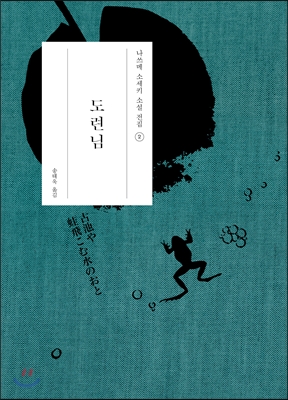
Old pond, the sound of frogs jumping into the water
The 'Master' appears as if he were a hero.
Things that happened quietly and were covered up quietly resurface wherever he walks.
He gets pelted with locusts by students out of the blue, gets kicked out of his boarding house, and gets cleverly beaten up while trying to solve a case with his crazy math teacher.
If there is something wrong, 'I' must 'smash it'.
And according to 'my' logic, if you break it down right away, the world ends up making a joke of the word 'justice' and a group of people expressed by that word.
That lonely fight continued 100 years ago and continues today.
We catch a glimpse of Soseki's bitter smile dedicated to the 'young men of our time' who rise up and get angry.
Natsume Soseki serialized "Master" in "Hototogisu" in 1906.
It is said that the material was based on his experiences after graduating from university and working as a teacher at Tokyo Higher Normal School, and then transferring to Matsuyama Middle School in Shikoku, a remote area even in Japan.
From the millennial writer Natsume Soseki to Haruki Murakami
Where did the 100 years between them and us go?
Reading Soseki in autumn, steeped in the sound of crickets.
Complete translation commemorating the 100th anniversary of Natsume Soseki's death in 2016
The first volume of Korea's first full-length novel collection has been published.
"During those gloomy days of youth, the one who always whispered to me was Natsume Soseki."
In a prosperous society where people chant for freedom, assert independence, and assert their own egos, why are we all so lonely?
Natsume Soseki, who portrayed the egoism, loneliness, and slivers of hope hidden within human relationships—parents and children, couples, relatives, friends, lovers, and teacher—is undoubtedly a pioneering writer not only in Japan but also in Korea.
_ Kang Sang-jung (Professor, Seigakuin University, Professor Emeritus, University of Tokyo)
The Complete Novels of Natsume Soseki: The Cat's Father
“In 2016, ahead of the 100th anniversary of Natsume Soseki’s death, we are publishing a series of Natsume Soseki’s full-length novels for the first time in Korea.
With solid translations, meticulous editing, and design, Natsume Soseki's novels are reinterpreted with profound humor and poignant observations of life.
We invite readers of world and Korean literature to experience the joy of reading and writing novels through the power of reflection.
Natsume Soseki, the origin of modern Japanese literature and a novelist in an era when novels did not exist, had a great influence on modern and contemporary Japanese writers and is called the great writer of the 20th century and the Shakespeare of Japan.
In Japan, his portrait was used on the 1,000 yen note from 1984 to 2004, and since the publication of the complete works of Soseki by Iwanami Shoten in 1907, his works have been republished in new forms over time, and are still loved to this day.
In Korea, Natsume Soseki's works have been published repeatedly by various publishers, with a focus on his representative works. However, the complete collection of Soseki's novels being published this time is the first complete collection in Korea to be available in a 'contemporary translation', while shedding new light on the world of Soseki's works, which he concentrated on writing for 12 years.
Starting with the four volumes 『I Am a Cat』, 『Master』, 『Grass Pillow』, and 『Typhoon』, it contains not only widely known works that are included in our textbooks, but also hidden novels that are sometimes omitted from Soseki's chronology.
During his short creative period, Soseki wrote numerous works in various fields, including Chinese poetry, haiku, essays, and novels.
There is no doubt that Soseki's works can be called classics, given the unique atmosphere each piece exudes and the unique variations in style according to the content.
Song Tae-wook's meticulous translation, which vividly portrays Soseki's writing style with the phrase "not a single unnecessary sentence," and Noh Jae-myung's deep understanding of Soseki, who translated the complete collection of Soseki's short stories, have been added to create a "Soseki translation for our time."
Furthermore, the work of fully unfolding Soseki's works and reviving them here and now is the life work of Song Tae-wook (『Cat』 and 11 other volumes) and Noh Jae-myung (『Typhoon』 and 『After』).
From Natsume Soseki's first novel, "I Am a Cat," to "Light and Shadow," which he wrote until the end while suffering from a gastric ulcer and nervous breakdown, a total of 14 full-length novels will be presented, with the complete publication date set for 2015.
The questions Natsume Soseki grappled with 100 years ago are still relevant today.
Natsume Soseki may not sound familiar to Korean readers.
However, the question he constantly asks and seeks to answer through literature and scholarship is the fundamental question of 'what does it mean to live humanely for us living in this era?' and it becomes a life topic for us to ponder deeply.
Natsume Soseki suffered from stomachaches throughout his life and suffered from nervous breakdowns and headaches.
Although all of his photographs are of faces with expressionless or nervous expressions, what is never missing from his work is the laughter and fun that digs into people with a solemn face and then bursts out in absurdity.
Universal issues such as life, love, loneliness, death, and society transcend the space of Japan and the times, and are still relevant to us today.
Accordingly, in publishing the complete works of Natsume Soseki's novels, the translator and publisher took pains to ensure that Soseki, who is not only an "object of inquiry" for Japanese literature majors to study in connection with the historical and social background, but also a "living" Soseki, who has been cherished in the hearts of countless readers for over a century, could be read.
One of the unique features of the first complete collection of Natsume Soseki's novels in Korea is the "Soseki Reading Notes" by Korean writers at the end of each volume.
The struggles of “Cat” read by poet Jang Seok-ju, the novelist Baek Ga-heum’s take on “The Young Master” of our time, the compassion of “Grass Pillow” chosen by literary critic Hwang Ho-deok, and the literary theory of “Typhoon” explored by literary critic Shin Hyeong-cheol.
Writers active in various fields have added to the enjoyment of reading Soseki for Korean readers by freely presenting their own interpretations of Soseki in the form of “commentary, not commentary.”
"master"
It's not a fairy tale, but it reads like one.
It's a story about school teachers, but it feels like reading a story about school children.
(…) Strange adults, such as the vice principal who schemes or the boarding house owner who forces you to buy antiques, are not so much hateful as funny.
_ From the “Translator’s Note”
The young master is lonely.
Because I am honest, because I am frank, because I am generous, because I am compliant, I am lonely.
The young master is generous even though he is harmed, criticized, ignored, and robbed by the world.
It's sad, but it's a necessity in a broken world.
_ From the "Commentary" by Baek Ga-heum (novelist)
The young master has a very strong personality, but I am concerned about his excessively quick temper.
You should not give nicknames to other people without thinking, as this can lead to resentment from others.
If you have a nickname, please let Kiyo know in a letter.
(…) Your letter is too short, so I don’t know your situation very well. Next time, please write at least half the length of this letter and send it to me.
_ From the text 'Letter from Grandma Kiyo (Nanny)'
What you did is done, and what you didn't do is clearly not done.
The book begins with a grumbling that somehow resonates with me: “Because of the indiscriminate nature I inherited from my parents, I have only suffered losses since I was young.”
To me, a kind of social misfit(?) who is 'righteously' old-fashioned and only judges and believes what I see, the unfair world just makes me angry.
Because of the consistent expression of dissatisfaction, anger, fighting, and talking back that 'I' show, the distance between the world and the master is not easily narrowed.
In the world, among his colleagues, among his students, the honest and frank young master is a loner.
Old pond, the sound of frogs jumping into the water
The 'Master' appears as if he were a hero.
Things that happened quietly and were covered up quietly resurface wherever he walks.
He gets pelted with locusts by students out of the blue, gets kicked out of his boarding house, and gets cleverly beaten up while trying to solve a case with his crazy math teacher.
If there is something wrong, 'I' must 'smash it'.
And according to 'my' logic, if you break it down right away, the world ends up making a joke of the word 'justice' and a group of people expressed by that word.
That lonely fight continued 100 years ago and continues today.
We catch a glimpse of Soseki's bitter smile dedicated to the 'young men of our time' who rise up and get angry.
Natsume Soseki serialized "Master" in "Hototogisu" in 1906.
It is said that the material was based on his experiences after graduating from university and working as a teacher at Tokyo Higher Normal School, and then transferring to Matsuyama Middle School in Shikoku, a remote area even in Japan.
GOODS SPECIFICS
- Date of issue: September 10, 2013
- Page count, weight, size: 200 pages | 330g | 153*224*20mm
- ISBN13: 9788932316765
- ISBN10: 8932316767
You may also like
카테고리
korean


korean

![ELLE 엘르 스페셜 에디션 A형 : 12월 [2025]](http://librairie.coreenne.fr/cdn/shop/files/b8e27a3de6c9538896439686c6b0e8fb.jpg?v=1766436872&width=3840)


