

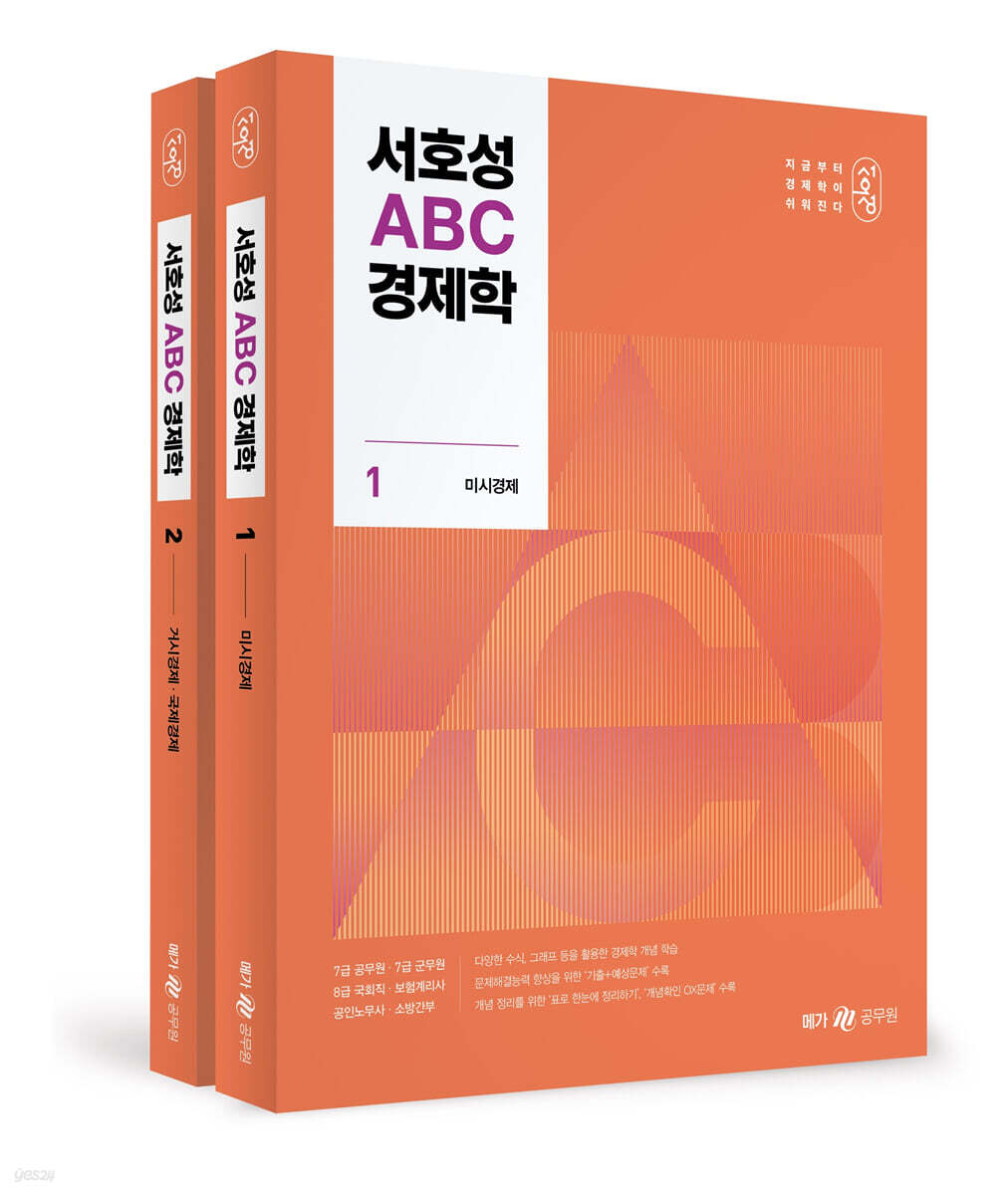
Seo Ho-seong's ABC Economics
 |
Description
Book Introduction
"Seo Ho-seong's ABC Economics" is a study guide that can be used to prepare for not only the 7th-grade civil service exam, but also the 7th-grade military service exam, the 8th-grade National Assembly exam, the insurance actuary exam, and the certified labor attorney exam.
It covers all aspects of economics for the exam, organizing key theories and concepts in an easy-to-understand manner, and includes only essential formulas and graphs for easier understanding.
Through 'Warm-up', you can review and organize basic economics-related terminology and economic mathematics common sense before studying economics in earnest.
Additionally, it is structured to enable strategic learning by indicating the importance of each economics point, and to provide exam-related tips for major keywords, including 'Exam Points', so that you can easily study on your own.
Through 'Table Summary', you can organize the main theories and concepts of each unit into a table for easy review and organization, and 'Concept Confirmation True or False Questions' allow you to check your learning by organizing the main contents of each unit into True or False.
'Previous Questions + Expected Questions' is a selection of past questions that are in line with the exam trend and consists of expected questions with a high probability of being on the exam.
Therefore, if you review through 'summarizing in a table at a glance', 'true/false questions to confirm concepts', and 'previous questions + expected questions' after learning the theory, you can prepare more thoroughly for the economics exam.
It covers all aspects of economics for the exam, organizing key theories and concepts in an easy-to-understand manner, and includes only essential formulas and graphs for easier understanding.
Through 'Warm-up', you can review and organize basic economics-related terminology and economic mathematics common sense before studying economics in earnest.
Additionally, it is structured to enable strategic learning by indicating the importance of each economics point, and to provide exam-related tips for major keywords, including 'Exam Points', so that you can easily study on your own.
Through 'Table Summary', you can organize the main theories and concepts of each unit into a table for easy review and organization, and 'Concept Confirmation True or False Questions' allow you to check your learning by organizing the main contents of each unit into True or False.
'Previous Questions + Expected Questions' is a selection of past questions that are in line with the exam trend and consists of expected questions with a high probability of being on the exam.
Therefore, if you review through 'summarizing in a table at a glance', 'true/false questions to confirm concepts', and 'previous questions + expected questions' after learning the theory, you can prepare more thoroughly for the economics exam.
- You can preview some of the book's contents.
Preview
index
Warm-up Basic Economics Terms and Multiple-Choice Economics Math Common Sense
Chapter 01 Basic Economics Terms
Chapter 02 Multiple Choice Economics Math Common Sense
Ⅰ Microeconomics
PART 1: The Fundamentals of Economics and the Determination and Fluctuation of Market Prices
Chapter 01 Economic Activities
Chapter 02 Resource Scarcity and Rational Choice
Chapter 03 Supply and Demand
Chapter 04 Determination and Fluctuation of Market Prices
Organize at a glance in a table
Concept check true or false questions
Previous questions + expected questions
PART 2 ELASTICITY
Chapter 01 Price Elasticity of Demand
Chapter 02 Income and Cross Elasticity of Demand, Price Elasticity of Supply
Organize at a glance in a table
Concept check true or false questions
Previous questions + expected questions
PART 3 CONSUMER THEORY
Chapter 01 Marginal Utility Theory
Chapter 02 Indifference Curve Theory
Chapter 03 Revealed Preference Theory and Expected Utility Theory
Organize at a glance in a table
Concept check true or false questions
Previous questions + expected questions
PART 4 PRODUCER THEORY
Chapter 01 Production and Production Function
Chapter 02 Costs and Cost Functions
Organize at a glance in a table
Concept check true or false questions
Previous questions + expected questions
PART 5 MARKET THEORY
Chapter 01 Market Concept and Perfectly Competitive Market
Chapter 02 Monopoly Market
Chapter 03 Monopolistic Competition and Oligopoly
Organize at a glance in a table
Concept check true or false questions
Previous questions + expected questions
PART 6: Factor Markets and Income Distribution
Chapter 01 Factors of Production Market
Chapter 02 Income Distribution Theory
Chapter 03 Income Distribution Indicators
Chapter 04 Budget and Taxation
Organize at a glance in a table
Concept check true or false questions
Previous questions + expected questions
PART 7 Welfare Economics and Market Failure
Chapter 01 General Equilibrium Theory and Pareto Efficiency
Chapter 02 Welfare Economics
Chapter 03 Externalities
Chapter 04 Public Goods
Chapter 05 Information Economics and Government Failure
Organize at a glance in a table
Concept check true or false questions
Previous questions + expected questions
Ⅱ Macroeconomics
PART 1: THEORY OF NATIONAL INCOME DETERMINATION
Chapter 01 GDP (Gross Domestic Product)
Chapter 02 Theory of National Income Determination
Chapter 03 Consumption Function and Investment Function
Organize at a glance in a table
Concept check true or false questions
Previous questions + expected questions
PART 2 Monetary and Financial Theory
Chapter 01 Money and Money Supply Theory
Chapter 02 Theory of Money Demand
Organize at a glance in a table
Concept check true or false questions
Previous questions + expected questions
PART 3: INFLATION AND UNEMPLOYMENT
Chapter 01 IS-LM Model
Chapter 02 Aggregate Demand and Aggregate Supply
Chapter 03 Prices and Inflation
Chapter 04 Unemployment
Chapter 05 The Phillips Curve
Chapter 06 Classical, Keynesian, Monetarist, and Supply-side Economics
Chapter 07 New Classical and New Keynesian Schools
Organize at a glance in a table
Concept check true or false questions
Previous questions + expected questions
PART 4: FIs and Economic Growth
Chapter 01 Business Fluctuations
Chapter 02 Business Cycle Theory
Chapter 03 Economic Growth Theory
Chapter 04 Economic Development Theory
Organize at a glance in a table
Concept check true or false questions
Previous questions + expected questions
Ⅲ International Economy
PART 1 TRADE
Chapter 01 Trade
Chapter 02 Free Trade and Protectionism
Organize at a glance in a table
Concept check true or false questions
Previous questions + expected questions
PART 2 International Finance
Chapter 01 Meaning and Fluctuations of Exchange Rates
Chapter 02 Exchange Rate System
Chapter 03 Balance of Payments
Organize at a glance in a table
Concept check true or false questions
Previous questions + expected questions
Chapter 01 Basic Economics Terms
Chapter 02 Multiple Choice Economics Math Common Sense
Ⅰ Microeconomics
PART 1: The Fundamentals of Economics and the Determination and Fluctuation of Market Prices
Chapter 01 Economic Activities
Chapter 02 Resource Scarcity and Rational Choice
Chapter 03 Supply and Demand
Chapter 04 Determination and Fluctuation of Market Prices
Organize at a glance in a table
Concept check true or false questions
Previous questions + expected questions
PART 2 ELASTICITY
Chapter 01 Price Elasticity of Demand
Chapter 02 Income and Cross Elasticity of Demand, Price Elasticity of Supply
Organize at a glance in a table
Concept check true or false questions
Previous questions + expected questions
PART 3 CONSUMER THEORY
Chapter 01 Marginal Utility Theory
Chapter 02 Indifference Curve Theory
Chapter 03 Revealed Preference Theory and Expected Utility Theory
Organize at a glance in a table
Concept check true or false questions
Previous questions + expected questions
PART 4 PRODUCER THEORY
Chapter 01 Production and Production Function
Chapter 02 Costs and Cost Functions
Organize at a glance in a table
Concept check true or false questions
Previous questions + expected questions
PART 5 MARKET THEORY
Chapter 01 Market Concept and Perfectly Competitive Market
Chapter 02 Monopoly Market
Chapter 03 Monopolistic Competition and Oligopoly
Organize at a glance in a table
Concept check true or false questions
Previous questions + expected questions
PART 6: Factor Markets and Income Distribution
Chapter 01 Factors of Production Market
Chapter 02 Income Distribution Theory
Chapter 03 Income Distribution Indicators
Chapter 04 Budget and Taxation
Organize at a glance in a table
Concept check true or false questions
Previous questions + expected questions
PART 7 Welfare Economics and Market Failure
Chapter 01 General Equilibrium Theory and Pareto Efficiency
Chapter 02 Welfare Economics
Chapter 03 Externalities
Chapter 04 Public Goods
Chapter 05 Information Economics and Government Failure
Organize at a glance in a table
Concept check true or false questions
Previous questions + expected questions
Ⅱ Macroeconomics
PART 1: THEORY OF NATIONAL INCOME DETERMINATION
Chapter 01 GDP (Gross Domestic Product)
Chapter 02 Theory of National Income Determination
Chapter 03 Consumption Function and Investment Function
Organize at a glance in a table
Concept check true or false questions
Previous questions + expected questions
PART 2 Monetary and Financial Theory
Chapter 01 Money and Money Supply Theory
Chapter 02 Theory of Money Demand
Organize at a glance in a table
Concept check true or false questions
Previous questions + expected questions
PART 3: INFLATION AND UNEMPLOYMENT
Chapter 01 IS-LM Model
Chapter 02 Aggregate Demand and Aggregate Supply
Chapter 03 Prices and Inflation
Chapter 04 Unemployment
Chapter 05 The Phillips Curve
Chapter 06 Classical, Keynesian, Monetarist, and Supply-side Economics
Chapter 07 New Classical and New Keynesian Schools
Organize at a glance in a table
Concept check true or false questions
Previous questions + expected questions
PART 4: FIs and Economic Growth
Chapter 01 Business Fluctuations
Chapter 02 Business Cycle Theory
Chapter 03 Economic Growth Theory
Chapter 04 Economic Development Theory
Organize at a glance in a table
Concept check true or false questions
Previous questions + expected questions
Ⅲ International Economy
PART 1 TRADE
Chapter 01 Trade
Chapter 02 Free Trade and Protectionism
Organize at a glance in a table
Concept check true or false questions
Previous questions + expected questions
PART 2 International Finance
Chapter 01 Meaning and Fluctuations of Exchange Rates
Chapter 02 Exchange Rate System
Chapter 03 Balance of Payments
Organize at a glance in a table
Concept check true or false questions
Previous questions + expected questions
Publisher's Review
Economics gets easier from now on
The best study guide for the economics exam!
Seo Ho-seong's ABC Economics
I wrote this book to break the stereotype that economics is a difficult subject and to enable step-by-step learning centered on the topics that appear on the exam.
The features of this textbook are as follows:
1.
Includes basic vocabulary and basic mathematical knowledge.
First, if you are new to economics, you may have difficulty understanding it due to unfamiliar economic terms.
Therefore, we have included economic terms separately so that you can come across them frequently and become familiar with them.
Second, for those who find objective economics too difficult because they think it is math, we have included simple mathematical concepts (graphs, differentiation, etc.) that are commonly used in objective economics to help them understand the explanations that follow.
2.
Learning objectives have been presented.
Before explaining the concept, I have summarized the most important parts in sentences.
Please review the important content at the beginning, and after finishing that part, review the learning objectives to help you recall the important content.
3.
Contains only the necessary information.
This text focuses on the basic content frequently tested in objective economics exams.
Additionally, we have marked the importance of the content to distinguish between content that will definitely appear on the exam and content that will not, and to avoid unnecessary efforts.
Additionally, we have tried to show how the content is developed into a problem by attaching past exam questions to frequently appearing topics.
4.
I tried to minimize the number of graphs and formulas.
We've minimized the graphs and formulas that make economics seem difficult, and focused on graphs that you absolutely need to know.
Therefore, you must know the graphs and formulas that appear here.
5.
I have commented on the points raised.
Not all topics in economics are covered.
It is most desirable to study intensively the content that must be covered and to expand on it.
Since I have commented on important content, you should make an effort to study the content in the comment accurately.
6.
We have focused on organizing the calculation problems.
Multiple-choice economics questions consist of sentence interpretation and computational problems.
In particular, not all topics are presented as computational problems.
Therefore, for topics that are likely to be presented as calculation problems, the solution method is described in detail through examples after the core explanation to ensure a clear understanding.
7.
A summary table is included.
The important thing in economics is to make the material you are learning familiar.
Therefore, after describing the content, the most important information is included in a table.
8.
Includes numerous O, X questions and past exam questions.
Since the multiple-choice exam is mostly based on topics from previous exams, we have made sure to repeatedly study the important points covered previously and important sentences from previous exams through numerous past exams and true/false questions.
The best study guide for the economics exam!
Seo Ho-seong's ABC Economics
I wrote this book to break the stereotype that economics is a difficult subject and to enable step-by-step learning centered on the topics that appear on the exam.
The features of this textbook are as follows:
1.
Includes basic vocabulary and basic mathematical knowledge.
First, if you are new to economics, you may have difficulty understanding it due to unfamiliar economic terms.
Therefore, we have included economic terms separately so that you can come across them frequently and become familiar with them.
Second, for those who find objective economics too difficult because they think it is math, we have included simple mathematical concepts (graphs, differentiation, etc.) that are commonly used in objective economics to help them understand the explanations that follow.
2.
Learning objectives have been presented.
Before explaining the concept, I have summarized the most important parts in sentences.
Please review the important content at the beginning, and after finishing that part, review the learning objectives to help you recall the important content.
3.
Contains only the necessary information.
This text focuses on the basic content frequently tested in objective economics exams.
Additionally, we have marked the importance of the content to distinguish between content that will definitely appear on the exam and content that will not, and to avoid unnecessary efforts.
Additionally, we have tried to show how the content is developed into a problem by attaching past exam questions to frequently appearing topics.
4.
I tried to minimize the number of graphs and formulas.
We've minimized the graphs and formulas that make economics seem difficult, and focused on graphs that you absolutely need to know.
Therefore, you must know the graphs and formulas that appear here.
5.
I have commented on the points raised.
Not all topics in economics are covered.
It is most desirable to study intensively the content that must be covered and to expand on it.
Since I have commented on important content, you should make an effort to study the content in the comment accurately.
6.
We have focused on organizing the calculation problems.
Multiple-choice economics questions consist of sentence interpretation and computational problems.
In particular, not all topics are presented as computational problems.
Therefore, for topics that are likely to be presented as calculation problems, the solution method is described in detail through examples after the core explanation to ensure a clear understanding.
7.
A summary table is included.
The important thing in economics is to make the material you are learning familiar.
Therefore, after describing the content, the most important information is included in a table.
8.
Includes numerous O, X questions and past exam questions.
Since the multiple-choice exam is mostly based on topics from previous exams, we have made sure to repeatedly study the important points covered previously and important sentences from previous exams through numerous past exams and true/false questions.
GOODS SPECIFICS
- Date of issue: July 15, 2024
- Page count, weight, size: 924 pages | 190*260*40mm
- ISBN13: 9791167227249
- ISBN10: 1167227247
You may also like
카테고리
korean


korean

![GQ KOREA Mark (Monthly): December [2025]](http://librairie.coreenne.fr/cdn/shop/files/8ef265dbbfbf186523ed75ba7319009d.jpg?v=1765340328&width=3840)


