

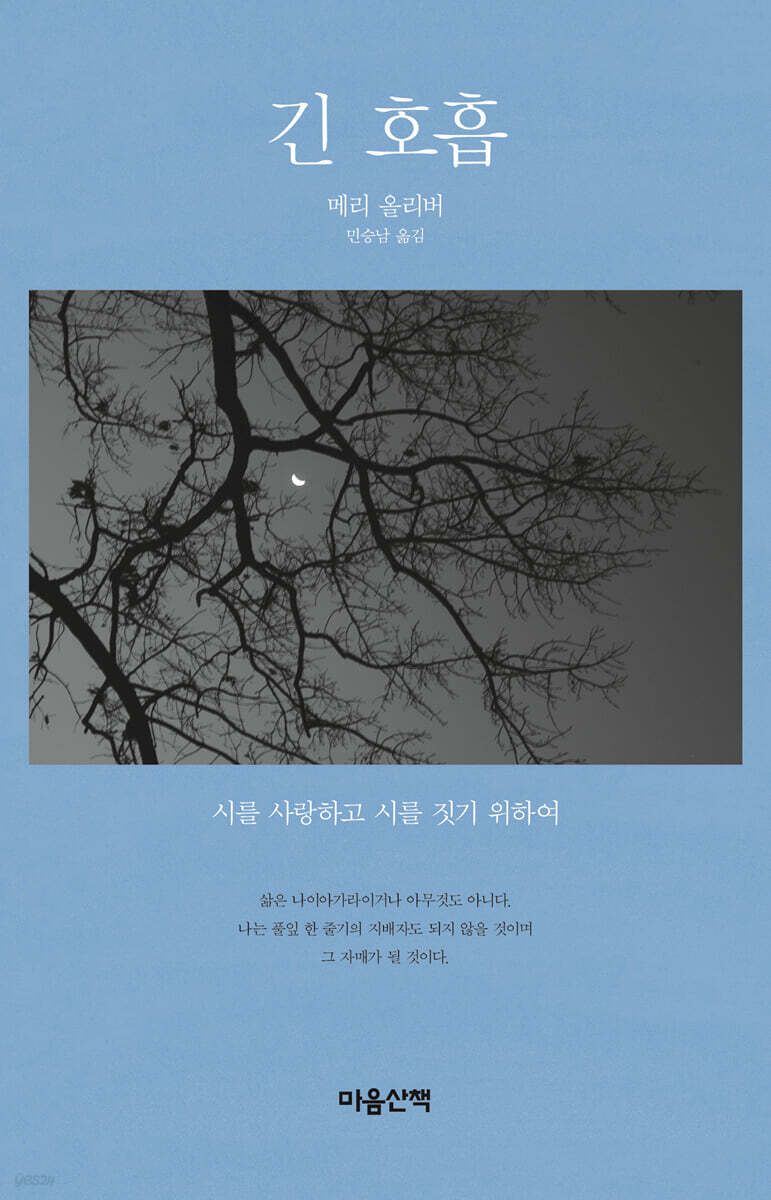
long breath
 |
Description
Book Introduction
- A word from MD
- When you read Mary Oliver, you fall in love.
Because everyone discovers the irresistible power of language in her poetry and writing.
This collection of essays is all the more welcome because it was written before her previous book.
We will be able to vividly encounter the source and scenery that will help us understand why we loved her.
- Essay MD Kim Yu-ri
The poet's message as he returned to the weed-covered sand dunes
“Life is either Niagara Falls or nothing.”
Mary Oliver, known as the Pulitzer Prize-winning poet, and the poem "Wild Geese," which was recited by then-Vice President Joe Biden at the 2009 September 11th terrorist attack memorial service and imprinted in the hearts of people around the world.
In Korea, he quickly satisfied readers' poetic hunger with two prose collections, 『Perfect Days』 (2013) and 『The Whistler』 (2015).
The poet, who has lived his entire life as a piece of nature, returned to what he calls “wild, weed-covered sand dunes” earlier this year.
It had been four years since I left Provincetown, the home of my beloved life and writing, and moved to Florida after my health deteriorated.
Celebrities from all walks of life, including Hillary Clinton, Oprah Winfrey, and Roxane Gay, expressed their condolences at the death of the poet beloved by his generation.
The third collection of essays published by Maumsanchaek, 『Long Breath』, is composed of essays written before the two previously published books.
She meticulously captures the turbulent changes of nature in the passing seasons, ponders how to maintain her artistic self while creating, reflects on the “life companions” who shaped her into a literary girl in her childhood, and unfolds her own theory of poetry and stories about modern American poetry with a “long breath.”
Mary Oliver's delicate observations and unwavering insight into nature, life, and literature, which permeate her life, are brought to life through her solid prose.
The recognition that humans are also part of the natural world is that “life is either Niagara or nothing.
This is most clearly expressed in the concise sentence, “I will not be the ruler of a single blade of grass, but will be its sister.”
The void left by Mary Oliver, who was acclaimed as America's greatest poet, still looms large.
For readers who have yet to find the sparkling words that will fill their souls in his stead, this book will resonate warmly and richly above all else.
“Life is either Niagara Falls or nothing.”
Mary Oliver, known as the Pulitzer Prize-winning poet, and the poem "Wild Geese," which was recited by then-Vice President Joe Biden at the 2009 September 11th terrorist attack memorial service and imprinted in the hearts of people around the world.
In Korea, he quickly satisfied readers' poetic hunger with two prose collections, 『Perfect Days』 (2013) and 『The Whistler』 (2015).
The poet, who has lived his entire life as a piece of nature, returned to what he calls “wild, weed-covered sand dunes” earlier this year.
It had been four years since I left Provincetown, the home of my beloved life and writing, and moved to Florida after my health deteriorated.
Celebrities from all walks of life, including Hillary Clinton, Oprah Winfrey, and Roxane Gay, expressed their condolences at the death of the poet beloved by his generation.
The third collection of essays published by Maumsanchaek, 『Long Breath』, is composed of essays written before the two previously published books.
She meticulously captures the turbulent changes of nature in the passing seasons, ponders how to maintain her artistic self while creating, reflects on the “life companions” who shaped her into a literary girl in her childhood, and unfolds her own theory of poetry and stories about modern American poetry with a “long breath.”
Mary Oliver's delicate observations and unwavering insight into nature, life, and literature, which permeate her life, are brought to life through her solid prose.
The recognition that humans are also part of the natural world is that “life is either Niagara or nothing.
This is most clearly expressed in the concise sentence, “I will not be the ruler of a single blade of grass, but will be its sister.”
The void left by Mary Oliver, who was acclaimed as America's greatest poet, still looms large.
For readers who have yet to find the sparkling words that will fill their souls in his stead, this book will resonate warmly and richly above all else.
- You can preview some of the book's contents.
Preview
index
introduction
A pen, paper, and a breath of air
About Power and Time
A pen, paper, and a breath of air
Stay alive
Blue Pasture
In Herring Cove
owls
Blue Pasture
ponds
Cheer
Life companions
My friend Walt Whitman
Four companions with a passion for life
stipple top
A few words
The Poet's Voice
City flounder, one
The Poet's Voice
City flounder, two
Acknowledgements
Translator's Note
Recommendation
Author's chronology
Tributes to Mary Oliver
A pen, paper, and a breath of air
About Power and Time
A pen, paper, and a breath of air
Stay alive
Blue Pasture
In Herring Cove
owls
Blue Pasture
ponds
Cheer
Life companions
My friend Walt Whitman
Four companions with a passion for life
stipple top
A few words
The Poet's Voice
City flounder, one
The Poet's Voice
City flounder, two
Acknowledgements
Translator's Note
Recommendation
Author's chronology
Tributes to Mary Oliver
Detailed image
Into the book
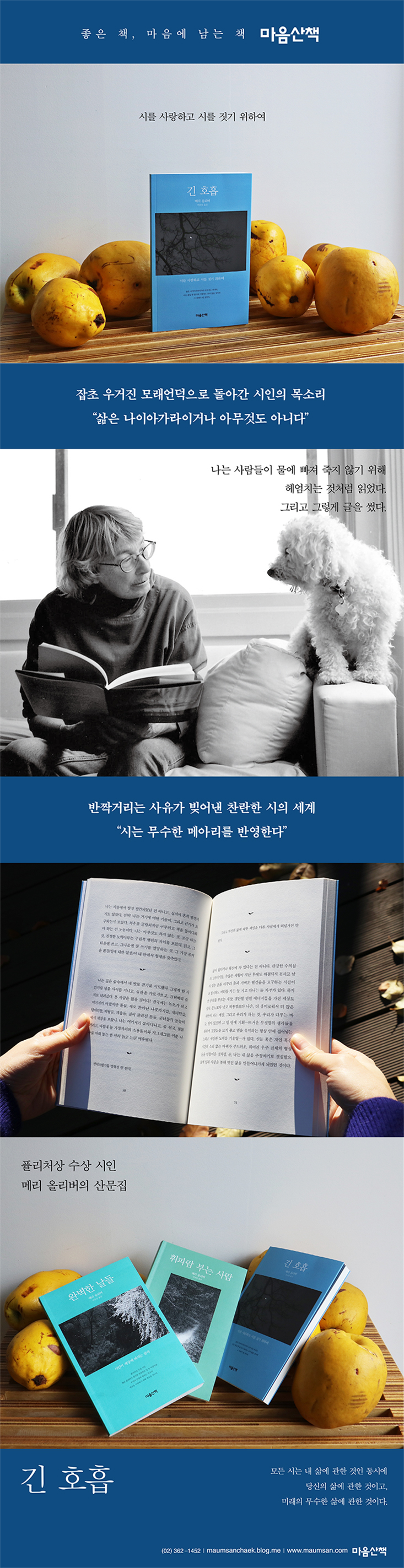
The book is full of bias, passion, and the author's flaws.
This book is biased and dogmatic, but it is also enjoyable and perhaps even despairing.
Is it possible to live sixty years effortlessly, without despair? But readers will discover joy more clearly and more frequently than the rivulets of discouragement.
Because my life has been influenced by these enduring passions: my love of the wild world, my love of literature, and my love of others.
--- p.8
If I promise to meet you at three o'clock and I'm late, I'll be very happy.
If I don't show up at all, you'll be even happier.
--- p.20
All notes and phrases are meant to return us to the moment and place where they were written.
This is a very strict statement.
The record takes me back to the experience of feeling, whatever it is, for whatever reason I wrote it.
This is important.
Then, rather than thinking back on the idea, the meaning of the event, I can think about it before the idea even comes.
What I want to capture in my notebooks is not comments or thoughts, but the moment.
--- p.22
It is not poetry's fault that so few people read it, that its influence in this fearful and money-loving world is so minimal.
After all, poetry is not a miracle.
It is an effort to formalize (consciousenize) personal moments and make their transcendent effects into music that everyone can use.
Poetry is the song of our species.
--- p.42
I read books diligently, honed my skills, and gained certainty.
I read it as people swimming to avoid drowning.
And so I wrote.
--- p.47
My life is my own.
I made it.
I can do whatever I want with it.
Living my life.
And one day, without a heavy heart, return it to the wild, weed-covered sand dunes.
--- p.53
Once upon a time, this was a hungry green bug.
Then, passing through the bottleneck of deep sleep, through the net of the wind, I flew into the warm fields.
And now it's become a shining trash of the past.
The emptiness of this is complete.
And it's terrible.
--- p.61
It's as if the wild rose's mission is to captivate all of us who happen to stumble upon the sand dunes for a moment, and to bring us back to simple joy.
Let that stretch of imagination, that balance, tease your mind.
Now I flinch at the sound of a great horned owl spreading its black wings above my head.
Until recently, I was sitting on a sand dune, looking out at the city of roses.
--- p.67
Fishing is a distinctly vibrant activity here, whether we participate in it or not.
The sea surrounds us.
It is surrounded by houses and two long, winding roads.
It surrounds leisurely conversation and the mind absorbed in thought, hoping for original ideas.
--- p.70
Sometimes I lean over and look into the water.
The pond water is a rough and honest mirror.
Not only my gaze, but also the halo of the world that merges into the water shadow from all sides shines.
So the swallows that fly across the pond and sing a little song fly over my shoulder and through my hair.
A turtle slowly gliding across the muddy ground touches my cheekbone.
--- p.83
Of course, I never met my friends in the usual way.
They were strangers, living only in their writings.
They may have been shadow comrades, but they were constant, powerful, and amazing.
They told amazing stories, and for me, those stories changed the world.
--- p.89
And I too learn a lot, feel overwhelmed, and feel energized.
No more being too busy or too tired.
Will there be another glacier, another ocean, another sun-drenched countryside, another black stream, another 18-mile (approximately 29 kilometers) walk in the near future? Absolutely.
And with such a great companion, I am ready to go anywhere.
--- p.98
Someday someone will publish a biography of Millay, and it will contain everything he has gleaned from careful and thoughtful study of another man's complex, difficult, and brilliant life.
That electricity will not be definitive.
It will be as true and precious as possible.
We must be each other's storytellers.
At least we should make that effort.
We want to know about beautiful people we don't know.
There is a need to know.
--- p.115
And there's nothing cute in the forest.
The fox is not cute and the cubs are not cute.
I see them running up and down the sand dunes.
When a fox brings a dirty seagull wing, the others rush in and bite it.
He jumped into the golden grass and came out, his small teeth chattering.
They are not lovable, attractive, or cute.
--- p.116
So, the poet's voice begins with the poems encountered as the first example.
To do and create something, you must first be captivated and captivated by what already exists.
To love poetry and become a poet, you must love one poem, and then several poems.
--- p.125
No attempt is about one or some of us, but about all of us.
Poetry is part of a long record of our species.
Every poem is about my life, about your life, and about countless lives to come.
This book is biased and dogmatic, but it is also enjoyable and perhaps even despairing.
Is it possible to live sixty years effortlessly, without despair? But readers will discover joy more clearly and more frequently than the rivulets of discouragement.
Because my life has been influenced by these enduring passions: my love of the wild world, my love of literature, and my love of others.
--- p.8
If I promise to meet you at three o'clock and I'm late, I'll be very happy.
If I don't show up at all, you'll be even happier.
--- p.20
All notes and phrases are meant to return us to the moment and place where they were written.
This is a very strict statement.
The record takes me back to the experience of feeling, whatever it is, for whatever reason I wrote it.
This is important.
Then, rather than thinking back on the idea, the meaning of the event, I can think about it before the idea even comes.
What I want to capture in my notebooks is not comments or thoughts, but the moment.
--- p.22
It is not poetry's fault that so few people read it, that its influence in this fearful and money-loving world is so minimal.
After all, poetry is not a miracle.
It is an effort to formalize (consciousenize) personal moments and make their transcendent effects into music that everyone can use.
Poetry is the song of our species.
--- p.42
I read books diligently, honed my skills, and gained certainty.
I read it as people swimming to avoid drowning.
And so I wrote.
--- p.47
My life is my own.
I made it.
I can do whatever I want with it.
Living my life.
And one day, without a heavy heart, return it to the wild, weed-covered sand dunes.
--- p.53
Once upon a time, this was a hungry green bug.
Then, passing through the bottleneck of deep sleep, through the net of the wind, I flew into the warm fields.
And now it's become a shining trash of the past.
The emptiness of this is complete.
And it's terrible.
--- p.61
It's as if the wild rose's mission is to captivate all of us who happen to stumble upon the sand dunes for a moment, and to bring us back to simple joy.
Let that stretch of imagination, that balance, tease your mind.
Now I flinch at the sound of a great horned owl spreading its black wings above my head.
Until recently, I was sitting on a sand dune, looking out at the city of roses.
--- p.67
Fishing is a distinctly vibrant activity here, whether we participate in it or not.
The sea surrounds us.
It is surrounded by houses and two long, winding roads.
It surrounds leisurely conversation and the mind absorbed in thought, hoping for original ideas.
--- p.70
Sometimes I lean over and look into the water.
The pond water is a rough and honest mirror.
Not only my gaze, but also the halo of the world that merges into the water shadow from all sides shines.
So the swallows that fly across the pond and sing a little song fly over my shoulder and through my hair.
A turtle slowly gliding across the muddy ground touches my cheekbone.
--- p.83
Of course, I never met my friends in the usual way.
They were strangers, living only in their writings.
They may have been shadow comrades, but they were constant, powerful, and amazing.
They told amazing stories, and for me, those stories changed the world.
--- p.89
And I too learn a lot, feel overwhelmed, and feel energized.
No more being too busy or too tired.
Will there be another glacier, another ocean, another sun-drenched countryside, another black stream, another 18-mile (approximately 29 kilometers) walk in the near future? Absolutely.
And with such a great companion, I am ready to go anywhere.
--- p.98
Someday someone will publish a biography of Millay, and it will contain everything he has gleaned from careful and thoughtful study of another man's complex, difficult, and brilliant life.
That electricity will not be definitive.
It will be as true and precious as possible.
We must be each other's storytellers.
At least we should make that effort.
We want to know about beautiful people we don't know.
There is a need to know.
--- p.115
And there's nothing cute in the forest.
The fox is not cute and the cubs are not cute.
I see them running up and down the sand dunes.
When a fox brings a dirty seagull wing, the others rush in and bite it.
He jumped into the golden grass and came out, his small teeth chattering.
They are not lovable, attractive, or cute.
--- p.116
So, the poet's voice begins with the poems encountered as the first example.
To do and create something, you must first be captivated and captivated by what already exists.
To love poetry and become a poet, you must love one poem, and then several poems.
--- p.125
No attempt is about one or some of us, but about all of us.
Poetry is part of a long record of our species.
Every poem is about my life, about your life, and about countless lives to come.
--- p.139
Publisher's Review
The poet's message as he returned to the weed-covered sand dunes
“Life is either Niagara Falls or nothing.”
Mary Oliver, known as the Pulitzer Prize-winning poet, and the poem "Wild Geese," which was recited by then-Vice President Joe Biden at the 2009 September 11th terrorist attack memorial service and imprinted in the hearts of people around the world.
In Korea, he quickly satisfied readers' poetic hunger with two prose collections, 『Perfect Days』 (2013) and 『The Whistler』 (2015).
The poet, who has lived his entire life as a piece of nature, returned to what he calls “wild, weed-covered sand dunes” earlier this year.
It had been four years since I left Provincetown, the home of my beloved life and writing, and moved to Florida after my health deteriorated.
Celebrities from all walks of life, including Hillary Clinton, Oprah Winfrey, and Roxane Gay, expressed their condolences at the death of the poet beloved by his generation.
The third collection of essays published by Maumsanchaek, 『Long Breath』, is composed of essays written before the two previously published books.
She meticulously captures the turbulent changes of nature in the passing seasons, ponders how to maintain her artistic self while creating, reflects on the “life companions” who shaped her into a literary girl in her childhood, and unfolds her own theory of poetry and stories about modern American poetry with a “long breath.”
Mary Oliver's delicate observations and unwavering insight into nature, life, and literature, which permeate her life, are brought to life through her solid prose.
The recognition that humans are also part of the natural world is that “life is either Niagara or nothing.
This is most clearly expressed in the concise sentence, “I will not be the ruler of a single blade of grass, but will be its sister.”
The void left by Mary Oliver, who was acclaimed as America's greatest poet, still looms large.
For readers who have yet to find the sparkling words that will fill their souls in his stead, this book will resonate warmly and richly above all else.
The book is full of bias, passion, and the author's flaws.
This book is biased and dogmatic, but it is also enjoyable and perhaps even despairing.
Is it possible to live sixty years effortlessly, without despair? But readers will discover joy more clearly and more frequently than the rivulets of discouragement.
Because my life has been influenced by these enduring passions: my love of the wild world, my love of literature, and my love of others.
─From the “Preface” on page 8
A song of supreme joy in living in harmony with nature
“None of us are cute.”
In his recommendation, poet Lee Je-ni describes Mary Oliver as “a devoted observer of nature for a very long time, who has fiercely practiced and realized the vastness of nature and the order of the universe through her own sentences and her own life.”
Mary Oliver found joy in the most primal sense of life, right in the heart of nature.
In particular, the records that constantly capture the cycle of seasons with a keen eye are superior to any nature observation journal.
In "Owls," he persistently searches for a great horned owl and confirms that the world he and the great horned owl live in is one world. In "Green Pasture," he goes fishing and is delighted by the fact that "he didn't catch anything." In "Ponds," he names an unnamed pond and spends the day observing turtles, ducks, and foxes.
Sometimes I lean over and look into the water.
The pond water is a rough and honest mirror.
Not only my gaze, but also the halo of the world that merges into the water shadow from all sides shines.
So the swallows that fly across the pond and sing a little song fly over my shoulder and through my hair.
A turtle slowly gliding across the muddy ground touches my cheekbone.
_From page 83, “Ponds”
Meanwhile, Mary Oliver is blunt in saying that there is nothing attractive or cute in the forest.
Because we clearly understand the meaning of the words cute, attractive, or lovable.
“Cute is small, helpless, captureable, tameable, and possessable.
It sounds an alarm at the arrogance of humans who try to label nature, saying, “It’s all a mistake.”
This would be a unique and profound reflection that only a poet who has lived thoroughly as a “full member of nature” could bring out.
In this way we become our own masters.
If nature is filled with lovely, charming, tiny, and helpless things, who will be in power? We! We are the parents and the rulers.
Such thinking leads us to see the world as a playground or a laboratory, a perspective that is clearly inadequate.
And it's also dishonest.
On the surface, it seems so harmless and responsible, but in reality, it is neither.
_From page 117, “A Few Words”
A brilliant world of poetry created by sparkling thoughts
Poetry reflects countless echoes.
In this book, Mary Oliver reveals the notes from her small notebook.
In the notebook, which is “used haphazardly and chaotically,” everything that is seen, heard, and thought in life is written down, including fleeting thoughts, observations of nature, and quotes.
Although “some of them never make the leap to complete prose or poetry,” they are poignant records of his life.
Through the habit of consistent and meticulous record-keeping, we can glimpse, though not completely, the poet's special daily life.
The record takes me back to the experience of feeling, whatever it is, for whatever reason I wrote it.
This is important.
Then, rather than thinking back on the idea, the meaning of the event, I can think about it before the idea even comes.
What I want to capture in my notebooks is not comments or thoughts, but the moment.
And of course, there are many cases like this that we want to capture in the finished poem itself.
_From page 22, “A Pen, Paper, and a Breath of Air”
What makes 『Long Breath』 even more welcome is that it allows us to encounter the first two works of the serial poem "Flounder" and to look into Mary Oliver's theory of poetry.
It is significant in that it is an early prose collection by Mary Oliver, who mainly published poetry, and thus allows us to confirm the origins of her literary milestones.
Mary Oliver tells of the joy of the moment when childhood experiences, curiosity, and imitation, combined with the intelligence and individuality built up through hard work, become poetry.
He also emphasizes the importance of the 'first poem' we encounter, and summons up his beloved poets one by one, starting with Whitman's poem, which he first encountered, and then Edgar Allan Poe, William Blake, Walter de la Mare, and John Keats.
Furthermore, after examining the theoretical aspects of poetry, such as its grammar, changes in subject matter and intention, and the interest of rhythm and rhyme, it emphasizes the importance of imagining the landscape of 'poetry' in a world that is losing poetry.
Mary Oliver is dead, but the poet's poetry and life, which live on with a strong spirit, will be etched deep in our hearts for a long time through "Long Breath."
So, the poet's voice begins with the poems encountered as the first example.
To do and create something, you must first be captivated and captivated by what already exists.
To love poetry and become a poet, you must love one poem, and then several poems.
_From page 125, “The Poet’s Voice”
No attempt is about one or some of us, but about all of us.
Poetry is part of a long record of our species.
Every poem is about my life, about your life, and about countless lives to come.
_From page 139, “The Poet’s Voice”
“Life is either Niagara Falls or nothing.”
Mary Oliver, known as the Pulitzer Prize-winning poet, and the poem "Wild Geese," which was recited by then-Vice President Joe Biden at the 2009 September 11th terrorist attack memorial service and imprinted in the hearts of people around the world.
In Korea, he quickly satisfied readers' poetic hunger with two prose collections, 『Perfect Days』 (2013) and 『The Whistler』 (2015).
The poet, who has lived his entire life as a piece of nature, returned to what he calls “wild, weed-covered sand dunes” earlier this year.
It had been four years since I left Provincetown, the home of my beloved life and writing, and moved to Florida after my health deteriorated.
Celebrities from all walks of life, including Hillary Clinton, Oprah Winfrey, and Roxane Gay, expressed their condolences at the death of the poet beloved by his generation.
The third collection of essays published by Maumsanchaek, 『Long Breath』, is composed of essays written before the two previously published books.
She meticulously captures the turbulent changes of nature in the passing seasons, ponders how to maintain her artistic self while creating, reflects on the “life companions” who shaped her into a literary girl in her childhood, and unfolds her own theory of poetry and stories about modern American poetry with a “long breath.”
Mary Oliver's delicate observations and unwavering insight into nature, life, and literature, which permeate her life, are brought to life through her solid prose.
The recognition that humans are also part of the natural world is that “life is either Niagara or nothing.
This is most clearly expressed in the concise sentence, “I will not be the ruler of a single blade of grass, but will be its sister.”
The void left by Mary Oliver, who was acclaimed as America's greatest poet, still looms large.
For readers who have yet to find the sparkling words that will fill their souls in his stead, this book will resonate warmly and richly above all else.
The book is full of bias, passion, and the author's flaws.
This book is biased and dogmatic, but it is also enjoyable and perhaps even despairing.
Is it possible to live sixty years effortlessly, without despair? But readers will discover joy more clearly and more frequently than the rivulets of discouragement.
Because my life has been influenced by these enduring passions: my love of the wild world, my love of literature, and my love of others.
─From the “Preface” on page 8
A song of supreme joy in living in harmony with nature
“None of us are cute.”
In his recommendation, poet Lee Je-ni describes Mary Oliver as “a devoted observer of nature for a very long time, who has fiercely practiced and realized the vastness of nature and the order of the universe through her own sentences and her own life.”
Mary Oliver found joy in the most primal sense of life, right in the heart of nature.
In particular, the records that constantly capture the cycle of seasons with a keen eye are superior to any nature observation journal.
In "Owls," he persistently searches for a great horned owl and confirms that the world he and the great horned owl live in is one world. In "Green Pasture," he goes fishing and is delighted by the fact that "he didn't catch anything." In "Ponds," he names an unnamed pond and spends the day observing turtles, ducks, and foxes.
Sometimes I lean over and look into the water.
The pond water is a rough and honest mirror.
Not only my gaze, but also the halo of the world that merges into the water shadow from all sides shines.
So the swallows that fly across the pond and sing a little song fly over my shoulder and through my hair.
A turtle slowly gliding across the muddy ground touches my cheekbone.
_From page 83, “Ponds”
Meanwhile, Mary Oliver is blunt in saying that there is nothing attractive or cute in the forest.
Because we clearly understand the meaning of the words cute, attractive, or lovable.
“Cute is small, helpless, captureable, tameable, and possessable.
It sounds an alarm at the arrogance of humans who try to label nature, saying, “It’s all a mistake.”
This would be a unique and profound reflection that only a poet who has lived thoroughly as a “full member of nature” could bring out.
In this way we become our own masters.
If nature is filled with lovely, charming, tiny, and helpless things, who will be in power? We! We are the parents and the rulers.
Such thinking leads us to see the world as a playground or a laboratory, a perspective that is clearly inadequate.
And it's also dishonest.
On the surface, it seems so harmless and responsible, but in reality, it is neither.
_From page 117, “A Few Words”
A brilliant world of poetry created by sparkling thoughts
Poetry reflects countless echoes.
In this book, Mary Oliver reveals the notes from her small notebook.
In the notebook, which is “used haphazardly and chaotically,” everything that is seen, heard, and thought in life is written down, including fleeting thoughts, observations of nature, and quotes.
Although “some of them never make the leap to complete prose or poetry,” they are poignant records of his life.
Through the habit of consistent and meticulous record-keeping, we can glimpse, though not completely, the poet's special daily life.
The record takes me back to the experience of feeling, whatever it is, for whatever reason I wrote it.
This is important.
Then, rather than thinking back on the idea, the meaning of the event, I can think about it before the idea even comes.
What I want to capture in my notebooks is not comments or thoughts, but the moment.
And of course, there are many cases like this that we want to capture in the finished poem itself.
_From page 22, “A Pen, Paper, and a Breath of Air”
What makes 『Long Breath』 even more welcome is that it allows us to encounter the first two works of the serial poem "Flounder" and to look into Mary Oliver's theory of poetry.
It is significant in that it is an early prose collection by Mary Oliver, who mainly published poetry, and thus allows us to confirm the origins of her literary milestones.
Mary Oliver tells of the joy of the moment when childhood experiences, curiosity, and imitation, combined with the intelligence and individuality built up through hard work, become poetry.
He also emphasizes the importance of the 'first poem' we encounter, and summons up his beloved poets one by one, starting with Whitman's poem, which he first encountered, and then Edgar Allan Poe, William Blake, Walter de la Mare, and John Keats.
Furthermore, after examining the theoretical aspects of poetry, such as its grammar, changes in subject matter and intention, and the interest of rhythm and rhyme, it emphasizes the importance of imagining the landscape of 'poetry' in a world that is losing poetry.
Mary Oliver is dead, but the poet's poetry and life, which live on with a strong spirit, will be etched deep in our hearts for a long time through "Long Breath."
So, the poet's voice begins with the poems encountered as the first example.
To do and create something, you must first be captivated and captivated by what already exists.
To love poetry and become a poet, you must love one poem, and then several poems.
_From page 125, “The Poet’s Voice”
No attempt is about one or some of us, but about all of us.
Poetry is part of a long record of our species.
Every poem is about my life, about your life, and about countless lives to come.
_From page 139, “The Poet’s Voice”
GOODS SPECIFICS
- Publication date: December 20, 2019
- Page count, weight, size: 168 pages | 294g | 135*210*12mm
- ISBN13: 9788960906037
- ISBN10: 8960906034
You may also like
카테고리
korean


korean

![GQ KOREA Mark (Monthly): December [2025]](http://librairie.coreenne.fr/cdn/shop/files/8ef265dbbfbf186523ed75ba7319009d.jpg?v=1765340328&width=3840)


