

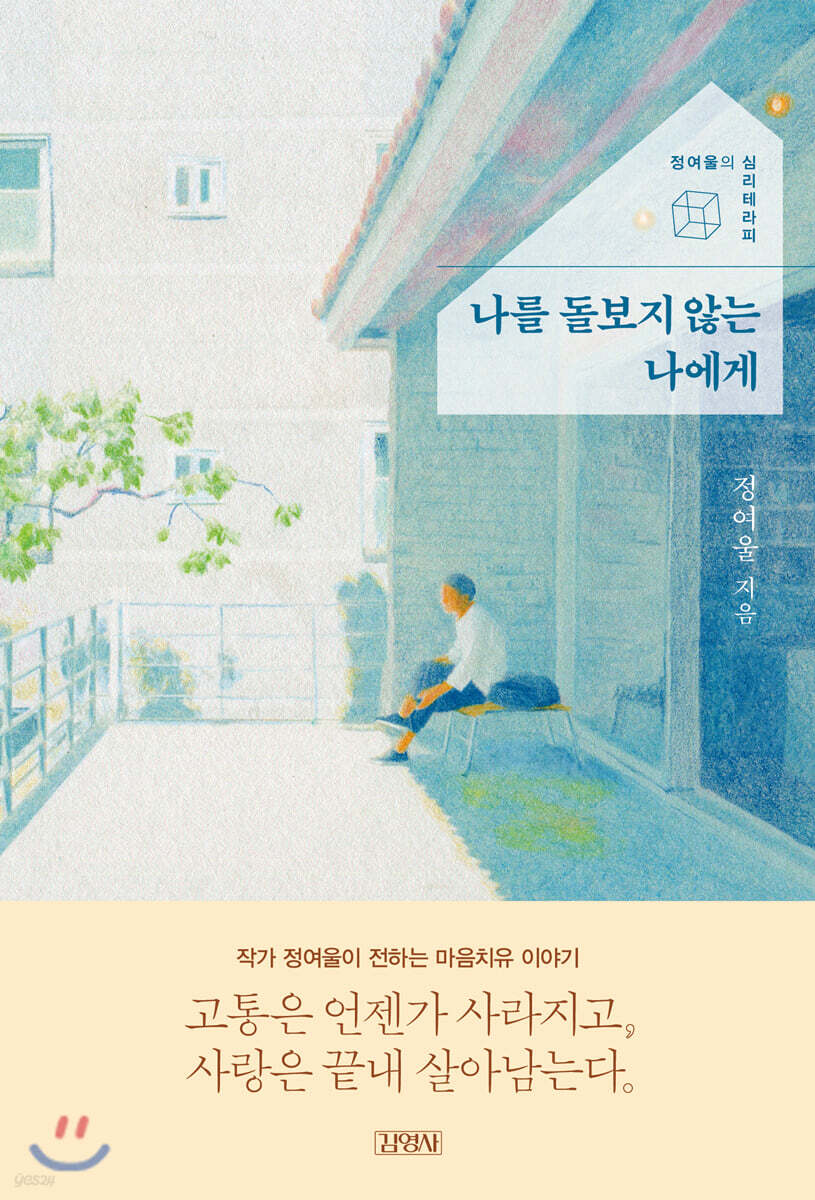
To me who doesn't care about myself
 |
Description
Book Introduction
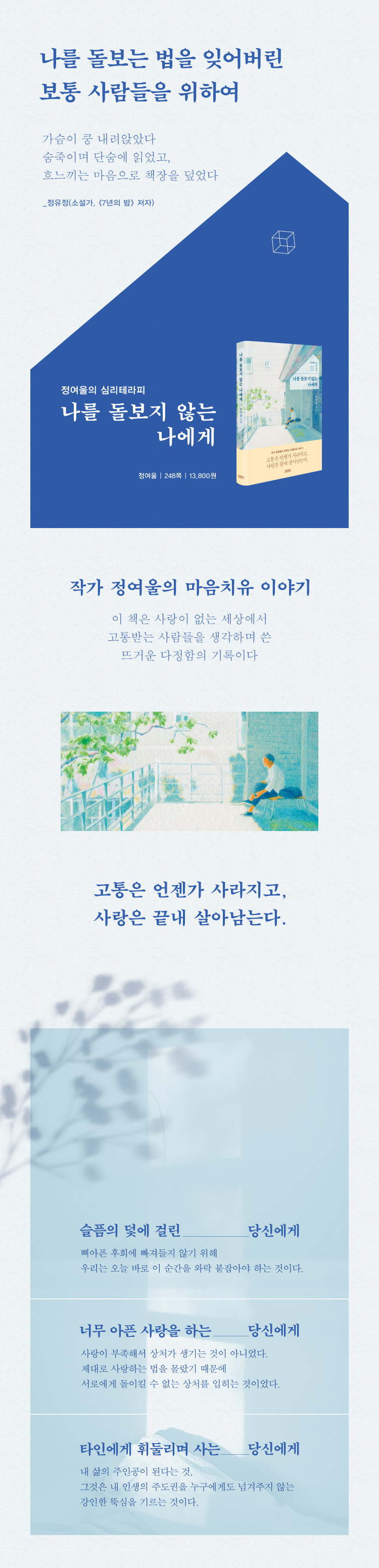
To you who forgot how to take care of me
A story about psychotherapy told by Jeong Yeo-ul
Author Jeong Yeo-ul is loved by readers for her delicate observation of wounds and calm portrayal of sadness.
Even bestselling authors have hidden stories.
The author was once bullied by his friends, blamed himself for his introverted personality, and lived with anxiety as he repeatedly failed job interviews.
Even after becoming a famous writer, I struggled with mental illness, and through studying psychology, I learned how to comfort myself and take care of myself again.
"To Me Who Doesn't Care About Myself" is a warm and sincere record of the author's exploration of the light and shadow within.
It is also a warm healing package for readers who are suffering, sad, and in pain.
A story about psychotherapy for people who are afraid to go to a hospital or a counseling center, but want to heal themselves on their own.
If you've been so busy running forward that you've forgotten how to take care of yourself, and are going through a painful and bitter time, this book will give you the strength to rebuild your broken emotions.
A story about psychotherapy told by Jeong Yeo-ul
Author Jeong Yeo-ul is loved by readers for her delicate observation of wounds and calm portrayal of sadness.
Even bestselling authors have hidden stories.
The author was once bullied by his friends, blamed himself for his introverted personality, and lived with anxiety as he repeatedly failed job interviews.
Even after becoming a famous writer, I struggled with mental illness, and through studying psychology, I learned how to comfort myself and take care of myself again.
"To Me Who Doesn't Care About Myself" is a warm and sincere record of the author's exploration of the light and shadow within.
It is also a warm healing package for readers who are suffering, sad, and in pain.
A story about psychotherapy for people who are afraid to go to a hospital or a counseling center, but want to heal themselves on their own.
If you've been so busy running forward that you've forgotten how to take care of yourself, and are going through a painful and bitter time, this book will give you the strength to rebuild your broken emotions.
- You can preview some of the book's contents.
Preview
index
Publishing a book. A healing package for my heart.
Prologue. Fighting the voice that says, "You won't make it."
1. Because I didn't know how to love properly
A society that values extroversion and discourages introversion
When a missed opportunity breaks your heart
The moment when the unconscious inside me stirs and awakens
The inevitable distance between you and me
Teachers' words that hurt children's hearts
The wave of shadow labor is coming.
Trauma occurs even in happy families.
Even though you are clumsy and wounded
A moment when you need the courage to confess your fears
The greatness of humanity in the face of suffering
Eternal need, thirst for a better life
2. Even the you you don't want to admit
The Light and Shadow of Language in Psychological Analysis
Persona, the Path to Embracing the Masked Personality
The Age of Ego Inflation
Defense Mechanisms That Hinder Growth and Healing
Reaching wholeness by facing complexes
The Beauty of Pruning Ego and Self for the Bigger Picture
The Power of Bliss to Overcome Trauma
Dreaming of a happy coexistence between persona and trauma
The path to overcoming inferiority complex and moving toward a better life
Mindfulness that softens the sharp spear point of my mind
We hide something every day
3. We need time to ask about the well-being of our hearts.
From self-loathing to self-empathy
People who finally make peace with their shadows
In search of food that heals a weary mind
The warmth that comforts the wounded inner child
A Freelancer's Depression Treatment
Gratitude Journal: A New Beginning of Healing
To you who are still searching for your dream even after you are over 30
The Master's Language That Changes His Disciples' Lives
A mentor who teaches you even when you don't meet him
4. Give me the warmest hug when I'm sad
From Writing Teacher to Wounded Healer
What only one-on-one communication can achieve
Leaving behind a beautiful trace
Can I be my own healer?
In the age of burnout, finding the lost energy within me
Depression: Is it really just a cold of the mind?
Complexes, the powder keg of the human mind
Post-traumatic stress disorder: The repercussions of never-ending wounds
Defense mechanisms, the mental weapons that protect me
Thank you for giving me a chance to love again
Epilogue. Time to become the true protagonist of my life.
Get help.
Prologue. Fighting the voice that says, "You won't make it."
1. Because I didn't know how to love properly
A society that values extroversion and discourages introversion
When a missed opportunity breaks your heart
The moment when the unconscious inside me stirs and awakens
The inevitable distance between you and me
Teachers' words that hurt children's hearts
The wave of shadow labor is coming.
Trauma occurs even in happy families.
Even though you are clumsy and wounded
A moment when you need the courage to confess your fears
The greatness of humanity in the face of suffering
Eternal need, thirst for a better life
2. Even the you you don't want to admit
The Light and Shadow of Language in Psychological Analysis
Persona, the Path to Embracing the Masked Personality
The Age of Ego Inflation
Defense Mechanisms That Hinder Growth and Healing
Reaching wholeness by facing complexes
The Beauty of Pruning Ego and Self for the Bigger Picture
The Power of Bliss to Overcome Trauma
Dreaming of a happy coexistence between persona and trauma
The path to overcoming inferiority complex and moving toward a better life
Mindfulness that softens the sharp spear point of my mind
We hide something every day
3. We need time to ask about the well-being of our hearts.
From self-loathing to self-empathy
People who finally make peace with their shadows
In search of food that heals a weary mind
The warmth that comforts the wounded inner child
A Freelancer's Depression Treatment
Gratitude Journal: A New Beginning of Healing
To you who are still searching for your dream even after you are over 30
The Master's Language That Changes His Disciples' Lives
A mentor who teaches you even when you don't meet him
4. Give me the warmest hug when I'm sad
From Writing Teacher to Wounded Healer
What only one-on-one communication can achieve
Leaving behind a beautiful trace
Can I be my own healer?
In the age of burnout, finding the lost energy within me
Depression: Is it really just a cold of the mind?
Complexes, the powder keg of the human mind
Post-traumatic stress disorder: The repercussions of never-ending wounds
Defense mechanisms, the mental weapons that protect me
Thank you for giving me a chance to love again
Epilogue. Time to become the true protagonist of my life.
Get help.
Detailed image
Into the book
Psychology gave me the best energy.
Psychology taught me something that I used to always berate myself for, saying, "I don't have many friends my age with whom I can share my deepest feelings," and "I lack the ability to make friends."
How to become friends with my heart and no one else.
I realized that I had not been caring for myself enough, and that because of my depressed state, I had difficulty caring for others.
While studying psychology, I made peace with the uncontrollable tenderness within me.
It is affection, it is kindness, it is this inner asset that has allowed me, who am so sensitive and picky, to endure my entire life without losing love, even in moments of despair, and it is this ultimate resilience.
--- p.10
It wasn't a lack of love that caused the wounds.
Because we didn't know how to love properly, we ended up causing irreparable harm to each other.
This complex love-hate relationship, where we love each other very much but hate each other very deeply, creates a deep tunnel of trauma in our hearts.
--- p.43~44
If we use trauma as a way to excuse our laziness or mistakes, if we use the very fact of trauma as an excuse for our wrongdoings, then we are not learning anything from trauma.
--- p.67~68
I started clearing out my list of aspirations.
Rather than unconditionally suppressing desires, let's carefully prune away the small branches of desires so that the larger branches of a deeper dream can properly grow.
Let's prune away the thorny branches of our minds that are obsessed with visible results, and prune our desires by focusing on the big picture, imagining the grand drama of our lives.
--- p.90
Studying psychology is about cultivating my mind to be more transparent, gentle, and clear so that I can fall in love with this world anew every day.
I can't erase the wounds, but changing my frame of view of the wounds is the beginning of true healing.
--- p.110
Rather than fearing being abandoned by the organization, I love the freedom to do my best in the moment without regret and to leave at any time without hesitation. That's the essence of courage that my life as a freelancer has taught me.
--- p.135
I realized this while silently hugging the shoulder of the student who was shedding tears.
What students need is not a writing strategy, but someone to confide in.
Children needed not just a writing teacher, but a friend who would listen wholeheartedly to their painful stories.
--- p.160
One of my favorite self-healing techniques is to do something that is not directly related to what I am doing now.
Traveling or taking a walk, watching a movie or an exhibition, or meeting people you miss, even if only for a little while.
Just that alone will naturally relieve stress.
--- p.169
The less we reflect on life, the more we risk burnout.
Reflecting, looking back, and contemplating are the mindfulness techniques that allow us to escape the fast pace of life and love and care for ourselves more deeply.
--- p.190
The belief that I can create my own life, the confidence that I can solve my own problems, the hope that I can make the world around me a little more livable through my own power, and the proactiveness to reclaim sovereignty over my life are the first and most necessary cures for depression.
--- p.200
When we realize that it is not suffering that destroys us, but our attachment to suffering that destroys us, sorrow no longer destroys us.
Suffering and I are not synonymous.
Sadness and I are not synonymous.
--- p.237
Becoming the protagonist of my own life means developing a strong will to not hand over control of my life to anyone else.
Being the protagonist of my own life means never losing the courage to create the life I want, the way I want, with the people I want.
Psychology taught me something that I used to always berate myself for, saying, "I don't have many friends my age with whom I can share my deepest feelings," and "I lack the ability to make friends."
How to become friends with my heart and no one else.
I realized that I had not been caring for myself enough, and that because of my depressed state, I had difficulty caring for others.
While studying psychology, I made peace with the uncontrollable tenderness within me.
It is affection, it is kindness, it is this inner asset that has allowed me, who am so sensitive and picky, to endure my entire life without losing love, even in moments of despair, and it is this ultimate resilience.
--- p.10
It wasn't a lack of love that caused the wounds.
Because we didn't know how to love properly, we ended up causing irreparable harm to each other.
This complex love-hate relationship, where we love each other very much but hate each other very deeply, creates a deep tunnel of trauma in our hearts.
--- p.43~44
If we use trauma as a way to excuse our laziness or mistakes, if we use the very fact of trauma as an excuse for our wrongdoings, then we are not learning anything from trauma.
--- p.67~68
I started clearing out my list of aspirations.
Rather than unconditionally suppressing desires, let's carefully prune away the small branches of desires so that the larger branches of a deeper dream can properly grow.
Let's prune away the thorny branches of our minds that are obsessed with visible results, and prune our desires by focusing on the big picture, imagining the grand drama of our lives.
--- p.90
Studying psychology is about cultivating my mind to be more transparent, gentle, and clear so that I can fall in love with this world anew every day.
I can't erase the wounds, but changing my frame of view of the wounds is the beginning of true healing.
--- p.110
Rather than fearing being abandoned by the organization, I love the freedom to do my best in the moment without regret and to leave at any time without hesitation. That's the essence of courage that my life as a freelancer has taught me.
--- p.135
I realized this while silently hugging the shoulder of the student who was shedding tears.
What students need is not a writing strategy, but someone to confide in.
Children needed not just a writing teacher, but a friend who would listen wholeheartedly to their painful stories.
--- p.160
One of my favorite self-healing techniques is to do something that is not directly related to what I am doing now.
Traveling or taking a walk, watching a movie or an exhibition, or meeting people you miss, even if only for a little while.
Just that alone will naturally relieve stress.
--- p.169
The less we reflect on life, the more we risk burnout.
Reflecting, looking back, and contemplating are the mindfulness techniques that allow us to escape the fast pace of life and love and care for ourselves more deeply.
--- p.190
The belief that I can create my own life, the confidence that I can solve my own problems, the hope that I can make the world around me a little more livable through my own power, and the proactiveness to reclaim sovereignty over my life are the first and most necessary cures for depression.
--- p.200
When we realize that it is not suffering that destroys us, but our attachment to suffering that destroys us, sorrow no longer destroys us.
Suffering and I are not synonymous.
Sadness and I are not synonymous.
--- p.237
Becoming the protagonist of my own life means developing a strong will to not hand over control of my life to anyone else.
Being the protagonist of my own life means never losing the courage to create the life I want, the way I want, with the people I want.
--- p.245
Publisher's Review
“Pain will eventually go away, and love will always survive.”
Psychotherapy for those who don't care about themselves
A healing essay by Jeong Yeo-ul, who has gained a large fan base through her lectures on psychology and humanities.
We whisper to each other about how we, ordinary people, can heal our wounds and manage our hearts.
We have selected articles that have been well-received in various media outlets and have also included prose that we have kept aside.
A book that gives strength to those who have been so busy looking ahead that they have no time to take care of themselves, and who have lost their sense of purpose.
The author describes “To Me Who Doesn’t Care About Myself” as “a record of warm affection.”
This book is a small healing package for me who is suffering, my friends who are grieving, and my readers who are in pain.
It is also a psychotherapy for those of us who are still healthy or pretend to be healthy, and for those who are afraid of going to the hospital or consulting a doctor but want to bravely heal ourselves with our own strength.
This book is a record of my passionate affection, written while thinking of those moments when love seemed absent, of those times when I didn't appreciate love even though it was there, and of those who suffer in a world without love.
_Author's Note
When you need first aid for your mind
A story that's easy to read, like a first aid kit
How many people can say that their heart is okay right now?
How should we live in an age overflowing with complexes, trauma, feelings of inferiority and defeat, loneliness and suffering?
The author does not rashly offer irresponsible comfort to us who are hesitating and clutching our hearts.
We offer practical solutions that can be implemented immediately.
For example, he says that you can overcome pain by writing down in a notebook, “Why I hate myself,” and then writing down again, “Why I should still love and cherish myself.”
Through writing, I found a way to simultaneously confront the light and shadow within myself.
(…) First, write down ‘the moments I regret the most in my life’, second, write down ‘the moments when I was proud of myself’, and lastly, write down ‘the thing I want to do the most right now’.
In this way, you can penetrate the deepest shadows of your mind to meet the brightest light, and finally meet your wholeness, which integrates shadow and light.
Page 83
Additionally, the author gives advice to those who are suffering from a cold of the mind.
Just pouring out your heartfelt pain to others can be a relief.
To cultivate the strong will to not hand over control of my life to anyone.
I need to take time to reflect on myself so I can break free from the fast pace of life and love myself deeply.
This story is like a much-needed first aid kit for those of us who neglect to take care of our inner selves while looking outward.
From wounded to courageous healer
A bestselling author's journey through life
The writer was once bullied.
As the eldest daughter, I lived hiding my feelings in order to appear strong.
I have been suffering from a sense of victimization.
The thought that 'I will never be able to heal my wounds' was deeply rooted inside me.
But when I encountered psychology, I learned how to take care of myself, love myself, cherish myself, and even embrace the hearts of others.
I tried to write without being conscious of being a woman, and decided to accept myself as I am.
By sharing similar fears with my friend, I developed a strong friendship, and by writing a gratitude journal every day, I found small joys.
I recently started keeping a gratitude journal.
It's honestly embarrassing that this extremely introverted person, who is shy even to myself, started writing about being grateful for even the smallest things, but I feel so proud every day.
(…) Every day, there are more things to be grateful for, and every day, I realize the greater and deeper love in this world that surrounds me, and so my trauma becomes softer every day, becomes a worthy opponent, and finally, becomes my most intimate friend in the world.
Pages 138-139
The pain and suffering he experienced as a human being before becoming a writer whose native language was Korean sounds like the story of not only the writer but all of us.
Just as you nod your head while reading someone's diary, as you read along with the intimate sentences, you might find yourself underlining them and saying, "This is my story!"
Maybe that's why.
Novelist Jeong Yu-jeong said she “read this book in one sitting, holding her breath,” as if “it was like carefully unsealing a long-held secret of mine.”
Crossing psychology and humanities
A very special mind-healing essay
There are many books on psychology.
However, it is rare to find a book that talks about psychology like Jeong Yeo-ul.
In recent years, the author has overcome his own wounds by indiscriminately accepting the theories of psychologists who have influenced human history, such as Sigmund Freud, Carl Gustav Jung, and Alfred Adler.
For example, the author was deeply immersed in the psychology of Jung for several years.
Like Jung, it deals with the aspect of ‘you that you do not want to acknowledge’ as a problem of ‘shadow.’
For those suffering from self-loathing, I explain that facing your inner shadow, rather than avoiding it, is the beginning of healthy healing.
The first problem I faced in the process of mindfulness was my blaming mind.
If only my parents had understood me more back then, if only that person hadn't abandoned me back then, if only that friend hadn't bullied me back then.
Changing this feeling of resentment and anger into the frame of, 'If only I had observed my heart more fiercely and taken care of it myself back then.'
That is the first step to enlightenment.
Page 108
The author also recommends that people suffering from burnout syndrome have some "time behind the scenes."
He advises that if you question the life that revolves around work and carefully examine why you are obsessed with work, you can restore your daily life.
It also tells us that we can increase our resilience by not being swayed by the world's judgment and sometimes by breaking free from the demands of others.
The sophisticated insight into suffering is profound.
The author learned the integrative perspective that “when we suffer, only parts suffer, not the whole” while reading “No Boundary” by Ken Wilber, a leading figure in integrative psychology.
They say that a mental world that excessively separates the boundaries between self and non-self intensifies suffering.
As a solution to this, I suggest that we break free from our obsession with the parts and instead have the wisdom to see the whole.
Can painkillers and tranquilizers really make you feel better? Going to the hospital is scary, and consulting a doctor is burdensome. Can't you heal yourself on your own? The mind is too complex to be left solely to psychologists or psychiatrists.
“Rather than leaving everything to experts and becoming comfortable, when we cultivate the power to become our own healers, only then will our problems begin to show signs of resolution.” To you who are scratching and belittling yourself, what you need most right now is to take care of yourself.
On my journey to take care of myself, Jeong Yeo-ul's psychotherapy story will be the most clear and affectionate guide to self-care.
Psychotherapy for those who don't care about themselves
A healing essay by Jeong Yeo-ul, who has gained a large fan base through her lectures on psychology and humanities.
We whisper to each other about how we, ordinary people, can heal our wounds and manage our hearts.
We have selected articles that have been well-received in various media outlets and have also included prose that we have kept aside.
A book that gives strength to those who have been so busy looking ahead that they have no time to take care of themselves, and who have lost their sense of purpose.
The author describes “To Me Who Doesn’t Care About Myself” as “a record of warm affection.”
This book is a small healing package for me who is suffering, my friends who are grieving, and my readers who are in pain.
It is also a psychotherapy for those of us who are still healthy or pretend to be healthy, and for those who are afraid of going to the hospital or consulting a doctor but want to bravely heal ourselves with our own strength.
This book is a record of my passionate affection, written while thinking of those moments when love seemed absent, of those times when I didn't appreciate love even though it was there, and of those who suffer in a world without love.
_Author's Note
When you need first aid for your mind
A story that's easy to read, like a first aid kit
How many people can say that their heart is okay right now?
How should we live in an age overflowing with complexes, trauma, feelings of inferiority and defeat, loneliness and suffering?
The author does not rashly offer irresponsible comfort to us who are hesitating and clutching our hearts.
We offer practical solutions that can be implemented immediately.
For example, he says that you can overcome pain by writing down in a notebook, “Why I hate myself,” and then writing down again, “Why I should still love and cherish myself.”
Through writing, I found a way to simultaneously confront the light and shadow within myself.
(…) First, write down ‘the moments I regret the most in my life’, second, write down ‘the moments when I was proud of myself’, and lastly, write down ‘the thing I want to do the most right now’.
In this way, you can penetrate the deepest shadows of your mind to meet the brightest light, and finally meet your wholeness, which integrates shadow and light.
Page 83
Additionally, the author gives advice to those who are suffering from a cold of the mind.
Just pouring out your heartfelt pain to others can be a relief.
To cultivate the strong will to not hand over control of my life to anyone.
I need to take time to reflect on myself so I can break free from the fast pace of life and love myself deeply.
This story is like a much-needed first aid kit for those of us who neglect to take care of our inner selves while looking outward.
From wounded to courageous healer
A bestselling author's journey through life
The writer was once bullied.
As the eldest daughter, I lived hiding my feelings in order to appear strong.
I have been suffering from a sense of victimization.
The thought that 'I will never be able to heal my wounds' was deeply rooted inside me.
But when I encountered psychology, I learned how to take care of myself, love myself, cherish myself, and even embrace the hearts of others.
I tried to write without being conscious of being a woman, and decided to accept myself as I am.
By sharing similar fears with my friend, I developed a strong friendship, and by writing a gratitude journal every day, I found small joys.
I recently started keeping a gratitude journal.
It's honestly embarrassing that this extremely introverted person, who is shy even to myself, started writing about being grateful for even the smallest things, but I feel so proud every day.
(…) Every day, there are more things to be grateful for, and every day, I realize the greater and deeper love in this world that surrounds me, and so my trauma becomes softer every day, becomes a worthy opponent, and finally, becomes my most intimate friend in the world.
Pages 138-139
The pain and suffering he experienced as a human being before becoming a writer whose native language was Korean sounds like the story of not only the writer but all of us.
Just as you nod your head while reading someone's diary, as you read along with the intimate sentences, you might find yourself underlining them and saying, "This is my story!"
Maybe that's why.
Novelist Jeong Yu-jeong said she “read this book in one sitting, holding her breath,” as if “it was like carefully unsealing a long-held secret of mine.”
Crossing psychology and humanities
A very special mind-healing essay
There are many books on psychology.
However, it is rare to find a book that talks about psychology like Jeong Yeo-ul.
In recent years, the author has overcome his own wounds by indiscriminately accepting the theories of psychologists who have influenced human history, such as Sigmund Freud, Carl Gustav Jung, and Alfred Adler.
For example, the author was deeply immersed in the psychology of Jung for several years.
Like Jung, it deals with the aspect of ‘you that you do not want to acknowledge’ as a problem of ‘shadow.’
For those suffering from self-loathing, I explain that facing your inner shadow, rather than avoiding it, is the beginning of healthy healing.
The first problem I faced in the process of mindfulness was my blaming mind.
If only my parents had understood me more back then, if only that person hadn't abandoned me back then, if only that friend hadn't bullied me back then.
Changing this feeling of resentment and anger into the frame of, 'If only I had observed my heart more fiercely and taken care of it myself back then.'
That is the first step to enlightenment.
Page 108
The author also recommends that people suffering from burnout syndrome have some "time behind the scenes."
He advises that if you question the life that revolves around work and carefully examine why you are obsessed with work, you can restore your daily life.
It also tells us that we can increase our resilience by not being swayed by the world's judgment and sometimes by breaking free from the demands of others.
The sophisticated insight into suffering is profound.
The author learned the integrative perspective that “when we suffer, only parts suffer, not the whole” while reading “No Boundary” by Ken Wilber, a leading figure in integrative psychology.
They say that a mental world that excessively separates the boundaries between self and non-self intensifies suffering.
As a solution to this, I suggest that we break free from our obsession with the parts and instead have the wisdom to see the whole.
Can painkillers and tranquilizers really make you feel better? Going to the hospital is scary, and consulting a doctor is burdensome. Can't you heal yourself on your own? The mind is too complex to be left solely to psychologists or psychiatrists.
“Rather than leaving everything to experts and becoming comfortable, when we cultivate the power to become our own healers, only then will our problems begin to show signs of resolution.” To you who are scratching and belittling yourself, what you need most right now is to take care of yourself.
On my journey to take care of myself, Jeong Yeo-ul's psychotherapy story will be the most clear and affectionate guide to self-care.
GOODS SPECIFICS
- Publication date: October 23, 2019
- Format: Hardcover book binding method guide
- Page count, weight, size: 248 pages | 390g | 136*200*18mm
- ISBN13: 9788934999348
- ISBN10: 8934999349
You may also like
카테고리
korean


korean

![GQ KOREA Mark (Monthly): December [2025]](http://librairie.coreenne.fr/cdn/shop/files/8ef265dbbfbf186523ed75ba7319009d.jpg?v=1765340328&width=3840)


