

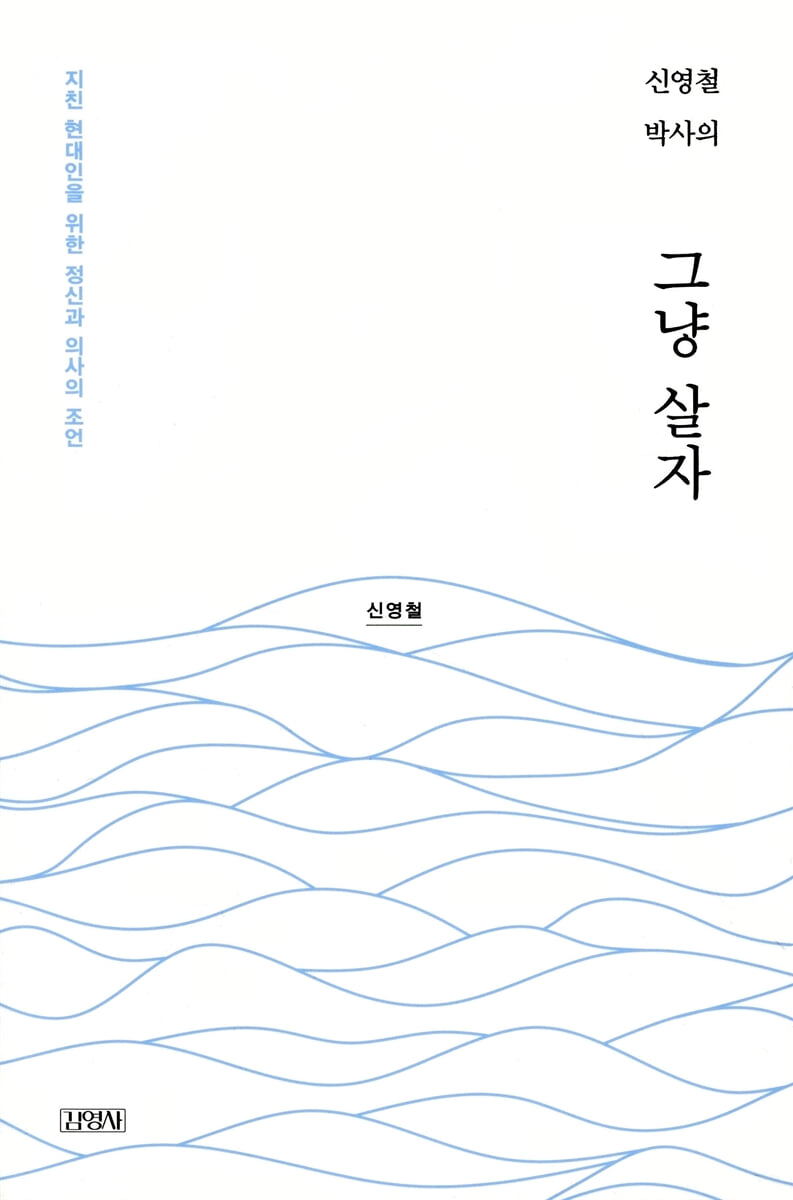
Dr. Shin Young-cheol's Just Live
 |
Description
Book Introduction
A Prescription for the Mind by Shin Young-cheol, Director of the Corporate Mental Health Research Institute at Kangbuk Samsung Hospital
10 Action Guidelines for "Just Living" and Creating a Happy Life
People who live busy and lonely lives think hundreds of times a day.
Why am I not happy? Why am I the only one unhappy? Why do I always fail? The questions and blame always turn on me.
But the gap between anxiety and comfort, unhappiness and happiness, is surprisingly narrow.
When you change your frame of mind, you will find happiness and courage to live life.
By following the guidelines of Dr. Shin Young-cheol, who has been responsible for the mental health of patients and businesses for decades, you will come to accept yourself as you are.
"Just Living" has resonated with countless people and creates a happy life!
10 Action Guidelines for "Just Living" and Creating a Happy Life
People who live busy and lonely lives think hundreds of times a day.
Why am I not happy? Why am I the only one unhappy? Why do I always fail? The questions and blame always turn on me.
But the gap between anxiety and comfort, unhappiness and happiness, is surprisingly narrow.
When you change your frame of mind, you will find happiness and courage to live life.
By following the guidelines of Dr. Shin Young-cheol, who has been responsible for the mental health of patients and businesses for decades, you will come to accept yourself as you are.
"Just Living" has resonated with countless people and creates a happy life!
- You can preview some of the book's contents.
Preview
index
Starting the article
Chapter 1: Just Live
There is no other way / Any stimulus or stress that breaks homeostasis
Chapter 2: Build Your Mental Strength
Mental toughness, resilience / Appropriate frustration fosters resilience / Is post-traumatic growth possible? / There is also positive stress / Physical responses to stress / Depression and depression / Mood, body, and thoughts / Anxious modern people / Drinking / The era of addiction / Is stocks gambling? / How to control anger? / Maintain a daily rhythm
Chapter 3: Create Your Own Weapon
A weapon is a weapon if it helps / Should I eat sirloin or tenderloin? / Is life really short? / Reconcile reality with ideals / Dream big? / Life is a series of choices and decisions / Be faithful to today
Chapter 4: Develop True Self-Esteem
Self-efficacy is not self-esteem / The high school girl who jumped into the Han River / People whose lives disappear when their business cards disappear / Become a true narcissist
Chapter 5: Break Free from Obsession
It's a small thing / What is neuroticism? / People who are overly vulnerable to stress / Is perfectionism a good thing? / Let's live according to our personality.
Chapter 6: Invest in Relationships
The Importance of Good Relationships / Is It Okay to Hit a Child? / Get Out of the Delusion of Relationships / The World's Most Complex Relationships / There's Nothing You Can't Understand / Is It Possible to Communicate with Your Children? / Communication Isn't Just About Words / How to Reduce Stress in Relationships / How Does the Motivation for Change Come About? / From Judge to Lawyer
Chapter 7: Awaken Your Empathy Neurons
The Empathy Neuron, the Mirror Neuron / What Bullying, School Violence, and Gapjil Have in Common / The Makga-pa and Princess Syndrome / Can We Develop Empathy? / Raising Children
Chapter 8: Be Truly Thankful in All Things
A "30 Second Gratitude" Posted on the Ceiling / Are Anxiety and Pain Something to Be Grateful For? / The Story of How I Got a Team from a Taxi Driver
Chapter 9: Use Positive Emotional Memories
Life-Changing Emotional Memories / The Perpetrator Doesn't Know / The Power of Positive Emotional Memories / My Father's Legacy
Chapter 10: Serotonin
What to Pass on to Your Children / Training to Find Happiness by Reflecting on Everyday Life / A Nurse's Postcard / Is the Age of Humanity Over?
In closing
Appendix: Recommended books and lecture videos
Chapter 1: Just Live
There is no other way / Any stimulus or stress that breaks homeostasis
Chapter 2: Build Your Mental Strength
Mental toughness, resilience / Appropriate frustration fosters resilience / Is post-traumatic growth possible? / There is also positive stress / Physical responses to stress / Depression and depression / Mood, body, and thoughts / Anxious modern people / Drinking / The era of addiction / Is stocks gambling? / How to control anger? / Maintain a daily rhythm
Chapter 3: Create Your Own Weapon
A weapon is a weapon if it helps / Should I eat sirloin or tenderloin? / Is life really short? / Reconcile reality with ideals / Dream big? / Life is a series of choices and decisions / Be faithful to today
Chapter 4: Develop True Self-Esteem
Self-efficacy is not self-esteem / The high school girl who jumped into the Han River / People whose lives disappear when their business cards disappear / Become a true narcissist
Chapter 5: Break Free from Obsession
It's a small thing / What is neuroticism? / People who are overly vulnerable to stress / Is perfectionism a good thing? / Let's live according to our personality.
Chapter 6: Invest in Relationships
The Importance of Good Relationships / Is It Okay to Hit a Child? / Get Out of the Delusion of Relationships / The World's Most Complex Relationships / There's Nothing You Can't Understand / Is It Possible to Communicate with Your Children? / Communication Isn't Just About Words / How to Reduce Stress in Relationships / How Does the Motivation for Change Come About? / From Judge to Lawyer
Chapter 7: Awaken Your Empathy Neurons
The Empathy Neuron, the Mirror Neuron / What Bullying, School Violence, and Gapjil Have in Common / The Makga-pa and Princess Syndrome / Can We Develop Empathy? / Raising Children
Chapter 8: Be Truly Thankful in All Things
A "30 Second Gratitude" Posted on the Ceiling / Are Anxiety and Pain Something to Be Grateful For? / The Story of How I Got a Team from a Taxi Driver
Chapter 9: Use Positive Emotional Memories
Life-Changing Emotional Memories / The Perpetrator Doesn't Know / The Power of Positive Emotional Memories / My Father's Legacy
Chapter 10: Serotonin
What to Pass on to Your Children / Training to Find Happiness by Reflecting on Everyday Life / A Nurse's Postcard / Is the Age of Humanity Over?
In closing
Appendix: Recommended books and lecture videos
Into the book
The moment the lid opens, thoughts automatically flow through my head.
Why is this person angry? Is he ignoring me now? This negative train of thought naturally leads to anger.
Let's just accept the situation as it is.
I need to regain my composure and think rationally to see if my misinterpretation has amplified the anger.
---From "Building the Strength of Your Heart"
Let's get rid of the idea that we have to eat this because it's good for our bodies or force ourselves to exercise because it's good for our bodies.
Whether it's food or exercise, you should do it because you like it.
That way, it's good for your body and mind.
Do what you like and eat what you like, as long as it doesn't harm others or seriously harm yourself.
It becomes a true weapon only when it ultimately helps.
---From "Make Your Own Weapon"
Our society is an achievement-oriented society.
Only performance is good.
Of course, what's wrong with being good at something? Is it bad to earn a lot of money, get promoted quickly, and achieve more than others? Of course, we should strive to achieve good results and become number one.
But if you believe that that is your only value, problems arise.
If you don't know that you are a valuable person, even without external achievements, you will never be happy no matter what conditions are met.
---From "Develop True Self-Esteem"
Those two people, who are delicate, kind, and gentle, lose sleep over it.
Why did that girl say that? Why does that friend hate me? Why? Why? Why? I spend all night thinking about it.
There is no need for that.
Just get along with the five of you.
That's the correct answer.
I just need to keep a reasonable distance from the two people I don't get along with and spend time with them appropriately.
There is no reason or need to have good relationships with everyone.
What could possibly be wrong with those people if they aren't even husband or wife? ---From "Invest in Your Relationship"
There is something that has a greater healing power than time.
This is the power of positive emotional memories.
As we have seen above, negative emotional memories have a significant impact on people.
Conversely, wouldn't positive emotional memories also have a significant impact? Let's consider the fact that many positive emotional memories remain in our brains.
When life gets tough, tiring, and frustrating, wouldn't it be the force that saves us?
Why is this person angry? Is he ignoring me now? This negative train of thought naturally leads to anger.
Let's just accept the situation as it is.
I need to regain my composure and think rationally to see if my misinterpretation has amplified the anger.
---From "Building the Strength of Your Heart"
Let's get rid of the idea that we have to eat this because it's good for our bodies or force ourselves to exercise because it's good for our bodies.
Whether it's food or exercise, you should do it because you like it.
That way, it's good for your body and mind.
Do what you like and eat what you like, as long as it doesn't harm others or seriously harm yourself.
It becomes a true weapon only when it ultimately helps.
---From "Make Your Own Weapon"
Our society is an achievement-oriented society.
Only performance is good.
Of course, what's wrong with being good at something? Is it bad to earn a lot of money, get promoted quickly, and achieve more than others? Of course, we should strive to achieve good results and become number one.
But if you believe that that is your only value, problems arise.
If you don't know that you are a valuable person, even without external achievements, you will never be happy no matter what conditions are met.
---From "Develop True Self-Esteem"
Those two people, who are delicate, kind, and gentle, lose sleep over it.
Why did that girl say that? Why does that friend hate me? Why? Why? Why? I spend all night thinking about it.
There is no need for that.
Just get along with the five of you.
That's the correct answer.
I just need to keep a reasonable distance from the two people I don't get along with and spend time with them appropriately.
There is no reason or need to have good relationships with everyone.
What could possibly be wrong with those people if they aren't even husband or wife? ---From "Invest in Your Relationship"
There is something that has a greater healing power than time.
This is the power of positive emotional memories.
As we have seen above, negative emotional memories have a significant impact on people.
Conversely, wouldn't positive emotional memories also have a significant impact? Let's consider the fact that many positive emotional memories remain in our brains.
When life gets tough, tiring, and frustrating, wouldn't it be the force that saves us?
---From "Use Positive Emotional Memories"
Publisher's Review
“It’s okay to just live.
“You always come first.”
A Prescription for the Mind by Shin Young-cheol, Director of the Corporate Mental Health Research Institute at Kangbuk Samsung Hospital
Just Live, and a Happy Life Comes
I ran into a coworker by chance on my way to work.
We lived in similar places, so we met often, and we talked about various things while going to work together.
But today, no matter what I said, my colleague's reaction was indifferent.
It seemed like he wasn't even listening.
Even after arriving at work, I felt bad and kept thinking about it.
What's wrong? Am I inconvenient? Is it because I couldn't get the materials you asked for last time?
Many people interpret the situations and words around them through their own frame, usually giving them negative meanings and causing self-destruction.
Feelings of inferiority eat away at self-esteem, and low self-esteem can easily turn into depression.
This phenomenon occurs because we are unable to accept the people and situations surrounding us as they are.
Dr. Shin Young-cheol's "Just Live" is a kind of mental prescription for these people.
Dr. Shin Young-cheol is a psychiatrist who has appeared on various broadcasts, including KBS's [Morning Plaza] and [Vitamin], and EBS's [My Doctor] and [Parents].
He also serves as the director of the Corporate Mental Health Research Institute at Kangbuk Samsung Hospital, which was established in 2013, and has been working to improve the mental health of employees for corporate sustainability through more than 100 lectures annually at major companies such as Samsung, Hyundai, and SK.
This is one thought he heard while working in hospitals for a long time, giving lectures at companies, and giving counseling on TV.
We just need to live, and always put ourselves first.
In this book, Dr. Shin Young-cheol says that the frame of 'just' is the key to a happy and flexible life.
When he says, 'let's just live', he doesn't mean 'let's just live roughly'.
It means to live by simply accepting the circumstances surrounding you, the words and actions of others, etc., as they are.
Since the frame through which we view the world is different for each person, the world seen through ‘my’ frame cannot always be correct.
What if we framed every situation, relationship, and emotion as "just that" and faced them as they are? We'd realize that someone's blunt remark was just that, a word, and that many of the things we're currently worried about are actually quite trivial.
If you just look at it, the hardened muscles of your heart will loosen up and you will be able to have a flexible mind rather than a crooked mind.
Comfort and happiness will come naturally then.
Empathy and comfort for busy and lonely modern people
10 Clear Action Plans to Reduce Stress and Create Happiness
Dr. Shin Young-cheol introduces 10 specific guidelines for "just living" to create a flexible mind.
These are guidelines for prioritizing yourself and leading a comfortable and happy life, including developing empathy for relationships with family and others, managing negative emotions like anger and anxiety, maintaining a high happiness index even in old age when great happiness declines, and enduring life when suffering from stress and anxiety that make you feel stuck.
The author has met countless people, including patients, viewers, and office workers, and has offered empathy and comfort to their stress and anxiety.
At the same time, the author has been thinking for a long time about how they can become happy, and this book is the author's first book, which contains the experience and wisdom accumulated over decades of working as a psychiatrist.
The author's ten specific and clear guidelines for action will help readers' rigid minds become more flexible and lead them to a more comfortable life that reduces stress.
Wake up your empathy neurons
When forming human relationships, there are bound to be numerous conflicts.
In fact, all conflicts start from the idea that 'I am right.'
If I'm right, who's wrong? It's the other person, of course.
So who needs to change? Obviously, it's the other person.
This is the beginning of the conflict.
To reduce this type of conflict, it is important to try to understand the other person, that is, to empathize with their position.
Good human relationships come from empathy.
To empathize with others, you must first be comfortable with yourself.
In a situation where you are always being chased, you cannot have any leisure time, and if you do not have leisure time, it is difficult to read your own mind, let alone the mind of the other person.
If you can, you should allow yourself some rest.
Put your phone away, do nothing, just rest, turn off the switch of your tiring daily life, and take time to reflect solely on yourself.
When your mind is at peace, you can let go of useless little obsessions and use that energy to be considerate and empathetic to others.
No matter how good something is, it's only a weapon if it's helpful.
There are many foods in the world that are good for your body, and many exercises that are good for your health.
Every broadcast shows so many things that are good for the body that it's hard to keep my wits about me.
But there is no one thing in the world that is good for everyone.
Not all exercise is good.
You need to manage it in a way that suits your body and mind and that you like.
The way other people relieve stress is not necessarily the way I relieve stress.
Instead of focusing on finding something good for your body, it's better to spend time doing something you enjoy, whether it's watching a movie, taking a walk, lying down, or eating ice cream.
Anything is fine as long as it doesn't harm others or seriously harm yourself.
That way, it's good for your body and mind.
A weapon is something that helps me.
Create positive emotional memories
Few people remember where they were or what they were doing at 2 p.m. on August 27th last year.
Unless you won the lottery or it's someone you're really close to, it's normal not to remember.
However, memories that are accompanied by special emotions, such as major accidents or life-changing events, remain vivid even as time passes.
Even if you don't consciously think about it, it remains in your subconscious and has a huge impact on your entire life.
Memories imprinted in the brain in this way are called emotional memories.
Emotional memory plays a crucial role in determining human behavior and often serves as a compass as we navigate life.
What if, among all the memories, there were more positive emotional memories? There will continue to be days when we struggle, weary, and struggle in pain, but those positive emotional memories will always raise their heads and remind us of the good old days.
I would say that it wasn't always just about being tired and sad.
Remember that on days when you feel like collapsing, it is the positive emotional memories imprinted in your brain that will keep you going.
The happiness index of 'serotonin' type people does not decrease.
As we get older, there are fewer things that bring us great happiness.
Because the big events that made us feel happy, such as getting a job, getting a promotion, or getting married, have already passed.
But getting older doesn't necessarily mean your happiness index decreases.
You just have to become a serotonin type person who feels happiness in a different way than in the past.
Serotonin, a neurotransmitter, helps maintain a calm mind by effectively controlling human aggression and addiction.
To increase serotonin, it is good to look back on your daily life and practice feeling small happiness.
It's about finding small but pleasant things, like someone's words or an unexpectedly nice day.
If you continue to create memorable happy moments, you will be able to maintain a high happiness index even as you get older.
“You always come first.”
A Prescription for the Mind by Shin Young-cheol, Director of the Corporate Mental Health Research Institute at Kangbuk Samsung Hospital
Just Live, and a Happy Life Comes
I ran into a coworker by chance on my way to work.
We lived in similar places, so we met often, and we talked about various things while going to work together.
But today, no matter what I said, my colleague's reaction was indifferent.
It seemed like he wasn't even listening.
Even after arriving at work, I felt bad and kept thinking about it.
What's wrong? Am I inconvenient? Is it because I couldn't get the materials you asked for last time?
Many people interpret the situations and words around them through their own frame, usually giving them negative meanings and causing self-destruction.
Feelings of inferiority eat away at self-esteem, and low self-esteem can easily turn into depression.
This phenomenon occurs because we are unable to accept the people and situations surrounding us as they are.
Dr. Shin Young-cheol's "Just Live" is a kind of mental prescription for these people.
Dr. Shin Young-cheol is a psychiatrist who has appeared on various broadcasts, including KBS's [Morning Plaza] and [Vitamin], and EBS's [My Doctor] and [Parents].
He also serves as the director of the Corporate Mental Health Research Institute at Kangbuk Samsung Hospital, which was established in 2013, and has been working to improve the mental health of employees for corporate sustainability through more than 100 lectures annually at major companies such as Samsung, Hyundai, and SK.
This is one thought he heard while working in hospitals for a long time, giving lectures at companies, and giving counseling on TV.
We just need to live, and always put ourselves first.
In this book, Dr. Shin Young-cheol says that the frame of 'just' is the key to a happy and flexible life.
When he says, 'let's just live', he doesn't mean 'let's just live roughly'.
It means to live by simply accepting the circumstances surrounding you, the words and actions of others, etc., as they are.
Since the frame through which we view the world is different for each person, the world seen through ‘my’ frame cannot always be correct.
What if we framed every situation, relationship, and emotion as "just that" and faced them as they are? We'd realize that someone's blunt remark was just that, a word, and that many of the things we're currently worried about are actually quite trivial.
If you just look at it, the hardened muscles of your heart will loosen up and you will be able to have a flexible mind rather than a crooked mind.
Comfort and happiness will come naturally then.
Empathy and comfort for busy and lonely modern people
10 Clear Action Plans to Reduce Stress and Create Happiness
Dr. Shin Young-cheol introduces 10 specific guidelines for "just living" to create a flexible mind.
These are guidelines for prioritizing yourself and leading a comfortable and happy life, including developing empathy for relationships with family and others, managing negative emotions like anger and anxiety, maintaining a high happiness index even in old age when great happiness declines, and enduring life when suffering from stress and anxiety that make you feel stuck.
The author has met countless people, including patients, viewers, and office workers, and has offered empathy and comfort to their stress and anxiety.
At the same time, the author has been thinking for a long time about how they can become happy, and this book is the author's first book, which contains the experience and wisdom accumulated over decades of working as a psychiatrist.
The author's ten specific and clear guidelines for action will help readers' rigid minds become more flexible and lead them to a more comfortable life that reduces stress.
Wake up your empathy neurons
When forming human relationships, there are bound to be numerous conflicts.
In fact, all conflicts start from the idea that 'I am right.'
If I'm right, who's wrong? It's the other person, of course.
So who needs to change? Obviously, it's the other person.
This is the beginning of the conflict.
To reduce this type of conflict, it is important to try to understand the other person, that is, to empathize with their position.
Good human relationships come from empathy.
To empathize with others, you must first be comfortable with yourself.
In a situation where you are always being chased, you cannot have any leisure time, and if you do not have leisure time, it is difficult to read your own mind, let alone the mind of the other person.
If you can, you should allow yourself some rest.
Put your phone away, do nothing, just rest, turn off the switch of your tiring daily life, and take time to reflect solely on yourself.
When your mind is at peace, you can let go of useless little obsessions and use that energy to be considerate and empathetic to others.
No matter how good something is, it's only a weapon if it's helpful.
There are many foods in the world that are good for your body, and many exercises that are good for your health.
Every broadcast shows so many things that are good for the body that it's hard to keep my wits about me.
But there is no one thing in the world that is good for everyone.
Not all exercise is good.
You need to manage it in a way that suits your body and mind and that you like.
The way other people relieve stress is not necessarily the way I relieve stress.
Instead of focusing on finding something good for your body, it's better to spend time doing something you enjoy, whether it's watching a movie, taking a walk, lying down, or eating ice cream.
Anything is fine as long as it doesn't harm others or seriously harm yourself.
That way, it's good for your body and mind.
A weapon is something that helps me.
Create positive emotional memories
Few people remember where they were or what they were doing at 2 p.m. on August 27th last year.
Unless you won the lottery or it's someone you're really close to, it's normal not to remember.
However, memories that are accompanied by special emotions, such as major accidents or life-changing events, remain vivid even as time passes.
Even if you don't consciously think about it, it remains in your subconscious and has a huge impact on your entire life.
Memories imprinted in the brain in this way are called emotional memories.
Emotional memory plays a crucial role in determining human behavior and often serves as a compass as we navigate life.
What if, among all the memories, there were more positive emotional memories? There will continue to be days when we struggle, weary, and struggle in pain, but those positive emotional memories will always raise their heads and remind us of the good old days.
I would say that it wasn't always just about being tired and sad.
Remember that on days when you feel like collapsing, it is the positive emotional memories imprinted in your brain that will keep you going.
The happiness index of 'serotonin' type people does not decrease.
As we get older, there are fewer things that bring us great happiness.
Because the big events that made us feel happy, such as getting a job, getting a promotion, or getting married, have already passed.
But getting older doesn't necessarily mean your happiness index decreases.
You just have to become a serotonin type person who feels happiness in a different way than in the past.
Serotonin, a neurotransmitter, helps maintain a calm mind by effectively controlling human aggression and addiction.
To increase serotonin, it is good to look back on your daily life and practice feeling small happiness.
It's about finding small but pleasant things, like someone's words or an unexpectedly nice day.
If you continue to create memorable happy moments, you will be able to maintain a high happiness index even as you get older.
GOODS SPECIFICS
- Date of issue: March 11, 2019
- Page count, weight, size: 224 pages | 368g | 140*210*20mm
- ISBN13: 9788934994985
- ISBN10: 8934994983
You may also like
카테고리
korean


korean

![GQ KOREA Mark (Monthly): December [2025]](http://librairie.coreenne.fr/cdn/shop/files/8ef265dbbfbf186523ed75ba7319009d.jpg?v=1765340328&width=3840)


