

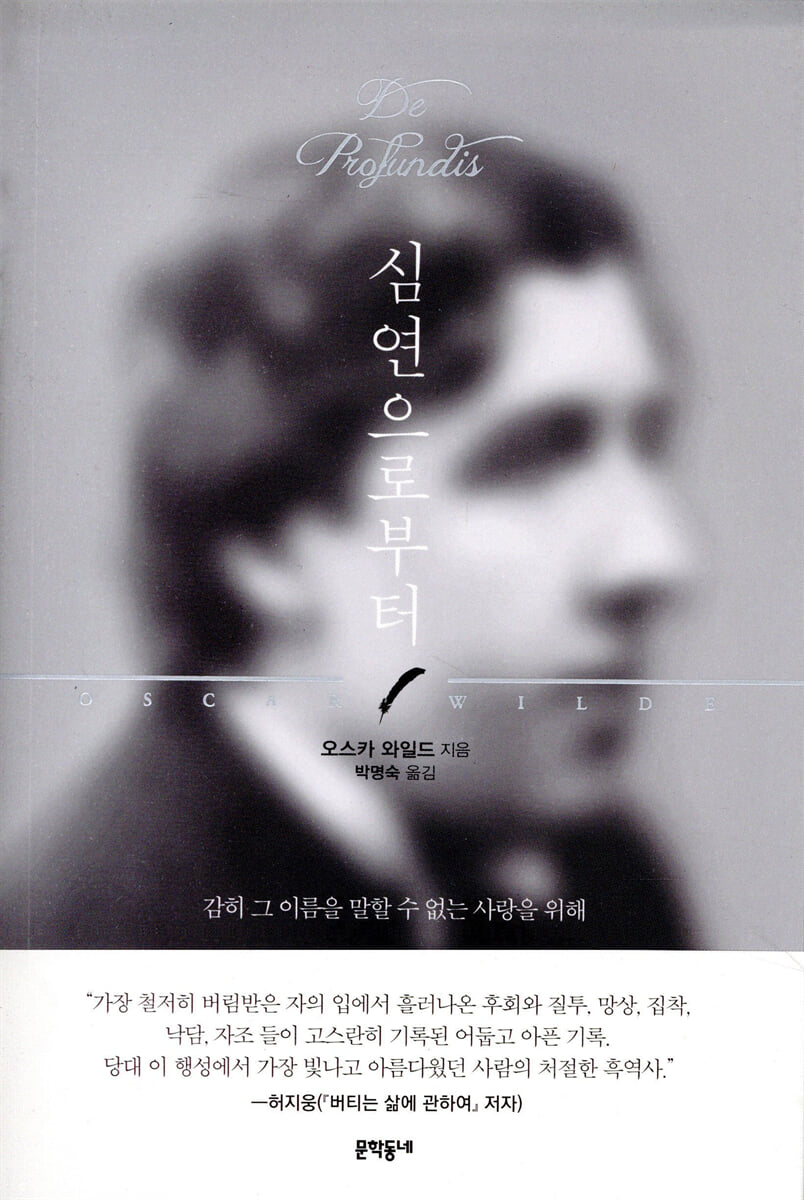
From the abyss
 |
Description
Book Introduction
Oscar Wilde, who lived his life and love as if they were works of art.
In the cold darkness and silence of the prison
A passionate confession of life he wrote with great passion
"From the Deep" is a letter written by Irish writer Oscar Wilde (1854-1900) to his homosexual lover Alfred Douglas (1870-1945) from Reading Prison.
Critic Richard Ellman, who wrote a biography of Wilde, called it “one of the greatest and longest love letters ever written.”
In Korea, it has been translated several times since the 1950s under the title ‘Okjunggi (獄中記)’ and has been read for a long time.
Although the title may focus on the fact that Wilde wrote it in prison, the book is actually a poignant love letter and, contrary to popular belief, closer to a meditation than a confessional.
In this book, Wilde boldly expresses his resentment and longing for the lover who led him to the abyss, deeply reflects on his past life, and reveals his firm belief in art.
This book is filled with Oscar Wilde's aspirations to regain hope for the future and his dignity as an artist even in the midst of pain and despair.
In the cold darkness and silence of the prison
A passionate confession of life he wrote with great passion
"From the Deep" is a letter written by Irish writer Oscar Wilde (1854-1900) to his homosexual lover Alfred Douglas (1870-1945) from Reading Prison.
Critic Richard Ellman, who wrote a biography of Wilde, called it “one of the greatest and longest love letters ever written.”
In Korea, it has been translated several times since the 1950s under the title ‘Okjunggi (獄中記)’ and has been read for a long time.
Although the title may focus on the fact that Wilde wrote it in prison, the book is actually a poignant love letter and, contrary to popular belief, closer to a meditation than a confessional.
In this book, Wilde boldly expresses his resentment and longing for the lover who led him to the abyss, deeply reflects on his past life, and reveals his firm belief in art.
This book is filled with Oscar Wilde's aspirations to regain hope for the future and his dignity as an artist even in the midst of pain and despair.
- You can preview some of the book's contents.
Preview
index
Translator's Note
Oscar Wilde's name regained after 100 years, the story of its rise and fall… 7
From the Abyss… 41
Oscar Wilde - André Gide … 241
In memory of Oscar Wilde… 245
Reading "From the Abyss"... 283
Americas...297
Oscar Wilde's name regained after 100 years, the story of its rise and fall… 7
From the Abyss… 41
Oscar Wilde - André Gide … 241
In memory of Oscar Wilde… 245
Reading "From the Abyss"... 283
Americas...297
Publisher's Review
A life of fatal love and a fall into the abyss
Wilde, who became known as a proponent of humanism, reached the pinnacle of his career as a writer by publishing the novel The Picture of Dorian Gray in 1891, the collection of literary and art criticism Intentions, the collection of short stories The Crime and Other Tales of Sir Arthur Savile, and the collection of fairy tales The House of Pomegranates, and by finishing writing the play Salome.
And then we meet Alfred Douglas, whose life was plunged into endless turmoil.
Douglas, who had read The Picture of Dorian Gray nine times and developed a curiosity about the author, was a student at Magdalen College, Oxford, where Wilde had attended, and was twenty-one years old at the time.
Wilde and Douglas, both thirty-seven years old, soon developed a deep romantic relationship.
But their relationship, which lasted three years, completely destroyed Wilde's life.
Douglas had a violent temperament, was a spendthrift, and was pathologically obsessed with Wilde.
He did not even hesitate to threaten to commit suicide if they did not meet.
Douglas was from an aristocratic Scottish family and was himself a poet and writer.
He was in constant conflict with his father, the Marquess of Queensbury.
The Marquis of Queensbury publicly slandered Wilde in an attempt to separate him from his son.
Wilde, tired of the rich, finally takes legal action against the Marquess of Queensbury.
However, several trials held in 1895 turned out unfavorably for Wilde in many ways, and he was eventually sentenced to two years of hard labor on charges of "committing disgusting indecency with other men."
(Douglas was never punished, and left for Europe the day after Wilde's trial began, not returning to England for three years.) After his conviction, the name Oscar Wilde disappeared from London's theatres and bookshops.
He went from being one of London's most famous people to an unknown prisoner in an instant.
His wife left for Germany with their two sons and changed her surname from Wilde to Holland.
He never saw his two sons again, and after his death, none of his descendants ever reclaimed the surname Wilde.
The British prisons of the late 19th century, where Wilde served his sentence, were literally horrific.
He had to endure heavy punishments, hard labor, hunger, cold, and daily humiliation.
But what Wilde found most difficult to endure was intellectual hunger.
Then, thanks to the consideration of the new warden who was appointed while serving his sentence, Wilde was able to read books and write letters.
The warden collected and kept Wilde's letters, returning them to him when he was released.
(At that time, in Reading Prison, you could only write one page of a letter a day, and you had to return the letter and the pen immediately after you finished writing it.
So, in this letter, grammatical errors and incorrect literary quotations are often found.) That is how 『From the Abyss』 was able to come into the world.
The original version of "From the Abyss," published 65 years after it was written
After his release on 19 May 1897, Wilde left England and arrived in Dieppe, France the following day, where he met Robert Ross.
(Robert Ross was Wilde's first homosexual lover and his most loyal friend.
(He was buried with Wilde even after his death.) He handed Ross a bundle of letters, asking him to type up a copy and keep it for himself while giving the originals to Douglas.
However, Ross, who had kept the letter, typed a copy and gave it to Douglas, keeping the original for himself.
This letter was first published in Germany in 1905.
An expunged version of the letters was also published in London in the same year.
At the time, Ross deleted all passages related to Douglas and his family, which amounted to a whopping two-thirds of the entire letter, to prevent anyone from knowing who the recipients were.
So, until the original was made public, the general public knew this letter as simply Wilde's confessional memoir.
(Most of the translated versions introduced in our country also have similar problems as they are based on this deleted version.)
'From the Abyss (De Profundis)' is the title given by Ross when he published the excised version in 1905 (Psalm 130 of the Old Testament).
The title Wilde initially gave it was 'Epistola: In Carcere et Vinculis' (Letters Written in Prison and Chains).
Ross left the original letter to the British Museum on the condition that it remain unpublished for the next 50 years.
The letter's recipient was first made known in 1912.
Ross's friend Arthur Ransom had mentioned the deleted passages Ross had pointed out in his book Oscar Wilde: A Critical Study.
Douglas sued Ransom and the editor for defamation, but lost.
However, Ransom deleted the offending passages from the next edition, and an informal agreement was reached that Wilde's full letter would not be published during Douglas's lifetime, as Ross had requested.
After some time, Ross gave Wilde's second son, Vivienne Holland, a typewritten letter he had kept (this manuscript contained many errors, and Ross deleted over 100 passages where Wilde criticized Douglas and the Marquess of Queensbury).
After Douglas's death in 1945, Vivian published the incomplete manuscript she had received from Ross in 1949 under the title From the Abyss.
Wilde's letters were not published in their entirety until 1962, 65 years after they were written.
The Last Days of Oscar Wilde
Wilde's main motivation for writing this lengthy letter is well revealed in the letter he sent to Ross on April 1, 1897, when he had finished writing the letter and was awaiting his release from prison.
So, if you are to become my literary executor, you must have the only document that properly explains my bizarre behavior towards Queensbury and Alfred Douglas.
When you read this letter, you will find that it contains a psychological explanation for my actions, which to the world would seem to be the height of foolishness and vulgar pretense.
Someday the truth will come out.
Maybe not in my lifetime or Douglas's lifetime.
But I don't want to be stuck in this weird public sphere with them forever.
Because I inherited a noble name in literature and art from my father and mother.
So I can't allow that name to forever be the shield and weapon of the Queensbury rich.
I'm not going to make any excuses for my actions.
Just clarifying.
The letter also contains passages dealing with my mental growth in prison, my intellectual attitude towards my past life, and the inevitable changes in my temperament.
I hope that those who stand by me, including you, who have always held my affection, will know exactly what kind of heart and attitude I intend to have in facing the world.
After his release, Wilde left England and lived in a small French village, using the pseudonym Sebastian Melmoth.
Although he published his final work, The Ballad of Reading Gaol, he did not write any more.
He lost all will to live and even skipped meals because he had no money.
He had to endure loneliness and humiliation mostly alone in a world that was hostile to him.
His place did not exist anywhere in the world.
And Wilde was reunited with Douglas.
In August 1897, they met in Rouen and left for Italy together.
They moved around here and there, including Naples, but were separated again due to criticism and pressure from Wilde's wife, friends, and the Marquis of Queensbury.
To Ross, who was concerned about him, Wilde sent the following letter:
Dear Robbie, I received your letter today.
It was psychologically inevitable that I would return to Bossi (Douglas).
(…) That the world made me that way.
I can't live without the energy of love.
I am a person who loves and must be loved.
No matter what the cost.
(…) During the last month I spent in Bernwald, I was so lonely that all I wanted to do was die.
When the world closed its doors on me, the door of love was still open.
When people criticize me for going back to Bosei, I tell them this.
He gave me the gift of love.
After three months of fierce fighting against the terrible world of vulgarity, amidst loneliness and shame, I naturally returned to him.
Of course I will often be unhappy.
But I still love him.
The fact that he ruined my life is what made me love him.
Wilde spent the last days of his life living in cheap hotels in Paris.
In September 1900, his health deteriorated rapidly, and in October he underwent ear surgery in his hotel room.
He was baptized and converted to Roman Catholicism shortly before his death.
On November 30, Wilde died surrounded by two friends.
The cause of death was meningitis.
Oscar Wilde meets André Gide
Two essays by André Gide are included in this book ("In Memory of Oscar Wilde" and "Reading From the Abyss").
These writings, which are included in Gide's book, Oscar Wilde, reveal a new side of Wilde that was previously unknown.
Gide first met Wilde in Paris on November 26, 1891.
At that time, Wilde was enjoying the heyday of his career as a writer.
The young man, Gide, who met Wilde, was shocked to the core.
He said in a letter to Paul Valéry:
“Since I met Wilde, I feel like I no longer exist.” He kept the memory of Wilde with him for the rest of his life.
The influence that Gide received from Wilde is indeed evident throughout his work.
In "In Memory of Oscar Wilde," Gide recalls his first encounter with Wilde in Paris, followed by several encounters with him in Florence, Algiers, Bernval, and again in Paris.
"Reading From the Abyss" is particularly helpful in understanding Wilde's letters.
A special pictorial was included at the front of the book.
It is composed mainly of previously unpublished materials, such as photographs of Wilde and Douglas together, newspaper illustrations from the time of the trial, a draft of Out of the Deep, and photos of the hotel room where Wilde stayed in his later years.
Through the pictorial, you will be able to experience Wilde's dramatic life and the charm of this book more vividly and three-dimensionally.
Translator Park Myeong-suk, who published Oscar Wilde's essay collection, The Decline of Lies (Eunhaengnamu, 2015) earlier this year, delved into Wilde's life and meticulously analyzed the text to present a complete translation of From the Abyss that is as close as possible to the original.
Through faithful annotations that aid understanding of the work and a delicate translation that preserves Wilde's unique style, readers will be able to encounter the book's contents, which have been misunderstood, and the true face of Oscar Wilde as an artist in a new light.
Oscar Wilde's quote from "Out of the Abyss"
“For us who are imprisoned, with nothing to do but grieve, we can only measure time by the pain of suffering and the memories of bitter moments.”
“Pain is the means by which we can survive.
Because pain is the only thing that makes us aware that we are alive.”
“The gods are really strange.
When God punishes us, it is not enough to use our vices as tools; he also uses the good, the kind, the human, and the loving within us to lead us to our destruction.
“If I hadn’t felt compassion and affection for you and your family, I wouldn’t be crying in this terrible place right now.”
“Life’s fatal mistakes are not due to human irrationality.
Sometimes the most irrational moments can be the best moments.
“Life’s fatal mistakes do not come from human logic.”
“Love does not trade in the marketplace or use the scales of a peddler.
The joy of love, like intellectual joy, is to feel alive in love itself.
The purpose of love is to love.
“Nothing more, nothing less.”
“Because pain is one long moment.
Pain is not something that can be divided like seasons.
We can only record those various moments and talk about those moments coming back again.
For us, time does not move forward.
“It just keeps circulating.”
“To deny your own experiences is to hinder your own development.
To deny one's own experience is to put a lie on one's own life.
“It is no different from denying one’s own soul.”
“It is a true tragedy that so few people ‘possess their soul’ before they die.
Emerson once said, 'There is nothing more precious to a man than his own actions.'
He is absolutely right.
Most people are different people.
Their thoughts are someone else's opinions, their lives are imitations, and their passions are mere quotations.”
“It may be unscientific and hypocritical to promise to become a better person, but becoming a more profound person is a privilege given to those who have suffered.”
“Good intentions are worthless in art.
“All bad art comes from good intentions.”
“We have to pay a price even for the most noble feelings of self-sacrifice.
It may sound strange, but that's what makes those feelings more noble.”
“Every trial is a trial of someone’s life.
“Every sentence is like a death sentence.”
Wilde, who became known as a proponent of humanism, reached the pinnacle of his career as a writer by publishing the novel The Picture of Dorian Gray in 1891, the collection of literary and art criticism Intentions, the collection of short stories The Crime and Other Tales of Sir Arthur Savile, and the collection of fairy tales The House of Pomegranates, and by finishing writing the play Salome.
And then we meet Alfred Douglas, whose life was plunged into endless turmoil.
Douglas, who had read The Picture of Dorian Gray nine times and developed a curiosity about the author, was a student at Magdalen College, Oxford, where Wilde had attended, and was twenty-one years old at the time.
Wilde and Douglas, both thirty-seven years old, soon developed a deep romantic relationship.
But their relationship, which lasted three years, completely destroyed Wilde's life.
Douglas had a violent temperament, was a spendthrift, and was pathologically obsessed with Wilde.
He did not even hesitate to threaten to commit suicide if they did not meet.
Douglas was from an aristocratic Scottish family and was himself a poet and writer.
He was in constant conflict with his father, the Marquess of Queensbury.
The Marquis of Queensbury publicly slandered Wilde in an attempt to separate him from his son.
Wilde, tired of the rich, finally takes legal action against the Marquess of Queensbury.
However, several trials held in 1895 turned out unfavorably for Wilde in many ways, and he was eventually sentenced to two years of hard labor on charges of "committing disgusting indecency with other men."
(Douglas was never punished, and left for Europe the day after Wilde's trial began, not returning to England for three years.) After his conviction, the name Oscar Wilde disappeared from London's theatres and bookshops.
He went from being one of London's most famous people to an unknown prisoner in an instant.
His wife left for Germany with their two sons and changed her surname from Wilde to Holland.
He never saw his two sons again, and after his death, none of his descendants ever reclaimed the surname Wilde.
The British prisons of the late 19th century, where Wilde served his sentence, were literally horrific.
He had to endure heavy punishments, hard labor, hunger, cold, and daily humiliation.
But what Wilde found most difficult to endure was intellectual hunger.
Then, thanks to the consideration of the new warden who was appointed while serving his sentence, Wilde was able to read books and write letters.
The warden collected and kept Wilde's letters, returning them to him when he was released.
(At that time, in Reading Prison, you could only write one page of a letter a day, and you had to return the letter and the pen immediately after you finished writing it.
So, in this letter, grammatical errors and incorrect literary quotations are often found.) That is how 『From the Abyss』 was able to come into the world.
The original version of "From the Abyss," published 65 years after it was written
After his release on 19 May 1897, Wilde left England and arrived in Dieppe, France the following day, where he met Robert Ross.
(Robert Ross was Wilde's first homosexual lover and his most loyal friend.
(He was buried with Wilde even after his death.) He handed Ross a bundle of letters, asking him to type up a copy and keep it for himself while giving the originals to Douglas.
However, Ross, who had kept the letter, typed a copy and gave it to Douglas, keeping the original for himself.
This letter was first published in Germany in 1905.
An expunged version of the letters was also published in London in the same year.
At the time, Ross deleted all passages related to Douglas and his family, which amounted to a whopping two-thirds of the entire letter, to prevent anyone from knowing who the recipients were.
So, until the original was made public, the general public knew this letter as simply Wilde's confessional memoir.
(Most of the translated versions introduced in our country also have similar problems as they are based on this deleted version.)
'From the Abyss (De Profundis)' is the title given by Ross when he published the excised version in 1905 (Psalm 130 of the Old Testament).
The title Wilde initially gave it was 'Epistola: In Carcere et Vinculis' (Letters Written in Prison and Chains).
Ross left the original letter to the British Museum on the condition that it remain unpublished for the next 50 years.
The letter's recipient was first made known in 1912.
Ross's friend Arthur Ransom had mentioned the deleted passages Ross had pointed out in his book Oscar Wilde: A Critical Study.
Douglas sued Ransom and the editor for defamation, but lost.
However, Ransom deleted the offending passages from the next edition, and an informal agreement was reached that Wilde's full letter would not be published during Douglas's lifetime, as Ross had requested.
After some time, Ross gave Wilde's second son, Vivienne Holland, a typewritten letter he had kept (this manuscript contained many errors, and Ross deleted over 100 passages where Wilde criticized Douglas and the Marquess of Queensbury).
After Douglas's death in 1945, Vivian published the incomplete manuscript she had received from Ross in 1949 under the title From the Abyss.
Wilde's letters were not published in their entirety until 1962, 65 years after they were written.
The Last Days of Oscar Wilde
Wilde's main motivation for writing this lengthy letter is well revealed in the letter he sent to Ross on April 1, 1897, when he had finished writing the letter and was awaiting his release from prison.
So, if you are to become my literary executor, you must have the only document that properly explains my bizarre behavior towards Queensbury and Alfred Douglas.
When you read this letter, you will find that it contains a psychological explanation for my actions, which to the world would seem to be the height of foolishness and vulgar pretense.
Someday the truth will come out.
Maybe not in my lifetime or Douglas's lifetime.
But I don't want to be stuck in this weird public sphere with them forever.
Because I inherited a noble name in literature and art from my father and mother.
So I can't allow that name to forever be the shield and weapon of the Queensbury rich.
I'm not going to make any excuses for my actions.
Just clarifying.
The letter also contains passages dealing with my mental growth in prison, my intellectual attitude towards my past life, and the inevitable changes in my temperament.
I hope that those who stand by me, including you, who have always held my affection, will know exactly what kind of heart and attitude I intend to have in facing the world.
After his release, Wilde left England and lived in a small French village, using the pseudonym Sebastian Melmoth.
Although he published his final work, The Ballad of Reading Gaol, he did not write any more.
He lost all will to live and even skipped meals because he had no money.
He had to endure loneliness and humiliation mostly alone in a world that was hostile to him.
His place did not exist anywhere in the world.
And Wilde was reunited with Douglas.
In August 1897, they met in Rouen and left for Italy together.
They moved around here and there, including Naples, but were separated again due to criticism and pressure from Wilde's wife, friends, and the Marquis of Queensbury.
To Ross, who was concerned about him, Wilde sent the following letter:
Dear Robbie, I received your letter today.
It was psychologically inevitable that I would return to Bossi (Douglas).
(…) That the world made me that way.
I can't live without the energy of love.
I am a person who loves and must be loved.
No matter what the cost.
(…) During the last month I spent in Bernwald, I was so lonely that all I wanted to do was die.
When the world closed its doors on me, the door of love was still open.
When people criticize me for going back to Bosei, I tell them this.
He gave me the gift of love.
After three months of fierce fighting against the terrible world of vulgarity, amidst loneliness and shame, I naturally returned to him.
Of course I will often be unhappy.
But I still love him.
The fact that he ruined my life is what made me love him.
Wilde spent the last days of his life living in cheap hotels in Paris.
In September 1900, his health deteriorated rapidly, and in October he underwent ear surgery in his hotel room.
He was baptized and converted to Roman Catholicism shortly before his death.
On November 30, Wilde died surrounded by two friends.
The cause of death was meningitis.
Oscar Wilde meets André Gide
Two essays by André Gide are included in this book ("In Memory of Oscar Wilde" and "Reading From the Abyss").
These writings, which are included in Gide's book, Oscar Wilde, reveal a new side of Wilde that was previously unknown.
Gide first met Wilde in Paris on November 26, 1891.
At that time, Wilde was enjoying the heyday of his career as a writer.
The young man, Gide, who met Wilde, was shocked to the core.
He said in a letter to Paul Valéry:
“Since I met Wilde, I feel like I no longer exist.” He kept the memory of Wilde with him for the rest of his life.
The influence that Gide received from Wilde is indeed evident throughout his work.
In "In Memory of Oscar Wilde," Gide recalls his first encounter with Wilde in Paris, followed by several encounters with him in Florence, Algiers, Bernval, and again in Paris.
"Reading From the Abyss" is particularly helpful in understanding Wilde's letters.
A special pictorial was included at the front of the book.
It is composed mainly of previously unpublished materials, such as photographs of Wilde and Douglas together, newspaper illustrations from the time of the trial, a draft of Out of the Deep, and photos of the hotel room where Wilde stayed in his later years.
Through the pictorial, you will be able to experience Wilde's dramatic life and the charm of this book more vividly and three-dimensionally.
Translator Park Myeong-suk, who published Oscar Wilde's essay collection, The Decline of Lies (Eunhaengnamu, 2015) earlier this year, delved into Wilde's life and meticulously analyzed the text to present a complete translation of From the Abyss that is as close as possible to the original.
Through faithful annotations that aid understanding of the work and a delicate translation that preserves Wilde's unique style, readers will be able to encounter the book's contents, which have been misunderstood, and the true face of Oscar Wilde as an artist in a new light.
Oscar Wilde's quote from "Out of the Abyss"
“For us who are imprisoned, with nothing to do but grieve, we can only measure time by the pain of suffering and the memories of bitter moments.”
“Pain is the means by which we can survive.
Because pain is the only thing that makes us aware that we are alive.”
“The gods are really strange.
When God punishes us, it is not enough to use our vices as tools; he also uses the good, the kind, the human, and the loving within us to lead us to our destruction.
“If I hadn’t felt compassion and affection for you and your family, I wouldn’t be crying in this terrible place right now.”
“Life’s fatal mistakes are not due to human irrationality.
Sometimes the most irrational moments can be the best moments.
“Life’s fatal mistakes do not come from human logic.”
“Love does not trade in the marketplace or use the scales of a peddler.
The joy of love, like intellectual joy, is to feel alive in love itself.
The purpose of love is to love.
“Nothing more, nothing less.”
“Because pain is one long moment.
Pain is not something that can be divided like seasons.
We can only record those various moments and talk about those moments coming back again.
For us, time does not move forward.
“It just keeps circulating.”
“To deny your own experiences is to hinder your own development.
To deny one's own experience is to put a lie on one's own life.
“It is no different from denying one’s own soul.”
“It is a true tragedy that so few people ‘possess their soul’ before they die.
Emerson once said, 'There is nothing more precious to a man than his own actions.'
He is absolutely right.
Most people are different people.
Their thoughts are someone else's opinions, their lives are imitations, and their passions are mere quotations.”
“It may be unscientific and hypocritical to promise to become a better person, but becoming a more profound person is a privilege given to those who have suffered.”
“Good intentions are worthless in art.
“All bad art comes from good intentions.”
“We have to pay a price even for the most noble feelings of self-sacrifice.
It may sound strange, but that's what makes those feelings more noble.”
“Every trial is a trial of someone’s life.
“Every sentence is like a death sentence.”
GOODS SPECIFICS
- Date of issue: May 2, 2015
- Page count, weight, size: 328 pages | 536g | 140*210*30mm
- ISBN13: 9788954636162
- ISBN10: 8954636160
You may also like
카테고리
korean


korean

![GQ KOREA Mark (Monthly): December [2025]](http://librairie.coreenne.fr/cdn/shop/files/8ef265dbbfbf186523ed75ba7319009d.jpg?v=1765340328&width=3840)


