

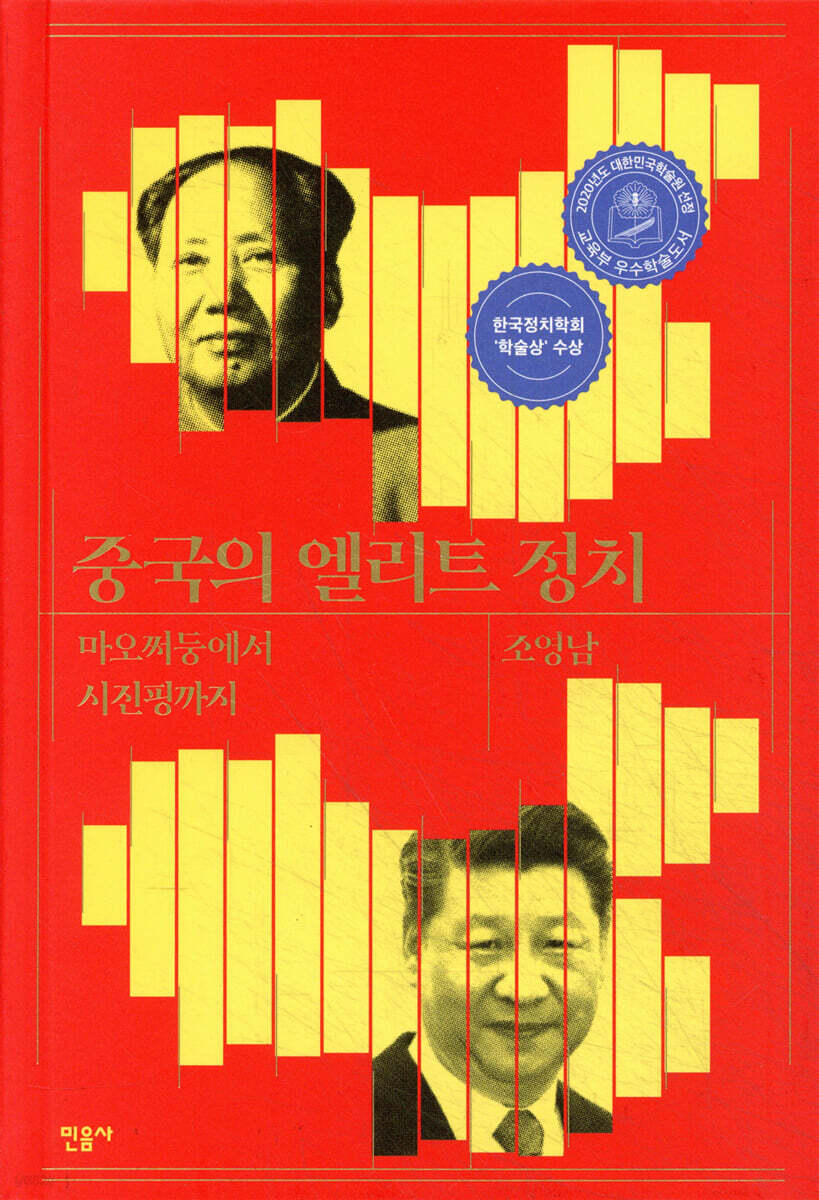
China's elite politics
 |
Description
Book Introduction
How has China changed since its founding 70 years ago?
Will the collective leadership system of the Deng Xiaoping era turn into one-man rule in the Xi Jinping era?
You can't understand China without understanding elite politics!
Professor Cho Young-nam, the author, has been a professor at the Graduate School of International Studies at Seoul National University since 2002, in recognition of the value of his research on Chinese political leadership.
Having worked closely with Chinese government officials and academic leaders, conducting both practical, face-to-face research and extensive data collection, he not only provides academic guidance but also possesses a clearer understanding of the realities of China than anyone else.
All of his books were copyrighted and exported to China, but none of them have been published to this day due to censorship by the Chinese government.
However, 『China's Dream』(2013) has been featured prominently on Chinese TV, and Professor Cho Young-nam's verification of facts that are difficult to understand even in China and his rigorous academic insight have garnered significant attention both domestically and internationally.
In particular, this 『China's Elite Politics: From Mao Zedong to Xi Jinping』 follows the trilogy 『China in the Deng Xiaoping Era』 (2016), which analyzed the factors behind China's successful reform and opening up (『Reform and Opening Up』, 『Factions and Struggle』, and 『Tiananmen Square Incident』, and summarizes the most important keywords for understanding how China operates today, the core descriptions of political power.
Professor Cho Young-nam of Seoul National University, Korea's leading authority on Chinese politics, uses accurate data, solid academic evidence, and clear analysis to promote a systematic and in-depth understanding of China, rather than a sensational "novel."
Will the collective leadership system of the Deng Xiaoping era turn into one-man rule in the Xi Jinping era?
You can't understand China without understanding elite politics!
Professor Cho Young-nam, the author, has been a professor at the Graduate School of International Studies at Seoul National University since 2002, in recognition of the value of his research on Chinese political leadership.
Having worked closely with Chinese government officials and academic leaders, conducting both practical, face-to-face research and extensive data collection, he not only provides academic guidance but also possesses a clearer understanding of the realities of China than anyone else.
All of his books were copyrighted and exported to China, but none of them have been published to this day due to censorship by the Chinese government.
However, 『China's Dream』(2013) has been featured prominently on Chinese TV, and Professor Cho Young-nam's verification of facts that are difficult to understand even in China and his rigorous academic insight have garnered significant attention both domestically and internationally.
In particular, this 『China's Elite Politics: From Mao Zedong to Xi Jinping』 follows the trilogy 『China in the Deng Xiaoping Era』 (2016), which analyzed the factors behind China's successful reform and opening up (『Reform and Opening Up』, 『Factions and Struggle』, and 『Tiananmen Square Incident』, and summarizes the most important keywords for understanding how China operates today, the core descriptions of political power.
Professor Cho Young-nam of Seoul National University, Korea's leading authority on Chinese politics, uses accurate data, solid academic evidence, and clear analysis to promote a systematic and in-depth understanding of China, rather than a sensational "novel."
- You can preview some of the book's contents.
Preview
index
Why elite politics?
Chapter 1: Elite Politics in China
Part I: Elite Politics in the Era of Mao Zedong and Deng Xiaoping
Chapter 2: One-Man Rule in the Mao Zedong Era
Chapter 3: The Establishment of Mao Zedong's One-Man Rule: 1935–1956
Chapter 4: The Development of Mao Zedong's One-Man Rule: 1957–1965
Chapter 5: The Tragedy of Mao Zedong's One-Man Rule: 1966–1976
Chapter 6: The Rule of Elders in the Deng Xiaoping Era
Part II: Elite Politics after Deng Xiaoping 1: Collective Leadership and the Exercise of Power
Chapter 7: The Emergence of Group Leadership
Chapter 8: Factional Politics and Collective Leadership
Chapter 9: The Practice of Group Leadership
Part III: Elite Politics after Deng Xiaoping 2: Collective Leadership and Power Succession
Chapter 10: Rules of Succession to Power
Chapter 11: Peaceful and Stable Succession of Power
Part IV: Elite Politics after Deng Xiaoping 3: Collective Leadership and Consolidation of Power
Chapter 12: Contents and Strategies for Consolidating Power
Chapter 13: The Reality of Power Consolidation
Chapter 14 Conclusion: Differentiation and Prospects of Group Leadership
Note
Chapter 1: Elite Politics in China
Part I: Elite Politics in the Era of Mao Zedong and Deng Xiaoping
Chapter 2: One-Man Rule in the Mao Zedong Era
Chapter 3: The Establishment of Mao Zedong's One-Man Rule: 1935–1956
Chapter 4: The Development of Mao Zedong's One-Man Rule: 1957–1965
Chapter 5: The Tragedy of Mao Zedong's One-Man Rule: 1966–1976
Chapter 6: The Rule of Elders in the Deng Xiaoping Era
Part II: Elite Politics after Deng Xiaoping 1: Collective Leadership and the Exercise of Power
Chapter 7: The Emergence of Group Leadership
Chapter 8: Factional Politics and Collective Leadership
Chapter 9: The Practice of Group Leadership
Part III: Elite Politics after Deng Xiaoping 2: Collective Leadership and Power Succession
Chapter 10: Rules of Succession to Power
Chapter 11: Peaceful and Stable Succession of Power
Part IV: Elite Politics after Deng Xiaoping 3: Collective Leadership and Consolidation of Power
Chapter 12: Contents and Strategies for Consolidating Power
Chapter 13: The Reality of Power Consolidation
Chapter 14 Conclusion: Differentiation and Prospects of Group Leadership
Note
Publisher's Review
● The future of China as discussed by the top authority on Chinese politics in Korea
Professor Cho Young-nam, the author, has been a professor at the Graduate School of International Studies at Seoul National University since 2002, in recognition of the value of his research on Chinese political leadership.
Having worked closely with Chinese government officials and academic leaders, conducting both practical, face-to-face research and extensive data collection, he not only provides academic guidance but also possesses a clearer understanding of the realities of China than anyone else.
All of his books were copyrighted and exported to China, but none of them have been published to this day due to censorship by the Chinese government.
However, 『China's Dream』(2013) has been featured prominently on Chinese TV, and Professor Cho Young-nam's verification of facts that are difficult to understand even in China and his rigorous academic insight have garnered significant attention both domestically and internationally.
In particular, this 『China's Elite Politics: From Mao Zedong to Xi Jinping』 follows the trilogy 『China in the Deng Xiaoping Era』 (2016), which analyzed the factors behind China's successful reform and opening up (『Reform and Opening Up』, 『Factions and Struggle』, and 『Tiananmen Square Incident』, and summarizes the most important keywords for understanding how China operates today, the core descriptions of political power.
● What is elite politics, the core power that moves the great China?
China is a socialist country, a 'party-state' with the one-party system of the Communist Party as its most important political characteristic.
It is a political system in which the Communist Party and the state are linked in terms of personnel and organization, and in which the Communist Party often replaces the state in the actual political process.
China also has a central government called the State Council and a central legislature called the National People's Congress, but these organs simply follow the "leadership" of the Communist Party and implement policies determined by the Party in advance according to their own circumstances.
Therefore, if you do not understand elite politics, you cannot understand the activities of the state, or even the activities of China as a whole.
Since the reform and opening up, elite politics has revolved around the Central Politburo, which consists of about 25 people.
In everyday Chinese speech, when people say "Central Party of China," they are referring to the Politburo.
This is because the Politburo exercises its authority when the Party Congress and the Central Committee are in recess.
However, the workings of the highest power organ of the Chinese Communist Party, called the "Central Committee of the Communist Party of China," are not properly explained to foreigners or even to Chinese citizens, so the decision-making and leadership changes of the Chinese Communist Party are often portrayed as a kind of "wuxia novel."
Professor Cho Young-nam of Seoul National University, the leading authority on Chinese politics in Korea, promotes a systematic and in-depth understanding of China, not just through sensationalist novels, but through accurate data, solid academic evidence, and clear analysis.
● The one-party system of the Communist Party has never changed since its founding in 1949, yet China has continued to change!
How did Mao Zedong become a leader with "overwhelming authority"? How did Deng Xiaoping establish a structure of collective leadership? What are the differences between Jiang Zemin, Hu Jintao, and Xi Jinping? Historical analysis provides the most accurate understanding of modern China.
Since 1949, there have been three types of elite politics in China.
One-man rule during the Mao Zedong era, rule by elders during the Deng Xiaoping era, and collective leadership in the post-Deng Xiaoping era.
Mao Zedong's one-man rule refers to the elite politics in which he monopolized and arbitrarily exercised almost all power as a revolutionary leader who successfully led the socialist revolution and as the founding father of the People's Republic of China.
Mao Zedong's 'overwhelming position' was something that could not be found in later elite politics, and this one-man rule method had a great influence on the direction of later elite politics, so the process of its formation was analyzed in detail by period.
The rule of elders in the Deng Xiaoping era refers to elite politics in which a small number of revolutionary elders hold and exercise actual power regardless of whether they hold official positions.
Because Deng Xiaoping did not have the same "overwhelming position" as Mao Zedong, he had to consult with the revolutionary elders, known as the "Eight Elders."
During this period, the highest official political position was merely that of 'chief policy executor', who carried out decisions made by informal meetings of elders.
In the post-Deng Xiaoping era, with the deaths of all the revolutionary elders, the informal politics they had led disappeared, leaving only formal politics.
Political power can now be collectively exercised centered around the Politburo Standing Committee and the Politburo, which are comprised of the current top leaders responsible for the main power organs of the party, government, and military.
This is the collective leadership of elite politics during the eras of Jiang Zemin, Hu Jintao, and Xi Jinping.
The emergence of collective leadership enabled the Communist Party to peacefully and stably address important issues, including the succession of power. As a result, China not only secured the political leadership necessary to advance reform and opening up, but also maintained political stability while addressing numerous difficult challenges.
● Will Xi Jinping truly recreate the one-man rule of Mao Zedong?
Xi Jinping has emerged as a "strong general secretary" compared to his predecessor Hu Jintao, and along with China's rise to the status of a true "G2," he is also seen as a significant threat to neighboring countries.
In particular, some scholars and media outlets have argued that the purge of high-ranking leaders such as Zhou Yongkang and Bo Xilai, and the insertion of his eponymous guiding ideology, “Xi Jinping Thought on Socialism with Chinese Characteristics for a New Era,” into the Party Constitution at the 19th National Congress of the Communist Party of China in 2017, are evidence that China’s elite politics is changing from collective leadership to one-man rule.
Can Xi Jinping truly recreate the one-man rule that Mao Zedong practiced?
Professor Cho Young-nam points out that concerns about Xi Jinping's strong leadership are largely exaggerated when he properly understands the meaning of one-man rule in Chinese elite politics and historically analyzes the process of collective leadership consolidating power.
Xi Jinping's efforts to consolidate power, including strengthening his own faction, implementing rectification and anti-corruption campaigns, and leading the Communist Party with his own ideology, are no different from those pursued by Jiang Zemin and Hu Jintao.
In this respect, Xi Jinping is just one of the leaders after Deng Xiaoping, in the same vein as Jiang Zemin and Hu Jintao.
However, it is true that Xi Jinping, due to the favorable domestic and international circumstances, has pushed for a more vigorous rectification and anti-corruption campaign than his predecessor, and as a result, has achieved more tangible results.
However, this is merely a 'quantitative difference' rather than a 'qualitative difference', and can be seen as a difference between 'decentralized' and 'centralized' in terms of the basic characteristics of collective leadership.
Furthermore, Mao Zedong was the only one who ruled China since its founding, but Mao Zedong did not start with one-man rule from the beginning, but went through a series of processes of formation and establishment.
Professor Cho Young-nam analyzes this in detail by period, event, and political power structure, and rationally argues why it is difficult for one-man rule to reappear in China.
Professor Cho Young-nam, the author, has been a professor at the Graduate School of International Studies at Seoul National University since 2002, in recognition of the value of his research on Chinese political leadership.
Having worked closely with Chinese government officials and academic leaders, conducting both practical, face-to-face research and extensive data collection, he not only provides academic guidance but also possesses a clearer understanding of the realities of China than anyone else.
All of his books were copyrighted and exported to China, but none of them have been published to this day due to censorship by the Chinese government.
However, 『China's Dream』(2013) has been featured prominently on Chinese TV, and Professor Cho Young-nam's verification of facts that are difficult to understand even in China and his rigorous academic insight have garnered significant attention both domestically and internationally.
In particular, this 『China's Elite Politics: From Mao Zedong to Xi Jinping』 follows the trilogy 『China in the Deng Xiaoping Era』 (2016), which analyzed the factors behind China's successful reform and opening up (『Reform and Opening Up』, 『Factions and Struggle』, and 『Tiananmen Square Incident』, and summarizes the most important keywords for understanding how China operates today, the core descriptions of political power.
● What is elite politics, the core power that moves the great China?
China is a socialist country, a 'party-state' with the one-party system of the Communist Party as its most important political characteristic.
It is a political system in which the Communist Party and the state are linked in terms of personnel and organization, and in which the Communist Party often replaces the state in the actual political process.
China also has a central government called the State Council and a central legislature called the National People's Congress, but these organs simply follow the "leadership" of the Communist Party and implement policies determined by the Party in advance according to their own circumstances.
Therefore, if you do not understand elite politics, you cannot understand the activities of the state, or even the activities of China as a whole.
Since the reform and opening up, elite politics has revolved around the Central Politburo, which consists of about 25 people.
In everyday Chinese speech, when people say "Central Party of China," they are referring to the Politburo.
This is because the Politburo exercises its authority when the Party Congress and the Central Committee are in recess.
However, the workings of the highest power organ of the Chinese Communist Party, called the "Central Committee of the Communist Party of China," are not properly explained to foreigners or even to Chinese citizens, so the decision-making and leadership changes of the Chinese Communist Party are often portrayed as a kind of "wuxia novel."
Professor Cho Young-nam of Seoul National University, the leading authority on Chinese politics in Korea, promotes a systematic and in-depth understanding of China, not just through sensationalist novels, but through accurate data, solid academic evidence, and clear analysis.
● The one-party system of the Communist Party has never changed since its founding in 1949, yet China has continued to change!
How did Mao Zedong become a leader with "overwhelming authority"? How did Deng Xiaoping establish a structure of collective leadership? What are the differences between Jiang Zemin, Hu Jintao, and Xi Jinping? Historical analysis provides the most accurate understanding of modern China.
Since 1949, there have been three types of elite politics in China.
One-man rule during the Mao Zedong era, rule by elders during the Deng Xiaoping era, and collective leadership in the post-Deng Xiaoping era.
Mao Zedong's one-man rule refers to the elite politics in which he monopolized and arbitrarily exercised almost all power as a revolutionary leader who successfully led the socialist revolution and as the founding father of the People's Republic of China.
Mao Zedong's 'overwhelming position' was something that could not be found in later elite politics, and this one-man rule method had a great influence on the direction of later elite politics, so the process of its formation was analyzed in detail by period.
The rule of elders in the Deng Xiaoping era refers to elite politics in which a small number of revolutionary elders hold and exercise actual power regardless of whether they hold official positions.
Because Deng Xiaoping did not have the same "overwhelming position" as Mao Zedong, he had to consult with the revolutionary elders, known as the "Eight Elders."
During this period, the highest official political position was merely that of 'chief policy executor', who carried out decisions made by informal meetings of elders.
In the post-Deng Xiaoping era, with the deaths of all the revolutionary elders, the informal politics they had led disappeared, leaving only formal politics.
Political power can now be collectively exercised centered around the Politburo Standing Committee and the Politburo, which are comprised of the current top leaders responsible for the main power organs of the party, government, and military.
This is the collective leadership of elite politics during the eras of Jiang Zemin, Hu Jintao, and Xi Jinping.
The emergence of collective leadership enabled the Communist Party to peacefully and stably address important issues, including the succession of power. As a result, China not only secured the political leadership necessary to advance reform and opening up, but also maintained political stability while addressing numerous difficult challenges.
● Will Xi Jinping truly recreate the one-man rule of Mao Zedong?
Xi Jinping has emerged as a "strong general secretary" compared to his predecessor Hu Jintao, and along with China's rise to the status of a true "G2," he is also seen as a significant threat to neighboring countries.
In particular, some scholars and media outlets have argued that the purge of high-ranking leaders such as Zhou Yongkang and Bo Xilai, and the insertion of his eponymous guiding ideology, “Xi Jinping Thought on Socialism with Chinese Characteristics for a New Era,” into the Party Constitution at the 19th National Congress of the Communist Party of China in 2017, are evidence that China’s elite politics is changing from collective leadership to one-man rule.
Can Xi Jinping truly recreate the one-man rule that Mao Zedong practiced?
Professor Cho Young-nam points out that concerns about Xi Jinping's strong leadership are largely exaggerated when he properly understands the meaning of one-man rule in Chinese elite politics and historically analyzes the process of collective leadership consolidating power.
Xi Jinping's efforts to consolidate power, including strengthening his own faction, implementing rectification and anti-corruption campaigns, and leading the Communist Party with his own ideology, are no different from those pursued by Jiang Zemin and Hu Jintao.
In this respect, Xi Jinping is just one of the leaders after Deng Xiaoping, in the same vein as Jiang Zemin and Hu Jintao.
However, it is true that Xi Jinping, due to the favorable domestic and international circumstances, has pushed for a more vigorous rectification and anti-corruption campaign than his predecessor, and as a result, has achieved more tangible results.
However, this is merely a 'quantitative difference' rather than a 'qualitative difference', and can be seen as a difference between 'decentralized' and 'centralized' in terms of the basic characteristics of collective leadership.
Furthermore, Mao Zedong was the only one who ruled China since its founding, but Mao Zedong did not start with one-man rule from the beginning, but went through a series of processes of formation and establishment.
Professor Cho Young-nam analyzes this in detail by period, event, and political power structure, and rationally argues why it is difficult for one-man rule to reappear in China.
GOODS SPECIFICS
- Date of publication: September 25, 2019
- Format: Hardcover book binding method guide
- Page count, weight, size: 700 pages | 1,000g | 153*222*37mm
- ISBN13: 9788937443961
- ISBN10: 8937443961
You may also like
카테고리
korean


korean

![GQ KOREA Mark (Monthly): December [2025]](http://librairie.coreenne.fr/cdn/shop/files/8ef265dbbfbf186523ed75ba7319009d.jpg?v=1765340328&width=3840)


