

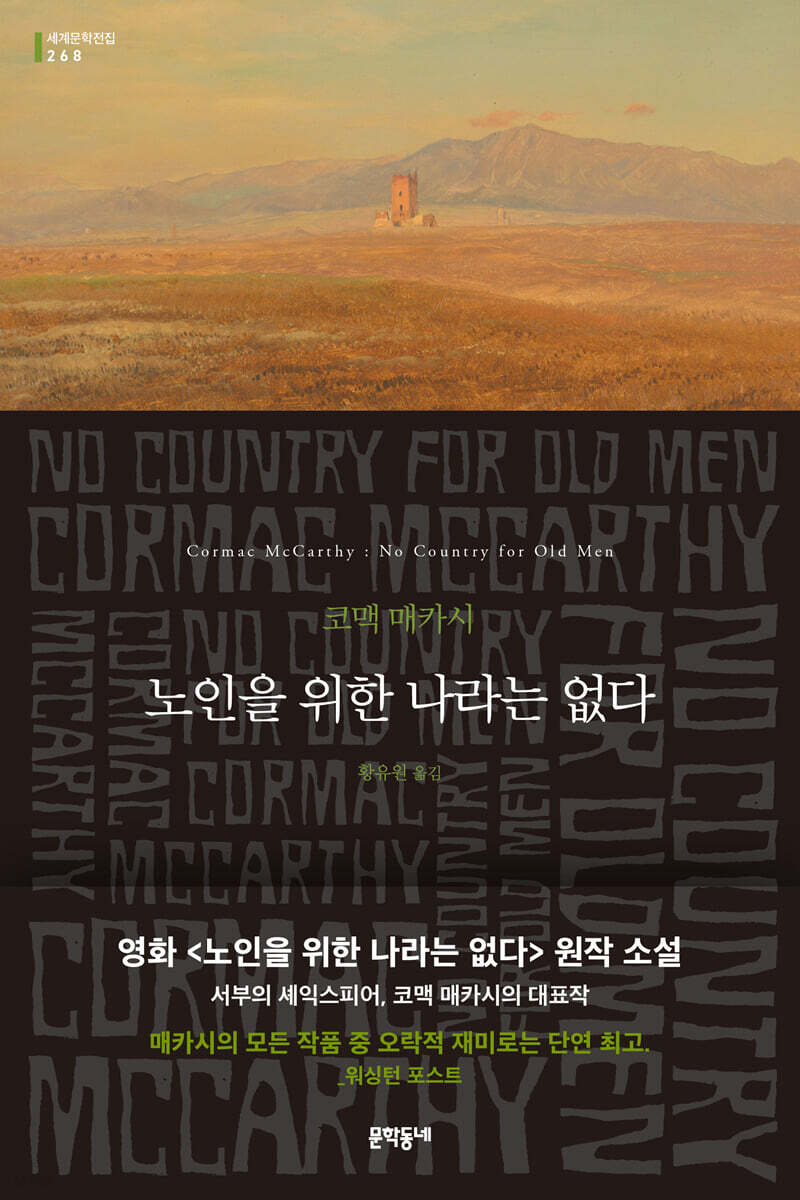
No Country for Old Men
 |
Description
Book Introduction
The most brutal and intense chase between good and evil in history
A gloomy gunshot that divides an era where justice and order have collapsed
The original novel of the movie [No Country for Old Men]
The Shakespeare of the West, Cormac McCarthy's masterpiece
Cormac McCarthy, a master of modern American literature known for his Border Trilogy, has published his novel, No Country for Old Men, in the Munhakdongne World Literature Collection.
This is also the original novel for the film [No Country for Old Men], which was produced by the Coen brothers and created a groundbreaking fandom at the time of its release and has now become a classic.
Even if you haven't seen the movie, you've probably seen the iconic short-haired psychopathic serial killer, Anton Chigurh, flipping a coin in front of a store owner for his life.
The film, starring Tommy Lee Jones and Javier Bardem, won four Academy Awards, including Best Picture and Best Director, and two Golden Globes, setting an incredible record.
The novel No Country for Old Men is McCarthy's masterpiece, which exquisitely portrays the still-relevant themes of the cruelty of fate, the collapse of moral justice, and the helplessness of aging with a brisk pace and restrained prose.
This work, which received praise as “a monstrous book” and “by far the most entertaining of all McCarthy’s works,” received much attention and love from readers.
The original text of the familiar title, 'No Country for Old Men', is taken from the first stanza of William Butler Yeats' poem 'Sailing to Byzantium'.
In the context of the poem, this sentence does not exactly mean 'there is no country for old men', but rather that this corrupt world today is 'not a country for old men'.
In poetry, the image of the elderly is never portrayed negatively; they appear to be beings who are simply one step ahead of a destination they must reach (perhaps death, or the ideal of art).
These images are also naturally connected to Chapter 13, which serves as the epilogue of the work, where the narrator, old Sheriff Bell, dreams of his dead father silently passing in front of him with a lantern, seemingly guiding him along the way.
In his masterpiece, "The Road," McCarthy, who explored life and love through the most terrifying dystopian imagination, perhaps hid a small light within the endless desert landscape, guiding us down an invisible path. Thus, "No Country for Old Men" is a work that embraces limitless possibilities for interpretation within its fast-paced, straight-line narrative.
Packed with both gripping suspense and a refreshing twist on the genre that sometimes betrays expectations, McCarthy's Western noir will open up a world of cinematic delights.
A gloomy gunshot that divides an era where justice and order have collapsed
The original novel of the movie [No Country for Old Men]
The Shakespeare of the West, Cormac McCarthy's masterpiece
Cormac McCarthy, a master of modern American literature known for his Border Trilogy, has published his novel, No Country for Old Men, in the Munhakdongne World Literature Collection.
This is also the original novel for the film [No Country for Old Men], which was produced by the Coen brothers and created a groundbreaking fandom at the time of its release and has now become a classic.
Even if you haven't seen the movie, you've probably seen the iconic short-haired psychopathic serial killer, Anton Chigurh, flipping a coin in front of a store owner for his life.
The film, starring Tommy Lee Jones and Javier Bardem, won four Academy Awards, including Best Picture and Best Director, and two Golden Globes, setting an incredible record.
The novel No Country for Old Men is McCarthy's masterpiece, which exquisitely portrays the still-relevant themes of the cruelty of fate, the collapse of moral justice, and the helplessness of aging with a brisk pace and restrained prose.
This work, which received praise as “a monstrous book” and “by far the most entertaining of all McCarthy’s works,” received much attention and love from readers.
The original text of the familiar title, 'No Country for Old Men', is taken from the first stanza of William Butler Yeats' poem 'Sailing to Byzantium'.
In the context of the poem, this sentence does not exactly mean 'there is no country for old men', but rather that this corrupt world today is 'not a country for old men'.
In poetry, the image of the elderly is never portrayed negatively; they appear to be beings who are simply one step ahead of a destination they must reach (perhaps death, or the ideal of art).
These images are also naturally connected to Chapter 13, which serves as the epilogue of the work, where the narrator, old Sheriff Bell, dreams of his dead father silently passing in front of him with a lantern, seemingly guiding him along the way.
In his masterpiece, "The Road," McCarthy, who explored life and love through the most terrifying dystopian imagination, perhaps hid a small light within the endless desert landscape, guiding us down an invisible path. Thus, "No Country for Old Men" is a work that embraces limitless possibilities for interpretation within its fast-paced, straight-line narrative.
Packed with both gripping suspense and a refreshing twist on the genre that sometimes betrays expectations, McCarthy's Western noir will open up a world of cinematic delights.
- You can preview some of the book's contents.
Preview
index
No Country for Old Men 7
Commentary | A Spark in a Dark and Cold World 345
Cormac McCarthy Chronology 359
Commentary | A Spark in a Dark and Cold World 345
Cormac McCarthy Chronology 359
Detailed image

Into the book
It was evenly filled with hundred dollar bills.
It was a bundle of money, each held in place by a banker's band stamped with a face value of ten thousand dollars.
Although I didn't know the exact amount, I could easily guess that it was a huge amount.
He sat there, staring at it, then closed the lid and sat with his head down.
His whole life was right before his eyes.
A life that continues from dawn to dusk every day until death.
It was all packed into a small bag, compressed into a forty-pound piece of paper.
--- p.24
The point is, when you stop someone's car, you don't know who is inside.
We get out onto the highway.
We walk to the car we parked, but we don't know what we'll find there.
--- p.44
He stood there, looking out at the desert.
It was very quiet.
The low hum of power lines in the wind.
Maple leaf ragweed growing tall along the road.
Wangbarangi and Sakkawista.
Beyond that, a dragon's footprints are carved into the rocky canyon.
The rugged rocky mountains cast shadows under the setting sun, and to the east, beneath a sky dark as soot and a curtain of rain that hung over the entire quadrant, the desert plains stretched out like a horizontal coordinate rippled.
The god who created this land from salt and ash was living in silence.
He returned to the patrol car, got into it, and drove off.
--- pp.51-52
Anything can be a means, said the cigar.
Even the little things.
Even things you might not even notice.
They are not passed from hand to hand.
People don't pay attention to it.
Then one day, the settlement is not made.
Then everything changes.
Well, you might say.
It's just a coin.
For example, like this.
That's nothing special at all.
What could that possibly be? That's the question.
Thinking of actions as separate from things.
As if part of one moment in history could be exchanged for part of another moment.
How could that be? Well, it's just a coin.
That's right.
That's true.
But is that really true?
--- p.65
It's a strange thing when you think about it.
Opportunities to abuse power exist in almost every case.
The Texas Constitution does not specify qualifications for a sheriff.
Not a single one.
There is no such thing as county law.
Isn't it bizarre that there is a profession that grants one almost god-like powers, yet requires no qualifications and is charged with upholding laws that don't exist?
That's what I think.
So is it going well? Yes.
Nine out of ten.
It takes little effort to govern good people.
Almost really.
And bad people are simply impossible to govern.
Even if it were possible, I've never heard of it happening.
--- p.73
People think they know what they want, but usually they don't.
Sometimes, if you're lucky, you just get what you want.
As for me, I've always been lucky.
My whole life.
If it weren't for that, I wouldn't be here.
I must have been in a corner.
But the day I saw her pass me as I was crossing the street from the commercial center, I tipped my hat to her and she returned the favor with a near-smile, that was the luckiest day of my life.
People complain about the bad things that happen to them, but they rarely open their mouths about the good things that happen to them.
As to whether one deserves such good things.
I don't remember doing much that would make God smile on me.
But God did it.
--- pp.102-103
Stories are told and the truth is ignored.
As the saying goes:
Some might take this to mean that truth is powerless.
But I don't think so.
I believe that the truth will remain even after all the lies have been told and forgotten.
Truth does not move from place to place or change with time.
Just as you can't add salt to salt, you can't add taint to truth.
The truth cannot be tarnished because that is what it is.
--- p.136
We haven't found an answer to that question.
On a more hopeful day, I think there might be something I don't know or have missed.
But such times are rare.
Sometimes when I wake up in the middle of the night, I'm convinced that nothing short of the return of Jesus can slow down this runaway train.
I don't know what's the use of lying down with your eyes open and thinking about that.
But sometimes it does.
--- p.178
He looked at the cigar.
I don't care about your opinion, he said.
Kill me now.
This fucking psycho.
Kill me and go to hell.
He closed his eyes.
I closed my eyes, turned my head, and raised one hand to block the unstoppable.
Cigar shot him in the face.
Everything Wells knew, thought, or loved flowed slowly down the wall behind him.
My mother's face, my first communion, the women I knew.
The faces of the dead men kneeling before him.
The body of a child found dead in a roadside ravine in another country.
Wells was lying on the bed with his head half blown off, his arms outstretched, his right hand almost completely gone.
Cigar got up, picked up the shell that had fallen on the rug, blew on it, put it in his pocket, and looked at his watch.
There was still one minute left until the new day.
--- pp.197-198
I should have done that, but I didn't.
And in a corner of my heart, a constant desire to go back to that day is seething.
But that can't be done.
I didn't know we could steal our own lives.
And I also didn't know that a stolen life, like any other thing we can steal, brings no benefit.
I thought I did my best with my stolen life, but it still wasn't my life.
It was a bundle of money, each held in place by a banker's band stamped with a face value of ten thousand dollars.
Although I didn't know the exact amount, I could easily guess that it was a huge amount.
He sat there, staring at it, then closed the lid and sat with his head down.
His whole life was right before his eyes.
A life that continues from dawn to dusk every day until death.
It was all packed into a small bag, compressed into a forty-pound piece of paper.
--- p.24
The point is, when you stop someone's car, you don't know who is inside.
We get out onto the highway.
We walk to the car we parked, but we don't know what we'll find there.
--- p.44
He stood there, looking out at the desert.
It was very quiet.
The low hum of power lines in the wind.
Maple leaf ragweed growing tall along the road.
Wangbarangi and Sakkawista.
Beyond that, a dragon's footprints are carved into the rocky canyon.
The rugged rocky mountains cast shadows under the setting sun, and to the east, beneath a sky dark as soot and a curtain of rain that hung over the entire quadrant, the desert plains stretched out like a horizontal coordinate rippled.
The god who created this land from salt and ash was living in silence.
He returned to the patrol car, got into it, and drove off.
--- pp.51-52
Anything can be a means, said the cigar.
Even the little things.
Even things you might not even notice.
They are not passed from hand to hand.
People don't pay attention to it.
Then one day, the settlement is not made.
Then everything changes.
Well, you might say.
It's just a coin.
For example, like this.
That's nothing special at all.
What could that possibly be? That's the question.
Thinking of actions as separate from things.
As if part of one moment in history could be exchanged for part of another moment.
How could that be? Well, it's just a coin.
That's right.
That's true.
But is that really true?
--- p.65
It's a strange thing when you think about it.
Opportunities to abuse power exist in almost every case.
The Texas Constitution does not specify qualifications for a sheriff.
Not a single one.
There is no such thing as county law.
Isn't it bizarre that there is a profession that grants one almost god-like powers, yet requires no qualifications and is charged with upholding laws that don't exist?
That's what I think.
So is it going well? Yes.
Nine out of ten.
It takes little effort to govern good people.
Almost really.
And bad people are simply impossible to govern.
Even if it were possible, I've never heard of it happening.
--- p.73
People think they know what they want, but usually they don't.
Sometimes, if you're lucky, you just get what you want.
As for me, I've always been lucky.
My whole life.
If it weren't for that, I wouldn't be here.
I must have been in a corner.
But the day I saw her pass me as I was crossing the street from the commercial center, I tipped my hat to her and she returned the favor with a near-smile, that was the luckiest day of my life.
People complain about the bad things that happen to them, but they rarely open their mouths about the good things that happen to them.
As to whether one deserves such good things.
I don't remember doing much that would make God smile on me.
But God did it.
--- pp.102-103
Stories are told and the truth is ignored.
As the saying goes:
Some might take this to mean that truth is powerless.
But I don't think so.
I believe that the truth will remain even after all the lies have been told and forgotten.
Truth does not move from place to place or change with time.
Just as you can't add salt to salt, you can't add taint to truth.
The truth cannot be tarnished because that is what it is.
--- p.136
We haven't found an answer to that question.
On a more hopeful day, I think there might be something I don't know or have missed.
But such times are rare.
Sometimes when I wake up in the middle of the night, I'm convinced that nothing short of the return of Jesus can slow down this runaway train.
I don't know what's the use of lying down with your eyes open and thinking about that.
But sometimes it does.
--- p.178
He looked at the cigar.
I don't care about your opinion, he said.
Kill me now.
This fucking psycho.
Kill me and go to hell.
He closed his eyes.
I closed my eyes, turned my head, and raised one hand to block the unstoppable.
Cigar shot him in the face.
Everything Wells knew, thought, or loved flowed slowly down the wall behind him.
My mother's face, my first communion, the women I knew.
The faces of the dead men kneeling before him.
The body of a child found dead in a roadside ravine in another country.
Wells was lying on the bed with his head half blown off, his arms outstretched, his right hand almost completely gone.
Cigar got up, picked up the shell that had fallen on the rug, blew on it, put it in his pocket, and looked at his watch.
There was still one minute left until the new day.
--- pp.197-198
I should have done that, but I didn't.
And in a corner of my heart, a constant desire to go back to that day is seething.
But that can't be done.
I didn't know we could steal our own lives.
And I also didn't know that a stolen life, like any other thing we can steal, brings no benefit.
I thought I did my best with my stolen life, but it still wasn't my life.
--- p.306
Publisher's Review
Running at the speed of a bullet
It gives a deep resonance
McCarthy-style western thriller
The Texas-Mexico border in the 1980s, where drug traffickers run rampant, the old order has collapsed, and small towns have become lawless zones.
Llewelyn Moss, a Vietnam veteran and former welder, is hunting in the arid plains when he discovers several bodies, a pickup truck, heroin, and $2 million in cash.
He runs away with the money and hides it safely in his home, but the voice of one person barely alive in the bloody scene, asking for water, ultimately catches him by the ankle.
He returns to give water to the man whose life seemed in danger, and is caught in an irreversible chain of violence when he is spotted by a group looking for money and drugs.
Another pursuer of Moss's, along with the group, is Anton Seeger, a ruthless psychopathic killer.
He kills people by shooting them in the forehead with a pneumatic gun, easily kills his deputy and runs away while handcuffed, and decides someone's life or death by flipping a coin.
Meanwhile, old Sheriff Bell is on a hot pursuit of them to solve a case that occurred in his jurisdiction.
He struggles to save Moss's life and contain the situation, but he gradually feels helpless and empty in the face of the enormity and incomprehensibility of the evil surrounding the incident.
The bloodshed of life
In that inescapable wheel of fate
The life of a sheriff on horseback and armed with all kinds of guns in the arid western plains depicted by McCarthy, the 'Shakespeare of the West', is so vivid that it seems as if it could be pictured right before your eyes.
The bloody chase unfolds in a cleverly intensified fashion, with simple images and dry sentences that make even the killing feel like a process.
The characters in the work rarely show their emotions in the forefront, and their psychology can only be inferred through Sheriff Bell's monologues that appear at the beginning of each new chapter or through dialogue between characters.
Llewelyn Moss couldn't bear to ignore the possibility that her entire life, "compressed into a forty-pound piece of paper in a little bag," was money she could never have in her entire life.
He shouldered the fate of a fugitive and, like fate, met a tragic end.
Anton Seeger, with his own arguments that even felt persuasive, just did his homework and disappeared into thin air.
Bell, who has been watching all this, declares concisely:
“People think they know what they want, but usually they don’t.”
Perhaps those who run away, those who pursue, and even those who watch them, are all thrown into the wheel of fate, violence and chaos, without knowing the true meaning of this fierce pursuit or what they have chosen.
No, maybe the very idea that we can choose our lives is a huge delusion.
McCarthy once again poses huge questions about life and destiny with this dark, gunshot-like story.
It gives a deep resonance
McCarthy-style western thriller
The Texas-Mexico border in the 1980s, where drug traffickers run rampant, the old order has collapsed, and small towns have become lawless zones.
Llewelyn Moss, a Vietnam veteran and former welder, is hunting in the arid plains when he discovers several bodies, a pickup truck, heroin, and $2 million in cash.
He runs away with the money and hides it safely in his home, but the voice of one person barely alive in the bloody scene, asking for water, ultimately catches him by the ankle.
He returns to give water to the man whose life seemed in danger, and is caught in an irreversible chain of violence when he is spotted by a group looking for money and drugs.
Another pursuer of Moss's, along with the group, is Anton Seeger, a ruthless psychopathic killer.
He kills people by shooting them in the forehead with a pneumatic gun, easily kills his deputy and runs away while handcuffed, and decides someone's life or death by flipping a coin.
Meanwhile, old Sheriff Bell is on a hot pursuit of them to solve a case that occurred in his jurisdiction.
He struggles to save Moss's life and contain the situation, but he gradually feels helpless and empty in the face of the enormity and incomprehensibility of the evil surrounding the incident.
The bloodshed of life
In that inescapable wheel of fate
The life of a sheriff on horseback and armed with all kinds of guns in the arid western plains depicted by McCarthy, the 'Shakespeare of the West', is so vivid that it seems as if it could be pictured right before your eyes.
The bloody chase unfolds in a cleverly intensified fashion, with simple images and dry sentences that make even the killing feel like a process.
The characters in the work rarely show their emotions in the forefront, and their psychology can only be inferred through Sheriff Bell's monologues that appear at the beginning of each new chapter or through dialogue between characters.
Llewelyn Moss couldn't bear to ignore the possibility that her entire life, "compressed into a forty-pound piece of paper in a little bag," was money she could never have in her entire life.
He shouldered the fate of a fugitive and, like fate, met a tragic end.
Anton Seeger, with his own arguments that even felt persuasive, just did his homework and disappeared into thin air.
Bell, who has been watching all this, declares concisely:
“People think they know what they want, but usually they don’t.”
Perhaps those who run away, those who pursue, and even those who watch them, are all thrown into the wheel of fate, violence and chaos, without knowing the true meaning of this fierce pursuit or what they have chosen.
No, maybe the very idea that we can choose our lives is a huge delusion.
McCarthy once again poses huge questions about life and destiny with this dark, gunshot-like story.
GOODS SPECIFICS
- Date of issue: September 12, 2025
- Page count, weight, size: 372 pages | 478g | 140*210*20mm
- ISBN13: 9791141602574
- ISBN10: 1141602571
You may also like
카테고리
korean


korean

![ELLE 엘르 스페셜 에디션 A형 : 12월 [2025]](http://librairie.coreenne.fr/cdn/shop/files/b8e27a3de6c9538896439686c6b0e8fb.jpg?v=1766436872&width=3840)


