

Kim Young-ran's Open Law Story
 |
Description
Book Introduction
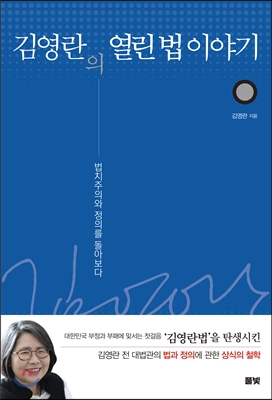
The first step in fighting against corruption and injustice in the Republic of Korea was the creation of the ‘Kim Young-ran Act’.
Former Supreme Court Justice Kim Young-ran's Philosophy of Common Sense on Law and Justice
[Reflecting on the Rule of Law and Justice: Kim Young-ran's Open Law Story] Popular Edition Released
The first female Supreme Court Justice of the Republic of Korea and the protagonist of the ‘Kim Young-ran Act’,
The culmination of his contemplation on the rule of law and justice
《Looking Back at the Rule of Law and Justice: Kim Young-ran's Open Law Story》 was published by Poolbit.
This is the popular edition of “Kim Young-ran’s Open Law Story,” published as the 10th book in the “Flying Youth” series last February.
After the book was published, many people gave me their feedback, saying that while it should be read by teenagers, they hoped it would be accessible to a wider range of people who want to engage in "intellectual conversations" about the law, free from the preconception that it is a book for teenagers. Thanks to their support and encouragement, the book was reborn as a popular edition for the general public.
The popular edition of "Looking Back at the Rule of Law and Justice: Kim Young-ran's Open Law Story" retains the original content of "Kim Young-ran's Open Law Story," but has been redesigned to be more accessible and lightweight in terms of format and design.
Any reader who has been curious about the original intent of the "Kim Young-ran Act," which has been at the center of recent controversy, and the legal philosophy of former Supreme Court Justice Kim Young-ran who proposed it, is expected to have the opportunity to read this book and develop their own position on it.
Former Supreme Court Justice Kim Young-ran's Philosophy of Common Sense on Law and Justice
[Reflecting on the Rule of Law and Justice: Kim Young-ran's Open Law Story] Popular Edition Released
The first female Supreme Court Justice of the Republic of Korea and the protagonist of the ‘Kim Young-ran Act’,
The culmination of his contemplation on the rule of law and justice
《Looking Back at the Rule of Law and Justice: Kim Young-ran's Open Law Story》 was published by Poolbit.
This is the popular edition of “Kim Young-ran’s Open Law Story,” published as the 10th book in the “Flying Youth” series last February.
After the book was published, many people gave me their feedback, saying that while it should be read by teenagers, they hoped it would be accessible to a wider range of people who want to engage in "intellectual conversations" about the law, free from the preconception that it is a book for teenagers. Thanks to their support and encouragement, the book was reborn as a popular edition for the general public.
The popular edition of "Looking Back at the Rule of Law and Justice: Kim Young-ran's Open Law Story" retains the original content of "Kim Young-ran's Open Law Story," but has been redesigned to be more accessible and lightweight in terms of format and design.
Any reader who has been curious about the original intent of the "Kim Young-ran Act," which has been at the center of recent controversy, and the legal philosophy of former Supreme Court Justice Kim Young-ran who proposed it, is expected to have the opportunity to read this book and develop their own position on it.
- You can preview some of the book's contents.
Preview
index
Preface_Reflecting on the Rule of Law and Justice: Kim Young-ran's Open Law Story
Prologue_The Land of Frogs
Part 1: The Origins and History of Law
Chapter 1: The Birth of Law
1 The Law of the Great Lord Sancho Panza | 2 The Law of Governor Robinson | 3 The Origin of Law
Chapter 2: The Birth of Modern Law
1 The Beginning of Modern Law | 2 The History of the Birth of Modern Rule of Law
Chapter 3: The Foundations of Modern Law - The Social Contract Theory
1 Hobbes - Establish a powerful entity to control the struggle of all men | 2 Locke - Make a contract to protect private property | 3 Rousseau - The government should enforce the law by entrusting the rights of all citizens | 4 How did the dual nature of law play a role in the birth of modern law?
Chapter 4: Modern Law in Korea: Its Beginnings and History of Distortion
1. Our country's modern law is a product of the Japanese colonial era. 2. A representative example of distortion - family law.
Chapter 5 Modern Law - Managing the Life and Happiness of Individuals?
1 State power that governs life and death|2 Is it right for the state to decide an individual's death?
Part 2: Constitutional Spirit and Legal Order
Chapter 1: The Values and Justice Pursued by Law
1. The Relationship Between Law and Justice | 2. How Has the Concept of Justice Changed?
Chapter 2: Various Definitions
1. Utilitarian conception of justice | 2. Liberal conception of justice | 3. Communitarian conception of justice
Chapter 3: Constitution and Constitutional Spirit
1. The Constitution's establishment as the 'law of law' | 2. Constitutional spirit 1 - the principle of popular sovereignty | 3. Constitutional spirit 2 - the principle of separation of powers | 4. Constitutional spirit 3 - the principle of protection of fundamental rights | 5. The problem of conflicts between fundamental rights between individuals | 6. The scope of application of the Constitution
Chapter 4: The Structure of Legal Stages and Their Evolution
1. The Relationship Between Natural Law and the Constitution | 2. The Relationship Between Public Law and Private Law
Part 3: Rule of Law and the System of Enforcing Law
Chapter 1: How is justice implemented in law?
1. What kind of rule of law is legitimate rule of law? 2. How far can substantive rule of law go? 3. Are there laws that are ineffective?
Chapter 2 Independence of the Judiciary
1. Why the Judiciary Must Be Independent | 2. The Contents of Judicial Independence
Chapter 3: Appeal System - A Device for a Fair Trial
1 The Importance of the Appeals System | 2 The Meaning of the Supreme Court's Final Decision and the Role of Lawyers
Chapter 4 Freedom of Expression - A Fundamental Tool for Maintaining Democracy
1. To what extent is freedom of expression guaranteed, and when is it restricted? 2. The free market of ideas.
Epilogue: What Kind of Master Do I Want to Be?
main
Prologue_The Land of Frogs
Part 1: The Origins and History of Law
Chapter 1: The Birth of Law
1 The Law of the Great Lord Sancho Panza | 2 The Law of Governor Robinson | 3 The Origin of Law
Chapter 2: The Birth of Modern Law
1 The Beginning of Modern Law | 2 The History of the Birth of Modern Rule of Law
Chapter 3: The Foundations of Modern Law - The Social Contract Theory
1 Hobbes - Establish a powerful entity to control the struggle of all men | 2 Locke - Make a contract to protect private property | 3 Rousseau - The government should enforce the law by entrusting the rights of all citizens | 4 How did the dual nature of law play a role in the birth of modern law?
Chapter 4: Modern Law in Korea: Its Beginnings and History of Distortion
1. Our country's modern law is a product of the Japanese colonial era. 2. A representative example of distortion - family law.
Chapter 5 Modern Law - Managing the Life and Happiness of Individuals?
1 State power that governs life and death|2 Is it right for the state to decide an individual's death?
Part 2: Constitutional Spirit and Legal Order
Chapter 1: The Values and Justice Pursued by Law
1. The Relationship Between Law and Justice | 2. How Has the Concept of Justice Changed?
Chapter 2: Various Definitions
1. Utilitarian conception of justice | 2. Liberal conception of justice | 3. Communitarian conception of justice
Chapter 3: Constitution and Constitutional Spirit
1. The Constitution's establishment as the 'law of law' | 2. Constitutional spirit 1 - the principle of popular sovereignty | 3. Constitutional spirit 2 - the principle of separation of powers | 4. Constitutional spirit 3 - the principle of protection of fundamental rights | 5. The problem of conflicts between fundamental rights between individuals | 6. The scope of application of the Constitution
Chapter 4: The Structure of Legal Stages and Their Evolution
1. The Relationship Between Natural Law and the Constitution | 2. The Relationship Between Public Law and Private Law
Part 3: Rule of Law and the System of Enforcing Law
Chapter 1: How is justice implemented in law?
1. What kind of rule of law is legitimate rule of law? 2. How far can substantive rule of law go? 3. Are there laws that are ineffective?
Chapter 2 Independence of the Judiciary
1. Why the Judiciary Must Be Independent | 2. The Contents of Judicial Independence
Chapter 3: Appeal System - A Device for a Fair Trial
1 The Importance of the Appeals System | 2 The Meaning of the Supreme Court's Final Decision and the Role of Lawyers
Chapter 4 Freedom of Expression - A Fundamental Tool for Maintaining Democracy
1. To what extent is freedom of expression guaranteed, and when is it restricted? 2. The free market of ideas.
Epilogue: What Kind of Master Do I Want to Be?
main
Publisher's Review
A look at the history of law, from its inception to its growth, transition, and present.
Appointed the first female Supreme Court Justice in Korean judicial history in 2004, she emerged as a female expert to emulate, and while working as the Chairperson of the Anti-Corruption and Civil Rights Commission, she pushed for the 'Act on the Prohibition of Improper Solicitation and Acceptance of Money, etc.', also known as the 'Kim Young-ran Act', which was passed in the National Assembly plenary session in 2015 and is scheduled to take effect in September 2016. She has established herself as a symbol of justice, not just as a female legal professional.
During her tenure as a Supreme Court Justice, Kim Young-ran was evaluated as a "justice for minorities" for her consideration of the socially disadvantaged and minorities and her efforts to protect the basic rights of the people. She was also called one of the "Five Eagle Brothers" who mainly made progressive decisions.
After publishing the legal education book “Kim Young-ran’s Open Law Story” that he had prepared for youth for two years, he received requests from many readers to allow people to read the book without the preconceived notion that it is a youth book and to use it as an opportunity to reflect on the rule of law and justice. Thanks to this, he published a popular edition of “Reflecting on the Rule of Law and Justice: Kim Young-ran’s Open Law Story.”
What is open law, and what are the essence of the rule of law and justice?
First, he examines the origins of law.
Why on earth were laws created and what was the need for them?
The person he attracted was Sancho Panza, the squire of Don Quixote, the protagonist of the novel Don Quixote.
He cites the scene where Judge Sancho resolves the debt relationship between an old man who claimed that the other person had not repaid the money he had borrowed from him and another old man who swears that he had definitely repaid the money, using common sense rather than legal provisions. He says that the law should be created based on people's common sense, and that the law emerged as a third, fair standard to resolve and resolve disputes between people when they feel wronged.
After explaining the background of how the law first emerged, we will closely follow the historical path of the development of the law.
This paper explains the background of the emergence of modern law, which states that even kings must follow the law and that the rights of citizens must be protected by law, through the era of absolute monarchy, where the king was the law, along with the theory of social contract, which became the foundation of modern law.
And we examine the process through which the rule of law was established as an institution to protect the rights of the people, who are the sovereign, and up to the present day.
To examine the process, the concept of justice and the spirit of the Constitution are naturally drawn out and explained.
The demand for just laws that reflect common sense is always the same, but each society has a different concept of justice. Therefore, we compare and analyze different views of justice and systematically explain the basic contents of the spirit of the constitution, the highest law of each country, in relation to justice.
It also provides a step-by-step explanation of how the ideology of the rule of law is realized and structured in reality.
Specific explanations are provided in order regarding the independence of the judiciary, the appellate system, and the standards and methods for guaranteeing freedom of expression.
A savory bowl of recipe cooked with a rich understanding of culture, history, and philosophy.
This book contains a vast amount of content on law, including the origins of law, the process of change, the various interpretations and controversies regarding law currently being raised, the necessity of law, the concept of justice as the foundation for maintaining law, and the specific realization system of the rule of law.
Just looking at the order of the dishes, it may seem burdensome and stiff, but Kim Young-ran's hidden virtue as an author shines through in cooking such a difficult and vast subject in a refreshing and gentle way, and in a way that makes you want to have another bowl of it.
The origin and necessity of law are expressed more clearly than any other explanation in a scene from Don Quixote and Vendredi, the End of the Pacific (by Michel Tournier), and a world without law and an unjust situation are vividly depicted in George Orwell's Animal Farm and William Golding's Lord of the Flies.
The spirit of the Constitution unfolds like a web, intertwined with the movie Avatar and the Amistad and Dred Scott cases, which are recorded as important decisions in American judicial history.
The various definitions of justice begin with the widely known 'out-of-control trolley' problem mentioned in Michael Sandel's 'Justice: What's the Right Thing to Do?', and the protagonist of the novel 'Hard Times' by the great British author Charles Dickens accurately presents one aspect of the definition of justice to us.
The social contract theory trio of Hobbes, Locke, and Rousseau appear, and Robin Hood appears with Richard the Lionheart and King John and takes out England's Magna Carta.
Chunhyang explains the relationship between public law and private law, and Michael Kohlhaas lectures on the appellate system.
In this book, Kim Young-ran reveals the vast reading knowledge and cultural literacy she has accumulated in various fields whenever she has the chance, as if it were a trump card.
I want to break the general public's prejudice that the law is something that I cannot and should not know because it is specialized and difficult, even though I think it is important.
The legal provisions may be difficult, but the common sense and philosophy contained in the law are the common sense of our common people. The law exists for the people, and the job of the National Assembly is to create laws for the people.
Although the law is closely connected to our lives itself, our perception of the law is said to be unrelated to it.
The principle is simple, the principle is concise.
We are the masters of the law.
That's all there is.
So, Kim Young-ran proves that there are principles of law and a hidden side to law in novels and films that seem to have nothing to do with law.
It's very easy and fun.
Knowing the law is what creates democracy and allows us to live as true masters.
This book covers the period from the Code of Hammurabi to the Magna Carta and the modern and contemporary eras, and travels across Eurasia and the Americas before arriving in Korea.
It examines how laws have changed and adapted to the diverse social circumstances of each era throughout history, and how institutional mechanisms have evolved and been strengthened to realize the justice and rule of law that society demands.
This book warns that if we objectively examine the current situation from the current perspective, as the necessity of law strengthens, the institutional mechanisms that have been formed to realize the rule of law are always at risk of losing their original purpose due to their rigidity.
The potential for 'rule by law' rather than 'rule of law' always exists in any era and any society.
To avoid this danger, this book tells us to recall the lessons of history.
This means that we must not forget the history of how the law has developed along with the development of democracy, where rulers and ruled are in harmony, and the constitutional protection of fundamental rights necessary to better defend democracy.
If the institutional devices we currently have and their operation do not align with this direction of historical development, they could at some point remain as rigid systems in name only or become obstacles.
Therefore, these devices must always be checked in the forum of citizen participation and discussion, and it is asserted that this is open democracy.
The National Assembly is constantly debating whether the mechanisms that guide our society, such as improving the electoral system and civil service system, economic democratization, and the introduction of youth allowances, are effective or not, but this is by no means a problem solely for members of the National Assembly.
He says that we must not forget that we are the masters of our own country, and that we must have an active attitude to think and judge independently and debate passionately about the current social discussions and systems.
We live in an age where ideas like "the law should be like this" and "justice is an immutable concept" are no longer valid.
At one time, the law ordained by God, at another time the law ordained by absolute monarchy, and at another time the law of nature were thought to be ideal systems of discipline separate from the society in which people lived.
But today's law is no longer something that comes from somewhere beyond people's reach.
People today will never obey a law if it does not properly reflect their thoughts.
Even if we obey it reluctantly, it will only undermine trust in the law.
This is precisely what is meant when we say that the law should be common sense.
The law always changes, and must change, to reflect the common sense of the times.
How do we find the law that suits us?
This book leaves open the question of what justice is, what kind of rule of law is appropriate, and what kind of law our modern society needs.
If there is a right answer, it is that it is a conclusion reached through serious reflection and passionate discussion by the sovereign people and the members of society, leaving only the principle behind.
Law is never the exclusive domain of the legislature and the judiciary.
Studying and understanding the law is to deepen democracy where the people are the masters and to live as true masters.
The idea that we create laws together, that each and every citizen should study, understand, know, and participate in the law as its own masters – this is the core of the “open law” that this book seeks to address.
We expect that "Looking Back at the Rule of Law and Justice: Kim Young-ran's Open Law Story" will serve as a stepping stone toward an open society.
Appointed the first female Supreme Court Justice in Korean judicial history in 2004, she emerged as a female expert to emulate, and while working as the Chairperson of the Anti-Corruption and Civil Rights Commission, she pushed for the 'Act on the Prohibition of Improper Solicitation and Acceptance of Money, etc.', also known as the 'Kim Young-ran Act', which was passed in the National Assembly plenary session in 2015 and is scheduled to take effect in September 2016. She has established herself as a symbol of justice, not just as a female legal professional.
During her tenure as a Supreme Court Justice, Kim Young-ran was evaluated as a "justice for minorities" for her consideration of the socially disadvantaged and minorities and her efforts to protect the basic rights of the people. She was also called one of the "Five Eagle Brothers" who mainly made progressive decisions.
After publishing the legal education book “Kim Young-ran’s Open Law Story” that he had prepared for youth for two years, he received requests from many readers to allow people to read the book without the preconceived notion that it is a youth book and to use it as an opportunity to reflect on the rule of law and justice. Thanks to this, he published a popular edition of “Reflecting on the Rule of Law and Justice: Kim Young-ran’s Open Law Story.”
What is open law, and what are the essence of the rule of law and justice?
First, he examines the origins of law.
Why on earth were laws created and what was the need for them?
The person he attracted was Sancho Panza, the squire of Don Quixote, the protagonist of the novel Don Quixote.
He cites the scene where Judge Sancho resolves the debt relationship between an old man who claimed that the other person had not repaid the money he had borrowed from him and another old man who swears that he had definitely repaid the money, using common sense rather than legal provisions. He says that the law should be created based on people's common sense, and that the law emerged as a third, fair standard to resolve and resolve disputes between people when they feel wronged.
After explaining the background of how the law first emerged, we will closely follow the historical path of the development of the law.
This paper explains the background of the emergence of modern law, which states that even kings must follow the law and that the rights of citizens must be protected by law, through the era of absolute monarchy, where the king was the law, along with the theory of social contract, which became the foundation of modern law.
And we examine the process through which the rule of law was established as an institution to protect the rights of the people, who are the sovereign, and up to the present day.
To examine the process, the concept of justice and the spirit of the Constitution are naturally drawn out and explained.
The demand for just laws that reflect common sense is always the same, but each society has a different concept of justice. Therefore, we compare and analyze different views of justice and systematically explain the basic contents of the spirit of the constitution, the highest law of each country, in relation to justice.
It also provides a step-by-step explanation of how the ideology of the rule of law is realized and structured in reality.
Specific explanations are provided in order regarding the independence of the judiciary, the appellate system, and the standards and methods for guaranteeing freedom of expression.
A savory bowl of recipe cooked with a rich understanding of culture, history, and philosophy.
This book contains a vast amount of content on law, including the origins of law, the process of change, the various interpretations and controversies regarding law currently being raised, the necessity of law, the concept of justice as the foundation for maintaining law, and the specific realization system of the rule of law.
Just looking at the order of the dishes, it may seem burdensome and stiff, but Kim Young-ran's hidden virtue as an author shines through in cooking such a difficult and vast subject in a refreshing and gentle way, and in a way that makes you want to have another bowl of it.
The origin and necessity of law are expressed more clearly than any other explanation in a scene from Don Quixote and Vendredi, the End of the Pacific (by Michel Tournier), and a world without law and an unjust situation are vividly depicted in George Orwell's Animal Farm and William Golding's Lord of the Flies.
The spirit of the Constitution unfolds like a web, intertwined with the movie Avatar and the Amistad and Dred Scott cases, which are recorded as important decisions in American judicial history.
The various definitions of justice begin with the widely known 'out-of-control trolley' problem mentioned in Michael Sandel's 'Justice: What's the Right Thing to Do?', and the protagonist of the novel 'Hard Times' by the great British author Charles Dickens accurately presents one aspect of the definition of justice to us.
The social contract theory trio of Hobbes, Locke, and Rousseau appear, and Robin Hood appears with Richard the Lionheart and King John and takes out England's Magna Carta.
Chunhyang explains the relationship between public law and private law, and Michael Kohlhaas lectures on the appellate system.
In this book, Kim Young-ran reveals the vast reading knowledge and cultural literacy she has accumulated in various fields whenever she has the chance, as if it were a trump card.
I want to break the general public's prejudice that the law is something that I cannot and should not know because it is specialized and difficult, even though I think it is important.
The legal provisions may be difficult, but the common sense and philosophy contained in the law are the common sense of our common people. The law exists for the people, and the job of the National Assembly is to create laws for the people.
Although the law is closely connected to our lives itself, our perception of the law is said to be unrelated to it.
The principle is simple, the principle is concise.
We are the masters of the law.
That's all there is.
So, Kim Young-ran proves that there are principles of law and a hidden side to law in novels and films that seem to have nothing to do with law.
It's very easy and fun.
Knowing the law is what creates democracy and allows us to live as true masters.
This book covers the period from the Code of Hammurabi to the Magna Carta and the modern and contemporary eras, and travels across Eurasia and the Americas before arriving in Korea.
It examines how laws have changed and adapted to the diverse social circumstances of each era throughout history, and how institutional mechanisms have evolved and been strengthened to realize the justice and rule of law that society demands.
This book warns that if we objectively examine the current situation from the current perspective, as the necessity of law strengthens, the institutional mechanisms that have been formed to realize the rule of law are always at risk of losing their original purpose due to their rigidity.
The potential for 'rule by law' rather than 'rule of law' always exists in any era and any society.
To avoid this danger, this book tells us to recall the lessons of history.
This means that we must not forget the history of how the law has developed along with the development of democracy, where rulers and ruled are in harmony, and the constitutional protection of fundamental rights necessary to better defend democracy.
If the institutional devices we currently have and their operation do not align with this direction of historical development, they could at some point remain as rigid systems in name only or become obstacles.
Therefore, these devices must always be checked in the forum of citizen participation and discussion, and it is asserted that this is open democracy.
The National Assembly is constantly debating whether the mechanisms that guide our society, such as improving the electoral system and civil service system, economic democratization, and the introduction of youth allowances, are effective or not, but this is by no means a problem solely for members of the National Assembly.
He says that we must not forget that we are the masters of our own country, and that we must have an active attitude to think and judge independently and debate passionately about the current social discussions and systems.
We live in an age where ideas like "the law should be like this" and "justice is an immutable concept" are no longer valid.
At one time, the law ordained by God, at another time the law ordained by absolute monarchy, and at another time the law of nature were thought to be ideal systems of discipline separate from the society in which people lived.
But today's law is no longer something that comes from somewhere beyond people's reach.
People today will never obey a law if it does not properly reflect their thoughts.
Even if we obey it reluctantly, it will only undermine trust in the law.
This is precisely what is meant when we say that the law should be common sense.
The law always changes, and must change, to reflect the common sense of the times.
How do we find the law that suits us?
This book leaves open the question of what justice is, what kind of rule of law is appropriate, and what kind of law our modern society needs.
If there is a right answer, it is that it is a conclusion reached through serious reflection and passionate discussion by the sovereign people and the members of society, leaving only the principle behind.
Law is never the exclusive domain of the legislature and the judiciary.
Studying and understanding the law is to deepen democracy where the people are the masters and to live as true masters.
The idea that we create laws together, that each and every citizen should study, understand, know, and participate in the law as its own masters – this is the core of the “open law” that this book seeks to address.
We expect that "Looking Back at the Rule of Law and Justice: Kim Young-ran's Open Law Story" will serve as a stepping stone toward an open society.
GOODS SPECIFICS
- Date of issue: June 30, 2016
- Page count, weight, size: 240 pages | 394g | 144*210*20mm
- ISBN13: 9788974747886
- ISBN10: 897474788X
You may also like
카테고리
korean


korean

![GQ KOREA Mark (Monthly): December [2025]](http://librairie.coreenne.fr/cdn/shop/files/8ef265dbbfbf186523ed75ba7319009d.jpg?v=1765340328&width=3840)


