

Lee Kuan Yew speaks
 |
Description
Book Introduction
Who will be No. 1? China or the United States?
The essence of Lee Kuan Yew's insightful analysis of today's global issues!
“This book is a must-read for anyone seeking to understand future world politics.”
Former Prime Minister Lee Kuan Yew, revered as Singapore's founding father, passed away on March 23, 2015, at the age of 91.
He took office as Singapore's first Prime Minister in 1959 and served as Prime Minister for 31 years until 1990, solidifying the foundation of the new nation as its architect. He also continued to exert great influence as Senior Advisory Minister until 2011, leading Singapore to its present state.
From Deng Xiaoping to Xi Jinping, all Chinese leaders, as well as all American presidents from Lyndon Johnson to Obama, and many leaders from various countries have sought his wisdom on national governance and international issues.
The connection with Korea is also special.
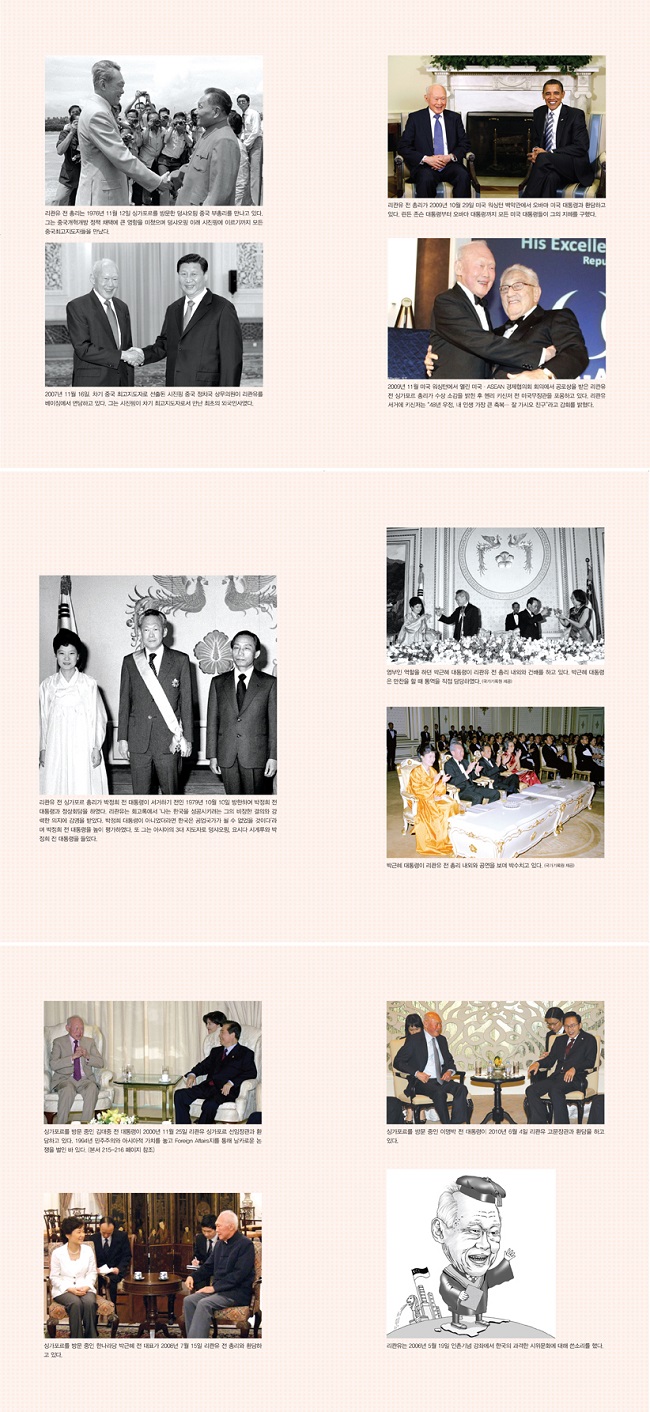
He met with a wide range of leaders, including former President Park Chung-hee, former President Kim Dae-jung, and President Park Geun-hye, and exchanged valuable opinions.
Opinions on him are extremely divided.
Although his outstanding capabilities as a top national leader, including his outstanding insight, strong drive, and pragmatism, are highly regarded, he is also harshly criticized for his media restrictions, suppression of freedom, dictatorial rule, and 'hereditary' succession of the prime minister.
This book is a compilation of interviews with former Prime Minister Lee Kuan Yew, his writings, and speeches, edited by Professor Graham Allison of Harvard University and Robert Blackwill, a research fellow at the Council on Foreign Relations.
The authors pose a total of 70 sharp questions in chapters 1 through 9, to which he provides clear, direct, and sometimes provocative answers.
His true nature as a pragmatist is clearly revealed everywhere, and we can savor his profound worldview and leadership philosophy.
The essence of Lee Kuan Yew's insightful analysis of today's global issues!
“This book is a must-read for anyone seeking to understand future world politics.”
Former Prime Minister Lee Kuan Yew, revered as Singapore's founding father, passed away on March 23, 2015, at the age of 91.
He took office as Singapore's first Prime Minister in 1959 and served as Prime Minister for 31 years until 1990, solidifying the foundation of the new nation as its architect. He also continued to exert great influence as Senior Advisory Minister until 2011, leading Singapore to its present state.
From Deng Xiaoping to Xi Jinping, all Chinese leaders, as well as all American presidents from Lyndon Johnson to Obama, and many leaders from various countries have sought his wisdom on national governance and international issues.
The connection with Korea is also special.
He met with a wide range of leaders, including former President Park Chung-hee, former President Kim Dae-jung, and President Park Geun-hye, and exchanged valuable opinions.
Opinions on him are extremely divided.
Although his outstanding capabilities as a top national leader, including his outstanding insight, strong drive, and pragmatism, are highly regarded, he is also harshly criticized for his media restrictions, suppression of freedom, dictatorial rule, and 'hereditary' succession of the prime minister.
This book is a compilation of interviews with former Prime Minister Lee Kuan Yew, his writings, and speeches, edited by Professor Graham Allison of Harvard University and Robert Blackwill, a research fellow at the Council on Foreign Relations.
The authors pose a total of 70 sharp questions in chapters 1 through 9, to which he provides clear, direct, and sometimes provocative answers.
His true nature as a pragmatist is clearly revealed everywhere, and we can savor his profound worldview and leadership philosophy.
index
Henry A.
Kissinger's Preface
Lee Kuan Yew, who is he?
Leaders who listen when Lee Kuan Yew speaks
preface
Preface by the editor
Chapter 1 - China's Future
Chapter 2 - America's Future
Chapter 3 - The Future of US-China Relations
Chapter 4 - India's Future
Chapter 5 - The Future of Islamic Extremism
Chapter 6 - The Future of National Economic Growth
Chapter 7 - Regional Situation and Globalization Prospects
Chapter 8 - The Future of Democracy
Chapter 9 - Lee Kuan Yew's Worldview and Principles
Chapter 10 - Conclusion
main
pictorial
Kissinger's Preface
Lee Kuan Yew, who is he?
Leaders who listen when Lee Kuan Yew speaks
preface
Preface by the editor
Chapter 1 - China's Future
Chapter 2 - America's Future
Chapter 3 - The Future of US-China Relations
Chapter 4 - India's Future
Chapter 5 - The Future of Islamic Extremism
Chapter 6 - The Future of National Economic Growth
Chapter 7 - Regional Situation and Globalization Prospects
Chapter 8 - The Future of Democracy
Chapter 9 - Lee Kuan Yew's Worldview and Principles
Chapter 10 - Conclusion
main
pictorial
Detailed image
Into the book
Among the national leaders of the past half century, Lee Kuan Yew stands out as a unique figure.
As Singapore's "founding father" and leader for over 50 years, he took the poverty-stricken and corruption-ridden city-state and built a modern nation.
The income level of people in this country is currently higher than that of most Americans.
Lee Kuan Yew understands its significance better than anyone, having conceived and led these changes.
For generations, leaders from around the world, including the United States and China, have sought out the "Sage of Singapore" to consult, advise, and listen attentively on global issues.
From President Richard Nixon, who envisioned the "opening of China" with Henry Kissinger in 1971-72, to President Barack Obama, every US president has made a point of stopping by Singapore when visiting Asia, and has always welcomed Lee Kuan Yew to the White House office when he visited the US.
From the time Deng Xiaoping first envisioned the bold reforms and opening up that would transition China to a socialist market economy, which would achieve double-digit growth for 30 consecutive years, to Hu Jintao and Xi Jinping, Lee Kuan Yew has been the most influential foreign advisor to Chinese leaders.
Beyond these powerful nations, smaller nations like Israel, whose survival hinges on how quickly they respond to situations outside their borders, have also benefited from Lee Kuan Yew's insights and wisdom.
Dozens of leaders facing daunting challenges, including Kazakhstan's Nursultan Nazarbayev, who became the leader of a newly independent nation overnight, Sheikh Khalifa bin Zayed of the United Arab Emirates, and Rwanda's Paul Kagame, have looked to Lee Kuan Yew for strategic guidance on navigating the international relations challenges their countries faced.
While Lee Kuan Yew's achievements and contributions over the past 50 years deserve recognition, the purpose of this small booklet is not to look back on that era.
Rather, it focuses on the future and the specific challenges America will face over the next quarter century.
We, the authors, have tried to imagine what the first issue will be that will concern the person who will be sworn in as President on January 20, 2013, and have compiled the most direct answer, in Lee Kuan Yew's own words, to that question.
We believe such answers will be valuable not only to U.S. foreign policymakers, but also to U.S. business and civil society leaders who invest limited resources and even more limited time in anticipating key global trends.
We would like to thank Anthony Tan and Ying Ying for their assistance in arranging and conducting the interview with Lee Kuan Yew.
The ten chapters that follow this introduction begin with a chapter on the rise of China, a topic on which Lee Kuan Yew is more knowledgeable than any other foreign observer or analyst.
Will China challenge America's position as the world's preeminent power, first in Asia and then globally? Most policymakers and experts answer this question vaguely, using vague and abstract terms.
But Lee Kuan Yew, stripping away all formality and caution, answers:
“Of course.
The awareness of destiny that has reawakened the Chinese people is overwhelming in its power.
China's intention is to become the world's most powerful nation, and to be accepted not as an honorary member of the West, but as China itself."
The authors then question the future of the United States and the US-China relationship that will shape international politics in the 21st century.
Lee Kuan Yew foresees a confrontation between these two superpowers.
“There will be a fight over securing influence.
Competition between the two countries is inevitable.” However, unlike pessimistic realists, Lee Kuan Yew believes that confrontation is not inevitable as long as the leaders of both countries make rational decisions.
The following chapters primarily cover topics such as India, Islamic extremism, regional politics and globalization, and democracy.
Each chapter begins by posing a key question and then concisely summarizing Lee Kuan Yew's response.
Many of these answers are sharp, because Lee Kuan Yew is not naturally interested in “politically correct expression” and is never daunted by controversy.
As authors and planners of this book, we have resisted the temptation to offer our own views or comment on them by reminding ourselves that it is Lee Kuan Yew's views, not ours, that the presidents and their closest advisers should be listening to and learning from.
We have summarized Lee Kuan Yew's key insights and core arguments for easy reference.
That doesn't mean that this book is easy to read and skip over.
We are confident that every single word on every page of this book is worth reading.
Of course, such judgment is up to the reader.
Still, we suspect that even readers who attempt to skim through this book will find themselves spending more time and pondering his surprising and shocking, yet equally enlightening, arguments than they initially anticipated.
Preparing this book has been far more rewarding than I anticipated, having the opportunity to listen to Lee Kuan Yew and peruse his extensive writings, interviews, and speeches.
If readers can enjoy even a small part of that rich feast through this book, the authors' wish will be fulfilled.
--- From the "Preface"
China's intention is to become the world's most powerful country.
All governments, especially those in neighboring countries, already have this in mind in their policies toward China.
These governments are recalibrating their positions because they know that if they interfere with China on issues that affect its core interests, they will face consequences.
China could simply impose economic sanctions by denying access to its market of 1.3 billion people, whose incomes and purchasing power are constantly growing.
--- p.38~39
Not at all.
Although the United States is going through a bumpy road due to debt and deficit, I am confident that it will not be relegated to a second-rate country.
At every critical juncture in history, the United States has demonstrated remarkable resilience and a remarkable capacity for recovery.
America's strengths include its unconventional, free-thinking and pragmatism, its diverse and exceptional focal points for new ideas and technologies, its social climate conducive to attracting talent from abroad, and its openness rivaling that of American society, which has established English as the common language among leaders in science, technology, invention, business, education, and diplomacy, as well as among world leaders in various fields.
--- p.61~62
A president who prescribes bitter medicine to the people will have a hard time being re-elected.
For this reason, unpopular policies tend to be delayed or put on hold in order to win elections.
Therefore, fiscal deficit, debt, and high
Problems like unemployment continued to be passed on to successive administrations.
--- p.68
Islamists believe that the time is ripe to revive the glory of Islam.
Among them, jihadists chose Iraq as their second battlefield.
The goal is to drive the United States out of Iraq, just as the Soviets were driven out of Afghanistan.
Radical Islamic groups in some countries are plotting a clash of civilizations, and they are using the power of oil to provide the means.
--- p.134
It is not philosophy or theory that guides my life.
My job is to find practical solutions, and it is up to others to extract some principles from the successful solutions I find.
I don't know how to do anything based on theory.
My approach is to think about how to solve a problem, examine various alternatives, and then, after finding a solution, try to figure out the underlying principles behind that solution.
So Plato, Aristotle, and Socrates are of no help to me.
What I'm interested in is solutions that actually work.
When I encounter a major challenge with a tangled web of conflicting positions, I consider what alternatives might be available if the proposed solution doesn't work.
That way, you'll have chosen a solution with a high probability of success, and if it doesn't work out, you'll have other alternatives.
There is no such thing as being cornered.
As Singapore's "founding father" and leader for over 50 years, he took the poverty-stricken and corruption-ridden city-state and built a modern nation.
The income level of people in this country is currently higher than that of most Americans.
Lee Kuan Yew understands its significance better than anyone, having conceived and led these changes.
For generations, leaders from around the world, including the United States and China, have sought out the "Sage of Singapore" to consult, advise, and listen attentively on global issues.
From President Richard Nixon, who envisioned the "opening of China" with Henry Kissinger in 1971-72, to President Barack Obama, every US president has made a point of stopping by Singapore when visiting Asia, and has always welcomed Lee Kuan Yew to the White House office when he visited the US.
From the time Deng Xiaoping first envisioned the bold reforms and opening up that would transition China to a socialist market economy, which would achieve double-digit growth for 30 consecutive years, to Hu Jintao and Xi Jinping, Lee Kuan Yew has been the most influential foreign advisor to Chinese leaders.
Beyond these powerful nations, smaller nations like Israel, whose survival hinges on how quickly they respond to situations outside their borders, have also benefited from Lee Kuan Yew's insights and wisdom.
Dozens of leaders facing daunting challenges, including Kazakhstan's Nursultan Nazarbayev, who became the leader of a newly independent nation overnight, Sheikh Khalifa bin Zayed of the United Arab Emirates, and Rwanda's Paul Kagame, have looked to Lee Kuan Yew for strategic guidance on navigating the international relations challenges their countries faced.
While Lee Kuan Yew's achievements and contributions over the past 50 years deserve recognition, the purpose of this small booklet is not to look back on that era.
Rather, it focuses on the future and the specific challenges America will face over the next quarter century.
We, the authors, have tried to imagine what the first issue will be that will concern the person who will be sworn in as President on January 20, 2013, and have compiled the most direct answer, in Lee Kuan Yew's own words, to that question.
We believe such answers will be valuable not only to U.S. foreign policymakers, but also to U.S. business and civil society leaders who invest limited resources and even more limited time in anticipating key global trends.
We would like to thank Anthony Tan and Ying Ying for their assistance in arranging and conducting the interview with Lee Kuan Yew.
The ten chapters that follow this introduction begin with a chapter on the rise of China, a topic on which Lee Kuan Yew is more knowledgeable than any other foreign observer or analyst.
Will China challenge America's position as the world's preeminent power, first in Asia and then globally? Most policymakers and experts answer this question vaguely, using vague and abstract terms.
But Lee Kuan Yew, stripping away all formality and caution, answers:
“Of course.
The awareness of destiny that has reawakened the Chinese people is overwhelming in its power.
China's intention is to become the world's most powerful nation, and to be accepted not as an honorary member of the West, but as China itself."
The authors then question the future of the United States and the US-China relationship that will shape international politics in the 21st century.
Lee Kuan Yew foresees a confrontation between these two superpowers.
“There will be a fight over securing influence.
Competition between the two countries is inevitable.” However, unlike pessimistic realists, Lee Kuan Yew believes that confrontation is not inevitable as long as the leaders of both countries make rational decisions.
The following chapters primarily cover topics such as India, Islamic extremism, regional politics and globalization, and democracy.
Each chapter begins by posing a key question and then concisely summarizing Lee Kuan Yew's response.
Many of these answers are sharp, because Lee Kuan Yew is not naturally interested in “politically correct expression” and is never daunted by controversy.
As authors and planners of this book, we have resisted the temptation to offer our own views or comment on them by reminding ourselves that it is Lee Kuan Yew's views, not ours, that the presidents and their closest advisers should be listening to and learning from.
We have summarized Lee Kuan Yew's key insights and core arguments for easy reference.
That doesn't mean that this book is easy to read and skip over.
We are confident that every single word on every page of this book is worth reading.
Of course, such judgment is up to the reader.
Still, we suspect that even readers who attempt to skim through this book will find themselves spending more time and pondering his surprising and shocking, yet equally enlightening, arguments than they initially anticipated.
Preparing this book has been far more rewarding than I anticipated, having the opportunity to listen to Lee Kuan Yew and peruse his extensive writings, interviews, and speeches.
If readers can enjoy even a small part of that rich feast through this book, the authors' wish will be fulfilled.
--- From the "Preface"
China's intention is to become the world's most powerful country.
All governments, especially those in neighboring countries, already have this in mind in their policies toward China.
These governments are recalibrating their positions because they know that if they interfere with China on issues that affect its core interests, they will face consequences.
China could simply impose economic sanctions by denying access to its market of 1.3 billion people, whose incomes and purchasing power are constantly growing.
--- p.38~39
Not at all.
Although the United States is going through a bumpy road due to debt and deficit, I am confident that it will not be relegated to a second-rate country.
At every critical juncture in history, the United States has demonstrated remarkable resilience and a remarkable capacity for recovery.
America's strengths include its unconventional, free-thinking and pragmatism, its diverse and exceptional focal points for new ideas and technologies, its social climate conducive to attracting talent from abroad, and its openness rivaling that of American society, which has established English as the common language among leaders in science, technology, invention, business, education, and diplomacy, as well as among world leaders in various fields.
--- p.61~62
A president who prescribes bitter medicine to the people will have a hard time being re-elected.
For this reason, unpopular policies tend to be delayed or put on hold in order to win elections.
Therefore, fiscal deficit, debt, and high
Problems like unemployment continued to be passed on to successive administrations.
--- p.68
Islamists believe that the time is ripe to revive the glory of Islam.
Among them, jihadists chose Iraq as their second battlefield.
The goal is to drive the United States out of Iraq, just as the Soviets were driven out of Afghanistan.
Radical Islamic groups in some countries are plotting a clash of civilizations, and they are using the power of oil to provide the means.
--- p.134
It is not philosophy or theory that guides my life.
My job is to find practical solutions, and it is up to others to extract some principles from the successful solutions I find.
I don't know how to do anything based on theory.
My approach is to think about how to solve a problem, examine various alternatives, and then, after finding a solution, try to figure out the underlying principles behind that solution.
So Plato, Aristotle, and Socrates are of no help to me.
What I'm interested in is solutions that actually work.
When I encounter a major challenge with a tangled web of conflicting positions, I consider what alternatives might be available if the proposed solution doesn't work.
That way, you'll have chosen a solution with a high probability of success, and if it doesn't work out, you'll have other alternatives.
There is no such thing as being cornered.
--- p.214
Publisher's Review
Who will be No. 1? China or the United States?
The essence of Lee Kuan Yew's insightful analysis of today's global issues!
“This book is a must-read for anyone seeking to understand future world politics.”
Former Prime Minister Lee Kuan Yew, revered as Singapore's founding father, passed away on March 23, 2015, at the age of 91.
He took office as Singapore's first Prime Minister in 1959 and served as Prime Minister for 31 years until 1990, solidifying the foundation of the new nation as its architect. He also continued to exert great influence as Senior Advisory Minister until 2011, leading Singapore to its present state.
From Deng Xiaoping to Xi Jinping, all Chinese leaders, as well as all American presidents from Lyndon Johnson to Obama, and many leaders from various countries have sought his wisdom on national governance and international issues.
The connection with Korea is also special.
He met with a wide range of leaders, including former President Park Chung-hee, former President Kim Dae-jung, and President Park Geun-hye, and exchanged valuable opinions.
He is a symbolic leader of Asia who, along with former President Park Chung-hee, who created the Miracle on the Han River, and Deng Xiaoping, the chief architect of China's reform and opening-up, achieved rapid economic growth under an authoritarian political system.
In 1999, Time magazine selected former Prime Minister Lee Kuan Yew and former President Park Chung-hee as one of the "20 most influential people in Asia in the 20th century."
Opinions on him are extremely divided.
Although his outstanding capabilities as a top national leader, including his outstanding insight, strong drive, and pragmatism, are highly regarded, he is also harshly criticized for his media restrictions, suppression of freedom, dictatorial rule, and 'hereditary' succession of the prime minister.
This book is a compilation of interviews with former Prime Minister Lee Kuan Yew, his writings, and speeches, edited by Professor Graham Allison of Harvard University and Robert Blackwill, a research fellow at the Council on Foreign Relations.
The authors pose a total of 70 sharp questions in chapters 1 through 9, to which he provides clear, direct, and sometimes provocative answers.
His true nature as a pragmatist is clearly revealed everywhere, and we can savor his profound worldview and leadership philosophy.
Above all, his deep understanding and insight into the future of the United States, China, Russia, and India, the key players shaping international relations today, are truly remarkable.
Chapter 3 presents his outstanding views on the future of US-China relations.
I believe it can be of great help to South Korea, which is struggling with diplomacy between the United States and China.
The focus of this book is not on looking back at the past, but on the future and the challenges ahead.
I hope this book will serve as a compass and guide for the captain, crew, and passengers of the Republic of Korea, who must navigate the rough waves.
Lee Kuan Yew (1923-2015)
Lee Kuan Yew is revered as the founding father of Singapore, who made it what it is today.
His political ideas were laid during the Japanese colonial period, which led him to take the lead in the anti-colonial movement.
After graduating from Cambridge University Law School, Lee Kuan Yew returned to Singapore in 1950 and began working as a labour lawyer.
Then, in 1954, he joined forces with like-minded people to found the People's Action Party (PAP).
Lee Kuan Yew was elected to the Legislative Council in 1955, before Singapore's independence from Britain, and became Prime Minister of the self-governing Singapore Government in 1959.
In 1963, he led the unification of Malaysia and Singapore, and in 1965, he spearheaded Singapore's withdrawal from the Federation of Malaysia.
Lee Kuan Yew was the driving force behind bringing Singapore, a Third World country, into the ranks of developed countries.
Even after stepping down as prime minister in 1990, he remained in the cabinet and participated in state affairs until 2011, when he was 87 years old.
Lee Kuan Yew is considered a great politician representing Asia and a great figure who led the revival of Asia in the 20th century.
Preface by the translator and editor
Former Prime Minister Lee Kuan Yew, revered as Singapore's founding father, passed away on March 23, 2015, at the age of 91.
He took office as Singapore's first Prime Minister in 1959 and served as Prime Minister for 31 years until 1990, solidifying the foundation of the new nation as its architect. He also continued to exert great influence as Senior Advisory Minister until 2011, leading Singapore to its present state.
When he took office as Prime Minister, a poor fishing village with a per capita GDP of only $400 had been transformed into a global center of aquaculture business. Now, with a per capita GDP exceeding $56,000, the country stands tall around the world as a corruption-free and clean country.
It is a remarkable achievement under his outstanding and powerful leadership.
From Deng Xiaoping to Xi Jinping, all Chinese leaders, as well as all American presidents from Lyndon Johnson to Obama, and many leaders of various countries have sought his wisdom on national governance and international issues.
The connection with Korea is also special.
He met with a wide range of leaders, including former President Park Chung-hee, former President Kim Dae-jung, and President Park Geun-hye, and exchanged valuable opinions.
Lee Kuan Yew showed Deng Xiaoping the path of reform and opening up, and the first foreign leader that Xi Jinping met after being appointed China's next top leader at the Chinese Communist Party Congress in October 2007 was none other than Lee Kuan Yew.
He was not the leader of a small city-state with a population of 5 million, but a world leader who changed the course of world history.
He is a symbolic leader of Asia who, along with former President Park Chung-hee, who created the Miracle on the Han River, and Deng Xiaoping, the chief architect of China's reform and opening-up, achieved rapid economic growth under an authoritarian political system.
In 1999, Time magazine selected former Prime Minister Lee Kuan Yew and former President Park Chung-hee as one of the "20 most influential people in Asia in the 20th century."
Opinions on him are extremely divided.
Although his outstanding capabilities as a top national leader, including his outstanding insight, strong drive, and pragmatism, are highly regarded, he is also harshly criticized for his media restrictions, suppression of freedom, dictatorial rule, and 'hereditary' succession of the prime minister.
This book is a compilation of interviews with former Prime Minister Lee Kuan Yew, his writings, and speeches, edited by Professor Graham Allison of Harvard University and Robert Blackwill, a research fellow at the Council on Foreign Relations.
The authors pose a total of 70 sharp questions in chapters 1 through 9, to which he provides clear, direct, and sometimes provocative answers.
His true nature as a pragmatist is clearly revealed everywhere, and we can savor his profound worldview and leadership philosophy.
Above all, his deep understanding and insight into the future of the United States, China, Russia, and India, the key players shaping international relations today, are truly remarkable.
Chapter 3 presents his outstanding views on the future of US-China relations.
I believe it can be of great help to South Korea, which is struggling with diplomacy between the United States and China.
The focus of this book is not on looking back at the past, but on the future and the challenges ahead.
I hope this book will serve as a compass and guide for the captain, crew, and passengers of the Republic of Korea, who must navigate the rough waves and move forward.
2015.
6
Seok Dong-yeon
The essence of Lee Kuan Yew's insightful analysis of today's global issues!
“This book is a must-read for anyone seeking to understand future world politics.”
Former Prime Minister Lee Kuan Yew, revered as Singapore's founding father, passed away on March 23, 2015, at the age of 91.
He took office as Singapore's first Prime Minister in 1959 and served as Prime Minister for 31 years until 1990, solidifying the foundation of the new nation as its architect. He also continued to exert great influence as Senior Advisory Minister until 2011, leading Singapore to its present state.
From Deng Xiaoping to Xi Jinping, all Chinese leaders, as well as all American presidents from Lyndon Johnson to Obama, and many leaders from various countries have sought his wisdom on national governance and international issues.
The connection with Korea is also special.
He met with a wide range of leaders, including former President Park Chung-hee, former President Kim Dae-jung, and President Park Geun-hye, and exchanged valuable opinions.
He is a symbolic leader of Asia who, along with former President Park Chung-hee, who created the Miracle on the Han River, and Deng Xiaoping, the chief architect of China's reform and opening-up, achieved rapid economic growth under an authoritarian political system.
In 1999, Time magazine selected former Prime Minister Lee Kuan Yew and former President Park Chung-hee as one of the "20 most influential people in Asia in the 20th century."
Opinions on him are extremely divided.
Although his outstanding capabilities as a top national leader, including his outstanding insight, strong drive, and pragmatism, are highly regarded, he is also harshly criticized for his media restrictions, suppression of freedom, dictatorial rule, and 'hereditary' succession of the prime minister.
This book is a compilation of interviews with former Prime Minister Lee Kuan Yew, his writings, and speeches, edited by Professor Graham Allison of Harvard University and Robert Blackwill, a research fellow at the Council on Foreign Relations.
The authors pose a total of 70 sharp questions in chapters 1 through 9, to which he provides clear, direct, and sometimes provocative answers.
His true nature as a pragmatist is clearly revealed everywhere, and we can savor his profound worldview and leadership philosophy.
Above all, his deep understanding and insight into the future of the United States, China, Russia, and India, the key players shaping international relations today, are truly remarkable.
Chapter 3 presents his outstanding views on the future of US-China relations.
I believe it can be of great help to South Korea, which is struggling with diplomacy between the United States and China.
The focus of this book is not on looking back at the past, but on the future and the challenges ahead.
I hope this book will serve as a compass and guide for the captain, crew, and passengers of the Republic of Korea, who must navigate the rough waves.
Lee Kuan Yew (1923-2015)
Lee Kuan Yew is revered as the founding father of Singapore, who made it what it is today.
His political ideas were laid during the Japanese colonial period, which led him to take the lead in the anti-colonial movement.
After graduating from Cambridge University Law School, Lee Kuan Yew returned to Singapore in 1950 and began working as a labour lawyer.
Then, in 1954, he joined forces with like-minded people to found the People's Action Party (PAP).
Lee Kuan Yew was elected to the Legislative Council in 1955, before Singapore's independence from Britain, and became Prime Minister of the self-governing Singapore Government in 1959.
In 1963, he led the unification of Malaysia and Singapore, and in 1965, he spearheaded Singapore's withdrawal from the Federation of Malaysia.
Lee Kuan Yew was the driving force behind bringing Singapore, a Third World country, into the ranks of developed countries.
Even after stepping down as prime minister in 1990, he remained in the cabinet and participated in state affairs until 2011, when he was 87 years old.
Lee Kuan Yew is considered a great politician representing Asia and a great figure who led the revival of Asia in the 20th century.
Preface by the translator and editor
Former Prime Minister Lee Kuan Yew, revered as Singapore's founding father, passed away on March 23, 2015, at the age of 91.
He took office as Singapore's first Prime Minister in 1959 and served as Prime Minister for 31 years until 1990, solidifying the foundation of the new nation as its architect. He also continued to exert great influence as Senior Advisory Minister until 2011, leading Singapore to its present state.
When he took office as Prime Minister, a poor fishing village with a per capita GDP of only $400 had been transformed into a global center of aquaculture business. Now, with a per capita GDP exceeding $56,000, the country stands tall around the world as a corruption-free and clean country.
It is a remarkable achievement under his outstanding and powerful leadership.
From Deng Xiaoping to Xi Jinping, all Chinese leaders, as well as all American presidents from Lyndon Johnson to Obama, and many leaders of various countries have sought his wisdom on national governance and international issues.
The connection with Korea is also special.
He met with a wide range of leaders, including former President Park Chung-hee, former President Kim Dae-jung, and President Park Geun-hye, and exchanged valuable opinions.
Lee Kuan Yew showed Deng Xiaoping the path of reform and opening up, and the first foreign leader that Xi Jinping met after being appointed China's next top leader at the Chinese Communist Party Congress in October 2007 was none other than Lee Kuan Yew.
He was not the leader of a small city-state with a population of 5 million, but a world leader who changed the course of world history.
He is a symbolic leader of Asia who, along with former President Park Chung-hee, who created the Miracle on the Han River, and Deng Xiaoping, the chief architect of China's reform and opening-up, achieved rapid economic growth under an authoritarian political system.
In 1999, Time magazine selected former Prime Minister Lee Kuan Yew and former President Park Chung-hee as one of the "20 most influential people in Asia in the 20th century."
Opinions on him are extremely divided.
Although his outstanding capabilities as a top national leader, including his outstanding insight, strong drive, and pragmatism, are highly regarded, he is also harshly criticized for his media restrictions, suppression of freedom, dictatorial rule, and 'hereditary' succession of the prime minister.
This book is a compilation of interviews with former Prime Minister Lee Kuan Yew, his writings, and speeches, edited by Professor Graham Allison of Harvard University and Robert Blackwill, a research fellow at the Council on Foreign Relations.
The authors pose a total of 70 sharp questions in chapters 1 through 9, to which he provides clear, direct, and sometimes provocative answers.
His true nature as a pragmatist is clearly revealed everywhere, and we can savor his profound worldview and leadership philosophy.
Above all, his deep understanding and insight into the future of the United States, China, Russia, and India, the key players shaping international relations today, are truly remarkable.
Chapter 3 presents his outstanding views on the future of US-China relations.
I believe it can be of great help to South Korea, which is struggling with diplomacy between the United States and China.
The focus of this book is not on looking back at the past, but on the future and the challenges ahead.
I hope this book will serve as a compass and guide for the captain, crew, and passengers of the Republic of Korea, who must navigate the rough waves and move forward.
2015.
6
Seok Dong-yeon
GOODS SPECIFICS
- Date of issue: July 17, 2015
- Page count, weight, size: 288 pages | 418g | 153*224*20mm
- ISBN13: 9791156022688
- ISBN10: 1156022681
You may also like
카테고리
korean


korean

![GQ KOREA Mark (Monthly): December [2025]](http://librairie.coreenne.fr/cdn/shop/files/8ef265dbbfbf186523ed75ba7319009d.jpg?v=1765340328&width=3840)


