

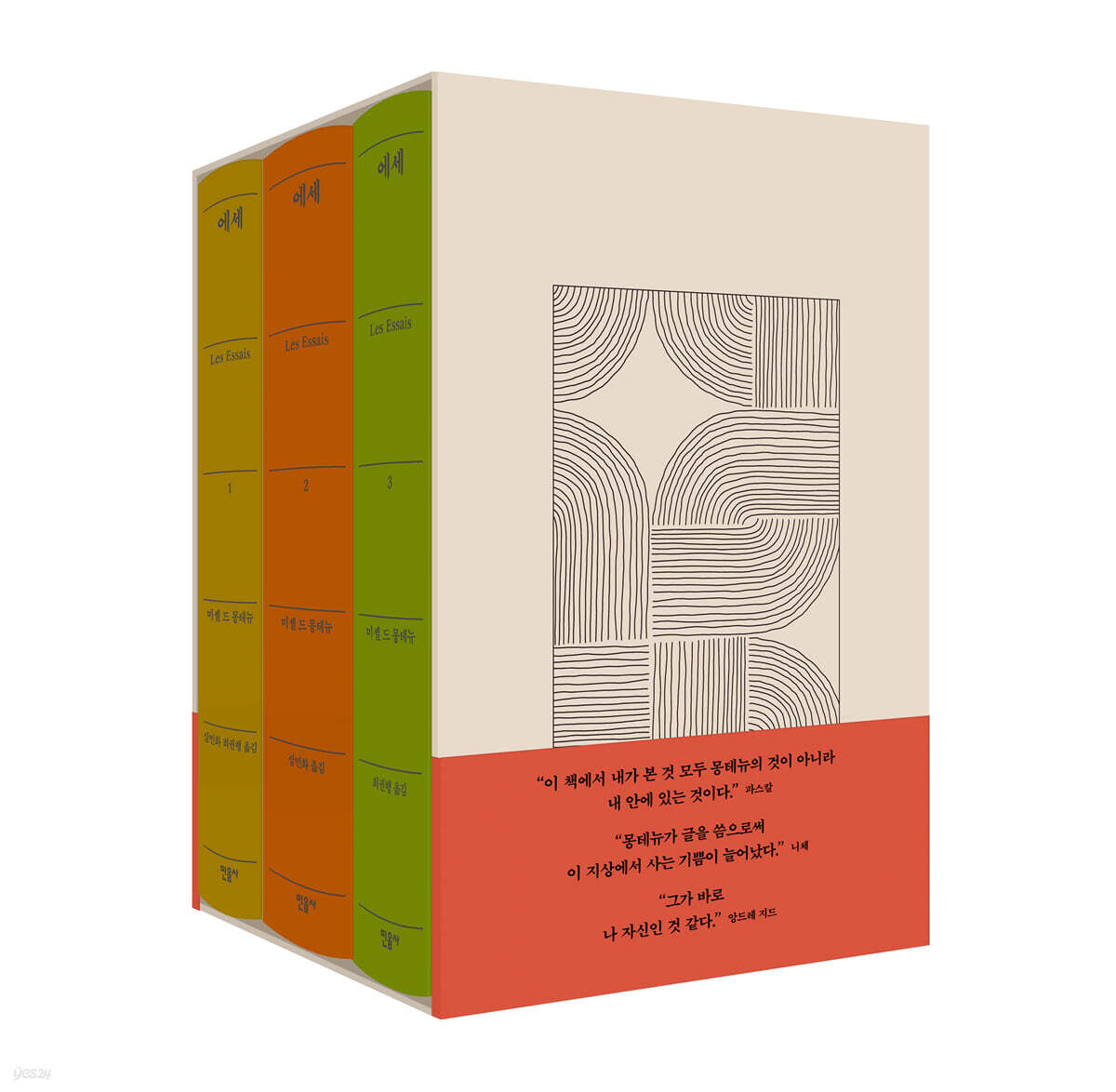
Essay set
 |
Description
Book Introduction
- A word from MD
-
Complete translation of Montaigne's EssaysWe meet Montaigne's "Essays," the origin of the word "essay," again in a complete translation.
"Essays" is a collection of 107 essays written by Montaigne over a period of twenty years after his resignation from his judicial post. This book reflects the additions made with each publication as well as the handwritten additions made to the edition that Montaigne himself owned.
July 5, 2022. Essay PD Park Hyung-wook
After 10 years of translation, 5 years of review, and half a century since its first domestic translation, this complete translation is here!
A portrait-like piece that reveals and testifies to the ever-changing "I, Michelle."
“This is a one-of-a-kind book, born from the wildest and most absurd ideas of a single-minded individual.”
After resigning from his judicial post in 1571 and retiring to the Château de Montaigne, Montaigne wrote 107 essays, both short and long, over the next twenty years until his death in 1592. Seven years after he began writing, he published the first edition of his essays under the title "Les Essais" (Essays), marking the birth of a new writing style.
Essay is a noun created by Montaigne from the verb 'essayer' which means 'to test', 'to experience', 'to try for the first time', and from this special writing style, the English writing style 'essay' was born.
Montaigne's essays, which describe thoughts rather than events, summon all the passions that shape human history and the arrogant aspects of the human world to the tip of his pen under 107 different titles, and as if in a courtroom, they contradict or intervene in each other within his mind, heart, and soul, revealing, testifying, and creating 'I, Michel.'
Montaigne, who retired to rebuild the Château de Montaigne, which his ancestors had devoted themselves to, and to live the 'life of contemplation' that the ancients and humanists had longed for, faced a mental crisis in 'a room of one's own', and decided to record the movements of his mind in writing to escape from it.
His writing was a means of 'self-exploration' to observe and control his own mind, to escape from depression that was contrary to his original nature, and thus to become one who took the reins of his own mind.
When a topic that aroused his curiosity or captivated his mind came to mind, Montaigne would list and contrast anecdotes related to the episode, whether from books, rumors, historical facts, or everyday stories, and examine the movements of his mind amidst the uncertainty created by these conflicting and contradictory examples.
The first thing he discovered within himself was that he had nothing to call his own except his own confused mind.
Through the process of self-exploration that began in this way, Montaigne discovered within himself the heterogeneity and fluidity of the human mind, the fragility and partiality of human senses and reason, and recognized their limitations as a universal human condition.
Then ask yourself:
'What do I know?'
A portrait-like piece that reveals and testifies to the ever-changing "I, Michelle."
“This is a one-of-a-kind book, born from the wildest and most absurd ideas of a single-minded individual.”
After resigning from his judicial post in 1571 and retiring to the Château de Montaigne, Montaigne wrote 107 essays, both short and long, over the next twenty years until his death in 1592. Seven years after he began writing, he published the first edition of his essays under the title "Les Essais" (Essays), marking the birth of a new writing style.
Essay is a noun created by Montaigne from the verb 'essayer' which means 'to test', 'to experience', 'to try for the first time', and from this special writing style, the English writing style 'essay' was born.
Montaigne's essays, which describe thoughts rather than events, summon all the passions that shape human history and the arrogant aspects of the human world to the tip of his pen under 107 different titles, and as if in a courtroom, they contradict or intervene in each other within his mind, heart, and soul, revealing, testifying, and creating 'I, Michel.'
Montaigne, who retired to rebuild the Château de Montaigne, which his ancestors had devoted themselves to, and to live the 'life of contemplation' that the ancients and humanists had longed for, faced a mental crisis in 'a room of one's own', and decided to record the movements of his mind in writing to escape from it.
His writing was a means of 'self-exploration' to observe and control his own mind, to escape from depression that was contrary to his original nature, and thus to become one who took the reins of his own mind.
When a topic that aroused his curiosity or captivated his mind came to mind, Montaigne would list and contrast anecdotes related to the episode, whether from books, rumors, historical facts, or everyday stories, and examine the movements of his mind amidst the uncertainty created by these conflicting and contradictory examples.
The first thing he discovered within himself was that he had nothing to call his own except his own confused mind.
Through the process of self-exploration that began in this way, Montaigne discovered within himself the heterogeneity and fluidity of the human mind, the fragility and partiality of human senses and reason, and recognized their limitations as a universal human condition.
Then ask yourself:
'What do I know?'
- You can preview some of the book's contents.
Preview
index
Essay 1
Translator's Note [005]
Preface: To the Reader [035]
Chapter 1 We arrive at similar conclusions in various ways [039]
Chapter 2: On Sorrow [045]
Chapter 3 Our hearts are always swept beyond us [052]
Chapter 4: When the soul loses sight of the true object of its passion, how does it release it in the wrong place? [064]
Chapter 5: Whether the leader of a besieged place should come out of the city to negotiate [068]
Chapter 6: Negotiation is Dangerous [073]
Chapter 7 Our actions should be judged according to our intentions [077]
Chapter 8: On Inaction [080]
Chapter 9: On Liars [083]
Chapter 10: On Speaking Quickly or Slowly [092]
Chapter 11: On Prophecy [096]
Chapter 12: On Righteousness [103]
Chapter 13: Concerning the Ceremony of Meeting Between Kings [107]
Chapter 14: Good and Bad Depend on Our Opinion [110]
Chapter 15: If you blindly cling to defending a fortress, you will be punished [140]
Chapter 16: On the Punishment of Cowardice [142]
Chapter 17: Characteristics of Some Ambassadors [145]
Chapter 18: On Fear [150]
Chapter 19: Our Happiness Must Be Judged After Death [155]
Chapter 20: To Philosophy Is to Learn to Die [160]
Chapter 21: On the Power of Imagination [189]
Chapter 22 One man's gain is another man's loss [207]
Chapter 23: On Habits, and the Unwillingness to Change Existing Laws [209]
Chapter 24: Various Results of the Same Plan [236]
Chapter 25: Concerning the Sciences [251]
Chapter 26: On the Education of Children [271]
Chapter 27: It is madness to try to distinguish truth from falsehood by our own power [328]
Chapter 28: On Friendship [335]
Chapter 29: Twenty-Nine Sonnets by Étienne de La Boësy [356]
Chapter 30: On the Doctrine of the Mean [358]
Chapter 31: On Cannibals [366]
Chapter 32: Do not try to judge God's will arbitrarily [388]
Chapter 33: Sacrificing One's Life to Avoid Worldly Pleasures [392]
Chapter 34: Fortune Sometimes Aligns with Reason [395]
Chapter 35: Concerning the Defects of Our Lives [400]
Chapter 36: On Dressing Customs [403]
Chapter 37: Concerning Cato the Younger [409]
Chapter 38 We both cry and laugh at the same thing [416]
Chapter 39: On Being Alone [422]
Chapter 40: Reflections on Cicero [442]
Chapter 41: On Not Sharing One's Glory with Others [452]
Chapter 42: On Inequality Among Us [456]
Chapter 43: On the Laws of Sumbundancy [473]
Chapter 44: On Sleep [477]
Chapter 45: On the Battle of Dreux [481]
Chapter 46: On Names [484]
Chapter 47: On the Uncertainty of Our Judgment [494]
Chapter 48: On War Horses [505]
Chapter 49: On Old Customs [519]
Chapter 50: On Democritus and Heraclitus [527]
Chapter 51: On the Emptiness of Words [533]
Chapter 52: On the Frugality of the Ancients [539]
Chapter 53: A Word from Caesar [541]
Chapter 54: On Useless Tricks [544]
Chapter 55: On Smell [549]
Chapter 56: On Prayer [553]
Chapter 57: On Age [569]
Essay 2
Chapter 1: On the Capriciousness of Our Behavior [011]
Chapter 2: On Alcoholism [023]
Chapter 3: On the Customs of Kea Island [039]
Chapter 4 Office is tomorrow [061]
Chapter 5: On Conscience [065]
Chapter 6: On Cultivation [072]
Chapter 7: On Honorary Awards [090]
Chapter 8: On a Father's Love for His Children [096]
Chapter 9: On the Armament of the Parthians [126]
Chapter 10: On Books [131]
Chapter 11: On Cruelty [153]
Chapter 12: The Defense of Raymond Sebong [177]
Chapter 13: Judging the Death of Others [460]
Chapter 14: How Our Minds Sabotage Themselves [470]
Chapter 15 Our desires grow stronger when we encounter difficulties [472]
Chapter 16: On Glory [482]
Chapter 17: Concerning Arrogance [504]
Chapter 18: On Lying [556]
Chapter 19: On Freedom of Conscience [564]
Chapter 20 We Cannot Taste Anything Pure [571]
Chapter 21: Condemning Laziness [576]
Chapter 22: About Post Stations [583]
Chapter 23: On the Use of Bad Means for Good Purposes [586]
Chapter 24: Concerning the Power of Rome [592]
Chapter 25: Do Not Imitate the Sick [595]
Chapter 26: On the Thumb [599]
Chapter 27: Cowardice is the Mother of Cruelty [601]
Chapter 28: There is a time for everything [616]
Chapter 29: On Courage [620]
Chapter 30: Concerning a Deformed Child [632]
Chapter 31: On Anger [635]
Chapter 32: The Apology of Seneca and Plutarch [647]
Chapter 33: The Story of Spurina [658]
Chapter 34: Considerations on the Art of War by Julius Caesar [670]
Chapter 35: About Three Virtuous Wives [683]
Chapter 36: Concerning the Most Excellent Men [695]
Chapter 37: On Children Resembling Their Fathers [708]
Essay 3
Chapter 1: On Practicality and Morality [011]
Chapter 2 Regret [037]
Chapter 3: On the Three Kinds of Relationships [060]
Chapter 4: On Mood Change [080]
Chapter 5: On Some Verses of Virgil [099]
Chapter 6: Concerning the Chariot [211]
Chapter 7: On the Inconvenience of Power [241]
Chapter 8: On the Art of Conversation [250]
Chapter 9: On Vanity [294]
Chapter 10: Regarding the Control of One's Will [399]
Chapter 11: Concerning the Cripple [439]
Chapter 12: On Appearance [459]
Chapter 13: On Experience [511]
Appendix: Montaigne's Study and the Ceiling Quotes [609]
Montaigne's Annals [636]
Translator's Note [005]
Preface: To the Reader [035]
Chapter 1 We arrive at similar conclusions in various ways [039]
Chapter 2: On Sorrow [045]
Chapter 3 Our hearts are always swept beyond us [052]
Chapter 4: When the soul loses sight of the true object of its passion, how does it release it in the wrong place? [064]
Chapter 5: Whether the leader of a besieged place should come out of the city to negotiate [068]
Chapter 6: Negotiation is Dangerous [073]
Chapter 7 Our actions should be judged according to our intentions [077]
Chapter 8: On Inaction [080]
Chapter 9: On Liars [083]
Chapter 10: On Speaking Quickly or Slowly [092]
Chapter 11: On Prophecy [096]
Chapter 12: On Righteousness [103]
Chapter 13: Concerning the Ceremony of Meeting Between Kings [107]
Chapter 14: Good and Bad Depend on Our Opinion [110]
Chapter 15: If you blindly cling to defending a fortress, you will be punished [140]
Chapter 16: On the Punishment of Cowardice [142]
Chapter 17: Characteristics of Some Ambassadors [145]
Chapter 18: On Fear [150]
Chapter 19: Our Happiness Must Be Judged After Death [155]
Chapter 20: To Philosophy Is to Learn to Die [160]
Chapter 21: On the Power of Imagination [189]
Chapter 22 One man's gain is another man's loss [207]
Chapter 23: On Habits, and the Unwillingness to Change Existing Laws [209]
Chapter 24: Various Results of the Same Plan [236]
Chapter 25: Concerning the Sciences [251]
Chapter 26: On the Education of Children [271]
Chapter 27: It is madness to try to distinguish truth from falsehood by our own power [328]
Chapter 28: On Friendship [335]
Chapter 29: Twenty-Nine Sonnets by Étienne de La Boësy [356]
Chapter 30: On the Doctrine of the Mean [358]
Chapter 31: On Cannibals [366]
Chapter 32: Do not try to judge God's will arbitrarily [388]
Chapter 33: Sacrificing One's Life to Avoid Worldly Pleasures [392]
Chapter 34: Fortune Sometimes Aligns with Reason [395]
Chapter 35: Concerning the Defects of Our Lives [400]
Chapter 36: On Dressing Customs [403]
Chapter 37: Concerning Cato the Younger [409]
Chapter 38 We both cry and laugh at the same thing [416]
Chapter 39: On Being Alone [422]
Chapter 40: Reflections on Cicero [442]
Chapter 41: On Not Sharing One's Glory with Others [452]
Chapter 42: On Inequality Among Us [456]
Chapter 43: On the Laws of Sumbundancy [473]
Chapter 44: On Sleep [477]
Chapter 45: On the Battle of Dreux [481]
Chapter 46: On Names [484]
Chapter 47: On the Uncertainty of Our Judgment [494]
Chapter 48: On War Horses [505]
Chapter 49: On Old Customs [519]
Chapter 50: On Democritus and Heraclitus [527]
Chapter 51: On the Emptiness of Words [533]
Chapter 52: On the Frugality of the Ancients [539]
Chapter 53: A Word from Caesar [541]
Chapter 54: On Useless Tricks [544]
Chapter 55: On Smell [549]
Chapter 56: On Prayer [553]
Chapter 57: On Age [569]
Essay 2
Chapter 1: On the Capriciousness of Our Behavior [011]
Chapter 2: On Alcoholism [023]
Chapter 3: On the Customs of Kea Island [039]
Chapter 4 Office is tomorrow [061]
Chapter 5: On Conscience [065]
Chapter 6: On Cultivation [072]
Chapter 7: On Honorary Awards [090]
Chapter 8: On a Father's Love for His Children [096]
Chapter 9: On the Armament of the Parthians [126]
Chapter 10: On Books [131]
Chapter 11: On Cruelty [153]
Chapter 12: The Defense of Raymond Sebong [177]
Chapter 13: Judging the Death of Others [460]
Chapter 14: How Our Minds Sabotage Themselves [470]
Chapter 15 Our desires grow stronger when we encounter difficulties [472]
Chapter 16: On Glory [482]
Chapter 17: Concerning Arrogance [504]
Chapter 18: On Lying [556]
Chapter 19: On Freedom of Conscience [564]
Chapter 20 We Cannot Taste Anything Pure [571]
Chapter 21: Condemning Laziness [576]
Chapter 22: About Post Stations [583]
Chapter 23: On the Use of Bad Means for Good Purposes [586]
Chapter 24: Concerning the Power of Rome [592]
Chapter 25: Do Not Imitate the Sick [595]
Chapter 26: On the Thumb [599]
Chapter 27: Cowardice is the Mother of Cruelty [601]
Chapter 28: There is a time for everything [616]
Chapter 29: On Courage [620]
Chapter 30: Concerning a Deformed Child [632]
Chapter 31: On Anger [635]
Chapter 32: The Apology of Seneca and Plutarch [647]
Chapter 33: The Story of Spurina [658]
Chapter 34: Considerations on the Art of War by Julius Caesar [670]
Chapter 35: About Three Virtuous Wives [683]
Chapter 36: Concerning the Most Excellent Men [695]
Chapter 37: On Children Resembling Their Fathers [708]
Essay 3
Chapter 1: On Practicality and Morality [011]
Chapter 2 Regret [037]
Chapter 3: On the Three Kinds of Relationships [060]
Chapter 4: On Mood Change [080]
Chapter 5: On Some Verses of Virgil [099]
Chapter 6: Concerning the Chariot [211]
Chapter 7: On the Inconvenience of Power [241]
Chapter 8: On the Art of Conversation [250]
Chapter 9: On Vanity [294]
Chapter 10: Regarding the Control of One's Will [399]
Chapter 11: Concerning the Cripple [439]
Chapter 12: On Appearance [459]
Chapter 13: On Experience [511]
Appendix: Montaigne's Study and the Ceiling Quotes [609]
Montaigne's Annals [636]
Detailed image
.jpg)
Publisher's Review
Michel de Montaigne, the greatest thinker and philosopher of the 16th century French Renaissance.
107 Stories by Montaigne, the Master of Self-Exploration
The complete translation of the 1588 Bordeaux edition of 『Essay』, the origin of the word 'essay', has been published!
The complete translation of 『Essays』, the lifelong work of Michel de Montaigne, the greatest intellectual, thinker, and philosopher of the 16th century French Renaissance, who retired from all public office at the age of 38 and lived in seclusion in his study at the Château de Montaigne until his death, has been published by Minumsa.
This is the translation of the Bordeaux version (with Montaigne adding new notes in the margins) of the 1588 edition (the last edition he had ever published) half a century after the complete translation by Son Woo-seong, known to us as 'Susangrok' (first edition published on May 5, 1965).
The massive 『Essay』, which is over 1,000 pages in the original (1,988 pages in our translation), is the result of 15 years of work by French literature scholars Sim Min-hwa and Choi Kwon-haeng, including 10 years of translation and 5 years of review.
Translator Sim Min-hwa visited Bordeaux, Montaigne's hometown, to trace his footsteps in order to translate "Essays," and conducted a thorough review by viewing the Bordeaux version stored in the library.
After resigning from his judicial post in 1571 and retiring to the Château de Montaigne, Montaigne wrote 107 essays, both short and long, over the next twenty years until his death in 1592. Seven years after he began writing, he published the first edition of his essays under the title "Les Essais" (Essays), marking the birth of a new writing style.
Essay is a noun created by Montaigne from the verb 'essayer' which means 'to test', 'to experience', 'to try for the first time', and from this special writing style, the English writing style 'essay' was born.
Montaigne's essays, which describe thoughts rather than events, summon all the passions that shape human history and the arrogant aspects of the human world to the tip of his pen under 107 different titles, and as if in a courtroom, they contradict or intervene in each other within his mind, heart, and soul, revealing, testifying, and creating 'I, Michel.'
Montaigne, who retired to rebuild the Château de Montaigne, which his ancestors had devoted themselves to, and to live the 'life of contemplation' that the ancients and humanists had longed for, faced a mental crisis in 'a room of one's own', and decided to record the movements of his mind in writing to escape from it.
His writing was a means of 'self-exploration' to observe and control his own mind, to escape from depression that was contrary to his original nature, and thus to become one who took the reins of his own mind.
When a topic that aroused his curiosity or captivated his mind came to mind, Montaigne would list and contrast anecdotes related to the episode, whether from books, rumors, historical facts, or everyday stories, and examine the movements of his mind amidst the uncertainty created by these conflicting and contradictory examples.
The first thing he discovered within himself was that he had nothing to call his own except his own confused mind.
Through the process of self-exploration that began in this way, Montaigne discovered within himself the heterogeneity and fluidity of the human mind, the fragility and partiality of human senses and reason, and recognized their limitations as a universal human condition.
Then ask yourself:
'What do I know?'
The Birth of the 'Spiritual Individual', Escaping Medieval Self-Awareness
A human, all too human, Montaigne-style literary wandering
“We, our judgments, and all mortal things,
“It flows and rolls on endlessly.”
Living in an age of disillusionment and violence, Montaigne did not seek beyond human misery, beyond the misery of the world, beyond the ‘other side of the world’ or ‘beyond the grave.’
Death becomes a drain that intensifies every moment of life, and his awareness that “every moment seems to be slipping away from me” changes into an active desire to “snatch the swiftness of time with my agility” while writing. (Chapter 13 of 『Essays 3』) Montaigne never stopped calling the products of his mind “delusions” or “dreams,” but despite his humble attitude, they are also the possibility of a new world of objects that will be given tomorrow, the possibility of a new “me.”
In this way, without any illusions about humans, the world, or even about the future when life will come to an end, we only grasp reality, phenomena, and actuality, and, as humans, find a way to live well and die well, as humans, in order to find a way to live well and die well, the time of the now/here (hic et nunc) that will be recorded “as long as there is ink and paper in the world” until the very end, the time that transitions from negation to affirmation, while reading 『Essays』, we too are carried away to that time.
As you read 『Essays』, you will understand why Nietzsche called him a ‘victor’ and said, “It is happy to be with a victor.” (『Anti-Timely Meditations』)
In ancient and medieval times, self-reflection was a major aspect of self-cultivation, and it was carried out according to the collective doctrines of philosophical and religious schools.
The self-awareness of medieval people could only be understood in universal and collective forms such as tribe and family.
Montaigne's exploration of the self began with the 'I', the 'mental individual' who had escaped this perception, and was an attempt by, of, and for the self to confirm the reality of the self and redefine the self.
Montaigne adopted the unobservant conventions of Pyrrhonism (skepticism), observing and writing down the phenomena that occurred to him at every moment.
This phenomenological technique through suspension of judgment (Epoche) opens the way to recovering one's own initiative over oneself and living as a 'subject', the master of one's own life, with a 'subjective view' accompanied by critical consciousness.
When he speaks of the universal human condition, he uses 'we' (nous) as the subject, and when he expresses his own views, he uses 'I' (je) as the subject.
“These essays are my capricious thoughts, and what I want to do with them is not to give you knowledge of things, but to let you know about myself.” (Essays 2, Chapter 10) Similarity as a species makes us compatriots.
Our individual differences allow us to communicate.
We, the readers, who are each individuals, now meet Montaigne as an equal 'subject' with the same universal human condition as Montaigne, and as a modern man who faces us.
"Isn't that the case for everyone, in every age? I feel deeply that for us too, meeting someone, someone's heart and soul, shapes the direction and shape of our lives.
So, for me, it was quite a stroke of luck to have met a lifelong friend like Montaigne. (Choi Kwon-haeng) (……) I also pray for all the readers who open this book, using Montaigne’s last words.
May you attain and enjoy ‘health and wisdom, the wisdom that allows you to be truly cheerful and get along with people’ (Essay 3, Chapter 13)… … .” (Sim Min-hwa)
― From the translator's note
■ What are two points to keep in mind when reading 『Essay』?
1588 Bordeaux edition A, B, C labels and quotes
“When I dance, I dance, and when I sleep, I sleep.
and (……)
“I bring my thoughts to myself, to the comfort of being alone.”
It is estimated that 『Essays』 were published five times during Montaigne's lifetime.
Only four editions are known and preserved to date: those of 1580, 1582, 1587, and 1588. However, this is because Montaigne filled the margins of the 1588 edition of Essays he personally owned with handwritten notes, clearly stating in his own hand that it was “for the sixth edition.”
Montaigne's personal copy, later called the "Bordeaux version," was donated to the library of the Abbey of Faylan by his wife after Montaigne's death and was long forgotten. However, in the 20th century, when a new edition based on it was published and photographic copies of the Bordeaux version were made, the strata composing each chapter were revealed and the parts that Montaigne added with each new edition could be distinguished.
The symbols A, B, and C attached to the text are symbols that distinguish the layers, and their meanings are as follows.
If you read this sign attached in small letters with interest, you will be able to feel the movement and change in Montaigne's thoughts.
A: Portions from the 1580 and 1582 editions, published in two volumes by Simon Millange in Bordeaux.
(The third edition, published by Jean Lysée in Paris in 1587, is identical to the 1582 edition.)
B: A portion added to the entire book in 1588 when thirteen chapters in three volumes were added by the publisher Langelier in Paris.
C: A part densely added in handwriting to the margins of the 1588 edition (Bordeaux version) that Montaigne had.
Looking at the numerous figures and quotes Montaigne mentions, one need not assume that prior knowledge of the classics is necessary to read the Essays.
Montaigne would not have wanted to study hard and rack his brain to read his own writings.
That such study is not necessary is also stated in Montaigne's own writings.
“I do not intend for these decorations to cover me and obscure me.
It is contrary to my intention, for I wish to show only what is mine, and what is originally mine.
And if I had only had enough confidence, I would have left everything to chance and spoken only with my own voice.” ((Essay 3, Chapter 12)
There was a reason why Montaigne rarely cited the sources of his quotations beyond the words he quoted in the text.
Montaigne criticized the anthologies that simply pile up quotations and pretend to be sane, saying:
“I am very comfortable with being able to steal, disguise, and transform anything from countless quotations.
“At the risk of being criticized for not understanding the original meaning, I give them some special direction with my own hands so that they do not become completely superficial writings of others.” (Essay 3, Chapter 12)
Meanwhile, Montaigne left his readers with a very simple order regarding quotations.
“In what I have quoted, it remains to be seen whether I have had the ability to select something that would make my subject stand out.” (Chapter 10 of Essays 2) So, we, the readers, can trust Montaigne’s words and read ‘I, Michel’ with ease and savor.
“I sleep when I sleep and dance when I dance.”
[Praises]
“When I read ‘Essays,’ I feel like I wrote them myself.”
― 16th-century poet Tavro
“Not everything I saw in this book was Montaigne’s.
It is inside me.”
― Pascal, 17th-century thinker
“I feel like I wrote it myself in a past life.”
― 19th-century essayist Emerson
“Montaigne's writing increased the joy of living on this earth.”
― 20th-century philosopher Nietzsche
107 Stories by Montaigne, the Master of Self-Exploration
The complete translation of the 1588 Bordeaux edition of 『Essay』, the origin of the word 'essay', has been published!
The complete translation of 『Essays』, the lifelong work of Michel de Montaigne, the greatest intellectual, thinker, and philosopher of the 16th century French Renaissance, who retired from all public office at the age of 38 and lived in seclusion in his study at the Château de Montaigne until his death, has been published by Minumsa.
This is the translation of the Bordeaux version (with Montaigne adding new notes in the margins) of the 1588 edition (the last edition he had ever published) half a century after the complete translation by Son Woo-seong, known to us as 'Susangrok' (first edition published on May 5, 1965).
The massive 『Essay』, which is over 1,000 pages in the original (1,988 pages in our translation), is the result of 15 years of work by French literature scholars Sim Min-hwa and Choi Kwon-haeng, including 10 years of translation and 5 years of review.
Translator Sim Min-hwa visited Bordeaux, Montaigne's hometown, to trace his footsteps in order to translate "Essays," and conducted a thorough review by viewing the Bordeaux version stored in the library.
After resigning from his judicial post in 1571 and retiring to the Château de Montaigne, Montaigne wrote 107 essays, both short and long, over the next twenty years until his death in 1592. Seven years after he began writing, he published the first edition of his essays under the title "Les Essais" (Essays), marking the birth of a new writing style.
Essay is a noun created by Montaigne from the verb 'essayer' which means 'to test', 'to experience', 'to try for the first time', and from this special writing style, the English writing style 'essay' was born.
Montaigne's essays, which describe thoughts rather than events, summon all the passions that shape human history and the arrogant aspects of the human world to the tip of his pen under 107 different titles, and as if in a courtroom, they contradict or intervene in each other within his mind, heart, and soul, revealing, testifying, and creating 'I, Michel.'
Montaigne, who retired to rebuild the Château de Montaigne, which his ancestors had devoted themselves to, and to live the 'life of contemplation' that the ancients and humanists had longed for, faced a mental crisis in 'a room of one's own', and decided to record the movements of his mind in writing to escape from it.
His writing was a means of 'self-exploration' to observe and control his own mind, to escape from depression that was contrary to his original nature, and thus to become one who took the reins of his own mind.
When a topic that aroused his curiosity or captivated his mind came to mind, Montaigne would list and contrast anecdotes related to the episode, whether from books, rumors, historical facts, or everyday stories, and examine the movements of his mind amidst the uncertainty created by these conflicting and contradictory examples.
The first thing he discovered within himself was that he had nothing to call his own except his own confused mind.
Through the process of self-exploration that began in this way, Montaigne discovered within himself the heterogeneity and fluidity of the human mind, the fragility and partiality of human senses and reason, and recognized their limitations as a universal human condition.
Then ask yourself:
'What do I know?'
The Birth of the 'Spiritual Individual', Escaping Medieval Self-Awareness
A human, all too human, Montaigne-style literary wandering
“We, our judgments, and all mortal things,
“It flows and rolls on endlessly.”
Living in an age of disillusionment and violence, Montaigne did not seek beyond human misery, beyond the misery of the world, beyond the ‘other side of the world’ or ‘beyond the grave.’
Death becomes a drain that intensifies every moment of life, and his awareness that “every moment seems to be slipping away from me” changes into an active desire to “snatch the swiftness of time with my agility” while writing. (Chapter 13 of 『Essays 3』) Montaigne never stopped calling the products of his mind “delusions” or “dreams,” but despite his humble attitude, they are also the possibility of a new world of objects that will be given tomorrow, the possibility of a new “me.”
In this way, without any illusions about humans, the world, or even about the future when life will come to an end, we only grasp reality, phenomena, and actuality, and, as humans, find a way to live well and die well, as humans, in order to find a way to live well and die well, the time of the now/here (hic et nunc) that will be recorded “as long as there is ink and paper in the world” until the very end, the time that transitions from negation to affirmation, while reading 『Essays』, we too are carried away to that time.
As you read 『Essays』, you will understand why Nietzsche called him a ‘victor’ and said, “It is happy to be with a victor.” (『Anti-Timely Meditations』)
In ancient and medieval times, self-reflection was a major aspect of self-cultivation, and it was carried out according to the collective doctrines of philosophical and religious schools.
The self-awareness of medieval people could only be understood in universal and collective forms such as tribe and family.
Montaigne's exploration of the self began with the 'I', the 'mental individual' who had escaped this perception, and was an attempt by, of, and for the self to confirm the reality of the self and redefine the self.
Montaigne adopted the unobservant conventions of Pyrrhonism (skepticism), observing and writing down the phenomena that occurred to him at every moment.
This phenomenological technique through suspension of judgment (Epoche) opens the way to recovering one's own initiative over oneself and living as a 'subject', the master of one's own life, with a 'subjective view' accompanied by critical consciousness.
When he speaks of the universal human condition, he uses 'we' (nous) as the subject, and when he expresses his own views, he uses 'I' (je) as the subject.
“These essays are my capricious thoughts, and what I want to do with them is not to give you knowledge of things, but to let you know about myself.” (Essays 2, Chapter 10) Similarity as a species makes us compatriots.
Our individual differences allow us to communicate.
We, the readers, who are each individuals, now meet Montaigne as an equal 'subject' with the same universal human condition as Montaigne, and as a modern man who faces us.
"Isn't that the case for everyone, in every age? I feel deeply that for us too, meeting someone, someone's heart and soul, shapes the direction and shape of our lives.
So, for me, it was quite a stroke of luck to have met a lifelong friend like Montaigne. (Choi Kwon-haeng) (……) I also pray for all the readers who open this book, using Montaigne’s last words.
May you attain and enjoy ‘health and wisdom, the wisdom that allows you to be truly cheerful and get along with people’ (Essay 3, Chapter 13)… … .” (Sim Min-hwa)
― From the translator's note
■ What are two points to keep in mind when reading 『Essay』?
1588 Bordeaux edition A, B, C labels and quotes
“When I dance, I dance, and when I sleep, I sleep.
and (……)
“I bring my thoughts to myself, to the comfort of being alone.”
It is estimated that 『Essays』 were published five times during Montaigne's lifetime.
Only four editions are known and preserved to date: those of 1580, 1582, 1587, and 1588. However, this is because Montaigne filled the margins of the 1588 edition of Essays he personally owned with handwritten notes, clearly stating in his own hand that it was “for the sixth edition.”
Montaigne's personal copy, later called the "Bordeaux version," was donated to the library of the Abbey of Faylan by his wife after Montaigne's death and was long forgotten. However, in the 20th century, when a new edition based on it was published and photographic copies of the Bordeaux version were made, the strata composing each chapter were revealed and the parts that Montaigne added with each new edition could be distinguished.
The symbols A, B, and C attached to the text are symbols that distinguish the layers, and their meanings are as follows.
If you read this sign attached in small letters with interest, you will be able to feel the movement and change in Montaigne's thoughts.
A: Portions from the 1580 and 1582 editions, published in two volumes by Simon Millange in Bordeaux.
(The third edition, published by Jean Lysée in Paris in 1587, is identical to the 1582 edition.)
B: A portion added to the entire book in 1588 when thirteen chapters in three volumes were added by the publisher Langelier in Paris.
C: A part densely added in handwriting to the margins of the 1588 edition (Bordeaux version) that Montaigne had.
Looking at the numerous figures and quotes Montaigne mentions, one need not assume that prior knowledge of the classics is necessary to read the Essays.
Montaigne would not have wanted to study hard and rack his brain to read his own writings.
That such study is not necessary is also stated in Montaigne's own writings.
“I do not intend for these decorations to cover me and obscure me.
It is contrary to my intention, for I wish to show only what is mine, and what is originally mine.
And if I had only had enough confidence, I would have left everything to chance and spoken only with my own voice.” ((Essay 3, Chapter 12)
There was a reason why Montaigne rarely cited the sources of his quotations beyond the words he quoted in the text.
Montaigne criticized the anthologies that simply pile up quotations and pretend to be sane, saying:
“I am very comfortable with being able to steal, disguise, and transform anything from countless quotations.
“At the risk of being criticized for not understanding the original meaning, I give them some special direction with my own hands so that they do not become completely superficial writings of others.” (Essay 3, Chapter 12)
Meanwhile, Montaigne left his readers with a very simple order regarding quotations.
“In what I have quoted, it remains to be seen whether I have had the ability to select something that would make my subject stand out.” (Chapter 10 of Essays 2) So, we, the readers, can trust Montaigne’s words and read ‘I, Michel’ with ease and savor.
“I sleep when I sleep and dance when I dance.”
[Praises]
“When I read ‘Essays,’ I feel like I wrote them myself.”
― 16th-century poet Tavro
“Not everything I saw in this book was Montaigne’s.
It is inside me.”
― Pascal, 17th-century thinker
“I feel like I wrote it myself in a past life.”
― 19th-century essayist Emerson
“Montaigne's writing increased the joy of living on this earth.”
― 20th-century philosopher Nietzsche
GOODS SPECIFICS
- Publication date: June 24, 2022
- Format: Hardcover book binding method guide
- Page count, weight, size: 1,988 pages | 2,796g | 152*235*112mm
- ISBN13: 9788937472237
- ISBN10: 8937472236
You may also like
카테고리
korean


korean

![GQ KOREA Mark (Monthly): December [2025]](http://librairie.coreenne.fr/cdn/shop/files/8ef265dbbfbf186523ed75ba7319009d.jpg?v=1765340328&width=3840)


