

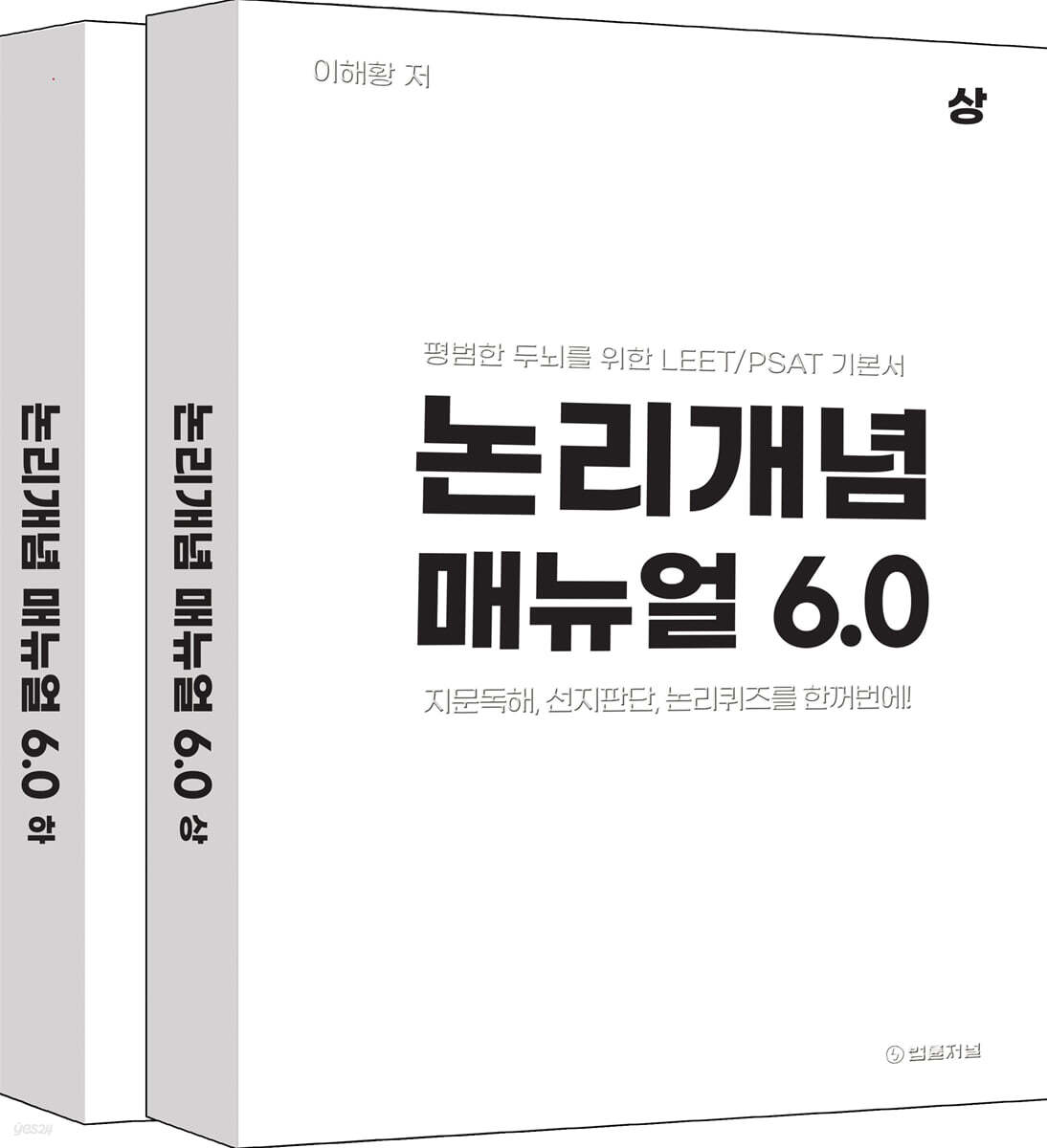
Logic Concepts Manual 6.0 Upper and Lower Set
 |
Description
Book Introduction
This is a basic book that covers the principles and exceptions, basics and advanced concepts of logic in a single volume.
This is a basic self-study book that explains things in an easy/friendly/detailed manner.
It was written to prevent misconceptions by analyzing each and every question from test takers and to naturally resolve any questions that arise while studying.
Approximately 480 previous exam questions were analyzed.
We provide free e-books (PDF) to textbook buyers.
For difficult problems or concepts, lectures are uploaded to YouTube and can be viewed through QR codes.
This is a basic self-study book that explains things in an easy/friendly/detailed manner.
It was written to prevent misconceptions by analyzing each and every question from test takers and to naturally resolve any questions that arise while studying.
Approximately 480 previous exam questions were analyzed.
We provide free e-books (PDF) to textbook buyers.
For difficult problems or concepts, lectures are uploaded to YouTube and can be viewed through QR codes.
- You can preview some of the book's contents.
Preview
index
Commercial Areas: I~III
I.
Basic concepts of logic
T0.
Why Logic? 14
T1.
Logical Possibility 18
T2.
Valid Inference 34
T3.
Contradiction 45
T4.
Proposition 58
T5.
True 82
T6.
Standard Logic 111
T7.
Possible World 114
II.
Sentence symbolization
T8.
Symbol Orientation 119
T9.
Singular sentence 122
T10.
Jeong-eon Sentence 127
T11.
Negative Symbolization 134
T12.
Symbolization of linked speech 136
T13.
Declaration Symbolization 143
T14.
Interpretation of the Law 152
T15.
Exclusive Declaration Symbol 166
T16.
Logic Circuit 170
T17.
Symbolizing Conditional Statements 186
T18.
Necessary and sufficient conditions 199
T19.
Negation of Necessary and Sufficient Conditions 211
T20.
Necessary Condition Estimation 235
T21.
Very Easy Explanation 239
T22.
'Biroso' symbolization 240
T23.
Inclusion Relationship 241
T24.
Symbolization of 'for' 254
T25.
Symbolization of 'Man' 255
T26.
Symbolization of 'Han' 264
T27.
Symbolization of 'Premise' 270
T28.
Symbolization of 'Rado' 277
T29.
Nested conditional statements 278
T30.
Symbolic Q&A 290
T31.
A Complete Guide to Symbolizing Conditional Statements 293
T32.
Equivalence Symbol 297
T33.
Everyday Language 305
T34.
Misleading statement 306
T35.
Counterfactual Conditional 308
III.
Predicate logic
T36.
Discussion Area 316
T37.
What is What 318
T38.
Symbolization of the full sentence 323
T39.
Special Sentence Symbolization 325
T40.
329 square meters
T41.
Existential Implication 334
T42.
Yangwhasa Distribution 338
T43.
Existence is not an attribute 341
T44.
Precautions for Symbolizing the Jeong-eon Sentence 344
T45.
Auxiliary 347
T46.
Multiple Quantifier Sentence 355
T47.
Words of Encouragement 359
Volumes 2: IV-VI
IV.
logical relationship
T48.
Orientation 365
Compatible
T49.
Compatible 370
equivalence relation
T50.
Equivalence Concept 383
T51.
Equivalent standard form 384
T52.
Basic Equivalence Relations 387
T53.
Substantial Implications 393
T54.
Entry Rule 397
T55.
Separation of consequent and antecedent 398
Implications
T56.
Implication Concept 403
T57.
Conditional Culture 413
T58.
Information amount 415
T59.
Introduction/removal of consonants 432
T60.
Introduction of the Declaration 434
T61.
Declaration of Removal 438
T62.
Equivalent introduction/removal 441
T63.
All positive 443
T64.
A counterexample to the predicate? 446
T65.
Negation of the consequent 452
T66.
Conditional Chain 454
T67.
Law of Absurdity 468
T68.
Dilemma 490
T69.
Mathematical Proof 495
T70.
Breaking Down the Argument 504
T71.
Empty Truth, Trivial Truth 515
T72.
IOTA Split 521
T73.
Explosion Principle 522
T74.
Argument Type 524
T75.
Argument Structure Diagram 526
T76.
Premise 541 to be added
T77.
Predicate Logic Inference Rule 583
T78.
Logical leap concept 600
T79.
Post-consequence affirmation 602
T80.
Negation of all matters 620
T81.
Geongeondanjeong 625
T82.
628
T83.
Declaration of Affirmation 632
T84.
Declaration of Independence 632
T85.
Special Implication 638
T86.
Full name 641
T87.
Naturalistic Fallacy 644
contradictory relationship
T88.
Misconception of Contradiction 658
T89.
Contradiction in categorical sentences 672
V.
Expansion pack
T90.
Modal Logic 694
T91.
Deontological Logic 695
VI.
Appendix - Expected Questions
T92.
Liar Paradox 706
T93.
Extension and Connotation 712
T94.
The Essence of Art 744
T95.
Continuum Hypothesis 752
T96.
Diagram 758
T97.
Mental and Physical Problems 764
T98.
Moral Responsibility 772
T99.
Objects of Moral Consideration 785
T100.
Ambiguous 793
Postscript 799
800 Acknowledgements
I.
Basic concepts of logic
T0.
Why Logic? 14
T1.
Logical Possibility 18
T2.
Valid Inference 34
T3.
Contradiction 45
T4.
Proposition 58
T5.
True 82
T6.
Standard Logic 111
T7.
Possible World 114
II.
Sentence symbolization
T8.
Symbol Orientation 119
T9.
Singular sentence 122
T10.
Jeong-eon Sentence 127
T11.
Negative Symbolization 134
T12.
Symbolization of linked speech 136
T13.
Declaration Symbolization 143
T14.
Interpretation of the Law 152
T15.
Exclusive Declaration Symbol 166
T16.
Logic Circuit 170
T17.
Symbolizing Conditional Statements 186
T18.
Necessary and sufficient conditions 199
T19.
Negation of Necessary and Sufficient Conditions 211
T20.
Necessary Condition Estimation 235
T21.
Very Easy Explanation 239
T22.
'Biroso' symbolization 240
T23.
Inclusion Relationship 241
T24.
Symbolization of 'for' 254
T25.
Symbolization of 'Man' 255
T26.
Symbolization of 'Han' 264
T27.
Symbolization of 'Premise' 270
T28.
Symbolization of 'Rado' 277
T29.
Nested conditional statements 278
T30.
Symbolic Q&A 290
T31.
A Complete Guide to Symbolizing Conditional Statements 293
T32.
Equivalence Symbol 297
T33.
Everyday Language 305
T34.
Misleading statement 306
T35.
Counterfactual Conditional 308
III.
Predicate logic
T36.
Discussion Area 316
T37.
What is What 318
T38.
Symbolization of the full sentence 323
T39.
Special Sentence Symbolization 325
T40.
329 square meters
T41.
Existential Implication 334
T42.
Yangwhasa Distribution 338
T43.
Existence is not an attribute 341
T44.
Precautions for Symbolizing the Jeong-eon Sentence 344
T45.
Auxiliary 347
T46.
Multiple Quantifier Sentence 355
T47.
Words of Encouragement 359
Volumes 2: IV-VI
IV.
logical relationship
T48.
Orientation 365
Compatible
T49.
Compatible 370
equivalence relation
T50.
Equivalence Concept 383
T51.
Equivalent standard form 384
T52.
Basic Equivalence Relations 387
T53.
Substantial Implications 393
T54.
Entry Rule 397
T55.
Separation of consequent and antecedent 398
Implications
T56.
Implication Concept 403
T57.
Conditional Culture 413
T58.
Information amount 415
T59.
Introduction/removal of consonants 432
T60.
Introduction of the Declaration 434
T61.
Declaration of Removal 438
T62.
Equivalent introduction/removal 441
T63.
All positive 443
T64.
A counterexample to the predicate? 446
T65.
Negation of the consequent 452
T66.
Conditional Chain 454
T67.
Law of Absurdity 468
T68.
Dilemma 490
T69.
Mathematical Proof 495
T70.
Breaking Down the Argument 504
T71.
Empty Truth, Trivial Truth 515
T72.
IOTA Split 521
T73.
Explosion Principle 522
T74.
Argument Type 524
T75.
Argument Structure Diagram 526
T76.
Premise 541 to be added
T77.
Predicate Logic Inference Rule 583
T78.
Logical leap concept 600
T79.
Post-consequence affirmation 602
T80.
Negation of all matters 620
T81.
Geongeondanjeong 625
T82.
628
T83.
Declaration of Affirmation 632
T84.
Declaration of Independence 632
T85.
Special Implication 638
T86.
Full name 641
T87.
Naturalistic Fallacy 644
contradictory relationship
T88.
Misconception of Contradiction 658
T89.
Contradiction in categorical sentences 672
V.
Expansion pack
T90.
Modal Logic 694
T91.
Deontological Logic 695
VI.
Appendix - Expected Questions
T92.
Liar Paradox 706
T93.
Extension and Connotation 712
T94.
The Essence of Art 744
T95.
Continuum Hypothesis 752
T96.
Diagram 758
T97.
Mental and Physical Problems 764
T98.
Moral Responsibility 772
T99.
Objects of Moral Consideration 785
T100.
Ambiguous 793
Postscript 799
800 Acknowledgements
Publisher's Review
preface
I don't think anyone will read the long introduction, so I'll keep it short, like my hair!
1.
This is a basic book that covers the principles and exceptions, basics and advanced concepts of logic in a single volume.
2.
This is a basic self-study book that explains things in an easy/friendly/detailed manner.
3.
I analyzed each and every question from test takers to avoid misconceptions and to naturally resolve any questions that arise while studying.
4.
We analyzed approximately 480 previous exam questions.
5.
We provide free e-books (PDF) to textbook purchasers.
6.
For difficult problems or concepts, I've uploaded lectures on YouTube. You can watch them all at once using the QR code.
7.
Author email and SNS information
8.
The completion rate for this book is estimated at 11%.
I've explained the estimation method in a video. (If you've read the book introduction carefully, you'll likely finish it!)
9.
Mega School lectures will begin in the summer of 2024. I've also posted lectures on this book, but if you can study on your own, you don't need to attend the lectures.
(It's true.)
Please refer to the video that shows the case of a working person, a first-time test taker, a self-study student, and a test taker.
I don't think anyone will read the long introduction, so I'll keep it short, like my hair!
1.
This is a basic book that covers the principles and exceptions, basics and advanced concepts of logic in a single volume.
2.
This is a basic self-study book that explains things in an easy/friendly/detailed manner.
3.
I analyzed each and every question from test takers to avoid misconceptions and to naturally resolve any questions that arise while studying.
4.
We analyzed approximately 480 previous exam questions.
5.
We provide free e-books (PDF) to textbook purchasers.
6.
For difficult problems or concepts, I've uploaded lectures on YouTube. You can watch them all at once using the QR code.
7.
Author email and SNS information
8.
The completion rate for this book is estimated at 11%.
I've explained the estimation method in a video. (If you've read the book introduction carefully, you'll likely finish it!)
9.
Mega School lectures will begin in the summer of 2024. I've also posted lectures on this book, but if you can study on your own, you don't need to attend the lectures.
(It's true.)
Please refer to the video that shows the case of a working person, a first-time test taker, a self-study student, and a test taker.
GOODS SPECIFICS
- Date of issue: January 6, 2025
- Page count, weight, size: 800 pages | 190*260*40mm
- ISBN13: 9788963369655
- ISBN10: 896336965X
You may also like
카테고리
korean


korean

![GQ KOREA Mark (Monthly): December [2025]](http://librairie.coreenne.fr/cdn/shop/files/8ef265dbbfbf186523ed75ba7319009d.jpg?v=1765340328&width=3840)


