

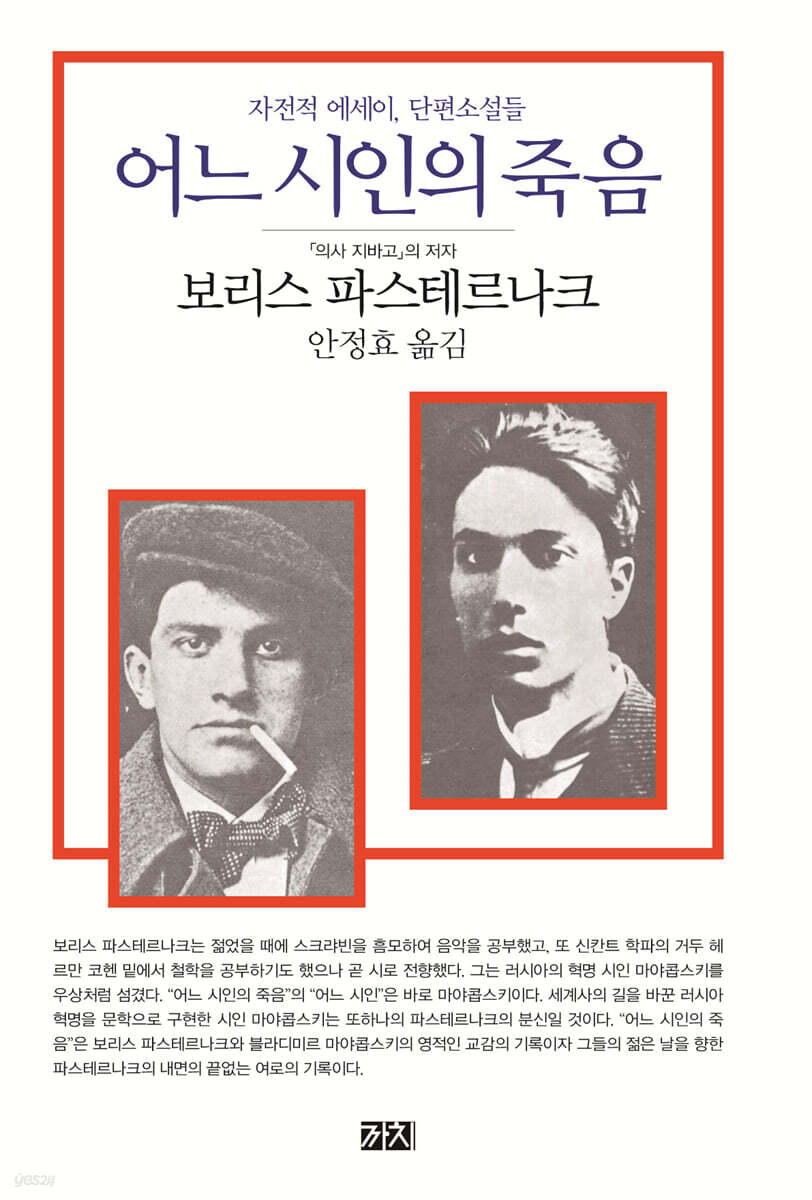
The Death of a Poet
 |
Description
Book Introduction
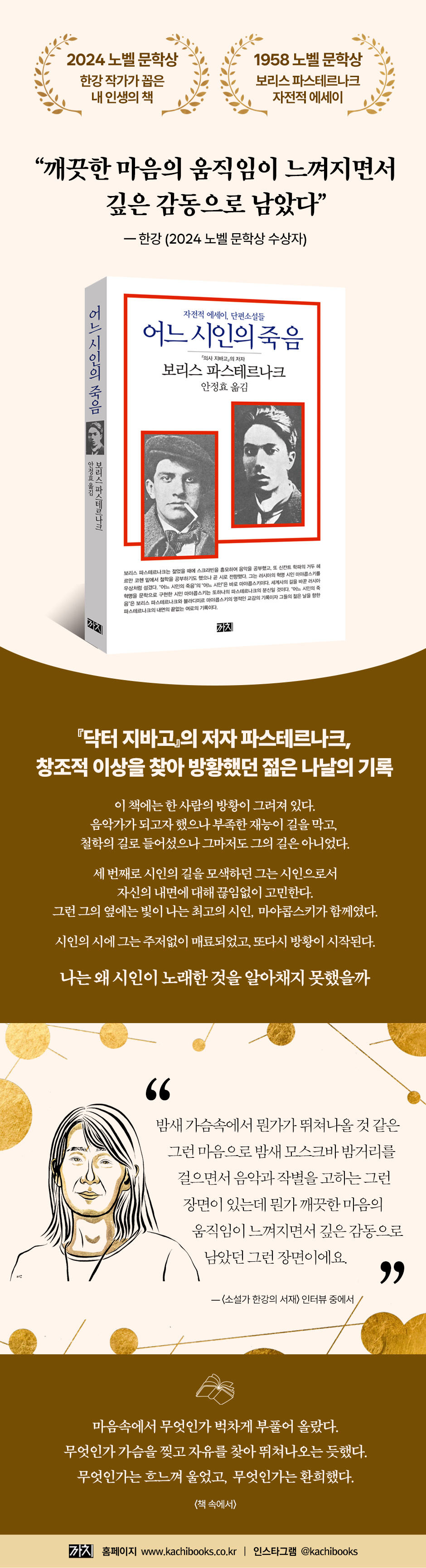
*The Book of My Life, Chosen by 2024 Nobel Prize in Literature Winner Han Kang*
*Autobiographical essays and short stories by Boris Pasternak, winner of the 1958 Nobel Prize in Literature*
Pasternak, author of "Doctor Zhivago" and Russian revolutionary poet Mayakovsky
A record of spiritual communion and an endless journey toward the inner self.
Boris Pasternak was born to a famous painter father and a pianist mother.
His father was a famous Russian painter who painted a portrait of Tolstoy and was also close to Maria Rainer Rilke.
As Pasternak reveals in this work, he met Rilke by chance in his childhood.
He also admired the Russian musician Scriabin, who was a close friend of their family, and studied music during his school days, even composing and publishing his works.
He followed Scriabin's advice and studied law, but was ultimately dissatisfied and, with his mother's help, studied philosophy at the University of Marburg.
At the time, he was under the supervision of Professor Hermann Cohen at the University of Marburg.
However, he realized that his path lay elsewhere, so he quit his studies and traveled to Italy before returning to his homeland, Moscow.
In Moscow, he decided to devote his life to poetry and began discussing literature with men of letters.
In the poetry world, he came to admire the Russian revolutionary poet Vladimir Mayakovsky.
His autobiographical essay "The Death of a Poet" concludes with Mayakovsky's tragic suicide.
In the title of this work, “The Death of a Poet,” the “poet” refers to Mayakovsky.
Pasternak admired Mayakovsky, the poet who embodied the Russian Revolution in literature.
Moreover, this work contains the story of how he became a poet.
This book depicts one man's wanderings.
He wanted to be a musician, but realized he lacked talent and had to find another path.
The path he found was to study philosophy, but even that was not his path.
So he made his third decision and began to explore his path as a poet.
As a poet, he constantly contemplates his inner self.
He was surrounded by the best poets who were shining brightly.
Whenever he heard the poet's poetry, he was captivated by the poet without hesitation, and wondered why he had not recognized what the poet had sung.
Although Pasternak appeared in the literary world through poetry, he is better known to us for his novel "Doctor Zhivago."
This book introduces his short stories.
Short stories will be of great help in understanding his world of works.
*Autobiographical essays and short stories by Boris Pasternak, winner of the 1958 Nobel Prize in Literature*
Pasternak, author of "Doctor Zhivago" and Russian revolutionary poet Mayakovsky
A record of spiritual communion and an endless journey toward the inner self.
Boris Pasternak was born to a famous painter father and a pianist mother.
His father was a famous Russian painter who painted a portrait of Tolstoy and was also close to Maria Rainer Rilke.
As Pasternak reveals in this work, he met Rilke by chance in his childhood.
He also admired the Russian musician Scriabin, who was a close friend of their family, and studied music during his school days, even composing and publishing his works.
He followed Scriabin's advice and studied law, but was ultimately dissatisfied and, with his mother's help, studied philosophy at the University of Marburg.
At the time, he was under the supervision of Professor Hermann Cohen at the University of Marburg.
However, he realized that his path lay elsewhere, so he quit his studies and traveled to Italy before returning to his homeland, Moscow.
In Moscow, he decided to devote his life to poetry and began discussing literature with men of letters.
In the poetry world, he came to admire the Russian revolutionary poet Vladimir Mayakovsky.
His autobiographical essay "The Death of a Poet" concludes with Mayakovsky's tragic suicide.
In the title of this work, “The Death of a Poet,” the “poet” refers to Mayakovsky.
Pasternak admired Mayakovsky, the poet who embodied the Russian Revolution in literature.
Moreover, this work contains the story of how he became a poet.
This book depicts one man's wanderings.
He wanted to be a musician, but realized he lacked talent and had to find another path.
The path he found was to study philosophy, but even that was not his path.
So he made his third decision and began to explore his path as a poet.
As a poet, he constantly contemplates his inner self.
He was surrounded by the best poets who were shining brightly.
Whenever he heard the poet's poetry, he was captivated by the poet without hesitation, and wondered why he had not recognized what the poet had sung.
Although Pasternak appeared in the literary world through poetry, he is better known to us for his novel "Doctor Zhivago."
This book introduces his short stories.
Short stories will be of great help in understanding his world of works.
- You can preview some of the book's contents.
Preview
index
autobiographical essay
The Death of a Poet
Short Stories by Boris Pasternak
Xenia Ljubers's Girlhood _ Long, Long Days
Xenia Ljubers's Girlhood _ The Stranger
The Way of Heaven
Letter from Tula
commentary
The Death of a Poet
Short Stories by Boris Pasternak
Xenia Ljubers's Girlhood _ Long, Long Days
Xenia Ljubers's Girlhood _ The Stranger
The Way of Heaven
Letter from Tula
commentary
Detailed image
Publisher's Review
Pasternak, author of Doctor Zhivago, and Russian revolutionary poet Mayakovsky
A record of spiritual communion and an endless journey toward the inner self.
Boris Pasternak was born to a famous painter father and a pianist mother.
His father was a famous Russian painter who painted a portrait of Tolstoy and was also close to Maria Rainer Rilke.
As Pasternak reveals in this work, he met Rilke by chance in his childhood.
He also admired the Russian musician Scriabin, who was a close friend of their family, and studied music during his school days, even composing and publishing his works.
He followed Scriabin's advice and studied law, but was ultimately dissatisfied and, with his mother's help, studied philosophy at the University of Marburg.
At the time, he was under the supervision of Professor Hermann Cohen at the University of Marburg.
However, he realized that his path lay elsewhere, so he quit his studies and traveled to Italy before returning to his homeland, Moscow.
In Moscow, he decided to devote his life to poetry and began discussing literature with men of letters.
In the poetry world, he came to admire the Russian revolutionary poet Vladimir Mayakovsky.
His autobiographical essay, The Death of a Poet, concludes with Mayakovsky's tragic suicide.
In the title of this work, “The Death of a Poet,” the “poet” refers to Mayakovsky.
Pasternak admired Mayakovsky, the poet who embodied the Russian Revolution in literature.
Moreover, this work contains the story of how he became a poet.
This book depicts one man's wanderings.
He wanted to be a musician, but realized he lacked talent and had to find another path.
The path he found was to study philosophy, but even that was not his path.
So he made his third decision and began to explore his path as a poet.
As a poet, he constantly contemplates his inner self.
He was surrounded by the best poets who were shining brightly.
Whenever he heard the poet's poetry, he was captivated by the poet without hesitation, and wondered why he had not recognized what the poet had sung.
Although Pasternak appeared in the literary world through poetry, he is better known to us for his novel Doctor Zhivago.
This book introduces his short stories.
Short stories will be of great help in understanding his world of works.
A record of spiritual communion and an endless journey toward the inner self.
Boris Pasternak was born to a famous painter father and a pianist mother.
His father was a famous Russian painter who painted a portrait of Tolstoy and was also close to Maria Rainer Rilke.
As Pasternak reveals in this work, he met Rilke by chance in his childhood.
He also admired the Russian musician Scriabin, who was a close friend of their family, and studied music during his school days, even composing and publishing his works.
He followed Scriabin's advice and studied law, but was ultimately dissatisfied and, with his mother's help, studied philosophy at the University of Marburg.
At the time, he was under the supervision of Professor Hermann Cohen at the University of Marburg.
However, he realized that his path lay elsewhere, so he quit his studies and traveled to Italy before returning to his homeland, Moscow.
In Moscow, he decided to devote his life to poetry and began discussing literature with men of letters.
In the poetry world, he came to admire the Russian revolutionary poet Vladimir Mayakovsky.
His autobiographical essay, The Death of a Poet, concludes with Mayakovsky's tragic suicide.
In the title of this work, “The Death of a Poet,” the “poet” refers to Mayakovsky.
Pasternak admired Mayakovsky, the poet who embodied the Russian Revolution in literature.
Moreover, this work contains the story of how he became a poet.
This book depicts one man's wanderings.
He wanted to be a musician, but realized he lacked talent and had to find another path.
The path he found was to study philosophy, but even that was not his path.
So he made his third decision and began to explore his path as a poet.
As a poet, he constantly contemplates his inner self.
He was surrounded by the best poets who were shining brightly.
Whenever he heard the poet's poetry, he was captivated by the poet without hesitation, and wondered why he had not recognized what the poet had sung.
Although Pasternak appeared in the literary world through poetry, he is better known to us for his novel Doctor Zhivago.
This book introduces his short stories.
Short stories will be of great help in understanding his world of works.
GOODS SPECIFICS
- Date of issue: May 25, 2011
- Page count, weight, size: 269 pages | 584g | 153*224*20mm
- ISBN13: 9788972915041
- ISBN10: 8972915041
You may also like
카테고리
korean


korean

![GQ KOREA Mark (Monthly): December [2025]](http://librairie.coreenne.fr/cdn/shop/files/8ef265dbbfbf186523ed75ba7319009d.jpg?v=1765340328&width=3840)


