

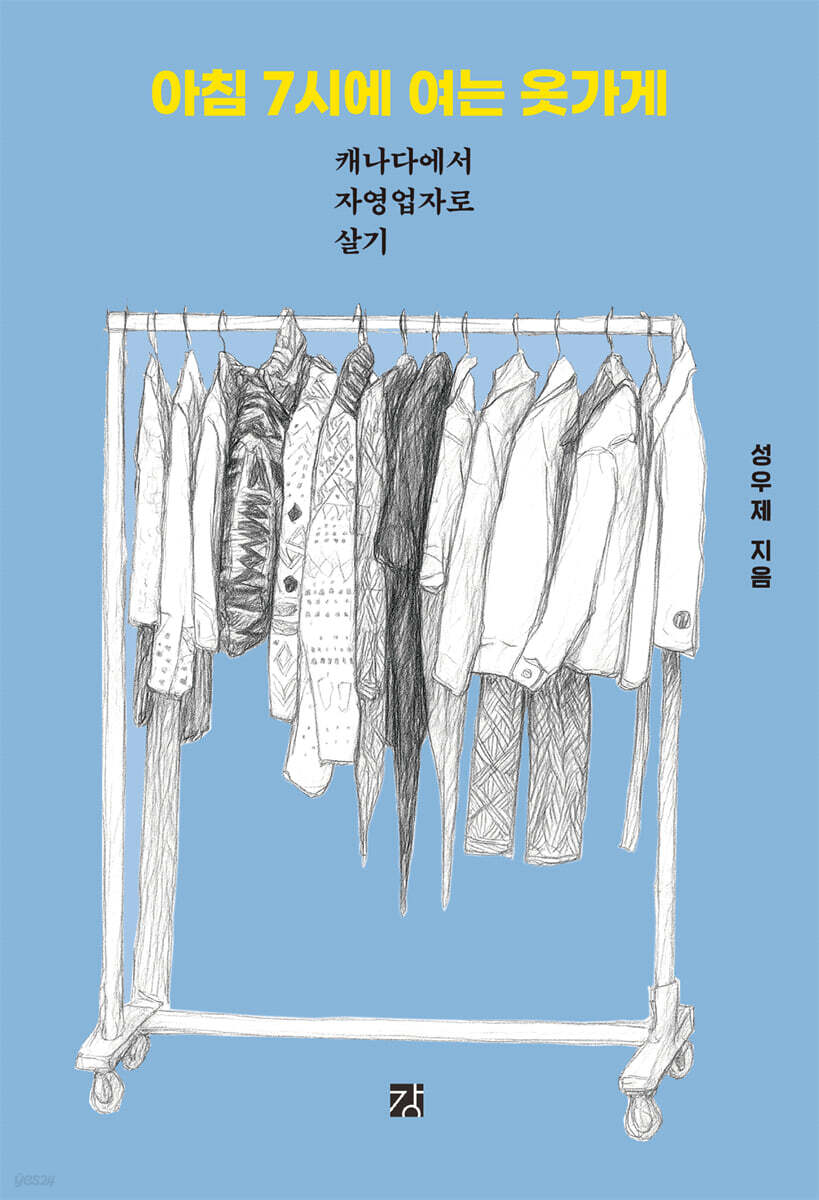
A clothing store that opens at 7 am
 |
Description
Book Introduction
A Canadian self-employed immigrant's survival story
Change the mannequin's clothes at least twice a day.
“Our store changes the clothes on the window mannequins every morning and evening.
At least twice a day.
They say displays are an important factor in attracting customers, but for our store, which targets subway passengers, there is no display more effective than changing mannequin clothes two or three times a day.
If your clothes for going to work and coming home are different every time, your store will always look new to customers.
This is possible because new items come in every day.
The best image a clothing store can have is one that makes customers think, “I can always find something new in that store.”
"The Clothing Store Opens at 7 AM" is a memoir of a self-employed person who ran a clothing store in Canada for over 20 years.
This book contains the various professional experiences of the author, Seong Woo-je, who worked as a journalist in Korea for 13 years before immigrating to Canada in 2002.
The author, who first jumped into a 'helper' (minimum hourly wage) job to settle down, delivered 100 sandwiches to companies all over Toronto during lunch hours, and worked as a baker at a bakery cafe, which was close to hard labor, and felt 'like my body was collapsing' every time I returned home.
He even opened his own sandwich shop, but quit after eight months.
It was because of the physical limitations I felt while working at the store.
After that, the author worked as a reporter for a Canadian Korean newspaper, meeting veteran immigrant self-employed people, receiving advice, and gaining experience.
And finally, he succeeded in opening his own clothing store and establishing himself.
From the early 2000s, when the "immigration boom" was taking place, to the present day in 2025, 20 years later, the book presents fragments of the author's life, neatly arranged like "new" products on a window hanger.
“This book can be said to be a memoir of a Canadian self-employed person, particularly one who ran a women’s clothing store.
It's a human life, and there's nothing particularly special about it, whether you're reading this or I.
But the story of a Korean man living (or, to put it a bit poignantly, 'surviving') as a self-employed Canadian might be a little different.
I think the story of an ordinary Korean with a liberal arts degree who dreamed of becoming a foreign literature researcher but ended up working as a journalist by chance, came to Canada and became self-employed, might pique the curiosity of Korean readers.
"
Change the mannequin's clothes at least twice a day.
“Our store changes the clothes on the window mannequins every morning and evening.
At least twice a day.
They say displays are an important factor in attracting customers, but for our store, which targets subway passengers, there is no display more effective than changing mannequin clothes two or three times a day.
If your clothes for going to work and coming home are different every time, your store will always look new to customers.
This is possible because new items come in every day.
The best image a clothing store can have is one that makes customers think, “I can always find something new in that store.”
"The Clothing Store Opens at 7 AM" is a memoir of a self-employed person who ran a clothing store in Canada for over 20 years.
This book contains the various professional experiences of the author, Seong Woo-je, who worked as a journalist in Korea for 13 years before immigrating to Canada in 2002.
The author, who first jumped into a 'helper' (minimum hourly wage) job to settle down, delivered 100 sandwiches to companies all over Toronto during lunch hours, and worked as a baker at a bakery cafe, which was close to hard labor, and felt 'like my body was collapsing' every time I returned home.
He even opened his own sandwich shop, but quit after eight months.
It was because of the physical limitations I felt while working at the store.
After that, the author worked as a reporter for a Canadian Korean newspaper, meeting veteran immigrant self-employed people, receiving advice, and gaining experience.
And finally, he succeeded in opening his own clothing store and establishing himself.
From the early 2000s, when the "immigration boom" was taking place, to the present day in 2025, 20 years later, the book presents fragments of the author's life, neatly arranged like "new" products on a window hanger.
“This book can be said to be a memoir of a Canadian self-employed person, particularly one who ran a women’s clothing store.
It's a human life, and there's nothing particularly special about it, whether you're reading this or I.
But the story of a Korean man living (or, to put it a bit poignantly, 'surviving') as a self-employed Canadian might be a little different.
I think the story of an ordinary Korean with a liberal arts degree who dreamed of becoming a foreign literature researcher but ended up working as a journalist by chance, came to Canada and became self-employed, might pique the curiosity of Korean readers.
"
- You can preview some of the book's contents.
Preview
index
7 at the beginning of the book
Part 1 I still ask myself and am surprised.
“Why did you come to live in Canada?” 11
Part 2: Meet the Sandwich Shop 39
Part 3: Clothing store 119 opens at 7 a.m.
Part 4: "Cinderella" Experience Korea 187
Untold Story 225
Part 1 I still ask myself and am surprised.
“Why did you come to live in Canada?” 11
Part 2: Meet the Sandwich Shop 39
Part 3: Clothing store 119 opens at 7 a.m.
Part 4: "Cinderella" Experience Korea 187
Untold Story 225
Into the book
It's been 20 years since I started my clothing store in Toronto.
The store I'm running now is the job I've been working at the longest in my life.
A reporter from the Toronto Korean newspaper who spoke to me on the phone the other day called me ‘Mr. Reporter.’
My first and last job after graduating from school lasted 13 years.
As I have been self-employed for 23 years (including my preparation period), it would be more accurate to call me a self-employed person or small business owner rather than a journalist (my title is usually 'CEO').
--- p.7
At the time, there was an immigration boom in Korea, so there were many online immigration sites.
Not only would-be immigrants like me be there, but people who had recently moved to Canada were also there to exchange information.
People who have been to Canada before advise, “Everything is expensive in Canada, so bring even your old slippers.”
Maybe it was because I only lived in Canada for a short time, but their jokes were a bit harsh.
He probably said that because he was spending money lavishly even though he had no income, so he wanted to save every penny.
--- p.14
The immigration agent's words were blunt.
To summarize his words, Canada was the best country in the world to live in and was close to 'heaven'.
Although it sounded a bit far-fetched, there were a few things that caught my ear.
First of all, it seemed like the treatment and education for the disabled would be much better than in Korea.
Even without his words, it was something that could be guessed to some extent just from the image of Canada as a country.
Next, he said that even a liberal arts journalist like me, with neither technology nor money, could immigrate. It was from him that I first heard that Canada had opened its doors wide to quickly accept IT professionals.
--- p.22
“I want to open a coffee and bread shop, but I’m not going to start right away. I’m thinking of learning by working as a helper for now.”
I was a little worried about how my seniors would perceive what I said.
Some people might think, ‘Did you quit that good job just to work as a helper?’ or ‘You came here without any plan.’
But the seniors, without exception, responded favorably.
“Oh, really? That’s a very good idea.
That's how immigrant life begins.
“You don’t have to worry.” Hearing those words, I suddenly felt empowered.
--- pp.32-33
I deliberately sought out a lot of self-employed veterans.
The stories they told were helpful to me, but the articles they wrote would also be helpful to other early immigrants from Korea.
Some influential figures tried to persuade people like me to invest in them, saying they would "help new immigrants," but my fellow immigrants, who had been self-employed for decades, subtly warned me against such practices.
The store I'm running now is the job I've been working at the longest in my life.
A reporter from the Toronto Korean newspaper who spoke to me on the phone the other day called me ‘Mr. Reporter.’
My first and last job after graduating from school lasted 13 years.
As I have been self-employed for 23 years (including my preparation period), it would be more accurate to call me a self-employed person or small business owner rather than a journalist (my title is usually 'CEO').
--- p.7
At the time, there was an immigration boom in Korea, so there were many online immigration sites.
Not only would-be immigrants like me be there, but people who had recently moved to Canada were also there to exchange information.
People who have been to Canada before advise, “Everything is expensive in Canada, so bring even your old slippers.”
Maybe it was because I only lived in Canada for a short time, but their jokes were a bit harsh.
He probably said that because he was spending money lavishly even though he had no income, so he wanted to save every penny.
--- p.14
The immigration agent's words were blunt.
To summarize his words, Canada was the best country in the world to live in and was close to 'heaven'.
Although it sounded a bit far-fetched, there were a few things that caught my ear.
First of all, it seemed like the treatment and education for the disabled would be much better than in Korea.
Even without his words, it was something that could be guessed to some extent just from the image of Canada as a country.
Next, he said that even a liberal arts journalist like me, with neither technology nor money, could immigrate. It was from him that I first heard that Canada had opened its doors wide to quickly accept IT professionals.
--- p.22
“I want to open a coffee and bread shop, but I’m not going to start right away. I’m thinking of learning by working as a helper for now.”
I was a little worried about how my seniors would perceive what I said.
Some people might think, ‘Did you quit that good job just to work as a helper?’ or ‘You came here without any plan.’
But the seniors, without exception, responded favorably.
“Oh, really? That’s a very good idea.
That's how immigrant life begins.
“You don’t have to worry.” Hearing those words, I suddenly felt empowered.
--- pp.32-33
I deliberately sought out a lot of self-employed veterans.
The stories they told were helpful to me, but the articles they wrote would also be helpful to other early immigrants from Korea.
Some influential figures tried to persuade people like me to invest in them, saying they would "help new immigrants," but my fellow immigrants, who had been self-employed for decades, subtly warned me against such practices.
--- p.60
GOODS SPECIFICS
- Date of issue: November 7, 2025
- Page count, weight, size: 240 pages | 130*190*15mm
- ISBN13: 9788982183713
You may also like
카테고리
korean


korean

![GQ KOREA Mark (Monthly): December [2025]](http://librairie.coreenne.fr/cdn/shop/files/8ef265dbbfbf186523ed75ba7319009d.jpg?v=1765340328&width=3840)


