

puke
 |
Description
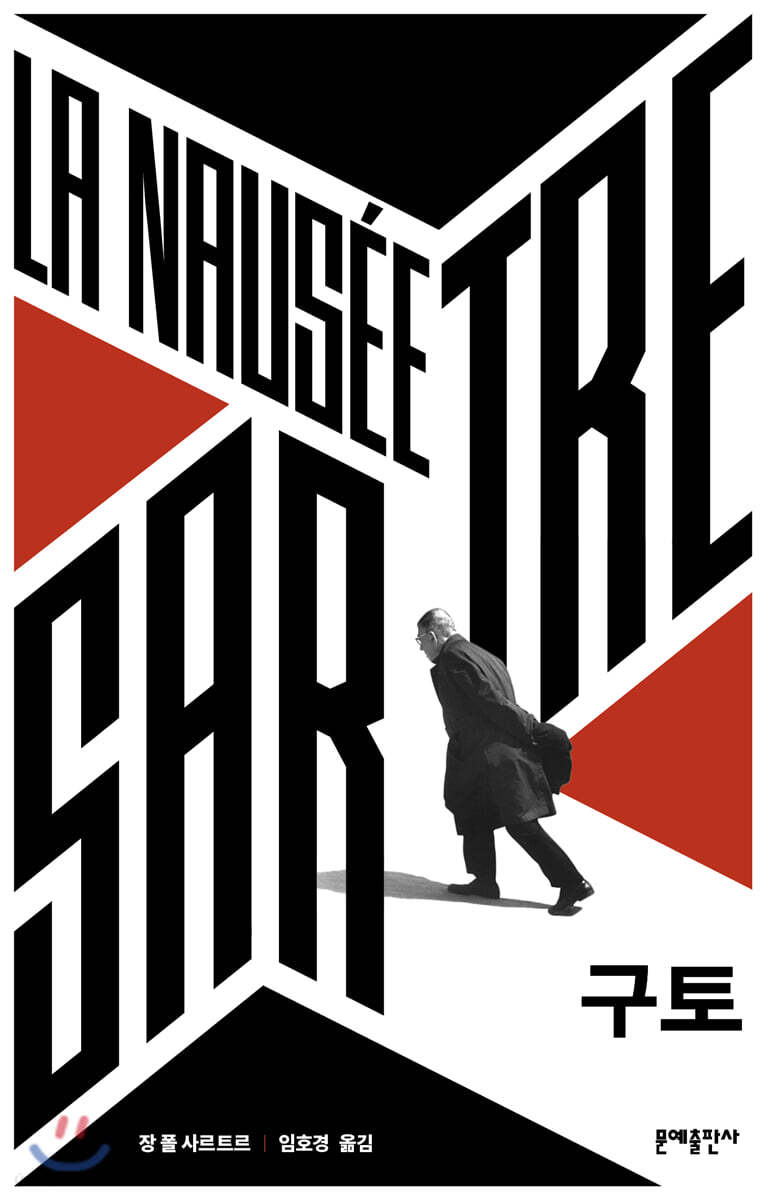
Book Introduction
The starting point of Sartre's thought, "Nausea," a representative French intellectual of the 20th century “By far the most important of Sartre's philosophical works!” _Hannah Arendt Sartre's masterpiece, Nausea, has been published in a new translation by translator Im Ho-kyung. This smooth translation, which preserves the meaning of the original text while enhancing readability, allows you to properly understand the 20th-century masterpiece, Nausea. This is a complete domestic translation published under an official contract with the French publisher Gallimard. "Nausea" is a work in which Sartre gives form to his philosophical thoughts and experiences through literature. The protagonist, Antoine Roquentin, is the epitome of a lonely person. He is a 'loser' who has as much money as a pensioner, but has no superior, wife, or children to serve. One day, he felt a strange discomfort while trying to throw a rock at the beach to play waterskiing, and later named the feeling as 'vomiting'. Roquentin, who began vomiting the moment he realized that he was a 'useless' and 'leftover' being who could not find any meaning in life, is the alter ego of Sartre, who lived as a philosophy teacher and aspired to fame as a writer. Through the sharp observations of the protagonist Roquentin, Sartre exposes the self-deception of intellectuals who rest on the knowledge and glory they have accumulated in the past, the petty-bourgeois ennui and the hypocrisy of the bourgeoisie, and further, the inauthenticity of all human beings who only exchange meaningless conversations. Leaving behind the 19th century, which is considered the most optimistic century in human history, Sartre captures the sense of crisis felt by people who experienced World War I and the Great Depression of 1929 in the early 20th century as a phenomenon of 'nausea.' This work depicts the agony of modern people who cannot find meaning in life and wander in a sense of helplessness, but nevertheless presents a horizon of hope and courage rather than despair and resignation. This is probably why 『Nausea』 still has a meaningful universality and is considered a masterpiece of 20th-century literature to this day. |
- You can preview some of the book's contents.
Preview
index
Editor's Note
Pages without dates
diary
Commentary on the work
Jean-Paul Sartre Chronology
Pages without dates
diary
Commentary on the work
Jean-Paul Sartre Chronology
Into the book
I am amazed by those young people.
They drink coffee and talk about things that are clear and true.
When you ask them what they did yesterday, they don't seem at all flustered.
Tell me in simple terms what you did.
If I were them, I would have stuttered.
In fact, for a long time now, no one has cared how I spend my time.
When you're alone, you don't even know what it means to talk.
Things that felt real with friends disappear.
You become indifferent to what is happening.
--- p.26~27
Now I get it.
I clearly remember how I felt when I was holding that pebble on the beach one day.
It was a kind of sweet, warm bath.
What an unpleasant feeling it was! It was clearly coming from the stone.
It was being passed from the stone to my hand.
Yeah, that was it.
That was it.
It was a kind of nausea that could be felt in the palm of one's hand.
--- p.34
It's the perfect day to get back to yourself.
This cold light, which the sun casts upon all living beings like a merciless judgment, enters me through my eyes, and my insides are illuminated with a light that makes us shabby.
I'm sure it only takes 15 minutes for me to hate myself so much.
--- p.43
I walked across the Bordurin Renault showroom.
And then he turned around.
Hello, little sanctuaries made of paintings, you beautiful lilies that gracefully nestle within your sanctuaries, hello, you beautiful lilies that are our pride and reason for being.
Hello, you motherfuckers.
--- p.222
My thoughts, that is me.
That's why it can't be stopped.
I exist because I think… …so I cannot stop thinking.
Even at this very moment? It's terrible? If I exist, it's because I think my existence is terrible.
It is I who is pulling me out of the nothingness I long for.
--- p.234-235
I grab the seat and then hurriedly take my hand off.
This exists.
This thing I'm sitting on, this thing I'm touching with my hand, is called a 'seat'.
People have intentionally built these with the idea of creating something they can sit on.
(…) I mutter, as if performing a bit of an exorcism, ‘This is a seat.’
But these words remain on the lips and do not settle down on it.
This is just this.
--- p.292
A little while ago I was in the park.
The roots of the horse chestnut tree were embedded in the ground just below the bench where I was sitting.
I couldn't remember anymore that this was a root.
Words have disappeared, and with them the meaning of things, the ways of using them, and the faint marks that humans have drawn on their surfaces.
I sat slightly hunched over, my head bowed before this black, lumpy mass, so strange and terrifying.
Then suddenly, everything became clear.
--- p.296
The key is randomness.
What I mean is, by definition, existence is not necessary.
To exist is simply to be here.
(…) contingency is not an appearance that can be most or most scattered, but is absolute and therefore completely gratuitous.
Everything is impermanent.
This park, this city, and myself.
Sometimes I become aware of this, and then my stomach turns and everything starts to float around, just like it did last night at the Rendez-vous des Cheminaux.
This is vomiting.
(…) But what a pathetic lie! No one has the right.
They are completely useless like everyone else, and they try not to feel useless, but they can't.
And they are secretly useless even within themselves.
That is, it is formless, vague, and miserable.
--- p.306~307
One book.
A novel.
Then, there will be people who read that novel and say this.
“Antoine Roquentin wrote this book.
“She’s the redhead who used to hang out at the cafe.” And I’ll think about my life as I think about this black woman’s life.
As if thinking of something precious and half-legendary.
(…) I will not be able to stop myself from existing, from feeling that I exist.
But I think there will come a time when that book is finished and placed behind me, and some light it sheds will fall upon my past.
Then I will be able to look back on my life without disgust through that book.
They drink coffee and talk about things that are clear and true.
When you ask them what they did yesterday, they don't seem at all flustered.
Tell me in simple terms what you did.
If I were them, I would have stuttered.
In fact, for a long time now, no one has cared how I spend my time.
When you're alone, you don't even know what it means to talk.
Things that felt real with friends disappear.
You become indifferent to what is happening.
--- p.26~27
Now I get it.
I clearly remember how I felt when I was holding that pebble on the beach one day.
It was a kind of sweet, warm bath.
What an unpleasant feeling it was! It was clearly coming from the stone.
It was being passed from the stone to my hand.
Yeah, that was it.
That was it.
It was a kind of nausea that could be felt in the palm of one's hand.
--- p.34
It's the perfect day to get back to yourself.
This cold light, which the sun casts upon all living beings like a merciless judgment, enters me through my eyes, and my insides are illuminated with a light that makes us shabby.
I'm sure it only takes 15 minutes for me to hate myself so much.
--- p.43
I walked across the Bordurin Renault showroom.
And then he turned around.
Hello, little sanctuaries made of paintings, you beautiful lilies that gracefully nestle within your sanctuaries, hello, you beautiful lilies that are our pride and reason for being.
Hello, you motherfuckers.
--- p.222
My thoughts, that is me.
That's why it can't be stopped.
I exist because I think… …so I cannot stop thinking.
Even at this very moment? It's terrible? If I exist, it's because I think my existence is terrible.
It is I who is pulling me out of the nothingness I long for.
--- p.234-235
I grab the seat and then hurriedly take my hand off.
This exists.
This thing I'm sitting on, this thing I'm touching with my hand, is called a 'seat'.
People have intentionally built these with the idea of creating something they can sit on.
(…) I mutter, as if performing a bit of an exorcism, ‘This is a seat.’
But these words remain on the lips and do not settle down on it.
This is just this.
--- p.292
A little while ago I was in the park.
The roots of the horse chestnut tree were embedded in the ground just below the bench where I was sitting.
I couldn't remember anymore that this was a root.
Words have disappeared, and with them the meaning of things, the ways of using them, and the faint marks that humans have drawn on their surfaces.
I sat slightly hunched over, my head bowed before this black, lumpy mass, so strange and terrifying.
Then suddenly, everything became clear.
--- p.296
The key is randomness.
What I mean is, by definition, existence is not necessary.
To exist is simply to be here.
(…) contingency is not an appearance that can be most or most scattered, but is absolute and therefore completely gratuitous.
Everything is impermanent.
This park, this city, and myself.
Sometimes I become aware of this, and then my stomach turns and everything starts to float around, just like it did last night at the Rendez-vous des Cheminaux.
This is vomiting.
(…) But what a pathetic lie! No one has the right.
They are completely useless like everyone else, and they try not to feel useless, but they can't.
And they are secretly useless even within themselves.
That is, it is formless, vague, and miserable.
--- p.306~307
One book.
A novel.
Then, there will be people who read that novel and say this.
“Antoine Roquentin wrote this book.
“She’s the redhead who used to hang out at the cafe.” And I’ll think about my life as I think about this black woman’s life.
As if thinking of something precious and half-legendary.
(…) I will not be able to stop myself from existing, from feeling that I exist.
But I think there will come a time when that book is finished and placed behind me, and some light it sheds will fall upon my past.
Then I will be able to look back on my life without disgust through that book.
--- p.410~411
Publisher's Review
"All of Sartre's thinking flows from and flows into Nausea."
The starting point of Sartre's thought, a representative intellectual of 20th century France!
- A complete domestic translation officially contracted with the French publisher Gallimard
- 『Nausea』 in a new translation by Lim Ho-kyung that enhances readability while preserving the meaning of the original text.
A world without 'God' after war and economic depression,
What are the conditions of human existence?
Sartre's masterpiece, Nausea, has been published in a new translation by translator Im Ho-kyung.
This smooth translation, which preserves the meaning of the original text while enhancing readability, allows you to properly understand the 20th-century masterpiece, Nausea.
This is a complete domestic translation published under an official contract with the French publisher Gallimard.
"Nausea" begins like a detective novel.
In the "Editor's Note" at the beginning of the novel, it is stated that the book was published "entirely unaltered" from notes "found among the papers of Antoine Roquentin."
The notes are Roquentin's diary, written around early January 1932, and provide further clues that Roquentin had settled in the town of Bouville three years earlier to complete his research on a historical figure after traveling through Central Europe, North Africa, and the Far East.
From then on, the reader secretly looks into Antoine Roquentin's diary and naturally accompanies him on his explorations.
And soon we discover that the object of our joint exploration with Roquentin is the vomiting phenomenon that Roquentin experienced.
Now I get it.
I clearly remember how I felt when I was holding that pebble on the beach one day.
It was a kind of sweet, warm bath.
What an unpleasant feeling it was! It was clearly coming from the stone.
It was being passed from the stone to my hand.
Yeah, that was it.
That was it.
It was a kind of nausea that could be felt in the palm of one's hand.
(Page 34)
Roquentin's vomiting experience, which began like this, was not a one-time thing but continued.
Grabbing the doorknob, looking at other people's faces, looking at a piece of paper that has fallen to the ground, looking at one's own face in the mirror, holding the handle of a knife... ... Roquentin himself, the café he frequented, the park of the city of Bouville, and ultimately the entire world are experienced as vomit.
What is the meaning of 'vomiting', which has become Roquentin's entire life?
Roquentin is Sartre's alter ego, who worked as a philosophy teacher and dreamed of becoming a writer, and Nausea is a work in which Sartre gave form to his philosophical thoughts and experiences in literature.
Finding the meaning of vomiting in the work is no different from understanding Sartre's philosophical thoughts that question the conditions of human existence.
In Sartre's philosophical system, under the assumption that 'God' does not exist, the beings of this world are subject to the rule of chance, free from the logic of God's providence, that is, necessity.
The appearance of useless, superfluous, and surplus beings that are just there for no reason, not captured by any logic of necessity.
The unfamiliar and absurd emotion that humans feel in front of it is ‘vomiting.’
Leaving behind the 19th century, which is considered the most optimistic century in human history, Sartre also fully sympathized with the sense of crisis felt by people who experienced World War I and the Great Depression of 1929 in the early 20th century, especially the sense of crisis faced due to the absence of 'God'.
Sartre captures this sense of crisis and helplessness as the phenomenon of 'vomiting.'
Why and for whom are you writing?
Overcoming nausea through literature, for the salvation of humanity
Sartre mentioned Nausea whenever he had the chance, citing it as his favorite and best-written work.
However, some critics have criticized the work for having no power in the face of starving children in Africa.
Sartre, who advocated for 'participatory literature' immediately after World War II, explored and gained insight into the fundamental problems of literature by asking himself and answering three questions: 'What is the problem?', 'Why do we write?', and 'For whom do we write?' in his literary criticism treatise 'What is Literature?'
"Nausea" may not be in line with Sartre's assertion that "literature should aim at the salvation of neighbors, especially those who cannot lead a humane life due to oppression and violence."
However, 『Nausea』 is a work that deals with the author Sartre's own question of salvation, and furthermore, it can be said to be a work that has a meaningful universality even today, resonating with the agony of modern people who cannot find the meaning of life and wander in helplessness.
In this work, which deals with the human desire to become a god but can never be realized, the agony of existence, and anxiety, Sartre portrays the protagonist Roquentin, who projects himself, overcoming 'nausea' and being 'saved' to a true life through none other than literature.
One book.
A novel.
Then, there will be people who read that novel and say this.
“Antoine Roquentin wrote this book.
“She’s the redhead who used to hang out at the cafe.” And I’ll think about my life as I think about this black woman’s life.
As if thinking of something precious and half-legendary.
(Page 410)
Although "Nausea" starkly depicts the insurmountable conditions of human life, it presents a horizon of hope and courage rather than despair and resignation.
This is probably why 『Nausea』 is considered a masterpiece of 20th century literature.
Prévost, Stendhal and Flaubert, Gide and Proust, Faulkner and Hemingway
A work at the 'crossroads of literary creation' connecting the 18th, 19th, and 20th centuries
Sartre's "Adventures in Writing": Still challenging and innovative in the 21st century
Nausea, which instantly elevated Sartre, who was nothing more than an ordinary philosopher and a budding writer, to a promising writer, is a work that encompasses numerous novel techniques.
While conceiving this work over a period of about seven years starting in 1931, Sartre studied the works of writers active in the 18th, 19th, and 20th centuries, and borrowed numerous novel techniques from them.
Among the 18th century writers, he studied Prévost and others; among the 19th century writers, he studied Balzac, Stendhal, and Flaubert; among the 20th century writers, he studied French writers such as Gide, Proust, Malraux, and Céline; and among the foreign writers, he studied Kafka, Dos Passers, Faulkner, and Hemingway.
Nausea, written in the form of a diary by Antoine Roquentin, incorporates numerous techniques that Sartre mastered and applied, including interior monologue, surrealist automatism, fantasy novel techniques, intertextuality, pastiche, parody, collage, the use of dialogue and colloquial speech, and an expansion of vocabulary related to bodily sensations.
In particular, texts written in newspaper articles, jazz song lyrics, history books, restaurant menus, encyclopedias, and posters also form part of this work, and this 'collage' technique clearly demonstrates the originality and diversity of narrative techniques in 'Nausea'.
In this way, 『Nausea』 was in itself an 'adventure in writing' for Sartre, who was taking his first steps as a writer, and is evaluated as a work that stands at the 'crossroads of literary creation' connecting the 18th, 19th, and 20th centuries.
Additionally, 『Nausea』 is said to have played a pioneering role in the 'Nouveau roman' (new novel) that emerged in the 1960s in French literary history.
This is because 『Nausea』 contains devices such as precise and detailed descriptions close to the hyperrealism of the nouveau roman, which rejects the form of the existing novel (anti-roman) and pursues a new form, deconstruction of characters, segmentation of the story, destruction of the traditional concept of time, maximization of the effect of first-person point of view and subjective realism, and destruction of the logic of the story.
This is why 『Nausea』 is evaluated as a ‘challenging work’ against past literary traditions and an ‘innovative work’ ahead of its time.
Although "Nausea" has already become a classic, it is still fresh enough to provide readers living in the 21st century with its unfamiliar and new narrative techniques and experimental writing style.
Intellectual, inquisitive readers, or those who aspire to be writers, will enjoy accompanying Sartre on his "adventures in writing" through this book.
Jean-Paul Sartre's "Nausea": A Mini-Interview with the Editor
Jean-Paul Sartre, a representative French intellectual, writer, and existentialist philosopher who is very well known to us.
However, despite Sartre's fame and popularity, his works, especially his literary works, are surprisingly unfamiliar to the public.
His first full-length novel, Nausea, which introduced Sartre to the world and established him as a writer, is no exception.
Although it proudly occupies a place in world literature, is consistently cited as a must-read for high school students, as “the book that shaped the 20th century,” and as a modern classic, it was not easy to find anyone around me who said they had read “Nausea.”
The fact that 『Nausea』 is a work that embodies the author's own experiences, which form the basis of Sartre's existentialist philosophy, and therefore is called difficult and even 'esoteric' is likely related to this.
We asked Professor Byun Gwang-bae (Hankuk University of Foreign Studies), a Sartre expert who knows “Nausea” well, about who should read Sartre’s “Nausea” and how to do so.
Q.
As an editor, I would like everyone in Korea who has learned the Korean language to read 『Nausea (Editor's Collection)』, but I was surprised that surprisingly few people have read this classic work.
"Nausea" is a work that allows us to look into the life and suffering of Roquentin, the protagonist who is said to be Sartre's alter ego, through his diary.
As I read this work, I pictured a lonely intellectual young man who chose to be isolated.
Naturally, I felt like recommending this book to those who, like Roquentin, seriously contemplate their lives and the meaning of existence.
Professor, to what kind of readers would you recommend this work?
A.
It doesn't seem possible to limit the target audience for reading classics to 'who'.
I hope all the young people in this land read it at least once.
Existential problems are far away when your stomach is full and your back is warm.
People usually only reflect on themselves when they are faced with a crisis.
But doesn't everyone face such a crisis at some point in their lives? It could come during youth, or it could come later.
I think that state of existential crisis is precisely the state of 'vomiting'.
It may be a collective crisis, but I see it as having a strong individual crisis character.
I would like to recommend this work to young people who are entering society and starting to carve out their own lives for themselves, as a way to reflect on life and the meaning of existence.
Q.
Professor, you read "Nausea" when you were young.
I wonder how your feelings about it now are different from then.
A.
I think I empathized with the work more when I read "Nausea" in the past.
That's understandable, because it was the late 1970s and early 1980s, and social issues such as democratization and the issue of planning for my personal future were intertwined.
If I were reading this in the same situation as now, I probably would have given up halfway through. (Laughs) It might be different if you're majoring in literature or interested in philosophy, but if you were a typical college student or young person interested in other fields, you probably would have given up.
But if you have given up, it is a shame because it means you are a person who does not have the time or mental space to contemplate the true meaning of life and existence.
I admit that I cannot read or understand this work, just as I would avoid medicine that is good for the body but bitter in the mouth.
However, it is a work worth challenging while living in terms of giving us the opportunity to think about 'reality', about true life and existence.
Q.
The professor said that he might have given up on reading it, which was comforting, and somehow made me want to read 『Nausea』 again, feeling each and every sentence.
The recently published 『Nausea』 (Editor's Collection) has a special meaning as it is being re-released with the elegant translation of Lim Ho-kyung, a literary translator, approximately 40 years after its publication in 1983, translated by the late Professor Bang Gon.
How should I read this work?
A.
I understand literature as 'that which is not all there is (pas-toute)'.
In Lacan's sense, it shows the world beyond the 'symbolic order', or rather, it shows that there is a world beyond that.
Because human desires cannot be fully expressed through the ‘laws’, ‘systems’, ‘language’, and ‘symbols’ of the real world.
I understand the role of literature and its negativity to be to capture meaning beyond and to challenge the absurdity of reality.
Also, I think 『Nausea』 should be read slowly and leisurely.
One of the hallmarks of the humanities is "slowness," isn't it? I think it's similar to the way we focus on and love ourselves.
It's not simply that this work is difficult, but I think that the process of life and existence is long and not smooth, and so it requires patience.
That is what we often mean by the 'uselessness of uselessness', the usefulness of the useless.
Q.
You have always emphasized serious reflection on life and existence.
Young people in Korea are very anxious about the future due to being forced to worry about employment and livelihood issues and being exposed to a competitive environment for a long time.
Therefore, it's common to see people finding their identity in "consumption" or "taste." The act of openly revealing and sharing one's "consumption patterns" and "tastes" through social media is often seen as an expression of originality, a form of creative activity, and is even consumed by others.
What story would Sartre have told if he had seen this expression of modern people's identity?
A.
Because Sartre emphasizes ‘freedom,’ he will leave all choices up to each individual.
It is a strategy that emphasizes responsibility along with freedom.
I don't worry much about young people these days.
They are surrounded by far more information and knowledge than our generation in the past.
Smarter and more perceptive.
Yes, in the matter of ‘self-realization’.
I'm just busy.
There are many things I want to do, many things I want to have, and I want to own and achieve them faster.
So, as we think about convenient and efficient ways, I think that consumption and tastes have become a way of self-realization.
Humans project their own personality onto everything they do and everything they create.
To borrow a concept from 『Nausea』, whether it is consumption or taste, it should contain sincerity, sincerity, and authenticity.
I don't know if this is a 'latte rant', but one thing that worries me as an 'old man who makes poison' is that the world these days is too busy to contain sincerity.
I don't have time.
There is no room to look back and reflect deeply on oneself.
There's no time to truly "beautifully" create. Judging by the image-centric writing style that's quickly consumed and disappears on social media, it seems like they don't care much about their own "alter selves."
The problem is still ‘oneself’, ‘personality’, and ‘subjectivity’.
I think that the attitude of constantly hastily decorating what one creates, one's own avatar, and thinking of it as fake and light is the attitude of the 'sons of a bitch' mentioned in 'Nausea'.
I can't say that it's undesirable either, but it's definitely not a true life.
Sartre thinks of a human being as the sum total of his actions.
If so, then you must fully incorporate your personality and subjectivity into your actions.
In short, it seems like a story about trying to do more than anyone else while you're alive, working harder, more passionately, more fiercely, and leaving behind more things before you die.
In Sartre's thought, humans want to become gods, but that desire is not realized.
In that sense, human life is a history of failure, and humans are useless passion itself.
Sartre knows that, but he still says to live harder, to create something, and to leave something behind.
And that too by projecting yourself as much as possible.
It is an attitude that affirms a tragic life.
Wouldn't that leave at least some trace of our arrival and departure from this planet? Otherwise, we'd all just return to dust.
The starting point of Sartre's thought, a representative intellectual of 20th century France!
- A complete domestic translation officially contracted with the French publisher Gallimard
- 『Nausea』 in a new translation by Lim Ho-kyung that enhances readability while preserving the meaning of the original text.
A world without 'God' after war and economic depression,
What are the conditions of human existence?
Sartre's masterpiece, Nausea, has been published in a new translation by translator Im Ho-kyung.
This smooth translation, which preserves the meaning of the original text while enhancing readability, allows you to properly understand the 20th-century masterpiece, Nausea.
This is a complete domestic translation published under an official contract with the French publisher Gallimard.
"Nausea" begins like a detective novel.
In the "Editor's Note" at the beginning of the novel, it is stated that the book was published "entirely unaltered" from notes "found among the papers of Antoine Roquentin."
The notes are Roquentin's diary, written around early January 1932, and provide further clues that Roquentin had settled in the town of Bouville three years earlier to complete his research on a historical figure after traveling through Central Europe, North Africa, and the Far East.
From then on, the reader secretly looks into Antoine Roquentin's diary and naturally accompanies him on his explorations.
And soon we discover that the object of our joint exploration with Roquentin is the vomiting phenomenon that Roquentin experienced.
Now I get it.
I clearly remember how I felt when I was holding that pebble on the beach one day.
It was a kind of sweet, warm bath.
What an unpleasant feeling it was! It was clearly coming from the stone.
It was being passed from the stone to my hand.
Yeah, that was it.
That was it.
It was a kind of nausea that could be felt in the palm of one's hand.
(Page 34)
Roquentin's vomiting experience, which began like this, was not a one-time thing but continued.
Grabbing the doorknob, looking at other people's faces, looking at a piece of paper that has fallen to the ground, looking at one's own face in the mirror, holding the handle of a knife... ... Roquentin himself, the café he frequented, the park of the city of Bouville, and ultimately the entire world are experienced as vomit.
What is the meaning of 'vomiting', which has become Roquentin's entire life?
Roquentin is Sartre's alter ego, who worked as a philosophy teacher and dreamed of becoming a writer, and Nausea is a work in which Sartre gave form to his philosophical thoughts and experiences in literature.
Finding the meaning of vomiting in the work is no different from understanding Sartre's philosophical thoughts that question the conditions of human existence.
In Sartre's philosophical system, under the assumption that 'God' does not exist, the beings of this world are subject to the rule of chance, free from the logic of God's providence, that is, necessity.
The appearance of useless, superfluous, and surplus beings that are just there for no reason, not captured by any logic of necessity.
The unfamiliar and absurd emotion that humans feel in front of it is ‘vomiting.’
Leaving behind the 19th century, which is considered the most optimistic century in human history, Sartre also fully sympathized with the sense of crisis felt by people who experienced World War I and the Great Depression of 1929 in the early 20th century, especially the sense of crisis faced due to the absence of 'God'.
Sartre captures this sense of crisis and helplessness as the phenomenon of 'vomiting.'
Why and for whom are you writing?
Overcoming nausea through literature, for the salvation of humanity
Sartre mentioned Nausea whenever he had the chance, citing it as his favorite and best-written work.
However, some critics have criticized the work for having no power in the face of starving children in Africa.
Sartre, who advocated for 'participatory literature' immediately after World War II, explored and gained insight into the fundamental problems of literature by asking himself and answering three questions: 'What is the problem?', 'Why do we write?', and 'For whom do we write?' in his literary criticism treatise 'What is Literature?'
"Nausea" may not be in line with Sartre's assertion that "literature should aim at the salvation of neighbors, especially those who cannot lead a humane life due to oppression and violence."
However, 『Nausea』 is a work that deals with the author Sartre's own question of salvation, and furthermore, it can be said to be a work that has a meaningful universality even today, resonating with the agony of modern people who cannot find the meaning of life and wander in helplessness.
In this work, which deals with the human desire to become a god but can never be realized, the agony of existence, and anxiety, Sartre portrays the protagonist Roquentin, who projects himself, overcoming 'nausea' and being 'saved' to a true life through none other than literature.
One book.
A novel.
Then, there will be people who read that novel and say this.
“Antoine Roquentin wrote this book.
“She’s the redhead who used to hang out at the cafe.” And I’ll think about my life as I think about this black woman’s life.
As if thinking of something precious and half-legendary.
(Page 410)
Although "Nausea" starkly depicts the insurmountable conditions of human life, it presents a horizon of hope and courage rather than despair and resignation.
This is probably why 『Nausea』 is considered a masterpiece of 20th century literature.
Prévost, Stendhal and Flaubert, Gide and Proust, Faulkner and Hemingway
A work at the 'crossroads of literary creation' connecting the 18th, 19th, and 20th centuries
Sartre's "Adventures in Writing": Still challenging and innovative in the 21st century
Nausea, which instantly elevated Sartre, who was nothing more than an ordinary philosopher and a budding writer, to a promising writer, is a work that encompasses numerous novel techniques.
While conceiving this work over a period of about seven years starting in 1931, Sartre studied the works of writers active in the 18th, 19th, and 20th centuries, and borrowed numerous novel techniques from them.
Among the 18th century writers, he studied Prévost and others; among the 19th century writers, he studied Balzac, Stendhal, and Flaubert; among the 20th century writers, he studied French writers such as Gide, Proust, Malraux, and Céline; and among the foreign writers, he studied Kafka, Dos Passers, Faulkner, and Hemingway.
Nausea, written in the form of a diary by Antoine Roquentin, incorporates numerous techniques that Sartre mastered and applied, including interior monologue, surrealist automatism, fantasy novel techniques, intertextuality, pastiche, parody, collage, the use of dialogue and colloquial speech, and an expansion of vocabulary related to bodily sensations.
In particular, texts written in newspaper articles, jazz song lyrics, history books, restaurant menus, encyclopedias, and posters also form part of this work, and this 'collage' technique clearly demonstrates the originality and diversity of narrative techniques in 'Nausea'.
In this way, 『Nausea』 was in itself an 'adventure in writing' for Sartre, who was taking his first steps as a writer, and is evaluated as a work that stands at the 'crossroads of literary creation' connecting the 18th, 19th, and 20th centuries.
Additionally, 『Nausea』 is said to have played a pioneering role in the 'Nouveau roman' (new novel) that emerged in the 1960s in French literary history.
This is because 『Nausea』 contains devices such as precise and detailed descriptions close to the hyperrealism of the nouveau roman, which rejects the form of the existing novel (anti-roman) and pursues a new form, deconstruction of characters, segmentation of the story, destruction of the traditional concept of time, maximization of the effect of first-person point of view and subjective realism, and destruction of the logic of the story.
This is why 『Nausea』 is evaluated as a ‘challenging work’ against past literary traditions and an ‘innovative work’ ahead of its time.
Although "Nausea" has already become a classic, it is still fresh enough to provide readers living in the 21st century with its unfamiliar and new narrative techniques and experimental writing style.
Intellectual, inquisitive readers, or those who aspire to be writers, will enjoy accompanying Sartre on his "adventures in writing" through this book.
Jean-Paul Sartre's "Nausea": A Mini-Interview with the Editor
Jean-Paul Sartre, a representative French intellectual, writer, and existentialist philosopher who is very well known to us.
However, despite Sartre's fame and popularity, his works, especially his literary works, are surprisingly unfamiliar to the public.
His first full-length novel, Nausea, which introduced Sartre to the world and established him as a writer, is no exception.
Although it proudly occupies a place in world literature, is consistently cited as a must-read for high school students, as “the book that shaped the 20th century,” and as a modern classic, it was not easy to find anyone around me who said they had read “Nausea.”
The fact that 『Nausea』 is a work that embodies the author's own experiences, which form the basis of Sartre's existentialist philosophy, and therefore is called difficult and even 'esoteric' is likely related to this.
We asked Professor Byun Gwang-bae (Hankuk University of Foreign Studies), a Sartre expert who knows “Nausea” well, about who should read Sartre’s “Nausea” and how to do so.
Q.
As an editor, I would like everyone in Korea who has learned the Korean language to read 『Nausea (Editor's Collection)』, but I was surprised that surprisingly few people have read this classic work.
"Nausea" is a work that allows us to look into the life and suffering of Roquentin, the protagonist who is said to be Sartre's alter ego, through his diary.
As I read this work, I pictured a lonely intellectual young man who chose to be isolated.
Naturally, I felt like recommending this book to those who, like Roquentin, seriously contemplate their lives and the meaning of existence.
Professor, to what kind of readers would you recommend this work?
A.
It doesn't seem possible to limit the target audience for reading classics to 'who'.
I hope all the young people in this land read it at least once.
Existential problems are far away when your stomach is full and your back is warm.
People usually only reflect on themselves when they are faced with a crisis.
But doesn't everyone face such a crisis at some point in their lives? It could come during youth, or it could come later.
I think that state of existential crisis is precisely the state of 'vomiting'.
It may be a collective crisis, but I see it as having a strong individual crisis character.
I would like to recommend this work to young people who are entering society and starting to carve out their own lives for themselves, as a way to reflect on life and the meaning of existence.
Q.
Professor, you read "Nausea" when you were young.
I wonder how your feelings about it now are different from then.
A.
I think I empathized with the work more when I read "Nausea" in the past.
That's understandable, because it was the late 1970s and early 1980s, and social issues such as democratization and the issue of planning for my personal future were intertwined.
If I were reading this in the same situation as now, I probably would have given up halfway through. (Laughs) It might be different if you're majoring in literature or interested in philosophy, but if you were a typical college student or young person interested in other fields, you probably would have given up.
But if you have given up, it is a shame because it means you are a person who does not have the time or mental space to contemplate the true meaning of life and existence.
I admit that I cannot read or understand this work, just as I would avoid medicine that is good for the body but bitter in the mouth.
However, it is a work worth challenging while living in terms of giving us the opportunity to think about 'reality', about true life and existence.
Q.
The professor said that he might have given up on reading it, which was comforting, and somehow made me want to read 『Nausea』 again, feeling each and every sentence.
The recently published 『Nausea』 (Editor's Collection) has a special meaning as it is being re-released with the elegant translation of Lim Ho-kyung, a literary translator, approximately 40 years after its publication in 1983, translated by the late Professor Bang Gon.
How should I read this work?
A.
I understand literature as 'that which is not all there is (pas-toute)'.
In Lacan's sense, it shows the world beyond the 'symbolic order', or rather, it shows that there is a world beyond that.
Because human desires cannot be fully expressed through the ‘laws’, ‘systems’, ‘language’, and ‘symbols’ of the real world.
I understand the role of literature and its negativity to be to capture meaning beyond and to challenge the absurdity of reality.
Also, I think 『Nausea』 should be read slowly and leisurely.
One of the hallmarks of the humanities is "slowness," isn't it? I think it's similar to the way we focus on and love ourselves.
It's not simply that this work is difficult, but I think that the process of life and existence is long and not smooth, and so it requires patience.
That is what we often mean by the 'uselessness of uselessness', the usefulness of the useless.
Q.
You have always emphasized serious reflection on life and existence.
Young people in Korea are very anxious about the future due to being forced to worry about employment and livelihood issues and being exposed to a competitive environment for a long time.
Therefore, it's common to see people finding their identity in "consumption" or "taste." The act of openly revealing and sharing one's "consumption patterns" and "tastes" through social media is often seen as an expression of originality, a form of creative activity, and is even consumed by others.
What story would Sartre have told if he had seen this expression of modern people's identity?
A.
Because Sartre emphasizes ‘freedom,’ he will leave all choices up to each individual.
It is a strategy that emphasizes responsibility along with freedom.
I don't worry much about young people these days.
They are surrounded by far more information and knowledge than our generation in the past.
Smarter and more perceptive.
Yes, in the matter of ‘self-realization’.
I'm just busy.
There are many things I want to do, many things I want to have, and I want to own and achieve them faster.
So, as we think about convenient and efficient ways, I think that consumption and tastes have become a way of self-realization.
Humans project their own personality onto everything they do and everything they create.
To borrow a concept from 『Nausea』, whether it is consumption or taste, it should contain sincerity, sincerity, and authenticity.
I don't know if this is a 'latte rant', but one thing that worries me as an 'old man who makes poison' is that the world these days is too busy to contain sincerity.
I don't have time.
There is no room to look back and reflect deeply on oneself.
There's no time to truly "beautifully" create. Judging by the image-centric writing style that's quickly consumed and disappears on social media, it seems like they don't care much about their own "alter selves."
The problem is still ‘oneself’, ‘personality’, and ‘subjectivity’.
I think that the attitude of constantly hastily decorating what one creates, one's own avatar, and thinking of it as fake and light is the attitude of the 'sons of a bitch' mentioned in 'Nausea'.
I can't say that it's undesirable either, but it's definitely not a true life.
Sartre thinks of a human being as the sum total of his actions.
If so, then you must fully incorporate your personality and subjectivity into your actions.
In short, it seems like a story about trying to do more than anyone else while you're alive, working harder, more passionately, more fiercely, and leaving behind more things before you die.
In Sartre's thought, humans want to become gods, but that desire is not realized.
In that sense, human life is a history of failure, and humans are useless passion itself.
Sartre knows that, but he still says to live harder, to create something, and to leave something behind.
And that too by projecting yourself as much as possible.
It is an attitude that affirms a tragic life.
Wouldn't that leave at least some trace of our arrival and departure from this planet? Otherwise, we'd all just return to dust.
GOODS SPECIFICS
- Date of issue: December 31, 2020
- Format: Paperback book binding method guide
- Page count, weight, size: 444 pages | 422g | 120*188*30mm
- ISBN13: 9788931021516
- ISBN10: 8931021518
You may also like
카테고리
korean


korean

![ELLE 엘르 스페셜 에디션 A형 : 12월 [2025]](http://librairie.coreenne.fr/cdn/shop/files/b8e27a3de6c9538896439686c6b0e8fb.jpg?v=1766436872&width=3840)


